




Abstract
With the increasing concern over marine applications in recent years, the technology of underwater wireless sensor networks has received considerable attention. In underwater wireless sensor networks, the gathered data are sent to terrestrial control center through multi-hops for further processing. Underwater wireless sensor networks usually consist of three types of nodes: ordinary nodes, anchor nodes, and sink nodes. The data messages are transferred from an ordinary node or an anchored node to one of the sink nodes by discrete hops. Data forwarding algorithms are at the core position of underwater wireless sensor networks, which determines data in what way to forward. However, the existing data forwarding algorithms all have problems that transmission delay is too high and delivery ratio is low. Thus, we propose a data forwarding algorithm based on estimated Hungarian method to improve delivery ratio and reduce transmission delay. The estimated Hungarian method is applied to solve the assignment problem in data forwarding process, where the anchor nodes receive the forwarding requests from ordinary nodes and optimize the waiting queue. By applying this method in underwater wireless sensor networks, data forwarding has great advantages in success rate and transmission delay, which has been validated by both analysis and simulation results.
Introduction
With the increasing concern over marine applications in recent years, the technology of underwater wireless sensor networks (UWSNs)1,2 has received considerable attention. In UWSNs, the gathered data are sent to terrestrial control center through multi-hops for further processing. The UWSN technology has broad prospect in many marine applications, such as the early warning of underwater disasters, resource exploration, environmental monitoring, and surveillance. Specially, the UWSN communication is based on acoustic multi-hop mechanism and thus the underwater propagation delay cannot be negligible. As shown in Figure 1, an UWSN usually consists of three types of nodes: ordinary nodes, anchor nodes, and sink nodes. The ordinary nodes affected by environment (such as the water current) are inclined to move frequently, and the anchor nodes are pulled by anchored ropes. The data messages are transferred from an ordinary node or an anchored node to one of the sink nodes by discrete hops.
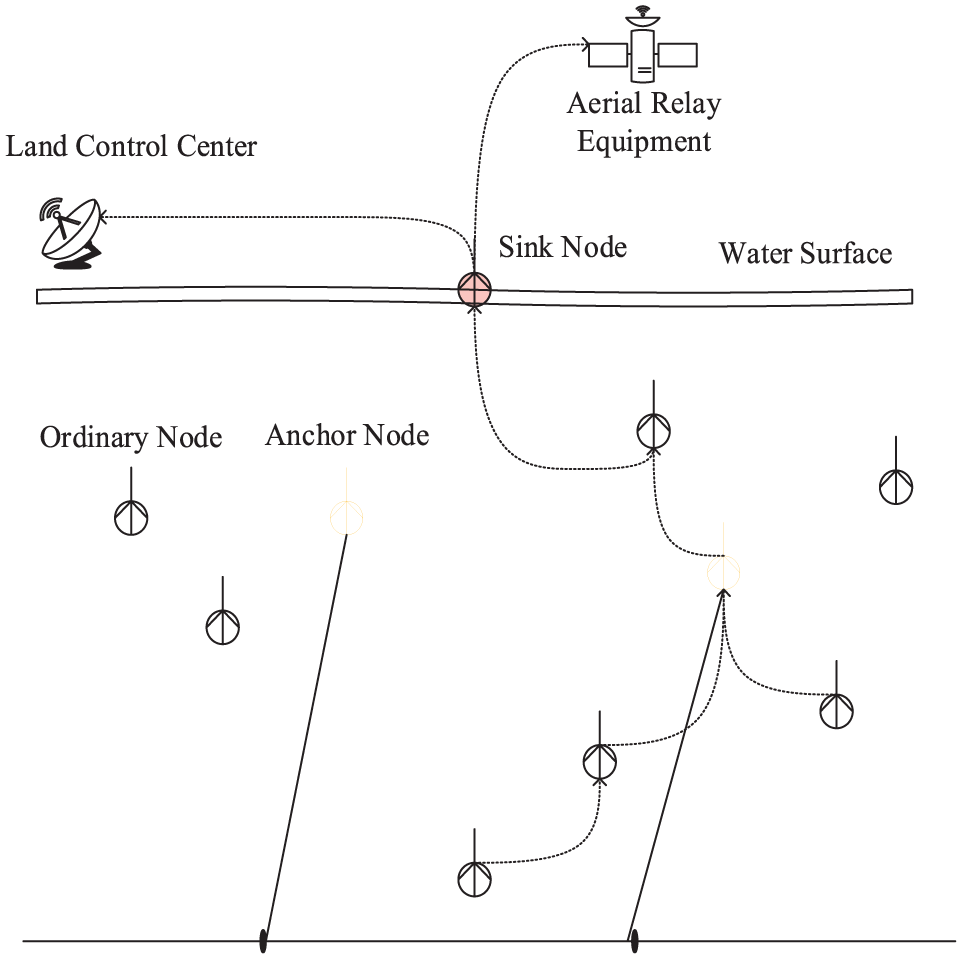
An underwater wireless sensor network.
In traditional self-organized networks, 3 the data transmission between nodes is relatively stable, and the routing path should be built prior to the data transmissions. However, with the influence of node mobility, sparse distribution of nodes, and the continuous variation of node distance, UWSN node links are easily interrupted frequently so that the transmissions cannot be guaranteed. Such network is of the opportunistic network architecture,4,5 where mobile nodes transfer the data messages through opportunistic contacts in store-carry-forward mode.6–8 Routing algorithms in opportunistic networks can be classified into single-copy routing and multi-copy routing. With regard to single-copy routing, the typical work is the FirstContact, 9 which allows only single copy of the data message be disseminated at each forwarding process, leading to a high transmission delay and a low reliability although a low cost is required. The multi-copy routing algorithms, such as Spay and Wait 10 and Epidemic, 11 disseminate multiple copies of the data message during a time cycle, and they are more suitable for the network with dynamic topology, because the delivery success rate is increased and the transmission delay is reduced, though the dissemination cost suffer a rise.
Hungarian method is applied to effectively solve the assignment problem, giving rise to many specific applications in the fields of finance, military, aviation, and so on.12–14 Similarly, the data forwarding process can essentially be regarded as the process of allocating message copies for the next-hop nodes. By applying Hungarian method in UWSNs, the forwarding stability of network would be improved and then data forwarding efficiency would be enhanced. Kuhn 15 proposed a latent space model based on Hungarian method in dynamic network, where questions in network would be framed and answered, thereby the network is more stable.
Although Hungarian method can get best results of data allocation, so as to maximize the data forwarding efficiency, the inefficiency and high consumption make it cannot be directly applied in the data forwarding of UWSNs. Thus, the traditional Hungarian method is improved and data forwarding algorithm based on estimated Hungarian method (DFAH) is proposed to solve the assignment problem in data forwarding process, where the anchor nodes receive the forwarding requests from ordinary nodes and optimize the waiting queue in which the data packets are waited to forward according to content in requests. The fuzzy strategy reduces the time complexity of obtaining the weight of processing matrix, and estimated principle reduces times of iteration. Thereby, the delivery success rate is improved, while the transmission delay is reduced, although to some extent, DFAH sacrifices the optimal assignment result.
Related research
Compared with traditional terrestrial sensor networks, the data forwarding issue in UWSNs faces more problems such as excessive transmission delay due to the underwater acoustic communication, the instability and destructibility of nodes caused by the severe underwater environment. An UWSN is a type of opportunistic networks, where the nodes move irregularly and the contacts among nodes are opportunistic.
To address the data forwarding issue, in ad hoc network, 16 compares residual energy that in candidate forwarding nodes with in neighbor nodes of last-hop node, the data packets are forwarded if the former is higher, otherwise discarded. The algorithms balance energy load of nodes based on energy consumption, where actual underwater implementation is difficult because of high requirement of node positioning. A distributed running mechanism to evaluate the possibility that nodes meet has been proposed by Davis et al., 17 where data forwarding is judged by evaluated possibility. Each node stores a possibility table regarding the node encounters, which would be updated at begin of each regular time slot. According to possibility table, nodes that have low possibility would try to deliver message to where possibility is high, then deliver success rate of entire network would be enhanced accordingly. Unfortunately, the method occupies too much network resource for numerical calculation. Based on the work described in the literature11,18 gets an improvement, message would be deleted when nodes receive confirmation signal or data buffer in nodes over preset threshold, where message flooding would be avoided and forwarding overhead would be reduced.
Unlike ad hoc network, controlling actual process of forwarding in UWSNs is more difficult. With special environment conditions in UWSNs, Yan et al. 19 proposed depth-based routing (DBR). In process of forwarding, nodes fed back depth information themselves to nodes around, where merely forwards data to nodes that have depth lower than themselves. Moreover, process of forwarding would be controlled by depth information. However, data redundancy and energy consumption both are too huge. A coverage-preserving algorithm called LEACH-Coverage-U 20 is proposed upon traditional LEACH algorithms, where cluster head is elected by calculating effective cover rate, and it will be used to forwarding judgment, whereas randomness using this method to select cluster head is too high so that cannot often select optimized cluster head. Hop-by-hop vector-based forwarding (HH-VBF) 21 forwards data based on vector parameters, where randomness is avoided by designing forwarding vectors for each node; however, sensing positioning of nodes is also a problem.
Hungarian method has advantages in solving the problems such as traffic control, trajectory tracking, production control, and others.15,22,23 In this article, Hungarian method is applied to optimize the data forwarding paths through setting a forwarding weight matrix. Especially, the forwarding weight matrix is set based on the relative positions between the ordinary nodes and the anchor nodes rather than the absolute positions of nodes, and thus, the real-time position information is not required. Nonetheless, the Hungarian method cannot be directly applied because of calculation method and handling limitation, because for high-order matrix, using traditional Hungarian method to process would lead to higher processing delay and low efficiency. Thus, the article has an improvement upon estimation. Through estimation, algorithms become more increasingly viable for underwater environment. In Zhang, 24 the proposed power efficient routing (PER) protocol also adopts an estimation control principle, where the suitable forwarding nodes are selected according to the distance between nodes, residual energy of nodes, and transmitting angle of nodes. Despite that, in UWSNs, the real-time information collection is very difficult, and the propagation delay becomes extremely large from calculating the optimal solution with a high complexity, which leads to more energy consumption in the data forwarding process as well. To this end, this article proposes a DFAH, which takes into account influences of the UWSNs environment and improves the inadaptability of traditional Hungarian method in UWSNs.
Note that this work is an extension to our previous work, which has proposed conference paper titled “A Data Forwarding Algorithm based on Estimated Hungarian Method for Underwater Sensor Networks.” 25 In terms of original model, data packet format, algorithm steps, mathematical analysis, and simulations, this article has some changes.
Forwarding technology description
Estimated Hungarian method description
The basic thought of Hungarian method is to seek independent 1-element group in matrix with a certain matrix transformation, the thought of which is similar to compute the optimal set of binary graph in the graph theory. The traditional Hungarian method can be described as follows
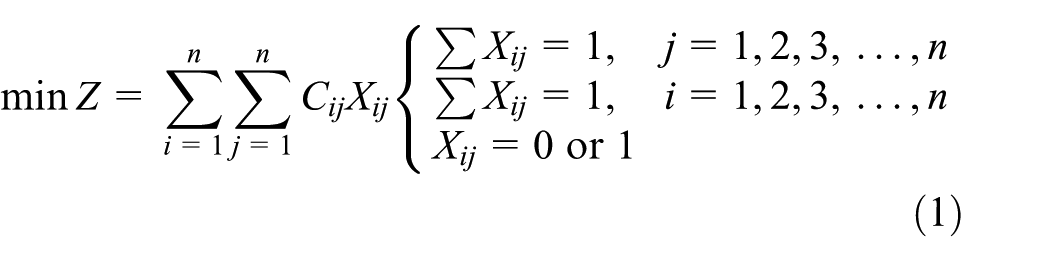
where Z represents optimal solution; i and j, respectively, represent row number and column number.
A new weight matrix
In UWSNs, we find that the traditional Hungarian method cannot be directly applied into the data forwarding algorithm due to the following reasons: (1) first, the integral weight matrix is the requirement for calculating optimal value in the traditional Hungarian method; however, in underwater environment, the sensor nodes usually cannot gather real-time information to construct this matrix. Therefore, the weight matrix has to be constructed by an estimation strategy. (2) Second, with regard to the execution cost, the traditional Hungarian method needs repeated iterations to simplify the weight matrix, and some of the iterations are invalid, and all these lead to extremely large overhead and processing delay. Thus, this article proposes an estimated Hungary-based average-simplified strategy, where the order reduction is introduced to decrease the overhead and the delay from iterations.
Forwarding technology description
In architecture structure of UWSNs, the node consists of ordinary nodes, anchor nodes, and sink nodes. The movement ranges of ordinary nodes are larger than others, and the movement speed of ordinary nodes is faster. Moreover, the movement ranges of anchor nodes are always limited. Sink nodes floating on the water surface are responsible for collecting the data packets for further process.
As shown in Figure 2, in DFAH, the anchor nodes play the role of data forwarding agents due to their limited movement ranges. At the start of each time slot, anchor nodes detect the forwarding requests from neighboring ordinary nodes which are deeper. If some requests have been detected, the anchor node sends inquire_msg to the deeper ordinary nodes. On receiving the inquire_msg, each ordinary node replies with a respond_msg, which includes the information of movement speed, distance to the anchor node, residual capacity, and number of historical contacts.

Forwarding model.
The number of historical contacts between node i and node j is marked as φij is calculated as the number of average contacts among nodes

where
After the anchor nodes receive the respond messages, where if the number of contacts is larger than the preset threshold, and if it is greater than reset value, they check the cache path. If it exists, forward data cache in a certain period first, because node mobile has regularity, and in general, node move in a certain range. Therefore, cache path is valuable to improve forwarding efficiency. Otherwise, if cache path does not exist, the forwarding weight

where
By calculating forwarding weight, anchor node would get forwarding request that weight is different. At begin of each time slot, anchor node would handle forwarding requests that have been received. For anchor node, upper threshold number of processing requests of anchor node Nmax would be set according to deployment density of nodes; when it is greater than Nmax, sorts forwarding weight value and only reaches Nmax forwarding requests would be handled. The purpose why it reaches Nmax is needed because energy consumption and delay of the estimated Hungarian method both are high compared with broadcast when the number of candidate next-hops is too small.
Estimated matrix description
By calculating the forwarding weights, the anchor nodes would get the forwarding requests with different weights. At begin of each time slot, the anchor nodes handle the received forwarding requests. The maximum number of the requests can be processed by each anchor node is marked as Nmax and set according to deployment density of nodes. If the number of received requests is larger than the preset Nmax, these requests will be sorted through their forwarding weights, and the requests with larger weights will be preferentially processed.
Suppose that an anchor node has received n forwarding requests, and the number of ordinary nodes shallower than the anchor node in communication range is m (n ≤ m). The forwarding matrix Cm × n is produced at the anchor node j, where the matrix element cij denotes the weight from an ordinary node i to another ordinary node j, and cij is calculated as

According to the property, ordinary nodes around same anchor node have similar feature of moving range and moving speed. For calculating parameter that cannot be obtained timely, estimated strategy should be adopted. For instance, when calculating δij, parameter Si may lack, anchor node thus gets
From Figure 3, accurate rate of estimated value decreased at the beginning and then kept nearly at 89%, fall at first is because order of processing matrix is smaller. Therefore, estimated method would be used, and finally, anchor node produces an estimated matrix C = (c ij ) mn , which would produce 0-1 matrix through estimated Hungarian method. The method is shown below.

Weight accuracy rate.
Therefore, the estimated method is used and thus an estimated matrix C = (c ij ) mn is generated, which would be transformed into a 0-1 matrix through the estimated Hungarian method. The method detail is given as follows:
Row reduction: the average value of each row is calculated and then each element minus the average value of its row. As a special case, if the element is smaller than the average, then the element is set to 0.
Matrix marking: the row having the least 0 element should be found from top to bottom in the matrix. The first 0 element is selected from left to right in the found row. The related row and column of the selected 0 element are then marked for further processing. After that, the 0 elements in the marked row and column will not be taken as 0 elements in future. This step will be repeated until all rows and columns have been marked.
0-1 matrix production: the selected 0 elements are set as 1, and other elements are set as 0. Thus, the 0-1 matrix is produced.
For instance, the generated matrix
Compared with traditional Hungarian method, in estimated Hungarian method, the iterative number is reduced greatly. Both time complexity and space complexity drop from O(n3) and O(n2) to O(n). Besides, such distribution forwarding can avoid congestion on some nodes.
Here, in the aspect of processing delay of matrix, we first use MATLAB tool to generate random matrix, then data of time consumption can be obtained by Hungarian method and estimated method as Figure 4 shows. From Figure 4, we can find that the plot gap between traditional Hungarian method and estimated Hungarian method become larger with the increase in matrix order.

Processing delay figure.
To measure the performance of estimated Hungarian method in the issue of data forwarding, we define the efficiency value M considering calculated result and the processing time, and M is expressed as


where
Efficiency value M takes full account of processing time and optimized degree can be a good assessment basis for matrix processing. As shown in Figure 5, with the increase in matrix order, the efficiency value of estimated Hungarian method decreases sharply, but the plot of estimated Hungarian method is higher than that of traditional Hungarian method regardless of the matrix order. For higher efficiency, order of weight matrix should not be too high. Obviously, with low-order weight matrix, estimated Hungary method performs better.

Efficiency value.
Forwarding strategy description
In the forwarding process, the ordinary nodes carry some generated data packets until they encounter the anchor nodes with shallower depths, and then, ordinary nodes send the forwarding requests to the anchor nodes. Anchor nodes sequentially process the received forwarding requests according to the weights of requests.
Afterward, the anchor nodes detect the neighboring ordinary nodes with shallower depths. Then, an estimated matrix is produced; on basis of that, 0-1 matrix is then obtained by the estimated Hungarian method.
Each forwarding node is related to a receiving node and called the primary receiving node. The receiving node with 0 elements in matrix is called the secondary receiving node. If the number of nodes is fewer than n, according to formula (4), then the data packets should be forwarded to the node with largest weight.
The anchor nodes play the role of forwarding agents, and thus, the data packets should be first sent to the anchor nodes which forward these packets to the upper ordinary nodes. Note that each anchor node should take a living-time process on basis of the obtained 0-1 matrix. With regard to the data packets to be forwarded to the primary receiving nodes or the secondary receiving nodes, the living-time should be set for each data packet to reduce network redundancy.
Once receiving the data packet by the destination node, the destination will broadcast an ack_msg to all the ordinary nodes and anchor nodes carrying the same data packet. The carried data packet will be discarded. The process of interaction between nodes is shown in Figure 6.
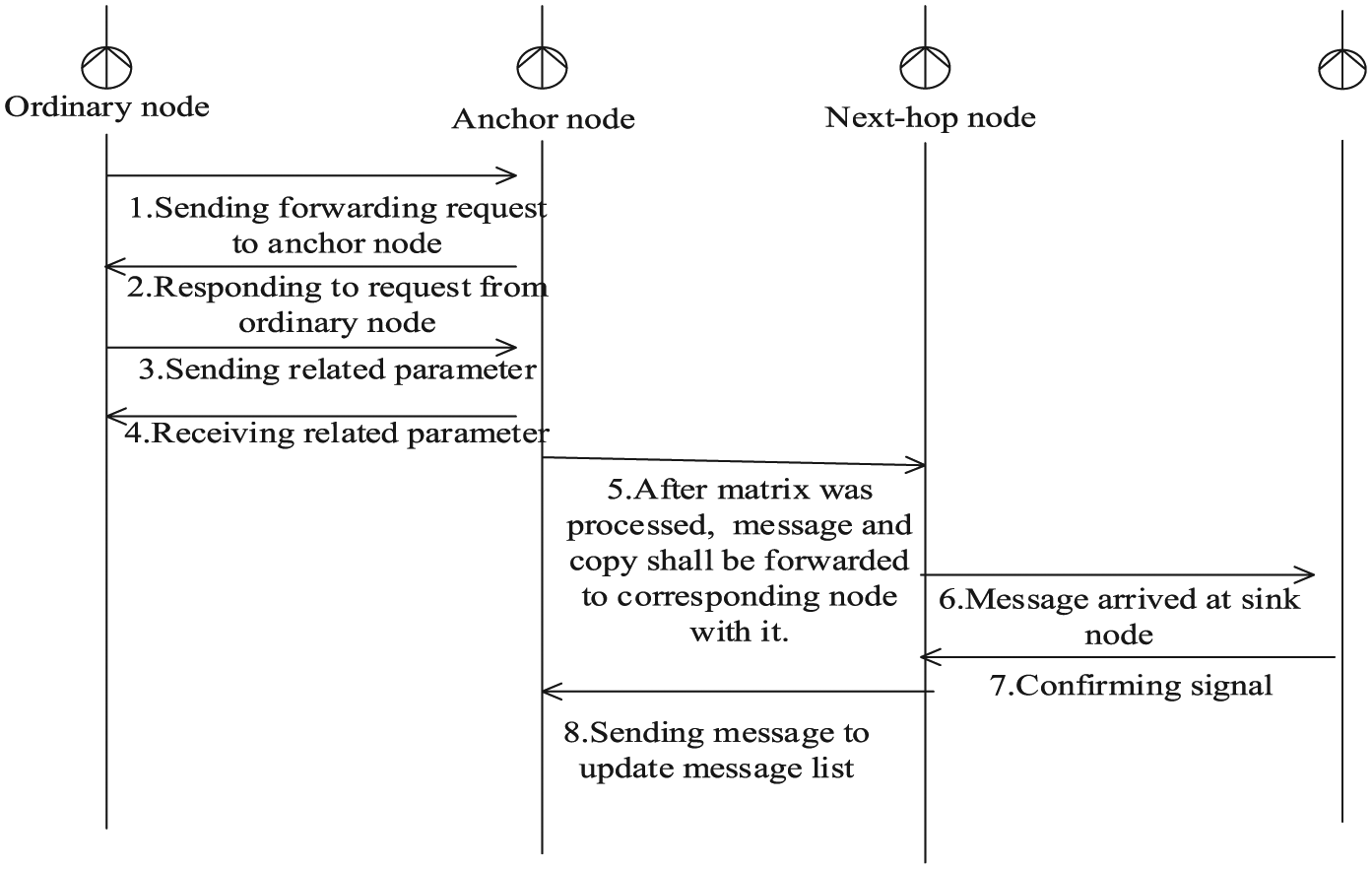
Interaction sequence diagram.
The stability of anchor nodes is utilized in this forwarding strategy, and the anchor nodes are assigned to undertake the task of forwarding agents. Meanwhile, the forwarding process is optimized by an estimated Hungarian method, and the data redundancy is reduced by setting proper living-time for data packets. Besides, the ack_msg list is updated to enhance the forwarding efficiency and reduce the forwarding delay.
Mathematical analysis
Suppose the node coordinates obey the normal distribution: X∼N(μ1, σ1), Y∼N(μ2, σ2), Z∼N(μ3, σ2), and the sink node coordinate is (xt, yt, zt), so the transmission distance
The speed of acoustic wave is marked as St, and the transmission delay is expressed as

From which it can be found that transmission delay is mostly affected by optimized degree of estimated Hungarian method and the positions of nodes.
Assume that order of weight matrix is n and the energy consumption of each forwarding process is e, and thus, the total energy consumption is calculated as

Hence, the influence factors of energy consumption are similar to those of transmission delay, excepting the order of matrix.
With regard to the delivery success rate, without considering the unexpected cases such as node corruption, assume accidental rate of each forwarding process is ar, then we can get delivery success rate as

According to the above formula, the node density and accidental rate are the main factors affecting the performance of our proposed estimated Hungarian method.
Simulation
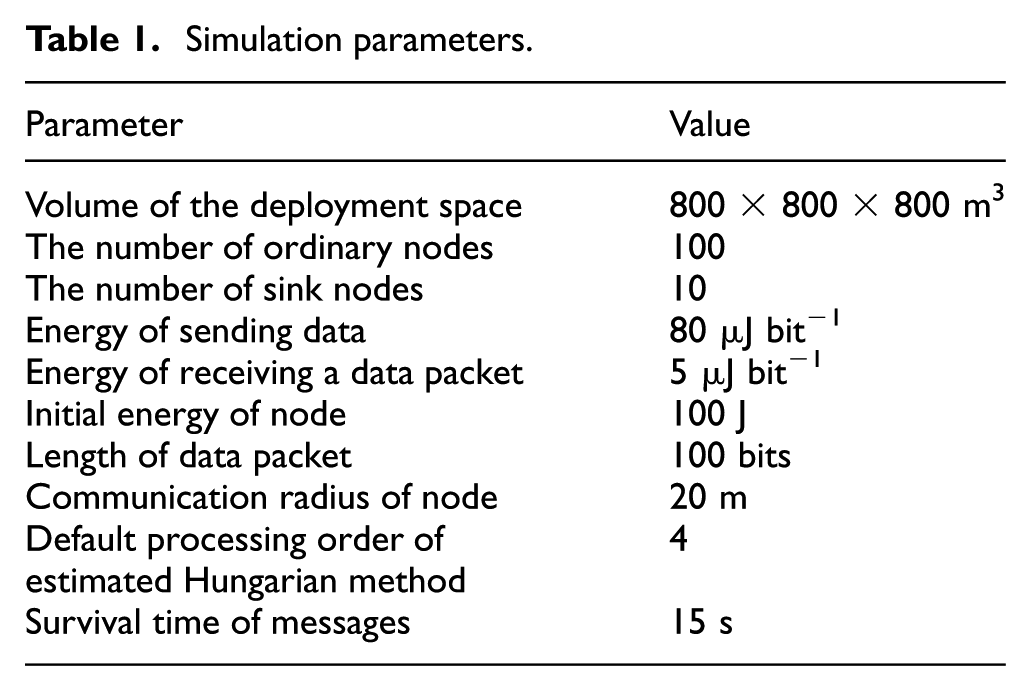
To verify the DFAH, it is realized on the platform of MyEclipse tool, and values of main parameters are given in Table 1. In this section, the indexes of node consumption, delivery success rate, and forwarding delay are observed while varying the value some simulation parameters. In addition, the performance DFAH is compared with DBR and HH-VBF.
Simulation parameters.
Self-comparison simulation
Average transmission delay of nodes indicates the average value of time period from the generation of a data packet to its delivery. Average consumption represents the average value of consumption that node consumes in unit time slot, and delivery success rate represents the ratio of delivered data. First, the deployment space from 600 × 600 × 600 m3 to 1000 × 1000 × 1000 m3, and the number of nodes is varied from 10 to 40 with a step of 10.
From Figure 7(a), with the increase in deployment space size, the average transmission increases accordingly. This is because transmission distance becomes longer; however, with the number increase in anchor nodes, the transmission delay decreases. It shows that the anchor nodes undertake the forwarding agents, indicating that more anchor nodes can forward the data packets more effectively. Besides, the gap between the plots of anchor node number = 30 and anchor node number = 40 is very small, that is, the delay reduction becomes unobvious with the continuous number increase in anchor nodes. Similarly, the delivery success rate and average energy consumption are observed in Figure 7(b) and (c), respectively, which indicate that with the increase in deployment space size, the delivery success rate drops, and the energy consumption increases.

Performance of DFAH versus number of anchor nodes, deployment space: (a) average transmission delay, (b) delivery success rate, and (c) average energy consumption.
Changing default processing order of Hungary matrix from 3 to 8, moreover, many tests were conducted simultaneously by changing the number of anchor nodes from 10 to 40, transmission delay, delivery success rate, and average energy consumption all are changed as following.
As shown in Figure 8(a), with processing order increases, transmission delay has a decreased trend; in addition, it would be stable gradually when order starts at 6. When order of matrix increases, it means the number of messages in every time piece would rise, so transmission delay shall reduce when order begin to rise. When processing order up to some degree, actually, such a large matrix is not needed in every time piece and thus delay begins to stable. In the aspect of delivery success rate as shown in Figure 8(b), the influence of estimated Hungarian method is low and is maintained at a stable value. For average energy consumption, high-order matrix needs more count times, so, with order of processing matrix increases, average energy up accordingly.

Handling order comparison: (a) self-comparison of average transmission delay, (b) comparison of delivery success rate, and (c) comparison of average energy consumption.
According to varied data in figure, the use of forwarding technology has an positive influence on entire forwarding process; meanwhile, for UWSNs, the deployment number of anchor nodes has optimal value. Thus, for practical application, the deployment number of anchor nodes should approximate optimal value as far as possible.
Algorithm comparisons
In this section, the number of selected anchor nodes is set 20. With the increase in the node number, the delivery success rate, average transmission delay, and energy consumption are compared among the DFAH, DBR, and HH-VBF, and the results are given in Figure 9.
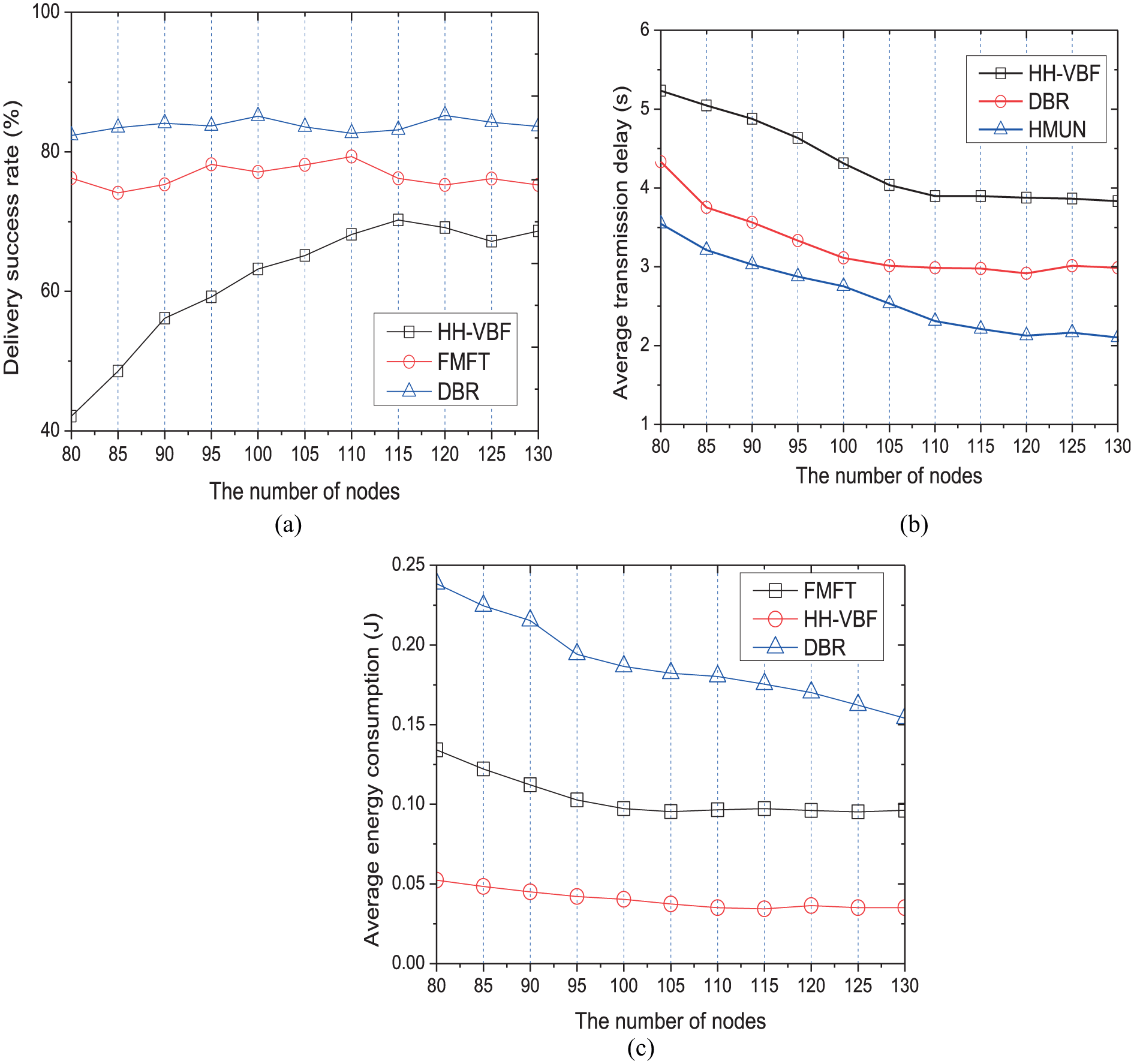
Algorithm comparisons: (a) average energy comparison, (b) average transmission delay comparison, and (c) average transmission consumption comparison.
As shown in Figure 9(a), when more nodes are deployed, both DBR and DFAH maintain stable delivery success rates, which are around 82% and 78%, respectively. However, when the number of nodes falls into the interval [80,115], the delivery success rate has a rising trend. The reason is that the forwarding of HH-VBF rely on the node positions, when the node number in network is very few, the number of interactions and delivery success rate are very low accordingly. In term of average transmission delay, with the increase in node number, three forwarding patterns have downtrend and gradually stabilized. In such an opportunistic network, the rise of the node number enhances the contacting possibilities between nodes, which also improve the delivery success rate. If the nodes are deployed densely enough, the delivery success rate is very close to the peak value. As a result, the transmission delay becomes stable, which mainly benefits from the optimal processing. In the aspect of energy consumption, the large data redundancy will lead to higher energy consumption in DBR. For DFAH, the data redundancy is eliminated through the estimated Hungarian method and the ack_msg list updates, where the energy consumption of DFAH is reduced. Although lower energy consumption is achieved by HH-VBF, which adopts the single-copy forwarding strategy, delivery success rate is also extremely unsatisfactory.
Conclusion
In DFAH, the estimated Hungarian method is applied to solve the assignment problem in data forwarding process in UWSNs, where the anchor nodes receive the forwarding requests from ordinary nodes and optimize the waiting queue in which data packet is waited to forward according to request content. Therefore, DFAH has advantages in delivery success rate and transmission delay, moreover, energy consumption is also reasonable.
In future work, further optimization and improvement would be given for the processing method of weight matrix that reasonable energy consumption should be guaranteed.
Footnotes
Handling Editor: Jaime Lloret
Declaration of conflicting interests
The author(s) declared no potential conflicts of interest with respect to the research, authorship, and/or publication of this article.
Funding
The author(s) disclosed receipt of the following financial support for the research, authorship, and/or publication of this article: This research was supported by the National Key R&D Program of China under grant no. 2017YFB0802300; National Natural Science Foundation of China under grant nos 61373139, 41571389, and 61502250; and Postdoctoral Science Foundation of China under grant nos 2014M560379 and 2015T80484.