




Abstract
Due to the limited energy and the non-equivalence of wireless sensor network nodes, it is imperative to reduce and rationally use the energy consumption of the nodes to prolong the network lifetime. Clustering routing algorithm can address the problem efficiently. In this article, a grid-based reliable multi-hop routing approach for wireless sensor networks is proposed. In order to minimize and balance the energy consumption, our proposed protocol, grid-based reliable multi-hop routing protocol, optimizes the cluster head election process by combining individual ability which consists of node’s residual energy and node’s location, and local cognition which can balance energy consumption among clusters via a consultative mechanism based on cluster head’s lifetime expectancy, while considering data forwarding delay and reliable transmission of data. Simulation results show that grid-based reliable multi-hop routing protocol has improved stability period as compared to other protocols. Meanwhile, grid-based reliable multi-hop routing protocol has better performance in energy efficiency, data forwarding delay, and reliable transmission of data.
Introduction
Large-scale wireless sensor networks (LS-WSNs) have attracted a lot of research interest, especially in the context of performing environmental monitoring and periodic data collection tasks. Due to the restricted energy and the non-equivalence of wireless sensor network nodes, it is imperative to reduce and rationally use the energy consumption of the nodes to prolong the network lifetime.1,2 Routing protocol is an effective method to address the problem, in which cluster-based protocol is widely used.
In order to make the research fit the actual situation more closely, the situation of the base station far away from the monitoring area is considered in this article. The location of the base station determines the flow direction and forwarding convergence of wireless sensor network nodes. Although many routing protocols based on clustering presented in the literature minimize energy consumption on data forwarding path to enhance energy efficiency of the nodes for prolonging the network lifetime, these protocols cannot necessarily extend network lifetime when the situation of the energy cavity occurs prematurely. Furthermore, most of the protocols focus on only one optimization criteria,3–6 such as reliability while ignoring other practical indicators, such as delay, network lifetime, throughput, and stability. Therefore, it is challenging to reach a convincing trade-offs among the various conflicting evaluation criteria, such as the network’s energy efficiency, data transmission latency, throughput, stability, reliability, and lifetime.
In this article, a grid-based reliable multi-hop routing protocol (GRMRP) is proposed. First, GRMRP divides the monitoring scenario into several virtual grids, where a virtual grid is a cluster. Then, the virtual grid is subdivided into several basic cover units, and only one node is kept in active state and other nodes go to sleep while still maintaining connectivity and coverage. An energy-triggered adaptive cluster head election (ET-CHE) strategy, combined with proactive round-robin rotation and passive adjustment, is proposed for balancing the energy dissipation in all basic cover units. Furthermore, a bilateral consultative mechanism based on cluster head’s lifetime expectancy is presented for allocating data flow reasonably among clusters. MATLAB simulation results show that GRMRP has improved stability period as compared to other protocols. Meanwhile, GRMRP has better performance in energy efficiency, data forwarding delay, and reliable transmission of data.
The main contributions of this article can be summarized as follows:
We propose a grid-based partition method for division of wireless sensor networks. GRMRP divides the monitoring area into several virtual grids (clusters) according to monitoring scene scale and node communication range, and all nodes in each grid cooperate with each other to collect data and transmit data to the sink until wireless sensor network fails to work.
Considering the significant node redundancy, GRMRP divides virtual grid into several basic cover units by comparing the size of grid and the communication range of sensor nodes, and just keeps only one node stay in active state and other nodes go to sleep while still maintaining coverage and connectivity.
We propose an ET-CHE method, using proactive round-robin rotation strategy when the energy level of cluster head is lower than the average energy level in the cluster and passive adjustment strategy when the cluster head receives feedback from the relay node, to optimize the energy dissipation among nodes in all basic cover units.
In order to balance energy dissipation among clusters and avoid the premature emergence of Energy Hole which is introduced by the unreasonable distribution of traffic load between source nodes and relay nodes, we design a bilateral consultative mechanism based on lifetime-forecast (BCM-LF). In order to determine the energy state of adjacent cluster, cluster head first selects the optimal adjacent relay node and then reselects the best forward node from other neighbors when the cluster head received negative feedback message.
The performance of the proposed protocol is evaluated with two models using MATLAB simulations. The first model uses a single indicator evaluation and the second adopts a comprehensive index model which can effectively make up the one-sided nature of the single index evaluation model. In comparison with existing data gathering protocols, our approach achieves better performance such as less latency, less energy consumption, better throughput, and high reliability which provides better quality-of-service (QoS) along with the extending of network lifetime.
The rest of the article is organized as follows. Section “Related work” gives an overview of related work. Section “Problem statement” describes our system model and states the objectives that we deal with in this work. Section “GRMRP” presents the data gathering problem, describes the details of the proposed protocol GRMRP, and argues that it meets its objectives. In section “Protocol simulation and result analysis,” we evaluate our protocol through extensive simulations by comparing it with several popular routing protocols. Finally, we give peroration and future research directions.
Related work
Our study gains inspiration from meaningful evaluation indicators such as reliability and latency and builds on related work for grid-based routing protocols7–12 and cluster-based routing protocols.13–28
In Farman et al., 4 a grid-based hybrid network deployment (GHND) framework is proposed for load balancing to ensure energy efficiency in WSNs. To evenly distribute load across the network, merge and split technique is used to achieve even distribution of sensor nodes across the grid. In GHND, low-density neighboring zones are merged together whereas high-density zones are strategically split to achieve optimum balance. Considering the nodes in LS-WSNs have the potential to be selfish without transmitting packets in routing, a reliable coalition formation routing (RCFR) protocol 5 is proposed to address stable cooperation among nodes for packets delivery and minimum routing cost. Huynh et al. 6 describe an investigation of the trade-off between minimizing energy consumption and minimizing end-to-end delay, propose a distributed clustering approach to determining the best cluster head for each cluster, propose two new functions for use in an inter-cluster routing algorithm by considering both energy consumption and end-to-end delay requirements, and present a multi-hop routing algorithm for use in disseminating sensing data from cluster heads to a sink at the minimum energy cost subject to an end-to-end delay constraint. In order to address the hot spot problem, a grid-based fault-tolerant clustering and routing algorithm (GFTCRA) 7 is proposed to deal with the trade-off between energy efficiency and fault tolerance of cluster heads. In order to solve the problem of network partition, which is caused by the early dead situation of the sensors, a position-based routing algorithm 8 is proposed to fairly use the energy of the sensors. The forwarding search space (FSS) is introduced to control unnecessary transmissions and a next forwarder selection function is designed based on the residual energy, node degree, distance, and angle. The literature 9 has proposed a grid-based reliable routing algorithm referred as GBRR, which achieve extensibility and adaptability for random deployed sensor networks at a dense and large-scale area. In GBRR, the next hop choice is made based on intra-cluster and inter-cluster communication quality, and the problems of barrier and cavity will be addressed using greedy and perimeter forwarding strategy to make the network reliable. In Zarifzadeh et al., 19 a game-theoretic topology control framework is proposed to study the problem of creating energy-efficient topologies for ad hoc networks in the presence of selfish nodes. Since the amount of energy consumed in each sensor node depends not only on its power but also on the volume of traffic it forwards, a new utility function that can better characterize the real interest of sensor nodes in energy optimization is proposed, by taking both their load and transmission power into consideration. Energy-aware routing algorithm presented by Li and Guan 20 uses local betweenness centrality to estimate the energy consumption of the neighboring nodes around a given local sensor node, without global information about the network topology. In Heinzelman et al., 22 a low-energy adaptive clustering hierarchy (LEACH) routing protocol, which is a typical representative of hierarchical routing protocols in WSNs, is proposed for periodic data collection applications. In LEACH, each node independently proclaims itself as the cluster head periodically by equal probability round-robin method. Cluster heads are responsible for collecting data of member nodes and delivering the aggregated data to the remote sink by single-hop communication. The advantages of LEACH protocol are it is easy to be implemented and it has no need for central control, but the performance such as scalability in heterogeneous networks and LS-WSNs is not well mainly because the far distance nodes will first run out of energy, not consider the energy level of nodes, the uneven distribution of cluster heads, and the difference in the number of cluster heads is very obvious. Hybrid energy-efficient distributed (HEED) clustering 23 is a typical distributed clustering approach, periodically selects cluster heads according to a hybrid of the node residual energy and a secondary parameter, such as node proximity to its neighbors or node degree. The merit of HEED is that it can asymptotically almost surely guarantee connectivity of clustered networks. In Xu et al., 24 a geography-informed energy conservation for ad hoc routing (GAF) is proposed to reduce energy consumption. GAF is a typical topology management protocol in which sensor nodes are classified into equivalence classes based on their position information and some nodes in each class participate in data acquisition and transmission, while other nodes are turned off for saving energy. In GAF, the location information of node can be obtained from a orientation system such as GPS. Power-efficient gathering in sensor information systems (PEGASIS) 25 is a position-based geographic routing protocol, which forms a chain in which all nodes can only transmit and receive message from the nearest neighbor nodes. In PEGASIS, only one node will directly deliver the aggregated data to the sink each round. Although PEGASIS is attractive due to its efficiency and scalability, it is confirmed that there would be still considerable room to optimize the performance such as low fault tolerance and too large latency. In order to mitigate the hot spot problem in multi-hop sensor networks, an unequal cluster-based routing (UCR) 28 protocol which groups the nodes into clusters of unequal sizes is proposed. In UCR, cluster heads closer to the sink have smaller cluster sizes than those farther from the sink, thus can preserve some energy for the inter-cluster data forwarding. In order to mitigate the overhead caused by frequent cluster head selection, a modified weight based cluster head selection algorithm with balanced partitioning (BP-DCA) 15 is presented for WSNs. BP-DCA considers the node’s residual energy, number of neighbor nodes, average distance between the nodes for selecting the best nodes as cluster heads, and distance between the cluster heads for optimum distribution of cluster heads during cluster formation. Table 1 summarizes related work for grid-based routing protocols and cluster-based routing protocols.
Comparative analysis of the selected routing protocols.

LEACH: low-energy adaptive clustering hierarchy; HEED: hybrid energy-efficient distributed; GAF: geography-informed energy conservation for ad hoc routing; PEGASIS: power-efficient gathering in sensor information systems; DEEC: distributed energy efficient clustering; UCR: unequal cluster-based routing; GBRR: grid-based reliable routing; RCFR: reliable coalition formation routing; GFTCRA: grid-based fault-tolerant clustering and routing algorithm; GHND: grid-based hybrid network deployment; BP-DCA: modified weight based cluster head selection algorithm with balanced partitioning; WSN: wireless sensor network; FSS: forwarding search space.
Problem statement
Cluster-based routing protocol for WSNs is closely related to specific application scenarios, in which monitoring tasks have the same essence, being a number of sensor nodes deployed randomly within a given region by throwing manner. Nodes send collected data to the sink by single-hop or multi-hop wireless transmission. In the following section, we first describe the network model, transmission model, data fusion model, and running time model and then give our objectives.
Network model
In this article, we consider a sensor network consisting of N sensor nodes uniformly dispersed within a vast monitor field to continuously monitor the environment. We denote the ith node by
All sensors are left unattended after deployment and have unique identification; the sensor nodes can be accurately located by GPS or some localization algorithm. All sensor nodes are quasi-stationary after deployment.
The energy of sink is unlimited, with strong computing and storage ability. Considering the need of real application, the sink is located far away from the sensing field.
All nodes have limited initial energy and nodes with different energy have different data-collecting abilities. The energy depletion of sleep nodes can be neglected.
Data within different fields have different requirements concerning the transmission delay to the sink.
Links are symmetric, that is, two nodes can communicate with each other using the same transmission power level. All sensor nodes can communicate directly with sink when their energy are allowable.
Each node has a fixed number of controlling transmission power level and can use power control to vary the level of transmission power according to the distance to the desired recipient.
The data sensed by adjacent sensor nodes are highly correlative, and all nodes have data fusion ability to eliminate the data redundancy and reduce the communication load.
Energy model
GRMRP protocol uses the same radio hardware energy dissipation model as that of Heinzelman et al. 22 Readers may refer to Heinzelman et al. 22 for more details. To transmit a k-bit message for a distance of d, the energy consumption is


The energy consumption model used in this article only considers the energy consumption in node sending and receiving the message, ignoring that produced in the process of computing and storage. The node energy consumption is proportional to the square of the distance d if
Data fusion model
Data fusion or aggregation has emerged as a useful paradigm in sensor networks. The key idea is to combine data from different sensors to eliminate redundant transmissions and provide a rich, multi-dimensional view of the environment being monitored. Gathered data moves from node to node, gets aggregated, and is eventually transmitted to the sink. To maximize the lifetime of the system, GRMRP uses data fusion technology to achieve the goal of saving and balancing energy consumption performance. We assume that all nodes have the same perception radius and the capability of aggregating its data packets. Cluster head collects n number of k-bit data from member nodes in the cluster and compresses it to cn k-bit messages with c ≤ 1. As there is a big difference in the data correlation of different clusters, we just consider transmission instead of data fusion among cluster heads; and the energy consumption of data fusion
System runtime model
Because of the difference in the initial energy of nodes, we assume that the number of data packet collected by each sensor node per time unit is proportional to the initial energy of each node. For simplicity, we refer to each time unit as a round based on LEACH protocol. 22 Similar to LEACH, the operation of cluster head election scheme is composed of cluster formation phase and data transmission phase. Network running time series model is shown in Figure 1.

Network running time series model.
Figure 1 illustrates the running time of GRMRP. In the initial operation stage Tinit, the monitoring area is divided into a number of small virtual grids based on the node communication range
GRMRP presented in this article aims to reduce nodes energy dissipation, balance network energy expenditure, shorten data forwarding delay, and increase network lifetime with the premise to ensure complete network coverage and monitoring quality. Security is not considered here.
GRMRP
To address the problem of quickly network energy consumption, unbalanced node energy dissipation, and overlong delay in data aggregation, we propose an efficient GRMRP, which can reasonably make use of the node energy and effectively prolong the network lifetime through using virtual grids to organize network topology, eliminating hot spot problem by adopting negotiation strategy which can predict lifetime, and dynamic cluster head adjusting strategy.
Network initialization phase
Consider the total number of sensor nodes N is randomly scattered in a given targeted scenario, the area of which is

Grid formation.
Cluster formation
We propose an adaptive grid formation algorithm (AGFA) to divide the monitor field into virtual grids and construct network topology whose details are presented in Algorithm 1. The base station divides the whole monitoring field into

In this article, just square grid is considered.
By comparison, we can see that our proposed grid formation algorithm has better adaptability than GHND which needs to know the number of grids in advance.
Basic cover unit formation
To meet the requirement of application in real life, high-density node deployment strategy is used in network deployment, and all the virtual grids in the network are covered with high probability. Assume that the size of the monitoring area is known, and it is divided into W virtual grids, with N nodes distributed uniformly and dispersed randomly within the W virtual grids, then the probability of any grid being not covered is
Due to the randomness of the node distribution, some nodes are densely distributed in the same grid and resulting in high redundancy of data which is bound to increase network traffic and cause unnecessary system energy consumption, as shown in Figure 2. In order to save network energy and ensure the quality of network monitor, this article proposes a perception-based intra-cluster subdivision algorithm (PISA) that effectively eliminates the node redundancy to reduce the network data traffic and guarantee the data forwarding delay as much as possible. The details of PISA are presented in Algorithm 2.
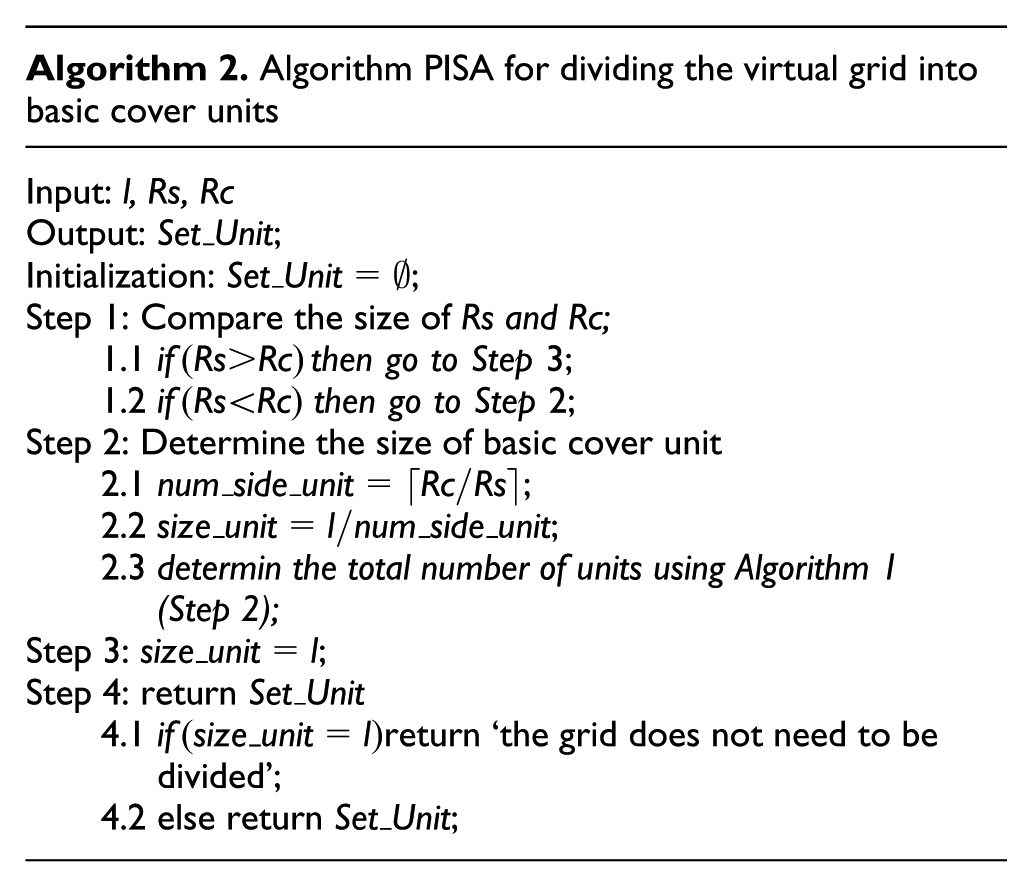
In algorithm PISA, we need to consider the relation between the sensor nodes’ perception radius Rs and the cluster size l. As shown in Figure 2, not all nodes in the cluster can cover the entire grid when

Minimum coverage example.
Active node election method
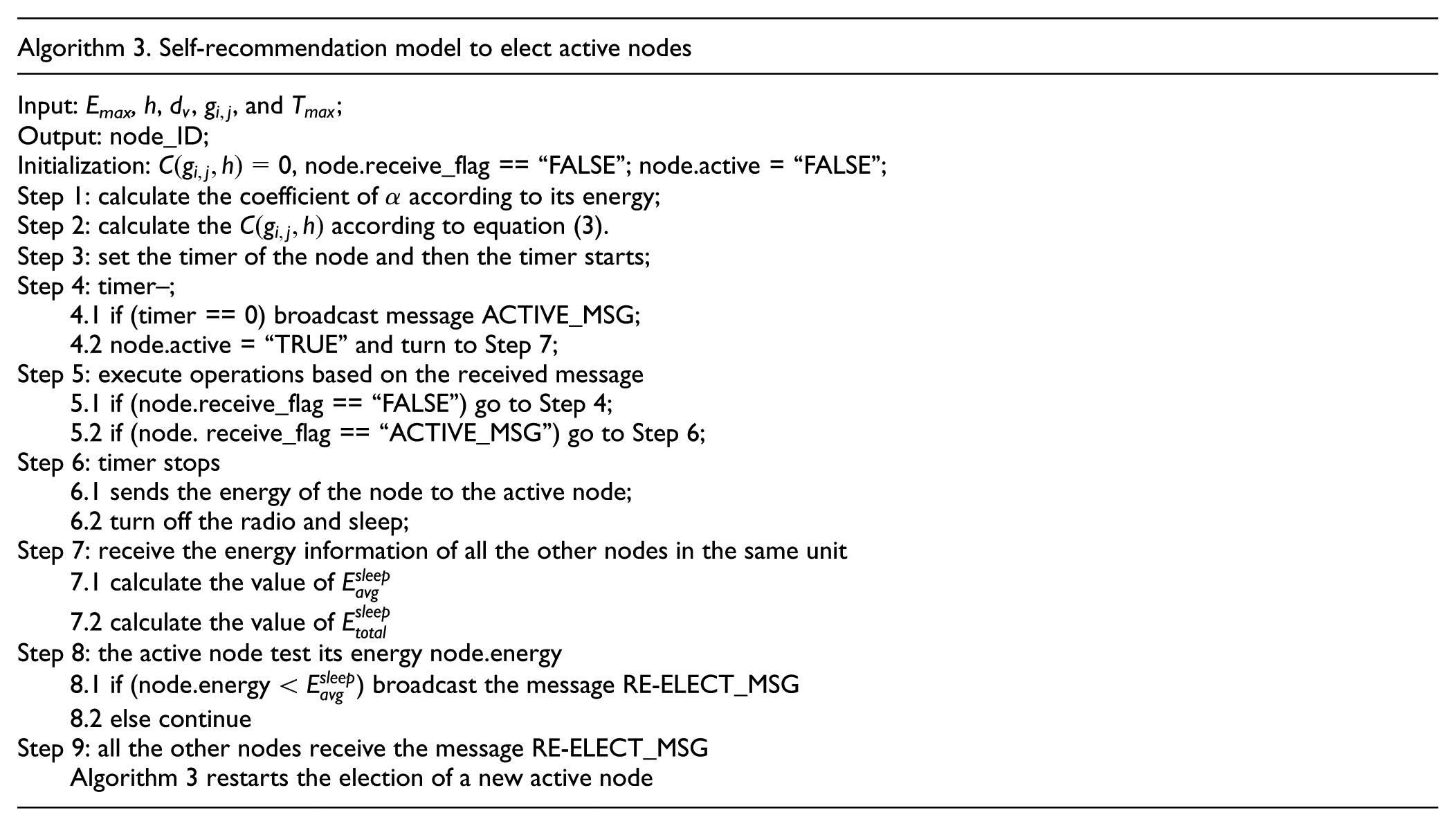
To make a reasonable use of the node energy, this article adopts the self-recommendation model to elect active nodes whose details are presented in Algorithm 3. The competitive power of the nodes will be the key factor. It is computed as follows
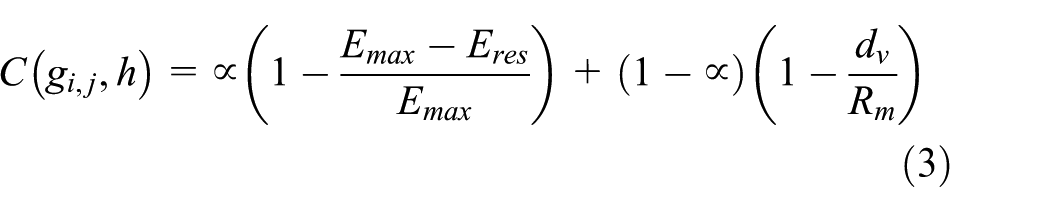
The node’s competitive power

In the above equation (4), Tmax is the initialized fixed time. The node broadcasts message ACTIVE_MSG to an area of the radius of Rm when the timer stops, announcing it has become the active node of the basic cover unit. The competitive power of the node is also broadcast in the message. If a node receives the message ACTIVE_MSG broadcast by other nodes before the timer stops, then the timer stops working and enter the state of sleep after sending its own energy to the active node. The message ACTIVE_MSG contains the node ID, location, and energy. Once the active node receives all the energy from the other nodes, it begins to calculate average energy
EANAS: energy-driven active node adjustment strategy
Since frequent interaction between active nodes will consume certain system energy, an energy-driven active node adjustment strategy (EANAS) is adopted to balance the energy depletion within the basic cover unit. The details of EANAS are presented in Algorithm 4.

When the energy of active node is lower than
Dynamic cluster head election phase
The communication energy consumption of nodes mainly includes those produced in sending or receiving controlling message (CM) and data message (DM) during network initialization and operation stage. Although the values of CM and DM are fixed and DM >> CM, a large number of literature studies have shown that broadcasts of CM in frequent cluster heads election have resulted in significant system energy consumption.
Dormancy-dominate cluster head election method
To select proper node to work as the cluster head, an ET-CHE method, combined with proactive round-robin rotation and passive adjustment, is proposed for balancing the energy dissipation in all basic cover units. The details of ET-CHE are presented in Algorithm 5.

In ET-CHE, we endow the active nodes different probability of being elected as cluster head based on the energy of sleep nodes in the basic cover unit. The node probability for becoming a cluster head is computed as follows

where
Cluster announce information
Once the cluster head has been selected, it needs to broadcast CH_MSG information in the cluster within the range of radius Rc, and other active nodes in the cluster choose it as the cluster head on receiving the information CH_MSG and send the information JOIN_MSG to join in. According to the size of the cluster, we know the whole network coverage can be achieved only when
Energy-driven cluster head round-robin method
Ensuring optimal node acts as cluster head each round requires frequent interaction of active nodes, which will bring certain system energy consumption. In this article, an energy-driven cluster head round-robin strategy is adopted to solve the problem. Through equation (5) we know the cluster head in current round will broadcast CH_ADJUST_MSG message to perform the algorithm ET-CHE when the unit it belongs to contributes so much energy that it leads to the fact that the energy in its unit is lower than the average energy in the cluster. According to equation (5), there is no need to change the cluster head when the basic cover unit which the cluster head belongs to is full of energy. But what we need to pay attention to is that the cluster head in current round will spontaneously switch from active state to dormant state within the basic cover unit it belongs to when its energy is lower than
Besides, the adjustment of cluster head can also be affected by the change in next-hop data relay node. For more detailed account, please see step 5 of algorithm BCM-LF in section “Reliable multi-hop routing.”
Reliable multi-hop routing
In single sink static WSNs, fixed sink leads to asymmetrical characteristics of network nodes. The location of the sink determines the communication data flow in the network and the route of data aggregation, which means data flows toward the sink and becomes intensified near it. Therefore, the key in designing routing protocol is to solve the problem of allocating the data forwarding probability of sensor nodes in a reasonable and balanced way.
To mitigate the hot spot problem, a BCM-LF is introduced to balance the forwarding probability of relay nodes. In BCM-LF, mixed communication model of direct cluster head transmission and multi-hop transmission is adopted. The idea behind algorithm BCM-LF is to judge whether the cluster head is qualified for data routing through negotiation between cluster heads. The negotiation message consists of source cluster head ID, estimated hop number, relay node ID, and

where
The executive steps of algorithm BCM-LF are as follows:
Step 1. Cluster head sets initialized lifetime and forms ideal routing forwarding path. That is, each cluster head gets and forms the list of its neighboring cluster heads according to the node’s communication radius, selects the cluster which is nearest to itself as its tacit routing forwarding cluster along the
Step 2. All cluster heads working for data transmission are evaluated on transmission qualification once the ideal routing forwarding path is formed. The cluster head is first evaluated on whether it has absolute data transmission capacity, that is, whether the residual energy of cluster head is larger than that needed for sending its own data and data to be forwarded to the next-hop nodes, including sink. The evaluation method is as follows

where
Step 3. The position relation of the adjacent cluster heads which communicate with each other on the ideal route forwarding path is compared. If the relay cluster is farther away from the sink than the source cluster head, just ignore this section. Otherwise, if the relay cluster head is closer to the sink, next is to evaluate whether data transmission will save network energy consumption. It is computed like this

where s denotes the cluster head which sends data transmission request; d denotes the neighboring cluster head which decides whether to reply data transmission;
Step 4. We need to judge whether the lifetime difference between two cluster heads is reasonable. Here is how to make the judgment*

where the value of
Step 5. Cluster head d sends message RELAY_OK_MSG to cluster head s. Message RELAY_OK_MSG includes the location, cluster head ID, and the number of its basic cover unit. When cluster head s receives message RELAY_OK_MSG, it will compare whether its own unit number is equal to the unit number in cluster d. If the two numbers are equal to each other, it is ready to send data. If the two numbers are not equal, then an active node set will be found satisfying the condition
Step 6. Message CH_ACT_MSG from cluster s is sent to notify it to be the cluster head, and the new cluster head in cluster s broadcasts information CH_NEW_MSG to inform the adjacent cluster head the change of cluster head. Message CH_ACT_MSG contains relevant information of the request node and relay node.
Step 7. Cluster head d sends message REFUSE_MSG to cluster head s, which shows that cluster d at present is lack of energy and incapable of providing data transmission service for cluster s. After cluster s receives this message, it sends data transmission request message REQUEST_MSG to its neighboring cluster heads for data forwarding.
Step 8. When the neighboring cluster head p receives message REQUEST_MSG, it first judge the relationship between
Step 9. The neighboring cluster head replies message CANDI_RELAY_MSG to the request cluster head s, indicating that it can provide data transmission service for cluster head s.
Step 10. If cluster head s has not received message CANDI_RELAY_MSG in a given time interval, it will transmit data directly to the sink using direct transmission model. If cluster head s receives one or more message CANDI_RELAY_MSG, a relay node selection method based on priority is adopted in algorithm BCM-LF to choose the best nodes for data forwarding. Only when the candidate assembly with top priority is empty does cluster head s select node in the low-priority candidate assembly. In the candidate node set assembly with same priority, cluster head s will pick up the node with highest
GRMRP data communication
Data forwarding routing becomes stable in data communication after the phases of cluster formation, active node election, and cluster head confirmation.
For simplification, this article adopts the same intra-cluster data-collection method as that in Heinzelman et al. 22 Once the cluster is formed, each cluster head i will create a TDMA schedule for all the active member nodes j in the cluster and then broadcast to allocate a data communication slot for each active member node. Each active member node sets a timer according to TDMA schedule and wake up to send data in the fixed time, after which enters the state of sleep to save energy.
In the intra-cluster data collection, each member node only needs to deliver the sensing data to its cluster head, the energy consumption of active member node j is

where
The energy consumption of cluster head i consists of


where
The cluster head aggregates the data after collecting all the data from member nodes and then sends the data to the sink according to the formed routing.
Protocol simulation and result analysis
To evaluate and compare the protocol GRMRP with other protocols such as DIRECT, LEACH, HEED, DEEC, and UCR, we evaluate the performance of the GRMRP protocol via simulations using MATLAB (version 2014b). For the experiments, we consider a
Simulation parameters.

First we study the effect of parameter
Parameter setting
There is an important parameter in GRMRP, namely
First, we test the effect of

The network lifetime with different
GRMRP extension of network lifetime
Network lifetime can be defined as the time elapsed until the first node (or the last node) in the network depletes its energy.
23
Due to the deployment of highly redundant nodes, the death of one or more nodes in the dense area does not affect the monitoring quality of the network. In this article, lifetime of WSNs is defined as the period starting from the network deployment to the moment that network stops providing valuable information for the user, and two evaluation indexes of lifetime are given. The network lifetime


where
For the sake of fair comparison, the value of data fusion rate c, the heterogeneous of node’s initial energy
Figure 5 shows the comparison of running rounds when the value of

Comparison of running rounds when the value of Einit and Sdata are homogeneous: (a) Tpopt scheme and (b) Tcover scheme.
From Figure 6(a), it can be seen that the performance of running rounds in LEACH protocol changes little, while other protocols like HEED, UCR, and DEEC are significantly improved. Combining Figure 6(a) and (b), we can see that the average number of rounds of LEACH protocol is significantly improved using Tcover scheme, and the increase in GRMRP protocol is not obvious but has better performance than other protocols. Combining Figures 5 and 6, we can see that the performance of running rounds in GRMRP is stable and slightly improved whether using Tpopt scheme or Tcover scheme, and this is because GRMRP takes into account the node energy factor and local energy information. Due to the limited space, only the homogeneity of energy and acquisition capacity is considered in subsequent section.

Comparison of running rounds when the value of Einit and Sdata are heterogeneous: (a) Tpopt scheme and (b) Tcover scheme.
GRMRP energy consumption
In this part, we investigate the energy consumption of GRMRP. In total, 30 rounds of simulations are sampled and the amount of total energy spent by all nodes is shown in Figure 7. Figure 7 indicates the change in total energy consumption with the increase in network running, which exhibits a linear increasing effect. Since cluster heads send their packets to the sink via single hop and its distribution is stochastic in LEACH, and a large number of isolated clusters are produced inevitably, the variation of energy consumption of cluster heads in LEACH is drastic. In HEED, DEEC, and UCR, the number of cluster heads generated relatively stable and a small number of isolated cluster heads are generated, thus a considerable amount of system energy is saved. The cumulative effect of energy consumption consumed by nodes in GRMRP is much lower than that in other protocols, because multi-hop and node dormancy strategy which can reduce the traffic load each round and save energy by data forwarding. Due to the stability of cluster heads topology using the grid-based method in GRMRP, the amount of energy spent by cluster heads is almost the same in each round.

Comparison of energy consumption.
GRMRP data latency
For the sake of fair comparison, data latency Tdelay is defined as the maximum delay of data delivering to the sink. Serial data transmission scheme is adopted for data gathering in the cluster and data forwarding between the cluster heads, and parallel data transmission scheme is adopted for data delivering to the sink. Tdelay is defined as follows

where
Figure 8 shows the data forwarding latency comparison of DIRECT, LEACH, HEED, DEEC, UCR, and GRMRP. Greater data forwarding latency, in case of LEACH and UCR protocol, is due to greater data gathering delay in the cluster and greater data delivering to the sink. Due to the node dormancy mechanism, the delay

Comparison of data latency.
Comprehensive evaluation of performance
In order to evaluate the performance of the WSNs routing protocols objectively, a comprehensive index model is adopted for making up the one-sided nature of the single indicator evaluation model mentioned above.
In this section, we compare the five simulated routing protocols, namely, LEACH, DEEC, HEED, UCR, and GRMRP using monitoring efficiency and latency metrics. Monitoring efficiency is defined as the network lifetime in the case of ensuring network coverage in this article.
According to the comprehensive evaluation index system, we can solve the problem of how to evaluate the performance of protocol using the comprehensive score. Since WSNs routing protocol has very strong application-related characteristics, it is difficult to design a kind of evaluation indexes which can be used in various fields. In order to apply to different application scenarios, evaluating value of comprehensive performance can be calculated according to weighted average evaluation model which is proposed in this article. Assume a collection of different algorithms

where

To ensure the effectiveness and credibility of the comparison, we consider network lifetime under a given failure coverage using Tcover scheme. In this article, the given failure ratio used in the simulations is 30%. Applying formula (19) to W, we get matrix W′ as follows

where

Comprehensive evaluation score: (a) I1=0.5, I2=0.5 and (b) I1=0.75, I2=0.25.
Simulation results show that the comprehensive evaluation score of GRMRP is much better than the total score in the other protocols, thus we can infer that GRMRP has better performance in monitoring efficiency and data forwarding delay.
GRMRP reliable transmission
As mentioned in section “Basic cover unit formation,” despite that the nodes fall into each cluster with high probability, the fact is that there may exist the Energy Hole area where nodes are sparse. In the GRMRP protocol, the total number of neighbor relay cluster through which a source cluster can forward data toward the sink is maximum 8, and the details are illustrated in Figure 10. Assume the probability of denial of service of each adjacent cluster to be 0.5, hence the probability of at least one feasible data forwarding cluster of source cluster is

Reliable transmission.
Conclusion
To mitigate the hot spot problem in LS-WSNs, we propose a GRMRP to balance the energy consumption among nodes. In GRMRP protocol, it should be noted that the number of grids is independent of the nodes’ distribution but closely related to the node transmission radius and node sensing radius. Once the node distribution is known, the number of initial cluster heads is determined and fixed. First, GRMRP divides the monitoring scenario into several virtual grids, where a virtual grid is a cluster. Then, the virtual grid is subdivided into several basic cover units, and only one node is kept in active state and other nodes go to sleep while still maintaining connectivity and coverage. GRMRP optimizes energy consumption among nodes in each grid by performing an ET-CHE strategy, combined with proactive round-robin rotation and passive adjustment. Furthermore, a bilateral consultative mechanism based on cluster head’s lifetime expectancy is presented for allocating data flow reasonably among clusters. Simulation results show that the GRMRP protocol effectively balances the energy consumption among nodes and achieves better monitoring performance, data forwarding delay, and significantly prolongs the network lifetime as compared to the existing WSNs routing protocols LEACH, HEED, DEEC, and UCR. Since we focus on evaluation index of the amount of data collection and the network lifetime, and consider the simplicity of the algorithm, much work on the protocol stability and scalability can be done in the future.
Footnotes
Acknowledgements
The authors are grateful to the anonymous referees for their insightful and valuable comments and suggestions.
Handling Editor: Muhammad Asim
Declaration of conflicting interests
The author(s) declared no potential conflicts of interest with respect to the research, authorship, and/or publication of this article.
Funding
The author(s) disclosed receipt of the following financial support for the research, authorship, and/or publication of this article: This work was supported in part by the National Natural Science Foundation of China under Grant 61170232 and 81160183, the research initiative Grant of Sun Yat-Sen University under Project 985, and Australian Research Council Discovery Project under Grant DP150104871.