




Abstract
In this article, we propose a novel harmonic clutter recognition and suppression method to overcome the deterioration of a target- or vehicle-detection performance due to harmonic clutters. Although several studies have been performed on the reflection and diffraction on road surfaces for automotive radar sensors, most of them did not consider the case where metallic structures such as iron tunnels with greater reflection are densely distributed. The proposed method measures the periodicity of harmonic clutters by analyzing the spectral characteristics of the received radar signal with various road conditions. The proposed method can successfully recognize harmonic clutters. In addition, experimental results show that early detection of a target vehicle in an iron tunnel under adaptive cruise control is improved using the proposed clutter suppression method.
Keywords
Introduction
With the grooming demand for autonomous driving, there has been paid a great attention to the incorporation of multiple sensors.1,2 The detection performance of the automotive radar looks outstanding compared to other sensors in poor weather conditions or poor environmental conditions of the roads. Among many applications of the automotive radar, the adaptive cruise control (ACC) and the autonomous emergency braking (AEB) using forward looking radars are the most basic functions for safety and convenience.3–5 Using ACC and AEB functions, drivers can be guaranteed safety as well as convenience when visibility is poor under bad weather conditions. Nowadays, most of forward looking radars are multi-beam, multi-range (MBMR) radars which consist of integrated narrow long-range beam and wide short-range beam in a single radar sensor. 6 The installation rate of automotive radars worldwide will increase because of its low cost and small size by employing MBMR radar. As the signal quality of automotive radars decreases by downsizing, their detection performance should be maintained for the safety. Moreover, their detection performance can be deteriorated by man-made structures on roads such as iron tunnels (ITs), guardrails (GRs), or soundproof (SP) walls that have high reflectivity for electromagnetic waves and generate harmonic clutters which are due to periodic structures on roads. To overcome the limitation of radar hardware, we need to implement a signal-processing technique to improve the detection performance.
There have been several studies about reflection or diffraction on road surfaces.7–9 These studies have found that the detection performance of radars is dependent on the surface roughness and road slopes. Meanwhile, there have been few studies on clutters caused by man-made structures on roads.10,11 These studies focused on ultra wideband pulse radars, so their application to frequency-modulated continuous waves (FMCW)12–14 is not appropriate. In addition, there have been several approaches to discriminate over-head or neighboring structures from stationary targets on roads.15–17 A recent study has introduced a recognition method for ITs that influence the detection performance of radars because of large reflections. 18 However, few of them considered the suppression method to improve the detection performance despite clutters on roads.
In this article, we propose a novel harmonic clutter recognition and suppression method to overcome the deterioration of detection performance due to harmonic clutters. The proposed method recognizes harmonic clutters by analyzing the spectrum of the received signal under different road conditions. We observed that the spectrum contains equally spaced frequency peaks which are harmonic clutters due to periodic structures such as ITs, GRs, and SP walls. The proposed recognition method measures the level of clutters by applying the discrete Fourier transform (DFT) to the spectrum in frequency domain and incorporating the concept of the peak-to-average power ratio (PAPR). The proposed suppression method restrains harmonic clutters by reducing the level of clutters. Raw experimental data were obtained using a 77-GHz forward looking FMCW radar for the ACC and AEB. We demonstrate that the proposed method can successfully recognize and suppress harmonic clutters using real field data. In addition, the detection results show that the problem of the late detection of a target vehicle in an IT under ACC is improved using the proposed clutter suppression method.
This article is organized as follows. In section “Clutter recognition,” we present a description of the radar model and the spectral analysis of the received signal in accordance with various road environments. Then, we discuss in detail the proposed harmonic clutter recognition method. In section “Clutter suppression,” we present and verify the proposed suppression method by performing the software-in-the-loop (SIL) test using real data obtained from the radar. In section “Experimental results,” we show the experimental results of the improved early detection in the ACC performance, and in “Conclusion,” we summarize and conclude this article.
Clutter recognition
In this section, we present a mathematical description of a signal model received from the radar. Then, we repeat the spectral analysis and harmonic analysis of the radar signal under various road conditions. We propose a novel method to recognize harmonic clutters based on the harmonic characteristics of periodic structures.
Radar model
In this study, we employed a 77-GHz forward looking radar of Mando Corporation using FMCW modulation. If the transmitted signal of the FMCW radar is reflected by L targets, the discrete-time received signal can be defined as

where

and

where B is the bandwidth, T is the duration of frequency chirping, c is the speed of light,
Then, the frequency domain signals that were calculated using the short-time Fourier transform (STFT) can be represented as

where f is the frequency index, m is the scan index, and
Spectral analysis of road environment
To analyze the characteristics of the radar signal affected by clutters on the road, we compared its spectral characteristics. To extract the characteristics of clutters that adversely affect the radar, we examined the frequency characteristics using the signal acquired on a normal road, an expressway, a SP wall, a GR, and the entry to and inside ITs. In the previous study,
18
we observed the spectrum spreading in dense structures such as ITs, SP walls, and GRs. More interestingly, we discovered the presence of spectral harmonics in the magnitude response under such environments. To extract the harmonics, we conducted DFT on the magnitude response of the spectrum

we call
Figure 1 illustrates spectral harmonics under a normal road, an IT, and a GR. The results under each road environment consist of five subfigures: the captured image on roads, the whole spectrogram, the spectrum at a certain time instance marked as the vertical solid line, the harmonogram in equation (5) at the same instance in time, and the whole harmonogram.

Spectrograms and harmonograms of the received radar signals under various road conditions: (a) normal road, (b) iron tunnel, and (c) guardrail.
The spectrogram
Figure 1(b) demonstrates the situation inside the IT. The high-intensity response is spread over the entire band because of iron structures inside the tunnel in the spectrogram
Figure 1(c) shows the condition involving a GR on the road. The high-intensity response shows up in the spectrogram
Proposed clutter recognition method (measuring harmonics of clutters)
To recognize clutters that deteriorate the detection performance of the radar, we need a quantitative measure that can be uniformly applied. The harmonogram reveals distinct harmonic characteristics. Therefore, harmonic clutters can be recognized if we can extract the peak components from the harmonogram. Considering the PAPR in the harmonogram, we defined the level of harmonic clutters,

We can calculate the average value,
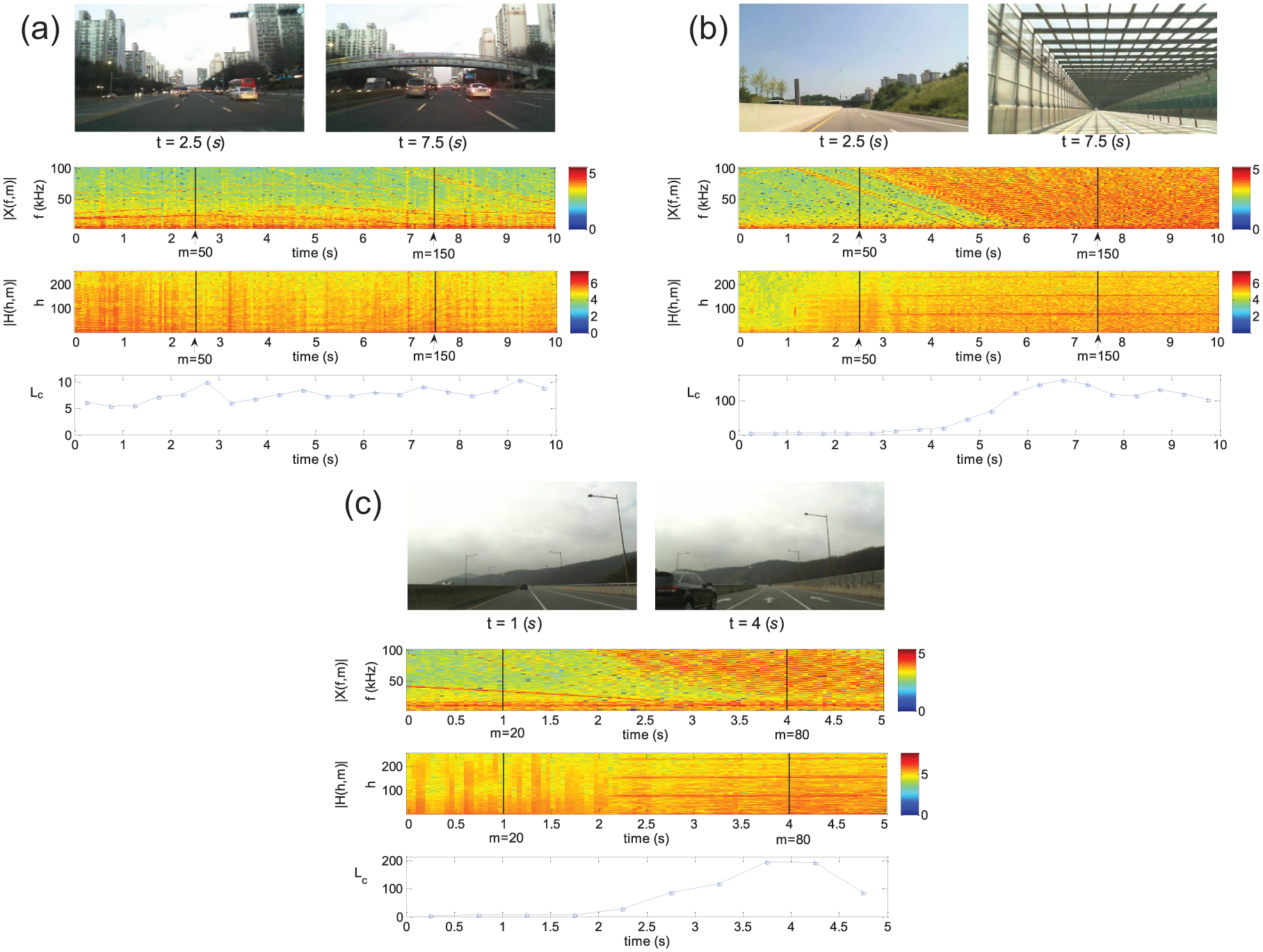
Analysis of the level of harmonic clutters under various road conditions: (a) normal road, (b) iron tunnel, and (c) guardrail.
Clutter suppression
In this section, we propose an efficient clutter suppression method, and we evaluate the performance of the proposed method using real data acquired from the radar.
Proposed clutter suppression method
The conventional iron-tunnel recognition method has a limitation in terms of its ability to improve the detection performance of the radar because it controls only the parameters for signal processing, such as the threshold for extraction of target peaks or parameters of tracking algorithm. Furthermore, it does not deal with the clutter signals. In this case, there is an increased probability of occurring false alarm. Thus, it can increase the signal processing required after frequency peak extraction, including the tracking algorithm to prevent false alarm.
To reduce this risk, we propose a new approach to suppress harmonic clutters maintaining signals from targets. If harmonic clutters can be recognized using the proposed method, we can reduce clutters by suppressing the peak components of the magnitude response from the DFT
If the presence of clutters is recognized from the recognition method, we calculate the average value of the magnitude of reference cells which are included in a window under the test around each peak from the CA-CFAR algorithm, with the exception of guard cells. Then, we set the magnitude value of guard cells, including the peak cell, as the average of the reference cells maintaining the phase of each cell as follows

where
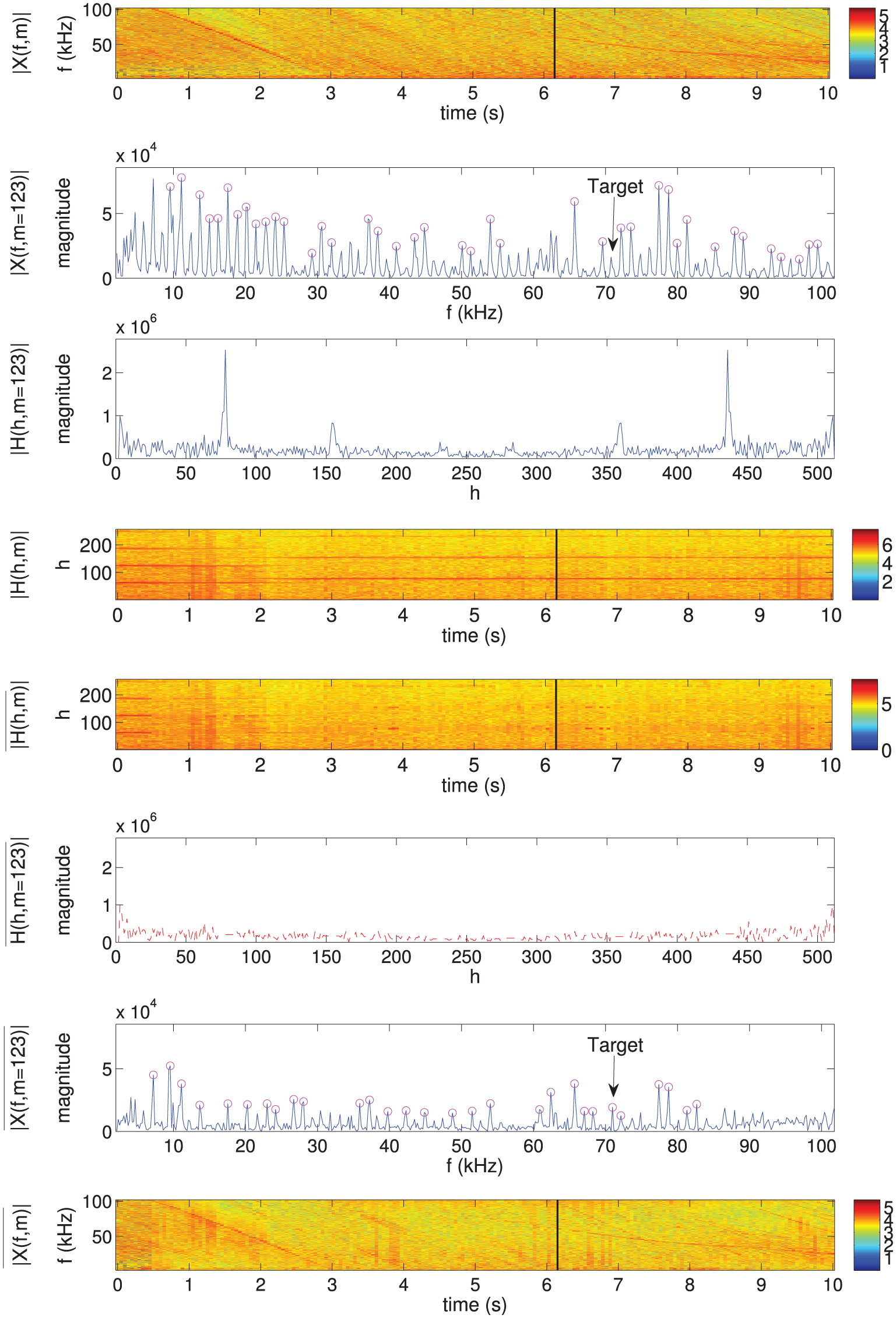
An example of clutter suppression results in an iron tunnel.
Verification using real data
To verify that harmonic clutters can be recognized and suppressed using the proposed method, we tested the proposed method using acquired data in various road environments that contain harmonic clutters. Table 1 summarizes the types of harmonic clutters for which we conducted experiments, the dates of the experiment, the latitudinal and longitudinal coordinates of the clutters, the entry time and exit time, the average level of clutters in dB scale where there are harmonic clutters without and with clutter suppression, and the clutter suppression ratio (CSR) by calculating the difference of average level of clutters according to suppression as

where
Profile of various harmonic clutters and the level of harmonic clutters.

CSR: clutter suppression ratio; IT: iron tunnel; GR: guardrail; SP: soundproof.
We confirmed that there are significant differences between the average values of the level of harmonic clutters,

Results of harmonic clutter suppression: (a) case A (CSR = 77.4%), (b) case D (CSR = 77.5%), and (c) case G (CSR = 77.5%).
Figure 4(b) shows the location around the entry point of an IT. Similarly, we observe horizontal lines in the second figure and a high
Figure 4(c) shows a similar tendency as Figure 4(b) around a GR on the curved road. The intensity at high frequency is stronger than low frequency because the reflected signals from close GRs laid on the edge of roads are weak. However, reflected signals from long distances can be strong enough to disrupt the signals from a target in front of the own vehicle. Moreover, the probabilities of those effects can be increased on curved roads because reflections are higher than on the straight roads. The results obtained for harmonic clutter suppression are similar to those of previous cases.
Experimental results
To determine the usefulness of the proposed harmonic clutter suppression method for ACC, we performed an experiment without the proposed method, and we gathered raw data from the radar. The bandwidth
Figure 5 shows the detection results with and without application of the harmonic clutter suppression method during the detection of the forward target vehicle inside the IT. Figure 5(a) show the spectrum comparison at the instance of time just before the target vehicle is detected by the radar of the own vehicle, and this is represented as the horizontal dashed line in Figure 5(c). The first spectrum represents the original spectrum obtained in the field experiment. There are many high-intensity harmonic clutters, so the target vehicle cannot be extracted because of the high clutter level. We confirmed that the spectrum after harmonic clutter suppression contains fewer clutter signals, whereas remaining information of targets. The frequency peak of the vehicle in front of the own vehicle can be obtained using the conventional CFAR algorithm.

Comparison of detection results (early detection): (a) spectrum comparison, (b) comparison of spectrograms and harmonograms, and (c) trajectory comparison of detection results.
Figure 5(b) shows spectrograms and harmonograms without and with the proposed method, respectively. The spectrogram and harmonogram without clutter suppression contain many clutter signals. However, we can confirm that horizontal lines by harmonic peaks are removed in the harmonogram, and diagonal lines with high intensity in the spectrogram are eliminated when we apply the proposed method.
Figure 5(c) shows the trajectory of the detected target vehicle along the distance axis. We can confirm that when harmonic clutters are suppressed using the proposed method, the target vehicle can be detected at an earlier time. The initial detection time is a critical factor in determining the performance of the ACC. The speed of the own vehicle was 170.6 km/h because of the continuous acceleration until the detection of the target vehicle in front of it, and the distance between the target vehicle and the own vehicle was 104.1 m when the target vehicle was initially detected. The driver in the own vehicle had to make a sudden deceleration to avoid a collision. However, the distance between the target vehicle and the own vehicle was 169.85 m after harmonic clutter suppression. In this case, there is no need to make an abrupt deceleration, and there was sufficient time to comfortably control the own vehicle.
Conclusion
In this article, we proposed new approaches for the detection and suppression of harmonic clutters on roads using an automotive radar. We performed spectral and harmonic analyses of the radar signal received in various road conditions using a conventional spectrogram and suggested harmonogram. We then obtained the features under harmonic clutters using those analysis results. We proposed a level of harmonic clutters using the PAPR concept with a harmonogram to measure the characteristics of harmonic clutters quantitatively. We also proposed the suppression method of harmonic clutters by reducing the level of clutters of the spectrum. We performed experiments to verify that the proposed level of the clutter-based method is very useful for recognizing and suppressing harmonic clutters. In addition, the proposed harmonic clutter recognition and suppression method improved the performance and robustness of an ACC system where there were severe harmonic clutters which reduced detection performance of the radar. Although we performed the proposed method using several sets of real data acquired from public roads, more field tests may be needed to enable a statistical analysis of the proposed methods.
Footnotes
Academic Editor: Kye-Shin Lee
Declaration of conflicting interests
The author(s) declared no potential conflicts of interest with respect to the research, authorship, and/or publication of this article.
Funding
The author(s) disclosed receipt of the following financial support for the research, authorship, and/or publication of this article: This work was supported by the Technology Innovation Program (or Industrial Strategic technology development program, no. 10051134, Middle range radar (150 m) development for Euro NCAP AEB) funded By the Ministry of Trade, Industry and Energy (MI, Korea).