




Abstract
Virtual network embedding has received a lot of attention from researchers. In this problem, it needs to map a sequence of virtual networks onto the physical network. Generally, the virtual networks have topology, node, and link constraints. Prior studies mainly focus on designing a solution to maximize the revenue by accepting more virtual networks while ignoring the energy cost for the physical network. In this article, to bridge this gap, we design a heuristic energy-aware virtual network embedding algorithm called EA-VNE-C, to coordinate the dynamic electricity price and energy consumption to further optimize the energy cost. Extensive simulations demonstrate that this algorithm significantly reduces the energy cost by up to 14% over the state-of-the-art algorithm while maintaining similar revenue.
Introduction
Network virtualization supports multiple virtual networks (VNs) to exist on one physical network (PN). It provides “Network as a service.” Each VN may have different topologies and different numbers of nodes and links, for deploying different applications. How to embed such VNs onto the PN while satisfying the topology, node, and link constraint is termed as VN embedding problem. This problem has been proved to be non-deterministic polynomial-time hard (NP-hard). 1
Since the VN embedding problem is one of the most significant challenges, it has been widely studied. However, most of these studies1–3 are devoted to designing efficient approaches with the goal of embedding more VNs and generating more revenues with little attention to the energy-related cost generated by the PN. In fact, energy-related cost is becoming more and more important, which is about 50% of the operating cost. 4 For example, in the United States, Akamai, one of the world’s leading providers of content delivery networking services, has an annual electricity cost of about US$10 million. 5 In China, China Mobile Communications Corporation, the largest mobile service provider in the world, consumed over 13 TWH power consumption in 2011. 6 To conserve more energy in VN embedding, we have studied energy-aware VN embedding problem in previous studies.7–9 In such studies, we observe that the electricity price varies a lot for different locations and it also exhibits great time diversity for just a location. Thus, we proposed to leverage such diversities to save energy in VN embedding. However, it still awaits to be further optimized because it first selects the physical domain with the lowest price and then performs the intra-domain VN embedding. That means, it does not coordinate these two factors together, that is, the power and electricity price. Selecting the physical domain with lowest price may cause the problem of high energy consumption and thus suffers from high energy costs. In this article, we propose to coordinate the power and electricity price together to further optimize the energy cost. Specifically, we first use the topology of the VN to generate a weighted similarity graph for capturing the similarity between each two virtual nodes. We then employ local clustering technique to cluster the virtual nodes. We next perform the VN embedding based on such clusters. Through extensive simulations, we show that our algorithm can significantly reduce energy consumption by up to 14% over the state-of-the-art algorithm.
The key contributions of this article are listed as follows:
To the best of our knowledge, this is the first attempt to coordinate the electricity price and power consumption to save energy cost in VN embedding problem.
To address this problem, we proposed a clustering-based coordinated VN embedding approach to further optimize the energy cost.
We conducted extensive simulations for evaluating our algorithm. We show that our algorithm reduces energy consumption by up to 14% over the existing migration-oblivious algorithm.
Modeling and formulation
In this section, we define the network model and the electricity price model first. We then specify how to calculate the electricity cost in terms of a given mapping solution. In the end, we give the performance metrics.
Network model
A PN consists of a set of physical domains and a set of backbone links connecting between them. So, we use
For a domain, there are two properties: location and electricity price. The electricity price we used is from the real-world power market. In our model, we denote
A physical node can be denoted as
We use
In this way, we can use
The notations used are given in Table 1.
Notations.

Power cost modeling
To calculate the power consumption of the VN embedding, we classify the power consumption into three categories: node power cost, link power cost, and switching power cost.
Node power cost
For embedding a VN, there are two kinds of roles for each node involved: hosting node and forwarding node. Hosting nodes are responsible for providing the CPU capacity and doing computation as required, and forwarding nodes are used to forward the traffic between hosting nodes if two of the hosting nodes are not connected directly.
As we can see in previous studies, the power consumption of normal server is a linear growth with the utilization of CPU. 10
So, we use the following equation to evaluate the power consumption of an active node

where

Let

Link power cost
We consider both long physical links, which span over a large geographical region and therefore require repeaters that consume power, and short physical links that span a small geographical region and require no repeaters. We use

We set

where
Switching power cost
Powering up a server incurs one-time energy consumption for transiting from the power-saving state into the active state, which is called the switching cost. We use

Performance metrics
Revenue
We define the long-term average revenue for mapping VN requests as follows

where
Energy cost
Based on equations (3), (4), and (6), for embedding a VN, the energy cost can be calculated as

To calculate energy cost in the long run, we define the long-term average energy cost as follows

where
Proposed solution
Motivation
Electricity cost is a large overhead in VN embedding, and thus there are a handful of studies focusing on energy-aware approaches to cut down the cost. However, they have not coordinated both electricity price and energy consumption into consideration. Some of them only consider the energy consumption,7,12 which will lead to a huge cost of electricity. Some of them only consider the electricity price, 9 which will lead to high energy consumption. To achieve the goal of minimizing energy cost, the ideal algorithm should take the following factors into account: (1) mapping virtual nodes into the physical domain with lower electricity price, (2) consolidating virtual nodes into less number of physical nodes for energy saving, and (3) shortening the length of inter-domain physical links for energy saving. In order to achieve the goals above, we design an efficient algorithm called EA-VNE-C, to coordinate the electricity price and energy consumption together. Specifically, we first use the topology of the VN to generate a weighted similarity graph for capturing the similarity between each two virtual nodes. We then employ local clustering technique to cluster the virtual nodes and next perform the VN embedding based on such clusters.
Evaluating clustering coefficient
Before we get started, we define the cluster as a group of virtual nodes in which virtual nodes can be mapped into the same physical domain. We use
For each cluster
For each pair of clusters
Unlike the classical local clustering schemes in social network, we evaluate the affinity as the clustering coefficient to measure the degree to which virtual nodes in a graph tend to cluster together. And we denote
We use
So, we have


where

and

Here,
Clustering
Our algorithm is based on a local clustering scheme, aiming to group virtual nodes into clusters and mapping each cluster into the best physical domain.
Our algorithm aims to coordinate the following aspects at the same time: (1) how much is the electricity price of a physical domain during the request, (2) how many physical domains could each pair of virtual nodes both mapped into, and (3) how much bandwidth does each pair of virtual nodes need. In this way, we can map virtual nodes into less physical domains with the lowest electricity price.
In this step, we apply local clustering technique to virtual nodes to group them into clusters. The input of this algorithm is the VN graph, and the output is the set of clusters. First, we produce a set of clusters and make it empty set initially. Second, we make each virtual node as a cluster and add this cluster to the result set. Third, we calculate the affinity between each pair of clusters and find the pair with the maximum affinity. If the maximum affinity is 0, that is, there is no pair of clusters which could be joined together, we end up the algorithm. Otherwise, we join the pair of clusters of the maximum affinity into one cluster. And then, we repeat this step until the maximum affinity meets 0. Finally, we return the set of remaining clusters.
VN embedding
In the second step, we apply energy-aware VN node and link embedding strategies in our previous studies.8,9 The core idea of the VN node mapping strategy lies in that we use the best-fit scheme to consolidate the virtual nodes to the minimum number of substrate nodes while meeting the CPU requirements of these virtual nodes. Specifically, (1) we first use
The core idea of the VN link mapping strategy lies in that we consider the power state of physical nodes and design active-preferred shortest algorithm. It means that, we calculate several shortest paths for each pair of corresponding physical nodes and select the physical path with maximum number of active physical nodes.
Time complexity
In Algorithm 1, for a given VN of size


Performance evaluation
Experimental setup
Like most previous works, we generate the PN and VN graphs by Georgia Tech Internetwork Topology Models. We use the similar configuration to the one in previous papers.
9
The PN used consists of five domains which are located in a
We set
We implement the algorithms in C++ and perform them side-by-side on Ubuntu 14.04 with 2.6 GHz CPU and 8 GB RAM.
In the first step, we compare our algorithm (denoted as EA-VNE-C) with the one (EA-VNE) that maps every virtual node into its corresponding lowest priced domain. We track down the long-term revenue, long-term electricity cost, active nodes’ count, mapping success rate, and running time for each 4000 time unit. In the second step, we compare between the above two algorithms on the variations of regular-sized VN. We evaluate the same performance as described in the first step under different request arrival densities and request duration densities. To facilitate such comparisons, we multiply 0.25, 0.5, 2, and 4 to request arrival time and duration, respectively. We use the result at the time point of 40,000 time unit for these comparisons. In the third step, we compare the performance of our algorithm with different bias factors, that is,
Evaluation results
Comparison with EA-VNE under various VN scales
We first compare our algorithm to the state-of-the-art algorithm under different VN scales. We report the comparison results in Figures 1–3. We also summarize the results in Figure 4. The results show that, compared to EA-VNE, the long-term revenue–cost ratios (long-term revenue divided by long-term cost) of EA-VNE-C increase by
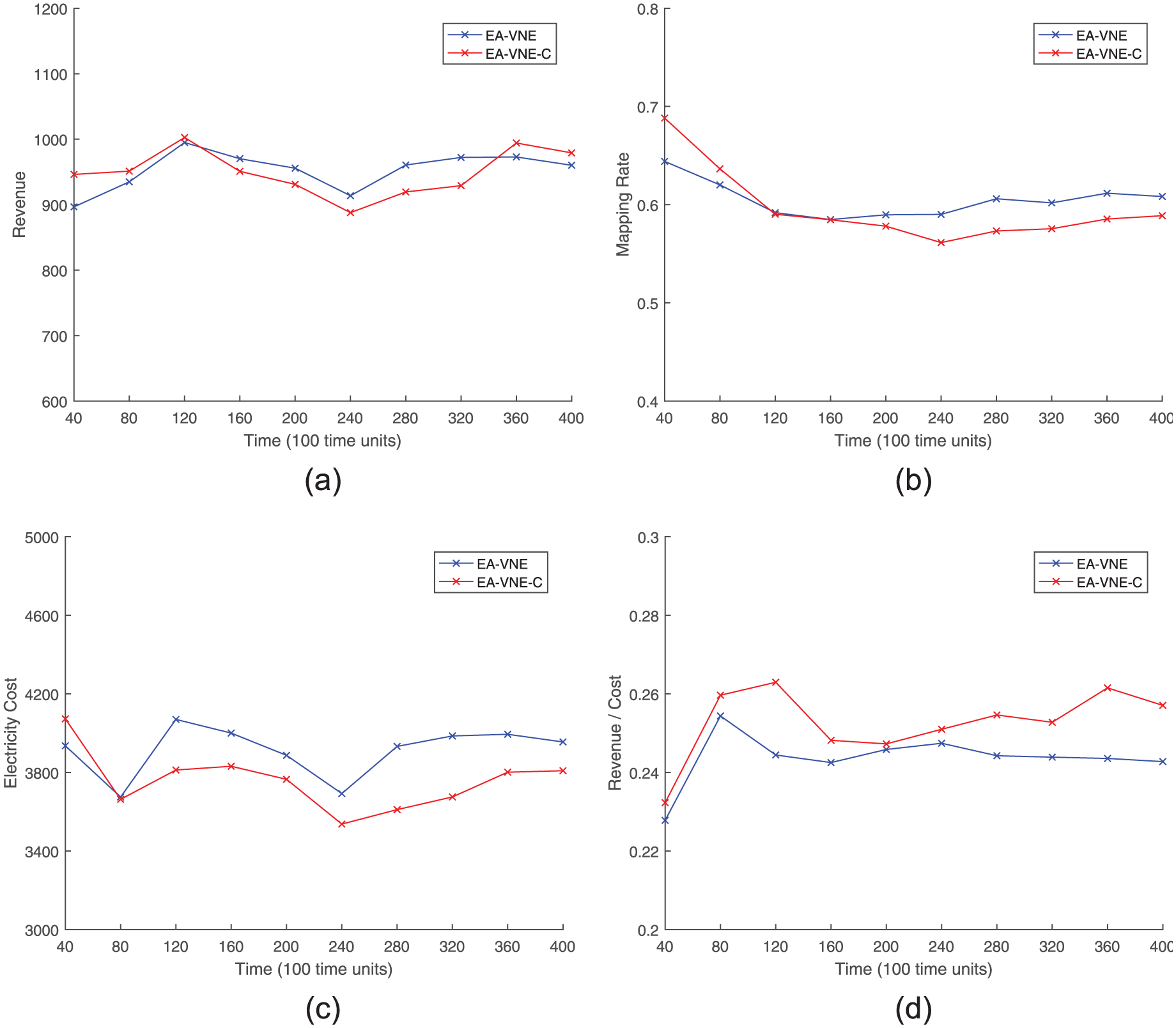
Comparisons between our algorithm and the state-of-the-art algorithm (small-sized VNs): (a) revenue, (b) mapping ratio, (c) energy cost, and (d) revenue/cost (RC) ratio.
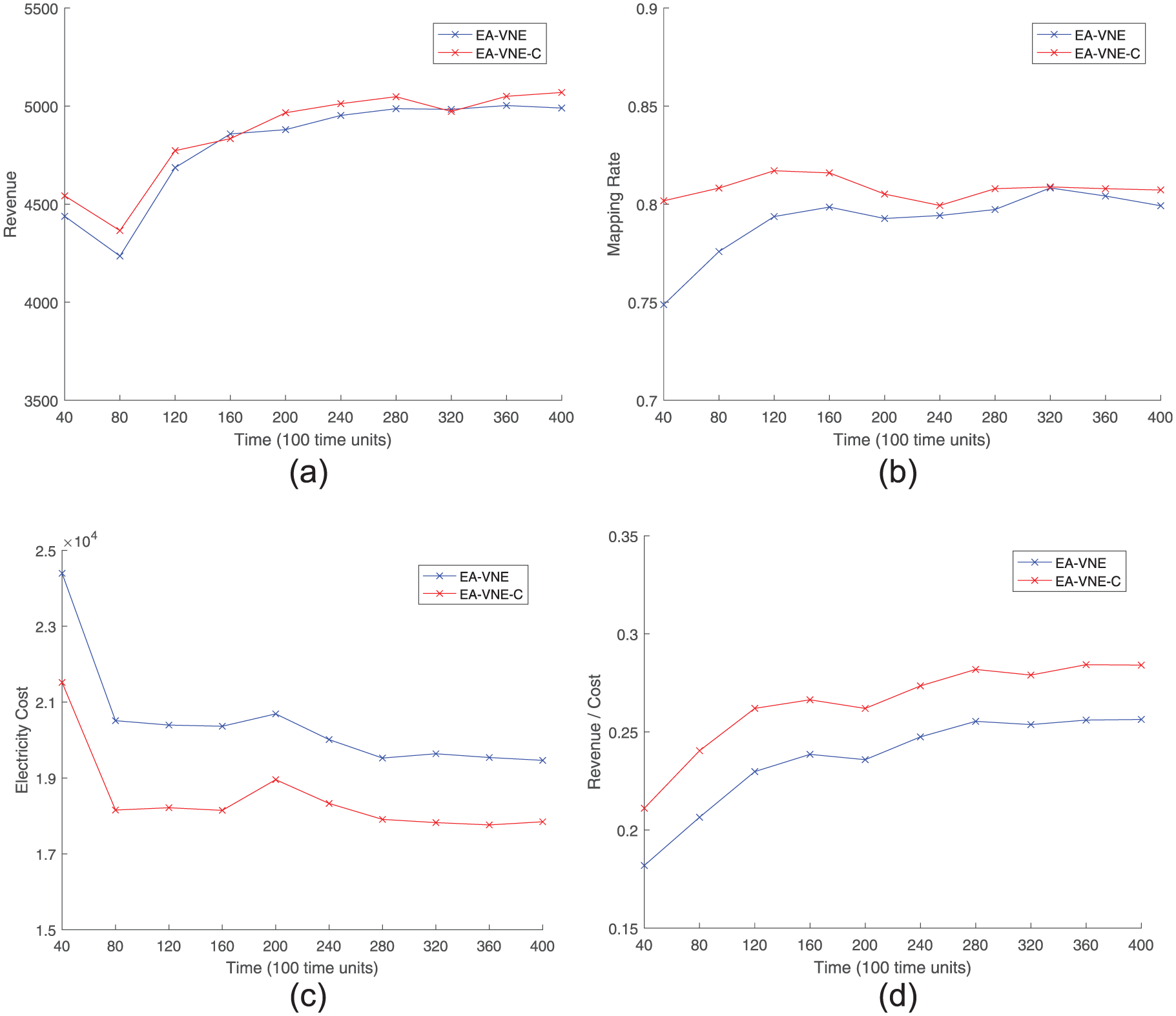
Comparisons between our algorithm and the state-of-the-art algorithm (regular-sized VNs): (a) revenue, (b) mapping ratio, (c) energy cost, and (d) revenue/cost (RC) ratio.

Comparisons between our algorithm and the state-of-the-art algorithm (large-sized VNs): (a) revenue, (b) mapping ratio, (c) energy cost, and (d) revenue/cost (RC) ratio.

Comparisons between our algorithm and the state-of-the-art algorithm (different scales): (a) revenue, (b) mapping ratio, (c) energy cost, and (d) revenue/cost (RC) ratio.
On one hand, EA-VNE-C has the same mapping success rate as EA-VNE or even slightly better in some cases, which leads to a tie on the aspect of the long-term revenue. On the other hand, EA-VNE-C successfully cuts down the electricity cost on all VN scales. And as we can see, EA-VNE-C has a better long-term revenue–cost ratio. Thus, EA-VNE-C is more profitable on the same cost of electricity.
The reason that EA-VNE-C gets more long-term profit than EA-VNE is obvious. EA-VNE always chooses the domain with the lowest electricity price to map, while EA-VNE-C considers both the electricity price and the topology of VN. In this way, EA-VNE-C can manage to cut down the electricity price by mapping to lowest priced domain, and it also minimizes the electricity energy by clustering virtual nodes together.
Regarding running time comparison, as shown in Figure 5, EA-VNE-C finishes all computation in a slightly more time than EA-VNE. The reason is that it produces a better domain selection by clustering (Algorithm 1), which is helpful to find out the best node–link mapping solution in the fastest way (Algorithm 2).

Time comparisons between our algorithm and the state-of-the-art algorithm (different scales).
However, on the small scaling network, virtual nodes are very sparse. Clustering before node mapping, in a way, could lead to the same result as direct selection by electricity price sometimes. Thereby, EA-VNE-C is not much better than EA-VNE in this case.
Impact of request density
We next evaluate the impact of the request density on the performance on our algorithm. We multiply 0.25, 0.5, 2, and 4 for the arrival time and duration of VN requests, respectively. We also use the result at the time point of 40,000 time unit for these comparisons. We report the comparison results in Figures 6 and 7. As the request gets denser, the mapping success rate for both EA-VNE and EA-VNE-C drops (as shown in Figures 6(b) and 7(b)), while the long-term revenue and long-term electricity cost rise (as shown in Figures 6(a), 6(c), 7(a), and 7(c)). Compared to EA-VNE, EA-VNE-C has a better mapping success rate and gets more long-term revenue while getting a little more on electricity cost. After all, EA-VNE-C improves the average long-term revenue–cost ratio by
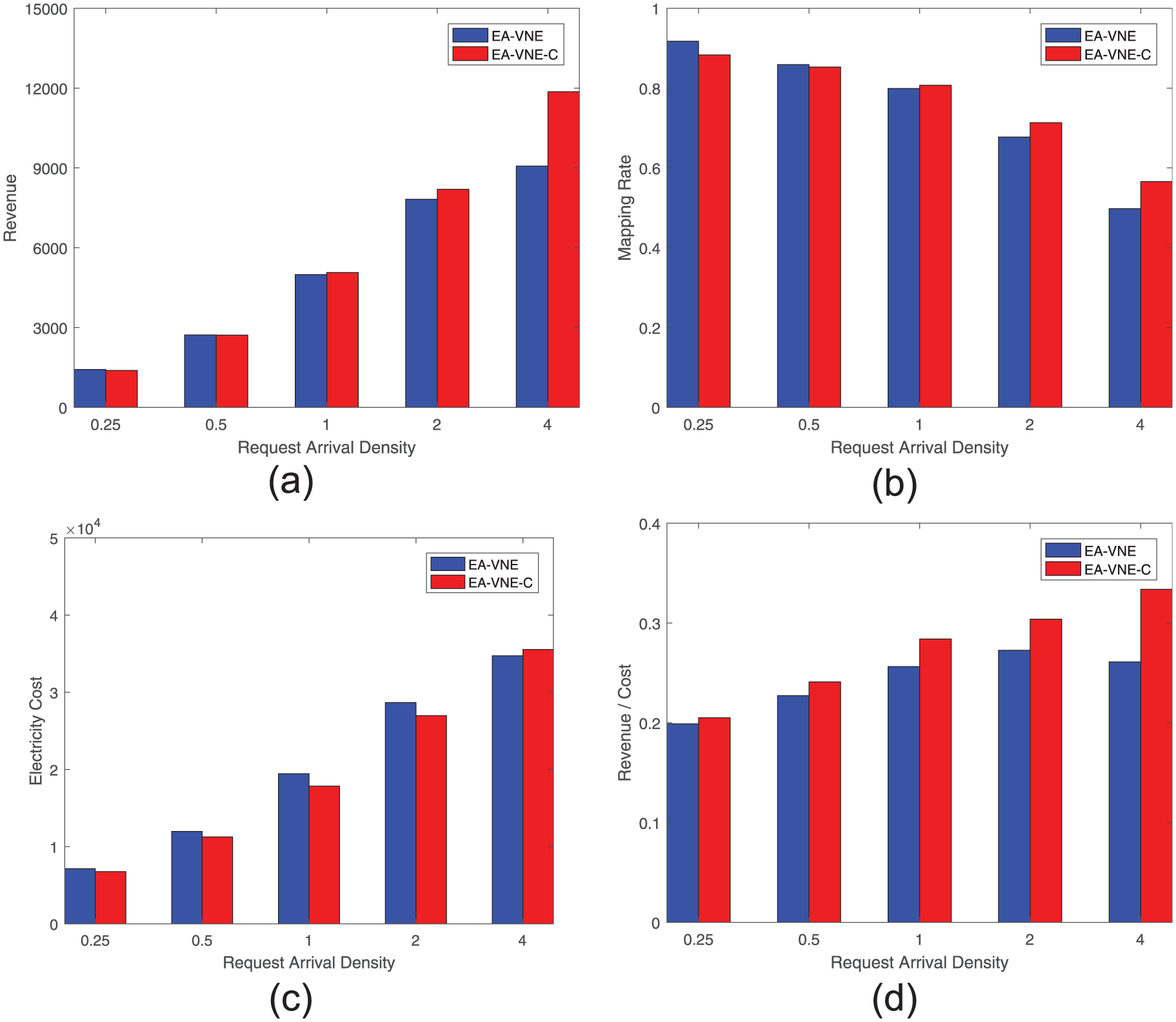
Comparisons between our algorithm and the state-of-the-art algorithm (different arrival density): (a) revenue, (b) mapping ratio, (c) energy cost, and (d) revenue/cost (RC) ratio.

Comparisons between our algorithm and the state-of-the-art algorithm (different duration density): (a) revenue, (b) mapping ratio, (c) energy cost, and (d) revenue/cost (RC) ratio.
Impact of bias factor
We next evaluate the impact of the parameter

Comparisons between our algorithm and the state-of-the-art algorithm (different alpha values): (a) revenue, (b) mapping ratio, (c) energy cost, and (d) revenue/cost (RC) ratio.
In this case, we can find that the best
Recall that
Related work
Since Yu et al. 1 propose the VN embedding framework formally, it has attracted increasing number of researchers’ attentions. There are two lines for addressing this problem: one is revenue-aware VN embedding and the other one is energy-aware VN embedding.
Revenue-aware VN embedding
Yu et al. 1 propose to leverage the path splitting and migration technique to increase the acceptance ratio of embedding a VN. Chowdhury et al. 2 formulate this problem to be a mixed integer programming model and employ the relax and rounding technique to solve this model. Zhang et al. 3 present an opportunistic resource sharing–based mapping framework and propose two first-fit-based algorithms to maximize the utilization of the PN for VNs with dynamic demands. Some other techniques have also been applied in this branches, such as subgraph isomorphism algorithm 14 and ant colony metaheuristic algorithm. 15 Our work differs from these existing studies in the following way: we try to address the energy-cost-aware VN embedding problem, which can save energy cost and increase the net profit for the infrastructure provider.
Energy-aware VN embedding
To save energy consumption for carrying out VN embedding, Su and colleagues7–9 propose the corresponding solution. Its core idea is that it leverages the location and time-varing diversities of electricity price to save the energy cost for multi-domain VN embedding. Our article proposes to further optimize the cost by coordinating electricity price and power consumption.
Recently, Zhang et al. 12 propose to save energy for VNs with dynamic demands. They first model the dynamics of VN demands as a combination of a Gaussian distribution. They then leverage this model and propose two efficient algorithms to minimize the energy consumption while keeping a high revenue for the PN. One algorithm processes the VN requests one by one, while the other one processes them group by group. We will also consider this factor to extend this article in the future.
Virtualized systems
There are also some other virtualized platforms16,17 to achieve high performance for the system. The authors can read the surveys18,19 of network virtualization and VN embedding for further reference.
Security and privacy issues
Besides the VN embedding allocation problem in cloud computing, there are also some hot topics, for example, security issues20–30 and privacy issues31,32 in cloud computing, which have attracted a lot of attention. Due to the page limits, we do not introduce them one by one.
Conclusion
In this article, we take a further step and coordinate the dynamic electricity price and energy consumption to optimize the energy cost. We first use the topology of the VN to generate a weighted graph for capturing the affinity between each two virtual nodes on the aspects of the electricity price and topology. We then employ local clustering algorithm to cluster the virtual nodes based on the affinity graph and finally perform the VN embedding based on such clusters. Through extensive simulations, we demonstrate that our algorithm saves up to 14% energy cost for the PN than the existing algorithm while obtaining attractive revenues.
Footnotes
Academic Editor: Hyungshin Kim
Declaration of conflicting interests
The author(s) declared no potential conflicts of interest with respect to the research, authorship, and/or publication of this article.
Funding
The author(s) disclosed receipt of the following financial support for the research, authorship, and/or publication of this article: This work was supported in part by the following funding agencies of China: National Natural Science Foundation under grants 61602050, 61170274, and U1534201.