




Abstract
Directional sensor networks have a lot of practical applications, and target coverage is one of the most important issues. In this article, we study the target coverage problem in directional sensor network, where directional sensors can rotate freely around their centers and targets are attached with differentiated coverage quality requirements. Our goal is to maximize the lifetime of sensor network, satisfying the coverage quality requirements of all targets. We model it as the maximum cover sets problem and address it by organizing the directions of sensors into a group of non-disjoint cover sets, which can cover all targets, satisfying their coverage quality requirements, and then schedule them alternately to extend the network lifetime. It consists of two parts. First, since directional sensor has infinite directions by rotating continuously, we propose sensing direction partition algorithm to find all non-redundancy directions for each sensor according to the targets deployed within the sensing region of the sensor. Then, based on the result of the sensing direction partition algorithm, we propose an efficient heuristic algorithm for the maximum cover sets problem to organize the directions of sensors into a number of non-disjoint cover sets and allocate work time for each cover set. Besides, we get an upper bound of the optimal solution for the problem. Finally, simulation results are presented to demonstrate the performance of our algorithm.
Introduction
Wireless sensor network is a multi-hop ad-hoc network, consisting of sensor nodes with low cost and stringent power budget through wireless communication, which is capable of monitoring physical phenomenon in real time, collecting, transmitting, and processing information in the fields of sensors. Wireless sensor network has powerful function and extensive application. 1 How to assign monitoring tasks to sensor nodes to make them effectively accomplished and how to reflect how well a sensor field is monitored are the fundamental problems in wireless sensor network, which are considered as coverage problems. In general, coverage problems can be classified into four categories: area coverage,2–9 target coverage,10–22 barrier coverage,23–25 and coverage problem aiming at determining the maximal breach path (MBP) and the maximal support path (MSP). 26 In this article, we consider the target coverage problem.
In view of the surveillance nature and the energy constraint of sensor networks, it is very important to prolong the network lifetime for solving coverage problem. Among many proposed approaches, there are three basic types. The first one is density control by utilizing the inherent redundancy of densely deployed sensors,2–6 which uses the number of working sensors as less as possible to satisfy the coverage requirement and turns off redundant sensors. When the coverage requirement is not met due to sensor nodes’ failure, redundant sensors can be activated to replace fault nodes to ensure network normal operation, so that the network lifetime can be extended. The second one is node scheduling by organizing sensors into a number of subsets,9–15 in which each subset can satisfy the coverage requirement, and scheduling them alternately to prolong the network lifetime. The third one is energy control by adjusting the sensing and communication ranges of sensors to reduce energy consumption as much as possible.20–22 In this article, we consider the sensor scheduling.
Conventional sensor networks adopt omni-directional sensors. Actually, in view of low cost and energy conservation, directional sensors with limited angle of sensing range have great value of practical application, such as video sensors, ultrasonic sensors, and infrared sensors. Previous studies on coverage problem mainly focus on the fixed directional sensors that cannot turn their orientations to cover different sensing regions upon initial placement. In the researches,13–16 the sensors are sub-tunable, that is, each sensor has finite separate and fixed work directions by turning to specific orientations and one sensor can only choose one direction to work at any time. However, a high-demanding coverage in important, and complicated places (such as bank, traffic, intelligence building, airport, and station) needs high accuracy and flexibility; it is inefficient to use fixed directional sensors or sub-tunable sensors in practice. We consider that the sensors can rotate their orientations around centers freely, which is viable in most of commercial camera sensors, and as a consequence, the sensors with infinite work directions have chance of covering more targets.
In practical application, the importance of each target may be different and the coverage quality required by each target is related to its importance. For example, in a video monitoring system, some key sites (such as nuclear reactors, entrances, and exits) need to be covered by more sensors so as to guarantee the fault tolerance of the system. In addition, if the monitoring data of targets have a certain precise requirements, the targets also need to be covered by more sensors to improve the sampling frequency. Generally, the coverage quality that sensors can provide to targets is influenced by the distance between sensors and targets, and it decreases as the distance increases. We assume that the coverage quality obtained by one target from sensors is the sum of actual coverage quality provided by all sensors covering it.
In this article, we consider the target coverage problem in directional sensor network where sensors have infinite directions by rotating continuously and targets require different coverage quality requirements. We assume that the density of sensors is sufficiently high to monitor all targets. We aim at maximizing the lifetime of directional sensor network and satisfying the coverage quality requirements of all targets. Several difficulties make our issue challenging. First, unlike wireless sensor networks, target coverage in directional sensor networks is determined by both location and direction of sensors. This feature makes target coverage scheduling more complex. Second, every sensor can rotate its orientation around the center freely, so it has infinite work directions. However, it is impossible to check all feasible choices exhaustively. Moreover, individual targets may be associated with differentiated coverage quality requirements, and the coverage quality that sensors can provide to targets is also different. So, for some targets, only one sensor may not satisfy its coverage requirement, and it needs some sensors to work cooperatively in order to achieve the coverage goal.
Our method is to study the intrinsic relationship between the work directions of sensors and the targets deployed within sensing region of sensors, and we propose sensing direction partition (SDP) algorithm to find all non-redundant directions for each sensor. Then, we design heuristic algorithm for the maximum cover sets (HMCS) problem to divide the directions of sensors into non-disjoint cover sets such that every cover set completely covers all targets satisfying their coverage quality requirements and then allocate work time for each cover set. These cover sets are activated alternately, such that at any moment, only one cover set is active. All sensors are in sleep state except sensors having a direction from the active cover set.
The rest of this article is organized as follows. First, we briefly review related research. Second, we define the directional sensor network model and the maximum cover sets (MCS) problem. We get an upper bound of the optimal solution for the problem and then formulate the MCS problem as integer programming formulation. Based on the model, we propose SDP and HMCS algorithms to solve the problem we study and simulation results are presented to show the performance of our algorithm. Finally, we conclude this article.
Related works
Coverage, as a fundamental concept in wireless sensor networks, is a reflection of the quality of service (QoS) of sensing function. 26 In the study of coverage problem, target coverage is an important part where the goal is to cover discrete targets satisfying the coverage requirements of all targets and extend the network lifetime. Referring to literature, one of the effective methods is node scheduling by dividing sensors into disjoint or non-disjoint subsets to alternately activate them. Slijepcevic and Potkonjak, 9 Cardei and Du, 10 and Diop et al. 11 design centralized protocols by organizing sensors into disjoint subsets, where sensors are restricted to participate in only disjoint subsets, that is, a sensor can be active in not more than one subset. Theoretically, the upper bound of the number of disjoint subsets is the minimum number of sensors covering each target. Cardei et al. 12 study maximum set covers (MSC) problem and maximize the lifetime of network by organizing sensors into non-disjoint set covers, where each sensor can be part of more than one set covers. The set of solutions to the disjoint subsets problem is a subclass of the non-disjoint subsets problem, so it often produces better result by dividing sensors into non-disjoint subsets. In this article, we consider the case that sensors are divided into non-disjoint subsets to cover targets.
Recently, research on directional sensors has made great progress, and many strategies about target coverage have been proposed in directional sensor networks. Maximum coverage with minimum sensors (MCMS) problem is studied by Ai and Abouzeid, 16 which is designed to activate the minimal number of directional sensors to cover the maximal number of targets. Lu and Li 17 use the directional sensor model with tunable directions and study maximum directional sensor coverage (MDSC) problem by assigning directions to sensors to maximize the number of targets covered by sensors. Zhang et al. 18 focus on the fairness-based coverage maximization problem; they consider how to schedule the orientations of camera sensors to maximize the minimum accumulated full-view coverage time of target points. However, these studies consider the practical scenario where sensors initially deployed are not sufficient to provide full coverage (or full-view coverage 18 ). Different from them, in this article, we consider that sensors are abundant to cover all targets satisfying their coverage quality requirements. Li et al. 13 address target Q-coverage (TQC) problem under the constraint of bounded service delay in directional sensor networks aiming at maximizing the lifetime of network. However, this study considers the scenario where targets in each coverage set may not be served continuously but can be served with tolerant service delay. In this article, we focus on sensors monitoring all targets continuously as long as possible. Cai et al. 14 address multiple directional cover sets (MDCS) problem by organizing the directions of sensors into non-disjoint cover sets. But in their works, they consider that directional sensors have a finite set of separate and fixed work directions and that targets are considered with the same importance and the coverage quality requirements of targets are not considered.
Among those existing literature, Yang et al. 15 and Wang et al. 19 are particularly relevant to our work. Yang et al. 15 study the maximal network lifetime scheduling (MNLS) problem where the coverage quality requirements of targets are different. However, our problem differs from their problem in the following several ways. First, the directional sensors in our model could rotate freely, while the sensors in their model are sub-tunable, because in their setting, each directional sensor has finite separate and fixed work directions. As a consequence, the sensors in our model have chance to cover more targets. For instance, as shown in Figure 1, a sensor could cover three targets, not just two. Second, despite the directional sensors in our model may have infinite work directions by rotating continuously around their centers, we study the intrinsic relationship between the work directions of sensors and the targets deployed within the sensing region of the sensors, and eliminate the redundant directions (where two directions are redundant if they cover the same set of targets). So that each directional sensor can have finite non-redundant directions, which leads to significant dimension reduction. Third, in the problem of Yang et al., 15 for each sensor, the finite directions are independent, that is, the covered target sets of any two different directions are disjoint. In our problem, for one target, it is possible to be covered by two non-redundant directions, which makes our problem more difficult.

(a) The sensor has four fixed directions, and this sensor can cover two targets at most; (b) the sensor is freely tunable, and this sensor can cover three targets.
Sensors equipped with continuous rotation capacity are considered by Wang et al., 19 thus each sensor has infinite directions and sensing regions of different directions may overlap. Given the assumption that targets to be covered have the prescribed priorities, they strive to find the minimum number of directional sensors to monitor all targets satisfying their prescribed priorities. Different from them, we study the target coverage problem in directional sensor network aiming at maximizing the directional sensor network lifetime and satisfying the coverage quality requirements of targets at any instant.
Sensor network model and problem description
In this section, we present the directional sensor network model and the formulation of MCS. Beyond that, we get an upper bound of the optimal solution for the MCS problem and then formulate the MCS problem as integer programming formulation.
To facilitate understanding, we first list the notations adopted throughout this article:
Considering the distance between sensors and targets influences the coverage quality, without loss of generality, and we employ the functions as defined as follows
Model and problem
First, we describe the sensor network model and then give definitions of the problem we study.
We consider a directional sensor network with
For each sensor
According to the directional sensor network model, we attempt to solve the problem of how to schedule the work directions of sensors to maximize the lifetime of directional sensor network, satisfying the coverage quality requirements of all targets.
It is challenging to solve the problem. First, each camera sensor has infinite choices to decide their work directions by rotating continuously. It is impossible to check all feasible choices exhaustively. Furthermore, targets have different coverage quality requirements, and the coverage quality that sensors can provide to targets is also different. Sensors need to work cooperatively at the same time slot so that targets can be covered satisfying their coverage quality requirements.
In order to solve this problem, we should give reasonable and explicit definitions based on the directional sensor network model.
Given a directional sensor network with sensor set
Given a directional sensor network with sensor set
Upper bound of network lifetime
In this section, we present an upper bound of the optimal solution for the MCS problem.
Apparently, the maximum network lifetime is decided by the minimum lifetime of sensors. Since the work time and the number of directions of sensors are depended on the deployment of sensor network, which is random, we can consider the minimum time that each target is covered by sensors in the network.
For each target

Integer programming formulation for MCS problem
We assume that the possible number of directions of sensor
Given: sensor set
We define a Boolean variable

The optimization problem can be written as follows
Maximize

Subjected to


The objective function (2) maximizes the total network lifetime of
Algorithm for MCS problem
To solve the MCS, our method is to organize the directions of sensors into a group of non-disjoint cover sets and schedule them alternately to extend the network lifetime. It consists of two parts. First, we find all non-redundant directions for each sensor according to SDP. Then, based on the result of SDP, we propose an efficient heuristic algorithm (HMCS) to divide the directions of sensors into non-disjoint cover sets and allocate work time for each cover set.
SDP
Here, we propose SDP to find all non-redundant directions for each sensor according to the targets deployed within the sensing region of the sensor, where two directions are redundant if they cover the same set of targets. The details are shown in Algorithm 1.

Figure 2 shows an example of determining the directions of directional sensor. There are seven targets that can be covered by directional sensor
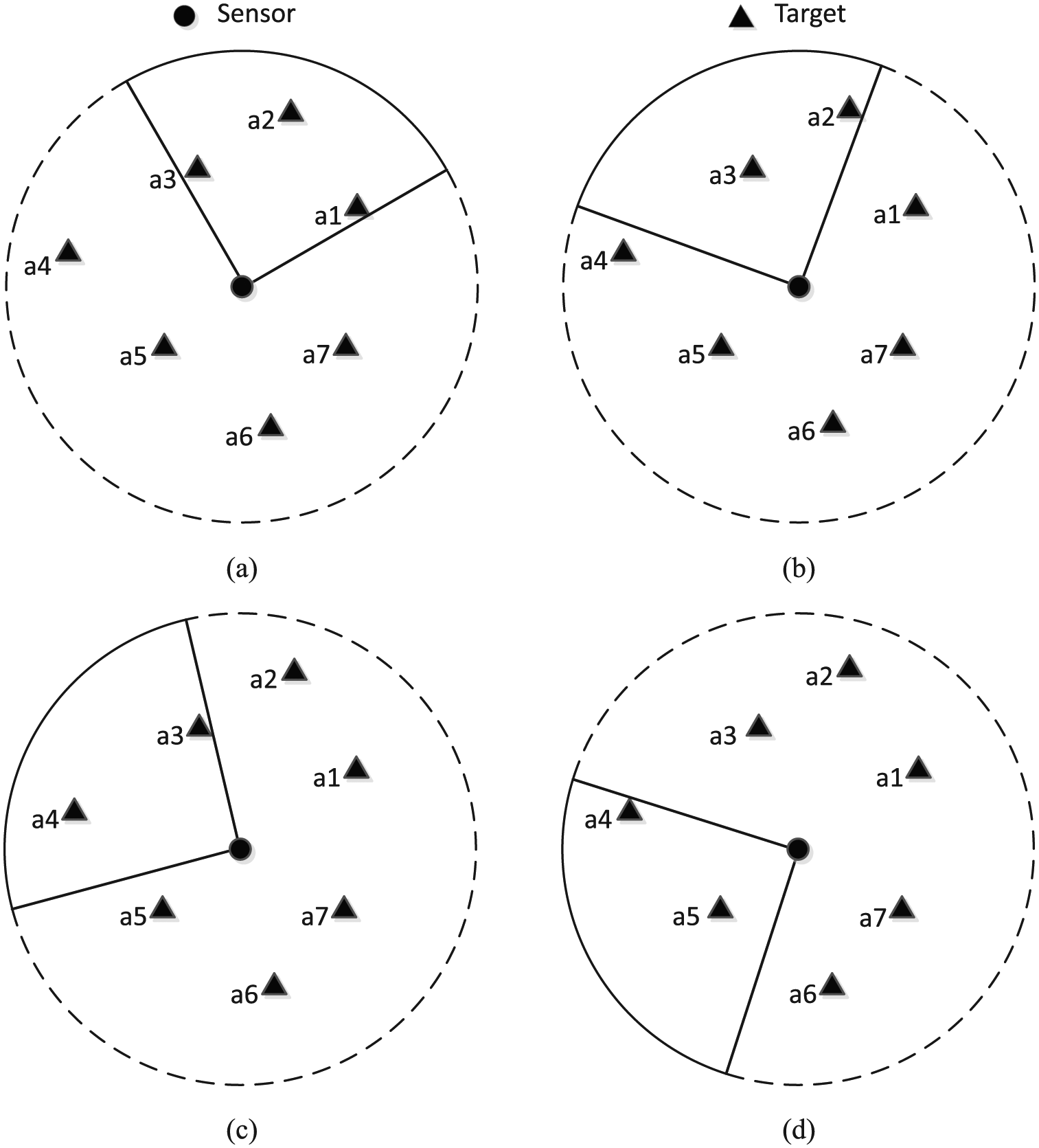
An example of determining the directions of directional sensor. (a) When s is in the first direction, it covers the set of targets
HMCS
In this section, we describe the HMCS. We define
The main idea of HMCS algorithm is to organize the directions of sensors into a number of non-disjoint cover sets and allocate work time for each cover set. When constructing cover sets, we keep on choosing the direction with the maximum available lifetime. If some directions have the same available lifetime, we give priority to the direction providing the greatest total actual coverage quality to targets. Then, we put the selected direction into

Now, we show an example of constructing cover sets and calculating the network lifetime. In Figure 3(a), there are three targets (
1. According to Algorithm 1, we get the direction set
We can obtain the coverage quality that every direction of sensors provide to every target from Figure 3(b):
Since
Based on
Every time, we select the direction with the maximum available lifetime. If some directions have the same available lifetime, we select the direction with the maximal value of total actual coverage quality. So, the direction
2. We get the direction set

An example of constructing cover sets and calculating the network lifetime. (a) There are three targets
Simulation results
In this section, we evaluate the performance of the heuristic algorithm HMCS through simulations. We first show the effect of network parameters (the number of sensors, the number of targets, sensing range, sensing angle, and coverage quality of targets) on the network lifetime and simultaneously compare our algorithm with the upper bound of the optimal solution for the MCS problem aforementioned. Then, we evaluate the performance of our algorithm by comparing with the heuristic algorithm in Yang et al. 15
All simulations are implemented via Visual Studio 2008 on Windows 7. We run 100 times through random placement of sensors and targets in each simulation and compute its average value.
Effect of network parameters
In our simulations, we deploy
Case 1. Number of sensors
In this section, we vary the number of sensors
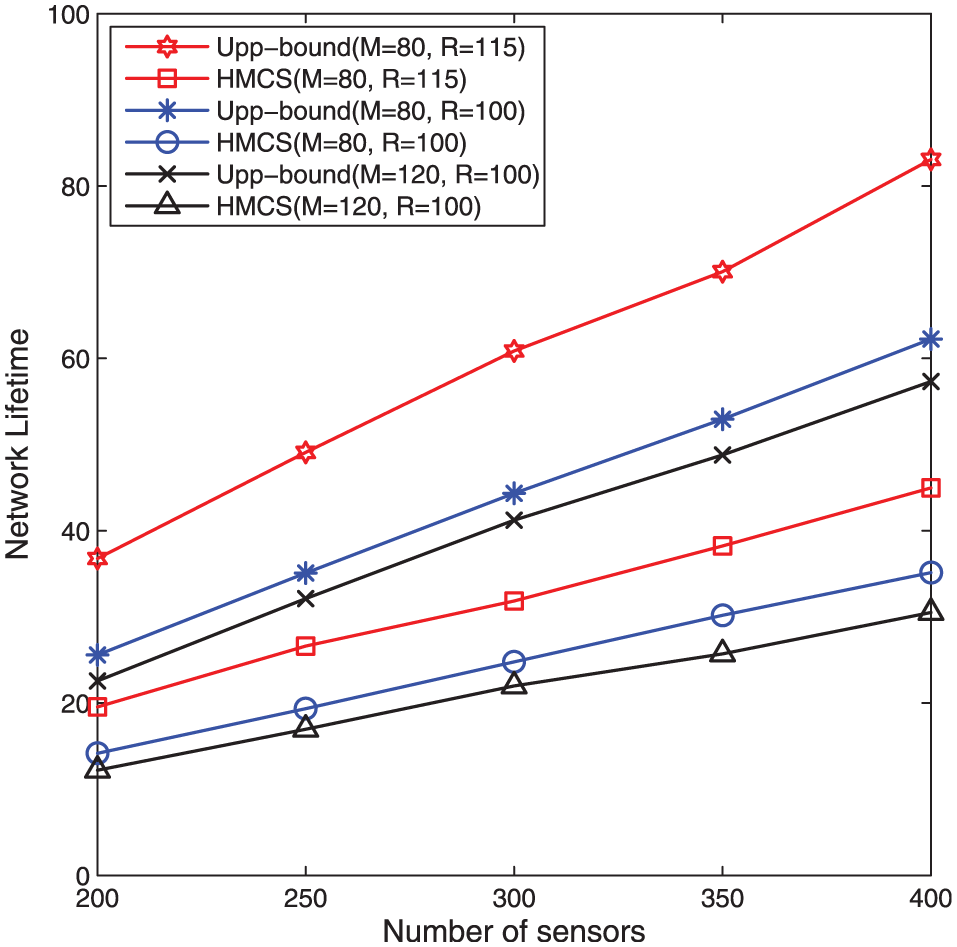
Network lifetime versus the number of sensors.
Case 2. Number of targets
In this section, we evaluate the impact of the number of targets

Network lifetime versus the number of targets.
Case 3. Sensing radius
In this section, we change the sensing radius

Network lifetime versus sensing radius.
Case 4. Sensing angle
In this section, we test the impact of the sensing angle

Network lifetime versus sensing angle.
Case 5. Coverage quality of targets
In this section, we change the coverage quality of targets and compare the network lifetime of HMCS algorithm and the upper bound in the following four cases:

Network lifetime versus coverage quality of targets.
Comparison with MNLS-H-T
Among those existing literature, Yang et al.
15
is the most relevant to our work. They employ the sub-tunable directional sensor model, that is, each sensor has finite separate and fixed work directions, to study the MNLS problem where the coverage quality requirements of targets are different. They design two heuristic algorithms named MNLS-H and MNLS-H-T, respectively, and their experimental results clearly demonstrate that the algorithm MNLS-H-T has better performance than MNLS-H. So, we evaluate our algorithm by comparing with MNLS-H-T. In the following simulations, we deploy randomly
We compare the network lifetime of our algorithm HMCS and the algorithm MNLS-H-T in the following four cases:
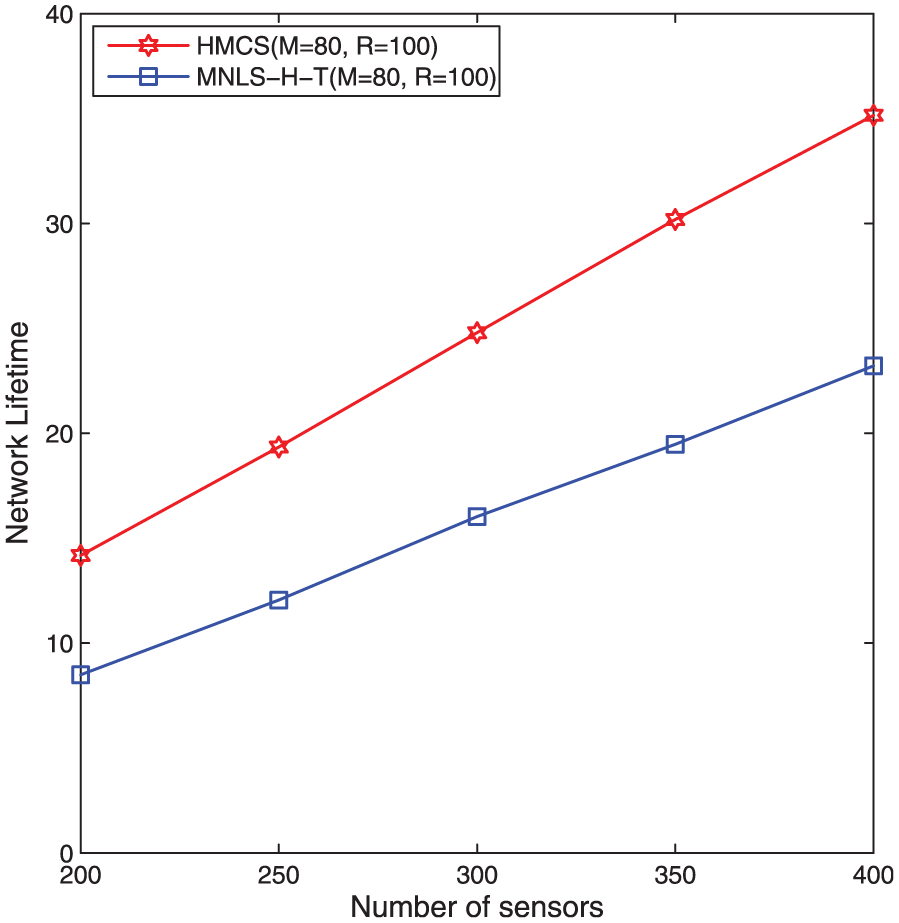
HMCS versus MNLS-H-T: network lifetime changing with the number of sensors.

HMCS versus MNLS-H-T: network lifetime changing with the number of targets.

HMCS versus MNLS-H-T: network lifetime changing with sensing radius.

HMCS versus MNLS-H-T: network lifetime changing with quality coverage of targets.
Conclusion
In this article, we investigated the target coverage problem in directional sensor network with the objective to maximize the network lifetime satisfying targets’ coverage quality requirements, where directional sensors can rotate freely around their centers and targets are associated with different coverage quality requirements. We studied the intrinsic relationship between the work directions of the sensors and the targets deployed within the sensing region of the sensors, and proposed the SDP algorithm to eliminate the redundant directions and found all non-redundant directions for each sensor, which leads to significant dimension reduction. Based on that, we proposed a heuristic algorithm HMCS to solve the target coverage problem. In simulations, we compared our algorithm with the upper bound of the optimal solution and the algorithm MNLS-H-T in Yang et al., 15 and evaluated the effect of several network parameters on the lifetime of sensor network. The simulation results showed the efficiency of our algorithm.
As a future work, we plan to consider the two-directional characteristic: the sensor nodes’ sensing and the communicating, and design distributed algorithms to prolong the lifetime of directional sensor network.
Footnotes
Academic Editor: Stefano Avallone
Declaration of conflicting interests
The author(s) declared no potential conflicts of interest with respect to the research, authorship, and/or publication of this article.
Funding
The author(s) disclosed receipt of the following financial support for the research, authorship, and/or publication of this article: This work was partly supported by the National Natural Science Foundation of China (grant no. 11671400) and the Research Funds of Central China Normal University (2016CXZZ159).