




Abstract
Due to the limited resource and vulnerability in wireless sensor networks, maximizing the network lifetime and improving network survivability have become the top priority problem in network topology optimization. This article presents a wireless sensor networks topology optimization model based on complex network theory and cyber-physical systems using software-defined wireless sensor network architecture. The multiple-factor-driven virtual force field and network division–oriented particle swarm algorithm are introduced into the deployment strategy of super-node for the implementation in wireless sensor networks topology initialization, which help to rationally allocate heterogeneous network resources and balance the energy consumption in wireless sensor networks. Furthermore, the preferential attachment scheme guided by corresponding priority of crucial sensors is added into scale-free structure for optimization in topology evolution process and for protection of vulnerable nodes in wireless sensor networks. Software-defined wireless sensor network–based functional architecture is adopted to optimize the network evolution rules and algorithm parameters using information cognition and flow-table configure mode. The theoretical analysis and experimental results demonstrate that the proposed wireless sensor networks topology optimization model possesses both the small-world effect and the scale-free property, which can contribute to extend the lifetime of wireless sensor networks with energy efficiency and improve the robustness of wireless sensor networks with structure invulnerability.
Keywords
Introduction
Wireless sensor networks (WSN) 1 is a major component in cyber-physical systems (CPS), 2 which showing powerful potentials in interfacing with the physical world and making its control much easier, achieved by the integrations of network, computation, and communication capabilities to the components of physical world. Interacted heterogeneous physical devices (e.g. sensor and actuator) are key physical elements in CPS.3,4 The heterogeneities reflect the diversity in capabilities, complexities, types, and mobility among sensors in CPS. It is crucial for CPS to support the ability of heterogeneity tolerance.
From the perspective of network functional architecture, most current traditional network topology optimization researches limited to non-software-defined network architecture are based on distributed algorithms, which result in the generation of a large quantity of network loads, reduction of life cycle, and lack of adaptability in the network evolution due to dynamic topology changes. Traditional network architecture does not support the dynamistic, scalability and heterogeneity in WSN cyber system and is lack of the feedback control functional component, which can efficiently exert impact on WSN physical system. Software-defined wireless networks (SDWNs) architecture5,6 presents an innovative framework for decoupling the original closed system, which can achieve novel feedback control in CPS with logical centralized control and physical distributed control to decouple control plane and data plane. The combination of SDWNs-based architecture and WSNs’ function, that is, software-defined wireless sensor network (SDWSN) based on programmable control of common hardware and software, enables flexible task configuration. Motivated by the advantages in SDWSN technology, we propose a SDWSN-based cyber-physical system framework (SD-CPSF) via introducing the software-defined network technology and actuator-based functional component into existing WSN infrastructure.
Based on SD-CPSF, the functionality, reliability, adaptability, compatibility, and autonomy can be efficiently improved in WSN. Sensors in WSN with limited energy supply always deploy in harsh environment to achieve the classical application of CPS. Consequently, sensors often suffer from fail due to natural hazards and energy resource depletion. The breakdown of some sensors can greatly damage the functionality of WSN. It is crucial for WSN to improve the ability of fault tolerance.
Network topology structure has intrinsic characteristics, which can impact on WSN’s performance. Therefore, build robust network topology to improve the survivability and energy efficiency of WSN is crucial.
Network robustness has become one of the most central topics in the complex network research. 7 Fault tolerance is well known as the typical scale-free network properties, 8 which can help to defend against random failure caused by energy depletion and environmental disturbances in CPS application. Complex network theories 9 provide new research ideas and methods to establish a reliable and energy-efficient network topology model by exploring the statistical properties inherited in networks.
Comprehensively considering the characteristic of node heterogeneity, resource scarcity, and structure vulnerability in WSN, we propose a novel WSNs topology optimization model according to scale-free complex network theory–based network evolution algorithm and SD-CPSF-based network functional architecture. We take the improvement of robustness of WSN as the design goal for WSN topology optimization, which help to prolong network lifetime and enhance the network invulnerability.
The contributions of our researches in the article mainly focuses on the improvement on adaptive ability, invulnerability, and energy efficiency on WSN, via introducing SDWN architecture and complex network theory (scale-free and small-world theory) based strategies in topology optimization and evolution mechanism.
The rest of the article is organized as follows. Section “Related work” states a summary of related work on network topology control. Section “System model and functional framework” elaborates the system model based on cognitive SDWSN prototype and its functional architecture. Section “Topology initialization based on super-nodes configuration” presents an implementation of topology initialization. In section “Topology evolution based on improved scale-free network model,” an optimal topology evolution model is proposed based on improved scale-free theory model and specific mathematical analysis on proposed evolution model is presented. Network structure characteristics are evaluated through experiments in comparison with BA model 10 in section “Experimental results and analysis.” Finally, conclusion is drawn in section “Conclusion.”
Related work
In the last decades, sufficient efforts have been devoted to design vulnerability-tolerant and energy-efficient topology construction mechanism in WSN. Wang et al. 11 adjusted the structure of scale-free network via optimizing the entropy distribution to enhance the anti-attack capability of scale-free network. However, the topology model did not take into account the problem of imbalanced energy consumption and finally reduced the network life cycle. In Sun et al., 12 the survivability was improved when building a WSNs topology by controlling network node’s saturation and residual energy. However, sensors with high load in networks were prematurely dead due to excessive energy consumption, and the network life cycle would be shortened. The research 13 was proposed to make the network tend to be more in sync by optimizing the network topology symmetry, which focused more on network model synchronization and lack of utilizing other statistical characteristics in WSNs revealed by the complex network theory. The literature 10 proposed a new topology of network evolutionary model based on BA scale-free network, which was with high robustness on random failures of node. However, clustering coefficient value keeps small while the average path length remains relatively large in proposed model, which lack of energy efficiency. In the literature study, 14 WSNs topology was optimized using conceptual cluster feature and edge betweenness in small-world model via introducing special threshold mechanism, so as to equip with a high clustering coefficient and obvious cluster structure after network optimization, but this work took little change on average path length.
Based on the complex networks theory, a new weighted local WSNs evolution model 15 was designed to deduce intensity distribution and weight distribution meeting the power-law; however, the dynamic changes in network topology were not considered. In research works, 11 the impact of the residual energy on network growth was considered in process of complex network models evolution, but the invulnerability in network model was not analyzed. Jian et al. 13 proposed two scale-free network models based on local world model, where the new sensors with high energy level had the priority to be connected, but the dynamic changes in network topology due to the expense of limited resource were not taken into account.
The above researches based on complex network theory focus on the topology control methods to homogeneous and tight coupling network architecture; however, none of those methods have been designed from the viewpoint of network heterogeneity and network functional architecture in CPS.
System model and functional framework
WSN is abstracted into a weighted directed graph,
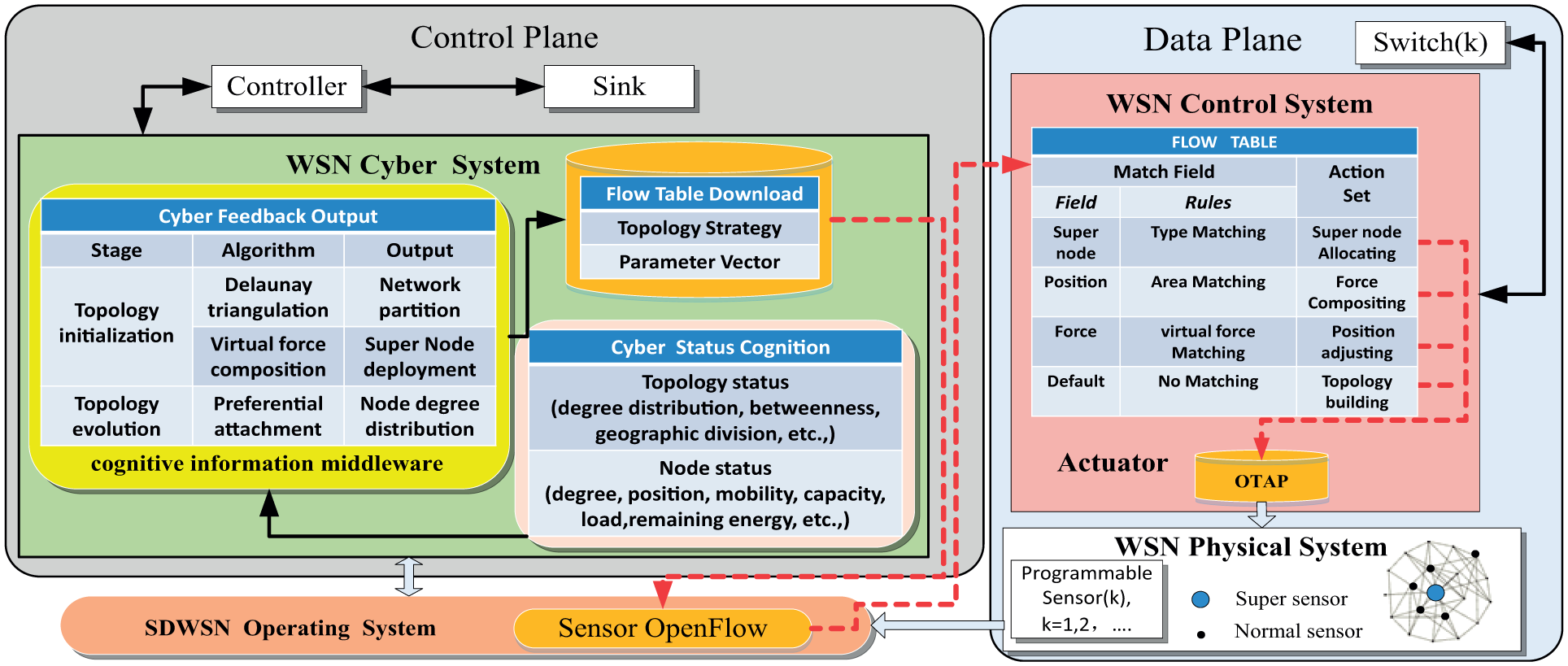
Software-defined network–based CPS framework for WSN topology optimization.
Cyber feedback and control process are illustrated as follows. Sensors in data plane gather the information on WSN physical system to the Sink entities, which can develop control algorithms based on WSN cyber system to produce strategy commands and instruct actuators to achieve the control on WSN physical system. The main idea of feedback control is to exploit cognitive information middleware (CIM) to reinforce learn the physical dynamics in WSN. Then, utilizing the output functional model determines the actions that yield the optimal topology control behaviors.
Based on SDN technology, Sink takes the role of controller to manage network services according to SDN protocol and develop topology optimization strategies based on WSN cyber system in control plane.
The core functionality module in the control plane of SD-CPSF is a CIM, 16 which performs knowledge-guided reinforcement learning 17 for mining heterogeneous information in WSN cyber system. The following procedures should be executed after the cyber-learning phase has been finished in CIM. Controller outputs the strategy rules and optimal algorithm parameters constituted by vector form to the data plane using pipelined flow-table mode. Then, topology evolution process should be executed based on the optimized algorithm parameters (e.g. parameters of particle swarm and virtual force algorithm (VFA) calculated by CIM). Specifically, each switch, which is designed as software-defined virtual sensor and acts as actuator in data plane, performs the appropriate topology evolution matching rules (i.e. flow-table entries) and configures the sensors in data plane to realize the position optimization of super-node for network initial configurations and scale-free model optimization for network evolutionary.
Other sensors in data plane can be provided with programmable ability and become cluster members to execute the specific actions guided by controller strategies and transmitted by switches using Over-the-Air Programming (OTAP) technique. 18
Total optimal topology generation process in logical field reflects the functionalities decoupling between control plane and data plane, where supported SDN protocol, Sensor OpenFlow, 19 enables the communication between the data plane and a remote controller (Sink). Correspondingly, the topology optimization process in temporal field is divided into two stages. First, in the cyber-learning phase, Sink takes the role of controller to collect the network status information based on the packet-in messages from the data plane and perform the configuring and scheduling in network resource (e.g. position adjustment for super-node, preferential attachment for edge) using particle swarm and VFA.
Topology building process reveals a tradeoff between resource efficiency and computational complexity, SDN-based design can yield very low complexity, which efficiently reduce the information exchange for topology optimization process over the cyber-world, which can effectively reduce energy consumption in the process of topology optimization and improve the re-configurability and scalability of network topology. The fundamental functionalities of proposed SD-CPSF reflect the interaction between physical world and cyber systems in WSN using SDN technology.
Topology initialization based on super-nodes configuration
Network division using particle swarm method
According to Delaunay triangulation,
20
which uses computational geometry to mathematically abstract two-dimensional network region, we propose an optimal planar triangulation with geometric criteria to divide entire network with
At the first step, determining a first region division line network, the whole network is divided into two different sub-regions via zone dividing line determined by equation (1)

wherein the point
Particle swarm optimization (PSO) is introduced in network division problem by iteratively improving candidate solutions with regard to given measure of quality. Fitness function in PSO can efficiently adjust plurality of different fitness values to determine the latest search results and corresponding particles used as global minimum plurality. The proposed fitness function in PSO is defined as mean squared error (MSE) form using norm

where

where
In equation (3),
Compared with classical topology segmentation in WSN, 23 the above program can make use of SDWSN architecture to achieve “coarse-grained” network segmentation step, which depends on the smaller number of network border switches and does not need to calculate the path information of the entire network, which helps to significantly reduce computational complexity and substantial reduction in information exchange between the control plane and switches in data plane.
Virtual force–oriented deployment of super-nodes
VFA 24 abstracts the mobile sensors into virtual charged particles to simulate distance-threshold–based virtual compositional force. Motivated by the principle of VFA, the multiple factors driven virtual force are utilized to optimize the deployment of super-nodes in WSN physical system, which can promote the rational allocation of resources within WSN to reduce the topological fragility using percolation theory.
In the first step of VFA, super-nodes adjusts its location in adjacent sub-target zone based on composition force, which is constructed by
Based on the above analyses, super senor

wherein
The above deployment process performed by the position adjustment of super-nodes is intrinsically determined by reconfiguring redundant network resources (capacity, energy, load, etc.) to fragile physical elements (sensor or link) in WSN, which can improve the network survivability and energy efficiency according to complex network theory–based percolation process, 25 which can provide the ability of network to properly perform even when a fractional components and small-world effect, which shows a small average shortest path length and a large clustering coefficient in properties of network topology.
Topology evolution based on improved scale-free network model
Based on SD-CPSF, a WSN topology optimal model (WTOM) according to complex theory is proposed via introducing super-nodes driven initial topology deployment and crucial-node associated topology evolution, which possesses both the small-world effect and the scale-free property. 26
WTOM generation algorithm
Suppose the network has originally deployed isolated
Comprehensively considering the influencing factors in network evolution, we define

wherein,
The connection probability based on integrated influence factor is shown as follows


Network topology optimization mechanism is achieved by repeating the algorithm steps from 2 to 4 until the required network size is met and the corresponding evolutionary process can produce small-world effect, directly affecting the energy saving performance of CPS for monitoring application.
Mathematical analysis on topology optimal model
Dynamic characteristics in scale-free network model can be analyzed based on continuous field theory. 27 Given the nature of continuous performance in proposed model WTOM, more detailed characteristics can be captured and predicted according to the degree distribution, which is denoted as time-varies and obtained via continuous approximation field method.
At each time step, the increment of node degree is in accordance with the following ratio

Initial boundary conditions of equation (6) are substituted as

The average node degree in local world is shown as

Time

The probability of super-node chosen to construct network is limited in the range
Flow-table driven control in WSN physical system
In proposed SD-CPSF, the specific mobile behavior of super-nodes is driven by composite virtual force and the optimal deployment principle is achieved according to “force field” (virtual force matching rule and threshold) set in flow-table entry. Furthermore, network evolution process is instructed by the preferential attachment probability stored in “default field.” Based on the functional module for cyber cognition and mining, WTOM is designed by controller in control plane and downloaded into switches in data plane via flow-table mode using OTAP. Based on the topology policies determined by WTOM, switches are acted as actuators in CPS to output the cyber feedback control on the physical system and the corresponding control processes by flow-table mode. As a result, super-nodes move to the suitable location and normal sensors choose preferential attachment to perform specific topology optimization actions.
Experimental results and analysis
We do experiments to evaluate the performance of proposed WTOM in SD-CPSF by analyzing the network characteristics including average path length, clustering coefficient, energy consumption, and life cycle.
The network simulator NS3 30 and network building tool Gephi 31 are used to construct the experiment environment and analyze the performance of the proposed topology optimization mechanism using SDWSN prototype. Table 1 lists experimental parameters.
Parameters of simulation experiment.

Performance comparison on network topology
This simulation situation is divided into two groups of comparison counterparts, the first group is in accordance with WTOM based on preferential attachment probability model and the second topology generation model is formed according to the BA scale-free model. 28 The red edges in Figure 2(a) denote the edges built by crucial nodes–dependent preferential attachment mechanism, which includes the set of shortcut paths created by super-nodes in networks. The red edges in Figure 2(b) represent the edges constructed by node degree–based attachment method.
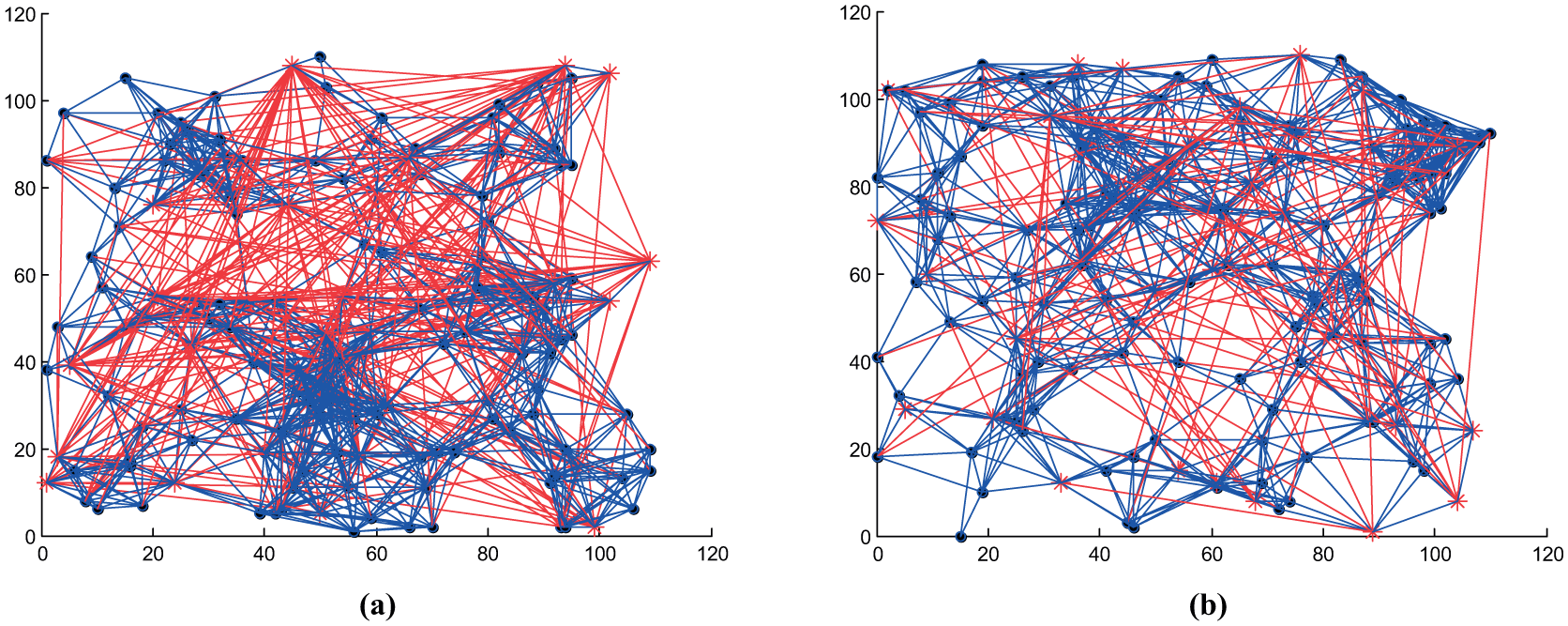
Network topology: (a) WTOM (N = 100, p = 0.05) and (b) BA model (N = 100, p = 0).
The set of blue lines in Figure 2 belongs to subset of the communication sides created by the network evolution process. The union set of blue and red edges constitute together the basic network communication topology.
Table 2 shows that the selected energy-rich sensor has the higher node degree and energy-barren sensor has the lower node degree in WTOM than the corresponding sensor with the same node ID in BA model. The main reason is that super-nodes with higher energy level in WTOM can contribute to build more shortcut paths to balance network energy consumption and result in the decrease in the average node degree of energy-barren sensors in networks.
Corresponding variety in degree with energy-diversity sensors in WTOM and BA model.

WTOM: wireless sensor networks topology optimization model.
The topological properties with power-law degree distribution, large clustering coefficient and disassortative degree correlation should contribute to improve the robustness in WSN network structure.
Comparison of degree distribution
The scenery of sensors death caused by exhausted energy and environment interferes is similar as the networks suffer from random attack. The degree distribution of formed topology follows a power-law with exponential cutoff, which can help to enhance the fault tolerance and reliability of WSN.
Figure 3 shows that both WTOM and BA have the similar scale-free structure characteristic on the distribution of node degree, that is to say, sensors with high degree are with small distribution probability, while other sensors with small degree are with large distribution probability. According to the analysis on degree distribution of WTOM, there exists of flat status within a certain degree range, but the network reflects the scale-free feature in overall degree distribution. The main reason is that super-nodes play an important role in network evolution mechanism, which contribute to smooth the exponential degree distribution and the amount of sensors with higher degree is reduced. This helps to reduce sensors’ premature death rate due to large energy consumption caused by high sensor degree. When p = 0, there is no super-node in network and WTOM has the similar functions as BA model.
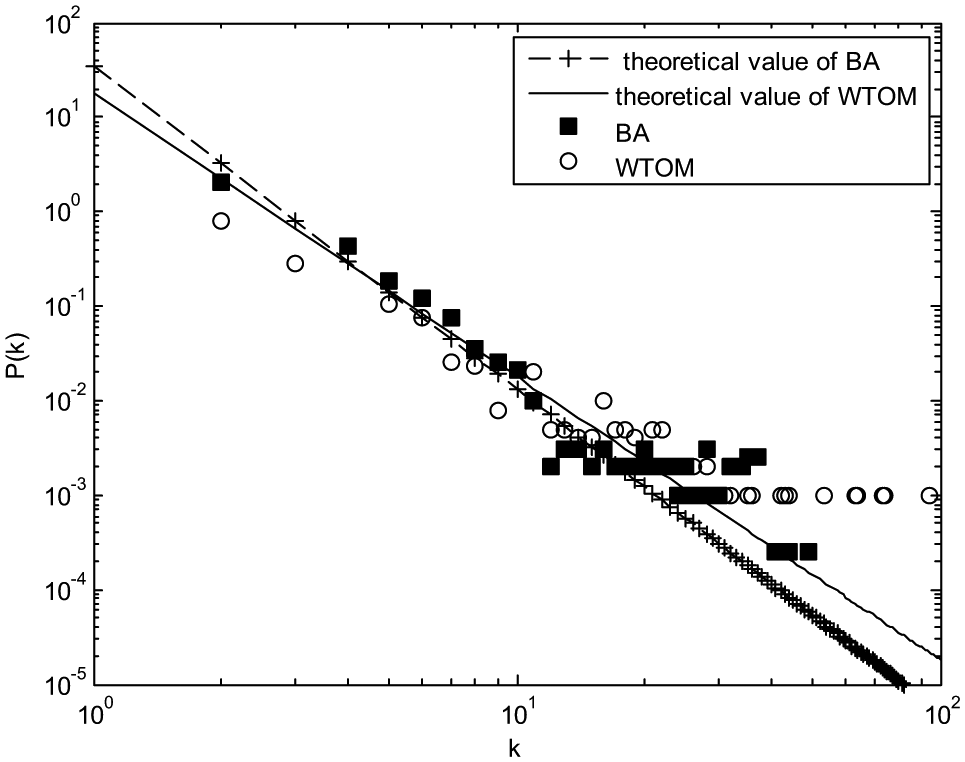
Degree distribution of WTOM (p = 0.045) and BA model (p = 0).
From Figure 4(a), we can see that the total failure rate of sensors can also be greatly reduced by adding appropriate initial energy to super-nodes adjusted by taking different values of parameter n. The super-node with higher energy level can do more contribution than the one with lower level to smooth the distribution of node degree and achieve balanced network energy consumption. Figure 4(b) shows the influence of super-nodes’ position for the degree distribution in WTOM, which can be seen that the node degree distribution tends to be more uniform as the position of super-nodes optimized by VFA.

Degree distribution of WTOM: (a) influence of super-nodes’ energy level for degree distribution of WTOM (n = 3, n = 4) and (b) influence of super-nodes’ position for degree distribution of WTOM.
Analysis on small-world effects
WTOM can find the weak disorder in the distribution of link length and reduce the average path length via optimally deploying the supper-nodes in WSN. Figure 5 focuses on the analysis on small-world effects in WTOM, which are inherent in the law of proposed WSN topology evolution. Figure 5(a) shows that the increase in initial energy of super-nodes can effectively reduce the average path length (shown as equation (11)) and the average hops of information transfer process in WSN.

where
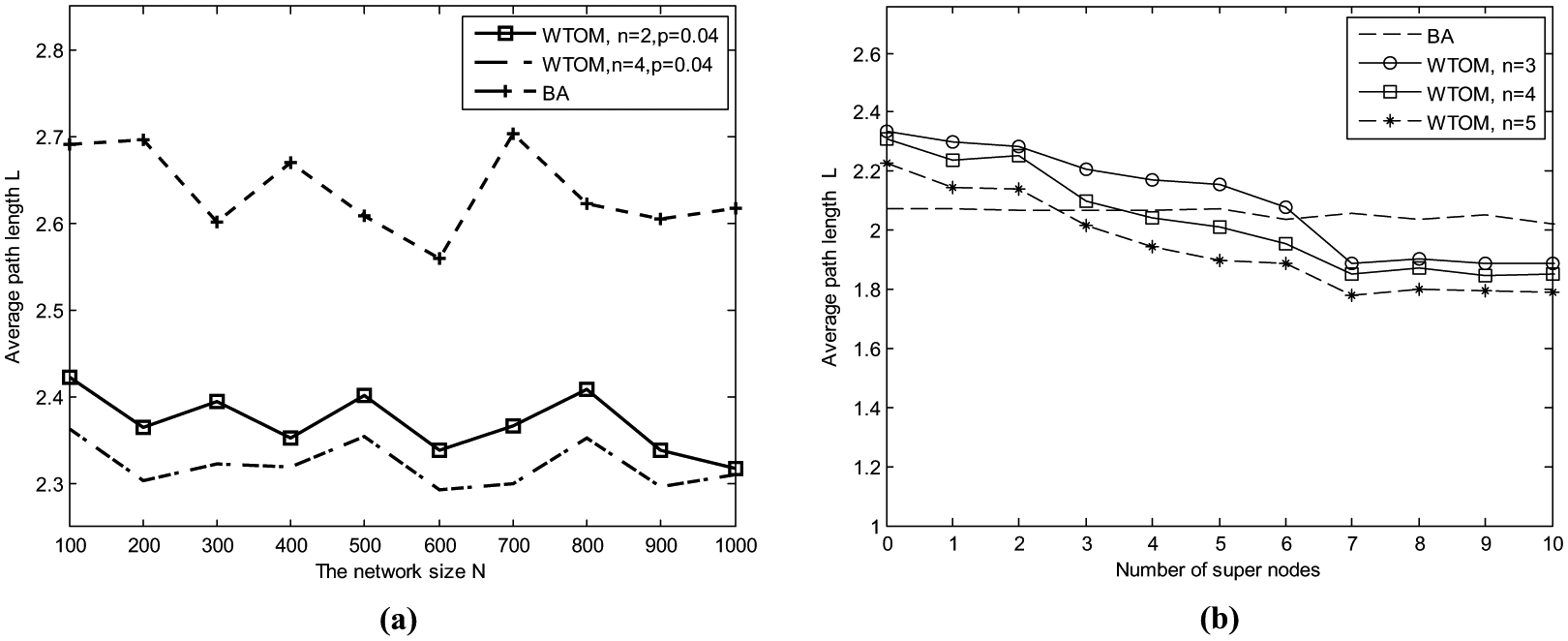
Average path length: (a) average path of WTOM and BA model (n = 2, p = 0.05; n = 3, p = 0.05; n = 1, p = 0) and (b) influence of the quantity for the average path of WTOM (n = 3; n = 1).
Comparison in the effect of clustering coefficient
Figure 6(a) shows the fact that WTOM has a larger clustering characteristic than BA model, which contributes to improve the robustness in local network connection denoted as an invulnerability indicator in WSN and the value of clustering coefficient

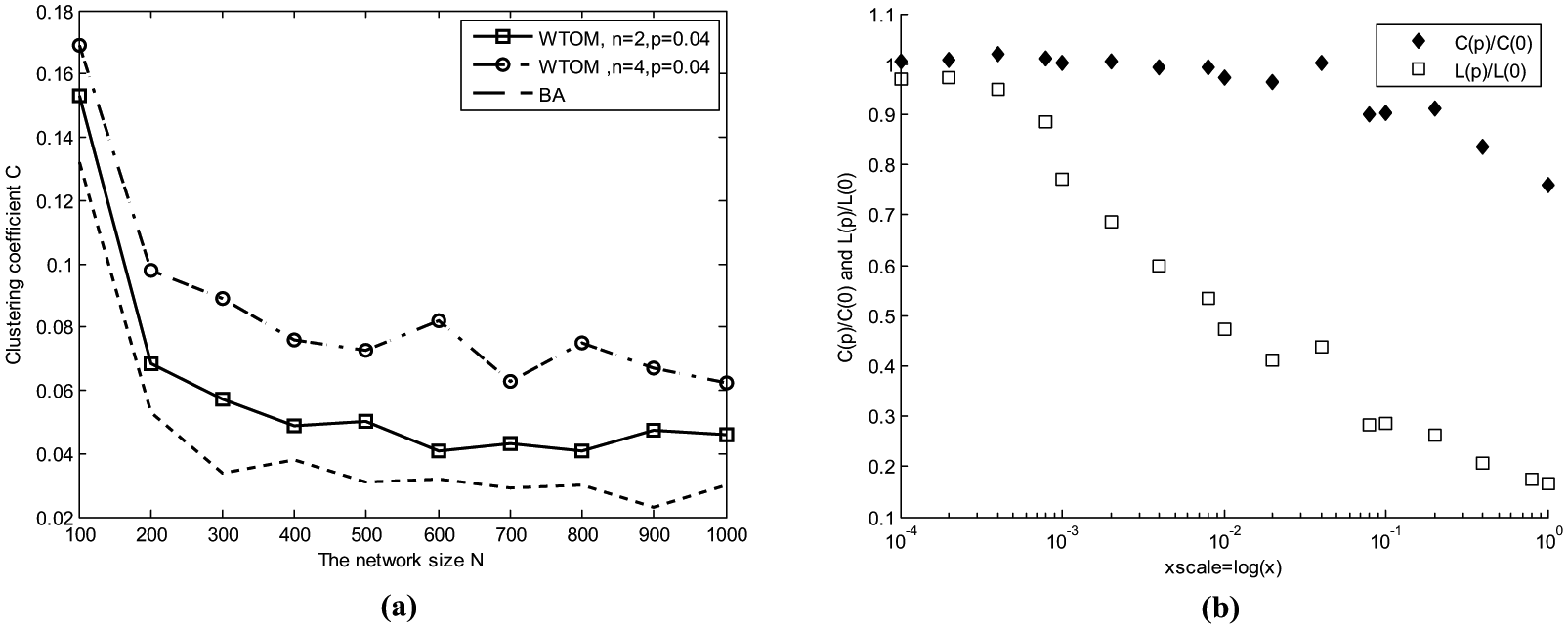
Small-world characteristics: (a) clustering coefficient of WTOM and BA model (n = 2, p = 0.04; n = 4, p = 0.04) and (b) small-world characteristics in WTOM.
Clustering coefficient of the entire network represents the average interconnected probability between any pair of connected sensors and is defined as the ratio of total number of connections
Figure 6(b) indicates the change processes in average path length and clustering coefficient of the network with sensors = 120 and average vertex degree = 10. We can see that when the adjusting probability of edge remains a very small value, the average path length has been substantially shortened, while the opposite branch coefficient nearly not changes in value. This means that the network state has already reflected notable characteristic in small-world model, that is, network structure features ranged between random and ordered architecture show a high degree of group property in local range and a short average path length in global range.
The comparison in robust of invulnerability
The comparison with the robustness in invulnerability of WSN between WTOM (p = 0.1) and BA model is shown in Table 3, which provides the statistics result on the model-related value
Maximum connected component of branch

WTOM: wireless sensor networks topology optimization model.
As can be seen from Table 3, WTOM has the better robustness in network survivability compared with BA model in the course of data gathering. The main reasons are that the failure of WSNs is mainly caused by the energy depletion node, while WTOM takes the residual energy and degree distribution into consideration in topology construction procedure and also takes the protection of critical sensors into account, which conducts to maintain network connectivity, thereby improving the robustness of network survivability.
Comparison in network lifetime
The lifetime of WSN is defined that at least 70% sensors are alive to support environment monitoring functionality in CPS service application. The lifetime is also an important index to reflect the energy efficiency of network. Figure 7 plots the average survival ratio of sensors to the number of data-gathering rounds for WTOM and BA model. The survival rate of sensors in a network can be used to evaluate the total energy consumption in data-gathering mechanism for CPS service. The lifetime of SDWSN is denoted as the duration of network operations (e.g. data gathering) while the sensors survival rate is above an application-based threshold (
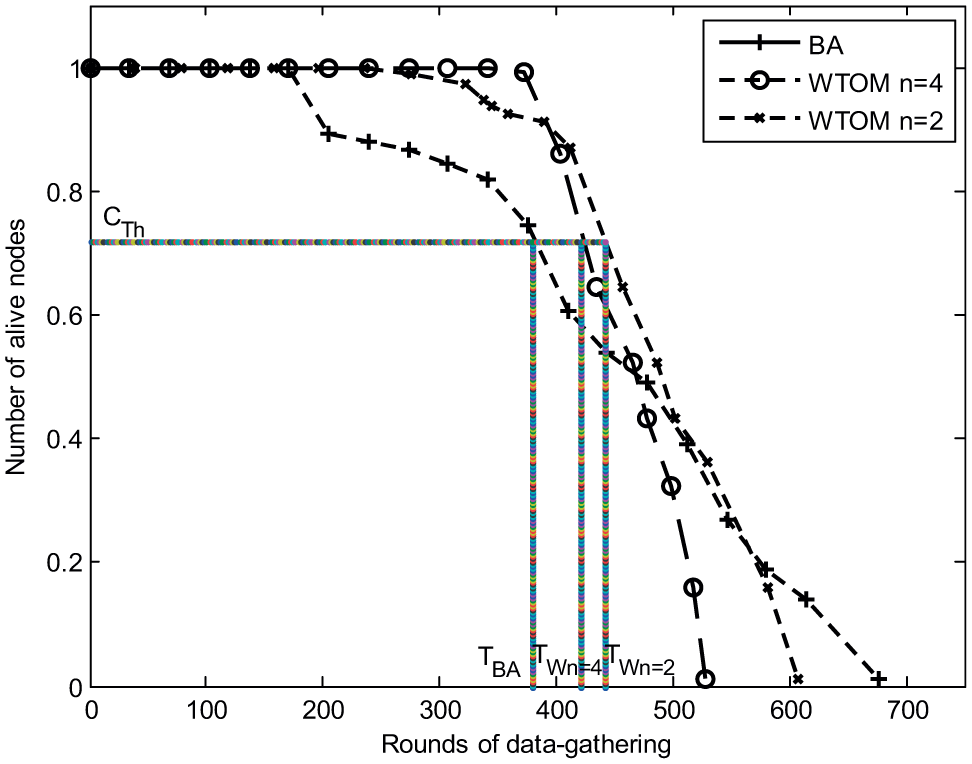
Network lifetime.
Table 4 shows that the network lifetime cycles should be prolonged with the more super-nodes being added into network using WTOM, which also contribute to increase the invulnerability of WSN.
Life time versus the number of super-nodes.

The negative performance that some sensors with high node degree easily exhaust their energy leading to network fragmentation in BA model is covered by introducing small-world–based super-nodes deployment and energy-aware network evolution with SDN-based mechanism in WTOM. Therefore, the overall routing performance and structure robustness of global network are optimized, which finally help to achieve energy efficiency and robustness in WSN.
Conclusion
Based on complex network theory and SDWN framework, an optimization WSN topology model is proposed to improve the invulnerability for fault tolerance, the adaptability for heterogeneity compatibility, and the energy efficiency for lifetime extendancy in WSN.
By introducing virtual force driven super-nodes deployment mechanism, redundant network resources can be reconfigured and allocated to vulnerable crucial network element, and small-world phenomenon can produced according to complex network theory–based percolation process, which can improve the survivability and energy efficiency in WSN. According to resource-driven preferential attachment mechanism in topology evolution strategy, the formed network can show the scale-free–based topology structure characteristics, which can efficiently defend against random failure caused by node breakdown or network attack.
The experimental results show that compared with the original BA model, the proposed optimal network model can efficiently prolong the lifetime of WSN by reducing the amount of exchanged information benefited from SDN-based functional architecture and shortening the average path length due to small-world effects created by rational deployment of super-nodes. In terms of survivability, the invulnerability of WSN can be enhanced by the scale-free–based network topology characteristic.
Footnotes
Academic Editor: Wei Yu
Declaration of conflicting interests
The author(s) declared no potential conflicts of interest with respect to the research, authorship, and/or publication of this article.
Funding
The author(s) received no financial support for the research, authorship, and/or publication of this article.