




Abstract
Femtocell network is an effective technique to improve spectrum utilization and indoor coverage. How to allocate users power while keeping acceptable performance under dynamic environment is still a challenge in practice. In this article, we study the problem of energy efficiency in a two-tier network. The objective of the article is to maximize energy efficiency for the two-tier femtocell network with the consideration of uncertain channels. The complex and dynamic communication environment will lead to the imperfect channel state information. In order to enhance the robustness of the two-tier network, we consider the imperfect channel state information of interference links in block-fading channels using probability constraints. We propose a novel scheme to derive optimal energy efficiency by transforming probability constraints into indicator function. A distributed iterative algorithm is proposed to obtain the optimal power solution. Numerical results illustrate the effectiveness of the proposed power control algorithm.
Introduction
In recent years, spectrum resources become more and more scarce. At the same time, the performance of indoor network coverage is not satisfactory. As a promising technology, femtocells have a lot of advantages. For example, femtocells can provide short-range (10–50 m) wireless communication service for home users and transportation users. They also increase wireless network capacity, offer indoor users reliable and high-speed data service, and extend cellular coverage, especially in blind coverage area.1,2 However, there are also some problems in this technology even if femtocells have so many advantages. Since femtocells are deployed randomly on a large scale, there exist some technical challenges such as cross-tier interference, network topology, and spectrum sharing. Since femtocells share the licensed spectrum with macrocells, cross-tier interference may seriously degrade the performance of two-tier network. For instance, a user at the cell-edge has to increase the transmit power to meet its signal-to-interference-plus-noise ratio (SINR) requirement, which causes excessive cross-tier interference at nearby femtocells. 3
In order to eliminate the interference, power control has attracted extensive attention and a certain amount of studies have been performed in the literature.4,5 In Han et al., 6 based on the adaptive adjustment of femtocell users’ (FUE) maximum transmission power, the authors propose a reasonable and effective interference suppression scheme. In Kim et al., 7 a power allocation algorithm is investigated for femtocells in downlink OFDMA systems with the consideration of the influence on neighboring macrocell base station (MBS). Previous work above considers that the limited channel information of those MBSs is available. However, the communication environment is generally complex and dynamic, which leads to that the channel state information (CSI) is not so easy to perfectly obtain. 8 Thus, there exists estimation error between the actual CSI and the measured CSI. 9 The above literatures do not consider the uncertainty of channel caused by the actual environment. The uncertainties of channel gains in two-tier network are significantly important for adapting the variable environment. Considering the uncertainties of channel gains, it makes the network more robust.
It is noted that most existing results analyze the problem of power optimization for the two-tier femtocell networks.10,11 Among them, utilizing the thought of energy efficiency to mitigate interference is a good choice with considering the uncertainties of channel gains. When it comes to maximizing the network’s efficiency, protecting the primary’s uplink communication is always neglected. 12 In recent years, energy-efficient problems for femtocell networks have stirred considerable research attention in both industry and academia.13,14 In Hasan et al., 15 a risk-return model, as a performance metric, has been proposed for power allocation of energy-efficient system in multi-carrier systems. In Han et al., 16 the problem of energy efficiency for green communication is investigated in two-tier femtocell networks. All the above work considers to apply the interference temperature (IT) constraint. They also do not consider the block-fading channel, which describes the channel state better and is more realistic.
In this article, the probability constraints are utilized to describe the uncertainty of channels. In order to make the channel more realistic, we considered block-fading channel. For the purpose of saving energy, we focus on maximizing the total energy efficiency of all FUEs and obtaining a optimal power allocation scheme. To protect the primary’s uplink communication, the rate of secondary link users is limited by a threshold. And an indicator function is used to replace the probability constraint, which makes solving the mathematical model more convenient. Moreover, how to obtain the system’s optimal power is shown by a graphical representation. Finally, numerical simulation results demonstrate that the scheme is effective in the two-tier network.
The rest of the article is organized as follows. Section “Related work” gives the system model. And the problem formulation is given according to the physical model. In section “System model and problem formulation,” the power control scheme and iterative algorithm are considered. In order to obtain the optimal power more visible, we adopt graphical representation by giving the explanation of practical meanings. Then, numerical results evaluate the performance of power control scheme in section “Proposed power control scheme.” Finally, last section gives the conclusion.
Related work
Xie et al. 24 utilized a Stackelberg game to make investigate interference management based on hierarchically joint user scheduling and power control in downlink femtocell networks. Considering statistical delay QoS guarantee in uplink two-tier OFDMA femtocell networks, He et al. 18 studied the interference mitigation. Given channel statistics information, Wang and Ding 19 developed a joint power control and resource-allocation scheme for outage balancing in a multicarrier femto/macro system to minimize the maximum FUE equipments’ outage probability constrained on macrocell user (MUE) equipments’ outage requirements.
The idea of energy efficiency is a good method to measure the rationality of the system. 20 Ashraf et al. 21 address the issue of energy consumption by proposing a novel energy-saving procedure. Considering the partially open channels, Ge et al. 22 conduct performance analysis for two-tier femtocell networks. In particular, it builds a Markov chain to model the channel access in the femtocell network and then derives the performance metrics in terms of the blocking probabilities. Le et al. 23 present an optimal design for the admission control problem using the theory of semi-Markov decision process (SMDP). This power adaptation algorithm reduces energy consumption for femtocells while still maintaining individual cell throughput by adapting the femtocell base station (FBS) power to the traffic load in the network.
System model and problem formulation
In this article, we consider a two-tier network which consisted of one macrocell and n femtocells as shown in Figure 1. First, the primary link consists of a MUE and a MBS, while the secondary link is made up of n FUEs and n FBSs. In the physical model, the MBS is in the center and the n FBSs distribute in the area randomly. Here, it is assumed that the measured channel gains are available and the system is closed access, which means that FUE equipments can only communicate with their own FBSs.

System model.
The coverage radius of the MBS is Rd and the coverage radius of femtocells is r. The MUE is located in the serving region of MBS and each FUE can only locate in the FBSs’ serving region. The solid lines denote the uplink signal links and dashed lines represent interference signal links. We study uplinks in the article. From Figure 1, when FUEs transmit signals to its FBS, the links suffer the interference caused by other FBSs’ user and MUE. How to deal with the interference and formulate the power control scheme without influencing the normal communication of MUE is our objective.
We consider uplinks in this article. To illustrate easily, we introduce some mathematical parameters. We denote the index set I = {0,1,2,…,n},N = I − {0}. Let Bi (i ∈ N) and M0 denote ith FBS and MBS, respectively. Let Ui (i ∈ N) and U0 denote ith FUE and MUE, respectively. Let pi represent the transmit power of user Ui (i∈N) and pm denote the transmit power of U0. The received SINR γi(α) from user Ui is given as

where the γi(α) is the SINR of the femtocell user, and α represents the joint fading state for all channels involved according to Zhang et al. 24
All the channel power gains are assumed to be independent and identically distributed (i.i.d.) random variables with each having a continuous probability density function (PDF). The additive noises at MBS and FBS are assumed to be independent circularly symmetric complex Gaussian (CSCG) random variables, each of which is assumed to have zero mean and variance N0.
Denote Γ i as the target SINR of user Ui. Considering the situation where the uncertainty of SINR is of stochastic nature, the target outage threshold εi is introduced to guarantee the QoS of the user Ui with probability given as

where Pr{·} represents the probability.
In the two-tier network, the FUEs should not affect the MUE. In order to utilize power properly, the energy efficiency of the network is considered. We formulate the energy efficiency robust optimization problem as follows

where

where Ri(α) represents the date rate of FUEs. W is the bandwidth of the network system. gi,i(α) denotes the channel gain from FUEs to its own FBS and gj,i(α) denotes the channel gain from FUEs to other FBSs. W is the bandwidth of the network.
Proposed power control scheme
In this section, an optimal power control scheme and an iterative algorithm are proposed for the two-tier femtocell network. First, the probability constraint is transformed into indicator function to obtain the optimal energy efficiency of the two-tier femtocell network. Then, a graphical representation is used to explain how to obtain the optimal value of pi (i∈I). Finally, an iterative power control algorithm is employed to maximize energy efficiency of the two-tier femtocell network.
Optimal energy efficiency retrieval
In this subsection, to deal with the probability constraint, an indicator function χp(α) is provided as follows

where

is a decision condition. If the decision condition is no greater than γs, χp(α) = 0, which means that the SINR of MUE can guarantee the need of normal communication. Otherwise, χp(α) = 1. Obviously, χp(α) is a function of step function. Generally, the step function serves as a penalty factor. If the communication between the MBS and MUE is disconnected, the MUE would give the FUEs a punishment in order to reduce the interference caused by the FUEs.
And the probability constraint of MUE can be transformed into the following form

By adding the expectation to χp(α), it equals to Pr{log2(1 + γi(α)) ≤ Γ i }. So it is more convenient to solve the problem (3), which can be expressed as follows

In order to solve this problem, we propose a fractional programming approach. Define a coefficient of energy efficiency q as

The fraction of (8) is difficult to deal with, the equation (8) is turned into the following form

If the coefficient q obtains the optimal value, the energy efficiency of the FUEs derives the optimal value. So problem (7) can be transformed into the following form

Next, in order to deal with the problem (10), a Lagrange duality method is used to solve it. The Lagrange function from (10) is given as follows

where λ is a Lagrangian multiplier. With the Lagrange duality method, the objective function is combined with the probability constraints. Through the first derivative of (11), the optimal power can be obtained. Thus, the problem (10) is converted into the following form

The maximization problem (12) can be decoupled into parallel subproblems which all have the same structure and each of which can be applied by the Lagrange dual-decomposition method as Zhang et al. 24 For a particular fading state, equation (12) is expressed as

Let the derivative of (13) equal to zero, we can get the optimal power. In order to make it convenient to the following graphic representation, we define

We define another variable

to show the penalty effect of indicator function.
Obviously, f(pi) is a concave function with respect to pi. So, there exists X such that f(X) reaches its maximum value if X satisfies

where (·)+ = max{·, 0}. X is the optimal power of f(pi). And it should be connected with the penalty term χp(pi). With the penalty term χp(pi), the optimal power can be obtained. Then, it follows from (5) that the indicator function is given as follows

If the power of FUEs is more than the upper bound of power, it will bring more interference to the MUE. So the upper bound of pi is derived and we define

The optimal power can be obtained by comparing X with Y.
Graphical representation
In this section, we aim to use the graphical representation to explain how to obtain the minimum value of pi (i ∈ I).
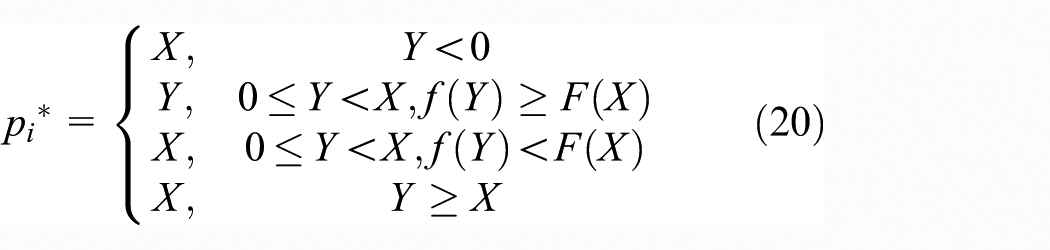
We obtain the two power variables X, Y from equations (17) and (18). Figure 2 shows the graphical representation results for obtaining the optimal value pi. In Figure 2, the red line represents the utility function F(pi) and the black dotted line denotes the utility function f(pi). If pi > Y, the utility function F(pi) has a sudden drop for the reason that χp(pi) = 1. Figure 2 shows that the utility function has a peak. The maximum utility function value is obtained at X or Y. Clearly, f(pi) obtains the maximum value if pi = X. Due to different F(pi), there exists the following cases.

Graphical representation: (a) Y ≥ X, (b) 0 ≤ Y < X, f(Y) ≤ F(X), (c) 0 ≤ Y < X, f(Y) ≥ F(X), and (d) Y < 0.
In Figure 2(a), X ≤ Y. In this case, χp(pi) = 0 when the power pi less than Y. Thus, the utility function F(pi) achieves its maximum value when the power is X.
Note that Figure 2(a) shows that the outage of the MUE will not occur even when the FUE’s transmission power is the optimal power X. Actually, when the primary link’s channel condition is good enough, this case may happen. If the interference link’s channel gain from FUE to MBS is small enough, this case may also happen. So the FUE’s interference power is not large enough to cause an outage for the MUE. Therefore, based on its own CSI, the FUE can allot transmit power solely.
In Figure 2(b) and (c), 0 ≤ X < Y. This case is divided into two subcases because of the different utility function F(pi). It follows from Figure 2(b) and (c) that

where
In this case, the channel of primary link conditions are not so favorable as those in Figure 2(a). Therefore, whether the MUE is in an outage or not lies on the FUEs’ interference power. It will lead to an outage to the MUE if the second link transmits signals with the optimal power X. Clearly, with the FUE’s transmit power X, the FUE will have a better energy efficiency.
In Figure 2(d),
Y ≤ 0. In this case,
χp(pi) = 1 for any
pi ≥ 0. As shown in Figure 2(d),
F(pi) has a constant λ gap
from f(pi), meaning that
χp(pi) has no effects on the
optimal solution. Therefore,
In this case, regardless of pi, the MUE is always in outage. When the primary link’s channel condition is very poor, this case happens. Even if the second link does not transmit information, the MUE will be in outage as well. In this part, the second link’s transmission will not cause any additional outage loss to the primary transmission. Thus, based on its own channel condition, the FUE can allocate the transmit power solely.
Therefore, the optimal solution for problem (12) is given by
Algorithm design
In this section, we introduce an iterative algorithm to obtain the optimization solution for problem (9). First, the method of solving the problem of energy efficiency is studied. Generally, the objective function of the problem of energy efficiency is given as

where the objective function is a form of fraction. R means the user’s rate and P represents the user’s transmission power. R/P denotes the user’s date transmission rate of consuming per unit power. The method of solving problem of energy efficiency is to set a value Q which is the factor of energy efficiency. Define

Then, equation (22) is changed into the following form

According to Kang et al., 25 and Cheung et al., 27 a conclusion is arrived at

The method of constructing Lagrange function can be used to solve the energy efficiency problem. The algorithm is shown in Algorithm 1.

Note that Lmax is the maximum iteration step. When n = Lmax, it means it does not have optimal solution.
Simulation results and performance analysis
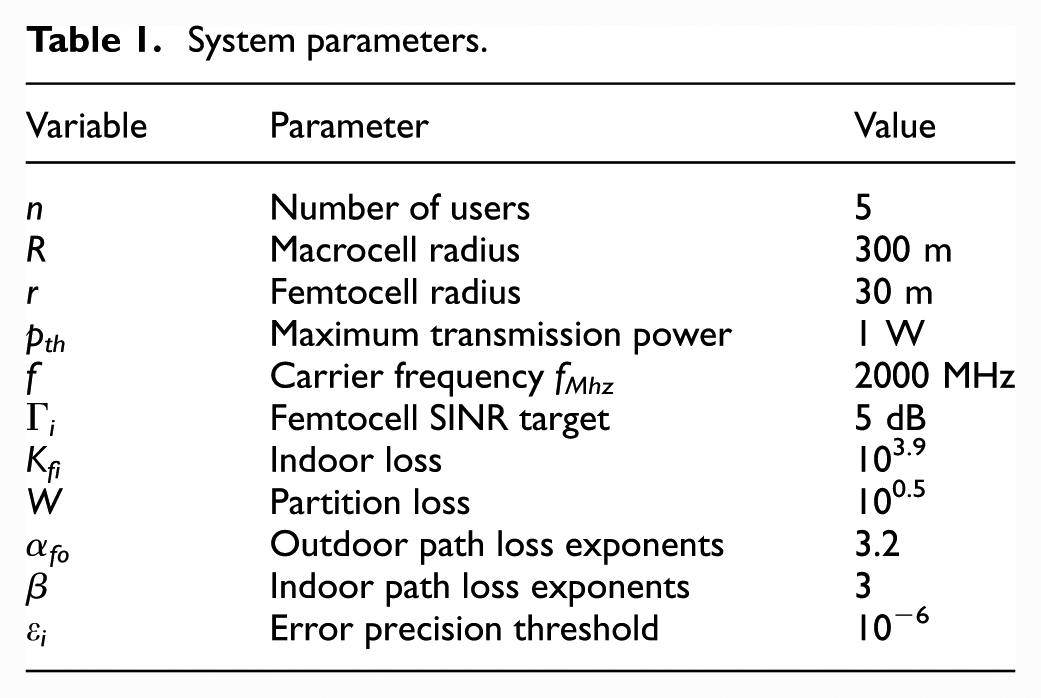
In this section, we carry out simulations to verify that the proposed algorithm is effective in two-tier network. The simplified path loss model 26 is given as follows

The notations in the simulation are given in Table 1.
System parameters.
In the simulation, there are five FBSs and one MBS. Every FBS has a user within its FBS’s coverage. In Figure 3, the red lines mean the rate of FUEs and blue lines denote the power of FUEs. Figure 3(a) and (b) shows that the rate and power of FUEs eventually converge to an equilibrium point in few iterations (about 13 steps). In the whole process, the convergence time is relatively short. From Figure 3, the power is relatively small. This is the advantage of mathematical model and physical model which make the two-tier network more energy saving. The rate can meet the requirement of normal communication. Meanwhile, the rate can be adjusted to satisfy different demands. This is one advantage of our algorithm. The result of Figure 3 verifies that the algorithm is effective.

The convergence figure of rate (R) and power (p).
As shown in Figure 4, the energy efficiency q is larger with the increase of iterations and converges to a constant value after a few iterations. The convergence time is relatively short. The equilibrium point means that the rate and power of FUEs both converge to a constant value. So the optimal energy efficiency of the two-tier femtocell network has been obtained. As we know, along with the increase in iteration steps, the rate and power of FUEs are smaller. From Figure 4, the energy efficiency q becomes bigger gradually. The reason is that the power of FUEs decreases faster than the rate. Meanwhile, the energy efficiency (q) converges to the constant value (more than 4), which verifies that the iterative resource-allocation algorithm is efficient.

The convergence figure of energy efficiency (q).
Figure 5 shows how ε affects power. As shown in Figure 5, the final convergence power is larger with the increase of ε. The reason is that the greater the ε, the more relaxed the limitation on the power will be. In order to make the converge time less, the power of users will be larger. Given that the MUE and FUEs can work regularly, the objective of the article is to make the power of FUEs as small as possible. So the limitation on the power of FUEs should be strict enough. Hence, the two-tier network can be more energy saving and the algorithm is more reasonable.

The convergence value of power with different ε.
Conclusion
In this article, we propose power control strategy to maximize the energy efficiency of the two-tier femtocell networks based on the block-fading channels. Previous literatures do not consider the uncertainty of the channels or do not involve the maximization of the femtocell networks’ energy efficiency. Due to the uncertainty of environment, the probability constraints are used to describe the imperfect CSI. The power and rate of the secondary users are limited to guarantee the primary user’s communication. A novel method of indicator function has been adopted to deal with the probability constraints. The indicator function reduces the complexity of dealing with the probability constraints greatly. Furthermore, we analyze how to obtain the optimal power in the form of graphics by cases. Simulation results have demonstrated the validity of our proposed scheme.
Footnotes
Academic Editor: Maio Jin
Declaration of conflicting interests
The author(s) declared no potential conflicts of interest with respect to the research, authorship, and/or publication of this article.
Funding
The author(s) disclosed receipt of the following financial support for the research, authorship, and/or publication of this article: This work was partly supported by the Natural Science Foundation of China under Grant numbers 61473247, 61571387, and 61602038.