




Abstract
This article presents comparison between data rate or rate control, that is, video transmission rate control algorithm and transmission power control algorithms for two different cases. First, energy consumption due to high peak variable data rates in video transmission. Second, energy depletion due to high transmission power consumption and dynamic nature of wireless on-body channel. The former one focuses on constant (fixed) transmission power level and variable data rate (“severe” conditions), for example, medical monitoring of the emergency patients. The latter considers variable transmission power level and constant (fixed) data rate (“less severe” conditions), for example, electrocardiography measurement for patients in wireless body sensor networks. Besides, energy efficiency comparison analysis of battery-driven or video transmission rate control algorithm and transmission power control–driven or power control algorithm is presented. Finally, proposed algorithms are analyzed and categorized as energy-efficient and battery-friendly for medical applications in wireless body sensor networks.
Keywords
Introduction—the motivations and drivers behind the emergence of wireless body sensor network
Energy-efficient communications in wireless body sensor networks (WBSNs) have been receiving a lot of attention in recent years as body sensor network (BSN) and wireless body area networks (WBANs) have started to emerge to support various medical applications. In this article, we focus on addressing the issues of (a) increasing the data rate while keeping the power transmission low (e.g. for medical emergency applications where strict delay and reliability are required), (b) increasing the transmission power (TP) to maintain the data transmission rate (e.g. for emergency applications where some delay may be tolerable but strict reliability is needed, such as 12-lead electrocardiogram (12-lead electrocardiography (ECG)) measurement, for patients in WBSNs). To address the first issue, we investigate a battery solution based on the video transmission rate control algorithm (VTRCA). To address the second issue, we investigate a transmission power control (TPC)-based solution.
Previous studies and their theoretical analyses have shown that TPC does not fulfill the desired energy efficiency requirement in WBSNs because in short-range communication systems, the TP is much smaller than the transceiver’s power. The energy-saving efficiency of TPC depends on the average current (in mA). In this context, this article evaluates the VTRCA and TPC algorithms by considering the overall energy consumption at the transmitter node and transceiver. Key research issues we plan to address in this article include:
What level the theoretical bound of energy efficiency is affected by VTRCA and TPC algorithms?
How much transmission energy efficiency can be achieved?
To what extent can the lifetime of WBSNs be extended?
In the radio transceiver, the energy efficiency of TPC is restricted by the maximum current (in mA) at the base station (BS) and the minimum current at the transmitter node. The energy-saving of VTRCA monotonically increases when the average data rate increases. VTRCA save more energy than TPC algorithm. Finally, the performance of VTRCA and TPC algorithm is evaluated by a simulation in MATLAB with large datasets. The experimental results show that VTRCA saves energy about 47.8%, while TPC algorithm shows energy efficiency of 40.9%.
A WBSN is a radio frequency (RF)-based wireless network that typically consists of a group of small size, lightweight, energy-constrained and intrusive or non-intrusive sensor nodes with the ability to communicate and operate in the proximity of a human body. These nodes can be placed in, on, around, or implant inside the body, and regularly can monitor its physiological features according to environmental conditions. 1 In particular, WBSNs are attracting great attention because their real-world applications intend to improve the quality of people’s life by providing continuous, non-invasive, and cost-effective support. Moreover, WBSNs are a revolutionary paradigm in healthcare with the notion of “Healthcare for anyone anywhere and anytime.” Therefore, availability of energy-efficient and battery-related approaches help to cultivate the interactive environment and are capable of reporting data remotely to medical centers or hospital for longer time.2–4
Recent trends motivated by the patient’s preferences toward carrying smaller and limited battery capacity nodes on their bodies in WBSNs with joint and synchronized transmission between video and vital sign signals (i.e. 12-lead electrocardiogram) in order to get big and bright image of patient’s condition for fast and insightful medication. This has resulted in much higher energy consumption and consequently shortened battery lifetime of WBSNs. In fact, the biggest problem today in the sensor world is that they are battery-driven, and the battery technologies are not fulfilling the required energy demands. Besides, for medical health services in an emergency case, main scientific challenges are battery power, its limited lifetime, and energy drain during data transmission.
Apart from physiological signals (i.e. 12 lead ECG), these days video transmission becomes more demanding because of the remarkable and rapid progress in modern day emerging technologies.5–8 Video technology plays an essential role in providing easy and low-cost medical health services. The use of wireless video transmission has a notable impact on the patient’s health during the first hour, which is the golden hour of the emergency incident. The specialist physicians can provide instructions to nurse and paramedic based on vital sign signals and video images of the patients for timely and cost-effective care at their homes or medical theater.
It is determined that the combination of video and physiological signals is a prevailing deployment in WBSNs for the emergency patients monitoring through moving ambulance, in which video cameras are installed, and video, vital sign signal transmission services are provided to physicians/patients at remote location. Therefore, the inclusion of video in WBSNs is very necessary for the economical and successful care of the patients. Moreover, the integration and use of video transmission is an influential, supporting, and imperative step in WBSNs for physicians to observe and monitor the patients remotely in the emergency theater. Also, the insightful progress and incredible role of video transmission in both industry and academia are considered as a cornerstone for healthcare, especially in WBSNs. But it consumes more energy and battery charge due to variable high peak data rates and dynamic nature of wireless on-body channel. Furthermore, due to the energy hungry transmission part, a major amount of energy is consumed as compared to other parts, such as, sensing, processing, transient, and receiving. In this process, more power is consumed and operation times of nodes are reduced. As battery-powered sensor nodes can efficiently and effectively carry out their tasks, such as, event detection, data processing, and radio transmission, as long as their battery level is sufficient to supply the required energy.9–11 However, when battery is drained, the sensor nodes experience a decline in their operations, before becoming constantly idle. In energy-constrained WBSNs, the energy efficiency is very important ingredient because nodes are equipped with fixed energy supplies, for example, battery, which is of limited operation time. The battery power not only confines the sensor node’s weight and size but also restricts its energy efficiency and lifetime. The increase in battery capacity would enhance the energy efficiency, but it is not a feasible option in long-term operation of WBSNs. Therefore, for miniature and limited battery lifetime sensor nodes, energy-efficient and battery-friendly communication solutions are of great importance in WBSNs (Figure 1).
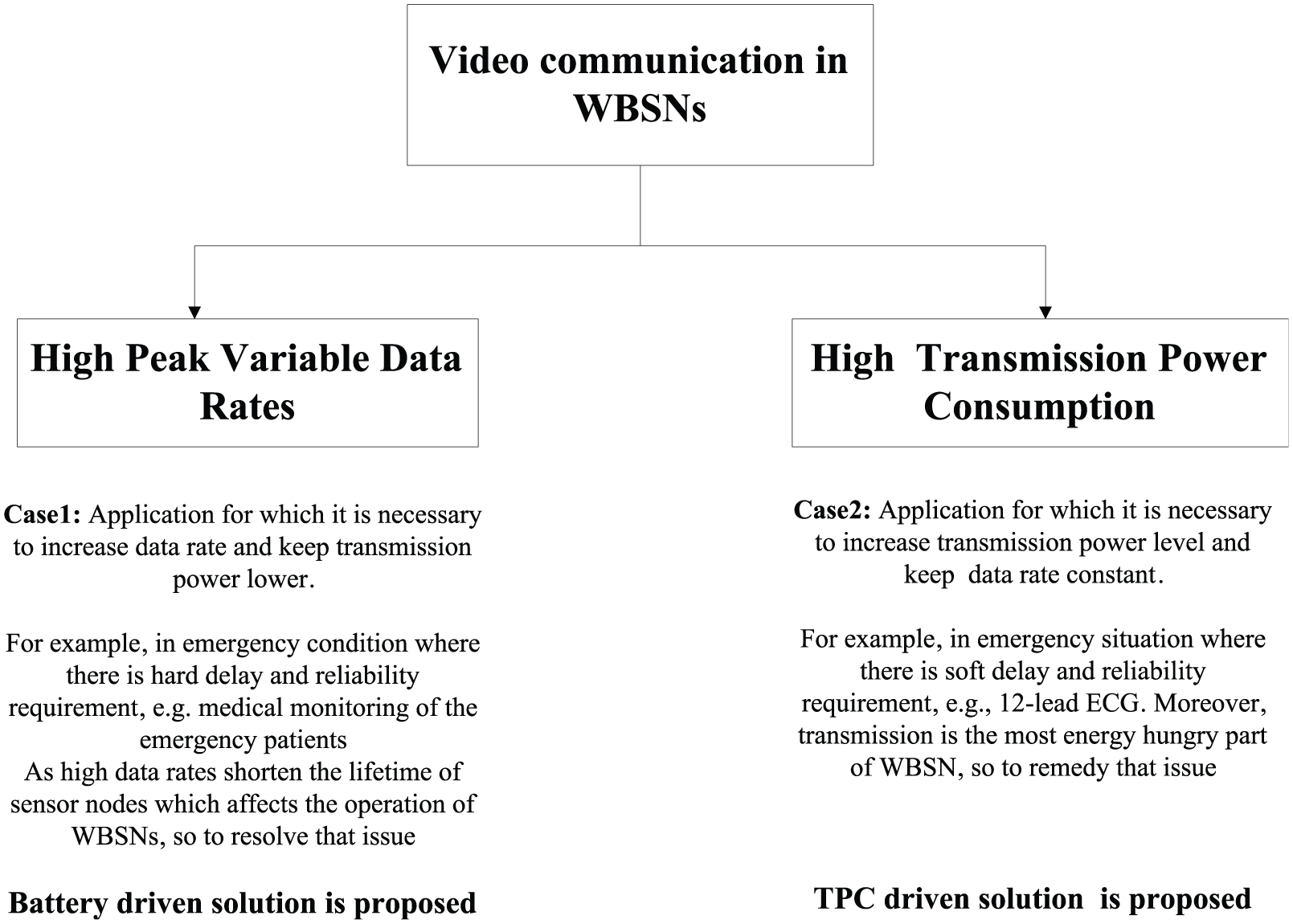
Classification of applications and proposed energy-efficient solutions in WBSN.
As WBSNs are also often specified as a subset of wireless sensor networks (WSNs), however, instead of some common characteristics, there exist huge differences between them. The main differences reside in the type and requirements of applications. Although WBSN is promising and emerging, still a great deal of additional research is required before it finally becomes a mature technology. This article emphasizes on three factors which are holding back the development of WBSNs. First, there is a lack of energy efficiency for WBSNs. Second, battery lifetime extension approaches for WBSNs need more investigation. Third, the development of joint energy-efficient and battery-friendly communication for WBSNs remains hardly touched areas.
The main contribution of this article is fourfold. First, a vast literature review is presented in detail for several energy-efficient techniques. Second, novel battery-friendly algorithm, namely, VTRCA is developed. Third, an energy-efficient TPC algorithm is designed. Fourth, comparison between TPC and battery-friendly algorithms is presented.
The remaining of the article is organized as follows. Section “Literature review” presents vigorous and vast literature review. Section “Energy efficiency of different applications in WBSN” discusses energy efficiency of various medical applications in WBSNs. Section “Trade-off between data rate and TP in WBSN and algorithms classification” designs the trade-off between data rate and power consumption. Energy efficiency comparison of proposed algorithms is presented in section “Performance evaluation of TPC and VTRCA” which evaluates the performance of TPC and VTRCA, and finally article is concluded in section “Conclusion and future research.”
Literature review
We divided the related work of several researchers into three important techniques of energy-saving in WBSNs, which are categorized as follows.
Energy efficiency with TPC
Several researchers have conducted research on TPC for energy-saving in WBANs. A Ouni et al. 12 present trade-off between energy and throughput optimization in wireless mesh networks. Using open-source test-bed, 13 S Xiao et al. 14 developed a dynamic TPC approach which can regulate TP by comparing the average received signal strength indicator (RSSI) to the pre-specified lower and upper RSSI thresholds. Their algorithm saves about 35% energy without negotiating packet loss ratio (PLR). M Quwaider et al. 15 proposed many TPC approaches body motion or posture change. They used Mica2 mote with CC1000 radio for performance evaluation. Dynamic postural position indicator (DPPI) is one of their developed power control schemes, which gives 43%–50% energy. DB Smith et al. 16 designed a brand new channel prediction method, which uses start-up delay time of 2 s. Their scheme adopts few power levels in order to reduce PLR. They stated that about 22% energy is saved in comparison with a fixed TP of 10 dBm.
Due to transceiver’s constant power consumption, there is no linear trade-off between data rate and power drain, but nearly after 10 Mbps, direct proportion can be observed in both entities.17,18 This reveals that energy can be saved in linear fashion with data rate at transmitter and BS because of high data rate. A Wang et al. 19 and R Cavallari et al. 20 analyzed that the power drain is always managed by the frequency synthesizer and mixer circuits in short-range RF transceivers. Furthermore, A Wang et al. 19 examined that high data rate binary modulation strategies conserve energy by minimizing data transfer time.
S Lanzisera et al. 21 proposed rate adjustment scheme to save energy in WSNs. They found that channel quality (good or bad) is related to the RSSI or link quality indicator (LQI) measurement. It is stated that about 40% energy is saved from experimental setup. F Martelli et al. 22 developed various data rate schemes to minimize PLR and hence the better channel performance in WBSNs.
In the study of D’Andreagiovanni and Nardine, 23 it is discussed that WBSN is emerging low-power technology that enables the communications between transmitter node and BS, by facilitating many medical and non-medical applications, such as stress monitoring, chronic diseases management, and sports and entertainment, respectively. However, the energy and computing ability of sensor node are quite limited, so the major hurdles for the extensive deployment of WBSNs technology are the energy supply and its efficient utilization. Therefore, the energy efficiency and the prioritized scheduling of emergency data are the pretty important requirements in WBSNs. With the tremendous progress of the high data rate applications in WBSNs, energy-saving in wireless wearable networks has recently attended increasing attention from the research and academia. 24 Wang and Nie 25 and Jiang et al. present the power control methods to save energy, but they did not focus on adaptive energy-saving techniques.
Several conventional approaches were used by many researchers, for example, data rate maximization for constant (fixed) power and TP minimization for constant (fixed) date rate. Also, lot of research work has been presented on energy-efficient communication. Many applications of WBSNs, such as military, disaster management, and medical health, have diverse data traffic and power requirements. We consider a star topology, where nodes collect different kinds of data and transmit them toward BS. A common example of such a topology is patient’s monitoring in a hospital room, where different vital sign signals such as, 12-lead ECG, are obtained and then directed toward the medical healthcare servers, which are accessible to the expert physician’s, paramedic, and nursing staff. Moreover, we categorize the energy efficiency comparison between two applications of WBSN as (a) high data rate and low TP and (2) high TP and low data rate. Finally, a generic solution, to balance data rates and power consumption in WBSNs, is proposed.
According to the research report by Cisco, “80% of the world’s mobile data traffic will be video up to 2018.” As a result, these additional characteristics are attending the power consumption of cell phones up to the level of desktop computers. However, the lack of a constant power supply and limited battery capacity puts some restrictions on the overall power consumption of the sensor nodes. 26 Therefore, minimization of the power depletion in wearable nodes is a great challenge. Hence, a profound research in this field has concentrated on power consumption minimization. We acknowledge the TP drain in the uplink transmission (i.e. from transmitter sensor to BS). Two different cases of normal and emergency data traffic with proper selection of network parameters, for example, power level and data rate, in medical healthcare scenarios are discussed. Due to the increased attraction of mobile video applications, the analysis is then extended to the case of constant bit rate (CBR) video transmission. Experimental results show that in this case, the proposed solutions save more energy during video transmission as compared to the typical conventional approaches. One of the major concerns in WBSNs is high energy efficiency, which is also the key to extend the lifetime of battery-powered sensor nodes and to avert troublesome process of recharging or replacing battery of an on-body and implantable devices.
Energy efficiency with modulation level adaptation
As modulation level is simply the data rate in digital communication, before discussing it in detail, we will categorize the data rates. There are two types of data rate, such as CBR and variable bit rate (VBR), used in MPEG-4 video encoder. In CBR, the video is transmitted at a constant rate with bounded delay, in addition; it depends on changing the quantization parameter at the video frame level with fixed allocated quantity of bits to each frame. In VBR, the video is transmitted with rate variations (constant quality) which depend on the activity and complexity of the application scenario. However, this results in a high burstiness in some cases because of the big difference between the intra-frame and inter-frame sizes, high TP consumption, and shorter battery lifetime of sensor nodes (Figure 2).

CBR and VBR transmission in WBSN.
The heterogeneous nature of WBSNs characterizes them from the perspective of following parameters:
CBR—CBR represents a scenario where all sensor nodes send physiological parameters transmit at the same data rate. In healthcare system, it usually indicates acute (i.e. severe or critical) medical condition, where data are transmitted by the transmitter node in low packet generation interval (PGI). This condition requires maximum throughput, low packet error rate (PER), and less delay. CBR generates traffic at a deterministic rate. It is not an ON/OFF traffic.
VBR—the VBR is the scenario where all sensor nodes send the measured vital sign data to the BS at their specific data rate. This is motivated by the fact that VBR video offers stable and superior CBR videos. It is a typical case where all the sensors measure the physiological signals under normal condition. Table 1 describes the data statistics of the sensor nodes under VBR, in which ECG sensor offers the maximum traffic to the system as compared to others. The estimated throughput of the system with nodes, for example, 12-lead ECG, body temperature, blood pressure, accelerometer, respiration rate, and glucose, is about 8–10 kbps (600 samples per second, each sample of 2 bytes with overhead of processing time of 200 ms).
Priority—the level of significance and attention of each sensor node. Since the clinical environment is intensively random, sensor node’s priority will be also flexible; thus, it is mostly related to the application type and health condition of the patient.
Data packet size—group of bits in which information is broken down into small chunks and then transmitted.
Inter-arrival packet time—corresponds to the time delay in generation of two packets.
Power consumption—it is the energy consumption of each sensor node per unit of time. The TP requirement is very dependent on the nature of the application. However, WBSN nodes are generally battery-powered, and their lifetime is required to be up to several years for on-body and implanted nodes. Ultra-low-power design of radio transceiver and medium access control (MAC) protocol are very essential. A common technique for the latter at the expense of end-to-end delay is lowering the duty cycle, which allows nodes to be in sleep mode (transceiver and central processing unit (CPU) shutdown) for most of the time. This solution is effective for applications that require infrequent transmissions, however, a proper trade-off between data rate and power consumption should be found.
Duty cycle—in sensor nodes, we can define duty cycle as the ratio of the active period and the full active or inactive period, or we can say that percentage of usage of each component of the node such as, sensor, CPU, and radio, in certain periods of time.
Battery lifetime—the time of power supply provided by batteries before they drained, directly impacting the sensor node’s liberty.
Extreme energy efficiency/battery lifetime of WBSN—as node size obviously limits the capacity of the batteries and hence the energy efficiency. So WBSNs must be extremely cost-effective in their management. Hence, conserving battery resources is very crucial. At the physical (PHY) layer, the data rate and the TP are the main parameters for an energy-efficient communication in WBSNs.
Classifications of traffic applications in WBSNs.
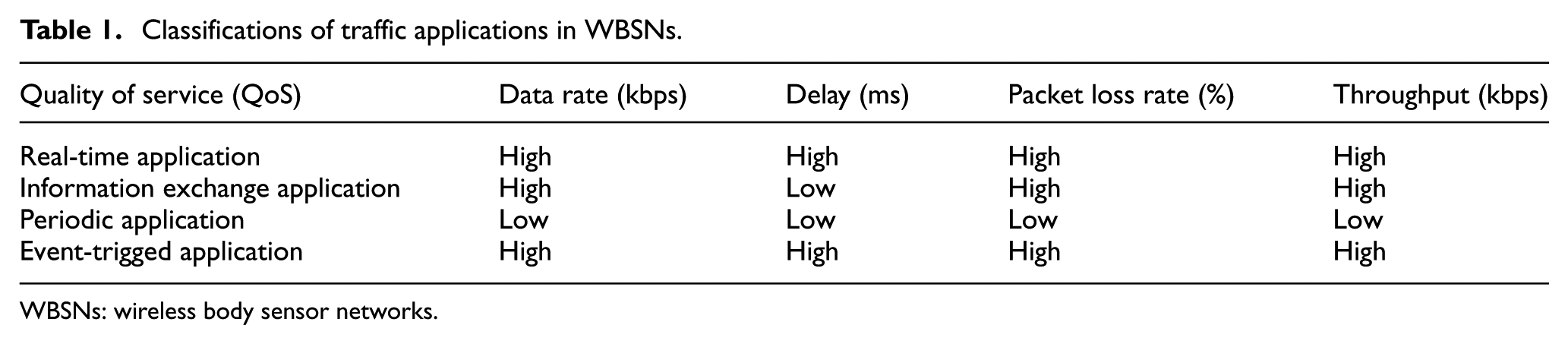
WBSNs: wireless body sensor networks.
In the study of Liang et al., researchers propose a non-coherent frequency shift keying (FSK)-based modulation technique which is appropriate for implementation using low-power integrated circuitry and contains enough flexibility to support adaptive modulation and multiple simultaneous access. Y Peng and J Choi 27 propose cooperative multiple input–multiple output (MIMO) scheme for the energy efficiency improvement in the WSNs, in which MIMO approach is based on the M-ary modulation level, so most favorable for energy-saving. R Anane et al. 28 present the comparative analysis of four types of modulation frequently used in wireless communications, namely, M-ary quadrature amplitude modulation (MQAM), M-ary phase shift keying (MPSK), and M-ary frequency shift keying (MFSK). The performance of minimum shift keying (MSK) modulation is analyzed and compared with the other modulation to improve the energy efficiency and bandwidth efficiency in a WSN. S Wang and J Nie 25 design the cooperative communication scheme for energy efficiency in WSNs. They maximized the energy efficiency by optimizing the packet size and modulation level. J Hua et al. present energy-efficient strategy based on the link level in WSNs; they used the error code and low-power modulation to analyze their proposed protocols at MAC layer. J Abouei et al. 29 describe a proactive system model according to a flexible duty-cycling mechanism utilized in practical sensor apparatus. The present analysis includes the effect of the channel bandwidth and the active mode duration on the energy consumption of popular modulation designs.
There are two basic approaches: first, to run the system toward the highest possible data rate and tune the data rate and power levels consequently (high-performance mode); second, to focus on power-saving (low-performance mode). Besides, the special cases with TP or data rate adjustment are also discussed. It can be said that in most cases, the better choice for obtaining low transmission time, maximum throughput, and remedy the hidden terminal problem is to transmit at maximum data rate and high TP level. This “high-performance” mode of operation also minimizes the transmission time, which in turn enlarges the sleep mode time, thereby minimizing the overall energy consumption. Particularly, two problems are formulated: one is to minimize the average TP consumption subjected to an average data rate constraint, while the other is used to maximize the average data rate with respect to an average TP restraint.
Energy efficiency with cross-layer approach in WBSNs
Energy efficiency represents one of the primary challenges in the development of WBSNs.30,31 Since communication is the most power-consuming operation for sensor nodes, many current energy-efficient protocols are based on TPC and duty-cycling mechanisms. However, most of these solutions are expensive from both the computational and the memory resources’ point of view, and therefore, they result in being hardly implementable on resources constrained devices, such as sensor nodes. 31 The PHY layer plays a very important role in WBSN due to the dynamic nature of wireless channel. The power consumption of sensor nodes heavily depends on the PHY layer. The MAC layer manages wireless resources for PHY layer and directly impacts overall performance of WBSN. The PHY layer deals with data transmission over wireless channels and consists of RF circuits, modulation level, and TPC.
Traditional wireless systems are built to operate on a fixed set of operating points to support the highest feasible PHY layer rate; therefore, they always transmit the maximum allowable TP levels, that is, no power adaptation. 32 This results in excessive energy consumption for average channel conditions. Hence, a set of PHY parameters that influence the system-level energy efficiency and performance should be adjusted to adapt the actual user requirements. The MAC layer ensures that wireless resources are efficiently allocated to maximize energy efficiency in WBSN. Energy can be saved in sensor nodes by shutting down system components when inactive. The MAC can enable inactive periods by scheduling shutdown intervals according to wireless channel states (good or bad) and data traffic requirements. At MAC layer, when data rate increases, then sleep time increases and active time decreases. On the contrary, at the PHY layer, active time increases with the data rate. So due to these two contradictory conditions, we introduce the concept of cross layer between MAC and PHY layers in order to control the data rate and optimize the energy in WBSNs as shown in Figure 3. How to adapt the variable high peak data rates and TPC according to the dynamic wireless on-body channel conditions and application requirement in the WBSN is very important to consider, and this cannot be handled by single PHY layer in WBSN. Because at the PHY layer, the active time increases with the data rate which is not always possible; on the contrary, at MAC layer, when data rate increases, then sleep time increases and active time decreases. So these two contradictory conditions suggest to develop energy-efficient cross layer between PHY layer and MAC layer for WBSNs as shown in Figure 3. Algorithms, architectures, and platforms from different aspects are proposed and developed accordingly for BSNs in the studies of Fortino and colleagues.33–36
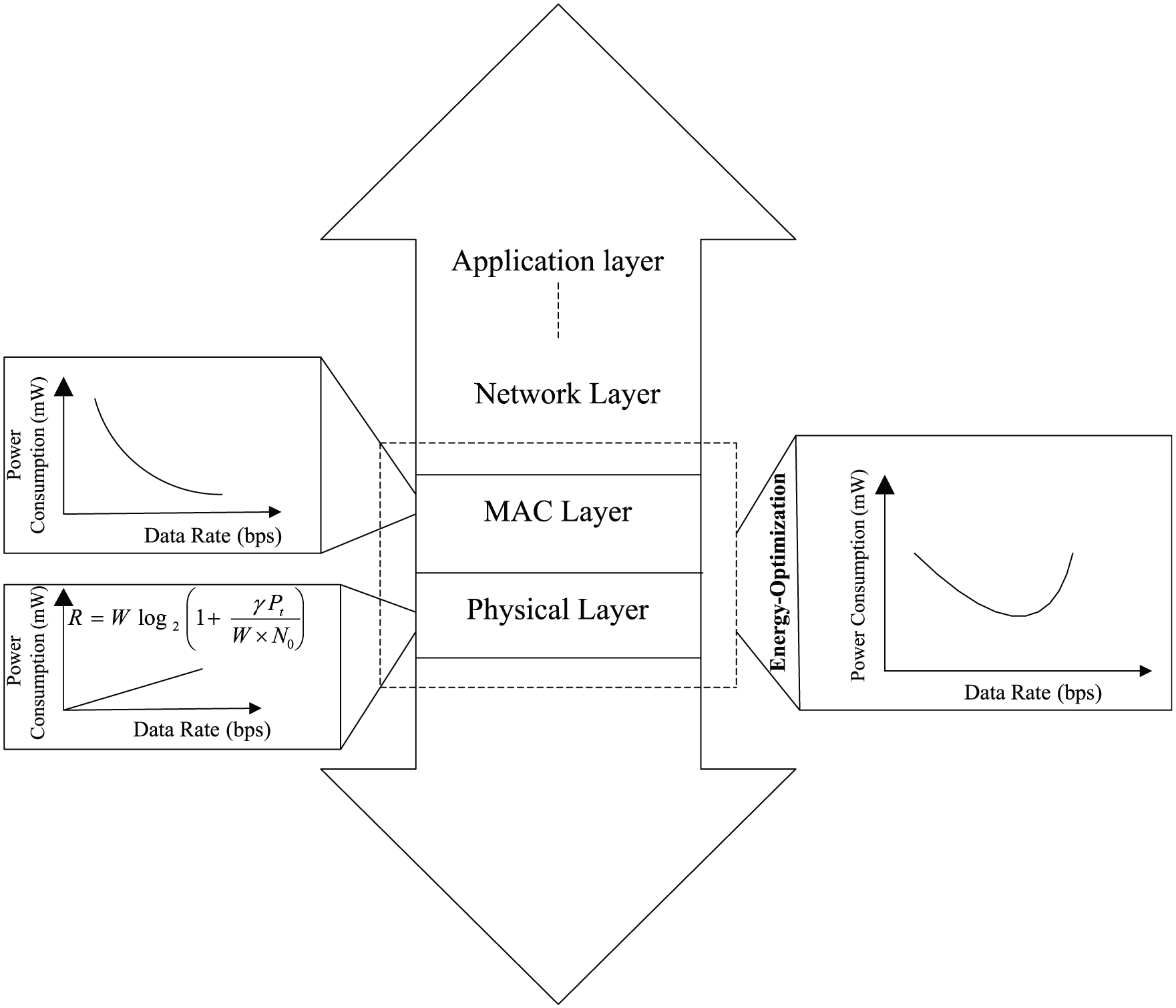
Relationship between data rate and transmission power consumption.
Energy efficiency of different applications in WBSN
Medical data traffic is random and divergent in nature with distinctive quality of service (QoS) requirements, and depends on the frequent health monitoring of the patients. There are several different traffic classes based on energy efficiency, delay, and PLR as shown in Table 1. It is inspected that energy efficiency and longer battery lifetime are important for all healthcare applications. Main QoS parameters for performance analysis, such as data rate, delay, and PLR, are adopted to categorize data traffic in WBSN.
Class 1. Real-time data traffic—very strict deadline is the main concern of these application types, but, however, PLR can be tolerated at some extent (e.g. tele-surgery). As PLR deteriorates the output quality, but still traffic perseverance is guaranteed.
Class 2. Information exchange traffic—there is hard PLR and reasonable delay requirement for these kinds of applications, such as transmission of high data rate images in capsule endoscopy.
Class 3. Periodic traffic—soft QoS delay and PLR are required for these types of applications, for instance, 12-lead electrocardiogram, in which real-time continuous medical data must be delivered with less PLR in certain deadline.
Class 4. Event-triggered—in this emergency type application, hard QoS conditions in terms of both delay and PLR are the top-most priority. It is called event-triggered, because life-critical situations are encountered most of the time, for example, video streaming of emergency patients.
Data uncertainty in WBSN can be foreseen, for example, to event-driven sensor nodes, which generates data only under some particular conditions, so that their data rate is not constant and even not exactly known earlier.30,31,37 When any sensor node transmits data, it consumes energy, and a main focus is to develop the energy-efficient communication system to extend the battery lifetime of WBSNs.
Figure 4 shows the power consumption in three different states: sleep state, idle state, and active state. Less power is consumed in sleep state, while more power is drained in active state and relatively less power is depleted by idle state. Data traffic mapping and transmission of four different applications is presented in Figure 5. Different applications of WBSN have distinct requirement of data rate and TP. Here, we will discuss class 3, periodic data traffic (i.e. 12-lead ECG) application and class 4, event-triggered traffic application (i.e. medical monitoring of emergency patients) and their data rate and TP requirements, as shown in Tables 1 and 2.

Power consumption during different states of transceiver.

Data traffic mapping of different applications in WBSNs.
Data rate and operation requirements of applications in WBSNs. 20

WBSNs: wireless body sensor networks; BER: bit error rate; ECG: electrocardiogram; EEG: electroencephalogram; EMG: electromyogram.
Trade-off between data rate and TP in WBSN and algorithms classification
We assume data rate (in bps) in case of adaptive modulation during vital sign signal and VBR video transmission. Initially, it is difficult to find strong trade-off between data rate and TP consumption on the basis of Figure 6, as power consumption is one of the challenging issues in WBSNs. However, we have limited battery power to operate sensor nodes. Due to the lack of power/energy, the node’s battery will be depleted. Recently, TPC in WBSN has become the attractive attention of many researchers.

Power consumption at different data rates for WBSN and other wireless technologies. 38
Energy of nodes is consumed according to TP required by the RF radios; so different methods are used to save energy at different layers, and WBSNs do not need high bandwidth but they require low latency and low-power consumption. Energy conservation is obtained by decreasing the sending rate in WBSNs, that is, only a subset of the sampled data produced by these nodes will be delivered to the BS. Although the increase in power may raise the error-free data rate, it may decrease the accessing time of other links due to increased interference level and therefore could have bad impact on the overall energy efficiency in WBSNs.
However, it is not necessary that lower data rates result in less energy-saving because the wireless on-body channel operating at lower data rate will be more robust to interference (from other transmitter sensor node to BS pair) and then could increase the accessing time, which has positive influence on the energy-saving. Figure 6 shows that the TP consumption is a function of data rate for a short-range RF transceiver. It is clear that the TP consumption is not a function of the data rate until the data rate exceeds 100 kbps. As explained by AY Wang and CG Sodini, 39 data rate does not scale linearly with power consumption due to the fixed amount of TP. Since reducing the data rate increases the transmission time, or equivalently, the duty cycle, which reduces the battery lifetime.
The data rates and TP levels can be randomly selected. However, the main concern is how much RSSI is obtained at the BS, in other words, very high data rate at very small TP produces small RSSI and consequently unreliable transmission. Thus, to build robust relationship between TP and data rate theoretically, we have Shannon bound which guarantees negligible bit error rate (BER) and high RSSI, as shown in Figure 7. It is imperative to adopt a high-order modulation scheme like quadrature amplitude modulation (QAM) to get more energy efficiency because it optimally manages the TP and data rate.

Variable rate with variable power versus variable rate with constant power.
Transmitting packets at a high data rate reduces the susceptible time (thus, less interference), increases the data rate, and also increases the thermal noise. Therefore, the minimum TP is required to reduce energy consumption. If data rate is carefully chosen, the TP can be minimized, thereby, prolonging the battery lifetime of WBSNs. According to the standard and requirement of application, we categorized the relationship of data rate and TP into four categories:
Variable rate and variable power (VRVP);
Variable rate and constant power (VRCP);
Constant rate and variable power (CRVP);
Constant rate and constant power (CRCP).
VRVP
With the rapid proliferation in wireless technology and microelectromechanical systems (MEMS), the small size and battery-operated sensor nodes support variable TP and variable high peak data rates. In this subsection, it is investigated that how to adjust the TP and data rate for enhancing energy efficiency in WBSN, as shown in Figure 6. We study and characterize the subtle relationship between TP and data rate of the transmitter–BS pair as well as the impact of TP and data rate setting on the energy-saving. It is found that there is interweaved association among energy efficiency, TP, and data rate. Hence, VRVP is suitable for the high energy efficiency and throughput application in WBSNs.
According to IEEE 802.15.6 standard, WBSNs are designed to handle data rates ranging from few kbps up to several Mbps while consuming small amount of energy in the range of few mJ/s, as shown in Figure 6. Increasing data rate can save energy in two ways. First, increasing data rate decreases the transmission time; hence, the chances of collision decreases. Less collision means less retransmission which is equal to saving energy. Second, in the equal and uniform time period, adaptive rates deliver more data than the non-adaptive rates. It is cleared that we need more power due to more transmissions. But the percentage of the correctly received data is more than the percentage of the power increased. Hence, the bits per joule will increase and the scheme could be more energy-efficient.
It is a well-known fact that high TP and high data rate are good for the energy-saving in the single transmitter–BS pair nodes. However, this is not always true to the total energy efficiency of the WBSNs because the rate requirement varies at very large scale depending on the type of application. It goes from kbps (e.g. 12-lead ECG) to Mbps (e.g. video transmission) as shown in Table 2. Moreover, many channel coding schemes are more energy-efficient at lower rates, that is, the energy required to send data packets can be reduced by transmitting the packet at a lower data rate and lower TP. Hence, significant power savings may be realized by transmitting data as slow as possible, for example, as usually proceeded in our proposed VTRCA.
Although the large amount of the superfluous TP is saved by the adaptive low-power technique, the reduction of TP is still limited by the data rates. Data rates of the transmitter are limited to a specific range because the various physiological features are grabbed by the analog-to-digital converter (ADC) with a fixed sampling rate. When the high frequency of the sampling rate affects accurate detection, it consumes more power during transmission of large amount of data. According to F D’Andreagiovanni and A Nardine, 23 the transceiver’s power consumption is proportional to the RF TP, which in turn scales linearly with the data rate (i.e. RF TP needs to be increased to maintain the identical BER at high data rate).
Recently, high data rate and low-power transceivers have got more attention. First, low-power transceivers like CC2420 and CC1000 have been used widely in various applications, but they do not completely fulfill the WBSNs’ requirements due to their lower data rate. From the study of N Zhu et al., 37 nRF transceivers are considered to be a good alternative to the CC2420 and CC1000. Table 3 shows some characteristics of the aforementioned transceivers. By comparing CC2420 and nRF2401A for high data rate of 2 Mbps, it is analyzed that nRF24L01 consumes less power.
Current consumption of different RF radios. 17
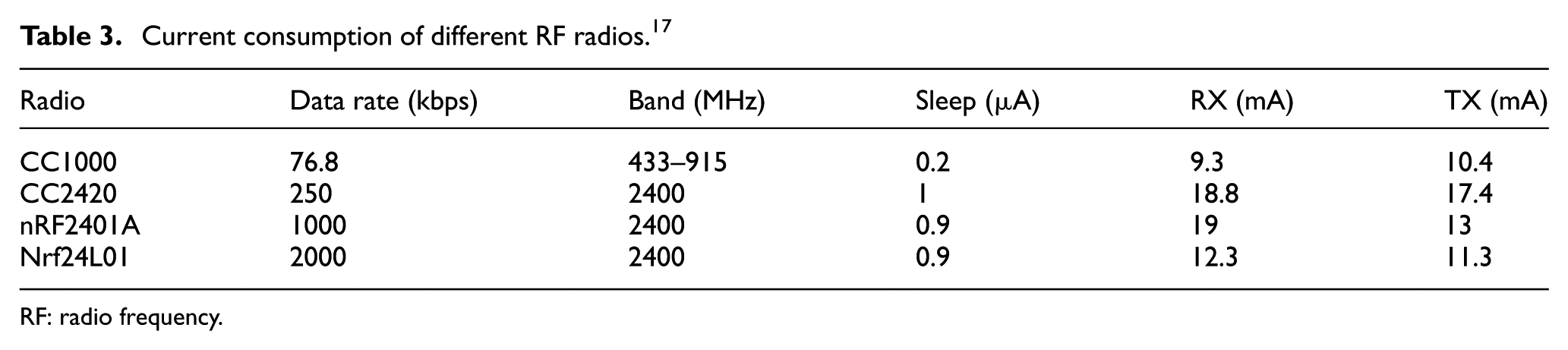
RF: radio frequency.
In emergency condition, it is very essential to provide energy-efficient and reliable information over time-varying wireless on-body channel according to patient’s body mobility, health status, and environmental conditions. 40 However, F Di Franco et al. 41 presented 128-channel neural recording system, which generates data rate about 20 Mbps. With the increase in channel number, the data rate will reach to a speed of 100 Mbps and higher, which creates a challenging problem for WBSN. Thus, many researchers studied the different types of data traffic. Data rates of different traffic applications may vary from few kbps to several Mbps as shown in Table 2. Although a single-channel sensor data only require <10 kbps, simultaneous transmission of multiple sensor data may obtain a higher speed, up to 10 Mbps. Most of the wireless short-range communication technologies designed for WSNs are not fully compatible with WBSN, so there should be ideal technology that can transmit bulk of Mbps at low power in WBSNs.
ZigBee technology has been extensively used in WSN, which is based on IEEE 802.15.4 standard. 42 It provides <250 kbps dual communication and work within the range of 100 m, but its main problem is the low transmission ability and the wireless interference in 2.4 GHz. Among the pool of broadly used wireless technologies for wireless personal area network, WiFi can provide high data rate up to 400 Mbps, whereas its structure is very complex and power consumption is up to 250 mW; so it is not appropriate for WBSN. Bluetooth is another largely used near field communication technology. It could provide up to 1 Mbps wireless communication with <100 mW power consumption, but its operation time is very limited. Ultra-wideband (UWB) technology which is the promising solution for WBSN and provides more than 10 Mbps data rate with slightly more power consumption. 38 The use of variable data rates can reduce network delay and average TP consumption, and automatic rate selection is critical for minimizing network overhead and improving its scalability.
VRCP
In this subsection, Figure 7 shows the relationship of variable rate with variable power and variable rate with constant power. We proposed novel algorithms named VTRCA with analytical battery model in order to adapt variable data rates at constant TP during video transmission for energy efficiency and battery lifetime extension of WBSNs. Proposed algorithms are suitable for the emergency application named medical monitoring of the emergency patients in the WBSNs. Further detail of VTRCA is presented in the study of A Hassan et al. 43
CRCP
The main issue of the energy depletion with constant (fixed) rate and constant TP is introduced here, as shown in upper part of Figure 8. In typical conventional wireless networks, where generally there is no feedback, the TP of all nodes is also constant. Main problem of the conventional constant power and constant data rate techniques is that they consume more energy with high reliability (i.e. small PLR). Furthermore, it is analyzed from lower part of the Figure 8 that TP changes at constant data rate. Various TP levels will be adapted on the basis of the dynamic nature of the wireless on-body channel in the WBSN, while constant power does not change with data rate. Hence, it can be said that variable TP saves more energy than the constant power.

Constant rate with variable power versus constant rate with constant power.
As TPC potentially minimizes energy drain, we have proposed energy-efficient adaptive TPC algorithm which saves more energy with reasonable PLR. In general, transmitting data at constant rate is the mechanism that consumes less energy. However, it has been proved that when a battery overflow occurs, then transmission at constant rate is not feasible. It is suitable for the highly reliable WBSN application. By developing rate control and power control algorithms, we can resolve the problem of constant data rate and constant power allocation in WBSNs. One source of constant rate video is a single-layer codec that helps to achieve constant data rate of the compressed video. 44 CBR transmission of VBR video can be performed with the optimal choice of buffer size, and the power consumption during CBR video transmission was analyzed. 26 This work describes the power consumption in the transmission part of the nodes, followed by a detailed analysis and measurements of the power consumption in the wireless on-body channel. Moreover, it was observed that much of the difficulty in determining WBSNs’ battery lifetime comes from modeling the transceiver’s power consumption as a function of time. Thus, it can be said that for extending battery lifetime of WBSNs, the data rate should be reduced. So based on these challenges, we propose battery-driven algorithms such as VTRCA with analytical battery model.
CRVP
In this subsection, we investigate the problem of dynamic nature of the wireless on-body channel then tried to adapt these changes in order to save the energy in WBSNs. Energy-efficient adaptive transmission power control (APC) algorithm is proposed which saves energy up to 40.9% with reasonable reliability. The fundamental concept of TPC is to transmit power at minimum level to save energy at a constant data rate. In WBSNs, the selection of the TP level influences the power consumption, network topology, and PLR. It is suitable for the less critical WBSN application such as vital sign signals (e.g. 12-lead ECG) measurement. Finally, we analyzed and observed that VRVP saves more energy than remaining cases, and CRVP saves less energy than VRVP but more than CRCP and VRCP, as shown in Figure 9. Hence, it can be said that VRVP outperforms all the cases due to adjustment of data rate and power with respect to channel characteristics in WBSNs. Moreover, in VRVP, for variable rates, we propose VTRCA, which controls the high peak data rate during video transmission and continues transmission for long time, while for variable TP levels, we propose adaptive TPC algorithm, which adjusts the power of each transmitter node in an on-demand fashion at constant data rate.
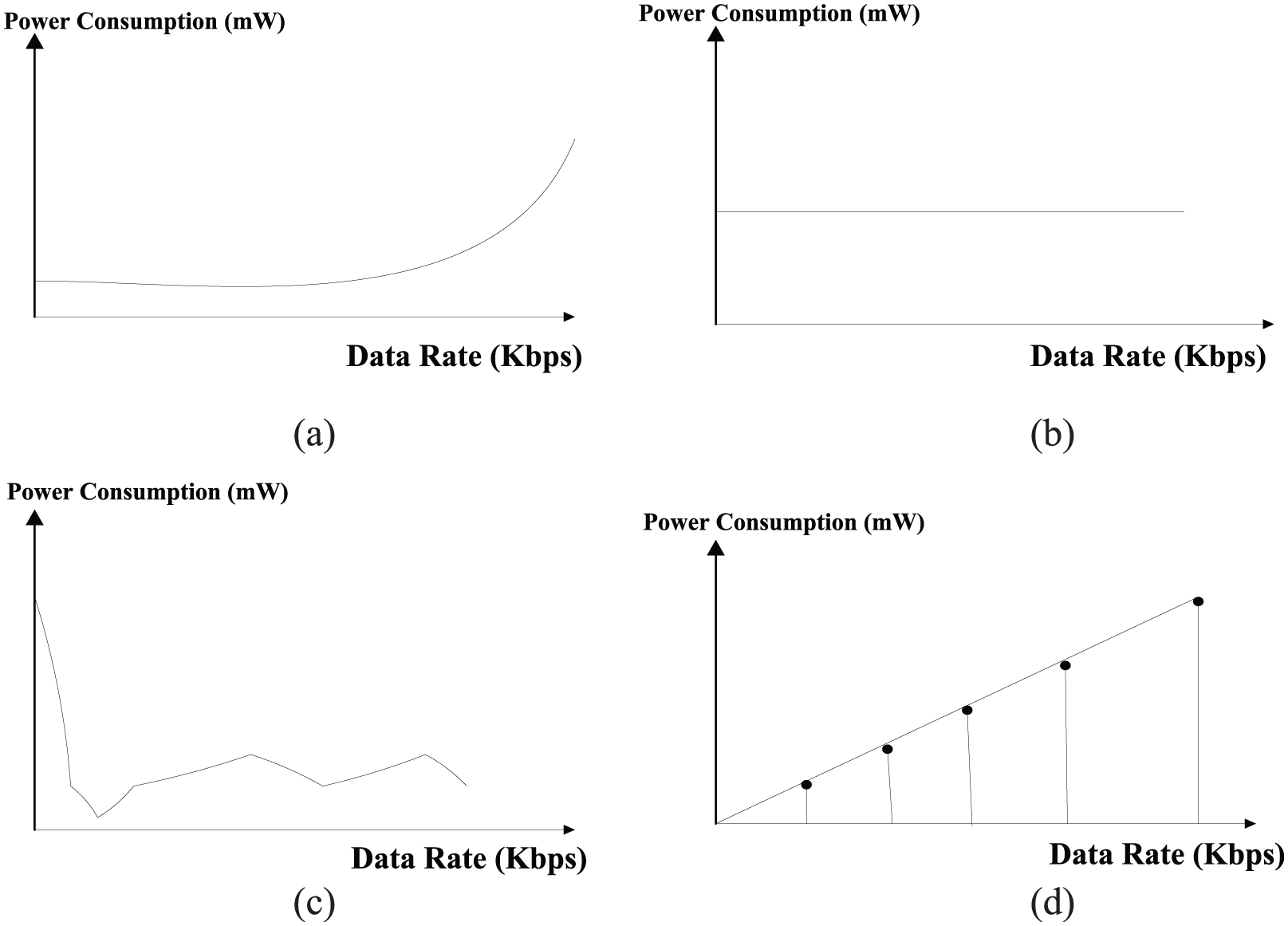
Power consumption and data rate: (a) VRVB, (b) CRCP, (c) CRVP, and (d) VRCP.
Energy efficiency comparison between TPC and rate control algorithms
This section presents comparative analysis of the energy efficiency obtained by proposed rate control (VTRCA) and power control (TPC) solutions in WBSNs.
Energy efficiency from TPC algorithm
TPC maximizes energy-saving by optimally selecting power levels at fixed rate. Moreover, TPC mostly helps in mitigating interference and near–far problems in cellular networks, such as wideband code division multiple access (WCDMA). Power control has also been used in mobile handheld devices to save energy. Cellular networks are typical long distance (≥100 m) coverage in which power depletion of power amplifier (PA) controls the transceiver’s power drain. The power dissipation of PA

Energy efficiency

whereby
When PA dominates the transceiver’s power consumption, then

Whereby
Hence, when

We can see that
Parameters used for energy efficiency comparison. 45

BS: base station; TPC: transmission power control; LVTA: Lazy video transmission algorithm; VTRCA: video transmission rate control algorithm.
Energy efficiency from VTRCA algorithm
The basic concept behind rate control transmission is to minimize high peak data rates and to maintain stable level of RSSI by adapting TP level or a combination of both. Data rate control algorithms, such as VTRCA, take advantage of good channel conditions by transmitting data at high speed. VTRCA potentially adapt variable high peak data rates to a constant TP, and their key purpose is to send desired amount of data at minimum energy and reasonable PLR. They are appropriate and adaptable with channel quality and characteristics. In conventional methods, both the data rate and the TP are fixed, which is the worst scenario for any network; and in that situation, transmission takes place at lowest data rate.
The problem of the constant rate and constant TP schemes is that they are not taking advantage of high peak data rate during transmission when the channel is in good condition (i.e. stable RSSI level). Comparing with the constant power algorithm, data rate control algorithm has potential to save energy, reduce data rate variability and channel allocation time. Our main focus is on energy efficiency because this is the challenging problem and need to be solved. When the TP is constant, the energy depletion will be in linear proportion with time. The energy obtained by VTRCA result from the uniform, smoothed, and slightly long transmission time at the transmitter node. Hence, the obtained energy efficiency increases in linear proportion with increased transmission duration. For further details, interested readers can read the study of A Hassan et al. 43
Energy efficiency comparison between VTRCA and TPC algorithms in WBSN
To compare the energy efficiency of TPC algorithm 46 and VTRCA 43 in WBSN, basic and simple energy model is considered. We do not talk about the transition time between sleep and active states because if the transition time is longer than the active duration, then VTRCA cannot give satisfactory results. Nonetheless, transition time impacts the even shorter active time during the transmission schedule design.
The basic constant TP and constant data rate approach is assumed to use maximum TP and the minimum data rate. Assume that no PLR occurs; the total energy consumption

Whereby
Suppose,

In TPC, the change in current (in mA) occurs on the basis of multiple power levels. Nevertheless, TPC does not contribute in power consumption at the BS; hence, the energy consumed to transmit

Suppose, the average current consumed during transmission of

In VTRCA, the transmission time changes according to data rates. Conventionally, high data rate modulation schemes increase the power consumption of transceiver but enhance the energy efficiency; that is why quadrature modulator is the center of attention for increasing inbuilt phase resolution. Q Zhang 45 presents the energy-saving comparison between power control and link adaptation; besides that author used frequency synthesizer–based power consumption model with M-ary modulation.
However, this will not take place in the case of transmitters compatible to IEEE 802.15.6 standard because they used high data rate binary modulation schemes containing a π/2 twisted form of a differential binary phase shift keying (DBPSK).
45
The revolution is only possible after deploying quadrature modulator; thus, power drain will not be enlarged at large extent in the transceiver while tuning from π/2 DBPSK to π/2 differential quadrature phase shift keying (DQPSK). Hence, the total energy drain during

Suppose, the mean data rate for transmitting the
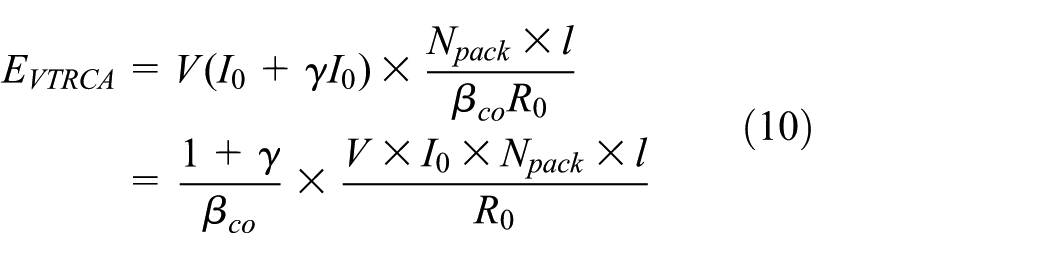
Comparing with the constant TP, the energy efficiency of variable TPC can be calculated by equation (11)

Energy efficiency of TPC depends on the average current at the transmitter and BS, and it is restricted by the maximum current at the BS and the minimum current at the transmitter node, that is,

From equation (12), it is obvious that the VTRCA uses the average values of both TP and data rate and save more energy, and it monotonically increases when the average data rate increases.
We come to the point that VTRCA are more energy-efficient than TPC; we can compare

Equation (13) show that as long as
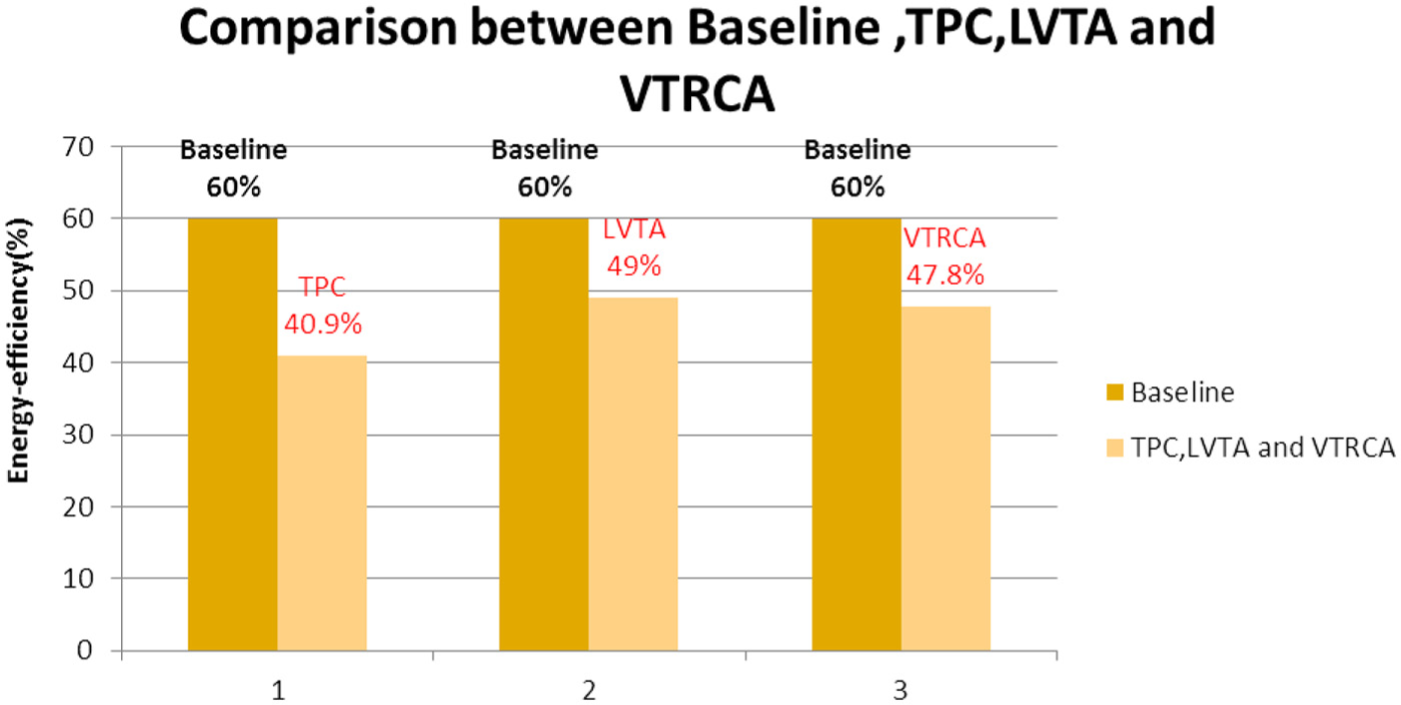
Energy efficiency of baseline, TPC, and VTRCA algorithms.
Performance evaluation of TPC and VTRCA
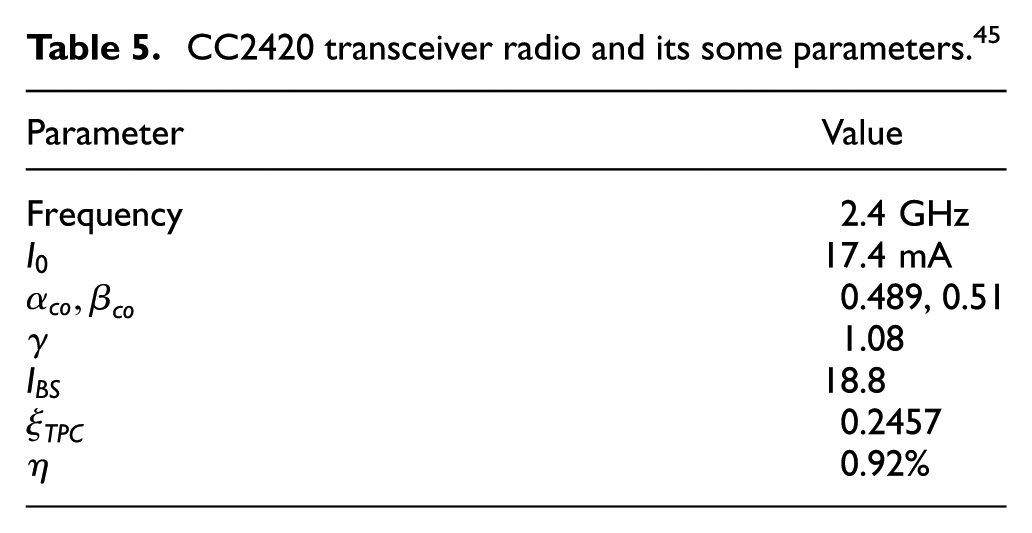
In this section, we will present the energy efficiency comparison of data rate control (i.e. VTRCA) and power control (i.e. TPC) algorithms, for the transceiver radio CC2420 with some relevant data
47
as shown in Table 5. It is clear from Table 5 that the energy efficiency of the transceiver radio is very low for short-range communications. Usually, the RSSI value is supposed to approximately deteriorate 3 dB, when data rate is doubled. For example, when spreading factor is reduced to half, the data rate is doubled, but the 3 dB processing gain is lost. In other words, we can say that switching from binary phase shift keying (BPSK) to quadrature phase shift keying (QPSK), the energy per symbol to noise density ratio
CC2420 transceiver radio and its some parameters. 45
The maximum data rate is assumed to be eight times of the minimum data rate in rate control algorithms, although rate control algorithms are not widely supported by the transceivers off-the-shelf. Based on these assumptions, when path loss is reduced to 3 dB, with TPC algorithm, ideally it can reduce the TP by 3 dB or alternatively it can double the data rate with VTRCA algorithm.
We represent in equation (18) the threshold of

Table 6 shows the

The basic concept of VTRCA is that the transmitter sensor node selects the rate based on the buffer size at BS. Moreover, rate determination in WBSNs is based on the RSSI value. The larger the RSSI, the better the chance of receiving data with the lower BER. In addition, some modulation schemes perform better than the other for transmitting information with a given RSSI and bandwidth. Rate adaptive approaches commonly use threshold-based mechanism to predict the suitable rate, such as if the RSSI at the BS is higher than the threshold value, then it selects a suitable data rate setting for next packet/frame transmission and updates the RSSI according to the selected data rate. If RSSI is below the threshold level, then the packet/frame is considered as lost. A lower data rate should be selected for the next frame/packet transmission.
The main idea of TPC algorithm is that when the current RSSI value is higher than the threshold R5SSI (i.e. –92 dBm), then it calculates the new TP level and transmits new frame/packet at that new TP level. Similarly, when current RSSI level is below the threshold RSSI, the packet is regarded as lost. That is why, adaptive power control algorithm is proposed to more energy efficiency in WBSNs. To make a comparison with rate control algorithms in terms of energy efficiency, the TPC algorithm adopts these TP levels [–31, …, –3, –2, –1, 0, 1, 2, 3, …, 31] dBm which is obtained based on the RSSI value as shown in Table 7. During experimental analysis, the voltage and current (mA) vales are taken from the data sheets of CC2420 transceiver radio.

DBPSK: differential binary phase shift keying; DQPSK: differential quadrature phase shift keying.
Conclusion and future research
This article compares the energy efficiency of the rate control algorithm (VTRCA) and TPC algorithm by considering generic energy consumption model in WBSNs. It reveals that how the average current (mA) and the average data rate (bps) at the transmitter node achieves energy efficiency of VTRCA and TPC algorithms. Mathematical proof in which VTRCA outperforms TPC algorithm is also presented. Moreover, for the assessment of energy efficiency, experiments were conducted on large datasets to verify the proposed algorithms, as shown in the study of AH Sodhro et al. 46 and A Hassan et al. 43 accordingly. The simulation results show that VTRCA saves more energy about 47.8% than TPC with energy-saving of 40.9% in WBSN.
Footnotes
Acknowledgements
Ali Hassan Sodhro and Li Chen have defined the research theme, conducted the literature review, and carried out the laboratory experiments. Ali Hassan Sodhro and Wanqing Wu have analyzed the data, designed “Methods and experiments,” and interpreted the results and wrote the paper. Yacine Ouzrout and Aicha Sekhari have helped to supervise the field activities and designed the study’s analytic strategy.
Handling Editor: Giancarlo Fortino
Declaration of conflicting interests
The author(s) declared no potential conflicts of interest with respect to the research, authorship, and/or publication of this article.
Funding
The author(s) disclosed receipt of the following financial support for the research, authorship, and/or publication of this article: This work is supported in part by the HEC Pakistan under the Start-Up Research Grant Program (SRGP) #21-1465/SRGP/R&D/HEC/2016, and Sukkur IBA University, Sukkur, Sindh, Pakistan, and science technology and innovation committee of Shenzhen for research projects (Grant JCYJ20160429174426094, JCYJ20151030151431727, JCYJ20150529164154046), Shenzhen Highlevel Oversea Talent Program (Peacock Plan) (#KQJSCX20160301141522), the National Natural Science Foundation of China under grants (#61771462), Guangdong Province Science and the Technology Planning Project of (No. 2016A030310129, No. 201704020079), Natural Science Foundation for Distinguished Young Scholars of Guangdong Province, China (2014A030306029), the National Key Research and Development Program of China (2016YFC1300300).