




Abstract
Due to the real-time requirement of message in vehicle ad hoc networks, it is a challenge to design an authentication for vehicle ad hoc networks to achieve security, efficiency, and conditional privacy-preserving. To address the challenge, many conditional privacy-preserving authentication schemes using bilinear pairing or ideal tamper-proof device have been proposed for vehicle ad hoc networks in recent years. However, the bilinear pairing operation is one of the most complex cryptographic operations and the assumption of tamper-proof device is very strong. In this article, an efficient location-based conditional privacy-preserving authentication scheme without the bilinear pairing and tamper-proof device is proposed. Compared with the most recently proposed authentication schemes, the proposed scheme markedly decreases the computation costs of message signing and message verification phase, while satisfies all security requirements of vehicle ad hoc networks and provides conditional privacy-preserving.
Introduction
With the substantial increase in vehicle ownership, people’s life and occupation have more and more closer relationship with vehicles. As a result, the importance of promoting traffic safety and efficiency is more and more highlighted. Over the past decade, vehicle ad hoc networks (VANETs) have drawn great attention from the government, academia, and industry. The security applications and value-added applications are proposed to improve the traffic safety and driving experience.1,2 In general, a VANET consists of vehicles equipped with onboard units (OBUs), fixed roadside units (RSUs), and a trusted authority (TA). Vehicle’s OBU communicates with other vehicles and RSUs via a public wireless channel. RSUs also connect TA via wired channel. A general system architecture of VANETs is shown in Figure 1. According to dedicated short-range communication (DSRC) protocol, OBUs broadcast traffic-related messages and vehicles’ condition messages periodically at every 100–300 ms, where traffic-related messages include congestion state, traffic events, and so on, and vehicles’ condition messages include speed, current time, direction, position, and so on. With these messages, the application can obtain better awareness of traffic data and provide the best solution for vehicles.3,4
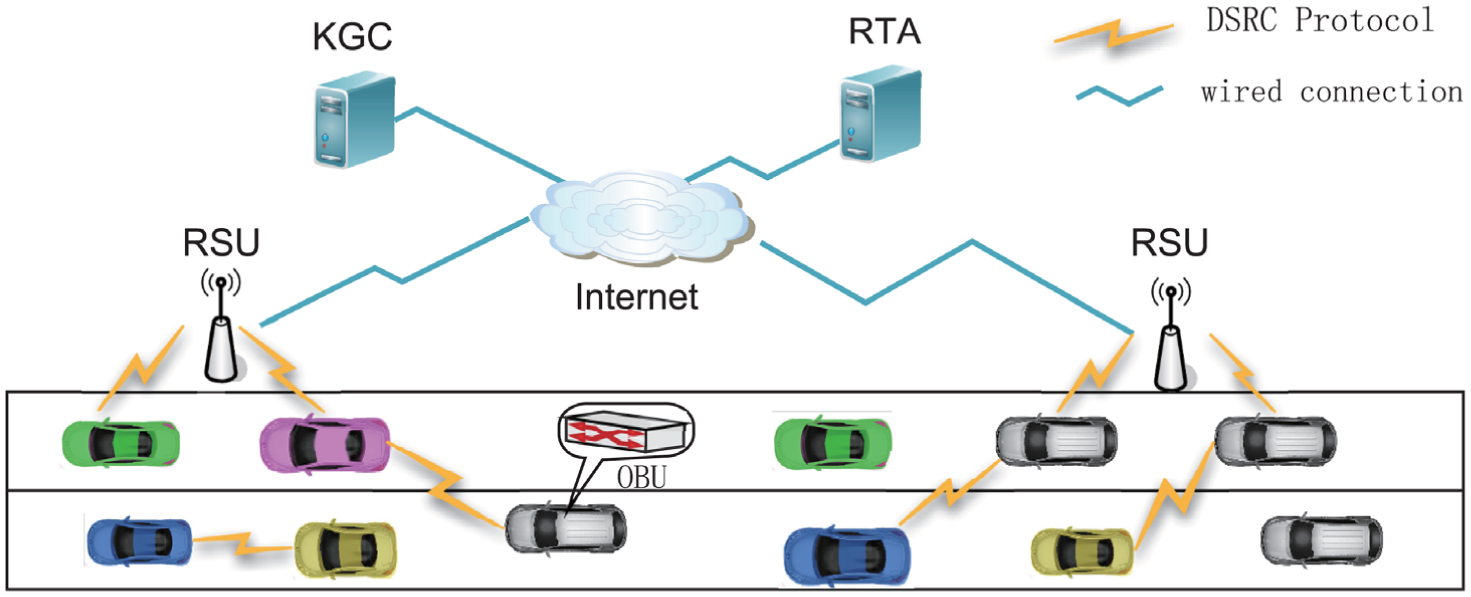
The general system architecture of VANETs.
Traffic-related messages are always transmitted by open channels and are vulnerable to various security attacks, privacy-leaking, and compromise. Therefore, prior to deployment of the promising applications in VANETs, the security and privacy issues of VANETs should be solved. To ensure the reliability and integrity of messages, message authentication scheme is involved in VANETs. 5 In general, the vehicles (i.e. the vehicle’s owner) do not want their private information to be exposed or be traced from the messages they have broadcasted, so VANETs should protect some sensitive information of the message generator. On the contrary, as a message involves in a controversial matter, there is one and only one, such as the trusted legal authority, that is able to retrieve the real identity of message generator. It is the so-called conditional privacy-preserving, which has been an urgent security requirement for VANETs.6–8 Traffic-related messages in VANETs are real-time and should be processed promptly, and therefore, another intractable issue is the efficiency of message signing and verification. Fortunately, many message authentication schemes have been proposed to address security, efficiency, and conditional privacy-preserving for VANETs during the recent 10 years.8 –23
Related work
Roughly speaking, there are two categories of conditional privacy-preserving authentication (CPPA) schemes for VANETs: schemes using group signatures and schemes using varied pseudonyms. In the first category, vehicles sign messages with the group signature. 24 To be specific, a vehicle can sign its messages on behalf of the whole group to hide its real identity with a signing key which is allocated by the group manager once it joins the vehicle group legally. Some interesting schemes are presented in previous studies.9–13 Because no one (except the group manager) can distinguish the signer of any message among the group member but the group manager can retrieve the real identity of message signers, these schemes can achieve conditional privacy-preserving well. However, the computation costs of these schemes are much more than that of the traditional signature. In addition, it may have to construct the whole group when vehicles are revoked. Therefore, group signature schemes are not suitable for the large-scale VANETs. Although some group signatures with verifier-location revocation, such as Boneh and Shacham, 25 can alleviate revocation problem, they are still very inefficient in revocation when the number of revoked vehicles is increasing. 26
In the second category, a vehicle signs messages with different pseudonyms and corresponding signing keys. In 2005, Raya and Hubaux 14 proposed a concrete anonymous authentication based on traditional signatures and anonymous certificates. In Raya et al.’s scheme, each vehicle should store a number of anonymous certificates and corresponding public/private key pairs, so that the vehicle can use different public/private keys in different authentication processes. Consequently, vehicles have to spend a mass of storage space to store public pairs in Raya et al.’s scheme. Freudiger et al. 15 proposed an anonymous scheme using mix-zones. But it still does not resolve the problem of certificates’ stores. Lu et al. 10 proposed an anonymous authentication using temporary anonymous certificates based on the group signature, in which the certificates are issued by an RSU when vehicles pass the RSU. Nevertheless, Lu et al.’s scheme is inefficient because of frequent and transient bilateral communication in certificates’ issues. To achieve secure communication with low communication overhead, Zhang et al. 16 proposed a message authentication using Hash Message Authentication Code (HMAC). However, their scheme needs to preload a certain amount of certificates to each vehicle. In the aforementioned authentication schemes, a large number of anonymous certificates raise an insurmountable problem to the management and storage of certificates.17,26
To solve the problem of certificates’ management, identity-based public key cryptosystem (PKC) 27 has been adopted to construct message authentication for VANETs, which needs no certificate to be bound to user’s identities and public keys. Zhang et al. 18 proposed an efficient authentication scheme using identity-based PKC. Zhang et al.’s scheme assumes that each vehicle is equipped with a tamper-proof device (TPD), which is supposed to be secure against any security attacks and infeasible to extract the data, including secret keys and codes, for any adversaries. Hence, each vehicle in Zhang et al.’s scheme can generate a pseudonym and corresponding signing key with TPD. To improve efficiency, Zhang et al.’s scheme provides batch verification to achieve the simultaneous verification for a large number of messages. But Zhang et al.’s scheme suffers from the relay attack and impersonation attack and cannot provide the function of non-repudiation.19,20 In recent years, researchers have proposed some similar authentication schemes for VANETs.8,13,21–23,28–30 These schemes can solve the problem of certificates’ management perfectly and achieve conditional privacy-preserving well. But these schemes are predicated on bilinear pairs, which is one of complex cryptographic operations. He et al. 7 proposed a new similar authentication scheme (called CPPA), which uses elliptic curve cryptosystem (ECC) instead of bilinear pairs. They demonstrated that CPPA achieves a better performance in terms of computation and communication cost than other similar schemes. However, the schemes using TPD are subjected to two key issues. On one hand, the security assumption of TPD is very strong.31,32 If the master key of the authority is corrupted from any TPD, the whole system will be devastated. On the other hand, TPD is much expensive and normally costs several thousand dollars, 33 which is very hard for all vehicle owners to pay several thousand dollars for TPD.
In view of the potential deficiency of TPD, some researchers proposed identity-based CPPA scheme without TPD.34–37 Chim et al. 34 proposed a software-based solution to construct message authentication scheme, called secure and privacy enhancing communications schemes (SPECS), which does not rely on any special hardware. In SPECS, the vehicle uses a different pseudo identity for each session to achieve conditional privacy-preserving. However, Horng et al. 35 demonstrated that SPECS 34 is vulnerable to impersonation attack and proposed an improved scheme over SPECS. Xue and Ding 36 proposed a top–down security authentication scheme, called location-based privacy-preserving authentication protocol (LPA). In LPA, the top authority authorizes the RSUs to issue group certificates to vehicles. Malhi and Batra 37 proposed a secure privacy-preserving authentication framework for VANETs (called privacy-preserving authentication framework using bloom filter (PAFB)). Multiple authorities are involved to retrieve the real identity of a message. The performance analysis showed that PAFB is much more efficient than similar schemes in terms of computation and communication cost.
Motivation and contributions
In most recent years, several authentication schemes based on bilinear pairing without any special security devices (e.g. TPD)35–37 have been proposed for VANETs. These schemes have overcome some serious weaknesses that exist in the certificate-based authentication scheme and shown better computation and security performance than previously proposed similar schemes. Nevertheless, bilinear pairing operation is involved in these schemes, which is a complex cryptographic operation. To achieve the security level of 80 bits, bilinear pairing should construct the paring operation and scalar multiplication operation using a super singular curve. 38 In VANETs, the OBUs and RSUs are limited in computational capability. According to DSRC protocol, vehicles or RSUs often receive a huge number of messages in a short time, and most of these messages in VANETs are time-sensitive and life-critical that should be verified and processed timely. As the bilinear pairing operations are too complex for OBUs and RSUs, these schemes still cannot satisfy the computation requirement of VANETs, especially for vast message verifications. Therefore, it is still a rewarding challenge to design an efficient and secure authentication scheme without using TPD for VANETs.
To address the challenge, we propose a new secure and efficient CPPA scheme using ECC, which could use a non-super singular curve to achieve the security level of 80 bits and decrease computation cost sharply. In brief, there are threefold contributions of this article:
We propose a new location-based CPPA scheme for VANETs without using any special device, such as ideal TPD.
The proposed scheme is constructed based on ECC without any complex bilinear pairing operations. In addition, the batch message verification is provided in the proposed scheme to improve the verification efficiency. The performance analysis and comparison show that the proposed scheme can achieve better performance than other similar schemes.
The security analysis demonstrates that the proposed scheme can meet the security and privacy requirements of VANETs.
The rest of this article is organized into five sections: section “Background” introduces the research background. The proposed authentication scheme for VANETs is proposed in section “The proposed scheme.” The security analysis is demonstrated in section “Security analysis.” Performance analysis is shown in section “Performance analysis and comparison.” Finally, conclusion is given in section “Conclusion.”
Background
System architecture
The three-layer network model 37 is adopted in this article. The top layer includes regional trusted authority (RTA) and key generation center (KGC), the middle layer includes RSUs, and the lower layer includes vehicles, as shown in Figure 1:
KGC and RTA: The KGC is viewed as a trusted administrator, and it is responsible for system parameters’ generation and allocates partial registered vehicles. The RTA is in charge of the public key management of registered vehicles and RSU under its jurisdictional area and is responsible for the deployment and monitoring. The KGC and the RTA can retrieve the real identity from wrong messages (i.e. a message with valid signature but untrue content) jointly.
OBUs: Each vehicle is equipped with an OBU and global position system (GPS) module. An OBU regularly broadcasts messages about traffic status, such as position, direction, speed, traffic condition, danger warming, and others. Moreover, it is in charge of communication with other OBUs and RSUs according to DSRC protocol.
RSUs: RSUs are some fixed substance units along roadside. An RSU can communicate with vehicle’s OBU via DSRC and connects RTA via a wired channel. RSUs are monitored by the RTA periodically. We assume that if an RSU is compromised, it will be detected soon and informed to its neighbor RSUs by the RTA. 37 Each RSU maintains a list of neighbor RSUs. If a neighbor in its list is compromised, the RSU will broadcast to vehicles within its communication range. When the compromised RSU is recovered, the RTA and RSUs will undo the former operation.
Threat model
The VANET system would suffer from various security attacks when providing secure driving service and some other application service. In our proposed system model of secure message authentication, we assume that the TA is fully trusted by other parties in the system, and it has the highest security level so that it can hardly be attacked by adversaries. And the authentication server (AS) is a credible service center as well. Thus, in this system, there are two major types of attackers who can implement security attacks.16,20
The external attacker
This kind of attackers can damage the VANET system via launching a series of security attacks, such as impersonation attacks (i.e. legal vehicles, RSUs and application servers), tampering attacks, replay attacks, DoS attacks, and tracking attacks. Usually, an external attacker will resort to unscrupulous means to achieve their attack goals.
The internal attacker
This kind of attackers is usually some malicious registered vehicles. They are likely to maximize their interest by the security vulnerabilities of the system. For example, a malicious vehicle may publish fake message about traffic congestion to tempt other vehicles to change their routes so that the malicious one can get better road resources. And the malicious vehicle can use a fake identity or collude with others to derive its own benefits. What is more, some malicious vehicles can tamper the position information to escape from traffic responsibility. Nevertheless, such attackers will not attack the system on the occasion of having known that it will be held accountable or no benefits.
Security requirements
In this article, similar to Malhi and Batra, 37 we assume that the KGC and the RTA are infeasible to compromise by any adversaries and can be completely trusted, which is a common assumption in VANET schemes.18,21,31 We also assume that once a compromised RSU could be checked out timely, it is under the real-time monitor of the RTA.36,37 Based on the assumption, authentication schemes for VANETs should satisfy the security and privacy requirements as follows:
Message integrity and authentication: In VANETs, a message should be authenticated. For this, the message’s generator can be ensured as a registered member of the system and the message is the original one without any modification. 39
Traceability: When a vehicle is involved in a controversial matter, the TA should be able to retrieve the real identity of the messages related to this matter for justice. Otherwise, inside attackers and malicious users have no qualms to broadcast wrong messages to other vehicles.
Provide conditional privacy-preserving: Like privacy-preserving in other scenarios, the real identity of a vehicle must be anonymous to any others, including vehicles, RSUs, and attackers. However, a maliciously behaved registered vehicle may broadcast wrong messages by abusing the anonymity function. To prevent the registered vehicles from abusing the property of anonymity, the RTA and KGC should be able to retrieve the identity of the message generator. Therefore, the authentication scheme should provide conditional privacy-preserving.
Resistance to modification attack: Because the messages of VANETs are delivered in unsecure wireless communication channels, the adversary can easily obtain and modify messages. The proposed authentication scheme should be able to resist the modification attack.
Resistance to impersonation attack: The adversary can send messages to others to impersonate an illegal vehicle to destroy traffic safety or obtain personal interest. Therefore, the proposed authentication scheme should be able to resist the impersonation attack. 40
Resistance to replay attack: This attack is a form of security attack in which a valid data transmission is maliciously or fraudulently repeated or delayed. In VANETs, the adversary can get the messages of other vehicles and launch security attack by repeating these messages. Therefore, the proposed authentication scheme should be able to resist the replay attack.
Resistance to man-in-the-middle attack: This attack is an attack where the attacker secretly relays and possibly alters the communication between two parties who believe they are directly communicating with each other. In VANETs, an attacker can launch this attack more easily. 37 Therefore, the proposed authentication scheme should be able to resist man-in-the-middle attack.
The proposed scheme
In this section, we propose a new efficient CPPA for vehicular communications. The proposed scheme consists of five phases: system setup, pseudonym allocation, message signing phase, message verification phase, and identity extraction phase. To simplify the presentation, the notations used in this article are listed in Table 1.
Notations used and description.

Like the analysis in section “Background,” we assume that KGC and RTAs can be trusted completely; they are infeasible to compromise by any adversaries, and the compromised RSUs can be checked out by RTA timely.
System setup
The system setup includes two processes: initialization parameters and management for RSUs’ registration for vehicles.
The initialization parameters are executed by the KGC as the following steps:
S1: The KGC chooses an elliptic curve
S2: The KGC chooses four secure hash functions,
S3: The TA sets
Each RTA selects
RSUs with location
The registration of the vehicle is executed as follows:
R1: Assume each vehicle obtains a unique identifier
R2: Upon receiving message
R3: After receiving
Pseudonym allocation phase
To achieve conditional privacy-preserving, the random short-term pseudonyms are adopted in our proposed scheme. The short-term pseudonym allocation mechanism of the proposed scheme allows a vehicle to require short-term pseudonyms from a new RSU if it comes within the communication range of the RSU. Then the vehicle uses its new pseudonyms to communicate with others when it is in the coverage of the RSU. The pseudonym allocation steps are described as follows:
P1: The vehicle
P2: Upon receiving message
P3: When receiving responding message, the vehicle decrypts the message with its own secret key
P4: Upon receiving message
P5: When receiving message
The schematic flow of pseudonym allocation phase is shown in Figure 2.

The progress of the pseudonym allocation.
Message signing phase
After the above pseudonym allocation phase, the vehicle
To send a message
Message verification phase
Upon receiving message

If so, the verifier accepts it, else drops it.
Due to
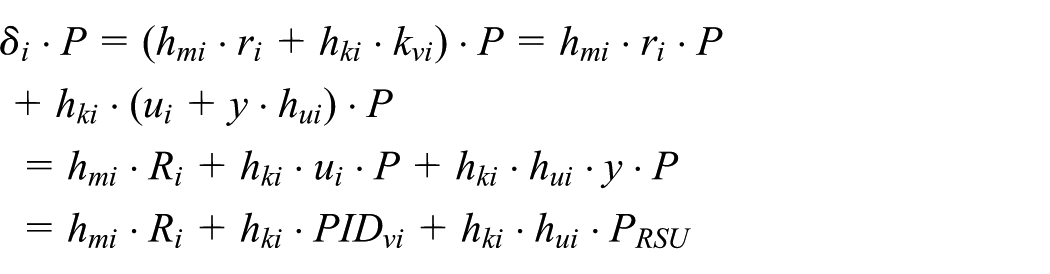
Therefore, it can prove that the single message verification is correct.
To improve the efficiency of message verification, the proposed scheme provides a function to batch message verification, which enables the verifier to verify multiple messages simultaneously. Assume the verifier has received n messages
B1: The verifier checks whether the timestamps
B2: To avoid false acceptation in batch verification, the small exponent test technology8,35 is adopted in our proposed scheme, where a vector including some small integers is used to detect any modifications in a batch of signatures. Assume there are n messages needed to be checked. The verifier selects a vector
B3: The verifier computes

If it holds, the verifier accepts these messages. Otherwise, there is at least one invalid message in these messages. The invalid message detection algorithm proposed in Huang et al. 23 is adopted to detect invalid messages. For more details, please refer to Huang et al. 23
Due to

Therefore, it can prove that the batch message verification is correct.
Identity extraction phase
When the valid message
E1: The RTA searches
E2: When receiving
Security analysis
In this section, the security proof of the proposed scheme is analyzed, and then the proposed scheme is demonstrated to meet the security requirements of VANETs. ECC41,42 is widely used in the design of authentication schemes. The security of ECC is according to a famous complex assumption about ECC, that is, elliptic curve discrete logarithm problem (ECDLP): Given two random points P and Q on
According to security assumption in section “Background,” RSUs are trustable entities in message signing and verification phase. Therefore, we mainly show that the proposed scheme is able to be unforgeable against an adaptive chosen message during the message signing phase.
Theorem 1
The proposed scheme is existentially unforgeable against an adaptive chosen message under the random oracle model.
Proof
Assume an adversary
Setup.
h1-Oracle. When
h2-Oracle. When
h3-Oracle. When
Sign-Oracle. When
Output. Finally,

If it does not hold,
According to the forgery lemma,
43
the adversary

According to equations (3) and (4), it can deduce as follows
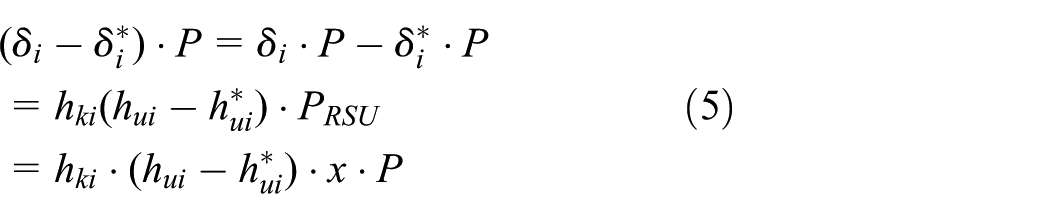
From equation (5), we could obtain

Now,
E1:
E2:
E3:
Let

Obviously, the probability cannot be non-negligible. It contradicts with the hardness of the ECDLP in the game. Therefore, it can prove that the proposed scheme is secure against forgery under adaptive chosen message attack in random oracle model.
Next, we show that the proposed scheme meets the security requirements of VANETs mentioned in section “Security requirements.”
Message authentication
The message authentication is a basic security requirement of VANETs. According to Theorem 1, an attacker cannot forge a valid message in the proposed scheme if the ECDLP is hard. A message can be authenticated by checking whether the message meets verification
Conditional privacy-preserving
In the proposed scheme, the real identity of the vehicle is involved in
Resistance to attacks
A secure authentication scheme should be able to resist all kinds of security attacks. 44 Next, we show that the proposed scheme is resistant to modification attack, impersonation attack, relay attack, and so on.
Modification attack
If an attacker makes some modifications on a message
Impersonation attack
To impersonate a vehicle, the attacker must forge a message
Man-in-the-middle attack
The proposed scheme provides authentication between the verifier and the sender for VANETs. If an attacker launches a man-in-middle attack, he or she must forge messages to communicate with the verifier and the sender, respectively. However, according to Theorem 1, it is impossible for the attacker to launch this kind of attack. Therefore, the proposed scheme is secure against the man-in-the-middle attack.
Replay attack
In the proposed scheme, each message
Performance analysis and comparison
In this section, we will evaluate the proposed scheme by comparing it with Horng et al.’s 35 scheme and Malhi and Batra’s 37 scheme in terms of computational and communication cost.
Computation cost analysis and comparison
The crypto-operations of Horng et al.’s
35
scheme and Malhi and Batra’s
37
scheme are built on bilinear pairings, while the crypto-operations of our proposed scheme are built on the non-super singular elliptic curve. To guarantee the justice of computation comparison, the crypto-operations of the three schemes should achieve the same security level in the same environments. The method of computation evaluation for VANETs proposed in He et al.
7
is adopted in this article. In He et al.,
7
the bilinear pairing on the security level of 80 bits is constructed as follows:
The cryptographic operations and corresponding execution time.
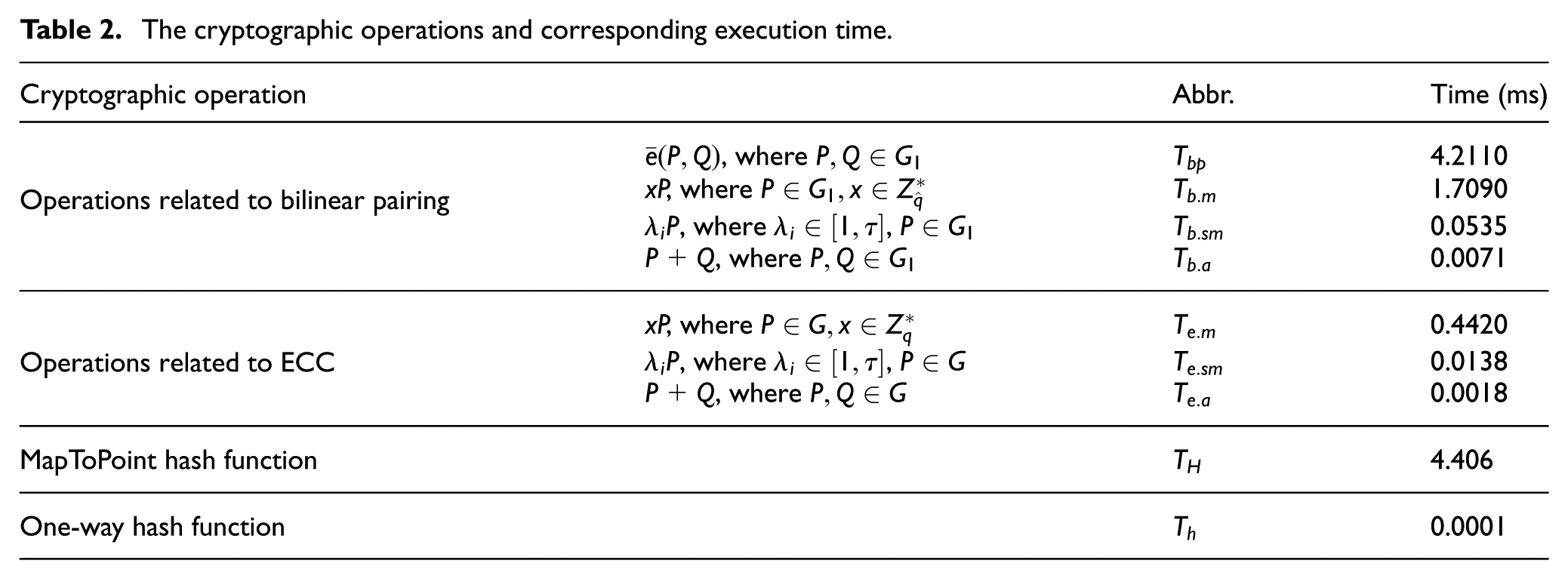
For simplicity, let MSP, SMV, and BMV denote the message signing phase, the single message verification phase, and the batch message verification phase, respectively. In Horng et al.’s
35
scheme, the scalar multiplication and point addition operation are built based on a super singular elliptic curve. The MSP of Horng et al.’s
35
scheme consists of five scalar multiplication operations, one point addition operation, two operations of MapToPoint hash function, and one operation of one-way hash function. So the total computation cost of MSP is
The computation cost of four authentication schemes for VANETs.

In our proposed scheme, the scalar multiplication and point addition operation are built on the non-singular elliptic curve. The MSP of the proposed scheme consists of one scalar multiplication operations and two one-way hash function operations. Therefore, the total computation cost of MSP is
As shown in Table 3, the computation cost time of MSP of our proposed scheme is 0.1942 ms, which decreases by 98.2% and 97.4%, respectively, when compared with the computation cost time of MSP in Horng et al.’s 35 scheme and Malhi and Batra’s 37 scheme. Meanwhile, the computation cost time of SMV of our proposed scheme is 0.5864 ms, which decreases by 95.7% and 96.9%, respectively, when compared with the computation cost time of SMV of Horng et al.’s 35 scheme and Malhi and Batra’s 37 scheme. As for BMV, the computation costs of batch verification for 50 messages of Horng et al.’s 35 scheme, Malhi and Batra’s scheme, 37 and our proposed scheme are 399.62, 269.34, and 45.27 ms, respectively, which means that our proposed schemes has 88.67% and 83.19% improvements over Horng et al.’s 35 scheme and Malhi and Batra’s 37 scheme, respectively. The improvement on computation cost of our proposed scheme is shown in Table 4.
The improvement on computation cost of our proposed scheme over other schemes.
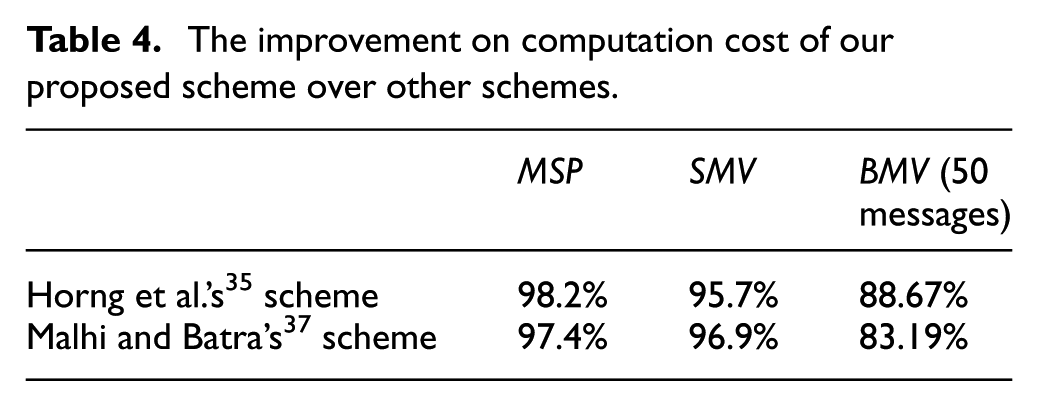
Figure 3 illustrates the computation costs of BMV phase for the different number of messages. As shown in Figure 3, our proposed scheme is more efficient than Malhi et al’s scheme and Horng et al’s scheme in BMV, regardless of the number of messages.
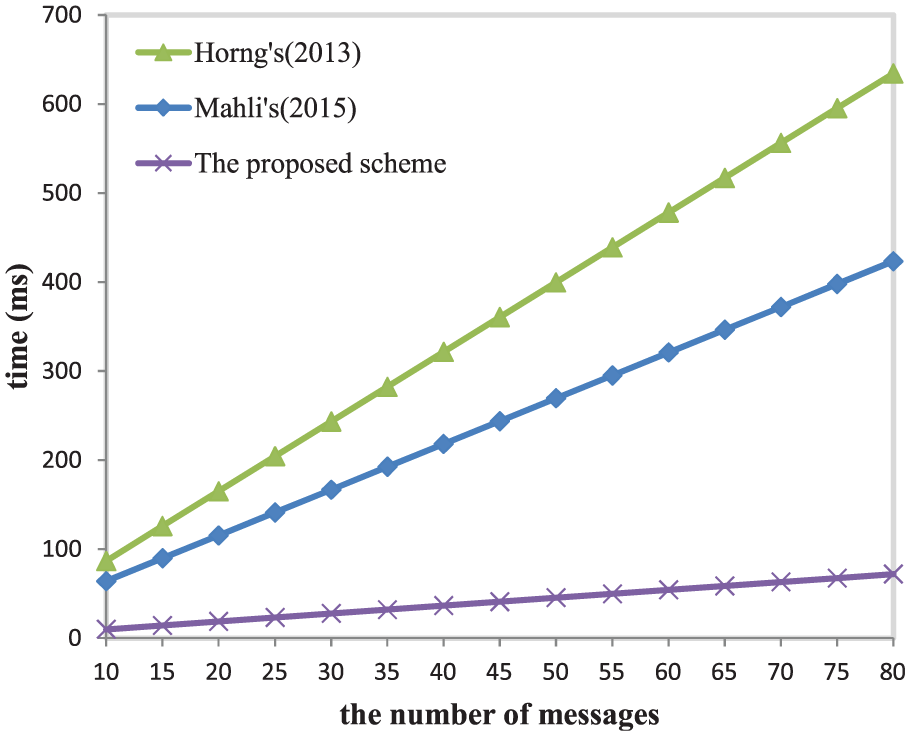
The computation costs of BMV for the number of messages.
Communication cost analysis and comparison
In this section, the proposed scheme is compared with Horng et al.’s
35
scheme and Malhi and Batra’s
37
scheme, in terms of communication cost. Like the analysis in the previous section, the size of
As shown in Table 5, the size of single message excluding
The comparison of communication cost.

Tip: the size excludes
Conclusion
In this article, a novel location-based CPPA scheme for VANETs is proposed. The proposed scheme utilizes the location information to allocate vehicles’ partial secret keys, and the vehicles could sign messages with unrelated pseudonyms to hide its real identity. Unlike the existing authentication schemes for VANETs, no TPDs and bilinear pairing operations are involved in the proposed scheme. Security analysis shows that the proposed scheme meets the security requirements of VANETs. Compared with the recently proposed similar authentication schemes, the proposed scheme greatly reduces the computation and communication costs to more than 90% and 50%, respectively, with the guarantee of security and privacy preservation. Therefore, the proposed scheme solves the challenge well and is more practical for VANETs. To improve the efficiency of message authentication, next, we will research on cooperating authentication scheme among vehicles for VANETs.
Footnotes
Academic Editor: Muhammad Khurram Khan
Declaration of conflicting interests
The author(s) declared no potential conflicts of interest with respect to the research, authorship, and/or publication of this article.
Funding
The author(s) disclosed receipt of the following financial support for the research, authorship, and/or publication of this article: This work is supported by Natural Science Foundation of China (61472287, 61572370), Science and Technology Support Program of Hubei Province (2015CFA068) and Science and Technology Plan Projects of Wuhan City (2016060101010047).