




Abstract
Vehicular cloud computing is envisioned to deliver services that provide traffic safety and efficiency to vehicles. Vehicular cloud computing has great potential to change the contemporary vehicular communication paradigm. Explicitly, the underutilized resources of vehicles can be shared with other vehicles to manage traffic during congestion. These resources include but are not limited to storage, computing power, and Internet connectivity. This study reviews current traffic management systems to analyze the role and significance of vehicular cloud computing in road traffic management. First, an abstraction of the vehicular cloud infrastructure in an urban scenario is presented to explore the vehicular cloud computing process. A taxonomy of vehicular clouds that defines the cloud formation, integration types, and services is presented. A taxonomy of vehicular cloud services is also provided to explore the object types involved and their positions within the vehicular cloud. A comparison of the current state-of-the-art traffic management systems is performed in terms of parameters, such as vehicular ad hoc network infrastructure, Internet dependency, cloud management, scalability, traffic flow control, and emerging services. Potential future challenges and emerging technologies, such as the Internet of vehicles and its incorporation in traffic congestion control, are also discussed. Vehicular cloud computing is envisioned to have a substantial role in the development of smart traffic management solutions and in emerging Internet of vehicles.
Keywords
Introduction
The communication network in vehicular ad hoc networks (VANETs)1,2 has distinctive properties, such as high speed and dynamic topology. Increasing number of cars on the road results in transportation infrastructure congestion and reduced driving safety. The existing traffic management systems must be improved based on emerging situations and technologies. At present, vehicle manufacturers are exerting effort in providing all possible services to drivers and passengers to ensure their safety and comfort. VANET, which is an integral part of intelligent transportation systems (ITS),3,4 enables the development of a variety of vehicular applications. These applications can be classified into traffic safety, traffic efficiency, and infotainment applications. Traffic management system (TMS) is a major subfield within the ITS, and the management perspective incorporates multiple technologies to improve the flow of road traffic and provide road safety. Researchers and manufacturers understand the necessity of these applications and have exerted efforts in establishing standards and rules to incorporate the emerging technologies.
The emerging communication technologies enable data and resource sharing among vehicles. Various vehicle resources can be configured and integrated dynamically over the VANET. Vehicles can access these resources to sense, process, store, and communicate vehicular data in cloud computing form, known as vehicular cloud computing (VCC). 5 VCC allows authorized users (vehicles) to dynamically access the resources of a group of coordinated vehicles. These resources are broadly referred to as computing, storage, sensing, and the Internet. They are shared for decision-making to achieve traffic management and road safety. VCC opens new possibilities in terms of road traffic management. Numerous VCC-based TMSs and prototypes have been proposed. These TMSs offer various services that provide a new direction to the development of TMSs. The integration of the vehicular cloud with other commercial and roadside clouds extends the capabilities of VCC. The different cloud types formed by vehicles and the distinctiveness among them depend on the VANET infrastructure and the nature of integration among clouds. Although VCC results in new services and solutions, it also poses new potential issues and challenges.6,7
Vehicular data are processed and the information is shared among vehicles to control traffic flow. At present, vehicles have multiple radio interfaces that enable vehicles to communicate with roadside units (RSUs) and other access networks, such as 3G/long term evolution (LTE). The availability of different communication technologies in vehicular clouds addresses the problem of intermittent connectivity, but it also simultaneously introduces heterogeneity in communication. The heterogeneity of devices, software, and communication technologies involves challenges in the effective implementation of VCC. To investigate the role of VCC in managing road traffic, the capabilities and challenges of VCC must be explored. Figure 1 provides a general view of urban traffic management that is broadly divided into safety and non-safety (traffic flow control) systems.

Overview of traffic management systems.
This article is an extension of our previous work, 8 in which we provided a basic survey to elucidate the role of VCC in vehicular TMSs. In this article, we significantly extend the review and comparative analysis with new parameters, thereby supplying researchers with an insight into and a new direction for the development of TMSs. The contributions of our study include the following:
An abstraction of vehicular cloud integration and cloud-centric computing is provided for visualizing the device-level and communication-level infrastructure. This helps in exploring and generalizing the VCC process.
A taxonomy of vehicular clouds that defines the cloud formation, integration types, and services is presented.
A taxonomy of vehicular cloud services is presented to explore the object types involved and their positions within the vehicular cloud.
A comparative analysis of current state-of-the-art VCC-based TMSs in terms of network infrastructure, traffic flow control, and emerging services is provided.
The potential future challenges and issues in relation to the emerging technologies are outlined and discussed.
This article is organized into the following sections. The background section discusses the VANET-based TMSs and the VCC infrastructure. To visualize the VCC process, vehicular cloud abstraction is presented in section “VCC and its abstraction.” Section “Taxonomy of vehicular clouds” provides a detailed discussion on the taxonomies of vehicular clouds and services. The comparison of VCC-based TMSs is presented in section “Comparative study of VCC-based TMSs.” The issues and future challenges are discussed under section “Potential issues and future challenges.” The conclusion of the article is presented in the “Conclusion” section, followed by the Acknowledgments and References.
Background
Vehicular networks lay out the communication infrastructure for road traffic management applications. Non-safety vehicular applications, such as road traffic efficiency and flow control, are prime applications for traffic control in urban areas. Emerging technologies, such as cloud computing and VCC, lay the foundation for the development of new applications and shift the whole application development paradigm. A brief review of VANET applications and VCC infrastructure is presented in the following section.
V2V and V2I applications for road traffic management
Vehicular networking is gradually converging with ITS to improve traffic flow, driving safety, and the environment. Various technologies are being incorporated to develop new applications in VANET. These applications mainly use two control strategies: predictive and adaptive. VANET-based applications or TMSs are classified in Table 1 based on the traffic control strategy being used and the underlying VANET infrastructure.
Types of TMSs.

One of the most common techniques is intersection management. Intersection management involves controlling the traffic signal to give priority to emergency vehicles or accommodate lanes as per the number of vehicles in the queue. 22 Traffic information aggregation is another useful technique to minimize the vehicle to vehicle (V2V) communications bandwidth and handle scalability. 23 Efficient data collection techniques should be adopted in V2V communication to avoid overlaps in aggregation. Clustering is also a useful technique. 24 However, most appropriate V2V schemes must calculate and detect congestion in a distributed way without the support of any traffic management authorities. The broadcasting scheme should be sufficiently adaptive so it can assess the overall congestion level in specific streets and road networks.
The Internet and social networking within vehicles connect the vehicle to the world and make vehicles more safe and comfortable. VANET is now an opportunistic network on the move for other access networks. The computing and storage resources of vehicles can be shared with network users to facilitate them. Some of the limitations of VANET-based TMSs are outlined in the following.
Third-party dependency
Modern TMSs, such as in previous studies,9–12 use additional data from the Internet or traffic management authorities, such as traffic management centers (TMC). The acquired data should be accurate for the vehicle to make the right decision.
Periodic broadcasting
Regular broadcasting is not an appropriate approach during rush hours when the road has considerable traffic. The broadcast storm may generate collisions, which are common when the number of vehicles is high.
Intensity and duration of congestion
Current TMSs, such as in previous studies,15–20 can predict the travel times of vehicles but not the intensity and duration of congestion. Additional data processing is required to assess the intensity and duration of congestion.
Data delivery and latency
Latency in the transfer of data has a direct effect on the performance of vehicular applications. Most schemes do not provide details on latency and data delivery.
Reliability
Current TMSs are not reliable because they are not sufficiently secure. Security and privacy are the significant issues in VANET.
Scalability
Another major limitation of TMSs is scalability because of the varied node density types of VANET. Which, when, and where a node can join or leave the VANET cannot be predicted and scaled.
VCC infrastructure
Many technologies have been implemented to improve ITS. Likewise, certain solutions have been developed to handle the prominent problems of vehicular networks. A solution emerges in the form of a VCC that is inspired by traditional cloud computing25–27 and mobile cloud computing (MCC). The VCC 5 allows authorized users to dynamically access the resources of a group of coordinated vehicles. In VCC, vehicular resource, such as computing, storage, sensing, and the Internet, are shared for decision-making in traffic management and road safety. Investing in cloud computing is unnecessary because instead of buying, resources and services are subscribed to on demand. Cloud computing uses the underutilized resources of vehicles for a short time. These solutions face 28 the traditional VANET mobility and scalability problem with additional cloud computing-related resource heterogeneity and management issues.
The interactions of vehicles, vehicles with the infrastructure, and vehicular cloud with commercial clouds (static clouds) are presented in Figure 2. The data collection and processing at devices start with the data collection at the device level, such as sensors within the vehicle. Then, data are sent to the local repository of the vehicle for low-level data processing. The application programming interface circulates these data to related hardware (actuators) to generate alarms or warnings accordingly.

Vehicular cloud computing.
Communication in the vehicular cloud starts within the car’s communication device itself, which is referred to as in-car communication. The second level is V2V communication for resource and information sharing. Vehicle-to-cloud infrastructure communication is a larger domain of communication for services that are provided by cloud computing over underlying ICTs, and a prominent form is cellular technologies. The services of the vehicular clouds include contextual services (driver’s behavior), communication services (global positioning system (GPS), road traffic info), and complementary services (parking, tolls).
VCC and its abstraction
VCC is a hybrid technology that uses vehicular resources for traffic management and road safety. VCC enables each vehicle that participates in the cloud formation to acquire additional virtual resources to complete a task that is required to manage the vehicle’s movement on the road, thereby providing vehicles with the extra ability to assess the traffic conditions and to take more appropriate decisions while traveling on the road. For example, an approach 29 derived from the existing cloud and grid computing approach, called cloud-based traffic management system (CTMS), allows dynamic routing by combining intersection control algorithms with intersection approach advice. CTMS is one of the VCC-based solutions that employs a traffic management method that relies on the ITS-cloud to deliver a detailed traffic simulation image. CTMS integrates an adaptive intersection control algorithm with a microscopic prediction mechanism. Another prominent example is the clustering approach, which connects vehicles with similar dynamics and collects information regarding a road segment. 30 This information is then sent to a roadside cloud for traffic estimation and generalization. The cloud server predicts traffic patterns and trends for particular road segments. A summary of current VCC-based TMSs is provided in Table 2.
Summary of VCC-based TMSs.

VANET: vehicular ad hoc network; ITS: intelligent transportation systems; MCC: mobile cloud computing.
The type of VCC-based TMSs depends largely on how traffic data are collected, processed, and disseminated. If data are to be processed over the Internet, then the vehicular cloud must be connected to the Internet cloud. If data are to be processed locally, then it depends on data distribution and resource allocation schemes. Cloud management, cloud leader selection, cooperation among cloud members, and cost and incentive management are central functions upon which VCC relies. Therefore, the focus should be on how these functions should be incorporated to manage road traffic efficiently. VCC is superior over traditional VANET-based TMSs in that data are collected, processed, and disseminated locally in a distributed manner by renting resources.
To visualize the device-level and communication-level infrastructures, an abstraction of the vehicular cloud integration and cloud-centric computation that explores and generalizes the entire VCC process is created. The abstraction helps in visualizing the VCC process, as presented in Figure 3.

Vehicular cloud abstraction.
Starting from the bottom left of the diagram, the VANET infrastructure of an urban scenario is abstracted to a vehicular cloud. The cloud shows the connections of the participating members (vehicles) of the cloud. One of the vehicles acts as the cloud leader or cloud controller. The cloud controller also communicates with the Internet cloud for additional services and resources. Over the Internet, the cloud leader communicates with the traffic management authorities at the TMC, thereby providing additional information (event-related info or instructions) regarding the traffic management for the entire road network of an urban city.
Each vehicle has its pool of resources and the primary service provider/consumer at the same time. An abstraction of the vehicle is depicted in the right-hand part of the diagram, as shown in Figure 3. Each vehicle has a firmware and a hardware at the primary level that is controlled by an onboard software, such as operating systems and virtual machines. The hardware and software provide storage, computing, sensing, and communication services. Vehicle resources are virtually available to the cloud via service-level agreements with the cloud leader. The cloud leader creates, publishes, and analyzes services for vehicles by continuously assessing and controlling the virtual resources of the participating vehicles. Each vehicle may act as a cloud leader depending on the procedure adopted for cloud leader selection.
Taxonomy of vehicular clouds
Vehicular clouds are formed to provide vehicles with required services, thereby enabling route planning, safety control, and the provision of comfort to passengers in vehicles. Thus, vehicular clouds interact with sensor clouds and other commercial clouds. During cloud formation, the type of cloud interaction is created for one or more services. A variety of services is exemplified in the literature, but they rely on basic vehicular cloud services, such as communication, processing, sensing, and storage. Furthermore, whenever a service is required by the vehicle on the road, the vehicle may join an existing cloud or initiate the cloud formation process. The cloud leader discovers resources from within the cloud members and controls the incoming requests from members dynamically.
Drivers or vehicles can communicate with clouds to subscribe to services at the right place and time. A focus on the vehicular cloud and its infrastructure 40 can provide a technological change model that enables feasible solutions. A taxonomy of vehicular clouds that highlights cloud formation aspects, various vehicular cloud integration, and their basic services is presented in Figure 4.

Taxonomy of vehicular clouds.
Cloud formation
Vehicular resources could be shared with other vehicles to provide services to intended users. Cloud formation is a mechanism by which vehicles show interest for a service(s). A vehicle that has the required service publishes the related information to the network to form a cloud so that the requested service can be provided to subscribed vehicles. The vehicular cloud formation broadly consists of the following steps.
Discovery of resources
During this process, the required resources, which are necessary for the services of interest, are discovered. These resources, such as computing, sensing, and storage, can be used dynamically to provide services to users. 41 Network as a service (NaaS) is one of the services provided by the vehicular cloud in which a vehicle, moving on the road, may use a LTE network to connect to the Internet.
Organization
When all the resources are discovered, the related information is stored to keep track of who is possessing what and where within the cloud. These resources are organized in a such a way that service requests are fulfilled.
Resource and information sharing
Resources and information are shared optimally. For example, if a vehicle wants to know the real status of the coming intersection, the vehicle at the intersection is first contacted to share sensory information or images from the front camera.
Content publishing and storage
The acquired information is stored and published to fulfill near future service requests within the vehicular cloud.
Cloud types
Vehicular clouds are categorized into three broad classes, such as a V2V cloud, a vehicle to infrastructure cloud (V2I cloud), and vehicular clouds merged with other commercial clouds (integrated clouds), as shown in Figure 4.
V2V clouds
Vehicles on the roads or in parking areas form a cloud to share resources for typical services. These clouds are subcategorized as dynamic vehicular cloud and static clouds. Vehicles on the road formulate a cloud to share information on vehicle dynamics and resources. Moving vehicles and vehicular sensor clouds are examples of dynamic clouds. The former example is formed by vehicles on the road to share resources and information. The sensory information of a vehicle and its surroundings is shared in the form of vehicular sensor clouds. One vehicle can obtain information by another vehicle located at the point of interest using that vehicle’s sensors. An example is the “pic on wheel”-type of information gathering. A static vehicular cloud example is a cloud of cars that remains parked in a parking lot. Such clouds are mostly used for storage and processing purposes.
V2I clouds
These types of clouds use the V2I infrastructure to form a cloud. V2I clouds are further categorized into V2R (roadside infrastructure) and V2cellular clouds. V2R uses RSUs for control information, whereas V2cellular clouds rely on 3G/LTE for communication. V2cellular clouds are useful in large areas, and V2R clouds are better in small road networks. The traffic monitoring sensors installed along the roads can be integrated to form a cloud, which can be referred to as roadside sensor clouds. These clouds are useful in providing participatory sensing and cooperative sensing.
Integrated vehicular clouds
When other clouds, such as mobile computing and Internet clouds, are associated with vehicular clouds, they are called integrated clouds. If the vehicular cloud is connected to the Internet cloud for GPS and other services, then the cloud is called an Internet-based vehicular cloud, and if the vehicular cloud uses the services of commercial clouds, such as the Google and Amazon clouds, then the vehicular cloud is called a services-dependent integrated cloud. The clouds in this category involve a cost factor because Internet and commercial cloud services are not free. Several incentive-based resource and content (Internet downloads) sharing mechanisms are required when incorporating such services into the vehicular clouds.
Basic services
The central core services of vehicular clouds are communication, processing, sensing, and storage, which are provided by incorporating the vehicle’s underutilized hardware and software. All other complementary services depend on these basic services. “Platform as a service” (PaaS), “software as a service” (SaaS), and “storage as a service” (STaaS) are among the pool of services offered to users. All these services require the cooperation of the cloud members and the cloud leader. The mobility and high speed of vehicles may lead to intermittent services. This is the main difference between a common cloud platform and vehicular clouds.
A vehicular cloud involves a variety of sensing, storage, communication, and processing objects (devices, software). These objects range from a very basic sensor within the vehicles to the TMC over the Internet. The services of a vehicular cloud depend on the type and position of the object within the cloud infrastructure. The four basic services that are offered depend on the operation that is being performed by the cloud. These operations are data sensing, communicating, storing, and processing. The efficiency of a vehicular cloud depends on the collection, communication, storage, and processing of traffic (vehicles)-related data to or from related objects at the right time and at the right location. Figure 5 shows the taxonomy of vehicular cloud services, operations, and sub-operations with underlying complementary services, such as SaaS, PaaS, STaaS, CaaS, and NaaS.

Taxonomy of vehicular cloud services.
Comparative study of VCC-based TMSs
By adapting “pay as you go,” model vehicles can process data on demand anytime from anywhere. Drivers can now connect to the cloud via the Internet using their mobile phones. Vehicular clouds derive from the traditional MCC, 42 which provides an integrated platform and technology that can monitor road safety and road traffic management, by processing network data using different mobile cloud architectures. Since the last decade, intensive work on cloud computing has been conducted, thereby leading to the development of Internet of vehicles (IoVs). Existing VCC applications are developed to manage traffic on roads and provide the vehicular infrastructure (resources, devices) for supplementary services (storage service by parked vehicles) to users other than vehicular users. A comparative analysis is performed to emphasize the areas where the existing TMSs are lacking and the areas that need improvement for better VCC-based TMSs. A comparison is made in terms of the parameters listed in Table 3. The parameters are VANET infrastructure, Internet cloud dependency, mitigating traffic congestion, and the type of services offered.
Comparison of current VCC-based TMSs.

Most of the examples in Table 3 are dependent on the Internet cloud and they rely on the hybrid VANET communication infrastructure. Scalability and cloud management are not fully present in most of the proposed prototypes. The main feature of good TMSs is traffic flow control, which is provided by most of the current VCC-based TMSs. For example, the vehicular cyber-physical system is managed by TMC. 48 This system maintains the road traffic status, statistics per road segment(s), and the navigation of vehicles moving on the road. Emergency evacuation during a disaster using in-car systems can be done by enabling vehicles to evacuate from a catastrophe area. However, the cooperation between the vehicular and Internet clouds in the context of road traffic management applications has become a critical challenge to researchers.
Most of the TMSs use V2V communication and a few are hybrid in nature. The majority does not connect to the Internet cloud for extra information or resources and claim traffic flow control. The trend is toward higher Internet cloud independence. The use of emerging access network technologies in the development of cloud-based solutions will lead to the exploration of new capabilities. Emerging services, such as cloud cooperation as a service (CCaaS) and cooperative sensing as a service (CSaaS), are not common in recent existing VCC-based TMSs. The new technological improvements in the VCC direct researchers toward new services that may help in managing traffic on roads.
Vehicular clouds incorporate emerging technologies for the sake of new services for the vehicles and users. As explained in our taxonomy, vehicular clouds have different forms, such as integrated and dynamic vehicular clouds. In Table 4, we compare these TMSs to analyze their properties and the services they provide.
Comparatives study of integrated and dynamic vehicular cloud–based applications.
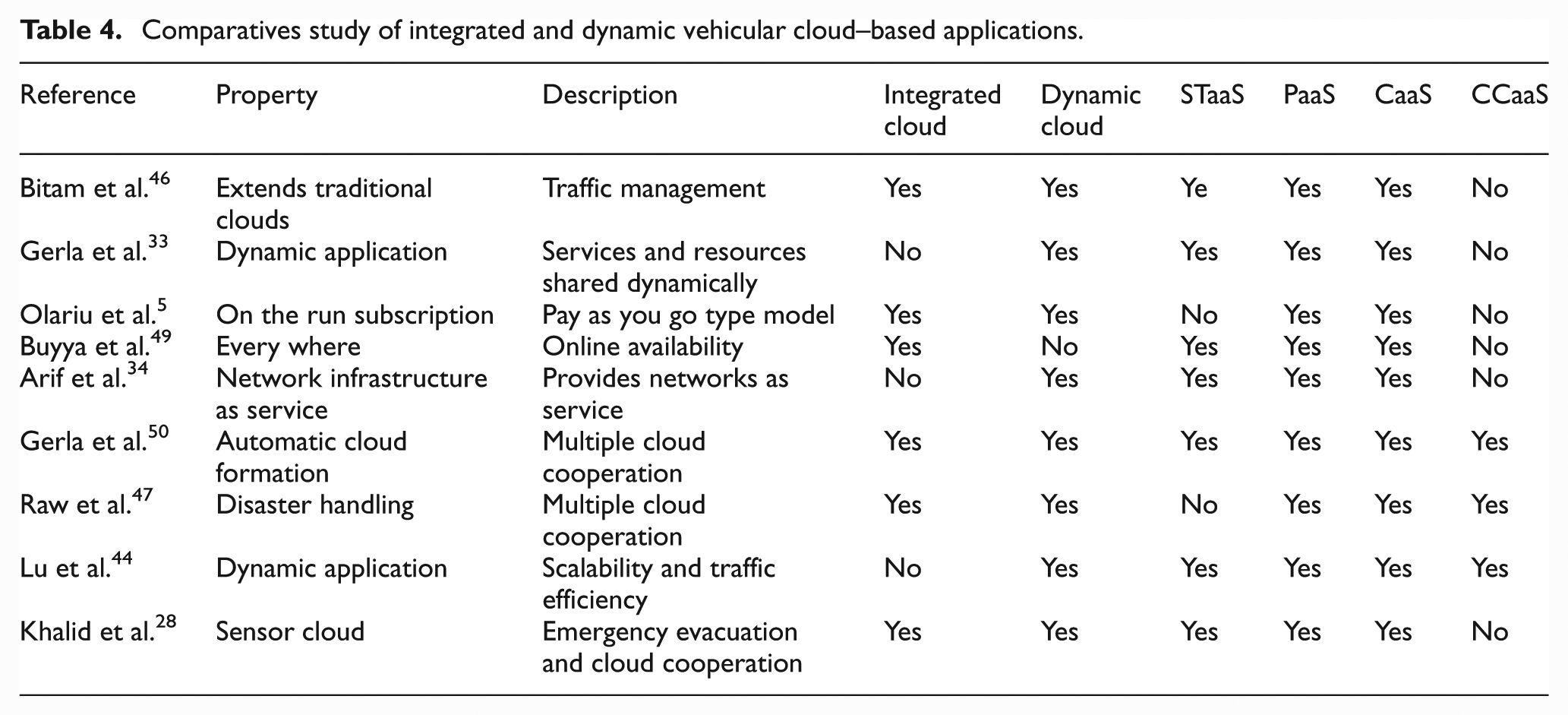
Some of the proposed TMSs have cloud cooperation properties and may provide emerging services, such as CCaaS. These services are only provided by the TMSs and are integrated and dynamic in nature. However, not all TMSs provide these types of services. Dynamic clouds are more suitable for the vehicular environment as mobility and speed prevent other clouds from functioning well as per service requirements. VCC extends VANET to a higher level of broader perspective regarding communication, computation, storage, and sensing. The effective incorporation of emerging technologies to provide a new extended pool of services helps in managing road traffic better.
Numerous opportunities and services are offered by the VCC, but certain issues and challenges that require attention remain. Multiple emerging information and communication technologies lead to different devices and software. Heterogeneity in devices, technologies, and software platforms is one of the main issues discussed in the following section.
Potential issues and future challenges
VCC helps overcome the significant challenges of real-time traffic management, evacuation management, and intersection management, as well as the problems that arise because of intermittent communication in VANETs. Meanwhile, VCC faces potential challenges that still require attention for the effective management of road traffic.
VCC and self-reliance
Heterogeneous vehicular applications (if not all) are mostly dependent on Internet or third-party networks. The emerging VCC technology should be incorporated such that it minimizes the dependency on the Internet. Fully V2V-exploited solutions are examples. VCC and cloud cooperation can be used to process more traffic data locally over the cloud. Internet cloud dependency can be minimized by exploiting cooperative VCC. For instance, if a vehicle wants to know the real situation at the approaching intersection, this vehicle needs to connect to an Internet-based server over the Internet cloud. In the vehicular cloud, the vehicle asks for the required information and the cloud controller may fulfill this query from within the cloud. Then, the vehicle is updated about the current situation at the intersection. The vehicular clouds fulfill this task effectively in proximity without letting the query be transferred to the distant Internet cloud.
Architectural robustness
In multiple cloud collaboration, when each cloud has their network, hardware, and software platform, successful service provisioning is difficult. Effective cooperation needs abstraction and flexibility of architecture to provide services. The VCC infrastructure should be sufficiently flexible to incorporate emerging application demands and to share a resource on the move. A level of robustness and service-oriented architecture are more feasible than the traditional layered architecture, such as virtualization.
Resource heterogeneity and cloud management
Vehicles produced by different vendors have different types of available resources. Furthermore, the number and type of resources in the vehicular cloud is always changing because which, where, and when a vehicle leaves or join the cloud cannot be predicted and controlled. In cloud cooperation, interoperability is essential to ensure that cloud cooperation is synchronized, reliable, and efficient. Mobility and heterogeneity should be managed efficiently for different cloud resources to be utilized efficiently. The formation and operation of a vehicular cloud requires standardization so that cloud management can be done dynamically.
Traffic management challenges
If we can allocate the appropriate resources at the right time and place within the VANET by incorporating VCC, then we can manage road traffic on a real-time basis. VCC can provide an alternative solution during disasters and help in the evacuation process. In the case of an accident/event, real-time information delivery can help in avoiding congestion on the roads by rerouting traffic.
Intersection management is a significant issue in urban intersections that cannot be avoided by simple rerouting. In this case, a birds-eye view of the area can help in managing the situation. More customized route and traffic planning are required in occasional scenarios, such as accidents and sports events.
For example, a common TMS in a city can alert drivers at a part of the city not to take a specific route because of congestion. TMSs suggest alternative routes and if a large bulk of vehicles follows the recommended route instantly, then the alternative route is likely to become congested as well. In such a situation, the load balancing of road traffic is necessary. The VCC can help by integrating multiple clouds and by processing all information to create a balanced traffic management plan for the overall traffic control of a city.
Communication challenges
The VCC relies on the communication infrastructure of VANET and on other access networks. 51 Without a successful communication, cloud computing cannot occur. The use and incorporation of emerging technologies, such as 4G/5G telecom technology, can help in facilitating communication between vehicles reliably and without delay at a large scale. The convergence of IEEE 802.11p with other access networks, such as cellular networks, can provide seamless network connections for smooth communication. The prominent examples of such networks are the heterogeneous vehicular networks that are based on Wi-Fi, WiMAX, 3G, LTE, and LTE advanced networks. Vehicular clouds incorporate these networks, for instance in V2cellular clouds, the interaction of the vehicle with the commercial cloud is via cellular networks.
The concept of fog computing 52 in V2infrastructure clouds can reduce the delay in response to vehicle requests for data or service in which network components serve as fog nodes. By contrast, a vehicle brings computing facilities closer to the source of the data as an edge node. As a localized computing paradigm, edge computing comprises end devices and is capable of faster response toward the core network. Edge and cloud computing may run in parallel, but edge computing extends the cloud computing capabilities.
Incorporation of IoVs
Vehicular networks are larger infrastructures that are available as opportunistic networks for a variety of emerging technologies, such as IoVs and the Internet of Things. 53 IoVs is an unavoidable convergence of the Internet and the Internet of Things that consists of mobile communication systems that connect vehicles and public networks. This enables IoVs to effectively guide and control the vehicles on the road. The main components of IoVs are as follows: client, connection, and cloud system. A client system contains the vehicle’s sensors and the intra- and inter-vehicle communication systems. The connection system incorporates the communication between VANETs and other heterogeneous networks. One of the important components related to VCC is the cloud system. IoVs rely on cloud computing because IoVs generate much more data, which can only be handled by cloud computing platforms.
The incorporation of the IoVs concept is helpful for the commuter, traffic management authorities, and drivers. IoVs provide a broader perspective of traffic on roads for making right decisions at the right place and time. Issues that need to be solved remain, such as cellular network convergence with VANET, IoVs standardization, and improved location-based services. IEEE 802.11p is not entirely capable of fulfilling the communication requirements via convergence with other access networks. Location-based services required more accurate location information, and assisted GPS does not satisfy this condition. Similarly, each organization, such as intelligent transportation, e-health, and military usage, has different perspectives on IoVs. 54
Autonomous driving
Autonomous and driverless vehicle is an emerging concept. The full control autonomous vehicles require an immense amount of data and computation. 55 The processing capabilities of a single vehicle may not be sufficient to perform all required processing tasks. Therefore, commercial clouds are subscribed to for such data processing. Vehicular clouds fulfill some of these tasks effectively in proximity. Managing autonomous vehicles in this manner not only saves communication bandwidth but also provides a sort of resilience to the availability of the Internet. VCC supports the processing of data locally over the vehicular cloud first, which is a useful process for autonomous vehicles.
An emerging concept is the Internet of autonomous vehicles and fog computing that enable the transition to IoVs. Fog computing provides an intermediary cloud for vehicles. This cloud is capable of providing all required services to the autonomous vehicles. This type of evolution is fast approaching, and vehicular clouds will be an integral part of this emerging concept.
Conclusion
VCC is reviewed in the traffic management perspective to provide an insight into the role of VCC. VCC provides an efficient enhancement to message dissemination, traffic management, and congestion control. The vehicular cloud infrastructure and its taxonomy explore the interaction of vehicular clouds with other clouds to extend the capabilities (services). The integration of the vehicular cloud with the commercial and Internet clouds opens a potential pool of resources and services. These resources and services are now available to commuters on the go, thereby changing vehicular mobility into an opportunity. The comparative study of VCC-based TMSs shows that current solutions significantly help in managing traffic on the roads, but issues remain in managing road traffic more comprehensively. Vehicles on the roads are increasing dramatically, thereby putting a question mark on modern TMSs. The emerging services should be considered when developing a new solution by incorporating emerging technologies, such as IoVs. Vehicular cloud cooperation is predicted to be a solution to the existing challenges. VCC has a significant role in the transformation of traditional road traffic into smart traffic.
Footnotes
Academic Editor: Wei Yu
Declaration of conflicting interests
The author(s) declared no potential conflicts of interest with respect to the research, authorship, and/or publication of this article.
Funding
The author(s) disclosed receipt of the following financial support for the research, authorship, and/or publication of this article: This research is supported by Grand Challenge Grant UM.0000007/HRU.GC.SS GC002B-15SUS from Sustainable Science Cluster, University of Malaya, Malaysia. The authors also extend their appreciation to the International Scientific Partnership Program (ISPP) at King Saud University for funding this research work through ISPP no. 0033.