




Abstract
Distinctive features of underwater communication channel pose significant challenges to effective underwater acoustic communication. Due to bandwidth limitation, orthogonal frequency division multiplexing is widely used for its high spectrum efficiency. However, orthogonal frequency division multiplexing also has its shortcomings, one of which is the relatively high peak-to-average power ratio, which leads to saturation in the power amplifier and consequent distortion of the signal. Clipping is the most commonly used method to address the high peak-to-average power ratio; however, it introduces additional noise resulting in degradation of the system’s performance. This article proposes a compressed sensing technique for mitigation of the clipping noise, which exploits pilot and data tones instead of reserved tones, thus making it distinct from the previous works and improves data rate. Moreover, in contrast with previous works, the channel is also estimated using compressed sensing technique, which provides more accurate channel characteristics for estimating the clipping noise than traditional methods like least square or minimum mean squared error. The better performance of the proposed Iterative compressed sensing algorithm is proved in simulations as well as in a pool experiment using acoustic wave sensors.
Keywords
Introduction
The bandwidth limitation of underwater acoustic (UWA) channel makes orthogonal frequency division multiplexing (OFDM) as one of the most significant and widely-used modulation technique for UWA communication. OFDM has considerable advantages over single-carrier modulations in combating frequency selective fading and is robust against the multipath interference with low complexity. However, the high peak-to-average power ratio (PAPR) is one of the major limitations of an OFDM system, which gets severe with the increase in number of subcarriers, thus several schemes have been proposed to mitigate the high PAPR issue. Overviews of PAPR reduction techniques for multicarrier transmission are given in Lim et al. 1 and Han and Lee. 2
Deliberate clipping is a widely-used method to lower the high PAPR by clipping signals exceeding a certain threshold. Unfortunately, the clipping process distorts signals and causes peak regrowth.3,4 This distortion caused by clipping is named as clipping noise, which must be reconstructed in order to avoid bit error rate (BER) degradation. Previously, in UWA field, the only way to reduce the influence of clipping was rising the clipping threshold, which badly affected the BER performance and was not much effective. Numerous schemes have been proposed for elimination of this distortion in wireless communication field including sparse signal processing where a sparse signal can be reconstructed from a small amount of compressed measurements. 5 As the clipping noise can be considered as sparse in time domain, the compressed sensing (CS)-based noise estimation is applicable and channel impulse response is used for calculating and mitigating clipping noise. The accuracy of clipping noise estimation depends on the precision of channel estimation. The sparsity of UWA channel can be exploited and CS can be used to improve the accuracy of channel estimation than the two conventional methods—least square (LS) and minimum mean squared error (MMSE).6–8 CS channel estimation is a promising method to improve the UWA communication system’s spectrum efficiency by reconstructing the UWA channel using less information, which is apparently more suitable for the bandwidth-limited UWA channels. 9
In this article, we propose and analyze a new clipping noise reconstruction technique, combined with the CS UWA channel estimation, which can significantly improve the performance of the communication system. Previously, clipping noise has been reconstructed using observations of reserved tones, which causes data rate loss, or pilot tones, which causes the output imprecision due to insufficient number of observations.10–16 Our technique uses the observations of data tones along with the pilot tones instead of reserved tones, which will enhance the data rate and improve the reconstruction accuracy. Also, the channel is estimated using CS technique to improve recovery of clipping noise. The proposed algorithm utilizes CS algorithm iteratively. First, CS is used to estimate the UWA channel and then reconstruct clipping noise. In the reconstruction of clipping noise, the output of CS channel estimation and transmitted data acquired from the channel estimation are exploited. Compared with traditional channel estimation algorithms, CS channel estimation algorithm can improve the spectral efficiency by reducing and optimizing pilot carriers, which is more suitable for the bandwidth-limited UWA field. The proposed algorithm is tested and verified by both simulation, as well as pool experiment, using acoustic wave sensors. The rest of this article is organized as follows. In section “Transmission and clipping model,” a typical UWA OFDM system is discussed and the clipping model to conquer the high PAPR issue is introduced, and compressive sensing model in channel estimation and cancelation of clipping noise, namely “iterative compressive sensing,” is proposed. Section “Transducer in the sending terminal” contains the details of the sensors being used. The performance details of the proposed scheme and its comparison with the traditional CS scheme for reconstructing the clipping noise through computer simulations and water tank experiment are explained in section “Simulation and experimental results.” Finally, the work is concluded in section “Conclusion.”
Transmission and clipping model
A discrete OFDM band-pass signal 17 is given in equation (1)

where N is the carrier’s number and

where

The cumulative distribution function can be written as

The complementary cumulative distribution function (CCDF) can be defined as

CCDF is a curve to measure the distribution of system’s PAPR.
The clipped signal can be written as

where

where

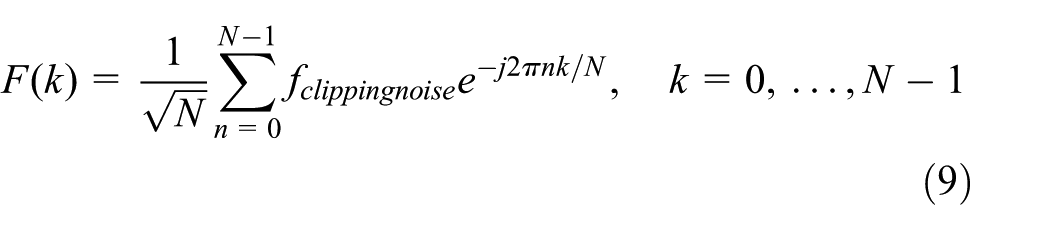
While the clipping noise spectrum can be written as
CS theory
Compress sensing is a technique designed to find solutions for sparse underdetermined linear systems. In signal processing domain, the main aim of this technique is to acquire or reconstruct signals that are sparse or compressible. The time-domain impulse response of the UWA channel is sparse, thus can be restored through frequent measurements.
In this article, orthogonal matching pursuit (OMP) algorithm is adopted which utilizes the Gram–Schmidt process to make the atom dictionary orthogonal and get the orthogonal basis.
The steps involved in OMP algorithm are as follows: 5
Initialization

where k is the number of iterations, y is the variable to be determined, and
Recursive extract
Calculate inner product
where Calculate the inner product to choose the maximum value of
while
After k iterations, y can be given by
The residual after k selection is written as




Determination of residual
If
CS channel estimation
A multipath UWA channel is modeled due to the multiple reflections of the signals traveling from transmitting to the receiving terminal. The receiving symbols are overlapped by signals with different amplitudes and phases. For such time-varying channel, the UWA channel model is given as 8

where

Combine the discrete Fourier transform (DFT) in OFDM with CS technique, the DFT transformation is represented by the basis matrix
CS reconstruction of clipping noise
Equation (6) shows the clipped signal and signals after clipping10,11 can be expressed as

where
In the frequency domain, it can be expressed as

where

where
Consider that the channel estimation and synchronization are accurate at the receiving terminal, then equivalent output through UWA channel can be written as

In order to apply the CS algorithm, subset of

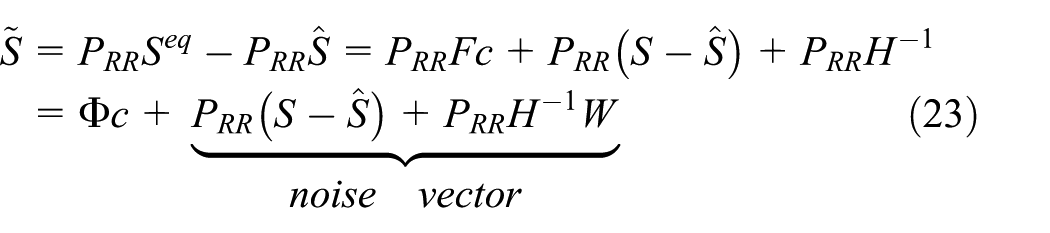
Subtract the estimated value of
where

In the following section, estimation of clipping noises and the iterative CS algorithm is proposed. Also, the reconstruction of clipped OFDM signals using CS approaches with pilot only and pilot assisted with selected data are given.
Iterative CS model in UWA OFDM communication system
Equation (23) shows that precise estimation of H is an utmost requirement for reconstruction of the clipping noise. Based on which this article compares the performance of iterative CS algorithm with traditional method. The block diagram of iterative CS algorithm is shown in Figure 1, where decision (1) can be expressed as

And decision (2) can be written as

where S with probability

Iterative CS UWA OFDM communication system.
The upper and lower cases of “s” represent the frequency and time domain of the sending signal, respectively. Clipping noise “c” appears after the clipping and filtering process, consequently the signal mixed with clipping noise is transmitted through the UWA channel, and the receiving time-domain signal is represented by “y.” Then, the clipping noise is estimated and removed by proposed iterative CS algorithm as shown in the above figure.
Transducer in the sending terminal
Air infinite element model of mosaic cylindrical transducer
Mosaic cylindrical transducer is made by splicing ceramic bars. The number of units being spliced determines the geometry of the pipe. In order to obtain good horizontal direction, according to the continuity conditions of circular array, the number of spliced units of the mosaic cylindrical transducer should meet the following condition:
Structure of the transducer
The simplified structure of the transducer is shown in Figure 2, where
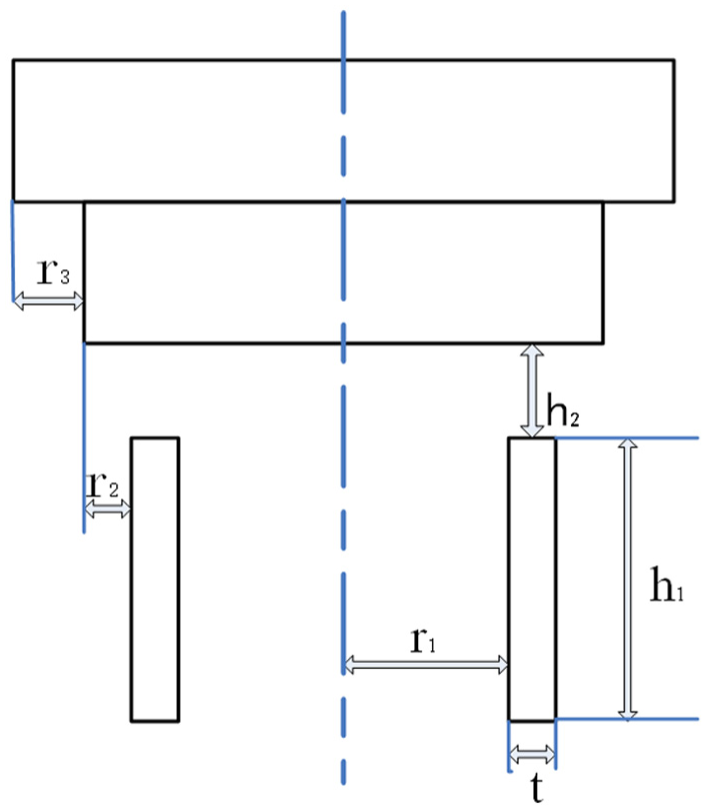
Structure of the transducer.
Transmitting voltage response
Transmitting voltage response (TVR) is a parameter that measures the transmitting ability of a transducer and depends on the pipe height

Transmitting voltage response of the transducer.
The transducer’s working frequency is from 6 to 12 kHz and the maximum TVR is about 140.5 dB. In the working band, the TVR is over 136 dB and the in-band fluctuation is less than 4 dB, which means the transducer gains a high TVR along with a good broadband performance.
Simulation and experimental results
Simulation results
OFDM UWA communication system’s parameters are shown in Table 1.
Simulation parameter.

FFT: fast Fourier transform; OFDM: orthogonal frequency division multiplexing.
The sample frequency of the system is 48 kHz and the bandwidth of the OFDM signal is B = 6 kHz. The transmitted signal occupies the frequency band between 6 and 12 kHz. We made 8192 points fast Fourier transform (FFT), so there are 8192 subcarriers. The comb-type pilot was used. The subcarrier spacing is
The time-domain signal before and after clipping is presented in Figure 4 with

Original signal and clipped signal.

CCDF of PAPR for OFDM and clipped OFDM signal.
The performance results of the proposed method are explained below. The simulated channel is illustrated in Figure 6, also the MP and OMP channel estimations are compared in this segment. Figures 7 and 8 show the difference between MP and OMP algorithms in residual energy and MSE characters. OMP algorithm is adopted in this article because of its better performance.

Comparison of MP and OMP channel estimation.

Residual energy of MP and OMP.

MSE of MP and OMP.
After UWA channel estimation by CS, clipping noise is calculated and is shown in Figures 9 and 10, which prove that the method which exploits pilot tones along with some reliable data tones can estimate the locations and amplitudes of the clipping noise better than the method that only exploits pilot tones.
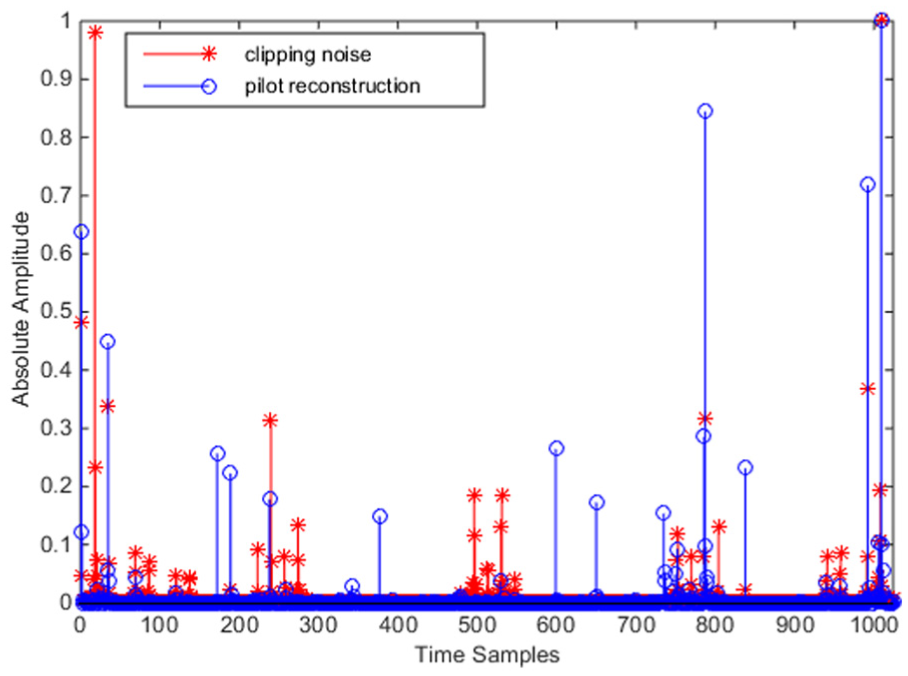
Clipping noise reconstruction by pilot carriers.

Clipping noise reconstruction by pilot and data carriers.
The inaccurate estimation of clipping noise may introduce additional noise to the system and the number of measurements determines the accuracy of CS. 18 Therefore, this article suggests the pilot with part of reliable data tones be utilized in reconstructing clipping noise as shown in Figure 10.
Figure 11 shows the average BER performance of four scenarios with the same operation-clipping in sending terminal but different operation in the receiving terminal. The “Clipping-LS” curve represents LS channel estimation. While “Clipping-CS” curve represents CS channel estimation. The scenario of CS clipping noise reconstruction and LS channel estimation is represented by “Clipping-r-LS” curve. Finally, the proposed method is represented by the curve named “Proposed” with the framework of Figure 1. Figure 11 depicts that the proposed method at 10-dB SNR closely approaches the performance with clipping CS method at 25 dB. And when the SNR approaches 30 dB, the BER of the proposed system reaches 10−5. At lower SNR, that is, below 5 dB, the proposed algorithm’s BER is slightly higher than the other algorithms because the high level of noise makes it difficult to differentiate between the clipping noise and other noises. While the SNR is higher than 6 dB, the performance gets better. Meanwhile, the advantage becomes 10−1 when the SNR approaches 16 dB. Compared with the “Clipping-r-LS” curve, when SNR reaches 30 dB, the BER of the proposed method can be lower than 10−1. Simulation results prove the efficiency of the iterative CS algorithm.

BER performance of different configurations.
Experimental results
The experimental pool shown in Figure 12 is 45-m long, 6-m wide, and 5-m deep and is surrounded by noise elimination wedges with sand at the bottom. The transducer is placed in 1-m depth and the hydrophone depth is 1.5. The horizontal distance is 6 m. The experimental UWA channel impulse is illustrated in Figure 13, whose maximum multipath time delay is about 10 ms. Picture of mosaic cylindrical transducer used in the experiment is given in Figure 14(a) and the receiving hydrophone is given in Figure 14(b). The transmitting acoustic wave sensor is a splicing circle pipe transducer, which has a working frequency of 6–12 kHz and a flat frequency response in working band, whereas the receiving sensor is a standard measuring hydrophone manufactured by Brüel & Kjær company and has a working frequency of 0.1 Hz–120 kHz with a flat frequency response over wide range.
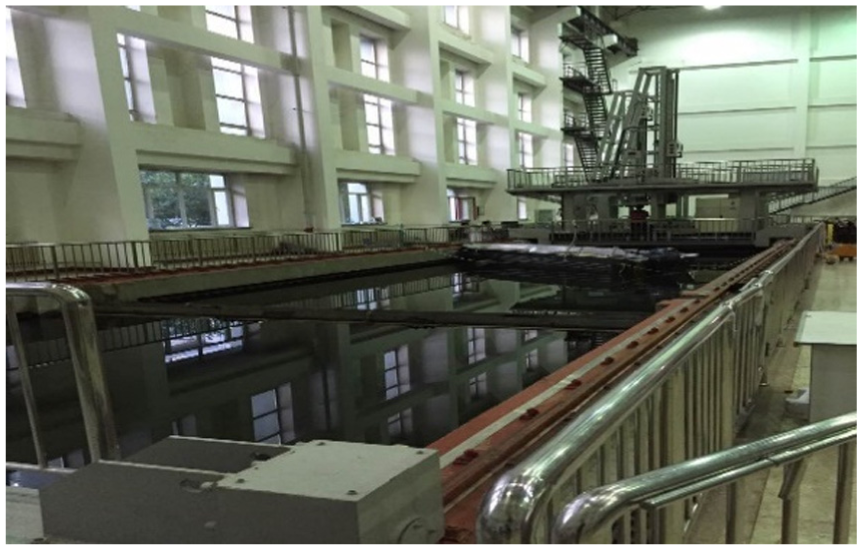
Experimental pool.

Experimental UWA channel in water tank.

Experimental transducer: (a) transducer and (b) hydrophone.
Figure 15(a) shows the pictures sent, and the pictures received with different scenarios are presented in Figure 15(b)–(e), with the same sending terminal but different receiving terminal. The receiving terminal of the four scenarios are as follows: LS channel estimation, CS channel estimation, clipping noise reconstruction utilizing CS with LS channel estimation after and the proposed iterative CS method with BER 0.97%, 0.2930%, 0.1302%, and 0.0570%, respectively. Simulation results demonstrate that the proposed method can reduce the BER performance by 10−1 compared with CS channel estimation. Also, CS channel estimation performs better than LS as can be judged from the BER curve.

(a) Sending picture, (b) clipping-LS method’s received picture, (c) clipping-CS method’s received picture, (d) clipping-r-LS method’s received picture, and (e) proposed method’s received picture.
Conclusion
High PAPR is one of the prime limiting factors that hurdles the use of OFDM in UWA communications. In this article, clipping algorithm is adopted in order to reduce the PAPR and the CCDF curves are shown. As clipping introduces additional noise to the communication system, an iterative CS algorithm is proposed here to reduce the influence of clipping. Both simulation and experimental results demonstrate that the proposed method has similar PAPR and better BER performance. The reconstruction of the clipping noise utilizes the pilot and signal carriers instead of reserved carriers, resulting in improved data rate and higher spectrum efficiency. However, the need of sufficient number of reliable measurements for CS estimation while compensating the clipping noise can be a limitation of this technique, which may be a focus for future research.
Footnotes
Declaration of conflicting interests
The author(s) declared no potential conflicts of interest with respect to the research, authorship, and/or publication of this article.
Funding
The author(s) disclosed receipt of the following financial support for the research, authorship, and/or publication of this article: This study was supported by the project of Heilongjiang Postdoctoral Sustentation Fund, China (no. HLJ20120008) and the National Natural Science Foundation of China (nos 61601137, 61431004, 6140114, and 11274079).