




Abstract
Power control technology is widely used in wireless sensor networks to improve network performance. The asymmetric transmission power strategy used in power control technology causes the re-emergence of hidden-node problems and more serious exposed-node problems. This article analyzes the reasons of these problems and proposes the concept of the pan-hidden node and pan-exposed node. To avoid pan-hidden-node problems and mitigate pan-exposed-node problems, a concurrent transmission mechanism is presented. The concurrent transmission mechanism contains a strict time schedule for different categories of frames and an interference degree criterion to ensure concurrent transmission. The rigorous time schedule can guarantee that different classes of frames do not interfere with one another. The interference among the frames of the same type is constrained by the interference degree criterion. Finally, the performance of the concurrent transmission mechanism is evaluated using simulation experiments.
Keywords
Introduction
Conserving the energy of sensor nodes is a critical issue in wireless sensor networks (WSNs) because the network lifetime completely depends on the durability of the batteries in the nodes, which cannot be replaced or recharged in most sensor network applications. 1 In WSNs, communication dominates the energy consumption of the nodes. 2 Hence, adjusting the transmission power to control the topology can increase the network lifetime and capability. Not controlling the transmission power level but instead using a fixed high power level for all nodes of the network will make the nodes quickly die and can reduce the network lifetime. 3 Thus, power control strategies are highly essential for WSNs.
To date, many excellent power control algorithms have been proposed.4–12 These algorithms perform well on the aspects of network throughput and transmission delay based on ideal Medium Access Control (MAC) protocols. However, the exposed- and hidden-node problems caused by asymmetric power control algorithms have not been properly resolved. The exposed- and hidden-node problems decrease the network throughput and increase the transmission delay.
Hidden-node problems are typically resolved using a scheme identical to the IEEE 802.11 Distributed Coordination Function (DCF) protocol in most existing MAC protocols. 13 Exposed-node problems have not been effectively resolved in the 802.11 DCF protocol. To resolve the exposed-node problem in WSNs, researchers have presented many concurrent transmission strategies.14–21 In a study by Phil, 14 the Multiple Access with Collision Avoidance (MACA) protocol was presented. In this protocol, the required transmission time is only covered in the Clear to Send (CTS) frame. The neighbor nodes that receive the CTS frame remain silent during transmission. Because the transmission time is not covered in the Request to Send (RTS) frame, the nodes that receive an RTS frame can concurrently transmit. Haas and Jing 15 proposed the Dual Busy Tone Multiple Access (DBTMA) protocol based on the dual channel hardware structure. The nodes decide whether to send according to the busy tone in the control channel instead of the carrier sensing of the data channel. Acharya et al. 16 proposed the Medium Access via Collision Avoidance with Enhanced Parallelism (MACA-P) protocol, which makes the exposed node concurrently transmit and improves the network throughput by aligning the sending time of the acknowledgement (ACK) and DATA frames. Zhang et al. 17 proposed the Signal strength-Based Frame Sensing Multiple Access with Collision Avoidance (SB-FSMA/CA) protocol, which enables the exposed nodes to concurrently transmit if and only if the correlation coefficient calculated by the exposed node is less than a certain threshold. Park et al. 18 increased the packet reception ratio using forward error correction schemes (FECS). In a study by Matoba et al.,19,20 the Asymmetric Range by Multi-Rate Control (ARMRC) algorithm intentionally allocates different transmission rates to RTS and CTS to proactively control the radio coverage and mitigate the effect of exposed-node problems in local area networks (LANs) and ad hoc networks. Vinh and Oh 21 proposed a new time division multiple access (TDMA)-based MAC protocol Optimized Medium Access Control (O-MAC) to maximize the data transmission parallelism with two channels. The O-MAC protocol includes two key schemes: a channel allocation scheme and a slot allocation scheme. Each node determines a sending channel and a receiving channel using the channel allocation scheme and a sending slot and a receiving slot using the slot allocation scheme. Ma et al. 22 proposed the Opportunistic Concurrency (OPC) algorithm, which is a new MAC layer scheme, to enable sensor nodes to capture the OPC and perform parallel transmissions instead of waiting for a clear channel.
Although many concurrent transmission MAC protocols are proposed, some drawbacks remain and have not been properly resolved. We summarized these drawbacks in a study by Zhao et al. 23 The drawbacks are as follows:
Applying only to the scenes where all sensor nodes transmit with identical powers;
Not considering the problem of accumulated interference;
Easily triggering new hidden-node problems because of the lack of a rigorous RTS-CTS-DATA-ACK transmission mechanism;
Not considering the interferences among multiple ACK frames or ACK frames and DATA frames;
Requiring nodes with complex hardware or software configurations;
Permitting only one node to concurrently transmit.
The distribution of drawbacks in the aforementioned algorithms is presented in Table 1.
Distribution of drawbacks.
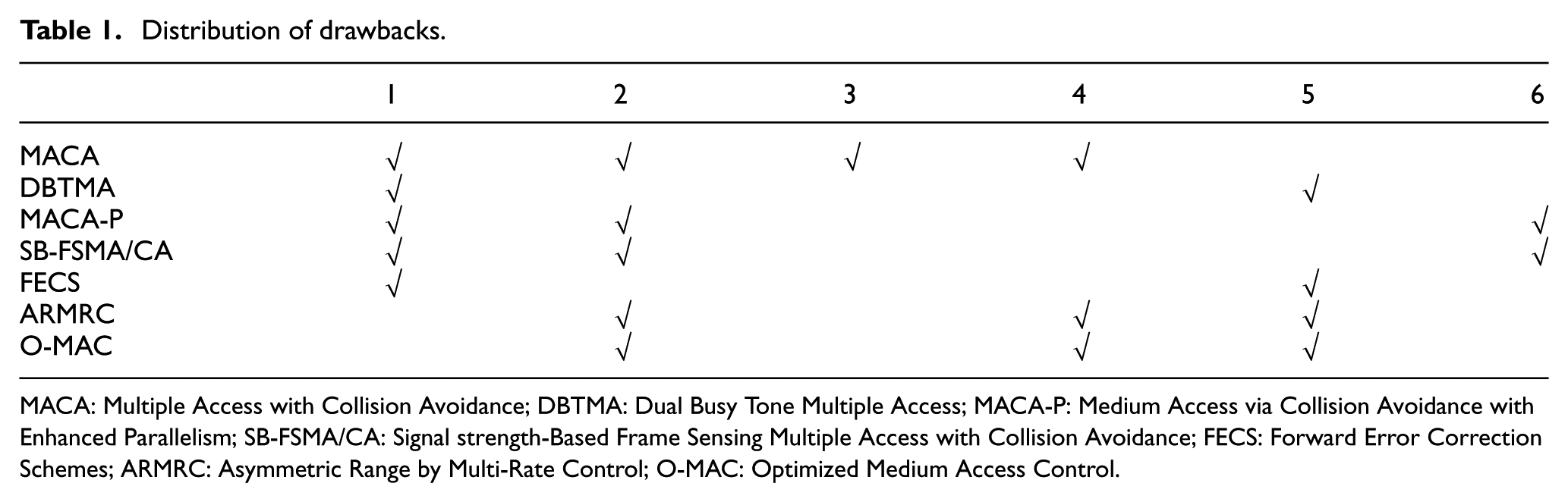
MACA: Multiple Access with Collision Avoidance; DBTMA: Dual Busy Tone Multiple Access; MACA-P: Medium Access via Collision Avoidance with Enhanced Parallelism; SB-FSMA/CA: Signal strength-Based Frame Sensing Multiple Access with Collision Avoidance; FECS: Forward Error Correction Schemes; ARMRC: Asymmetric Range by Multi-Rate Control; O-MAC: Optimized Medium Access Control.
Pan-hidden-node and pan-exposed-node problems in WSNs
If power control strategies are used in WSNs, the nodes usually transmit with asymmetric transmission powers. The asymmetric transmission power can cause the re-emergence of hidden-node problems and more serious exposed-node problems.
In Figure 1, the black points indicate the sensor nodes, and the circles indicate their coverage areas with certain transmission powers. When node a communicates with node b using a small transmission power, node c is outside the coverage of node a or b; hence, node c is not a hidden node for node a or b. However, the communication between nodes a and b can be disrupted when node c transmits to node d using a larger transmission power. Nodes such as node c are called quasi-hidden nodes. Quasi-hidden nodes and traditional hidden nodes comprise pan-hidden nodes. In another scenario, node c communicates with node d using a larger transmission power. If node c is the transmitter, only nodes a and b are exposed nodes according to the traditional concept of exposed-node problems. However, nodes e and f can also concurrently transmit without interfering with the transmission between nodes c and d. Similarly, we define nodes such as e and f as quasi-exposed nodes. The quasi-exposed nodes and traditional exposed nodes comprise pan-exposed nodes.
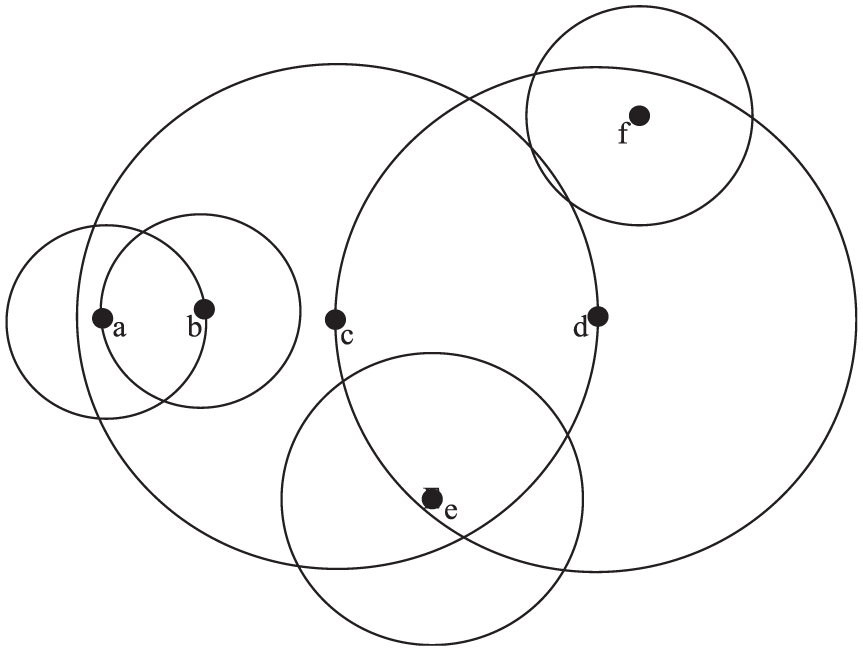
Illustration of the pan-hidden-node and pan-exposed-node problems.
Based on the above analysis, designing a concurrent transmission mechanism (CTM) to mitigate pan-exposed-node problems is a critical issue in WSNs. We proposed an interference degree criterion for the pan-exposed nodes to concurrently transmit in a study by Zhao et al. 23 Based on the interference degree criterion, a CTM is presented in this article. In the CTM, the interference degree criterion in the study by Zhao et al. 23 is simplified and theoretically proven. In addition, a strict time schedule to transmit different categories of frames is introduced. Finally, the performance of CTM is verified using simulation experiments.
Definitions and the interference model
In this article, we use the definitions and models from Zhao et al. 23 For convenience, the definitions and models are also presented in this article.
Definitions
Definition 1 (neighbor nodes)
The nodes within the coverage of node a are called neighbor nodes of node a and denoted by
Definition 2 (session)
The process of transmitting a data packet following the RTS-CTS-DATA-ACK mechanism from node a to node b is called a session and denoted by
Definition 3 (interference)
If a newly initiated session
Interference model
In this article, we assume that the radio transmission follows the log-distance path model.
24
In this model, the signal sharply decreases with distance. Thus, for node u, the interference caused by the nodes outside its coverage is notably weak and can be interpreted as environmental noise. Hence, the accumulated interference suffered by node u only considers the interference of the nodes in
It is universally known that if the signal-to-noise ratio is greater than a certain threshold

where

where S is all transmitting nodes in
Thought of the CTM
With the analysis in section “Pan-hidden-node and pan-exposed-node problems in WSNs,” we conclude that the power control strategy can introduce new pan-hidden-node and pan-exposed-node problems. In this section, the idea of the CTM is described based on the definitions and models in section “Definitions and the interference model.”
In the CTM, the pan-hidden-node problem can be easily resolved using the RTS-CTS-DATA-ACK mechanism. In Figure 2, there are two circles with center node a. The outer circle is the coverage that corresponds to transmission power

Illustration of the interference degree criterion.
However, to improve the energy efficiency, the DATA and ACK frames are transmitted with appropriate transmission power
In summary, the nodes that want to initiate a new session must satisfy these four conditions based on the rigorous time schedule. In Figure 2, there are three existing sessions:

Similarly, condition 2 can be described using equations (4) and (5)


Condition 3 can be described using equation (6)

Condition 4 can be using by equations (7) and (8)


In formulas (4)–(9),
Description of the CTM
Based on the above analysis, the CTM contains a time schedule and an interference degree criterion, which is described in detail in this section.
Preparation
In the CTM, a sensor node in the network must record the status of neighbor nodes. Then, each node in the network should maintain a Neighbor Vector Table (NVT) and two variables
During the CTM process, the session between the nodes, which includes the concurrent transmission of the exposed nodes, follows the RTS-CTS-DATA-ACK four-time handshake mechanism as the 802.11 DCF protocol. The RTS and CTS frames are used to avoid the emergence of the hidden-node problems, which are transmitted with the maximum transmission power
Time schedule
As mentioned above, a session follows the RTS-CTS-DATA-ACK four-time handshake mechanism in the CTM as the 802.11 DCF protocol. To avoid the interference caused by the RTS and CTS frames when transmitting the DATA and ACK frames, a rigorous time schedule was designed for CTM, which is shown in Figure 3. The time schedule retains the inter frame space—short interframe space (SIFS) and DCF interframe space (DIFS) and backoff mechanism of 802.11 DCF protocol. Furthermore, it also employs the message-passing mechanism of the Sensor Media Access Control (S-MAC) protocol, where long messages are divided into short messages during transmission. 26

Time schedule in the CTM.
In the CTM, a time interval T, which is called the competition cycle, is used for the channel competition. When node u in the network requests to initiate a new session

If the third condition is satisfied, node u implements the physical carrier sensing. When the channel is detected as idle, node u sends an RTS frame. After the transmission of the RTS frame, node u sets a timer
When the neighbors of node u (except node v), which are denoted as

where X is the sending node of session
When node v receives an RTS frame, it will determine whether the first condition of concurrent transmission is satisfied according to equation (11). If the first condition is satisfied, node v should feedback a CTS frame to node u. Equation (11) is as follows

When the neighbors of node v (except node u), which are denoted as

where Y is the receiving node of session
When node v receives the FAL frame from the neighbor nodes, the transmission of the ACK frame of the new session will interfere with the transmission of the ACK frame of the present session in the network. Consequently, node v will broadcast a CEL frame to cancel the new session.
Based on the preceding analysis, to successfully initiate a session, a series of specific events must be implemented. Figure 3 shows a schematic representation of a series of events 1–21. Events 1–21 represent the transmission or receiving of the frames. The relation between the events and whether a session can be successfully initiated is presented in Table 2.
Relationship between the events and the conditions.
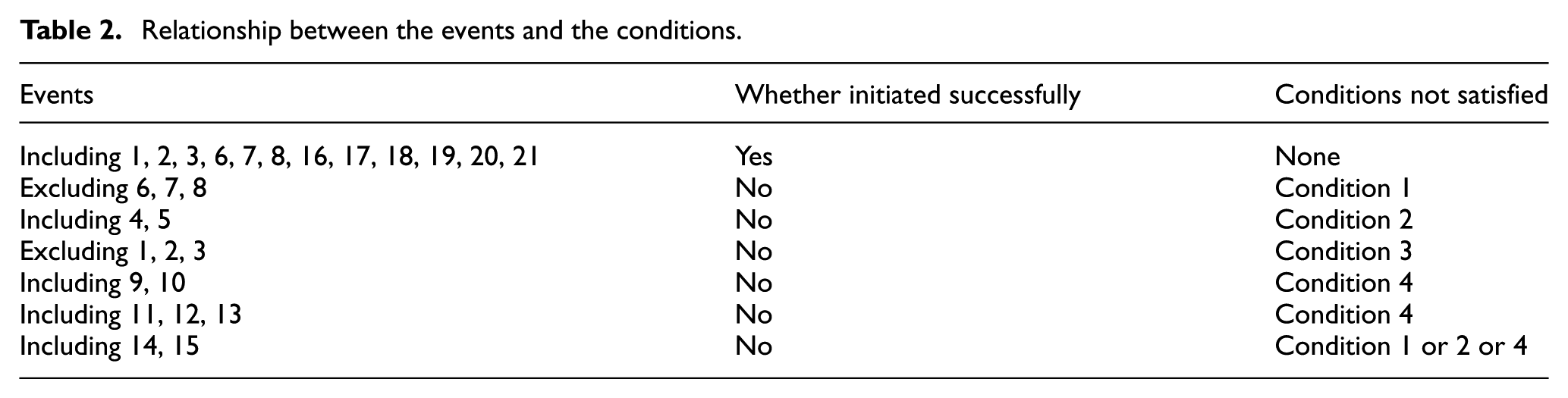
In Table 2, the first line indicates that if node u can successfully initiate a new session, all four conditions for concurrent transmission are satisfied. Then, events 1–3, 6–8, and 16–21 are sequentially executed. The second line implies that if events 6–8 cannot be triggered, the first condition for concurrent transmission is not satisfied. As a result, the new session cannot be initiated. The third line indicates that if events 4 and 5 are triggered, the second condition for concurrent transmission is not satisfied. Then, the new session cannot be initiated. The other rows in Table 2 can be similarly interpreted.
Interference degree criterion
According to the aforementioned time schedule, we conclude that the concurrent transmission can be successfully initiated if and only if the four conditions in equations (9)–(12) are satisfied. To simplify the conditions, we define the interference degree as follows.
Definition 4 (interference degree)
Suppose that

where

Theorem 1
In the CTM, the interference degree criterion for an exposed node u to initiate a concurrent session

and
Proof
As discussed above, the concurrent transmission for exposed nodes can be successfully initiated if and only if the four conditions in equations (9)–(12) are satisfied in the CTM. Equation (12) is equivalent to equation (15)

The left side of the inequality is the interference degree of the newly initiated session
Consequently, whether a session can be initiated successfully can be determined by the interference degree criterion according to Theorem 1. In the process of calculating the relevant interference degrees,
Simulation results
In this section, two groups of experiments were performed to verify the performance of the CTM. In the experiments, the number of packets received by the sink node and the average delay of the packets were tested.
In the experiments, 100 nodes were randomly deployed in an 800 m × 500 m rectangular area. When all nodes transmit with the maximum transmission power

Topology corresponding to
When the nodes transmit with the proper transmission power
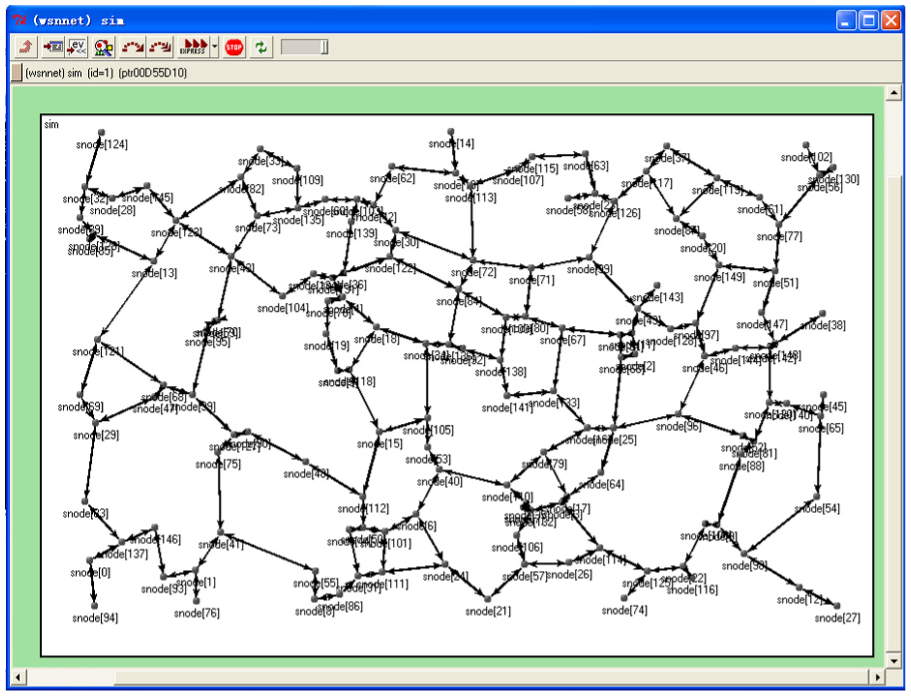
Topology corresponding to
In the XTC algorithm, the transmission ranges of the nodes are shown in Figure 6. When compared with Figure 4, it is clear that the network can be simplified and kept connected by adjusting the transmission powers of the nodes. Thus, the network lifetime can be extended, and the capability can be significantly enhanced by adjusting the transmission power based on the ideal MAC protocol. However, in fact, without the support of an ideal MAC protocol, the network performance cannot be significantly enhanced mainly because of the exposed-node problem, which is caused by asymmetric power transmission between nodes.
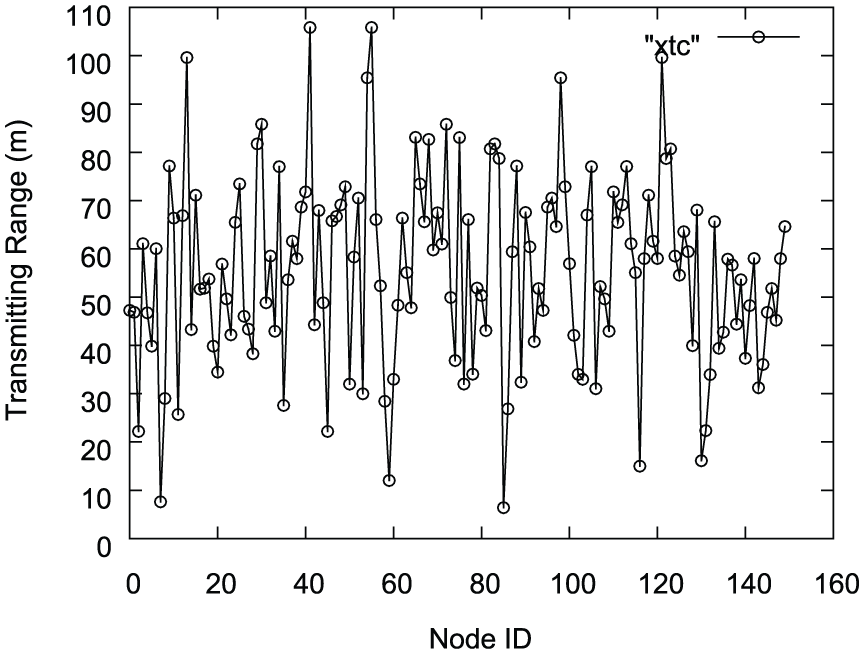
Transmission ranges of the nodes in the XTC algorithm.
Two groups of experiments were performed to validate the effectiveness of the proposed CTM. The simulation parameters are shown in Table 3.
Setting of simulation parameters.

The life cycle for the entire network heavily depends on the number of packets received by the sink node, which is located in the center of the rectangle and shown in Figure 7. In the CTM, the network can more rapidly reach a steady state. The CTM takes only approximately 13 s to reach and maintain a stable high network throughput. However, 802.11 DCF and SB-FSMA require 29 and 21 s, respectively. Moreover, in the CTM, the sink node can receive more packets than the 802.11 DCF and SB-FSMA protocols during the entire life cycle. The sink node receives 7789 packets in the CTM during the network life cycle, which is 19.3% and 42.9% more than that in SB-FSMA and 802.11 DCF, respectively. The average number of received packets by the sink node in the network life cycle is shown in Figure 8. The sink node receives approximately 48 packets per second in CTM, which is 32.4% and 87.5% more than SB-FSMA and 802.11 DCF, respectively.

Comparison of network throughput during the network lifetime.
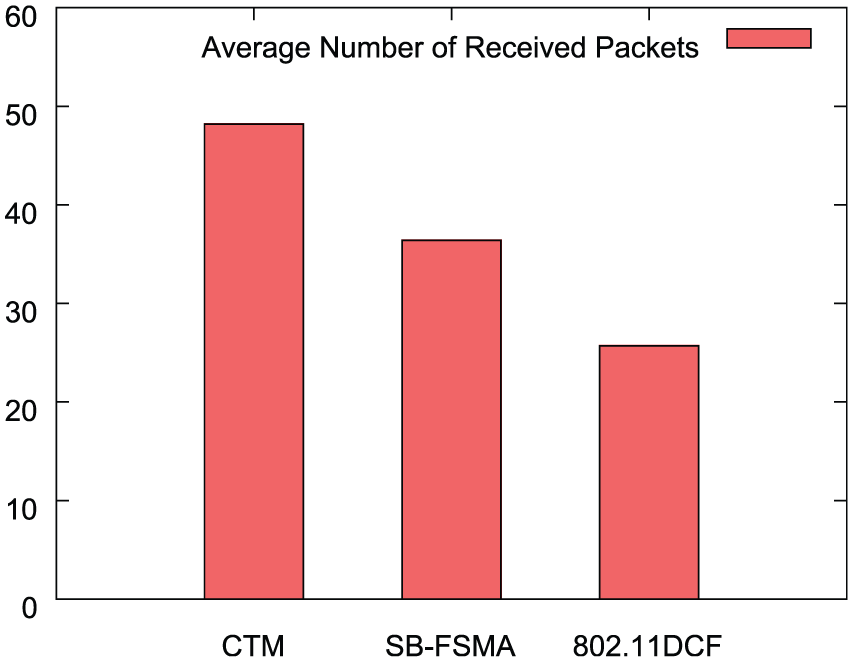
Comparison of the average number of received packets.
Figure 9 shows the average transmission delay of the packets during the entire life cycle of the network in the CTM, SB-FSMA, and 802.11 DCF protocols. The average transmission delay of the packets in all protocols sharply increases in the first several seconds until the value stabilizes. In this process, because the CTM has a more complex time schedule, the packets in the CTM have a greater average transmission delay than those in the SB-FSMA and 802.11 DCF protocols. However, when the delay reaches a steady state, the average transmission delay of the packets in CTM is approximately 6.6 s, which is 19.5% and 63.3% smaller than those in SB-FSMA and 802.11 DCF, respectively.

Comparison of the average delay.
Conclusion
For the hidden-node and exposed-node problems caused by power control strategies in WSNs, first, we define the pan-hidden nodes and pan-exposed nodes. To address the pan-hidden-node and pan-exposed-node problems, a CTM is proposed in this article.
The mechanism contains a rigorous time schedule and an interference degree criterion. The rigorous time schedule ensures that the DATA frame or ACK frame can only be interfered by identical types of frames. Thus, the concurrent transmission for pan-exposed nodes is significantly simplified. Using our previous study, 22 the interference degree criterion is further simplified and theoretically proven in this article.
In the CTM, the packets are transmitted by strictly following the RTS-CTS-DATA-ACK mechanism. In this process, the RTS and CTS frames are transmitted with the maximum transmission power to solve pan-hidden-node problems. However, the DATA and ACK frames are transmitted with a proper power to decrease the energy consumption of the network. The simulation results show that the proposed CTM performs well in terms of both network throughput and transmission delay.
However, the procedure of the CTM remains slightly complicated. Moreover, the performance of the CTM algorithm has not been verified using an actual deployment WSN in this article; there may be many unpredictable factors that can affect the efficiency of the CTM algorithm. In the future, we will perform experiments in an actual network environment to examine the unpredictable factors and further simplify the CTM procedure.
Footnotes
Academic Editor: Miguel Acevedo
Declaration of conflicting interests
The author(s) declared no potential conflicts of interest with respect to the research, authorship, and/or publication of this article.
Funding
The author(s) disclosed receipt of the following financial support for the research, authorship, and/or publication of this article: This work was supported by the National Natural Science Foundation of China (grant numbers 61373135, 61300240, 61401225, and 61502252); the Natural Science Foundation of Jiangsu Province of China (grant numbers BK20140883 and BK20140894); China Postdoctoral Science Foundation funded project (grant number 2015M581844); Jiangsu Planned Projects for Postdoctoral Research Funds (grant number 1501125B); and the NUPTSF (grant numbers NY214101 and NY215147).