




Abstract
A wireless-powered cooperative energy aware anycast routing protocol is proposed in this work. In contrary to conventional cooperative networks, it is considered here that all the relays did not have embedded energy supply, rather equipped with rechargeable batteries and energy harvesting units. Hence, from source signals, they accumulate sufficient harvested energy before the information is forwarded to its destination. Each relay between two basic modes will switch adaptively, which are information forwarding and energy harvesting. The research is limited to decode-and-forward scheme and fixed ratio combining, which works at the relay node of the network and the receiver end, respectively. The physical layer cooperative diversity and network layer multi-hop routing lead us to devise a minimum energy routing protocol as the joint optimization of power required for transmission at physical layer and also at network layer for the process to select a link. Simulating our algorithm demonstrates that the suggested cooperative energy aware anycast routing scheme has a better end-to-end delay and better ratio of packet delivery. Results further reveal that our proposed algorithm has improved energy consumption in comparison to the non-cooperative energy aware anycast scheme and the cooperation-based robust cooperative routing protocol scheme. Sensed data are allocated between nearby nodes by cooperative energy aware anycast routing in a cost-effective way in order to achieve maximum network lifetime.
Keywords
Introduction
Wireless sensor networks (WSNs) have been mainly designed for collecting and distributing the environmental data, which constitutes cheap and little nodes. These types of networks actually help us in controlling and monitoring the physical environments from a fairly distant locations having high precision level. They found out different kinds of applications with relevant fields such as habitat monitoring and environment, with gathered sensed data and military purposes at unreceptive extreme locations. In today’s age in a number of real-time critical situations, the mankind is facilitated, such as earthquake, roadside accident, flood, fire, etc. Since they emerged, the main focus has been on the design of processor and computing. However, issue of energy limitation still requires improvements because they greatly influence the design and operations of WSNs. Because of mediation surroundings of distributed capricious noises, they have caused and practiced a far-reaching damage and great outage to the data. Diversity has been utilized frequently to contest against fading to improve signal-to-noise ratio (SNR) of signals being transmitted. One can accomplish diversity through a number of systems such as space, time, cooperative, polarization, multi-user diversity, and frequency. The remaining additional nodes present in network routing domain as well as in competent skill of sensors that upsurge the excess of bandwidth, resources, and extra overheads. Here, a necessity is strongly needed for multiple antennas; therefore, we come up with multiple-input multiple-output (MIMO) techniques. This acute issue has already fascinated by many researchers, for example Abid et al. in Akhtar et al. 1 Numerous schemes have been studied for energy consumption improvement. Nadeem et al. scheme and different other practices have also been proposed for slacking the intake of energy in WSNs as defined in Akbar et al. 2 The wireless nodes consume excessive energy and some computational restrictions due to inexpensive nature and ad hoc scheme to deploy. Significant research is needed to overpower the aforementioned shortages through load balancing, localization and system design techniques, and additional energy efficient routing like that in Kim 3 and Kamal and Hamid. 4 For WSN that has unique base station,4–6 sensors here generate data and it will be forwarded to sink through various routing mechanisms. Networks that have sinks in multiple number will route the data traffic generated to multiple base stations via the techniques of splitting.2,7
Sensing applications such as surveillance and video sense the data through scattered sensors and are delivered to a particular sink. Hou et al. 8 presented an optimal scheme for anycast routing. This improved scheme for optimization of network lifetime was suggested and the followers were invited to take anycast routing in WSNs for better solutions. We propose cooperative energy aware anycast routing (Co-EAAR) in WSNs in this research, and it is explained in the latter sections.
Extensive advancements have been made in radio communications. Toward the improvement of sensor networks, researchers are heading by means of applying new techniques that are stimulated from radio communications. This type of a scheme is cooperative communication that matches for WSNs well enough. For distributed networks, it is deemed as a strong approach for improving the quality of link and data delivery reliability that consists of two or more relays which acts in cooperation. The degree of diversity is taken under consideration by wireless system designs; it enhances the dependable data delivery via providing more copies of the similar signal at a faraway node. MIMO, as the technique is called, is an efficient methodology to increase SNR through which improvement of spatial diversity is gained. Hardware for every sensor is needed with increased cost and complexity in this technique. Utilizing different sensors is another scheme to cooperate in enhancing the quality of linking path. Beside using a single user along with an antenna array, we route duplicate data via dispersed antennas by several sensors that make their way toward the destination although they have some delay. Wireless network researchers gave their attention which led to regular struggle to use it in WSNs. Providing that the different existing paths between the receivers and senders are independent and which also have sufficient performance, the work of channel can be improved via routing duplicate copies of data along these paths and combining them at a faraway node. The paths are independent which also lessens the chances of net error. Almost all the times, sensors are very light-weight, thus needing distributed antennas for the support. Cooperative routing idea has been suggested to cater this issue. A copy of packet is forwarded from sender node to one of the cooperative sensors. It either decodes each packet of data or amplifies them. Then, the transmission of it to the receiving node clearly depends on the scheme adopted. Relay path does not usually depend on the direct path. Both of the recovered signals are joined together by the destined node for receiving the packets being transmitted.
Wireless-powered communication strategy has brought new research opportunities to cooperative technique, which has attracted many researchers during the past years due to its promising advantages. Here, the relay node is able to harvest energy from an ambient radio frequency (RF) signals and then use harvested energy for assisting the source node transmission. Hence, relay is more willing to cooperate with the source since it does not need to consume its own energy.
Wireless link can be easily countered by means of cooperative diversity. Scattered users in the network are being allowed by the main concept of cooperative diversity in order to assist in relaying data of each other through the help of discovering spatial diversity which is available in relay links. It is suggested to have various cooperation techniques including adaptive and fixed relaying, that are coded and user schemes. The fixed relaying includes compress-and-forward (CF), amplify-and-forward (AF) and decode-and-forward (DF) schemes, where the relays help in the forward of source data. The AF scheme is responsible to amplify and then forward the data; however, the relays decode and receive that data and then forward it to the destined node in DF schemes. By the time, the relay fails to decode the transmitter signal, and the performance degradation is suffered by fixed DF protocol. The signal received from the source is quantized by the relay in the CF scheme, which encodes the sample into a newer packet. When channels are variable (which is typical in WSNs), fixed routing is not desirable as it unicasts packet to an already assigned relay that is suspected to be the bad channel. For mitigation of this issue, wireless channel broadcast nature is explored for determining the best intermediate relay opportunistically after a packet is being broadcasted. For implementing this technique, an opportunistic routing algorithm at intermediate node anycasts messages in a many-to-many manner and then from the set of nodes selects next relay which have successfully received the packet. According to Dehghan et al., 9 some common definitions in this respect are as follows:
Definition 1 (opportunistic route)
Anycasting helps data packets to reach their destinations from potentially various paths. The union of all possible paths is an opportunistic path made by a set of potential relays between a destination and a source at each intermediate node.
Definition 2 (anycast link cost)
The cost of the anycast link
We have arranged and organized the rest of the article in the subsequent manner: section “Literature review” reviews the literature review done for this work. We describe the problem statement for the research in section “Problem statement.” Furthermore, section “Network model of energy aware anycast” gives the detail of energy aware anycast (EAA) scheme. Moreover, we describe the suggested protocol in section “CO-EAAR: proposed protocol.” Section “Performance evaluation and basic assumptions” describes the results of simulation and performance metrics. Then, the limitations and future work needed in the field of WSNs have been highlighted in section “Limitations and future work.” Finally, the conclusion of the work is provided in the final section.
Literature review
A variety of routing schemes have been developed for WSNs, but none of them cover and implement all the desired features. All of the existing schemes are being designed via accessing several aspects of WSNs. Some WSNs routing scheme comparisons are shown below. A much famous scheme developed for the WSNs is the famous low-energy adaptive clustering hierarchy (LEACH) protocol 5 which has been designed such that the entire network is divided into multiple clusters. A random sensor is chosen as the head. Every sensor gets an equal opportunity to be chosen as the head, while load and energy consumption are equally distributed throughout the whole network.
Anycast routing method is widely researched in mobile and ad hoc networks in Dehghan et al., 9 Gao et al., 10 Kostin et al., 11 and Hao et al. 12 and especially for the delay tolerant networks (DTNs) in paper.13–15 Power saving, being the most significant key performance indicator (KPI) in these networks has attracted a lot of researchers toward it. A lot of research is done in literature to reduce the energy consumption in the medium access control (MAC) protocols as in Walchli et al. 16 and multicast routing in Xiangli et al., 17 Cao et al., 18 and Wu and Candan. 19 Unicast and broadcast routing methods are compared in Li et al., 20 Jurdak et al., 21 and Dehwah et al., 22 while the anycast routing is studied in Gupta et al. 23
In Hu et al., 24 the anycast routing protocol had been proposed for ad hoc WSNs according to which packets were passed out to the closest-sink node. The article, however, had turned a blind eye toward the energy requirements and lifetime execution. The closest-sink node methodology did not mention a very efficient execution for anycast flow routing. The authors designed a tree based on sources and analyze the anycast routing. This approach was very much like the closest-sink approach as it is considered path for least energy; however, promising performance is not ensured even by adapting the least energy path for network lifetime.
Significant advancement can be noticed lately concerning the cooperation in sensor networks. Robust cooperative routing protocol (RRP) 25 was cross-layer procedure that was into the coordinated effort of the sensors among neighboring relays for the weird and capricious mobile sensor networks. RRP had been devised in such a way that from proposed paths, the robust links were expended and a reliable path was chosen at this point from strong paths. The proposed path deals with variable topology that was, in fact in the light of the path quality with the use of path differences and link disconnectivity enhancement. Wang et al. 26 suggested distance-based energy aware routing (DEAR) protocol which not only assured energy efficiency but also ensured efficient load balancing. Diverse traffic and energy models have been utilized as premise to this protocol. The simulations of this techniques stated that the system lifetime is being drawn out by DEAR calculation by adjusting the circulation and decreasing the energy utilization. The authors proposed ideal power utilization by grid-based cooperative WSNs in Mardini et al. 27 By fluctuating the number of nodes in grid and grid separation, the authors here concentrated on these cases.
Problem statement
WSNs worked in such situation where system is autonomous of any base. Many issues rise such as the range of communication become limited as the transmission energy of sensor decrease in various utilities. Nodes make it conceivable for sharing their resources with one another in cooperative communication which is essential for such networks. To lessen the load on data paths, this technique is implemented so that the weaker connections are replaced with short but efficient interfacing sensors with sink. Presenting ready answers to routing and scheduling options between sensors and base stations gives strength against fading and noise. Amid communication in sensor networks, most exhaustion of power takes place.9,28 For streamlining least number of hops, routing tries its best for data transmission accessibility and having the least latency. A routing scheme is planned in sensor networks in such a way that has the potential to spare energy up to some desired level.29,30 Fading because of multipath is an incredible test in WSNs.31,32 Because of fading in data paths, sink sensors do not perceive the signals transmitted by the source. As sensor networks face big configuration challenges and different difficulties at the time of transmission energy to accomplish data forwarding, expansion and the sensors of battery powered are confinement resources on sensor devices. The collaboration differing qualities are managed in any case in an appropriate channel.
Cooperative routing protocols, which are energy based, work in a fashion that they end-up with information transmission with the least power dissipation. For avoiding clashes and duplicate transmitted information, MAC protocol is filled. Hence, the decreasing in energy utilization is being controlled in the starting and ending conditions of the source as well as relay nodes.33–35 For observing diverse physical limitations, the sensor networks are used, so in territories legitimate situation is needed where human access is troublesome or for basic applications. The whole system is obliged to be redesigned if there is an occurrence of connection disappointment and it will be heading to re-reckoning of links. The executions of WSNs were influenced by different issues such as constrained power, low memory, less infrastructure, and so on. For such scenarios, a technique must be planned which consolidate diverse scheme elements and give an improved result. The authors proposed an EAA routing convention for WSNs where among the current nodes, detected information been appropriated in a cost-effective manner for increasing network lifetime. 36
For the appraisal of routing schemes in WSNs, a variety of measurements are available like packet delivery ratio, normal end-to-end delay, left alive sensors, path length, and so on. In this research, we proposed cooperation-based Co-EAAR protocol for energy productive and two well-known protocols, EAA and RRP, are chosen for comparative analysis. The simulation results proved that Co-EAAR performance is enhanced than EAA and RRP protocols in some specific parameters.
Network model of EAA
Anycast is described to be a technique where among a group, a sensor forwards a message to preferably a single destined node. Depending on various parameters, data are being detected by a sensor node which needs to be forwarded to the sink. In EAA routing protocol for WSNs, 36 authors tried to lessen the transmission frequency along with efficient distribution of load among sensors (Figure 1). Figure 2 presents the working of technique in Hou et al. 8 that divides originator sensed data and all nodes in the way which move data toward optimal sink. The topology worsens when the nodes are several hops distant from the sink. The division also increases exponentially with rising mid-path sensors leading to multiple issues. 36

Topology of splitting data at every sensor node. 8

Topology presented in Hadi and Minhas 36 split data only at sensing nodes.
According to Figure 2, the Case-I situation showed that the sensors are over three-hop distant from the sink node but still at the second hop it leads to heavy data forwarding. Hence, it is still required to find out the best data division at each sensor for improving the residual energy that try to solve the issues highlighted in Hadi and Minhas 36 to some extent and ultimately for maximizing the network lifetime.
In Figure 3 (Case-II), the EAA scenario has depicted. The protocol divided the data into two segments at the source sensor for availing the neighboring nodes for load balancing. Relay sensors will help in forwarding the data as per its routing but do not divide it again to prevail over the issues to some extent.
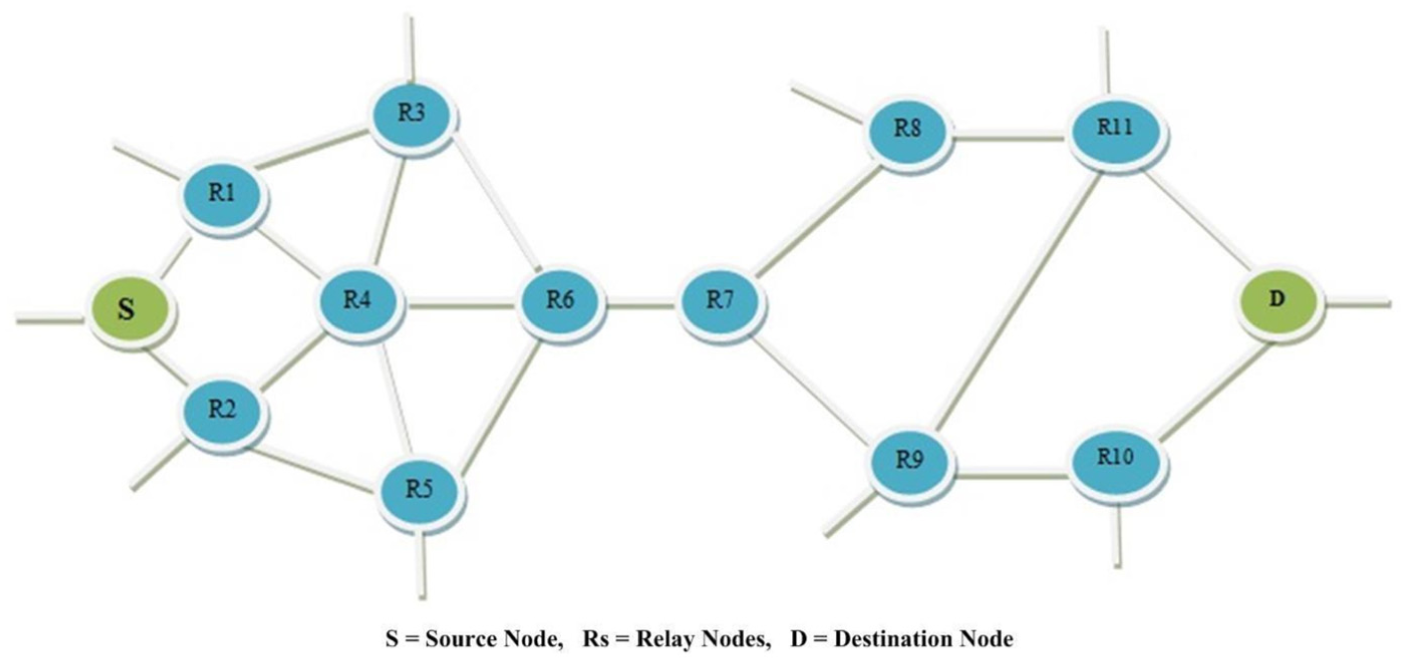
A cooperative system model.
Header contains an important parameter of payload ratio. This parameter increases exponentially and becomes a cause of energy loss. Additional loss of energy is due to the fact that propagation is more than the processing. Hence, splitting at every intermediate sensor causes serious issues leading to lessened network lifetime. MAC layer collisions lead to packet retransmissions which will use more energy and minimize network lifetime. For maximization of network lifetime, even load distribution is important and a proper strategy is needed to avoid infinite division of data.
The EAA scheme distributed load between the available links that kept an acceptable header for payload ratio. As all the data pass from the nodes 1 and 2 in both situations as shown in Figures 1 and 2; hence, it loses its energy rapidly. 36 According to nearest neighbors, the source data are divided into fragments in Case-I and then data being splitting continue until they reach to the sink while from originator the splitting of data is limited.
Co-EAAR: proposed protocol
In cooperative WSN environment, each node acts as a source that forwards information on its link, as well as relays data of other nodes on other links. Below stated analysis considers a two-step transmit technique which permits a non-overlapping forwarding for the source as well as relay. A single pair of source-sink having a separation of
Let a WSN environment be comprised of
Energy model
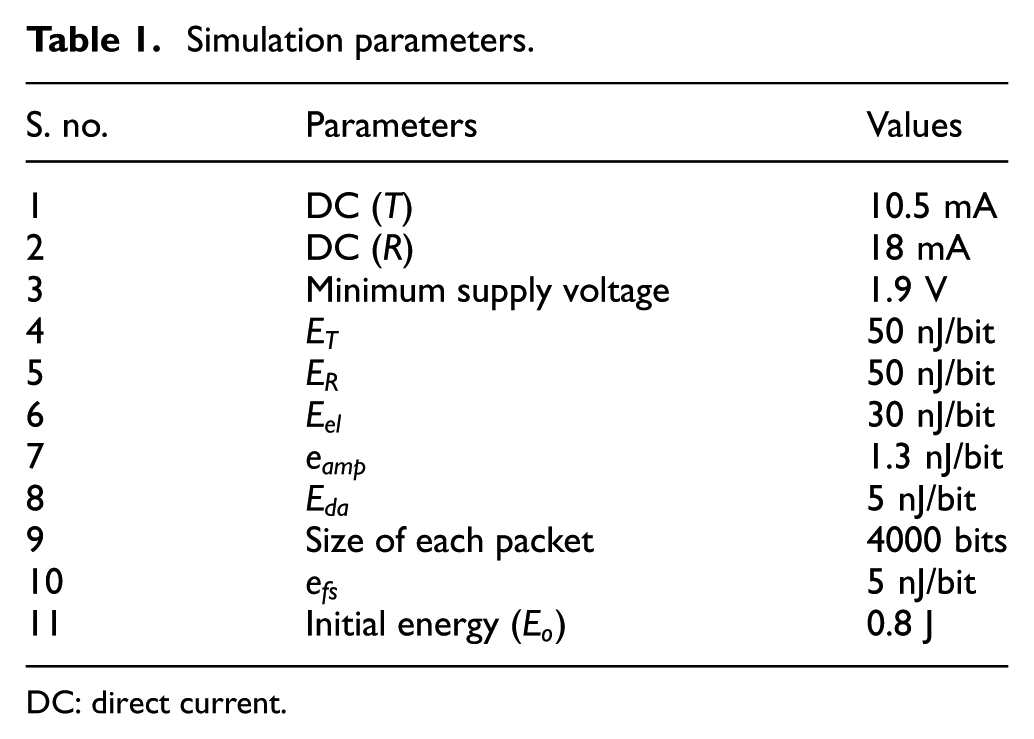
First-order radio model 5 presented for WSNs is as follows:
If

and if

Hence

equation for reception energy is given by

Here,
Simulation parameters.
DC: direct current.
Initialization phase
In this phase, three tasks are performed; sharing information of every sensor about its neighbors, identification of sink locations, and finding all possible paths to various sinks. Nodes update their information to sink and their neighbors when an information packet is broadcasted that contains node ID, left residual energy, and link length. Sink broadcasted a HELLO packet to all sensors for finding their total desired information. With the help of these packets, each sensor finds its optimal forwarders within its range of transmission and manages a list of forwarders under some threshold to find the best forwarder for its information forwarding (IF). Every sensor computes its weight function using expression 37 as follows

where
Cooperation model
In WSN environment using cooperation, each node having dual responsibility to act as a source and forward information that is been sensed on its path, or relaying forwarded information of other sensors on other links. Following analysis shows a consideration of two-step transmission mechanism, which permits a non-overlapping data forwarding for both the t and R nodes.
In Figure 3, a two-step transmitted protocol was considered that allowed from S to


where

where
In step 2,

where
Destination sensor
Relay selection and routing phase
A source
As given in Gu et al.,
38
we investigate the wireless-powered network consisting a single one
Relay strategy
Again by Gu et al.,
38
let

Also the residual energy

The signal received at D in step 2 is accordingly expressed as follows

where
Combining strategy
Destination node D follows diversity combining to aggregate incoming signals from

where

An acceptable value of weights ratio is 3:1 for DF technique. 37
where

and

If the transmitted symbol

Performance evaluation and basic assumptions
The working of Co-EAAR scheme is evaluated by comparing with two WSN routing schemes RRP and EAA. It is assumed that nodes were static and randomly deployed. The base station or sink was capable of collecting and transferring the data to the desired destinations from the relays. The simulations are performed for validating the working of the suggested Co-EAAR scheme with RRP and EAA schemes. In all, 100 sensors are deployed for simulations; and a base station is far from the nodes. Also supposed that each sensor deployed forwards its data to next higher level considering residual energy. Co-EAAR scheme is evaluated in terms of end-to-end delay, stability period, average energy consumption, and throughput having comparison with RRP and EAA. Assuming 100 nodes randomly deployed in a network area of 100 m × 100 m, initialized with same energy. Base station was installed in the center of network field. As in Heinzelman et al., 5 first-order model was used for calculation of consumed energy in reception and transmission. Energy of 50 nJ/bit is utilized for both circuitries; 5 nJ/bit/signal in data aggregation, 10 pJ/bit/4m2 for signals amplification in case transmission separation is less than prescribed, and 0.013 pJ/bit/m4 for amplification when vice versa.
Energy consumption
Figure 4 depicts the comparison of totality of consumed energy by all sensors to sense and/or relay packets and reach the final sink, of Co-EAAR, with other two schemes. Net energy consumption in cooperation-based Co-EAAR is less than those of RRP and EAA, as is portrayed in the plots.

Net energy consumption versus network lifetime.
More retransmission and energy is required for consumption in RRP and EAA to transfer a packet to the sink. Cooperation strategy of relays relies on channel conditions that ameliorate the quality of packet at the sink. Nonetheless, variation in quality can bring about changes in transmission with one path. Consumption of energy is more in EAA due to regular usage of high energy sensors while it gradually increases as the quantity of efficient forwarders falls with network density, that is, unbalanced load distribution in RRP. However, Co-EAAR expends a constant amount of energy during entire network lifetime by an introduction of cooperation compared to EAA and RRP protocols and an effective relay selection. An enhancement in the lifetime of network is brought about by the aforementioned proficient energy consumption that gets adjusted with the variation in network concentration. Table 2 shows the comparative analysis of residual energy in terms of percentage, for all schemes.
Percent drop in residual energy (J) after fixed intervals.

EAA: energy aware anycast; RRP: robust cooperative routing protocol; Co-EAAR: cooperative energy aware anycast routing.
Throughput
Figure 5 shows the throughput comparison of Co-EAAR with other schemes. For the reason of reducing the packet loss due to attenuation over the medium channel, the effects of the cooperative transmission scheme were assessed. In case of non-cooperative environment, more data are transferred from source nodes as the packet inter-arrival time is less. This, in turn, increases packet delivery ratio as compared to RRP and EAA. Packet loss is higher in RRP due to transmission without channel estimation. Furthermore, when traffic is more focused on smaller hops, it causes greater collisions and more packet delay. Transferring data on distinct paths and aggregating at destination sensor, cooperation strategy enhances the chances of successful reception of packets.

Packet delivery ratio versus network lifetime.
Both the RRP and EAA protocols forward redundant information along with high losses and packet delivery ratio goes down rather quickly because of sharp decay in the network density initiating right after 2000 rounds. Packet delivery ratio remains constant in Co-EAAR, up to 4250 rounds and then a steady decrease is recorded which can be attributed to maintenance of network density and low energy consumption. The throughput plummets are not suitable for both delay-sensitive and tolerant applications. But the protocol of Co-EAAR outweighs other schemes as there is little time lag in delivery of data, hence supporting our claim of its much better performance in flooding-based protocols. In an opportunistic forwarding fashion, RRP made use of basic greedy forwarding design and at each and every hop employed a fixed holding timer. By reducing the number of unnecessary transmissions between sender nodes and sink, higher throughput can be achieved in case of Co-EAAR. The higher throughput can be attributed to three reasons: (1) enhancing network lifetime, (2) improving stability period, and (3) improving connectivity in terms of relay nodes and cooperation. A numerical comparison of all the three protocols is depicted Table 3 in terms packet delivery ratio after equal intervals.
Packet delivery ratio after equal intervals.

EAA: energy aware anycast; RRP: robust cooperative routing protocol; Co-EAAR: cooperative energy aware anycast routing.
Network lifetime
A comparison of network lifetime among Co-EAAR, RRP, and EAA is shown in Figure 6. After simulation run, for fixed durations, each alive node forwards a packet until it reaches a sink or a relay. Death of the first node occurs after 1200, 850, and 1000 rounds in Co-EAAR, RRP, and EAA, respectively. Selection of proper relay and utilization of path loss of channel as medium also promote the stability period. This becomes a major cause of exclusion of rapid energy consumption due to usage of relaying nodes. The period of stability in EAA is longer than RRP, whereas energy consumption of network in EAA is greater. Stability period in the non-cooperation protocol RRP ends up rapidly because of clustering mechanism and prioritization of energy model that makes instability period to be inefficient. After equal round intervals, all three schemes present a comparison in terms of alive nodes in Table 4.

Number of alive nodes versus network lifetime.
Alive nodes available after equal intervals.

EAA: energy aware anycast; RRP: robust cooperative routing protocol; Co-EAAR: cooperative energy aware anycast routing.
Instability period of RRP is better than EAA that is on account of the gradual increase in network energy consumption. Network instability is caused by a decrease in the number of neighbors which in turn is induced when network becomes sparse. In Co-EAAR, the load balancing is done via the association of relay nodes and cooperation in each round. On the contrary, in case of RRP and EAA, energy consumption of nodes is not balanced which causes the continuous death of nodes after death of the first node. Uneven load distribution and lesser cluster heads make sharp slope of RRP graph in Figure 6. However, in Co-EAAR, the steady slope line scheme is because of the sensors and relays balanced energy consumption. After 3000 rounds, 85% of nodes die; hence, the network life time decreases that shows unbalanced load on nodes because of splitting of data at each layer.
End-to-end delay
The propagation delay in sensor networks induces high latency for data packets. In Figure 7, with respect to three schemes, an average end-to-end delay is shown. Figure 7 shows that end-to-end delay network is less in Co-EAAR than both the RRP and EAA which is due to the fact that forward distance between the nodes which are minimal, in both sparse and dense conditions. In RRP, initially, delay is much higher but then steadily decreases with network sparseness. Data are being sent from cluster heads and intermediate nodes in case of EAA and RRP to the base station directly without entailing relay nodes, which is why the propagation delay, in these schemes, is proportional to distance that traversing by a packet for reaching to the base station. Longer delay caused due to the prioritization of residual energy and whenever the networks get scattered, the delay rises with causing data transmission at minimum distance. In terms of end-to-end delay, Table 5 portrays the comparison of all three schemes.

End-to-end delay versus network lifetime.
End-to-end delay after equal intervals.

EAA: energy aware anycast; RRP: robust cooperative routing protocol; Co-EAAR: cooperative energy aware anycast routing.
In our proposed scheme, due to the consideration of signal quality and introduction of relay nodes that support cooperation, the time lag is minimal. Non-cooperative schemes forward data with least hops but loss full channel increases packet loss at sink; hence, data need to be re-forwarded. This increases the end-to-end packet delay while leading to lower retransmissions in Co-EAAR scheme was based on channel estimation where data were transmitted with more reliability. The packet reached to the sink with lower delay. The packet loss is reduced by execution of weight function and an adaptive movement of courier sensors along with reduction in end-to-end delay.
Performance with trade-offs
Throughput is improved in Co-EAAR at the cost of packet drop ratio. This is due to the reason that the network remained alive for longer time; hence, the probability of packet drop rises. As compares to other schemes in Co-EAAR, the drop in throughput is very much less. Co-EAAR scheme enhanced the receiving packet probability because of improved stability period. RRP achieved throughput at the cost of delay, packet loss, and much computation for selection of cluster head. Channel conditions in EAA are better than RRP, as the protocol coverage for maximum rounds in contrast to RRP; however, the performance of EAA gradually goes down in later stages having reduction in forwarding nodes, hence both the packet loss and delay raised but in its throughput at the cost of drop. Co-EAAR achieves 60% and 45% higher throughput than EAA and RRP. In terms of the price, Table 6 indicated the different performance parameters which they have to pay to enhance.
Performance parameters with their trade-offs.

EAA: energy aware anycast; RRP: robust cooperative routing protocol; Co-EAAR: cooperative energy aware anycast routing; SNR: signal-to-noise ratio.
The stability period is improved in Co-EAAR due to the cooperation; hence, the energy of amplification is very less utilized that enhanced the stability period. The network energy consumption is minimized by static segmentation and next-hop selection mechanism but at the cost of propagation delay. Due to large data sending separations, sensors utilize more energy and die quickly. Instability period started after 1200th round in Co-EAAR, but the throughput remained almost smooth, and net energy consumption increased gradually. In EAA and RRP, the instability periods started from 998 rounds and 1198 rounds. Cluster head selection is probabilistic in RRP and base station is directly communicated with cluster heads. Hence, the probability of creating energy and coverage hole is maximum in this scheme which causes a trade-off between energy consumption and the network lifetime. During an instable period of RRP, the network gets sparse slowly with creating load over high residual energy.
The propagation delay of EAA is higher than Co-EAAR also with the case of RRP due to the reduction of data packet routing paths. However, after 4000 rounds, the propagation delay of EAA remains similar as Co-EAAR. Because of this fluctuation in EAA, some clusters will have to transmit at shorter distance which are near to base station; however, in Co-EAAR, the curve of propagation delay remains stable. At the cost of time lag, the improvement in Co-EAAR is achieved in end-to-end delay. In EAA, at the cost of repeated transmissions, the delay is improved in addition due to distant data forwarding; in initial rounds, the delay in EAA is much higher at the cost of redundant transmissions. As throughout the network operations the scheme uses same number of next hop nodes, so end-to-end delay in EAA is better than RRP. In addition, the relay selection is not probabilistic that maintains load balance on the nodes.
Limitations and future work
Physical layer in any WSN environment should be efficient in energy consumption. Commencement of its designing starts with the design of the radio because it has significant impact on the performance of other layers. Radio that is efficient in energy consumption consumes least energy to operate and communicate. For the purpose of our research, we employ cooperation as the only parameter of physical layer that helped in the reduction of energy consumption, and to this aim, the physical layer needs the optimization of circuitry and transmission energy. The former can be minimized by reducing startup and wakeup times; shorter the wakeup and startup time, smaller will be the amount of energy consumed. For minimizing transmission energy for each bit, modulation schemes have been suggested in the literature. Work in the future needs new advances and techniques in low power radio design, and for reduction in synchronization and energy cost the generation of simple schemes of modulation, outlining the optimal transmission power, and designing more energy-efficient schemes and algorithms. These will aid a lot in the domain of underwater sensor networks and vehicular ad hoc networks.
Conclusion
The unbalanced distribution of load leads to a great deal of energy loss, which in turn results in lower stability period, which might also lead to traffic blockage. In this article, we propose Co-EAAR, for the maximization and reduction in lifetime and energy consumption of WSNs, respectively. By introducing cooperation and wireless-powered relays, lifetime of network is lengthened, improves ratio of packet delivery, and minimizes overall energy consumption by network. The schemes that do not employ cooperation, changes in channel quality affect transmission that has one path. The relay selection process considers the instantaneous link conditions and residual energy among surrounding nodes to successfully relay packets to the destination. Characteristics of single-hop and multi-hop communication schemes have been used for the reduction of path loss and have been increased network lifetime compared to non-cooperation-based EAA and with cooperation-based RRP protocols. Hence, this research is to provide useful ideas for designing cooperative routing schemes that are efficient in energy consumption with the usage of wireless-powered nodes, several other issues still need to be worked on for a comprehensive cooperative routing algorithm.
Footnotes
Academic Editor: Dongsoo Har
Declaration of conflicting interests
The author(s) declared no potential conflicts of interest with respect to the research, authorship, and/or publication of this article.
Funding
The author(s) received no financial support for the research, authorship, and/or publication of this article.