




Abstract
This article studies a joint performance optimization on the network lifetime and network throughput for an energy-constrained dynamic wireless sensor network. We propose a fully distributed power consumption balance opportunistic routing scheme to cope with the dynamic network that is not considered in the classic low-energy adaptive clustering hierarchy routing and evenly allocate power consumption among the sensor nodes for obtaining longer network lifetime. Moreover, a fully distributed optimization solution, whose distinctive feature to the Lagrange dual approach is capable of handling the changing network, is developed to achieve joint performance optimization of objectives. We mathematically prove the convergence of the proposed solution and analyze its computational complexity. Extensive simulation results illustrate the effective measures to deal with the varying network of power consumption balance opportunistic routing and the best tradeoff performance achieved by the proposed solution and evaluate the more positive impact on the network lifetime of power consumption balance opportunistic routing than the existing routings and better ability to adapt the dynamic network of the proposed solution than the Lagrange dual approach.
Keywords
Introduction
In a wireless sensor network (WSN), each sensor node is tasked to capture data and deliver them over wireless channels to the sink nodes for further data analysis and decision-making. In general, maximizing the network lifetime and network throughput are critical issues in WSNs. Nevertheless, the prolongation of the network lifetime always leads to the decrease in network throughput. How to make a tradeoff between the network lifetime and network throughput for the overall system performance remains a challenging problem. Moreover, WSNs usually comprise a large number of sensor nodes deployed randomly in a highly dynamic and hostile environment, resulting in the frequent change in network topology. In this article, for a joint network lifetime and throughput optimization under dynamic network settings, we focus on an opportunistic routing and a distributed optimization solution.
Low-energy adaptive clustering hierarchy (LEACH) routing is the classic clustering-based protocol that utilizes randomized rotation of local cluster heads to extend the network lifetime. However, LEACH routing does not take account of the dynamic networks. Moreover, neglecting the influence of transmission distance and the periodical clustering of LEACH routing limit maximization of the network lifetime. To overcome these problems, we propose a fully distributed power consumption balance (PCB) opportunistic routing scheme. It enables network topology update to cope with the dynamic network. For longer network lifetime, it abolishes clustering scheme and weakens the impact of long-distance transmission on node power consumption to save node energy. Furthermore, it adopts a new next-hop selection strategy to equally utilize power among the sensor nodes.
The Lagrange dual approach is frequently used to achieve the optimal solutions. But it could not handle the changing network. To solve this problem, we develop a fully distributed optimization solution, which is capable of tackling the changing networks, to achieve the joint performance optimization of the network lifetime and network throughput. The proposed solution decomposes the original problem into two stages. In the first stage, the optimization is executed at each individual node for maximizing the node lifetime and throughput. The second stage utilizes the results of the first stage to bring global optimization on the network lifetime and throughput.
The remainder of this article is organized as follows: section “System modeling” describes a generalized system model. Section “PCB opportunistic routing protocol” introduces the PCB opportunistic routing scheme. Section “Problem statement” formulates the proposed distributed optimization solution. In section “Theoretic analysis,” the convergence performance and computational complexity of the proposed solution are theoretically analyzed, and we prove Lemma 1 for the next section. Extensive simulation results are presented and discussed in section “Simulation results.” Finally, section “Concluding remarks” concludes this article.
Related work
In the past, a variety of routing and rate control schemes have been proposed to maximize the lifetime of WSNs.1–10 Madan and Lall, 1 He et al., 2 and Cetin et al. 3 studied distributed routing algorithms for maximizing the lifetime. Wang et al. 4 proposed a cross-layer design approach for minimizing the energy consumption of a multiple-source and single-sink WSN. Zhu et al. 5 exploited the interaction between the network lifetime maximization and fair rate allocation. Furthermore, many researches concentrated on LEACH routing protocol to prolong the network lifetime. Based on LEACH routing, Li et al. 6 proposed an improved cluster head reappointment algorithm (LEACH-R), to overcome the shortcoming of LEACH that each node would be frequently elected as the cluster head for several times and consumed some energy for this. Haneef et al. 7 utilized redundancy of the deployed nodes to increase energy efficiency in multi-group-based LEACH, outperforming LEACH at the network lifetime. A protocol named Bayesian network model LEACH realized uniform distribution of cluster heads that is not guaranteed in LEACH to extend the network lifetime in Ghasemzadeh et al. 8 Quynh et al. 9 presented energy and load balance LEACH routing (EL-LEACH), which showed a cluster head selection strategy for covering defects brought by the original method of LEACH, to achieve better energy consumption, load balance, and network lifetime. Ahmad et al. 10 controlled election and selection of cluster heads to uniform load on cluster heads and took the free association mechanism to remove back transmissions in adaptive clustering habit routing scheme for minimizing the overall energy consumption of the network. Whereas these studies are all on the basis of the static network and do not consider the dynamic settings. Thus, we propose a fully distributed PCB opportunistic routing to handle the varying network and obtain longer network lifetime than the existing routings.
How to maximize network throughput has been studied by extensive works. And most of them take the Lagrange dual approach to achieve the optimal solutions. Fida et al. 11 used a route selection metric based on the reception probability of Rician fading channel for avoiding the low-throughput routes of the conventional route selection metrics to optimize network throughput. Sappidi et al. 12 utilized in-network computation for statistical functions to reduce the volume of traffic transmitted, achieving maximized throughput in a WSN. The research results of Verdone et al. 13 showed that the density of the sensor nodes and the query interval decided optimized area throughput for different scales in a multi-sink clustered WSN. Based on the proposed mobile-relay-assisted data collection model, the achievable throughput capacity of large-scale WSNs is analyzed by choosing appropriate mobility parameters in Liu et al. 14 Xie et al. 15 solved the throughput performance deterioration problem by referring to the notion of fairness and demonstrated the availability of throughput maximum under an equal proportion of channel occupancy time for each contending node. Moreover, the tradeoff between throughput optimization and energy consumption optimization is considered. Ren and Liang 16 proposed a throughput maximized Medium Access Control (MAC) protocol, redividing each pico-net into several subsets in which communication pairs can make communication simultaneously, to maximize throughput and achieve short latency. However, these works are also founded on the static network and do not consider the condition that the change in a network happens. Hence, in this article, a fully distributed optimization solution, which has better ability to adapt the dynamic network than the Lagrange dual approach, is proposed to optimize the network lifetime and throughput simultaneously.
System modeling
A WSN could be modeled as a directed graph
Suppose that there are N nodes in a WSN. The ith node has a N-dimensional vector
To denote the latency resulting from channel contention, we introduce a concave increasing latency function
Moreover, define
PCB opportunistic routing protocol
Compared with LEACH routing protocol, the proposed PCB opportunistic routing scheme makes two improvements. The first is to achieve longer network lifetime, and the second is adapt to the dynamic network. To these ends, first, it cuts down the periodical clustering of LEACH routing to save the power consumption. Second, it takes into account the impact of transmission distance on power consumption. As is well known, the shorter the transmission distance, the less the transmit power required. In LEACH routing, a sensor node directly sends its data to the cluster head regardless of their distance. When the sensor node is far away from its cluster head, it uses a large amount of transmit power, which may lead to its early death and decrease
We now introduce some definitions and notations of PCB opportunistic routing. For a minimal number of hops to the sink node, the sensor nodes are classified into several levels. As shown in Figure 1, the 1st, 3rd, and 4th sensor nodes are considered as the third-level nodes because they need a minimum of three hops to reach the 10th sink node. Thus, the second, fifth, sixth, and seventh sensor nodes that need two hops are the second-level nodes. Following the same principle, the eighth and ninth sensor nodes are the first-level nodes.

Topology of the WSN.
Furthermore, we define the sensor node as an exclusive node when the number of the next low-level nodes it can connect is one. In Figure 1, the fourth node in the third level is an exclusive node as it only connects to one second-level node, that is, the seventh node. Similarly, the second, fifth, and seventh nodes in the second level are all exclusive nodes.
PCB opportunistic routing consists of three processes, that is, initialization, next-hop selection, and network topology update. The way of initialization uses LEACH protocol. It means that all nodes in a randomly distributed WSN (i.e. Figure 1) make sure their communication relationships in the ad hoc way. Within the maximum transmission range
When selecting the next hop, a sensor node follows the five principles that are listed below:
Next-hop selection starts from the highest level node, in a decreasing order to its next low-level node over the next hop, then one by one, and finally ends at the sink node. Next-hop selection among the sensor nodes in the same level is not allowed.
The exclusive nodes have the priority on next-hop selection. Afterward, other sensor nodes in the same level select their own next-hop nodes, one by one, from near to far around the exclusive node.
The sensor node selects only one next-hop node.
The sensor node selects the next-hop node whose node throughput is the least among the next low-level nodes of its neighbors.
The sensor node selects the nearest next low-level node under the circumstance that the next low-level nodes of its neighbors have the same node throughput.
Note that when next-hop selection process is finished, it will maintain stable until the network variation happens.
Take Figure 1 as an example. Assume that the amount of captured data at each sensor node is equal. Based on the principles above, the fourth exclusive node in the highest level first selects the seventh node in the next low level. Then, obeying principle (4), the third node in the highest level selects the sixth node in the next low level. According to principle (5), the first node in the highest level selects the second node in the next low level; moreover, the second and fifth exclusive nodes in the second level select the eighth node in the first level, and the seventh exclusive node in the second level selects the ninth node in the first level. Thereafter, following principle (4), the sixth node in the second level selects the ninth node with the least node throughput among the first-level nodes of its neighbors. Finally, the 8th and 9th nodes in the first level send data to the 10th sink node. To make a comparison, assume that in LEACH routing, the first, second, fifth, and eighth sensor nodes are in the same cluster and the eighth sensor node is elected as the cluster head. The first node would use a lot of power to transmit data to the cluster head for the long distance, which would lead to its early death. However, in PCB opportunistic routing, the first node could send its data to the much nearer second node, which could forward data of the first node to the eighth node, so as to save much power of the first node avoiding its early death.
Network topology update, including re-initialization and re-selection of the next hop, is triggered when the change in the network occurs. The sensor nodes that detect the change would notify the sink node, and then the sink node sends re-initialization messages to all the sensor nodes, telling them to do initialization and next-hop selection processes again.
Problem statement
Optimization problem
The total power of a sensor node is mainly used for two functions: (1) data transmission and (2) data reception. Based on the power consumption model widely used in WSNs,2,5 the transmission power consumption at the ith sensor node can be denoted as
Maximizing the network lifetime and network throughput are two contradictory objectives. To make a tradeoff, we use a simple and efficient weighting method,
18
to combine these two objectives into a single objective function. That is,

s.t.
Constraint (3) shows that the latency of the ith sensor node should be no more than node lifetime
In Problem
After the above transformation, Problem

s.t.
Proposed distributed optimization solution
According to the definitions of

s.t.

s.t.
Note that
Based on the results of subproblem

It is noted that the solution to

where

where EP and IP denote the equality penalty and inequality penalty, respectively. In practice, we use

where SEP and SIP denote the simulated equality penalty and simulated inequality penalty, respectively. For simplifying expression, we define
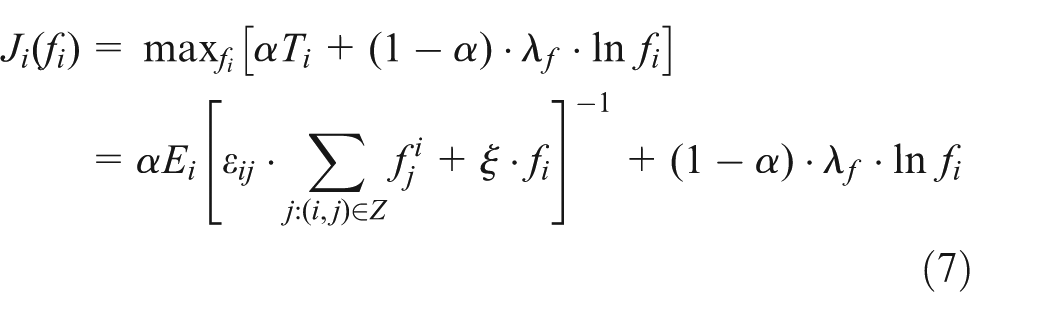

Hence, equation (6) is converted into
To find


where n is the iteration number,


In addition,

where
Because

where
It is worth mentioning that the first stage should also be conducted at the sink node. Since the sink node is supposed to be power infinite, lifetime maximization is no longer a problem, and throughput maximization becomes the sole objective of the sink node. Therefore, constraints (1) and (2) of subproblem

s.t.
Besides, equations (6)–(8) are re-depicted as follows


Meanwhile, equation (9c) remains the same, equations (9a) and (9b) are omitted, and this results in the worthlessness of equations (10) and (11). The reason is that equations (9a) and (9b) acquire

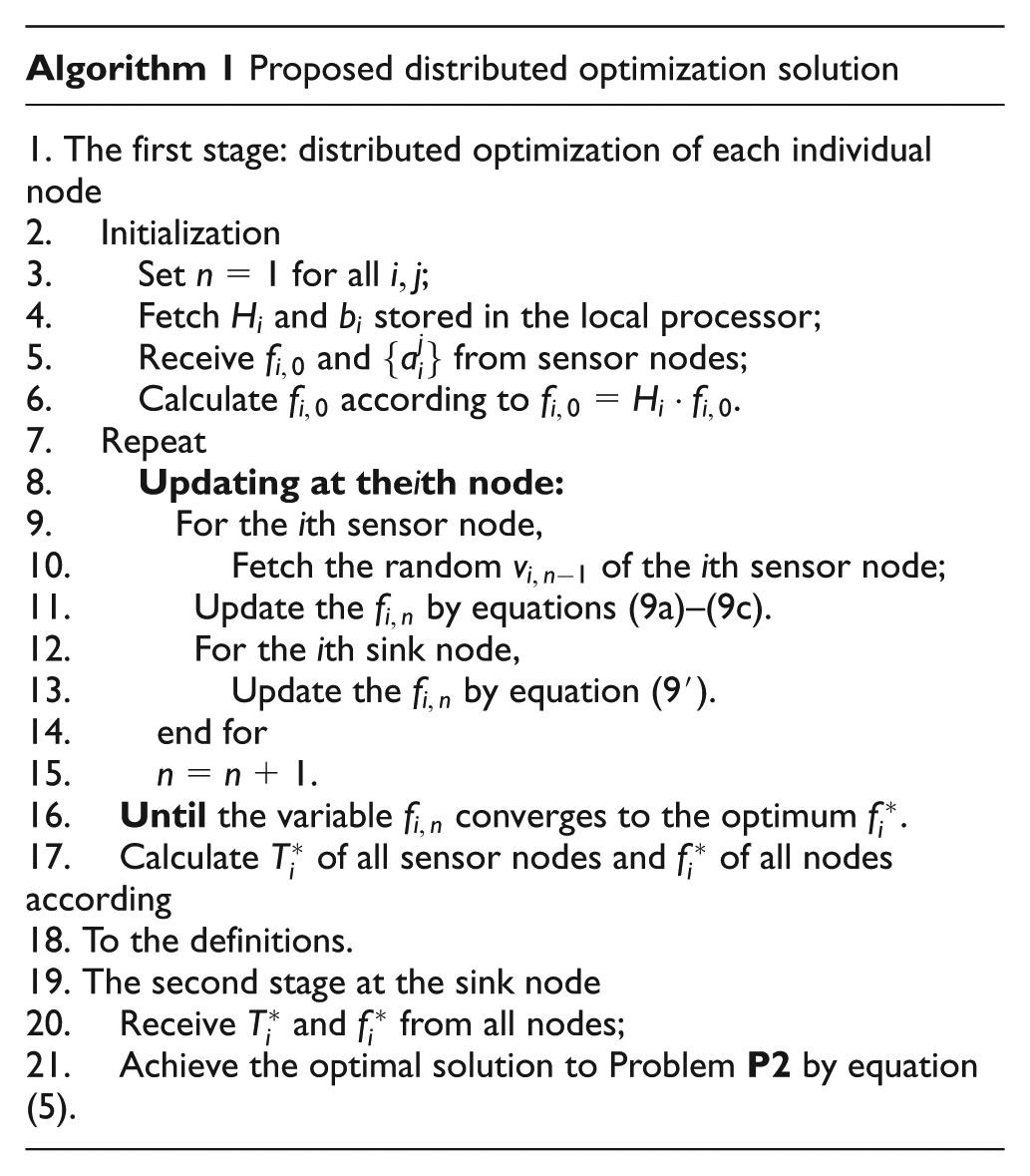
It is noted that when the network changes, the optimization of the lifetime and throughput at each node could run with the new parameters offered by the network topology update process of PCB opportunistic routing. After that, the second stage finds out the optimal
Practical problem
The computational complexity of the proposed distributed solution is determined by the computational complexity in two stages. At the first stage, the other nodes correlated to the ith node would obtain the optimums when the variable
To realize the proposed distributed optimization solution, each node is considered as a processor of a distributed computation system. Assume that the processor of the ith node keeps track of variable
There are three points need to emphasize: (1) for the static network,
When the communication overhead issue
21
is taken into account, all the update operations at the first stage can utilize those variables stored in the local node or link, except the updated rates
Theoretic analysis
As is stated above, subproblem
Theorem 1
The iterations at each individual node in the first stage converge to an optimum
Proof
According to the proposed distributed optimization solution, the optimization at each individual node is to seek the optimum of equation (6) obtained by the optimum


Assume that all constraints are satisfied, thus,
Because

Because

Hence,
The second-order derivative of equation (6) is
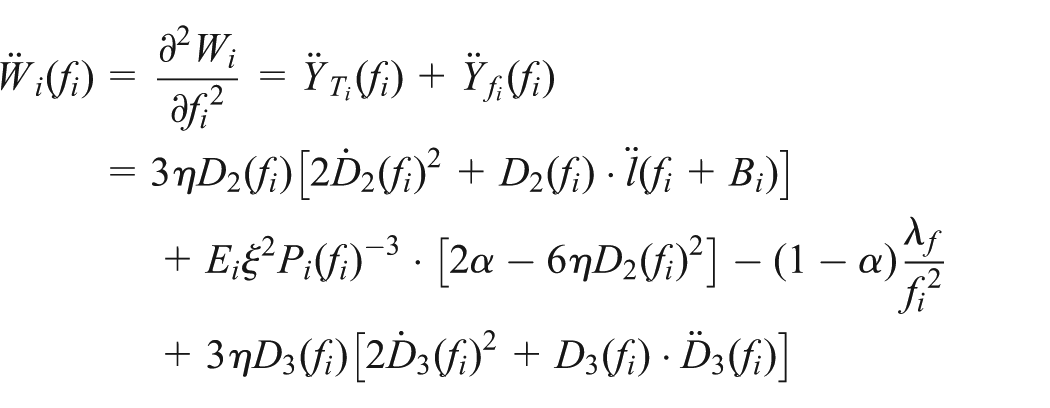
where
Since

Hence,
Considering another condition that the ith node is the sink node with infinite power, equation (6) is replaced by equation (6′). The first-order derivative of equation (6′) is

Because all the parameters are positive and

Hence,
The second-order derivative of equation (6′) is

Because all the parameters are positive and

Hence,
It is clear that equation (6′) has the same derivative properties as equation (6); thus, the optimum of equation (6′) and the optimum
Above all, this theorem is established.
Theorem 2
Starting from any sufficiently small
Proof
In fact, equation (6) could be written as
For the terms related to node lifetime,
For the terms related to node throughput,
When both
When the ith node is the sink node, equations (6′)–(9′) replace equations (6)–(8) and (9a)–(9c), and the results still remain the same. Detailed proof for the sink node is omitted.
In addition, for easy comparison of the performance of PCB opportunistic routing with LEACH routing, to be detailed in section “Simulation results,” we propose the following lemma.
Lemma 1
The average cost
Proof
According to definitions of
Differentiating

where all the variables and parameters are positive.
As we know
Simulation results
In this section, we will evaluate the overall performance of PCB opportunistic routing scheme and the proposed distributed optimization solution. We consider static WSNs with 10 nodes randomly distributed in a square region of
Configuration of model parameters in the WSN.

Convergence behavior of the proposed solution
In accordance with subproblem
Impact of the dynamic network
In this section, we take Figure 1 and 2 as an example to study the network topology update of PCB opportunistic routing. Figure 2(a) and (b) shows network topology updates of PCB opportunistic routing under the condition that the node moves and the condition that the sensor node dies, respectively. Precisely, in contrast to Figure 1, the variation in Figure 2(a) is the locomotion of the second node, which results in its larger distance to the fifth node and losing communication with the eighth node. The sensor nodes, which detect the change, inform the sink node by multi-hop transmission, and then the sink node sends re-initialization messages to all the sensor nodes. Re-initialization starts, where the second node builds communication with the third node. After that, the next-hop selection process brings us some changes that the first node sends data to the fifth node instead of the second node, and the second node transmits data to the sixth node rather than the eighth node. Moreover, when compared to Figure 1, the change in Figure 2(b) is the death of the ninth sensor node. It leads to that the 6th node, the 7th node, the 8th node, and the 10th node could not communicate with the 9th node. Therefore, the fourth node becomes the fourth-level node and the seventh node is considered as the third-level node in re-initialization. Also, it is given by the next-hop selection strategy that the seventh node sends data to the sixth node, and the sixth node transmits data to the eighth node. To summarize, the performance of the network topology update in PCB opportunistic routing in Figure 2 demonstrates that PCB opportunistic routing is capable of handling the dynamic WSN.

The comparisons of re-convergence behavior of the proposed solution and the Lagrange dual approach under the dynamic network are illustrated in Figures 4 and 5. Figure 4 is the comparison under the locomotion of the node, that is, Figure 2(a), and Figure 5 is the comparison under the death of the sensor node, that is, Figure 2(b). The final values of Figure 3(a) are the initial values of any sub-figure about the network lifetime in Figures 4 and 5, and the final values of Figure 3(b) are the initial values of any sub-figure about network throughput in Figures 4 and 5. Specifically, Figure 4(a) and (b) expresses iterations of each sensor node lifetime and each node throughput in the proposed solution under the locomotion of the node, respectively. Apparently, node lifetime re-converges to a steady state after about 6000 iterations and node throughput re-converges after about 8000 iterations. However, Figure 4(c) and (d) indicates that optimization goals do not converge after 10,000 iterations in the Lagrange dual approach. Moreover, Figure 5(a) and (b) shows iterations of each sensor node lifetime and each node throughput in the proposed solution under the death of the sensor node, respectively. Unlike Figure 4(a) and (b), node lifetime re-converges to a steady state after about 6500 iterations in Figure 5(a) and node throughput re-converges after about 7600 iterations in Figure 5(b). The death of the ninth sensor node results in smaller node lifetime optimums and node throughput optimums than the locomotion of the second node. The reason is that the death of the ninth sensor node increases the burden of other sensor nodes to forward data and more power would be consumed to shorten node lifetime. The death of the ninth sensor node also decreases the paths to the sink node and this would increase the delay lowering the transmission efficiency to decrease node throughput optimums. Nevertheless, the locomotion of the second node only adjusts the amount of forwarding data of other sensor nodes and adjusts transmission paths rather than increases the burden to forward data and decreases the paths to the sink node. Thus, it is lighter than the death of the ninth sensor node that the extent of decreasing node lifetime optimums and node throughput optimums brought by the locomotion of the second node. Meanwhile, Figure 5(c) and (d) indicates that optimization goals still do not converge after 10,000 iterations in the Lagrange dual approach. In conclusion, the results in Figures 4 and 5 demonstrate that the proposed distributed optimization solution outperforms the Lagrange dual approach at re-convergence under the dynamic network.
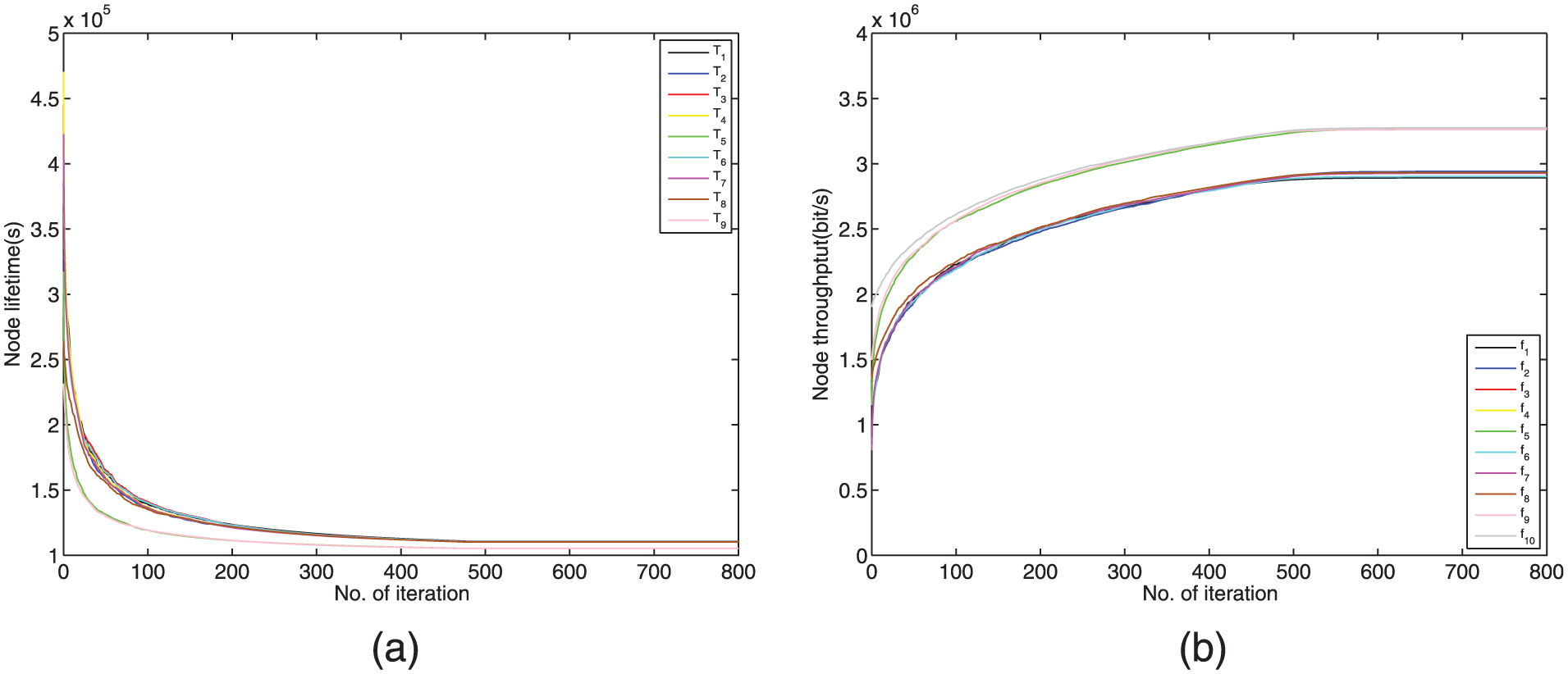
Convergence behavior of the proposed distributed optimization solution: (a) iterations of node lifetime and (b) node throughput.
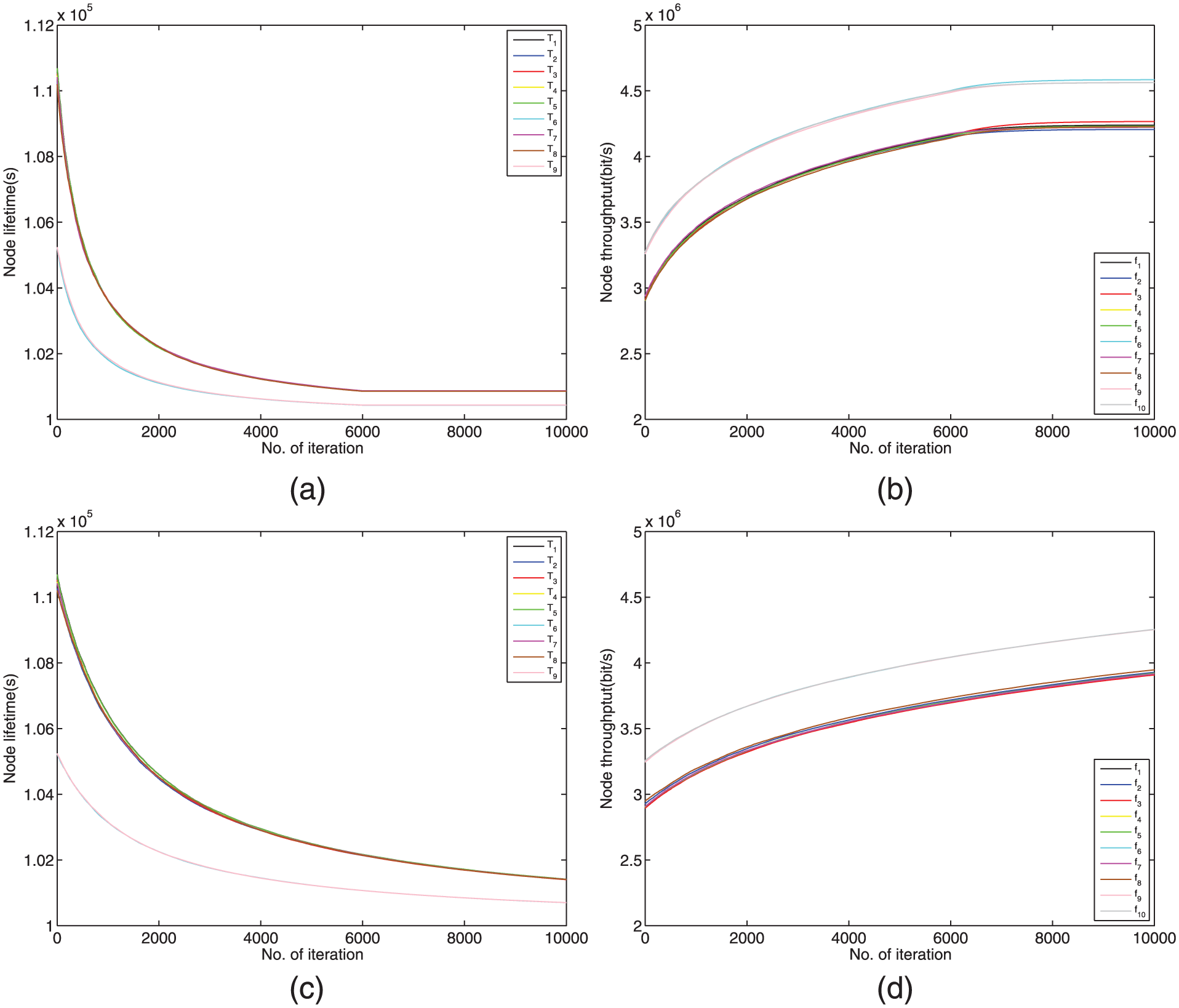
Re-convergence behavior of the proposed distributed optimization solution and the Lagrange dual approach for the locomotion of the node in the WSN: (a) and (b) the re-convergence process of the proposed distributed optimization solution and (c) and (d) the re-convergence process of the Lagrange dual approach.

Re-convergence behavior of the proposed distributed optimization solution and the Lagrange dual approach for the death of the sensor node in the WSN: (a) and (b) the re-convergence process of the proposed distributed optimization solution and (c) and (d) the re-convergence process of the Lagrange dual approach.
Tradeoff between network lifetime and throughput
The impact of the weighted system parameter
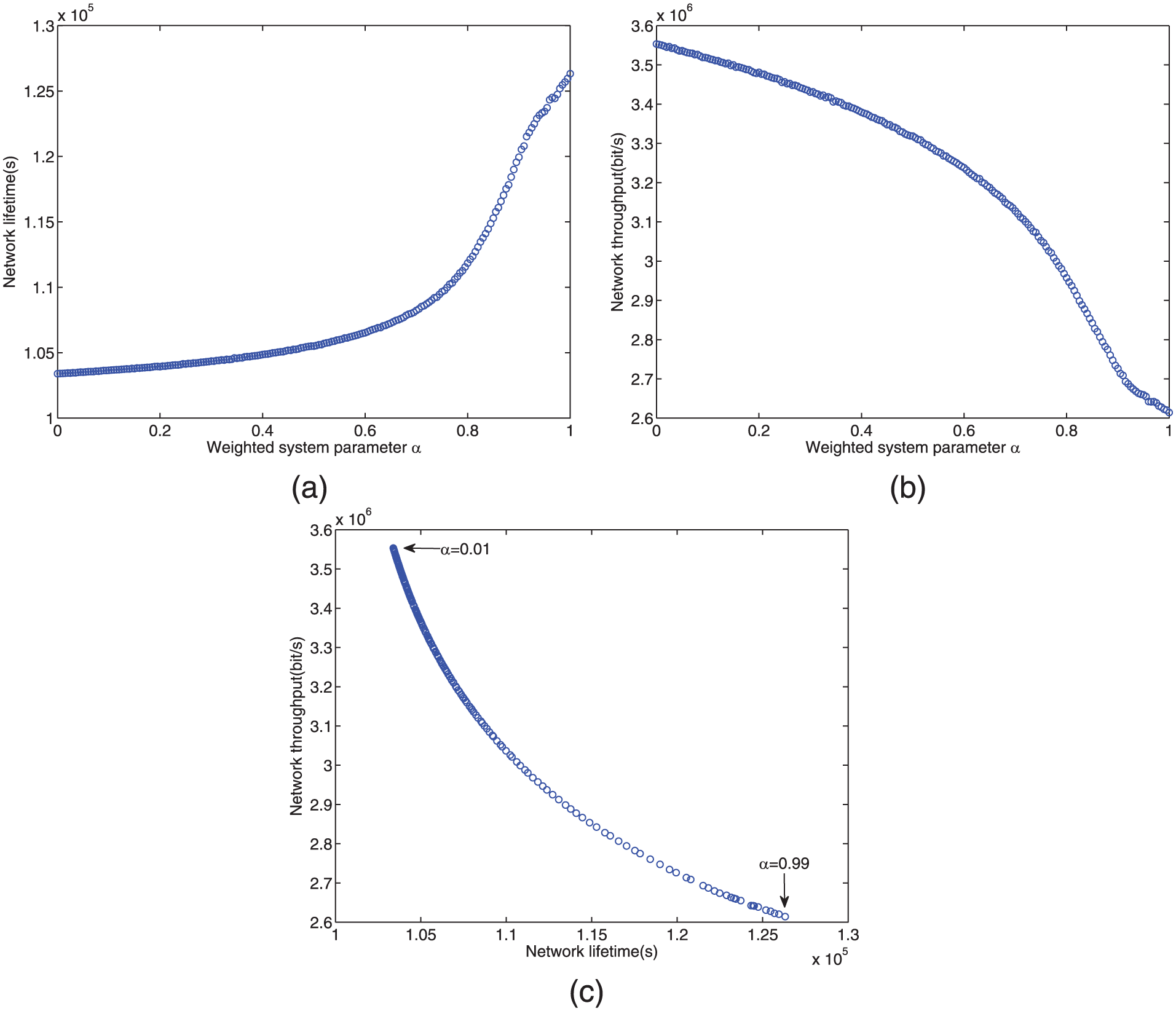
Impact of weighted system parameter

Comparison of PCB opportunistic routing, EL-LEACH routing, LEACH-R routing, and LEACH routing on different network scales: (a) variance of power consumption among sensor nodes, (b) average cost of nodes, (c) network lifetime, and (d) network throughput.
Impact of PCB opportunistic routing
To evaluate the impact of PCB opportunistic routing on the network lifetime, in Figure 7(a) and (c) we investigate the performance of variance
Smaller
Impact of network scale
To evaluate the impact of the network scale, we vary the size of networks and accordingly realize PCB opportunistic routing and the proposed distributed optimization solution over larger networks, where 20 and 30 nodes are randomly located in square regions of
Concluding remarks
In this article, we have investigated the tradeoff optimization between the network lifetime and throughput for dynamic WSNs. By the PCB opportunistic routing scheme, which could cope with the dynamic network and aims to prolong the network lifetime, and the proposed distributed optimization solution, which can tackle the changing network, we solve the tradeoff topic in a fully distributed manner. The convergence of the proposed solution was mathematically proved and its computational complexity was analyzed as well. Extensive numerical and simulation experiments evaluated the effectiveness of the proposed PCB opportunistic routing scheme on dealing with the varying network and achieving longer network lifetime by comparing with the existing routing schemes, and we demonstrate that the proposed distributed optimization solution can provide the best tradeoff performance in dynamic network settings and has better ability to adapt the changing network than the Lagrange dual approach. Besides, the PCB opportunistic routing scheme and the proposed solution both well support different network scales.
Footnotes
Academic Editor: Federico Barrero
Declaration of conflicting interests
The author(s) declared no potential conflicts of interest with respect to the research, authorship, and/or publication of this article.
Funding
The author(s) disclosed receipt of the following financial support for the research, authorship, and/or publication of this article: The work was supported in part by the NSFC, under grant numbers 61472234, 61271211 and 61622112.