




Abstract
Medium access control layer has been the hotbed of research in the field of wireless sensor networks since huge amount of research in wireless sensor networks has focused on saving energy and lately reducing latency. For the most part, medium access control layer solutions in wireless sensor networks are entrusted to save energy, to reduce latency, and at times to ensure reliability perhaps through cross-layer solutions. In this article, we review the surveys at medium access control layer and point to readers some of their strengths and relevancies to medium access control layer protocols. Furthermore, we classify the surveys subject-wise to show trend and usability. To cross compare, we devise a unified lexicon for the purpose and expose the coverage given to the wireless sensor networks’ medium access control protocols by different studies. We present medium access control solutions’ popularity on a known but hitherto unused metric: average citations/year from over 200 medium access control solutions. Our approach to assess the impact factor of protocols for ranking is validated prima facie from the coverage of these solutions by top ranking surveys. We believe it is the widest of such a study involving more than 30 survey papers and over 200 wireless sensor network medium access control protocols.
Introduction
Wireless sensor networks (WSN) consist of tiny nodes called motes installed with one or more sensors communicating their observations wirelessly to a single or multiple node(s) referred to as a sink which may possibly be connected to the Internet.1,2
Figure 1 depicts such a scenario. Due to advances in micro electro-mechanical systems (MEMS), the motes over the years have become cheaper and tinier allowing for a multitude of possible applications and deployment scenarios.

Typical sensor nodes’ topology.
In most scenarios, these nodes are scattered in the environment abundantly, typically in remote locations, hence their energy reservoirs, that is, batteries, cannot easily be replenished. Since energy was and still is a major concern for WSN solution developers, we see almost all early solutions developed with a single major goal: to conserve energy.
However, there is a huge amount of research being conducted at medium access control (MAC) layer where focus has been shifting from energy to latency and lately to reliability. Hence, there are numerous studies that review the state of art in the field from different perspectives.
Thus, in this article our contributions are as follows:
Subject-wise categorization of over 30 surveys on MAC protocols in WSN, eliciting their strengths and gaps. Our focus is to review the state of art in the surveys: highlight their strengths, sift out relevancies to the WSN MAC layer, and point out areas where further enquiry can be made.
Survey of over 200 WSN MAC protocols to gauge their impact with a well-known methodology—average citations per year. We show that the protocols coverage by different reviewers support our findings validating our approach.
The general category of surveys includes studies, which presented overall state of the art in WSN, and mostly conducted when WSN research was in its infancy; their focus per se is not MAC layer but they discussed MAC solutions and or guidelines such as Akyildiz et al. 3 and Ganesan et al. 4 Apart from these, we also include Demirkol et al., 5 Baronti et al., 6 and Zhao et al., 7 who review the mechanics of the MAC protocols and make little or no attempt to classify these protocols on any different criteria other than using existing well-known classifications. Focus of these works is to explain the protocol mechanism to the reader and in Demirkol et al. 5 and Zhao et al. 7 contrast this with other protocol design. Ali et al. 8 restrict themselves to providing guidelines to WSN MAC developers hence have also been included in this class.
Survey studies that have presented their taxonomy to classify the MAC protocols are best suited to readers who want to gain a holistic understanding of their relative position in the subject. However, taxonomists have used terminologies that are seemingly different in meaning but at times completely congruent which creates confusion in the mind of readers. Hence, an attempt has been made to elicit differences and similarities in meaning and the context of such terminology for providing greater clarity and perspective to the reader.
Lately, there is a surge of surveys focusing on quality of service (QoS) parameters and multimedia solutions. Goal of such studies are to apprise readers about the state of art in these fields since there is still a lot of work going on in these areas. Here, we point out the areas where more work is needed. Similarly, studies on cooperative diversity and ultra wideband (UWB) expose solutions for enhanced throughput in innovative ways.
In section “Medium access mechanisms,” we present the nature and restraints of the WSN environment and some recent developments leading to increased demand for innovative MAC solutions. Then, in the later part, we discuss proposed medium access mechanisms, in chronological and historical perspective, and their evolution as they tend to meet certain challenges posed by the typical WSN framework. In order to review surveys which survey WSN MAC layer solutions—in section “Review of surveys”—the studies are grouped subject-wise and each group is then discussed under separate sub-section extensively. In section “Coverage of MAC protocols by reviewers,” commentary on the coverage of MAC protocols by surveys is made after which, in the end, we summarize and conclude in section “Summary and conclusion.”
Medium access mechanisms
Before we discuss medium access mechanisms per se, it would be in order that we consider the nature and properties of wireless medium and sensor networks themselves.
Nature and challenges
MAC is a sub-layer of the Data Link layer in “OSI model” parlance. As the name suggests one of its primary functions is to control the access to the medium; hence, the radio is controlled by the MAC layer for the purpose.
In wireless medium when a node transmits a packet using its radio, it is received by all those nodes which are in the transmission range of the radio. This leads to energy consumption by all the other nodes which are neither transmitters nor recipients or routers of the packet. The nodes which are not part of communication chain but receive the packet due to the nature of the medium are said to be overhearing the packet. Similarly, when two nodes, whose transmission ranges intersect, transmit during the same duration, the transmitted packet becomes unusable and a collision is said to have occurred. To receive packets in the wireless medium, nodes are required to continuously scan for potential transmission. This activity is referred to as idle listening. Thus, overhearing, collisions, and idle listening are three major causes of energy wastage in energy constrained WSN.
With the advent of WSNs, the trend is toward miniaturization of the hardware. Fortunately, advances in MEMS provide a sustainable progress in the trend leading to nanotech technology being considered for WSN design. Thus, the acceptability and commercial viability of WSNs can be attributed to its small size and low-cost devices. This makes a multitude of applications, which were previously not thought of, possible. The WSN nodes are thus naturally deployed in abundance usually in non-controllable environment in the open where battery replacement is not an option. Ironically, their strength—miniaturization—is also their biggest weakness. They cannot carry big batteries, and neither their batteries can be replaced; hence, energy becomes a scarce resource. Thus, developers working at any layer of WSN generally would be required to design energy-efficient solutions but more so at the MAC layer. In WSN, MAC layer developers’ primary objective is to design energy savvy protocols as it is the MAC layer that controls the radio which expends most of the energy in WSN. 9 In this backdrop, network lifetime gains significant importance and alternate mechanisms are studied by researchers to conserve energy.10,11
Unlike conventional wireless local area networks (WLANs), most of the applications would require sensory readings to be reported to a node or sink which may or may not be power resilient. This gives rise to a unique network traffic pattern in WSN where all sensor nodes send their data to the sink. This communication pattern is called convergecast and is quite prevalent in WSNs. Besides, another unique traffic pattern of local gossip is also observed in WSNs when nodes locally share the information before sending it to the sink for better estimation or by reduction in overall transmissions by sending aggregate values and so on. Certain applications would however also require flooding and unicast transmissions.
Another limitation of the WSN nodes is that they also have limited processing and storage capabilities; thus, algorithms and protocol developers cannot rely on solutions that are computationally hungry and, or, use huge-buffer-allocation mechanisms.
Due to incorporation of complementary metal-oxide semiconductor (CMOS) technology 12 in image sensors and consequent realization of wireless multimedia sensor networks (WMSNs), many potential application areas such as surveillance,13–16 target detection, and critical infrastructure protection (CIP) 17 have emerged. Thus, the demand for increased QoS in WSN requiring the search for new mechanisms and solutions at the MAC layer.17–21 Likewise different technologies in medical sensing have increasingly made possible to monitor a variety of physiological phenomena of interest for preventive, diagnostic, and even medical interventional purposes accordingly motivating researchers to find newer solutions for this domain as well.22–26 Similarly, maintenance 27 and machine operational processes28,29 are being automated with wireless sensor and actuator networks (WSANs) in industries requiring different QoS bounds to be met by solution developers. For reasons, such as presented above, we see the exponential growth 30 of MAC protocols being developed to meet an ever increasing and diverse need of the applications.
The paradigm of restricting developers to the OSI model-based layers is also becoming hazy and blurred as more and more solutions are now demonstrating the benefits of cross-layer approach in protocol design in WSN.31–35 Multiple MAC layer solutions thus are also now providing reliability, routing, 36 and other functions previously attributed to other “layers.”
Some key mechanisms and their evolution
Although having roots in wired networks, Collision Sense Multiple Access/Collision Avoidance (CSMA/CA) is a highly analyzed and successfully employed medium access mechanism in WLAN. In the CSMA/CA protocol, a node senses the channel idle by performing clear channel assessment (CCA) for a certain fixed duration. Before transmitting, the node signals that the transmission is about to start, thus barring other nodes from transmitting. However, if the channel is found busy, it waits till the channel becomes available and then starts with CCA again. Note that a node present outside the transmission range of the sender may not be aware that the channel is busy and thus may start transmitting to a common receiver, thus leading to a collision at the receiver. Wireless networks label this phenomenon as a hidden node problem.
To resolve this and to enhance channel utilization, various improvements have made the CSMA/CA scheme sophisticated and viable for wireless communications. The IEEE 802.11 37 standard uses the same scheme as a fundamental mechanism—albeit with many improvements and amendments. BEB (binary exponential back off), control packets such as RTS/CTS/ACK (request-to-send/clear-to-send/acknowledgement), NAV (network allocation vector), and virtual sensing are all different features added to make the mechanism more robust and efficient to regulate medium access. For a detailed analysis of distributed coordination function (DCF), IEEE 802.11’s key access mechanism, we refer the readers to our earlier work. 38
Since the CSMA/CA protocol requires the nodes to carrier sense frequently, it is a costly procedure in terms of energy for WSN environment. In the following, we discuss the evolution of key ideas that were subsequently used by various WSN MAC protocols.
Duty cycling
The concept of duty cycling was first presented in a seminal work in sensor medium access control (SMAC) protocol. 39 Conceptually, the MAC layer would periodically turn the radio off to save energy for a certain amount of time. When the radio is turned OFF the node is said to be sleeping and when the radio is turned ON the node is said to be active. Generally, the idea was to divide the time into duty cycles of which a certain proportion the nodes would remain asleep. For sender/receiver rendezvous, it was proposed that the nodes would be synchronized locally instead of network-wide (global) synchronization which require much more precision and overhead.
This mechanism certainly leads to energy savings as was required by WSN, but it also engendered delay and additional energy-consuming overhead for synchronization. Subsequently, to address the former cause, many works suggested heuristics to alleviate the problem, dynamically adjusting the duty cycle of the nodes based on the traffic load, that is, instead of a fixed period; nodes would sleep less near the sink in a convergecast scenario. It was a key idea that led many protocols to adopt this concept. However, to address the issue of energy wastage from synchronization overhead, low-power listening (LPL) was conceived40–43 which is discussed next.
LPL
PS-ALOHA (Preamble Sampling-ALOHA) 44 and B-MAC (Berkeley-MAC) 45 were the first two protocols to propose LPL. In LPL, a simple concept is proposed where nodes would periodically awake, by turning their radios ON, to monitor the channel activity. Nodes would be alerted by the presence of a low-level signal (preamble) of an upcoming data transmission. Thus, node would remain in active state to receive the packet. If the node was not the intended receiver, then it would go to sleep. The receiver node, however, would stay awake. In this way, nodes would save energy earlier spent on synchronizing. However, a low-level signal — preamble — would precede a data packet whose duration would have to be greater than the sleep interval of the nodes in the network. This would guarantee that nodes would become active for preamble sampling before it finishes. Nodes would also perform calibration so as to differentiate between medium noise and preamble.
Although this mechanism saved the synchronization overhead, energy pilferage from the system could not be stopped altogether. First, long preambles would drain senders’ energy. Second, because of these long preambles, all nodes in the range of a sender would need to remain awake. Only after receiving packet header when receiver of the packet would become known, the nodes, other than recipient, can go to sleep. This results in energy wastage of neighboring nodes due to preamble overhearing. Yet, on the other hand, this scheme, by its very nature, precludes applications requiring high bandwidth.
Many novel techniques were proposed to address the energy waste from overhearing of the preamble. The studies46–50 used a technique called packetization to shorten the preamble length by sending packets instead of simple signal tone as part of the preamble containing rudimentary information such as the receiver of the upcoming packet. This allowed the neighboring nodes not to wait till the end of preamble to discover that a packet was not intended for them. Later works51–54 split the long preamble into small, intermittently repeated preambles, in the form of info packets. The gap between the preamble packets is adjusted to allow the receivers to send an ACK. This strobe packetization results in early cessation of preamble, thus saving energy in this breed of protocols. Developers also designed protocol for dual radio nodes 55 where exclusive low-power radio will be used for preamble transmissions which will further avoid collisions and enhance channel utilization.
Low-power probe (LPP) — a technique used by works such as56–60— was yet another novel technique in this category to boost channel utilization. In LPP receiver signals its readiness to receive and senders which would be awake if they had anything to send start sending. Here, the challenge is to have an efficient collision resolution mechanism to resolve conflict between multiple senders waiting for a receiver to be active. This was a departure from the conventional paradigm of sender initiating the communication; here, receivers’ initiate the communication by indicating their readiness to receive.
Scheduling
Sohrabi et al. 61 presented SMACS (self-organizing medium access control for sensor networks) protocol proposing scheduled access mechanism. It was assessed early-on that to guarantee QoS in WSN the organized access mechanism providing collision-free access is more suitable to the environment. Thus, many works were designed around this idea, where each node in the network is allocated a time slot for transmission to resolve a medium access. Various mechanisms, from distributed scheduling to hierarchical topology, evolved over time to decentralize the synchronization process required to observe a schedule.
Multichannel
MMSN (multi-frequency MAC for sensor networks) by Zhou et al.62,63 was the first attempt to use multiple-channel technique in WSN. Although it was already in use in wireless ad hoc networks, due to the smaller packet sizes in WSN, it was not earlier applied here. The main idea was to be able to use different frequencies to enhance channel utilization.
Some later works 64 incorporated the idea of dynamic allocation of frequency bands to the nodes instead to the fixed frequencies to make efficient use of allocated spectrum band.
Review of surveys
Our focus in this article is on surveys that review works related to the MAC layer in WSN. Some 30 surveys were reviewed and classified subject-wise. Figure 2 shows their subject-wise classification and Figure 3 displays the impact factors of these surveys. Refer to section “Coverage of MAC protocols by reviewers” for detailed account of articles’ impact factors and its use in our study. In Figure 2, showing the classification, many papers appear in more than one class or subject. Papers where authors review MAC protocols simply without any particular focus or where authors take a holistic view of WSN per se are placed in the General category. Similarly, papers that introduced their own taxonomy are classified as Taxonomical. Survey papers that review solutions presenting different innovative and unconventional techniques and or design approach are termed here as Eccentric. Other surveys were classified — with descriptive terms — as per their focus with respect to MAC.

Subject-wise classification of surveys illustrating the trend in studies.

Impact factors of surveyed survey papers.
We first review the Taxonomical papers, followed by General papers. Then, studies focusing on QoS are followed by surveys reviewing MAC protocols with respect to some performance metric not necessarily with the aim to provide QoS. In the end, we present a discussion on surveys covering eccentric techniques and design approaches. Coverage of protocols by these surveys has been left for section “Coverage of MAC protocols by reviewers,” where we dealt with the topic by first adopting a common lexicon.
Taxonomical surveys
In taxonomical surveys, authors present their classification of WSN MAC protocols along with their rationale for the classification. This description of their classification is important, as it help us understand the motivation and reason behind these groupings which then lead us to study the subject with a high level of understanding. Although one of the earliest such attempt that fulfills the criteria of a taxonomical work is by Langendoen, 65 earlier works of Kredo et al. and Ye et al. present a rudimentary taxonomy. Figure 4 presents a ranking of such studies based on average citations per year while Figure 5 gives a timeline view of these surveys. We shall review these studies in the order of their impact factors here.

Impact factors of taxonomical surveys.

Timeline of taxonomical surveys.
Bachir et al. 66 provide a taxonomy of WSN MAC protocols with motivations behind their design. Their classification divides protocols as: scheduled, common active periods, preamble sampling and hybrid.
Scheduled protocols that are typical of this class such as IEEE 802.15.4 are referred as Canonical solutions. Other sub-classifications are based on protocols scheduling mechanics such as Centralized, Distributed, or Location-based scheduling. Further sub-grouping is done on the basis of protocol support such as mobility and adaptive traffic patterns. The underlying process for such delineation is not any systematic breakdown on the basis of protocol mechanics, but the design goal is the motivational factor behind their classification.
Similarly, CAP protocols are also delineated on the basis of motivational factors behind the solutions. Likewise, after designating SMAC as the only canonical solution, CAP protocols are further split on the basis of flexibility, minimizing sleep delay and schedules, mobility support, use of wake-up radios, and statistical approaches. For instance, dynamic MAC (DMAC) and adaptive listening are both shown in one sub-category as minimizing sleep delay despite the differences in their mechanics. However, the use of terminology — CAP — appropriately describes the class.
Preamble Sampling protocols, however, are sub-classified mostly on the basis of their operation mechanics. Discussion here is much more design oriented where focus is to categorize protocols on the basis of their design. For instance, protocols that are motivated to reduce the preamble length are not clubbed together merely on this basis rather they are further split based on packetization and piggybacking mechanics employed to achieve their objective. Sub-classification of Hybrid protocols is unclear as it re-categorizes IEEE 802.15.4 here as flexible Hybrid protocol. Most of the protocols are characteristically sub-classified in Hybrid class.
This survey also provides a useful account of a number of hardware factors, whose recent contributions have made use of in the design of MAC protocols. Overall, the survey is a comprehensive and fairly detailed work.
Huang et al. 67 cover not just the classification but also the flow of ideas leading to the development of a family of protocols. It highlights the need and features of the solutions and problems that protocols try to address. Discussion here is much more focused and consistent with their theme. Chiefly, protocols are sorted on the basis of how they handle time much like an earlier work of Langendoen. 65 Those protocols where the clocks between nodes are not synchronized are labeled Asynchronous, whereas nodes that are locally synchronized are labeled as Synchronous, where nodes are synchronized network-wide they are termed Frame-slotted. Separately, a class of multichannel protocols is sub-classified into Static and Dynamic protocols depending on frequency allocation methodology of the protocol. The taxonomy is illustrated in Figure 6.

Huang et al.’s 67 taxonomy showing protocols in different categories.
Asynchronous protocols are sub-categorized into eight sub-classes based on their design evolution. Starting from Preamble Sampling (PS) as a baseline idea, the work progresses to LPL and then to a category of protocols with two radios. A detailed discussion is then presented on protocols which shorten preamble through packetization —Continuous and Strobe— to enhance throughput. Also, separate sub-classes are defined for protocols that (1) learn the schedule of neighbors in order to further shorten the preamble in pursuit of enhancing throughput, (2) use low-power probing (LPP) where receiver nodes initiate transmission, (3) resolve medium for multiple senders to the same node in LPP family of protocols, and (4) predict receiver’s duty cycle in order to minimize sender loss, within LPP group of protocols. These sub-classifications are neatly driven and several protocols and differences elicited as examples.
Synchronous protocols are also marked out in five evolutionary sub-classes but the discussion here is brief and examples are few. The sub-classes include Adaptive Listening, where a protocol adapts its sleep interval if it is the downstream node of the upcoming packet, and future request to send (FRTS), where active period is determined by participating nodes in the start. Also to reduce latency further in multi-hop transmissions, two sub-classes are defined protocols that allow transmission in sleep periods and protocols where schedules are staggered along the packet flow. In the end, a sub-class is catered for protocols which dynamically change their duty cycle based on their load. Intriguingly, Scheduled Channel Polling MAC (SCP-MAC) has been discussed in this class owing to its adaptive duty cycling while ignoring its channel polling technique.
Frame-slotted protocols are discussed under four sub-categories. Since TDMA protocols suffer under light traffic loads in terms of channel utilization, a sub-category is defined for protocols which contend for medium under low loads during unused slots. Another sub-category is used for protocols which define a frame consisting of two parts: in the first, a slot is allocated, and in the second part, medium is contention-based, that is, nodes contend for access much like CSMA. In yet another sub-category, protocols maximize their throughput at sink by using stable tree structure. Protocols which reserve nodes for receivers rather than senders — mirroring the operational nature of asynchronous MACs that predict the receivers’ schedule — are sub-categorized separately.
Multichannel protocols are the solutions with the design goal to address bursty traffic and multi-task applications. The authors have divided these protocols on the basis of two important but inherent challenges of multichanneling that they address: (1) communication between channels and (2) channel allocation between nodes. Additionally, they are also classified as per their medium access mechanism.
Toward the end of the paper, Huang et al. 67 discuss and contrast the most pertinent industrial process automation standards 802.15.4, WirelessHart and ISA-100.11. This is a recent work with extensive protocol coverage.
Kredo and Mohapatra 68 broadly divide protocols into two categories: Scheduled and Unscheduled. Because of its overtly simple classification, this work has little significance in terms of categorization of protocols. Additionally, the discussed categories lay out a lengthy discussion in two sub-articles. However, each category is then sub-divided into several classes. Nonetheless, this work distinctively reviews several less reviewed solutions such as SRBP and CC-MAC; additionally, it sub-categorizes Multipath and Event-centered solutions within unscheduled protocols. Conversely, all preamble sampling protocols are clubbed into one sub-category—Encounter-based protocols—which is an over simplification of their mechanics. Likewise, all TDMA MAC protocols are also sub-categorized under one subheading. Similarly, they discuss all synchronous duty-cycling protocols having CAP under Clustering-based solution’s category which is an oblique reference to their virtual cluster formation. The other classes of scheduled MAC do not evenly divide the body of protocols. It is also pertinent to note that there is no class or sub-class for Hybrid protocols; hence, despite the duality of access mechanisms found in traffic-based MAC solutions, they have been classified as Scheduled protocols. All of these traits make it a skewed classification.
Kredo and Mohapatra also make an extensive commentary on wireless MAC solutions before discussing differences and constraints of the WSN solutions. In wireless MAC, they discuss CSMA/CA, 69 MACA, 70 and its variants and IEEE 802.11 to conclude that these solutions inherently are not suitable for WSN. Also, IEEE 802.11 access mechanisms, DCF and PCF, are discussed in detail. Then, suitability of IEEE 802.15.4 for WSN applications is discussed and limitations of IEEE 802.11 are enumerated such as high-energy consumption even under power save mode in PCF, coupled with high protocol overhead.
Suriyachai et al. 71 have classified WSN MAC protocols for suitability to mission critical applications such as industrial process automation, sensor actuator, and body area networks. They present a rubric in the form of an X-Y axis where time (delay) and reliability lie on X and Y axis, respectively. Delay and reliability are thus the two metrics on which every protocol is weighed and placed in respective quadrant as shown in Figure 7. Based on protocol mechanics, a quantifying profile is developed where protocols were weighed from 0 to 1 with 0.125 intervals for meeting delay and reliability objectives with 0 given for protocols not addressing the objectives and 1 for guaranteeing end-to-end delay and reliability. The detailed scheme is reproduced here from Suriyachai et al. 71 in Tables 1 and 2 (taken from the paper) presenting the reviewed protocols as classified in Figure 7 by the authors.
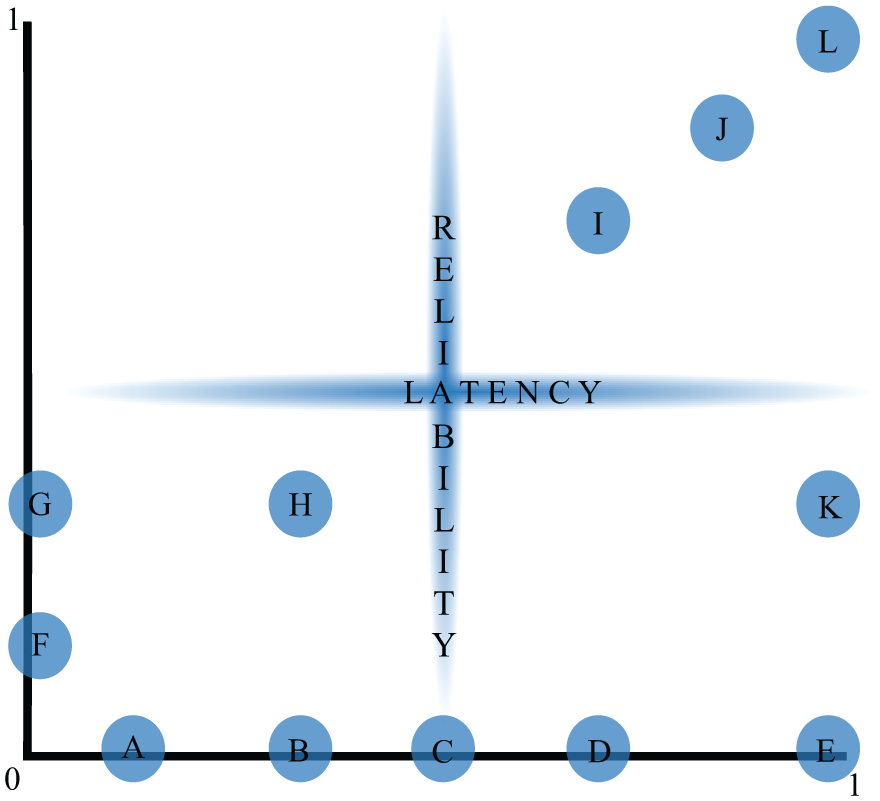
Protocols mapped onto a rubric presented by Suriyachai et al. 71
Quantifying the performance of protocols to map onto the rubric taken from Suriyachai et al. 71
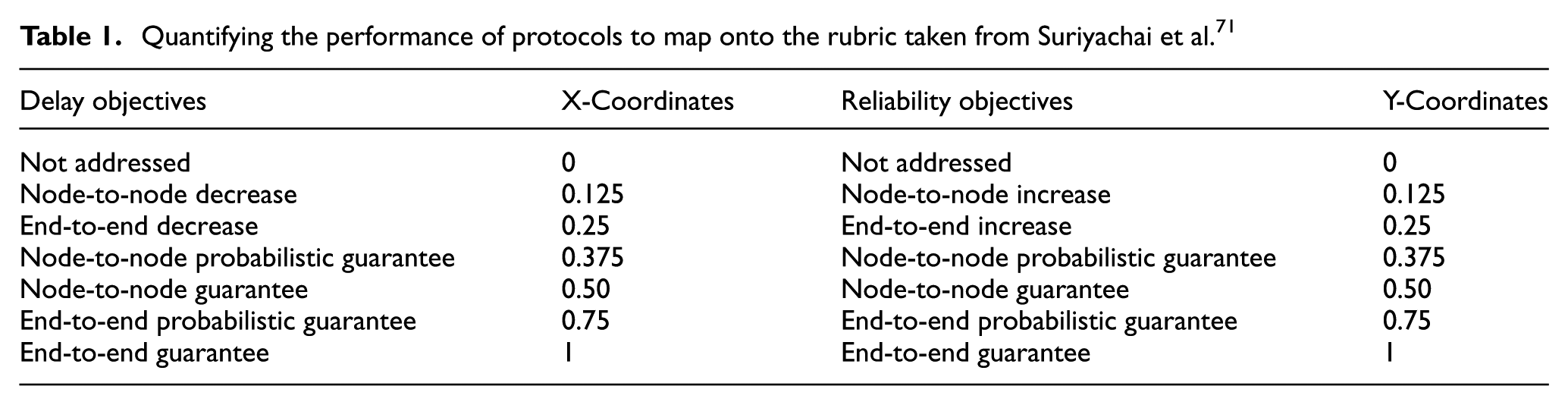

MAC: medium access control.
Suriyachai et al.’s survey is not based on simulations, rather the protocols design is used to measure the performance metrics which reduces it to a review of protocols design and procedure/mechanics. This approach is problematic when comparing protocols for performance. Nevertheless, this work provides a perspective to evaluate protocols but is limited in a sense as it does not consider node mobility, throughput, and jitter which may also be important metrics for such applications. Yet, it is novel in the sense that it elicits a different approach to classification which is performance oriented with respect to a breed of application.
Ye and Heidemann 94 in one of the earliest works, which classifies the WSN MAC protocols as Contention-based and Scheduled, much like Kredo and Mohapatra, 68 present a rudimentary and simple schema. This work heralds a beginning of a breed of WSN protocols: synchronous duty cycling. Since the authors themselves had presented SMAC, the work thoroughly reviews SMAC through simulations to exhibit its energy and latency performance under different conditions. It focuses on early design drivers for WSN MAC such as energy efficiency and collision avoidance. Latency, however, was not considered important at that time. In Scheduled protocols, it reviews SMACS and LEACH as representative protocols of the class. A synchronization cost in terms of energy has not been considered while evaluating scheduled protocols. Similarly, review of contention-based MAC is limited to primitive solutions such as CSMA/CA and MACAW. However, readers wanting to know the motivations behind the SMAC design and its authentic performance would benefit from reading through this interesting study since SMAC is a leading and eminent protocol which later resulted in ever expanding body of works based on it.
Yahya and Ben-Othman 95 categorize WSN energy-aware MAC protocols with four major classes: Unscheduled, Scheduled, Hybrid, and Cross-layer protocols. Each of these classes is then split into several sub-classes and their pros and cons enumerated. A section on cross-layer protocols also discusses solutions which are not MAC protocols. QoS-specific MAC protocols are also commented upon in a separate sub-section.
First, since all early solutions were energy-aware, the paper quite generically covers WSN MACs; second, the taxonomy does not follow a particular theme as Scheduled and Unscheduled classes focus on access mechanisms of the solutions whereas Hybrid and Cross-layer classes are design-based segregations.
There is a striking similarity between their sub-classification and that of an earlier work of Kredo and Mohapatra 68 for Unscheduled protocols; however, the classification is not as skewed. Also, protocol reviews are abundant and evenly spread, thus faring better in terms of protocol coverage. Like Kredo and Mohapatra, Multiple-channel and Event-based MAC solutions are separately sub-classified. But in contrast to them, not all preamble sampling protocols are clubbed together but rather split into two sub-classes based on their access and design mechanics. Multipath protocols are, however, not discussed but mentioned in the taxonomy. For Scheduled protocols, the authors have expanded their sub-classes to contain Slotted and Reservation-based protocols, in addition to TDMA and Priority-based solutions. Unlike Kredo and Mohapatra, 68 Yahya and Ben-Othman, 95 however, have classified synchronous duty-cycling protocols having CAP under a separate subheading: Slotted Contention.
The main strength of Yahya and Ben-Othman 95 is their contribution to hybrid taxonomy and protocols coverage where they extensively sub-classify the hybrid breed of protocols. Discussions on cross-layer solutions and QoS-aware protocols are other two strong areas of this work. Cross-layer solutions are not covered as extensively by any other work. Even protocols where MAC layer is not involved, network-physical layer solutions and transport-physical layer solutions are covered.
Langendoen 65 based on nodes’ organization of time classifies WSN MAC protocols in four main classes: Random, Slotted, Frame-based, and Hybrid protocols. It is one of the earliest works presenting the evolution of protocols in each of these classes. The classification is shown in Figure 8, wherein the timeline at the bottom of the figure depicts evolution of ideas in time domain. Unlike many later works, the classes cover multiple protocols in each, which suggest that the classification is not created with useless splitters and thus not disproportionate or skewed but rather a well-balanced thematic view of existing protocols. However, authors have stated that Crankshaft outperforms SCP-MAC in simulations without showing the results and SCP-MAC has not been described in detail, yet the work is a good and handy reference for WSN MAC.
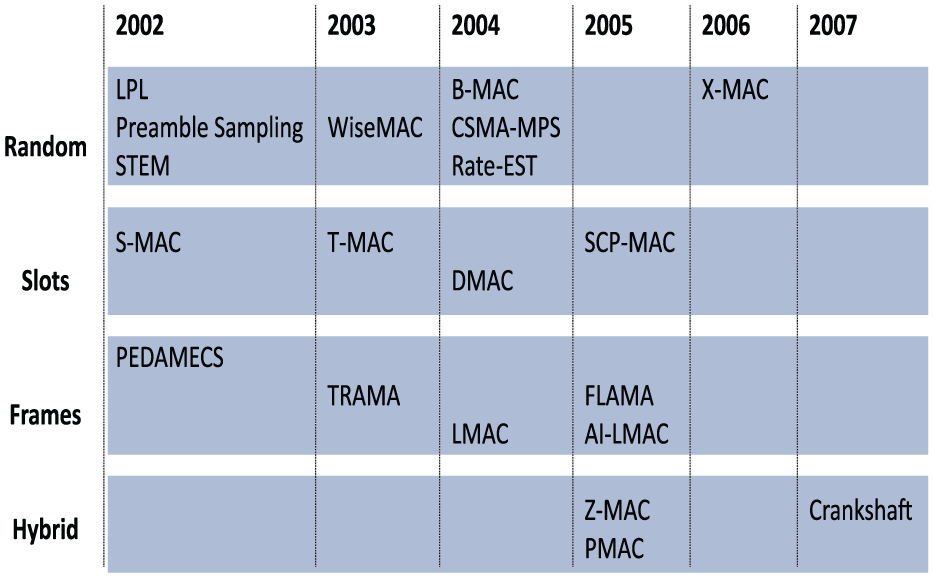
Langendoen’s 65 classification with timeline.
Messaoud et al. 96 review asynchronous WSN MAC protocols for their delay efficiency while presenting their classification of the asynchronous breed of protocols. They divide the protocols into six categories: Static and Adaptive Wakeup Preamble, Collaborative Schedulers, Collision Resolution, Receiver Initiated, and Anticipation-based protocols. Protocols that use a fixed length of preamble are categorized as Static Wakeup Preamble protocols. Similarly, protocols employing dynamically changing length of preamble based on network traffic load and receiver’s schedule are classified as Adaptive Wakeup Preamble protocol. Protocols where nodes set up their schedule collaboratively minimizing end-to-end delay are grouped as Collaborative Schedule Setting protocols. Protocols that focus on collision resolution mechanisms to avoid delay and to minimize probability of selecting same slot for transmission by more than one node are categorized as Collision Resolution protocols. Receiver Initiated protocols are those where receiving nodes initiate transmission to allow for greater network throughput. Protocols categorized as Anticipating Nodes try to minimize delay by forwarding packet to the one-hop neighbor in case the destination node is asleep, thus transmitting in anticipation. The classification is illustrated in the timeline backdrop in Figure 9.

Asynchronous MAC classification by Messaoud et al. 96
Messaoud et al.’s taxonomy is a balance approach on categorization; it does not split protocols into new classes for marginal differences in protocol mechanics as is the case in Huang et al. 67 with respect to sub-categorization of Asynchronous protocols. Messaoud et al.’s underlying criteria for classification of the Asynchronous protocols is the mechanism employed by the protocols to reduce end-to-end delay. Whereas, in contrast, Huang et al.’s 67 criteria for grouping is the technique employed to shorten the preamble length. Although both are linked in some ways, there is a subtle difference. Hence, Messaoud et al. group all protocols which use static preambles into one class whether they use continuous or strobe packetization because that would not affect the delay rather this would only result in energy savings. Similarly, all other classes are demarcated, keeping the latency gain into consideration rather than simple mechanical change in protocols working.
Lately, Muraleedharan et al. 97 in a book chapter present a general overview of MAC mechanisms used in WSN. Aim and object of this work is to discuss the need for sleeping techniques and holistically review different approaches to sleeping in MAC solutions. They categorize protocols based on sleeping technique it employs and review representative protocols in each class. However, the focus of this work is not to compare protocols’ impact rather to explain their design and mechanics with respect to sleeping techniques used. Thus, many high impact solutions such as PEDAMACS, RMAC, and DMAC are left out of discussion.
There are marked similarities and overlap in the use of terminology by the taxonomists which disorient the readers with WSN MAC classification. What Bachir et al. 66 classify as “Scheduled Protocols” are “Frame Slotted” and “Frame-based” protocols for Huang et al. 67 and Langendoen, 65 respectively. Similarly “CAP” protocols of Bachir et al. 66 are categorized as “Synchronous” and “Slotted” protocols by Huang et al. 67 and Langendoen, 65 respectively. Likewise, protocols that were classified as “Preamble Sampling” by Bachir et al. 66 were classified as “Asynchronous” by Huang et al. 67 and “Random Access” protocols by Langendoen. 65 The comparison is shown in tabular format in Table 3. Table 4 depicts and contrasts the terminology used to categorize asynchronous protocols by taxonomists.
Taxonomical similarities in WSN MAC protocols.

WSN: wireless sensor network; MAC: medium access control.
Contrasting sub-classes of asynchronous MAC protocols.
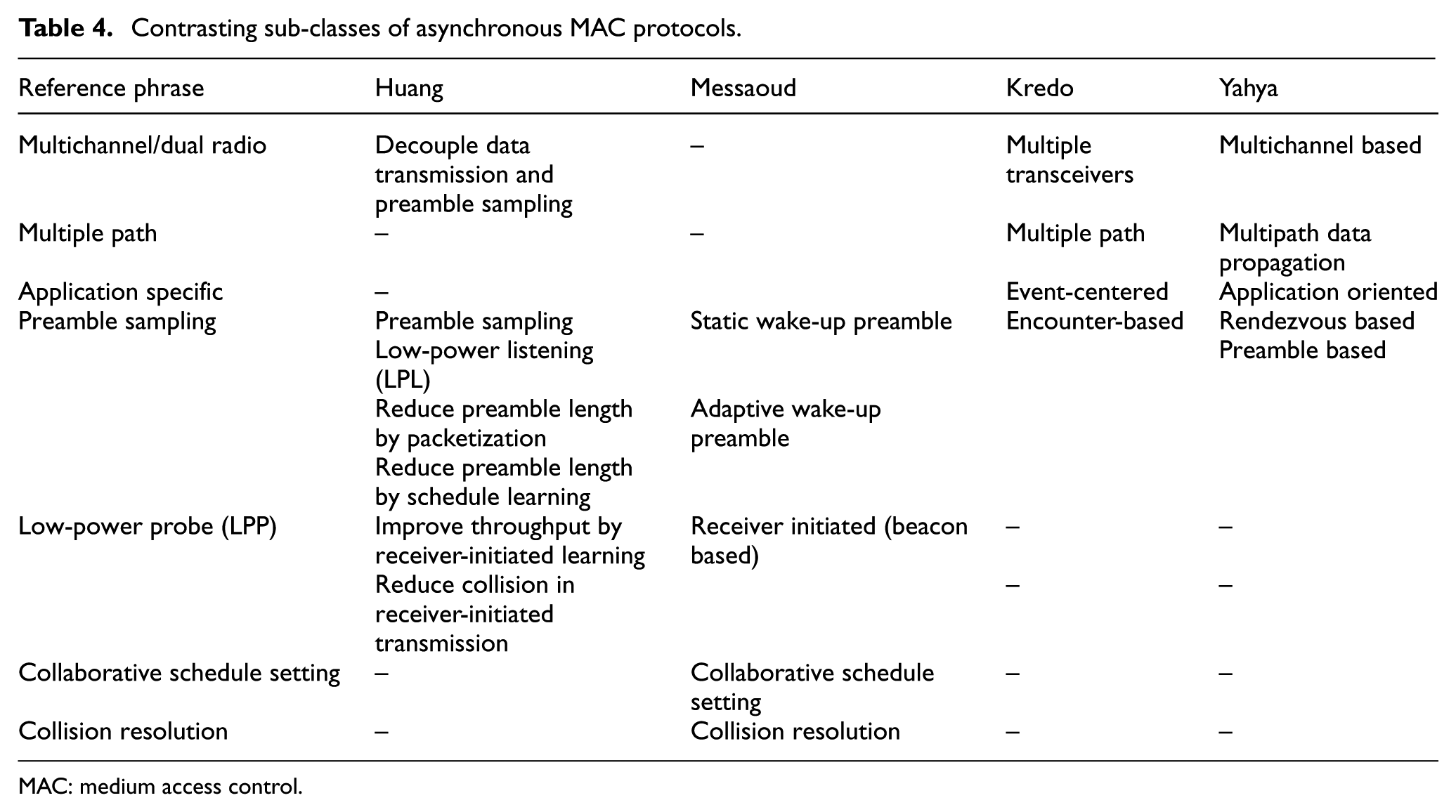
MAC: medium access control.
General reviews
Surveys which are generic in nature because of either presenting overview of the broader field or not focusing on any of the subject matter in particular other than the protocol mechanics or guidelines are covered here. Figure 10 shows the impact factors of the covered studies on a logarithmic scale and Figure 11 depicts them in time domain.

Impact factors of surveys/studies classified as generic.
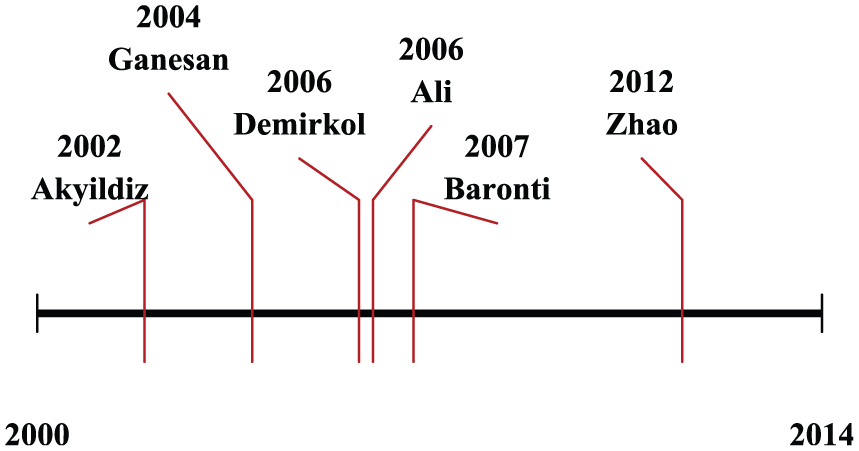
Timeline of generic surveys.
Akyildiz et al. 3 in their landmark survey review the WSN paradigm holistically. They explore design choices and challenges and constraints imposed by the environment that were more relevant, in the beginning. Layer-wise discussion follows and while discussing MAC layer they review SMACS and EAR, 61 hybrid TDMA/FDMA, 98 and CSMA-based protocols. 99 One of the limitations of their research at MAC layer was that not many protocols were available to them at the time for review. Thus, all three protocols are rudimentary works at early stage of WSN research; Sohrabi et al. 61 and Shih et al. 98 are basically frame based with latter having hybrid operation with centralized control, and Woo and Culler 99 is a CSMA-based as the name implies but without any duty cycling. Following a somewhat similar pattern, a less popular work of Ganesan et al. 4 a year later also reviews the entire field of WSN. The strength of this work lies in reviewing protocols with diverse MAC mechanisms like duty cycling (SMAC) wake-up on demand radios (STEM) and clustering (LEACH) against a case study to hypothesize appropriateness of certain solutions under a given set of conditions. Representative routing and MAC layer protocols are used in a WSN framework to study their impact under varying network scenarios in real-time environment.
Demirkol et al. 5 present a brief review of few selected and representative protocol mechanics with basic pros and cons of each. They simply present properties of the reviewed protocols on the basis of their type, communication pattern, adaptability to change, and synchronization time requirement; however, they do not group them into any classes. Whereas in a recent work, Zhao et al. 7 review MAC protocols extensively under the existing taxonomical lexis: Contention-based, Contention-free, Hybrid, and Preamble Sampling protocols. Apart from comparing and characterizing the protocols with pros and cons, they also list target applications for a reviewed protocol. Overall, Zhao et al. suggest that the Contention-based MAC protocols are well suited for event-driven applications, Schedule-based MAC protocols support event detection and monitoring applications, and the target for Preamble Sampling protocols are event monitoring applications. They present a useful graphical performance analysis of Contention-based and Schedule-based protocols under varying traffic loads. Baronti et al. 6 review IEEE 802.15.4 and ZigBee standards. This is a broad review of these WSN technologies at different layers also providing an account on the relationship of two. The work describes upper layers, that is, routing and application stack of ZigBee, and how they interface with the underlying IEEE 802.15.4 architecture in quite a detail.
Ali et al. 8 conclude that a plethora of MAC solutions are mere incremental works of primary medium access techniques and stress the importance of correcting the research direction and focus. In this pursuit, they share insight and set guidelines for research issues in WSNs at MAC layer. This work is still a good source for developers and researchers of WSN MAC protocols for finding research directions and focus.
QoS reviews
QoS is a broad and indistinct term, but lately we notice a surge of surveys reviewing QoS parameters. Figure 12 presents impact factor (IF) of the surveyed studies and Figure 13 shows them in timeline view. We can broadly classify these studies into two main categories: one which discusses QoS parameters with no particular focus with respect to applications and the other which have focus on a particular area or WSN application such as WMSN and CIP. Here, we review the importance and contributions of these studies in detail.

Impact factors of surveys pertaining to QoS issues.
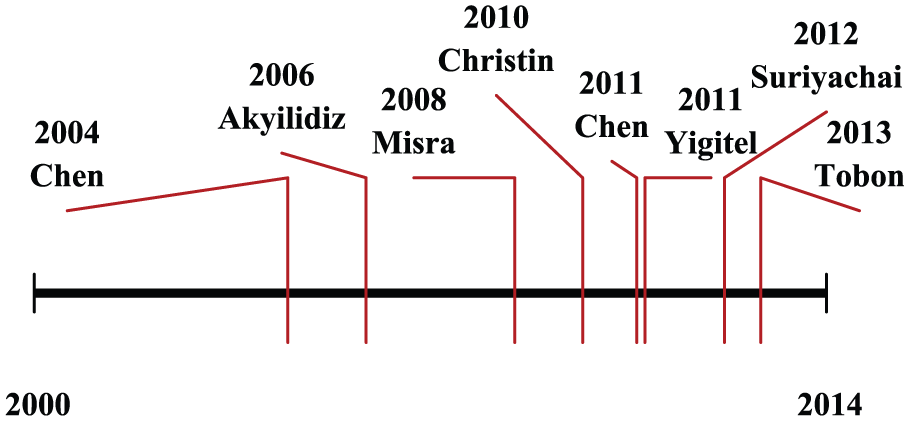
Timeline of QoS surveys.
In a significant and of the earliest works, Chen and Varshney 20 outline the QoS issues in WSN which are continued to be used by other important works in the field to advance the subject. Authors posit that QoS concepts and techniques from traditional networks cannot be applied to WSN due to underlying differences in the network dynamics, resources, traffic patterns, and its applications. In WSN, most users/applications would be more concerned with non-end-to-end QoS, where sensor-reading from a region, possibly, covered by multiple nodes rather than from each individual node is what applications/users require. Thus, a concept of collective QoS parameters is presented as a core contribution, where, for example, instead of end-to-end delay of a packet an end-to-end delay of an event is defined as collective end-to-end delay. In this case, it would be the time between first reading generated and the last report of the same event reached at sink.
This study covers the concept of QoS in a wider perspective and not just from network engineer’s point of view, thus bringing to fore some of the misunderstood concepts. It highlights the limitations of current work on QoS which is mostly keeping the traditional QoS dimension in view and sets new directions in the field such as the requirement of multiple QoS-frameworks for a variety of applications and or scenarios, and simpler cross-layer approaches to address the issue. Authors note with distinction an earlier innovative solution of Sankarasubramanaim et al. 100 based on collective QoS at only transport layer.
The major limitation in the work of Chen and Varshney 20 is the lack of application-specific QoS provisioning: applications are classified event-driven, query-driven, or continuous, generically based on their traffic flow. Readers may cope well with this sort of limitation as the focus of the study is to lay out the outline of QoS in WSN for further studies.
Lately, Yigitel et al. 19 review QoS-aware MAC protocols in WSN. While defining QoS, the authors approach is network specific rather than application specific, thus they make a detail comment on different approaches to support QoS, before reviewing and comparing different protocols that are QoS-aware. Authors note that as time has progressed—as in the case of Internet earlier—delay bounds and other hard-QoS guarantees have become essential in WSN due to advent of a variety of possible applications and scenarios that current MAC protocols do not offer. MAC protocols offer soft-QoS which does not sufficiently meet many current application requirements necessarily. Since the MAC layer has an unprecedented role in WSN due to their control on medium sharing and duty cycling, most of the efforts to provide QoS need to be focused at the MAC layer for WSN. Therefore, the authors have made an extensive commentary first on the mechanisms employed by the MAC solutions in addressing QoS and then on the protocols employing some of those mechanisms. This work comprehensively covers state of the art in QoS at the MAC layer.
Christin et al., 28 in a very pertinent study, focus on QoS and security for industrial automation applications. Their focus is constricted, such that they only evaluate industry standards like WirelessHART, IEEE802.15.4e, and ISA 100.11a-2009. Furthermore, they neatly and explicitly lay down quality of service parameters against types of applications, both, qualitatively and quantitatively to evaluate precisely. We reproduce Table 5 from Christin et al. 28 to show quantitative QoS parameterization. The study concludes that the discussed technologies have their pros and cons; however, none of these are appropriate for supporting real-time traffic as of now. Security is defined and evaluated in terms of confidentiality, integrity, and availability of information and device and message authenticity. Standards are found to be meeting most of them except where continuous transmission by malicious sources performs higher layer breaches.
QoS requirements for different real-time applications.
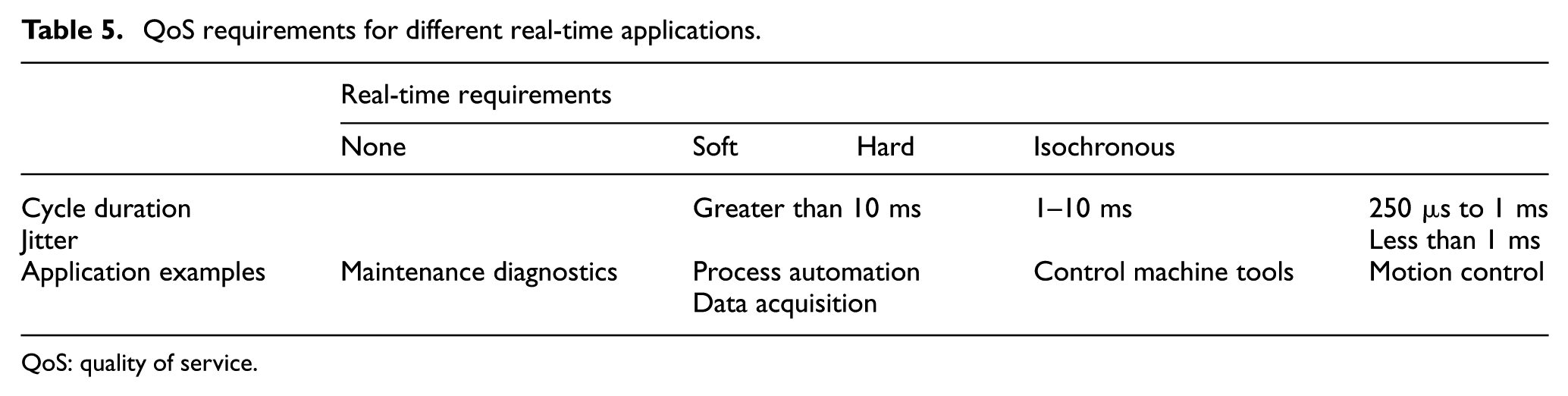
QoS: quality of service.
Chen et al. 17 define quality of service (QoS) parameters in their survey with respect to CIP using wireless sensor actuator network (WSAN). Figure 14 illustrates QoS with concrete parameterization as presented by them. For details of terminology used in the table, readers are referred to the original text in Chen et al. 17 Similar parameterization for other applications can be helpful for solution designers to gauge efficacy of their solutions for intended application(s). Chen reviews many MAC protocols rather briefly without completely applying defined QoS rubric to these protocols. Perhaps a revision of this work can be very useful for developers; however, PQMAC, Q-MAC, and IEEE 802.15.4 are shown to implement priority—a metric defined in the QoS.

QoS Parameterization of WSAN for CIP from Chen et al. 17
Akyildiz et al. 101 in their extensive work review the state of art in WMSN. In addition to OSI model’s layer-wise review of the literature, the paper also presents an account of cross-layer solutions. It is stimulating account as many open areas are highlighted and guidelines given. However, the discussion on MAC layer solutions is inadequate, which is frankly admitted by authors. Nonetheless, important notes are shared and likely outcomes pointed out with respect to channel access policies, scheduling, and error control. TDMA-based MACs are favored by authors for WMSN. This work familiarizes readers with challenges and issues in WMSN. The work by Akyildiz et al. 102 is an abridged version of the same work with easy to follow graphics.
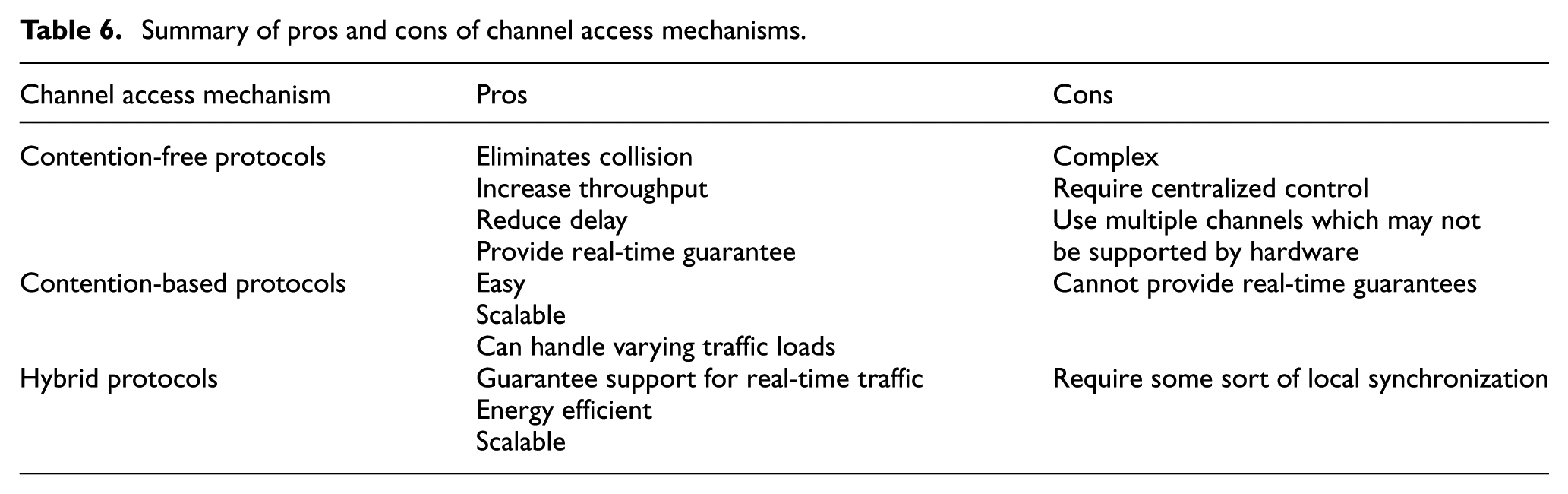
Misra et al. 103 lately have reviewed WMSNs solutions across different layers. Their treatment of MAC layer is in-depth covering many solutions meant for handling multimedia streaming. They also discuss cross-layer solutions. Contrary to Akyildiz et al., 101 the authors 102 posit that protocols where contention phase is followed by contention-free access to the medium, such as in SCP and IEEE 802.15.4, are deemed to be most suitable to handle WMSN traffic. Summary of their work is presented in Table 6, enlisting pros and cons of different access mechanisms.
Summary of pros and cons of channel access mechanisms.
Suriyachai et al. 71 present QoS parameters, latency, and reliability to evaluate MAC protocols for mission critical applications. Through the designed rubric, which we have outlined in taxonomical surveys, they show that TDMA and certain hybrid protocols fare better in providing QoS support for mission critical applications. Reliability, which in conventional networks was a higher layer concern, is shown to be provided at the MAC layer in WSN depicting interdependence.
Tobón et al. 25 in a study on context-awareness in wireless body area networks (WBANs) suggest that QoS requirements for WBANs are even more stringent than WSN and hence there is a need for context-aware MAC protocols and application-specific solutions. Physiological signal monitoring for medical and non-medical use is accomplished through WBANs, essentially a specialized WSN. The authors review three MAC-layer solutions, context-aware MAC, TAD-MAC, and CA-MAC, along with several application-layer solutions for medical and non-medical use of WBANs.
Performance-wise reviews
Most of the early surveys reviewing performance are energy related; however, many recent studies are now focusing on other parameters such as delay and reliability. Figures 15 and 16 show the surveyed studies with their impact factors and timeline, respectively.
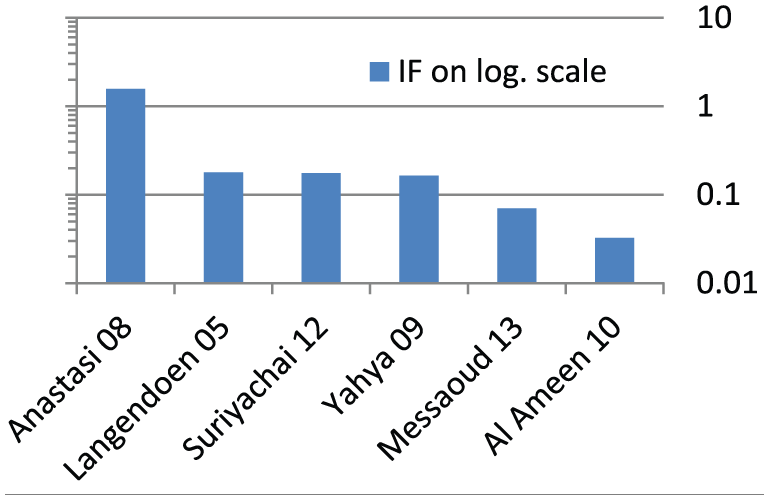
Performance reviews with their impact factors.
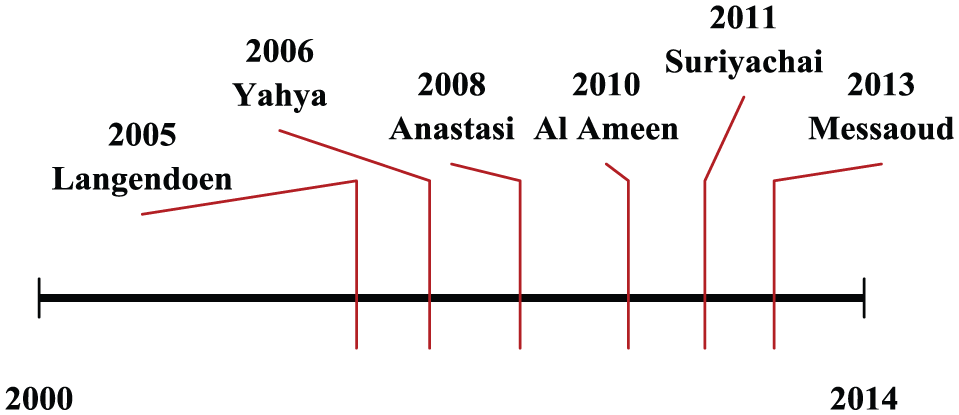
Timeline of performance reviews.
Anastasi et al. 104 present a classification for energy-saving protocols, network-wide, also, taking into consideration other not so popular parameters such as mobility and data gathering. Thus, this work does not address MAC directly per se; however, since MAC designs have been held responsible for energy efficiency, they are discussed in detail with respect to their mechanisms. It is a fairly detailed analysis, although MAC protocols are not its primary focus. The MAC-related mechanisms which help save energy are broadly categorized as Sleep/Wakeup and Low Duty-Cycle protocols. Sleep/Wakeup protocols are sub-classified further as On-demand, Scheduled Rendezvous, and Asynchronous, whereas low duty-cycle protocols are sub-categorized as TDMA, Contention-based, and Hybrid.
Having a secondary dedicated radio for wakeup in Sleep/Wakeup protocols to conserve energy is an ideal solution but far from practical as it entails additional cost and integration into existing platforms which is not always technically feasible. Scheduled rendezvous protocols are shown to be convenient but required synchronization is problematic or costlier. Asynchronous protocols result in higher duty cycle and broadcasting is problematic. Despite these limitations, Scheduled Rendezvous and Asynchronous are said to be better-suited protocols in this class.
In low duty-cycle protocols, despite being efficient, TDMA-based MAC solutions are not considered practical by the authors. On the other hand, Contention-based MAC is preferred though they have energy consumption and latency drawbacks. Similarly, Hybrid solutions are seen as too complex to be good candidate. However, authors suggest that existing standards can be extended to provide promising solutions. The discussions in this work imply that MAC energy management techniques should be explored in conjunction with data-driven and mobility-based techniques.
In a simulation-based study, Langendoen and Halkes 105 compare SMAC, LMAC, TMAC, LPL, and IEEE 802.11 for a variety of performance metrics; energy consumption and efficiency being one of them. Although this work reviews some 20 MAC protocols and assesses them qualitatively, the real strength comes from the later part which presents simulation graphs of the five selected protocols among them.
Yahya and Ben-Othman 95 provide a taxonomy for MAC which has been discussed in detail in previous sub-section for taxonomical solutions. However, since they intended to discuss energy-aware solutions, this work can rightly be mentioned here. Although their taxonomy is not based on energy-saving mechanisms, reviewed protocols’ energy-saving mechanisms are explored.
Al Ameen et al. 106 review the energy-saving mechanisms of WSN MAC protocols as well as the protocols that employ them. Since energy has been a primary design driver for MAC protocols, this review essentially provides a preview into the flow of ideas in this pursuit. In doing so, however, the authors also discuss clustering, routing, topology-control, and data aggregation protocols where designers’ motivation is to save energy. In this respect, they have pursued an earlier work of Anastasi et al., 104 where other energy-saving mechanisms were explored holistically across layers. However, quality of discussion with respect to energy-saving mechanisms is well covered in Anastasi et al., 104 whereas the protocol mechanics itself are better explained by Al Ameen et al.
In order to compare latency of asynchronous MAC protocols, Messaoud et al. 96 derive expressions for single-hop delay and end-to-end delay for surveyed protocols. A generic expression for single-hop delay is given as

Similarly, the end-to-end generic expression is stated as

Suriyachai et al. 71 also review protocols with focus on delay and reliability and quantify them based on protocol’s support for the features.
Eccentric techniques and design approaches
In search of solutions for better throughput to support upcoming bandwidth-hungry applications in WSN, designers are exploring newer and novel techniques such as Cooperative Diversity and UWB. There is also a focus on non-conventional design approaches such as cross-layer MAC solutions to provide QoS guarantees for certain applications. Similarly, mobile WSN applications and possible scenarios have given impetus to solutions designed with mobility support. Here, we explore surveys targeting such eccentric solutions.
Khan and Karl 107 review protocols using Cooperative Diversity in WLANs and WSN. Cooperative Diversity is a technique which exploits “overhearing” to improving robustness and coverage in the network by allowing nodes to relay the “overheard” packet to destination. WSC-MAC, 108 CPS-MAC, 109 gPMSS, 110 NDMA-based MAC, 111 CC-MAC, 112 and CL-MAC 113 are reviewed as representative protocols. Table 7, which is a derivative of a table from Khan and Karl, 107 shows the characteristics of Cooperative MACs in WSN. Note that delay bounds are certainly not provided in these solutions and an open area for researchers and developers. When and if delay bounds are provided in any of the solutions in this breed of protocols, it would be an interesting match for mission critical applications. Authors also list some other protocols in a table which are cooperative diversity-enabled but do not delve into their details.
Characterization of cooperative MACs in WSN derived from a table in Khan and Karl. 107

MAC: medium access control; WSN: wireless sensor network.
Karapistoli et al. 114 present an overview of WSN MAC protocols meant for impulse radio–ultra wideband (IR-UWB)—an emerging physical layer technology for potential in bandwidth-hungry applications in wireless communications. Since conventional WSN MACs, which are meant for narrow band communications, are inadequate for UWB-based communication, there is a need for specialized MAC solutions for UWB. MAC protocols that are based on UWB communications for ad hoc as well as WSN are reviewed. Table 8, a derivative from their work, shows that only one protocol provides QoS support.
UWB-based WSN MAC protocols derived from a table in Karapistoli et al. 114
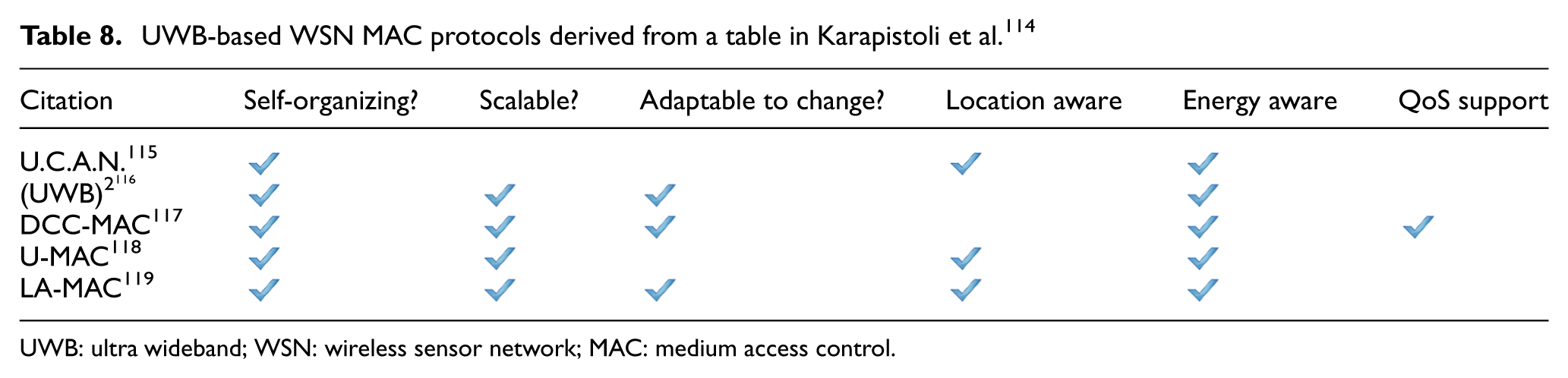
UWB: ultra wideband; WSN: wireless sensor network; MAC: medium access control.
Melodia et al. 35 review cross-layer protocols and the cross-layer methodology as an alternate design approach with pros and cons and also set guidelines for future works. Their approach is later used by Yahya and Ben-Othman 95 to cover cross-layer protocols which have been covered in taxonomical surveys in detail. They also indicate the inadequacy of current network simulators to implement cross-layer solutions. However, the reviewed protocols are few and discussion on their design is limited.
Dong and Dargie 120 survey six mobility-aware MAC protocols with their pros and cons and also discuss technologies/methods for mobility estimation to aid the developers for more innovative solutions. All of the reviewed protocols are derivatives of their non-mobility version with the exception of MobiSense which is scheduled based and requires multichannel communication to handle mobility. Similarly, of all discussed technologies, authors submit that GPS is the most accurate but has a host of disadvantages such as high price and unavailability in close spaces.
Kuntz 121 reviews protocols under three classes: Synchronized, Preamble Sampling, and Hybrid with energy efficiency and mobility perspectives. The author posits that preamble sampling protocols fare better to handle mobility and dwell his work around this premise.
Coverage of MAC protocols by reviewers
In this section, we review the coverage of WSN MAC protocols by key reviewers. To meet this end, a unified taxonomy is adopted to cross compare surveys. Venn diagrams are used as a tool to elicit the commonalities and differences among the key surveys. Furthermore, to validate the results, the impact of MAC protocols is gauged through articles’ impact factors which is often cited but hitherto unused—to the best of our knowledge—by any survey to gauge the influence. Eugene Garfield 122 while listing the use and benefit of using average-citations-of-published-papers acknowledged its limitations to gauge journals evaluation. The author suggests that instead of accounting for all published items in calculating the impact factor, citable-items-cited impact factor would be more useful metric. Garfield 123 and Seglen 124 have elaborated that journal impact factor should not be taken to evaluate individual article as it can only be used to cross compare the journals not the articles published in them. Lately, a metric Eigenfactor 125 has been introduced which is more robust as it evaluates journals on weighted citations. Citations from reputed journals increase the Eigenfactor score more than the others. Similarly, another metric, Article Influence score, is also computed for journals to evaluate per-article influence for published articles in a journal. Therefore, the comparison of average-citations-per-year of individual papers within a narrow discipline offers a more precise evaluation of the research impact of individual articles. However, in this methodology, recent publications may be at a disadvantage as number of citations increase over time for several years. 125 We set aside this effect with our commentary and the use of timelines.
Hence, for this purpose, we compiled a collection of over 200 reviewed MAC protocols with citation counts and computed the average citation count to gauge the impact of the protocols defined as

Impact-factor-wise ranking of WSN MAC protocols.
As evident by Tables 3 and 4, there are striking similarities in taxonomies presented by the authors. Therefore, we now amalgamate these versions and terminologies to bring a unified classification for the purpose of contrasting and comparing the coverage of protocols by different works. Thus, we review the coverage of protocols which loosely and locally synchronize their time to match their duty cycles—so that all nodes in vicinity can be active at a time for data communication—using Bachir et al.’s 66 taxonomy as CAP here.
The Venn diagram in Figure 18 shows the coverage of MAC protocols by Yahya and Ben-Othman, 95 Huang et al., 67 and Bachir et al. 66 Bachir et al. have reviewed the most number of protocols followed by Huang et al. and Yahya and Ben-Othman. Note that SCP-MAC 126 has been classified as a CAP protocol by Huang and Langendoen, whereas Bachir et al. declare it as a Hybrid protocol. The protocol clearly exhibits a hybrid behavior of TDMA and CAP, thus we believe Bachir’s classification is more accurate. Table 9 lists all of these protocols and their impact factors. It can be seen as one might expect that those protocols fare better which lie in the intersections of the Venn diagram.

Coverage of common active period (CAP) protocols by reviewers.
CAP protocols with their IF.
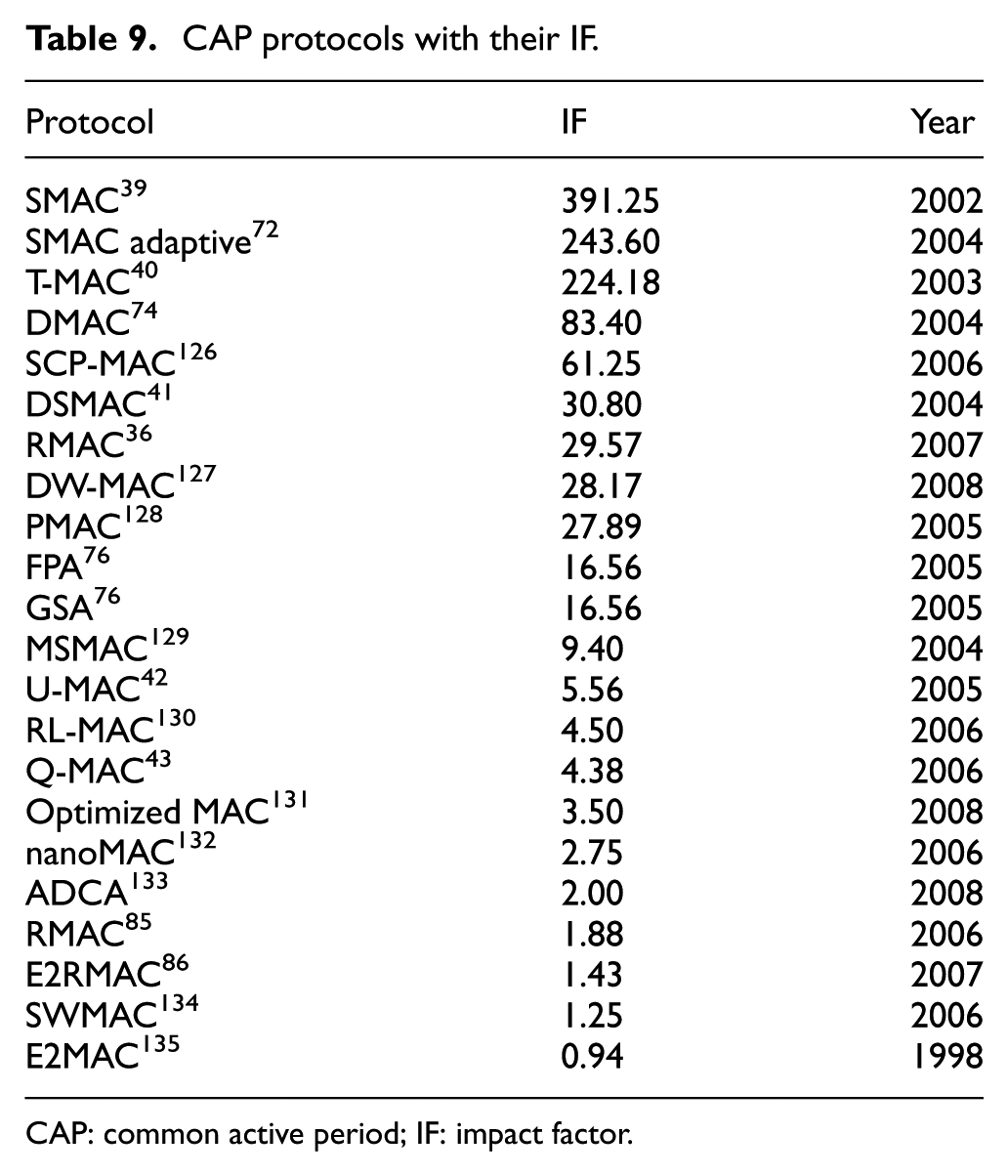
CAP: common active period; IF: impact factor.
Protocols which do not synchronize nodes’ clocks for sender/receiver rendezvous but rather explore asynchronous techniques such as sending a low-power signal tone to alert receivers of an incoming packet are covered here as Asynchronous protocols following Huang et al.’s 67 taxonomy. Figure 19 shows the Venn diagram of Asynchronous protocols coverage by the surveys. Messaoud et al. have reviewed the most number of protocols followed by Huang et al. and Bachir et al. It is to be noted that Langendoen 65 covers only a subset of Bachir et al. 66 Anastasi et al. 104 review RTWAC 136 and PTW, 78 whereas Yahya and Ben-Othman 95 cover three Asynchronous protocols not reviewed by above surveys: TrawMAC, 137 Alert MAC, 73 SIFT, 138 CC-MAC, 112 and PAMAS. 139 SIFT, 138 however, is covered by Bachir et al. 66 under Canonical solutions that try to improve MAC mechanism by reducing collision probability. In Table 10, IF of the surveyed protocols is shown to support the trend of popularity of the protocols as depicted in the Venn diagram.
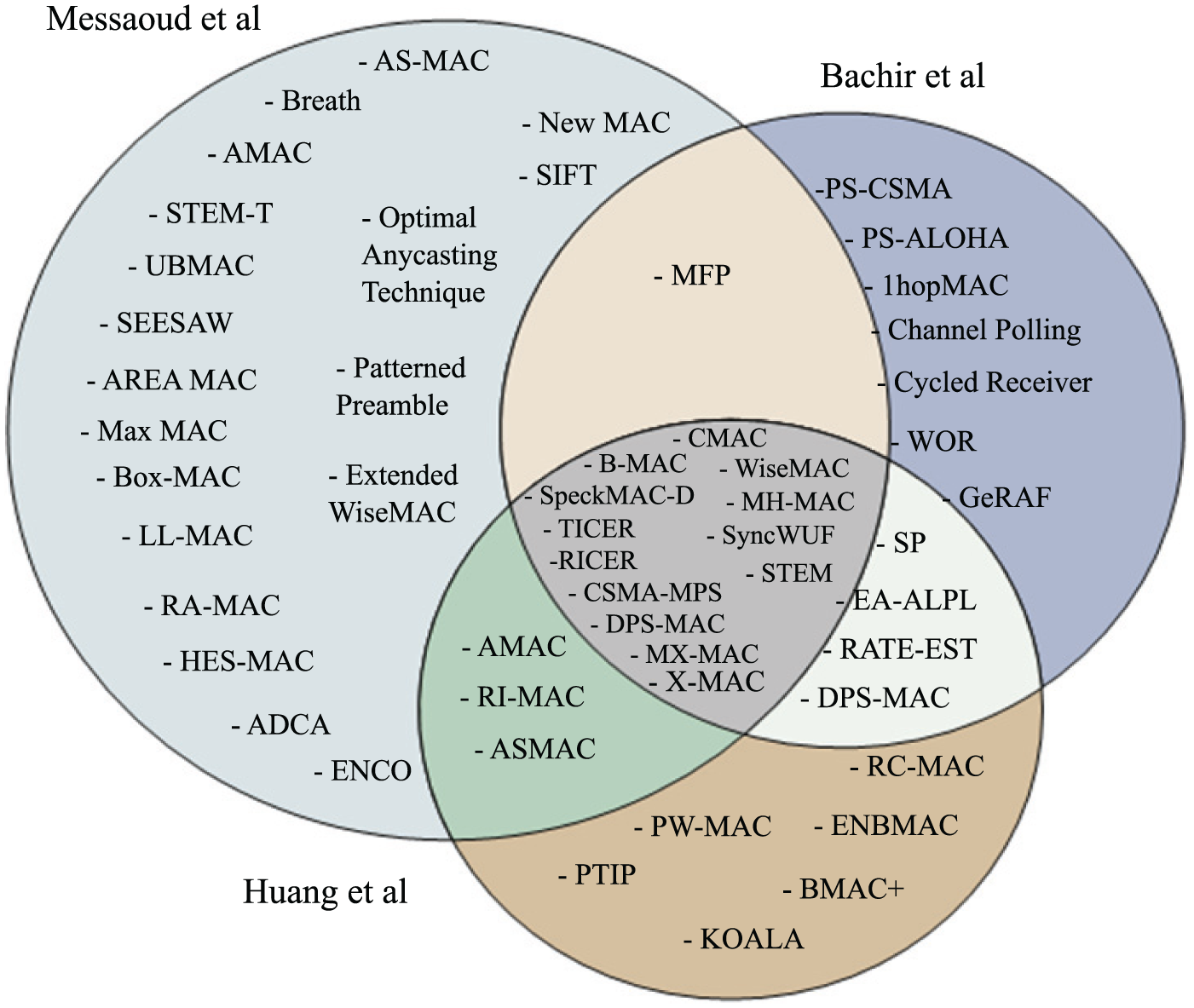
Asynchronous protocols surveyed by reviewers.
Asynchronous protocols with IF.

IF: impact factor.
Coverage of protocols that offer collision-free media access by assigning access slot of time to each node recurrently is shown in Figure 20 using Langendoen’s 65 taxonomy as Frame-based protocols. Anastasi et al. 104 and Langendoen 65 review the subset of Bachir et al.’s 66 coverage, whereas Chaari et al. 166 review A-MAC 167 not reviewed by any of the above papers.Table 11 lists the frame-based MAC protocols with their impact factors which support the Venn diagram. Note that since Huang et al. offer Multichannel protocol category, TDMA Multichannel protocols are categorized separately. Crankshaft 168 and ZMAC 169 are categorized as Frame based by Huang et al., whereas Bachir et al. classify them as Hybrid which is more suitable as both uses contention mechanism, thus exhibiting duality in nature.

Frame-based protocols with their IF.
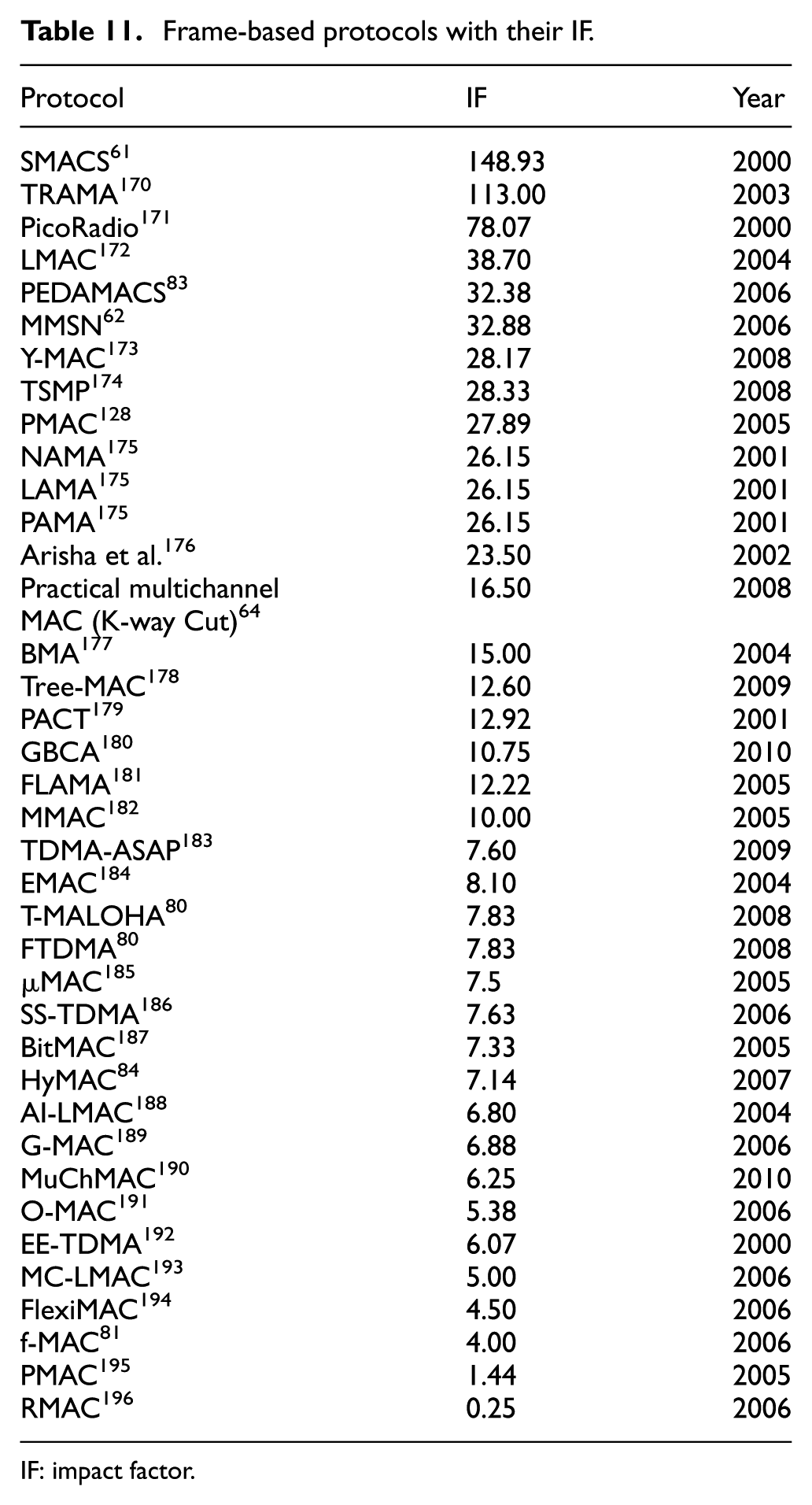
IF: impact factor.
Wherever designers have employed features of different breed of protocols to make a new solution, reviewers have labeled such protocols as Hybrid. Yahya and Ben-Othman 95 have extensively reviewed and sub-classified such protocols. Figure 21 depicts a Venn diagram for coverage of hybrid protocols by these surveys.

In addition, Anastasi 104 has classified PTDMA 197 as Hybrid which is not covered by others. Table 12 shows the list of Hybrid with their impact factors. Bachir et al., 66 Huang et al., 67 and Langendoen 65 have categorized TRAMA 170 as Frame-based protocol and WiseMAC 141 as Asynchronous protocol, whereas Yahya and Ben-Othman 95 rightly classified them as Hybrid because of the nature of their operation. WiseMAC employs TDMA and CSMA mechanisms to access data and control messages, respectively, whereas TRAMA uses contention and contention-free slots to access the medium. Likewise, Y-MAC 173 is also categorized as Asynchronous protocol by Bachir et al., whereas Yahya and Ben-Othman and Huang et al. classify it as Hybrid due to its use of FDMA and TDMA resulting in Multichannel.
Hybrid protocols with their IF.

IF: impact factor.
Huang et al. 67 and Yahya and Ben-Othman 95 have separated many protocols in a category not used by others—Multichannel protocols—for protocols that are making use of multiple frequencies in the spectrum to boost throughput. Venn diagram in Figure 22 illustrates surveyed Multichannel protocols while Table 13 lists their IF. Note that many of these protocols such as MMSN, TMCP, K-Way Cut, GBCA, and MC-LMAC are surveyed by Bachir et al. 66 as Frame-based protocols, however.

Multichannel protocols with their IF.

IF: impact factor.
In an interesting taxonomy, Suriyachai et al. 71 have taken leave from the traditional approach and classified protocols on the basis of the support they provide to mission critical applications. Since delay and reliability are considered as the most important support criteria by the author, they classify protocols in three distinct lots, that is, one: Delay-tolerant and Loss-tolerant, two: Delay-intolerant but Loss-tolerant, and three: Delay-intolerant and Loss-intolerant. Table 14 lists the protocols with their IF that were exclusively surveyed by them. For a complete list of surveyed protocols by Suriyachai et al., 71 readers can refer to Table 2.
Protocols that were exclusively surveyed by Suriyachai et al. 71

IF: impact factor.
In Table 15, we have re-categorized the surveyed protocols by Suriyachai et al. 71 according to our unified taxonomy. Interestingly, nearly all delay-tolerant protocols are either CAP or Asynchronous; similarly, delay-intolerant protocols are either Frame based or Hybrid. These observations are supported by earlier findings of Akyildiz et al. 101 and Misra et al. 103
Categorization of surveyed protocols by Suriyachai et al. 71 as per unified taxonomy.

Summary and conclusion
In this work, we have reviewed the surveys pertaining to protocols at WSN’s MAC layer. First, we discussed the environment in which WSNs operate with the inherent limitation of wireless medium and paucity of resources particularly energy and memory; then, recent increase in WSN applications, triggering the pace of MAC development, is specified. Key medium access mechanisms and the flow of ideas leading to them are detailed along examples of prominent solutions.
The reviewed surveys have been divided into five major subject-areas according to their focus. Average-citations-per-year is used as criteria to relate in each subject-area separately. Timeline views in each area add to the meaning and understanding the importance of studies to the reader. Few observations are in order: first, in taxonomical studies, there is an overlap of meaning in the use of lexicon for classification of WSN MAC protocols which we have alleviated by offering a unified classification that is used to discuss the coverage of MAC protocols by reviewers. The studies by Huang et al. 67 and Messaoud et al. 96 are noteworthy studies as they propose a detailed classification. However, in the study by Messaoud et al., 96 authors are limited only to classifying asynchronous MAC protocols. In Suriyachai et al., 71 authors classify MAC protocols using an application-specific performance rubric, thus presenting a new perspective for categorization. Hybrid protocols are classified in detail by the taxonomy proposed in Yahya and Ben-Othman. 95
Second, many surveys do not propose their own taxonomy, thus their contribution is limited to describing operational mechanics of protocols. Readers can find rounded and general view of WSNs in Akyildiz et al. 3 and Ganesan et al., 4 whereas some directions into unexplored or less-explored areas can be found in Ali et al. 8 However, some studies, Baronti et al., 6 Zhao et al., 7 and Demirkol and Ersoy, 150 are aimed at providing in-depth explanation of popular MAC protocol’s mechanisms.
Third, the notions of QoS in WSN, for the first time, are defined by Chen and Varshney; 20 thereafter, many studies have attended to the topic, which we have covered in detail in a sub-section on QoS in section “Review of surveys,” among them Yigitel et al. 19 is notable as it comprehensively reviews and outlines related issues. The focus of these studies, however, has not been to delineate application-specific QoS. Although some QoS-related surveys have lately explored domain-wise applicability such as Yigitel et al., 101 Misra et al. 103 review WMSN, 25 Tobón et al. discuss wireless body area network (WBAN), and Suriyachai et al. 71 focus on mission critical applications, there still remains an open area of research. Readers taking a review of industry standards that present WSN-enabled MAC solutions, such as IEEE 802.15.4, would find 28 helpful. The focus of surveys is now shifting to protocols for support to real-time traffic with application-specific QoS parameters. Although important insights such as suitability of contention-free protocol are shared by Misra et al. 103 and Ali et al. 8 with regard to protocol capabilities to handle real-time traffic, defining QoS parameters for different types of applications and then evaluating solutions is still an open area of research. Similarly, trade-off to strike a balance between energy savings and QoS support is the key domain that has yet to be explored by researchers.
Fourth, most of the performance reviewing surveys concentrated on energy efficiency metric of the protocols;95,104,106 however, lately, the trend has begun to shift to other metrics of interest71,96 such as delay and reliability. Yet, these studies lack the rigor and accuracy that may be required for such comparisons as they do not perform simulations and or test-bed implementations. As a result, with the exception of Langendoen et al., 105 all other performance-related surveys discussed in section “Review of surveys” evaluate protocols based on operational details. Messaoud et al., however, derive analytical expressions to evaluate delay of Asynchronous protocols.
Fifth, certain studies have explored solutions where designers have resorted to unconventional methodologies and techniques to help meet bandwidth-hungry applications’ demands. Eccentric techniques such as Cooperative Diversity and IR-UWB reviewed in Khan and Karl 107 and Karapistoli et al. 114 are in formative phase and an open area of research with respect to the provision of delay bounds. Similarly, few mobility-aware solutions have been proposed with their pros and cons in Dong and Dargie, 120 which is another open area for more solutions. Likewise, as a paradigm shift, cross-layer approach has been long pushed by designers as better suited for WSN environment; nevertheless, 35 Yahya and Ben-Othman 95 only review a few cross-layer MAC. Thus, cross-layer protocol development also remains an open area of research.
Toward the end, we focus on analyzing coverage of MAC protocols by survey papers; however, to validate our inferences, we compute protocols impact factor—average-citations-per-year of the published paper in which a protocol has been proposed first. We cite studies122–124 to support that our approach is technically sound and the same is validated by our inferences on coverage by top reviewers. From a list of 200 plus protocols, we present impact-factor-wise top ranking protocols in Figure 17. A similar methodology is adopted throughout in comparing different surveys. A unified taxonomy is adopted to cross compare different categories of protocols in different studies using Venn diagrams.
This article presents the readers a compendium of a decade-long scholarly discourse in WSN at MAC layer. It organizes and classifies the body of knowledge at WSN viewing holistically on how and why the discourse has shaped the way it has! It provides for academic reference a review of the studies on the subject. In doing so, it places 200 plus MAC protocols on a known but hitherto unused criterion, that is, average citations per year to gauge the relevance of the work. The same is validated through another technique by investigating the coverage given to these MAC protocols by surveys. Furthermore, it critically evaluates surveys by first placing them into five distinct categories subject-wise, which we believe is a first such effort providing the readers an insight into the field.
Footnotes
Academic Editor: Gianluigi Ferrari
Declaration of conflicting interests
The author(s) declared no potential conflicts of interest with respect to the research, authorship, and/or publication of this article.
Funding
The author(s) disclosed receipt of the following financial support for the research, authorship, and/or publication of this article: This research was supported by Telecommunication Research Lab (TRL) at Institute of Business Administration (IBA) and funded by Research Fund Committee (RFC) grant.