




Abstract
The routing layer quality of service in wireless sensor network depends on different indices such as throughput, delay, packet loss rate, energy consumption, and degree of congestion. A single index does not adequately reflect the real quality of service while an excessive number of indices increase the complexity of the evaluation model. In addition, existing quantitative evaluation methods can lead to under-fitting or over-fitting. In this article, we present a comprehensive qualitative quality-of-service evaluation method based on the cloud model. Using Gaussian cloud transformation, each quality-of-service index can be divided into several qualitative concepts (cloud models). Concepts belonging to different indices can be combined together to evaluate the quality of service. We use a frequent-pattern tree approach to mine association rules of quality-of-service concepts and arrive at a suitable decision. This method simplifies the evaluation model by transforming a numeric value to its equivalent qualitative concept and brings out the internal relationships among different quality-of-service indices according to the association rules. Besides, it automatically finds a common standard to evaluate and compare different routing protocols simultaneously. The evaluation results show that the proposed method provides a good quality-of-service assessment when applied to different routing protocols.
Keywords
Introduction
Over the past decade, there have been several advancements in wireless sensor network (WSN) research. An important aspect, the quality of service (QoS), depends on various key parameters, such as the loss rate, latency, lifetime, and throughput, and determines the performance of multiple layers.1,2 There are few studies that focus on QoS performance of different protocols for routing evaluation. However, the deployment scenario in WSN is complex and application-specific, making it difficult to evaluate the QoS using traditional methods. Most QoS evaluation techniques on routing protocols concentrate on some specific parameters. Typical examples include the communication reliability, topology robustness, network convergence, and energy consumption. Because of the differences among routing protocols, a comprehensive evaluation would need an excessive number of QoS indices.
In general, every routing protocol has a specific goal, and so the evaluation method is different for each. For a single protocol, the performance is compared by varying the protocol index, network scale, or protocol variety. 3 When there are many protocols, a horizontal comparison for more than one parameter can be performed.4,5 These evaluation methods concentrate on a specific single index and lack the ability to provide a comprehensive evaluation based on multiple indices. Moreover, because of the differences between the routing protocols, it is hard to create a unified model to describe and compare some common parameters. This makes the comparison of the protocols rigid, and the deep relationship between performance indices is not evident. In this article, we design a novel QoS evaluation method for routing protocols based on the cloud model. This method transforms a quantitative expression into its qualitative equivalent and provides a comprehensive evaluation of different protocols. The cloud model is a fuzzy concept that utilizes a mathematical model to represent the possibility that a quantitative expression belongs to a specific qualitative concept. 6 By transforming QoS indices into cloud models, we can divide an index into several concepts and mix different indices by association rule mining. Figure 1 shows the evaluation process using the cloud model and association rule mining. The association rule mining is a frequent-pattern tree (FP-tree) 7 algorithm which generates a set of QoS remarks (association rule set) with desired parameters. The FP-tree represents the internal relationships between the QoS indices and improves the reliability of the evaluation result.

QoS evaluation process based on the cloud model.
The rest of the article is organized as follows. In section “Cloud model and QoS evaluation,” we describe the basic procedure of QoS evaluation and the method based on the cloud model. Section “Division of QoS indices parameters” describes the division algorithm of QoS indices. Section “Association rule mining based on FP-tree” describes the association rule mining algorithm for QoS indices. Section “Design and analysis of the experiments” presents experimental results of concepts division and QoS evaluation. Section “Discussion” discusses some arguments and questions. Finally, the conclusions are presented in section “Conclusion.”
Cloud model and QoS evaluation
Cloud model description
The cloud model reflects the bidirectional transformation process between a qualitative concept and its quantitative expression. Let
A typical cloud model uses the expected value
QoS evaluation based on the cloud model
There is always an uncertainty associated with realistic networks because of the dynamic characteristics of the routing layer. This is reflected in the fluctuation of the QoS attribute values at different time or scenes. However, it is difficult to analyze excess QoS data. The quick changes in QoS performance do not allow for an accurate evaluation of the WSN. Sometimes, the optimal QoS performance values, such as the speed or efficiency, are not the best choice for evaluating applications in comparison with parameters like stability or survivability.10,11 In addition, existing evaluation methods that depend on a single parameter to describe the entire network are susceptible to issues like under-fitting and over-fitting. In such cases, the evaluation result is likely to misrepresent the present situation. Although these characteristics are hard to obtain and describe, a cloud model can convert quantitative QoS data to qualitative concepts. This simplifies the evaluation process, and the results are capable of reflecting the fuzziness of the WSN. Numerical characteristics
Division of QoS indices parameters
Confusion degree
The WSN is subject to uncertainties just like other wireless networks. This might cause the model to deviate from the Gaussian distribution. To ensure that the division into concepts is clear-cut, a parameter called the confusion degree

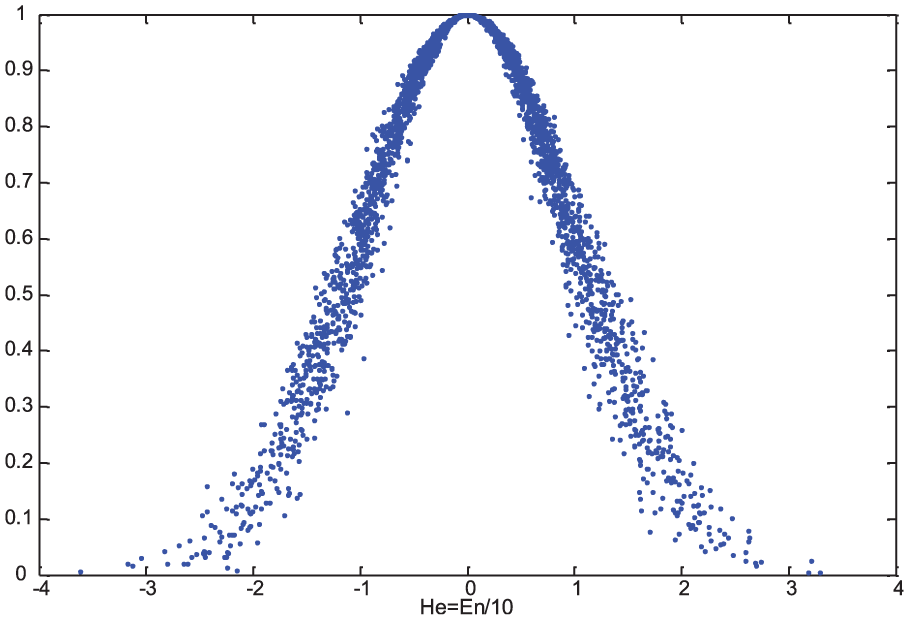

Gaussian cloud transformation
There are two algorithms used to divide the data sample: the heuristic algorithm for Gaussian cloud transformation (H-GCT) and the self-adaptive algorithm for Gaussian cloud transformation (S-GCT).
13
H-GCT needs to determine the number of concepts before division as opposed to S-GCT. To avoid manual selection of the concept count, we use S-GCT to find all suitable cloud models and describe the definition of a specific cloud concept by
Resolve

Compute the scale parameter
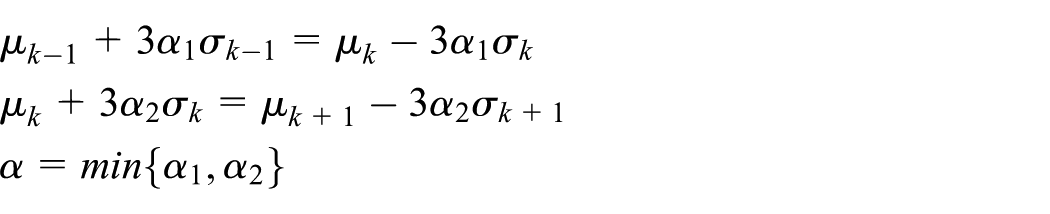
Generate the parameters of the Gaussian cloud model

Here,
Convert
Cluster

Calculate the
The threshold
In the execution phase, S-GCT will call H-GCT repeatedly to find appropriate cloud models (from Step 2 to Step 3 in S-GCT). The complexity of S-GCT depends on the sample set X and the required clarity of cloud models. If the I frequency histogram of X is smooth enough, the value of M will be less and close to correct. If an appropriate value of
Association rule mining based on FP-tree
There are various algorithms like FP-tree that are suitable for mining frequent sets. These algorithms target different structures, scenarios, and performance requirements. 15 In this section, we use FP-growth to find the final evaluation of QoS. This is an algorithm like FP-tree, has a simple structure, and is good for dense databases. An n-tuple consisting of different QoS indices is represented as a transaction in the FP-tree algorithm. Too many values on a specific index will lead to a dramatic increase in the size of the transaction database. The cloud transformation provides a way to map a set of quantitative data to a small amount of cloud concepts, reducing the complexity of the FP-tree algorithm. The data at the edge of a cloud model do not always fit in with the Gaussian distribution and presents some uncertainty; this partly reflects the randomness inherent to WSN.
When a new set of QoS data is obtained, the cloud models are used to map the data to a corresponding cloud concept by calculating the probability that the value belongs to a particular cloud model. For example, an n-tuple {580, 2.0, 92, 5.9} consisting of different QoS indices could be mapped to an n-tuple {medium, low, high, high} that can be set as a transaction in association rule mining. The cloud concepts of different QoS indices can be combined to generate a remark set about the QoS performance. By association rule mining, we can reject the unavailable evaluation remarks. 16 used an a priori algorithm to obtain link quality remarks. However, this involved scanning the transaction database repeatedly. In this work, the FP-tree algorithm is applied to routing performance association rule mining. All frequent sets are compressed into an FP-tree, and the algorithm uses a recursion method to obtain the rules.
Scan the transaction database and calculate the occurrence number of every transaction item. Delete the item if its minimum support is less than

Introduce
Scan CPB and create an FP-tree by inserting every transaction item into the FP-tree.
Choose an unused item from the FP-tree and find all the paths from the root to the item. Add this item to
Insert every path in Step 4 as a transaction item into a new CPB. If the new CPB is not empty, then jump to Step 3. Otherwise, go to Step 4.
Design and analysis of the experiments
In this section, we use different QoS parameters to evaluate a specific performance index. In certain circumstances, using different protocols can present greater diversity of performance as compared to a case using a specific protocol with various parameters. To find the most appropriate protocol, we compare Flooding, Directed Diffusion (DD), 17 and the low-energy adaptive clustering hierarchy (LEACH) protocols 18 using the same parameter. Experimental data are collected using a physical platform based on CC2530 and TinyOS. 19
Classification of QoS cloud concepts
We use the energy consumption level (ECL), network transmission effects (NTE) (the acceptance rate of effective packets), and the degree of congestion (DoC) (the average data quantity of nodes at a certain time) to evaluate the average transmission delay (ATD), a key index of the routing layer. ECL, NTE, and DoC are set as the rule antecedent of the evaluation remarks, and ATD is set as the rule consequent. When the threshold of CD is set as

Result of GMM transformation on ECL.
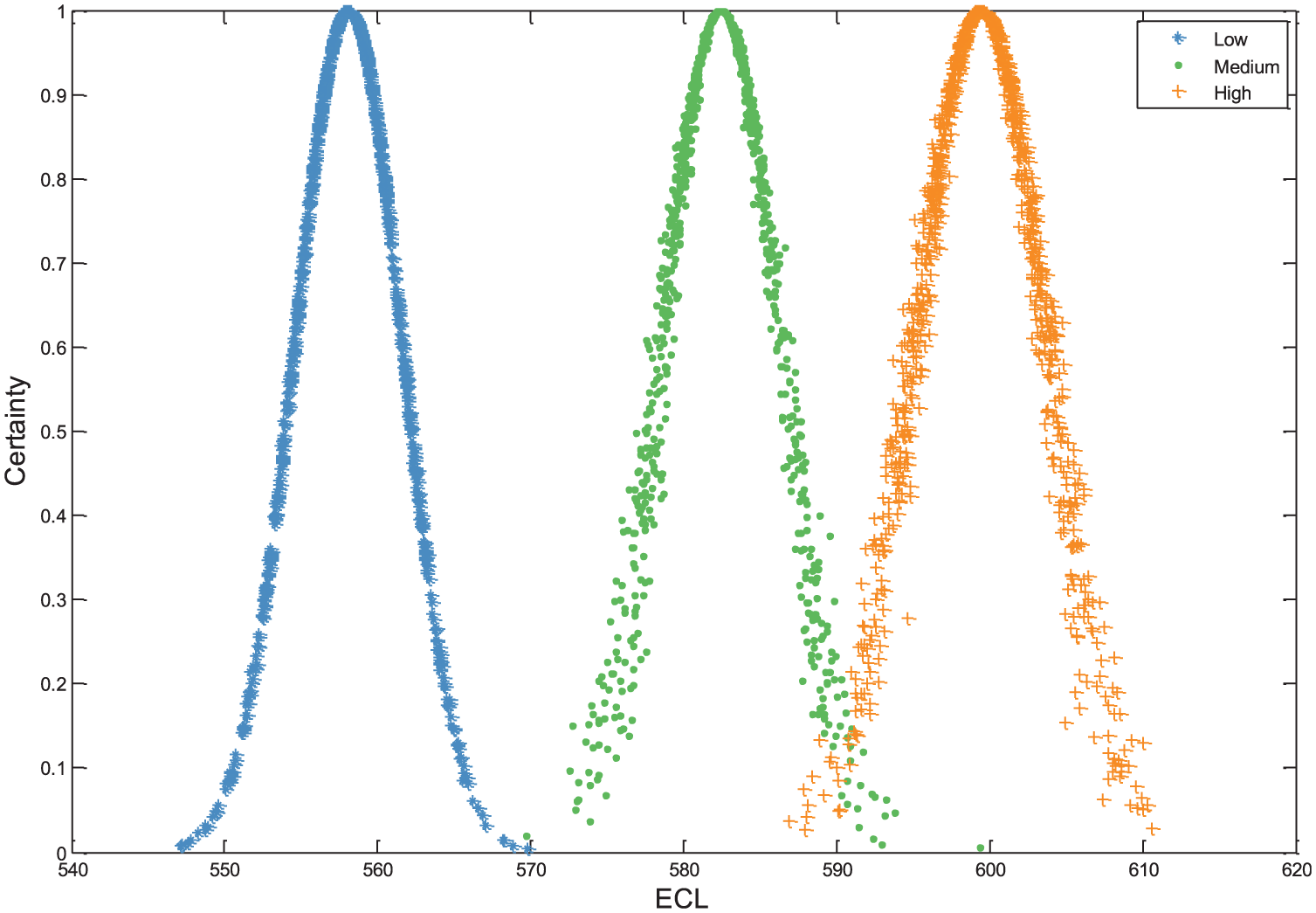
ECL concept cloud models.
Parameters of ECL cloud models.

CD: confusion degree.
In association rule mining, we set the minimum support as
Association rules of cloud concepts.

ECL: energy consumption level; NTE: network transmission effects; DoC: degree of congestion; ATD: average transmission delay.
QoS index evaluation
The association rules generated by this method can be used to evaluate the performance of different routing protocols. By dividing QoS data into cloud models and choosing the corresponding rule antecedent, we can get the ATD evaluation presented by the association rule. In this experiment, we evaluated the ATD of Flooding, DD, and LEACH. Figure 6 shows the ATD numerical data of these protocols and their cloud concept. The LEACH protocol had the lowest ATD (the concept is “extremely low”) when compared to the Flooding and DD protocols. The Flooding protocol had the least stability and with an evaluation between the concept “high” and “extremely high.”

Experimental ATD results. Three concepts are presented by the Gaussian cloud model to evaluate different protocols.
The QoS is affected by more than one factor, and it is difficult to find the most important factor or relationship among them. The evaluation of a specific QoS index can be simulated using other related indices. Therefore, we evaluate different QoS indices by changing the association rule mining target. Figure 7 presents the evaluation of DoC in the same situation (DoC is set as the rule consequent). In this experiment, the DD and LEACH protocols are evaluated as having a “low” DoC. The Flooding protocol spans the two concepts, which shows that it is unstable as compared to the other protocols. Because of the instability of the wireless environment, a protocol will exhibit a higher discreteness on DoC. However, it is still clear that all DoC samples can be divided into two concepts using the evaluation method.

Experimental DoC results.
Discussion
Gaussian clouds can provide an extensive description and concept division for most scenarios and protocols. However, there are some QoS indices whose distribution is erratic or coverage is big, such as the DoC concept “low” in Figure 7. In this case, a Gaussian cloud model will deviate from the realistic distribution of data samples and the points located at the edge of a concept could be divided incorrectly. Although GMM can generate enough Gaussian cloud models to fit the data, an excessive number of concepts will make the association rule mining and evaluation complex. Therefore, the task of deciding the optimal distribution and cloud model requires more analysis. It might also be advisable to divide a QoS index with different cloud distributions.
In order to ensure that the evaluation reflects the real-time network performance, different association rules must be activated depending on the dynamic QoS parameters. In such a complex scenario, the parameters could change beyond the coverage range of cloud models. There could be some unknown rule antecedents, in which case the algorithm will not be able to find a correct association rule. In our future work, we will try to solve this problem by improving the granularity of the cloud concept division and enhancing the transaction database. Furthermore, some useful features, such as network topology and node number, in WSN can be set as other indices to find the influence related to routing protocols.
Conclusion
In this work, we proposed an evaluation method based on the cloud model to analyze and compare the performance of different routing protocols. The S-GCT algorithm was used to create Gaussian cloud models. An FP-tree (FP-growth) algorithm was used to perform association rule mining, which reduced the I/O and memory overhead. Compared to other methods that only provide the numerical results associated with a single QoS index, the proposed method provided a comprehensive evaluation of the different routing protocols. Also, The rule antecedent and consequent values were changed for different evaluation demands to facilitate the generation of the corresponding evaluation remark.
Footnotes
Academic Editor: Stefano Avallone
Declaration of conflicting interests
The author(s) declared no potential conflicts of interest with respect to the research, authorship, and/or publication of this article.
Funding
The author(s) disclosed receipt of the following financial support for the research, authorship, and/or publication of this article: This work was supported by the Natural Science Foundation of Fujian Province of China under grant no. 2017J01776, the Science and Technology Plan Key Project of Fujian Province of China under grant no. 2014H0030, the Special Scientific Research Project of Provincial Colleges and Universities of Fujian Province of China under grant no. JK2015037, and the Young Dr Project of Quanzhou Normal University under grant no. 2015QBKJ02.