




Abstract
In the future, the Internet of things will reduce the cell radius and increase the number of low-power nodes to support thousands of times of traffic growth under 5G. As a virtual multiple input multiple output technology, cooperative communication technology can solve these problems effectively. According to the evolution characteristics of cooperative communication networks, a multi-domain cooperative communication network evolution model with preferential attachment and random attachment is constructed in this article. And then, the network properties and robustness are analyzed using the mean-field method and different attacks. Aiming at the resource constraints and resource allocation problems of communication nodes, a relay selection strategy based on the combination of maximum degree and minimum clustering coefficient is proposed. The simulation results show that the relay node selection strategy based on the combination of maximum degree and minimum clustering coefficient has significant advantages in selection steps and selection time, which greatly enhanced the performance of relay selection in multi-domain cooperative communication networks. Through real-time monitoring and updating of the performance and security indicators of the multi-domain cooperative communication networks, it provides a strong guarantee for the node deployment and security management of the Internet of things cooperative communication system.
Keywords
Introduction
The Internet of things (IoT) is a communication network between things established through the Internet, which can realize data transmission and management monitoring between things. In the 5G network environment with large capacity, low latency, and high speed, it can fully meet the data transmission requirements of the IoT, which will enable the application of the IoT to be comprehensively and deeply developed. The 5G network is to reduce the cell radius and increase the number of low-power nodes to support users’ demands for a 1000-fold increase in traffic. Among them, ultra-dense heterogeneous networks, self-organizing networks, and massive MIMO (multiple input multiple output) technologies have become several key technologies for improving data traffic in the future 5G network. 1 However, the deployment of ultra-dense networks will lead to denser interference distribution in the spatial domain, and cooperative communication technology can effectively overcome this interference with minimal changes to the original network architecture and provide a more uniform and continuous quality of service in the geographical area.2,3 Cooperative communication technology is a virtual MIMO technology that shares single-antenna mobile devices with other mobile devices in the multi-user scenario, thereby achieving diversity gain of multi-antennas. It has the advantage of eliminating network coverage blind spots, expanding network coverage, saving construction costs, improving communication system performance, and rapidly deploying networks. It is widely used in cellular mobile communication networks, 4 wireless local area networks, 5 and wireless sensor networks. 6 In the future 5G environment, the IoT will develop in the direction of broadband, diversification, intelligence, and integration. With the rapid development of various smart terminal devices, mobile data traffic will grow explosively. Due to the diversity and difference in performance and function of the increasingly large number of low-power nodes, the IoT integrated with cooperative communication technology forms a dynamic and complex multi-domain heterogeneous cooperative communication network.7,8
The complex networks theory can conduct in-depth research on the network topology, functional properties, action laws, and predictive control of complex systems. It has penetrated into many disciplines and fields and set off an upsurge of research at home and abroad. The multi-domain heterogeneous cooperative communication network of the complex IoT is composed of a large number of nodes with functional diversity and performance differentiation, which is distributed in different geographical areas to form a network topology by self-organization and realize the advantages of cooperative communication diversity gain, so that the whole network presents a variety of complex network characteristics. There are many research results of complex network evolution models, such as Erdös and Rényi (ER) random graph model, Watts and Strogatz (WS) small-world model, Newman and Watts (NS) small-world model, and Barabasi and Albert (BA) scale-free model. The two key characteristics of BA scale-free model are growth 9 and preferential attachment, 10 which makes the degree distribution of the generated network show the characteristics of power-law distribution, 11 while the degree distribution of the network generated by the evolution of ER random graph model shows the exponential distribution. However, the degree distribution of most practical networks in nature falls between exponential and power-law distribution. According to the topological characteristics of the cooperative communication network in different scenarios, a variety of cooperative communication network evolution models are proposed.12,13 However, the cooperative communication network models based on complex networks are all based on local homogeneous networks, and there are still some limitations when applied to actual multi-domain heterogeneous cooperative communication networks.
In this article, a multi-domain cooperative communication network evolution model with preferential attachment and random attachment is constructed. Using the rate equation and mean-field method, the topological properties of the network such as degree distribution are studied. Then, the robustness of the network model is analyzed. Finally, a relay node selection strategy combining maximum degree and minimum clustering coefficient is proposed. The main contributions of this article are as follows:
A multi-domain cooperative communication network evolution model with preferential attachment and random attachment is proposed, which can be properly applied to multi-domain heterogeneous cooperative communication networks in the actual IoT environment.
Five evolution steps of multi-domain cooperative communication network under different probability are given, and the corresponding rate equation of node degree is given.
The degree distribution of the network is analyzed by means of the mean-field method to calculate the rate equation and numerical simulation.
The robustness of a multi-domain cooperative communication network is studied, and the effects of three attack methods on network degree distribution, average degree, average path length, and average clustering coefficient are analyzed.
A relay selection strategy combining maximum degree and minimum clustering coefficient is proposed, and the optimal relay node selection scheme is obtained.
The rest of this article is organized as follows. The evolution model of the multi-domain cooperative communication network in detail and the degree rate equation corresponding to the five evolution steps are introduced in section “Related work.” The degree distribution of the network, which is consistent with the simulation results, is analyzed in section “Evolutionary modeling of multi-domain cooperative communication network.” Three attack strategies to analyze the robustness of the network are used in section “Analysis of network characteristics.” The superiority of the relay node selection strategy combining maximum degree and minimum clustering coefficient is proposed and verified in section “Robustness analysis.” Finally, it is concluded that the multi-domain cooperative communication network obtained in this article can effectively solve the problem of communication congestion. Then, the relay selection strategy combining maximum degree and minimum clustering coefficient has obvious advantages compared with the original strategy, and the best selection of relay nodes is obtained.
Related work
The multi-domain heterogeneous cooperative communication network is a dynamic behavior network, which needs to be analyzed and modeled from the dynamic behavior of the global cooperative communication network topology structure. Therefore, the multi-domain heterogeneous cooperative communication network evolution based on complex networks in the IoT environment model establishment and analysis still face great challenges. Based on the BA model, a multi-local world model was proposed 14 to describe the topology of the Internet, showing its superiority compared to other existing models. A weighted group priority model is proposed, 15 and various statistical properties such as the distribution of degree, intensity, and weight are analyzed and deduced.16,17 A class of growing networks combining preferential attachment and random attachment is constructed, 18 and the effects of random failure and intentional attack19,20 on network performance are examined. To make the constructed network evolution model closer to the real network, researchers have made some deeper research on some topological properties in complex networks.21,22 An information and communication network security management and control platform based on big data technology is built, 23 which can accurately collect sensor data and monitor network status in real time. A secure, efficient, and weighted access control scheme for cloud-assisted industrial IoT applications is proposed, which can better realize weighted access control. 24 The system composition of the new intelligent manufacturing system is proposed, 25 from industrial Internet system to artificial intelligence and then to the fifth-generation mobile communication; the system identified the application scenarios of information and communication technology–enabled manufacturing. The availability evaluation mechanism of the IoT system with malicious software propagation based on edge computing is constructed 26 to predict the probability of malicious software propagation and evaluate the steady-state availability of three typical IoT system topologies.
Due to the high speed and low latency of the 5G networks, it is proposed 27 to combine the 5G network and cognitive IoT to optimize available resources, providing technical help for the 5G network cognitive solutions on the IoT. To improve the transmission rate of mobile communication, a cooperative communication network model combining preferential attachment and random attachment was constructed, 12 and an in-depth study of its degree distribution and robustness was conducted. The cooperative communication fitness network model under the hybrid attachment mechanism is successively established, 13 and four fitness distributions are considered: linear fitness distribution, unique fitness distribution, exponential fitness distribution, and Rayleigh fitness distribution. By controlling the proportion of random attachment and preferential attachment, the problem of communication congestion is alleviated to a certain extent. The security of the IoT is also a hot spot of concern. The demand for information storage is increasing in the era of big data. A complex network search strategy combining maximum and minimum clustering coefficients is proposed, 28 which excellently controls the occupation of network resources by some unnecessary information. 29 A game theory framework for Mobile two-dimensional MIMO communication networks is proposed 30 to realize optimal relay selection and cooperative control. A new cooperative Non-orthogonal multiple access (NOMA) transmission scheme is proposed 31 for three-user downlink system, which is significantly superior to the prior art in terms of rate. A real-time scheme based on evolutionary fuzzy game is proposed, 32 which is used to make cooperative decisions on data distribution strategies of neighboring nodes on the road. A defense scheme based on deep neural network Stackelberg game is proposed, 33 which is superior to other power allocation mechanisms. A cooperative defense mechanism based on evolutionary game is proposed 34 to enable physical sensor nodes to realize evolutionary stable strategy based on their own utility. In order to enhance the security of IoT communication, an elliptic curve cryptographic asymmetric information encryption algorithm is proposed 35 to protect the information data in the IoT. An evolutionary privacy protection learning strategy based on edge computing for IoT data sharing scheme is proposed 36 to effectively solve the privacy protection during the data sharing of IoT.
Compared with the above work, we construct a multi-domain cooperative communication network evolution model with preferential attachment and random attachment. These studies are aimed at the modeling of single-layer cooperative communication networks and cannot accurately describe the actual situation of multi-domain cooperative communication in the IoT environment. Based on this, this article establishes a temporal evolution model of multi-domain cooperative communication networks based on complex network theory and accurately describes the network structure and evolution mechanism of multi-domain heterogeneous cooperative communication networks. Next, we will compare our work with other works in Table 1 to further highlight our contribution.
Comparison between our work and others.

IOT: Internet of things.
Evolutionary modeling of multi-domain cooperative communication network
In the multi-domain cooperative communication network under the environment of the IoT, some nodes with better performance will oversaturate their communication capacity because they attract other nodes to communicate with them. Therefore, it is assumed that the nodes in the cooperative communication network will grow over time according to the attachment rules that are neither completely preferential nor completely random. Here, the probability expression of node attachment is as follows

where
Initial state
Suppose that there are independent single-domain cooperative communication networks, there are
Step 1
Select a cooperative communication network

Step 2
Select a cooperative communication network

Step 3
Select a cooperative communication network

where
Step 4
Select a cooperative communication network

Step 5
Randomly select two cooperative communication networks and add a long link with probability

The parameters satisfy
Analysis of network characteristics
Degree distribution calculation
First, the degree distribution
The number of nodes in a cooperative communication network

where
In unit time

Here,
By adding the degree rate equations of the above five steps (1)–(5), the following equation is obtained as

Let

From the above two assignment equations, when

The analysis shows that
When

When

According to the above evolution steps, the generated multi-domain communication network has an obvious scale-free property.
When

Obviously, the network generated in this way is still a completely random cooperative communication network.
When

Since
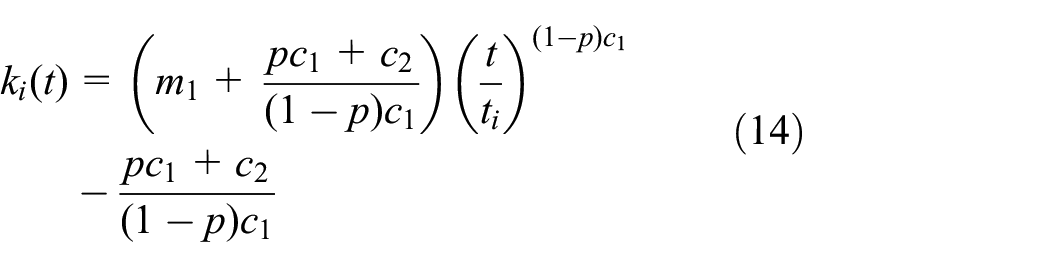
The average field method is used to calculate the degree distribution of the generated network

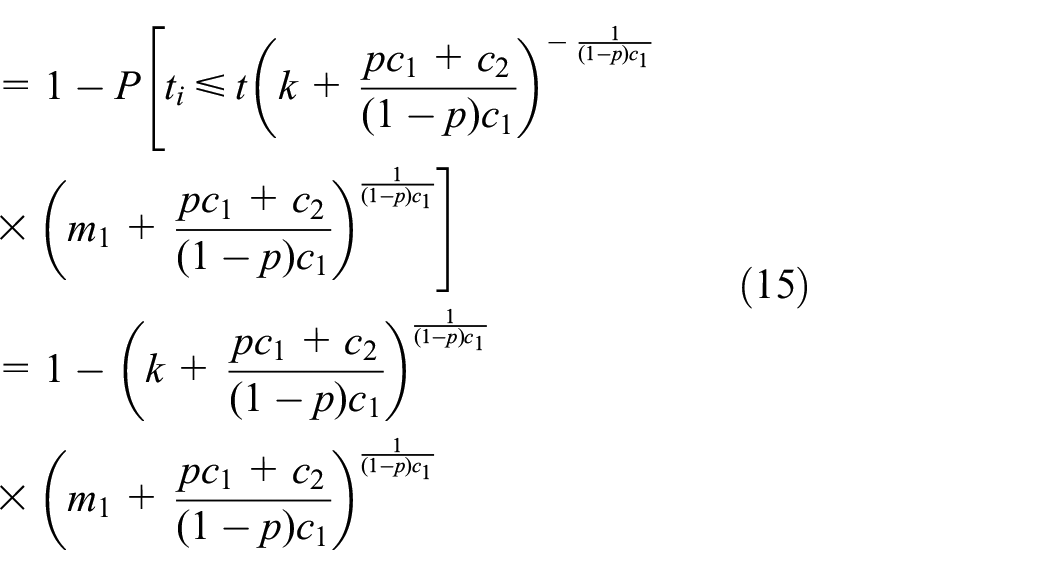

Let the exponent
Assume
To sum up, assuming that
Numerical simulation
Next, the network characteristics are analyzed through numerical simulation.
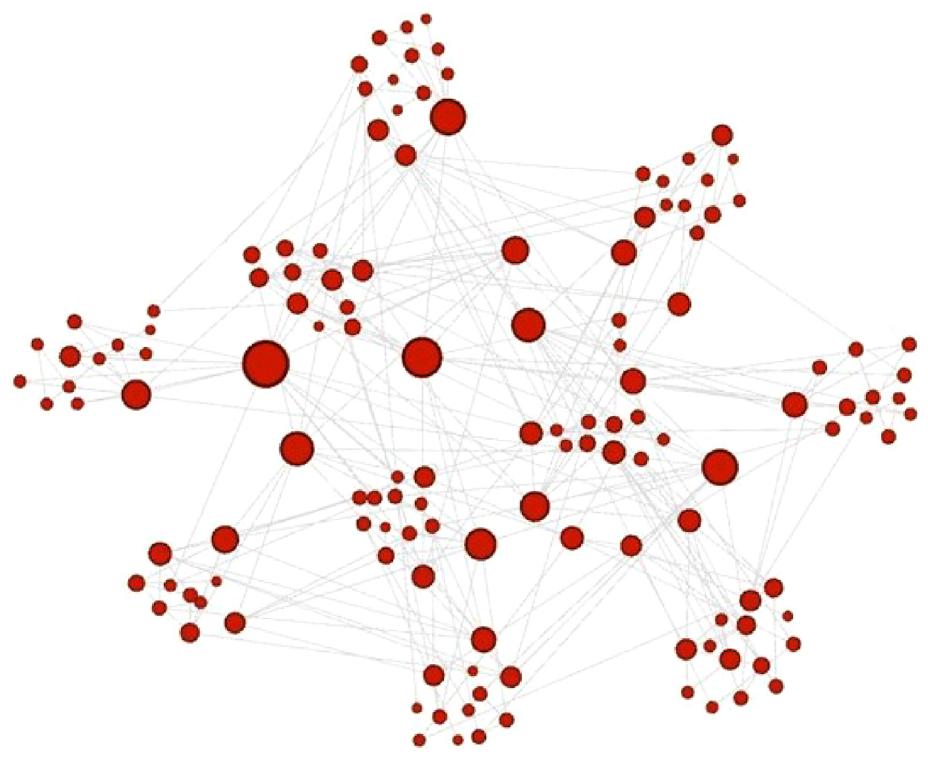
The topology diagram of the multi-domain cooperative communication network after evolution is shown in Figure 1. Set parameter

The evolution diagram of multi-domain cooperative communication network with network scale
When the network scale


The degree value corresponding to the node after the evolution of multi-domain cooperative communication network.

Degree distribution of multi-domain cooperative communication networks.
Robustness analysis
Based on the multi-domain cooperative communication network generated above, the robustness of the network is analyzed using random attack, intentional attack, and hybrid attack strategies. An intentional attack means attacking a node with a higher degree of probability with a certain probability. A random attack is a random attack on nodes in the network with a certain probability. The hybrid attack is to attack nodes in the network with two attack strategies at the same time.
The influence of the two attack methods on the degree distribution of cooperative communication networks under different attack probabilities is shown in Figures 4 and 5. Here, the number of attack nodes is 0, 40, and 80, respectively, and the corresponding attack probability is 0, 0.2, and 0.4, respectively. Other parameters
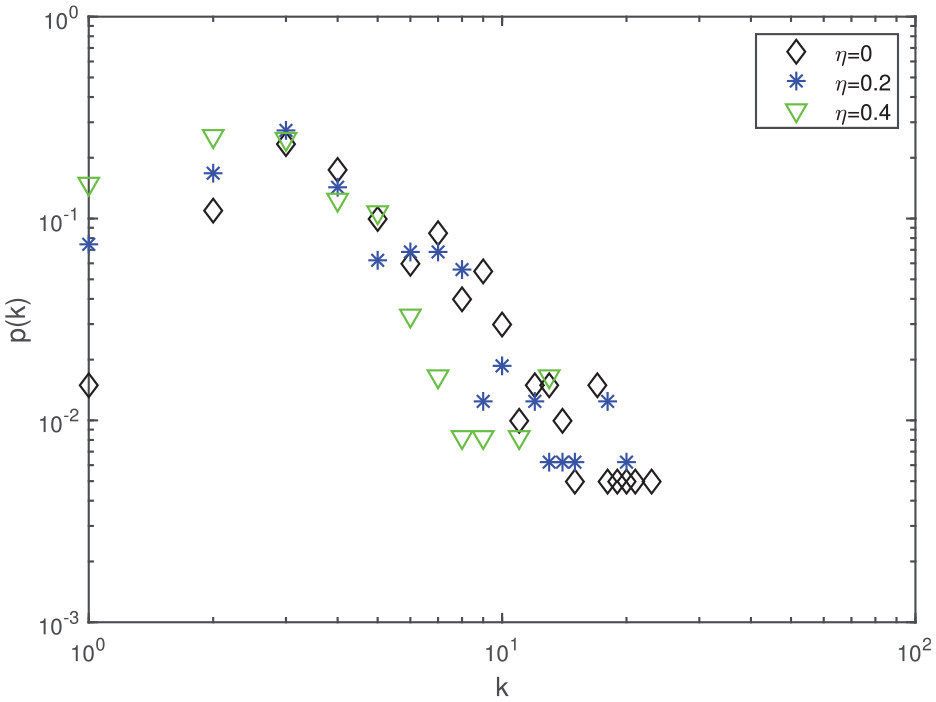
Influence of random attack on degree distribution of multi-domain cooperative communication network.

Influence of intentional attack on degree distribution of multi-domain cooperative communication network.
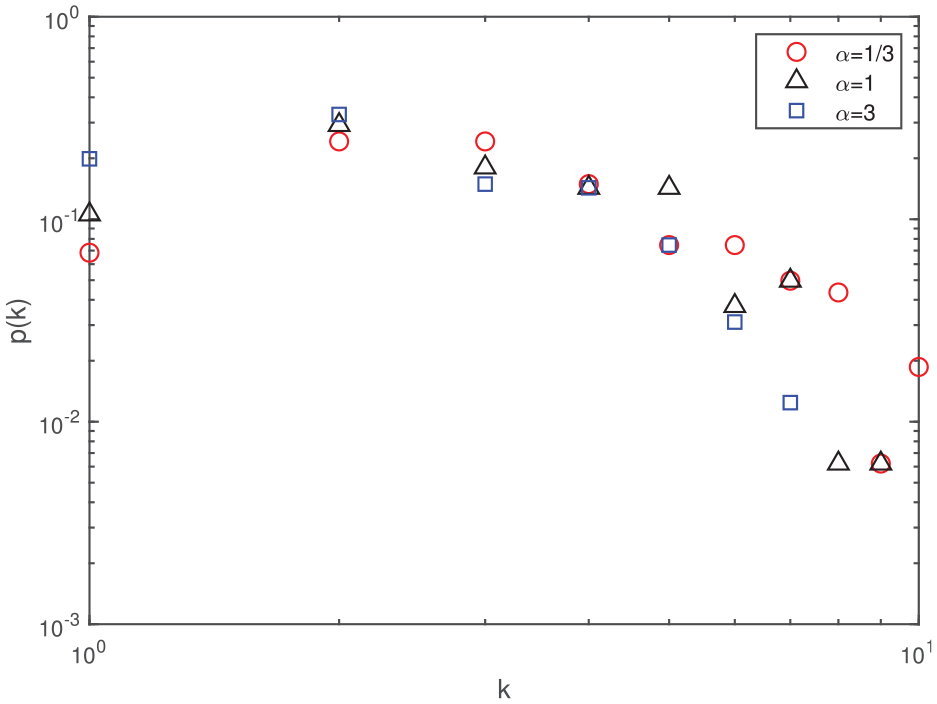
Influence of hybrid attack with attack probability of 0.2 on degree distribution of multi-domain cooperative communication network.

Influence of hybrid attack with attack probability of 0.4 on degree distribution of multi-domain cooperative communication network.
The network evolution topology of random attack with attack probability of 0.3.

The network evolution topology of random attack with attack probability of 0.6.

The network evolution topology of hybrid attack with attack probability of 0.3.

The network evolution topology of hybrid attack with attack probability of 0.6.

The network evolution topology of intentional attack with attack probability of 0.3.
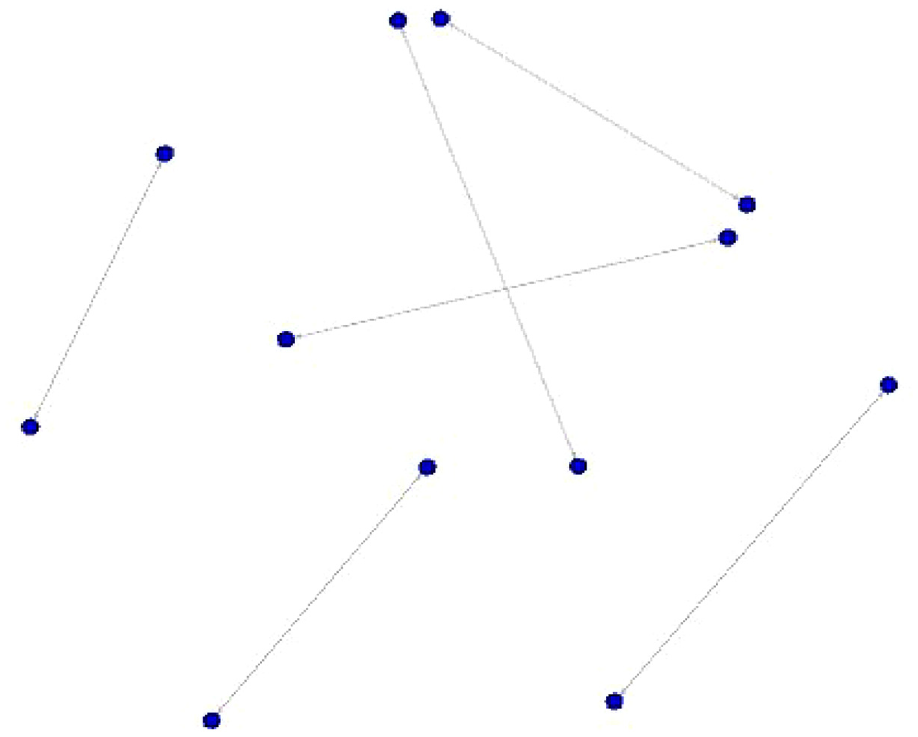
The network evolution topology of intentional attack with attack probability of 0.6.
From the above, we know that the average degree of network is 5.68, the average path length is 3.4, and the average cluster coefficient is 0.34. Other parameters

The effect of random attack and intentional attack on average degree and average path length of multi-domain cooperative communication network under different attack probabilities.

The effect of hybrid attack on average degree and average path length of multi-domain cooperative communication network under different attack probabilities.

The effect of three attack modes on average clustering coefficient of multi-domain cooperative communication network under different attack probabilities.
Relay selection strategy of the combined maximum degree and minimum clustering coefficient
In the future, wireless communication networks will carry more high-speed real-time communication services. Using relays can not only expand cell coverage and reduce communication blind spots but also save terminal transmit power, effectively achieve optimal resource allocation, and provide users with more reasonable high-speed communication services. Therefore, it is of great practical significance to study the relay node selection technology in cooperative communication networks. Combined with the transmission characteristics of the wireless communication system, it is necessary to formulate a relay selection scheme to determine the reliability of the relay location to improve the accuracy of communication. The selection of relay nodes is the key to realizing communication in a cooperative relay system. How to select the most suitable relay node to optimize the communication performance of the sender is the primary issue we consider, because an appropriate relay selection strategy can not only select the node that can effectively help the source node transmit information, improve the transmission quality, but also reduce the power waste caused by the relay forwarding signals with poor channel conditions, enabling energy-saving and efficient communication.
Based on the multi-domain cooperative communication network, the relay node selection strategy is studied and analyzed. From the above research and analysis, a multi-domain cooperative communication network has both scale-free characteristics and small-world characteristics. Most of the selected source nodes
The pseudo-code of relay node selection strategy combining maximum degree and minimum clustering coefficient is shown in Algorithm 1:
The relay node selection strategy combining maximum degree and minimum clustering coefficient.

Note. In the process of relay selection, the same node can be queried multiple times, but the same link can only be accessed once.
The basic parameter values of the generated network are shown in Table 2.
Basic parameters of the generated multi-domain cooperative communication network data set.

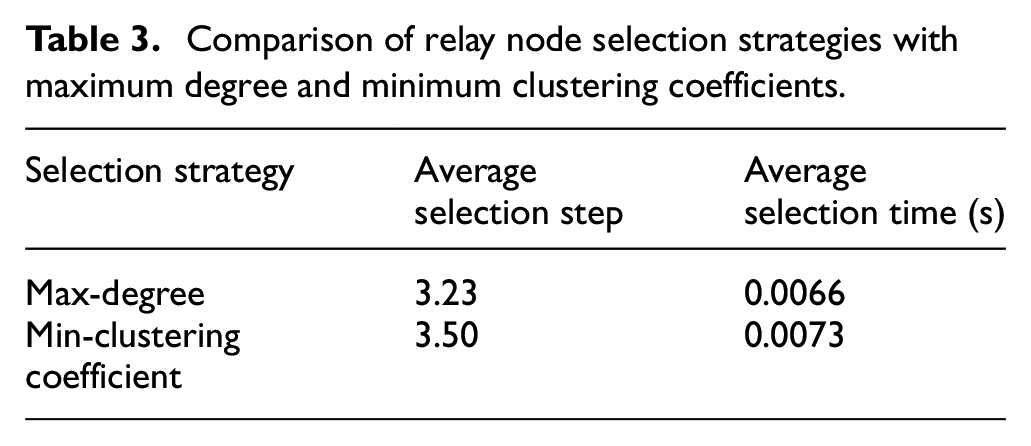
By analyzing the network performance generated by the relay node selection strategy of maximum degree and minimum clustering coefficient, the average selection steps and average selection time are obtained, as shown in Table 3.
Comparison of relay node selection strategies with maximum degree and minimum clustering coefficients.
The impact of different boundary values
The effect of improved relay node selection with different threshold value

It can be seen from Tables 3 and 4 that the relay node selection strategy combining the maximum degree and the minimum clustering coefficient is generally better than the maximum degree relay node selection strategy and the minimum clustering coefficient relay node selection strategy. When
Conclusion
In the context of the IoT, according to the actual characteristics of the cooperative communication network, a multi-domain cooperative communication network evolution model with preferential attachment and random attachment was constructed in this article, which improves the network transmission capacity and alleviates the problem of network congestion. The evolution model was proposed in five steps with five different probabilities. Using the rate equation and mean-field method, the topological properties such as the degree distribution of the network were studied and then the robustness of the network model was analyzed. Compared with random attacks, as the proportion of deliberate attacks in mixed attacks increases, the impact on network characteristics gradually increased. It could be seen that deliberate attacks had a greater impact on the degree distribution, average degree, average shortest path length, and average clustering coefficient of the network, but the attachment mode of nodes in the network can be more random by adjusting the
Footnotes
Handling Editor: Yanjiao Chen
Declaration of conflicting interests
The author(s) declared no potential conflicts of interest with respect to the research, authorship, and/or publication of this article.
Funding
The author(s) disclosed receipt of the following financial support for the research, authorship, and/or publication of this article: This research was supported by the National Key Science Research and Development Program of China (Grant No. 2018YF2000701), China Postdoctoral Science Foundation (Grant No. 2021M692400), Research and Development Plan of Science and Technology of China National Railway Group Co., Ltd (Grant No. P2021S005 and No. N2021X007), Research Project of China Academy of Railway Sciences Group Co., Ltd (Grant No. 2021YJ136), and National Natural Science Foundation of China (Grant No. 61973201 and No. 62006169).
