




Abstract
Although prior research has shown that reward provision might sometimes increase creativity, little is known about how leadership that clarifies effort-reward contingencies (i.e., contingent reward leadership) is related to team creativity. Drawing on the theory of learned industriousness, we argue that contingent reward leadership can enhance team knowledge exchange and, in turn, team creative performance. However, we propose that this relationship is moderated by leader unpredictability, which can create uncertainty about resource allocation, thereby undermining the otherwise positive effect of contingent reward leadership. In a two-source, lagged design (three-wave) field study with data from 60 organizational teams, we found a conditional indirect (moderated mediation) effect of contingent reward leadership on team creative performance through team knowledge exchange. This conditional indirect effect was positive when leader unpredictability was low, and negative when leader unpredictability was high. Our research provides leaders with clear and actionable advice by showing that contingent reward leadership promotes team creative performance only when leaders act in predictable and consistent ways.
Keywords
Today's organizations operate in a rapidly changing and complex work environment (By, 2005). To adapt to newly emerging challenges in such an environment, they are strongly dependent on the ability of their work teams to cooperative effectively and develop creative solutions (Farh et al., 2010). Therefore, scholars have been trying to identify leader behaviors that can help to facilitate creativity in teams (Hughes et al., 2018). When it comes to what motivates the members of these teams to be more creative, a large fraction of this research (e.g., Jaussi & Dionne, 2003; Wang et al., 2016) has drawn on theories that underscore the importance of intrinsic motivation (Amabile, 1983, 1988) such as, for example, self-determination theory (Deci & Ryan, 1987).
However, for most phenomena in the literature on organizational behavior, there are typically multiple mechanisms through which an outcome can be affected and that often exist in parallel and occur simultaneously (e.g., Ng, 2017). In fact, although this previously mentioned stream of literature often assumes that rewards might undermine intrinsic motivation and, in turn, creativity (Hughes et al., 2018; Zhang et al., 2022), there is also research which suggests that in some situations, the promise of rewards can increase creativity because it makes creativity-related effort more appealing and provides information regarding which kind of performance is expected and valued (Byron & Khazanchi, 2012; Eisenberger, 1992; Eisenberger et al., 1998, 1999). Similarly, studies have found that contingent reward (CR) leadership—that is, the degree to which leaders clarify expectations and establish rewards to meet these expectations (Bass et al., 2003; Wang et al., 2011)—can also be an important determinant of creativity-related performance (Byron & Khazanchi, 2012; Hughes et al., 2018; Lee et al., 2020). However, the process through which and the conditions under which CR leadership promotes creativity remain underresearched.
This seems to be especially the case when it comes to the question of how and when CR leadership influences creative performance at the team level of analysis (Van Dijk et al., 2021)—that is, “the production of novel and useful ideas concerning products, services, processes, and procedures by a team of employees working together” (Bai et al., 2016, p. 3240). This is unfortunate because creative processes are often products of collective rather than individual efforts (Van Dijk et al., 2021). Furthermore, an investigation of the effects of CR leadership on team creativity would be of great significance for organizations and leaders, as measures that provide rewards for creative performance are typically easy to implement and thus could be used frequently (Byron & Khazanchi, 2012; Zhou et al., 2022). Therefore, the overall goal of the present research is to address this theoretical gap and to develop and test a theoretical framework to explain how (i.e., through what processes) and when (i.e., under what conditions) CR leadership fosters creativity in teams.
To do so, we draw on the theory of learned industriousness (Eisenberger 1992; Eisenberger & Armeli, 1997; Eisenberger et al., 1998, 1999), which posits that the promise of rewards can reduce the innate aversiveness of effort required to reach high performance levels (Eisenberger & Armeli, 1997; Eisenberger et al., 1999). In addition, it also states that the promise of rewards has an informational character in that it signals which kind of behavior and performance is desired and will be rewarded in the future (Eisenberger et al., 1999). Through both mechanisms, the promise of rewards can then increase the general willingness of people to expend effort to achieve high performance levels in a certain domain (Eisenberger & Armeli, 1997). As the theory itself states that these motivational mechanisms also apply to creative performance (Eisenberger & Armeli, 1997) and since other researchers have drawn on this theoretical perspective to explain the relationship between CR leadership and creativity in groups (e.g., Kahai et al., 2003), the theory of learned industriousness lends itself well to explain the relationship between CR leadership and team creative performance.
In teams, one process that is both especially effort-intensive (Bartol & Srivastava, 2002; Szulanski, 1996) and highly important for creative performance is team knowledge exchange—that is, the extent to which team members exchange information, ideas, and suggestions relevant to the task with each other (Srivastava et al., 2006). But while previous research has shown that team knowledge exchange is a key determinant of team creativity (Dong et al., 2017), relatively little is known about whether CR leadership could be an effective tool to promote knowledge exchange among team members. The few existing studies that have examined the relationship between CR leadership and knowledge exchange have found a positive relationship, but only employed a cross-sectional and single-source design (Bradshaw et al., 2015; Hussain et al., 2017). In line with the theory of learned industriousness, we propose that when CR leaders promise rewards, they make knowledge exchange efforts seem less aversive and provide signals that knowledge exchange and creativity are important and valued outcomes, which will also be rewarded in the future. This should increase the team's level of knowledge exchange and, in turn, creativity.
However, the theory of learned industriousness also suggests that the promise of rewards only seems to have a positive effect on creative processes when the rewards are presented consistently and in a predictable way, while uncertainty about effort-reward contingences might undermine creativity-related effort (Eisenberger & Armeli, 1997; Eisenberger et al., 1998). Similarly, the few studies that have investigated the process through which CR leadership influences creativity in teams have also shown mixed results (Kahai et al., 2003; Liu et al., 2011; Rickards et al., 2001; Wei et al., 2010). Therefore, we propose that the effectiveness of this process also depends on whether the leader employs CR leadership in a consistent and predictable way.
To date, a large part of leadership research assumes that leaders employ certain behaviors consistently (Carton, 2022; Schilling et al., 2023). However, several factors, such as fairness motives (Scott et al., 2014), individual differences (Mayer et al., 2007), and situational aspects (e.g., competitive and intense work pressures; Sherf et al., 2019), can also cause leaders to exhibit inconsistent and unpredictable behavior (Schilling et al., 2023). Research has shown that leader unpredictability—that is, the extent to which leaders exhibit variable behaviors that the team cannot anticipate and predict (Greer et al., 2012; Schilling et al., 2023)—can undermine leadership effectiveness. For example, scholars have found that inconsistent fair treatment leads to more physiological stress than consistent unfair treatment (Matta et al., 2017), and that leader unpredictability can foster intrateam power struggles and hurt team performance (Greer et al., 2012). These findings underscore the need for further research on leader unpredictability (Greer et al., 2012; Schilling et al., 2023). We propose that the indirect effect of CR leadership on team creative performance through knowledge exchange is contingent on leader unpredictability. We argue that leader unpredictability hurts the informational character of CR leadership and increases the aversiveness of creativity-related effort, which causes team members to hoard knowledge to protect their resources, and thereby reduces team creative performance (Bartol & Srivastava, 2002; Greer et al., 2017).
In summary, we propose that CR leadership promotes knowledge exchange among team members, thereby increasing team creative performance. However, we argue that this effect can be undermined if leaders employ such behavior in unpredictable and inconsistent ways. Figure 1 shows our research model. We tested this model in a three-wave, two-source field study with 60 teams from various industries in India.
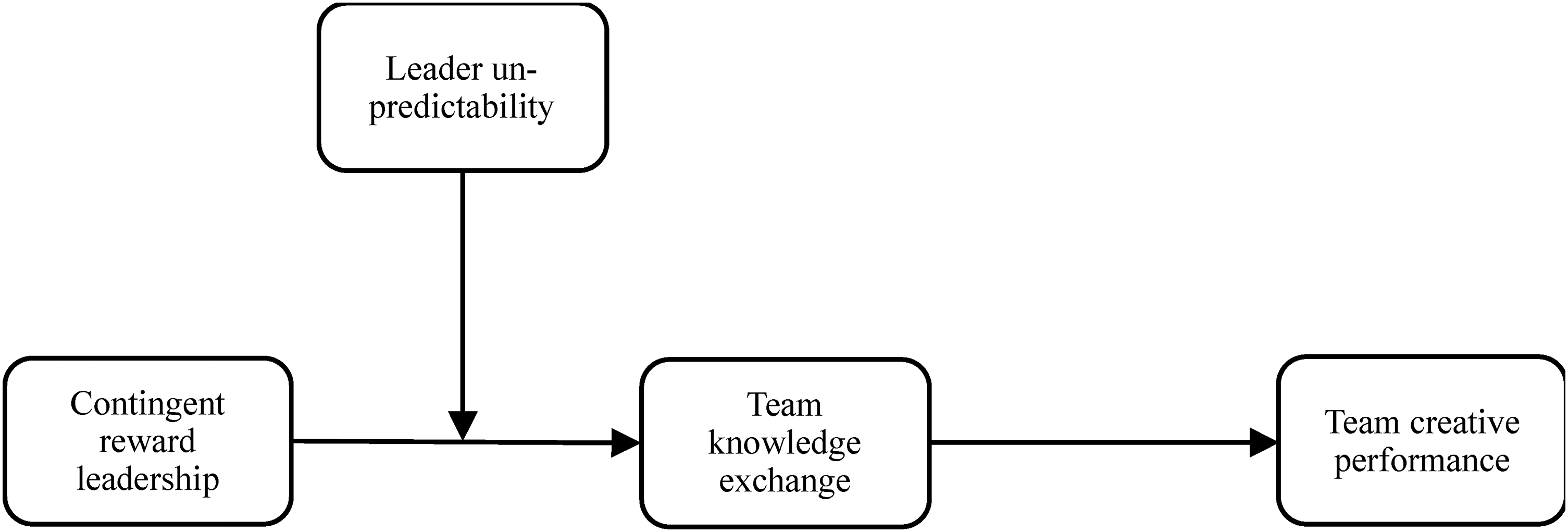
The hypothesized model.
This research makes several important contributions to the literature. First, regarding the transactional leadership literature, we extend efforts to better understand the relationship between CR leadership and team creative performance (e.g., Liu et al., 2011; Rickards et al., 2001; Wei et al., 2010). In doing so, we provide additional evidence for the group-level effects of CR leadership on team creativity and identify a mediating mechanism and a boundary condition for these effects. Second, we introduce leader unpredictability as a new moderator that can undermine and even reverse the effects of otherwise positive leadership behavior (CR). Scholars have argued that it is important not only to examine to what extent leaders engage in a certain behavior, but also to examine whether they act consistently and predictably (Schilling et al., 2023). While others have explored this idea theoretically, we follow their suggestion to empirically measure the level of leader unpredictability (Schilling et al., 2023). By examining leader unpredictability as a boundary condition for the indirect effect of CR leadership on team creativity, we also provide an explanation for the inconclusive findings of previous studies on CR leadership and creativity (Kahai et al., 2003; Liu et al., 2011; Rickards et al., 2001; Wei et al., 2010). In addition, we respond to calls for additional studies on how leaders should offer rewards to their subordinates to increase creativity (Byron & Khazanchi, 2012), namely, in a consistent and predictable manner. Third, regarding the team creativity literature, we investigate the role of CR leadership in fostering team creativity via knowledge exchange. By examining CR leadership as a predictor of team knowledge exchange, we respond to calls for more research on the mechanisms by which leadership can facilitate knowledge exchange (Carmeli et al., 2013). Overall, we show that clarifying effort-reward contingencies can also be an important predictor of effective team functioning and creativity.
Theory and Hypotheses
CR Leadership, Team Knowledge Exchange, and Team Creative Performance
Researchers have referred to transactional leader behavior as one of the core elements of effective leadership in organizations (Bass et al., 2003). Among the three components of transactional leadership (i.e., CR leadership, management by exception active, and management by exception passive; Bass & Riggio, 2006), past research suggests that CR leadership—that is, the degree to which a leader clarifies expectations and establishes the rewards for meeting these expectations (Bass et al., 2003; Wang et al., 2011)—is the most “positive” form of transactional leadership and the one that is closest to the core of the concept (e.g., Bass et al., 2003; Hughes et al., 2018). Indeed, evidence from meta-analyses shows that CR leadership is positively related to team performance, while management by exception active and passive were found to have insignificant or even negative relationships with team performance (Judge & Piccolo, 2004; Wang et al., 2011).
In this study, we propose that CR leadership also has the potential to promote team performance in terms of creativity because it facilitates knowledge exchange within the team. Knowledge exchange refers to the process by which team members exchange information, ideas, and suggestions relevant to the task with each other (Srivastava et al., 2006). Scholars have argued that knowledge exchange is arguably one of the most important team processes that has the potential to foster idea generation and implementation (Daellenbach & Davenport, 2004; Srivastava et al., 2006). However, others have also stated that knowledge is a source of power, and that knowledge sharing bears the threat of erosion of this power and a loss of authority (Bartol & Srivastava, 2002). Moreover, knowledge sharing requires time and effort on the part of the knowledge giver (Szulanski, 1996). Therefore, potential knowledge givers may refrain from sharing knowledge unless they understand what is in it for them and perceive the reward as sufficient compensation for their efforts (Bartol & Srivastava, 2002).
We draw on the theory of learned industriousness (Eisenberger 1992; Eisenberger & Armeli, 1997; Eisenberger et al., 1999) to explain how CR leadership can help to overcome this barrier to knowledge exchange and, in turn, creative performance. According to this theory, promising rewards provides behaviorally relevant information that steer goal-directed behavior, thereby increasing various types of performance, including performance in terms of creativity (Byron & Khazanchi, 2012; Eisenberger et al., 1999). The theory specifies two mechanisms through which the promise of rewards increases creativity-related effort and, in turn, creative performance (Eisenberger et al., 1999):
It assumes that people tend to see effort as an unpleasant and aversive sensation. However, when rewards are promised for putting high levels of cognitive or physical effort into an activity, this aversiveness is reduced and people's willingness to expend effort increases (Eisenberger & Armeli, 1997; Eisenberger et al., 1998). The promise of rewards also has attention-eliciting properties and provides information regarding which kind of performance is a valued criterion and will be rewarded in the future, which lets people increase their effort in the corresponding domain (Eisenberger et al., 1998, 1999).
We propose that CR leadership can foster team knowledge exchange efforts through both mechanisms. First, by offering rewards for both knowledge exchange and creativity, CR leaders reduce the aversiveness of knowledge exchange efforts. CR leadership can directly reduce the perceived aversiveness of team knowledge exchange by establishing clear effort-reward contingencies for knowledge exchange such that the extent to which team members engage in knowledge exchange is one of the criteria that the leader uses to evaluate and reward team members. CR leadership can provide positive feedback and praise and offer monetary and nonmonetary rewards, such as bonuses and promotions, to engage in knowledge exchange (Bryant, 2003). Moreover, CR leadership can also indirectly reduce the perceived aversiveness of knowledge exchange by providing rewards for creativity, which allows followers to see knowledge exchange, as a means to meet this end, as more desirable. As team members consider knowledge exchange efforts less aversive, they will also be more likely to engage in such behavior.
Second, we argue that CR leadership promotes knowledge exchange because it provides informational cues that such efforts are valued and will also be rewarded in the future. Research has shown that rewards for creative performance on previous tasks lead to higher creativity in later tasks, even when the instructions for this later task did not explicitly state that creativity was the expected form of performance (Eisenberger et al., 1998). This has been explained by the idea that rewards serve as information that creativity is valued and expected (Eisenberger et al., 1999). CR leadership clarifies expectations and offers recognition when goals are achieved. In other words, CR leaders specify roles and task requirements and define rules regarding work duties (Bass et al., 2003). In return, CR leaders provide work teams with material or psychological rewards when goals are achieved (Bass et al., 2003). In this way, they signal that knowledge exchange is a desired behavior that will also be rewarded in the future, which will motivate team members to also show more of this behavior.
Based on this reasoning, we posit:
Hypothesis 1: CR leadership is positively related to team knowledge exchange.
Scholars have argued that knowledge exchange is an important antecedent of team creative performance (Leung & Wang, 2015; van Knippenberg et al., 2004) because creativity is often not limited to exceptional individuals but is a multilevel construct that involves both intrapersonal and interpersonal processes (Hargadon & Bechky, 2006). Team creative performance refers to the creation of new and useful ideas for products, services, processes, and procedures by a team of individuals working together (Bai et al., 2016). To generate novel ideas, the acquisition of new knowledge or recombination of existing knowledge is necessary (Ward et al., 1997). When team members participate in knowledge exchange, they search for and provide others with information, expertise, and experiences relevant to the task. This enriches the existing repertoire of creative thinking of team members, provides them with alternative perspectives from other people, and redirects attention to previously overlooked aspects of the task (Jiang & Chen, 2018). Finally, effective knowledge exchange helps team members validate their own and others’ contributions, thereby ensuring that new ideas are useful (Gardner et al., 2012). In contrast, a lack of exchange and exploitation of existing knowledge makes the cognitive resources available within a team underutilized and can impair team creativity (Srivastava et al., 2006).
Based on this reasoning, we argue that knowledge exchange promotes team creative performance. Moreover, we argue that because CR leadership promotes knowledge exchange by reducing the aversiveness of knowledge exchange efforts and by signaling that such behavior is valued and will also be rewarded in the future, there is a positive indirect effect of CR leadership via team knowledge exchange on team creative performance.
We posit:
Hypothesis 2: Team knowledge exchange is positively related to team creative performance.
Hypothesis 3: CR leadership has a positive indirect effect on team creative performance through team knowledge exchange.
The Moderating Role of Leader Unpredictability
However, does CR leadership always promote team knowledge exchange, and in turn, team creative performance? Alternatively, could there also be aspects of a leader's behavior that might undermine the positive effects of CR leadership? We propose that one component that may be particularly harmful to CR leaders is the degree to which their behavior is perceived as inconsistent and thus unpredictable.
The study of leadership is typically premised on the notion that leaders act consistently. For example, in a typical questionnaire, raters are asked about the extent to which leaders exhibit certain behaviors (e.g., CR behaviors). However, it is also important to examine the degree to which leaders are consistent and predictable in displaying these behaviors (Carton, 2022; Schilling et al., 2023). For that, our conceptualization of leader unpredictability is based on Schilling et al.'s (2023) theoretical work on inconsistent leadership and Greer et al.'s (2012) research on leader emotional unpredictability. However, unlike Greer et al. (2012), we focus on the leader's behavior more generally rather than only on the leader's expression of emotions. We conceptualize leader unpredictability as the extent to which a leader engages in behavior that is difficult to anticipate and predict for the team. Not every variation in the behavior of a leader is perceived by the team as unpredictable. When leaders show new or unexpected behavior in a certain situation, team members engage in a sense-making process and try to use situational cues to make sense of the leader's behavior (Schilling et al., 2023). Many variations in the leader's behavior may not lead to the belief that the leader acts unpredictably because variations in situational demands also make variation in the leader's behavior appropriate (Greer et al., 2012). However, in other instances, leaders may act very differently in situations that appear very similar to the members of the team (Greer et al., 2012; Schilling et al., 2023). The extent to which a leader then engages in behavior for which team members lack a situational explanation is described by the concept of leader unpredictability.
At first blush, one could assume that CR leadership is the diametric opposite of leader unpredictability. In some cases, high levels of CR behavior will coincide with high levels of leader predictability. In other cases, leaders may say and promise that they will reward according to specified criteria. However, when evaluating their team's performance, they may be busy and preoccupied with other matters. Therefore, they may not adhere to those criteria and act unpredictably due to the realities of the organizational context, for example, high workloads, time pressure, and high demands. Under these conditions, ensuring fair and just treatment of employees—which requires focus—competes with other managerial tasks, forcing managers to allocate time and attention to salient technical responsibilities and urgent issues to the detriment of treating subordinates predictably (Sherf et al., 2019). When such leaders renege on previous promises, followers might rate them as low in both CR behaviors and predictability.
However, there may also be cases in which CR leadership is combined with high levels of leader unpredictability. In such cases, a leader may honor most of his or her promises such as providing rewards or assistance—and thus exhibit CR leadership—but combines these behaviors with unexpectedly critical and/or emotional behaviors. For example, such a leader may typically praise followers for good work, but sometimes, unexpectedly, become very critical or emotional in response to work that is of similar quality to that for which he/she typically offers praise (Schilling et al., 2023). In other words, in similar situations, the leader acts in ways that are difficult for the follower to anticipate. This is an example of leader unpredictability combined with high CR behaviors. Thus, although one might assume that CR leadership is negatively related to leader unpredictability, we argue that these two variables are independent, at least to a certain extent. Hence, we argue that it is important not only to study the degree to which leaders exhibit certain behaviors (in our study, CR leadership), but also to study whether their behavior, more generally, is predictable for followers.
Based on the theory of learned industriousness, we previously argued that CR leadership promotes knowledge exchange by decreasing the aversiveness of knowledge exchange efforts and by signaling that such efforts are a desirable behavior that will also be rewarded in the future. However, the theory also states that when it becomes unclear how effort will be rewarded, for example, when high effort is sometimes compensated with smaller rewards than low effort or when low effort is rewarded extensively, effort becomes more aversive, and people will be less motivated (Eisenberger & Armeli, 1997; Eisenberger et al., 1998). In other words, the positive effects of the promise of rewards can be undermined when uncertainty arises about effort-reward contingencies. Similarly, other scholars have argued that uncertainty is an unpleasant and alarming experience, which creates concerns in people about a lack of control in their lives and the outcomes they might achieve (Lind &Van den Bos, 2002). As uncertainty is often considered a major threat to the self, it has been argued that it has a major impact on people's cognitions, perceptions, feelings, and behaviors (Thau et al., 2009).
We expect the indirect effect of CR leadership on creativity via knowledge exchange to differ based on the level of leader unpredictability. Leaders are the primary source of information for the sense-making of team members. Typically, leaders play a crucial role in determining the level of uncertainty that team members feel about their team's dynamics and future outcomes (Greer et al., 2012). Scholars have argued that CR leadership aims to create transparency and consistency by clarifying effort-reward relationships (Gaudet et al., 2014). However, when leaders exhibit high unpredictability, team members may struggle to understand why the leader behaves as he or she does and to predict his or her future behaviors (Schilling et al., 2023). Thus, leader unpredictability increases the team members’ sense of uncertainty (Schilling et al., 2023). Therefore, we propose that when CR leadership is combined with unpredictable leader behavior, teams may perceive their leader's behavior as threatening because they are unable to predict what the leader will do and how they will be rewarded.
We argue that this uncertainty about the relationship with the leader and the leader's trustworthiness in honoring announced effort-reward contingencies also has a detrimental effect on the degree to which team members engage in knowledge exchange. We previously argued that individuals perceive knowledge as a valuable resource and a source of power (Bartol & Srivastava, 2002). Moreover, knowledge exchange requires time and effort on the part of the knowledge giver (Szulanski, 1996). Hence, team members may perceive knowledge sharing as an erosion of their resources, power, and authority if they do not think that this loss is compensated otherwise (Bartol & Srivastava, 2002). Predictable CR leadership provides this compensation by clarifying that knowledge exchange and creativity are valued outcomes that will be compensated. However, when CR leaders act unpredictably, they create uncertainty in their team members about effort-reward contingencies. This may drive team members to refrain from knowledge sharing and even lead to negative reactions, such as an active effort to hoard knowledge to protect their resources and status as knowledgeable and valuable team members (Bartol & Srivastava, 2002; Greer et al., 2017). Moreover, because unpredictable CR leadership creates uncertainty about effort-reward contingencies for knowledge exchange-based outcomes, it reduces team members’ motivation to actively search for and consider information from other team members.
Hence, we argue that when leader unpredictability is high, team members become uncertain whether knowledge exchange itself and creativity will be rewarded, which reduces their motivation to engage in knowledge exchange and achieve high levels of team creative performance. In contrast, when CR leaders act in predictable ways, they increase team members’ certainty that knowledge exchange and creativity are valued outcomes for which they might be rewarded, which increases the team's motivation to exchange knowledge and show high levels of creativity.
Thus, we posit:
Hypothesis 4: There is a conditional indirect (moderated mediation) effect such that the indirect effect of CR leadership via team knowledge exchange on team creative performance is moderated by leader unpredictability. This effect is significant and positive when leader unpredictability is low and becomes less strongly positive as leader unpredictability increases.
Methods
Sample and Procedure
We tested our hypothesized model using a sample of 60 work teams located in India. The teams came from various industries, including information technology, manufacturing, telecommunications, consulting, and banking. The teams worked in different functional areas such as procurement, operations, product design, marketing and sales, and business development, which provided an opportunity to examine the factors and mechanisms of team creativity in a representative context of work teams. Creativity was a key aspect of their job. For example, employees from procurement worked on procurement planning, solicitation planning, source selection, contract administration, and contract closure. Similarly, participants from the banking industry (e.g., bank manager and customer relationship manager) were expected to come up with new ways to attract clients and improve profitability. Hierarchically, the leaders in our sample held lower-level and middle-level managerial positions. We initially contacted the team leaders and asked them to participate in the study with their team. Participation was voluntary for all the team members. At the beginning of the study, we explained the general objectives of our research and ensured anonymity. The participants completed the questionnaire in English. We collected the data in two ways: (1) via an online survey and (2) via paper-based questionnaires. Most of the surveys were collected through paper surveys (80%). At the end of data collection, we combined online responses and paper-based questionnaires into a single database. Data collection occurred at three different times to minimize the risk of a common-method bias (Podsakoff et al., 2012). At time 1 (T1), team members provided data on demographics and their team leader's leadership behaviors. At time 2 (T2), 1 month after T1, the team members completed a questionnaire that contained a team knowledge exchange scale and potential control variables. Finally, at time 3 (T3), 2 months after T2, the respective team leaders rated their teams’ performance and provided additional information about their teams.
Of the 107 contacted teams, 67 (63%) agreed to participate. To be included in our sample, we required teams to provide complete data from the team leader and at least 5 team members, or 50% of all team members. This yielded a final sample of 60 teams, with data provided by 60 team leaders and 347 team members (average of 5.78 members per team). As the average team size was 5.85 (SD = 1.16), most of the teams in our final sample had a 100% response rate from their team members. On average, team members were 29.76 years old (SD = 6.00). Among them, 254 were male (73%) and 93 (27%) were female.
Measures
Unless otherwise noted, we measured all survey items described below with Likert-type scales ranging from 1 for “strongly disagree” to 7 for “strongly agree.”
CR Leadership (T1)
Team members assessed their team leader's CR leadership behavior on a three-item scale based on Avolio and Bass (2004). Respondents were asked to indicate the extent to which their leader “rewards good performance according to clear criteria,” “assists us based on how much effort we expend,” and “gives positive feedback when performance is good.” To justify aggregating member-rated constructs to the team level, we followed LeBreton and Sentner's (2008) recommendations. We explored inter-rater agreement by calculating the mean rwg(j) scores with a uniform null distribution. Furthermore, we calculated ICC(1) scores, which reflect the extent to which individual ratings can be explained by team membership, and ICC(2) scores, which reflect the reliability of team means and between-team variance. For CR leadership, we aggregated individual-level ratings of CR leadership to the team level of analysis based on a mean rwg(j) of .80, an ICC(1) of .14, and an ICC(2) of .48 (F[59, 287] = 1.93, p < .001). Cronbach's alpha was .70.
Leader Unpredictability (T1)
Team members rated their leader's unpredictability on a four-item scale based on Greer et al. (2012). While Greer et al.'s (2012) original scale focused on leader emotional unpredictability, we adapted the scale to leader unpredictable behavior, which is consistent with our definition of leader unpredictability behavior. The items were “It is unpredictable what our team leader will do in a given situation,” “It is hard to know in advance how our team leader will react,” “Our team leader enacts different behaviors at different times, even if the situation is the same,” and “Our team leader often acts very differently from one day to the next.” We aggregated responses for leader unpredictability to the team level based on the following values: mean rwg(j) = 0.81; ICC(1) = 0.36; ICC(2) = 0.76; F(59, 287) = 4.21, p < .001. Cronbach's alpha was .94.
Team Knowledge Exchange (T2)
Team members assessed team knowledge exchange with four items from Collins and Smith's (2006) scale. Respondents were asked, for example, to indicate the extent to which team members “are willing to exchange and combine ideas with their co-workers.” Individual-level ratings for team knowledge exchange were aggregated to the team level of analysis based on the following results: mean rwg(j) = 0.81; ICC(1) = 0.37; ICC(2) = 0.77; F(59, 285) = 4.40, p < .001. Cronbach's alpha was .82.
Team Creative Performance (T3)
Leaders rated their team's creative performance with 10 items from Zhou and George's (2001) scale, which were adapted to the team level. Respondents were asked, for example, to indicate the extent to which their team “suggests new ways to achieve goals or objectives.” Cronbach's alpha was .76.
Control Variables
We included team size (rated by the leader at T3) and task interdependence (rated by team members at T2) as controls. We controlled for team size (i.e., the number of persons on the team) because previous research suggests that it affects internal team communication (Keller, 2001). We included task interdependence because it can influence creative processes in teams (Van der Vegt & Janssen, 2003). To measure task interdependence, we used a four-item scale based on Van der Vegt and Janssen (2003). (Sample item: “I need to collaborate with my team members to perform my job well.”) We aggregated ratings for task interdependence based on a mean rwg(j) = 0.89; an ICC(1) = 0.41; and an ICC(2) = 0.80, F(59, 286) = 5.04, p < .001. Cronbach's alpha was .91.
Confirmatory Factor Analysis
We conducted a set of confirmatory factor analyses (CFA) to assess the validity of our measures. First, we tested our proposed four-factor model with all variables rated by the team members—CR leadership, leader unpredictability, team knowledge exchange, and task interdependence—to assess the possibility of potential common-method bias. This model yielded an adequate fit to the data (χ2 (84) = 98.16; CFI = .98; RMSEA = .05, SRMR = .08; Hu & Bentler, 1999). Moreover, this model was a significantly better fit to the data (p < .001) than all alternative three-factor models, for example, a model in which we combined CR leadership and leader unpredictability into one factor (χ2 (87) = 130.13; CFI = .93; RMSEA = .09, SRMR = .09), two-factor models (e.g., a model where we combined CR leadership and leader unpredictability into one and knowledge exchange and task interdependence into one factor: χ2 (89) = 314.30; CFI = .61; RMSEA = .21, SRMR = .18), and a one-factor model in which we combined all four variables into one factor (χ2 (90) = 433.93; CFI = .40; RMSEA = .25, SRMR = .22).
Results
Table 1 shows the means, standard deviations, scale reliabilities, and correlations between our variables.
Descriptive Statistics.
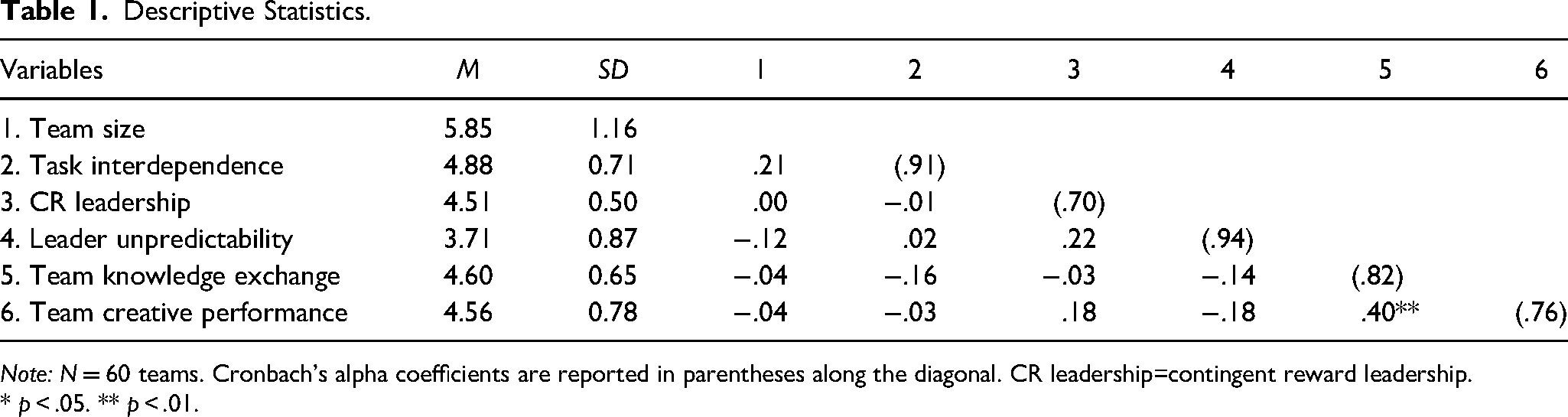
Note: N = 60 teams. Cronbach's alpha coefficients are reported in parentheses along the diagonal. CR leadership=contingent reward leadership.
* p < .05. ** p < .01.
To test our hypotheses, we used the approach proposed by Hayes (2022) and conducted several regression analyses. To make inferences about the indirect effects, we calculated 95% bootstrapped confidence intervals based on 50,000 bootstrap samples.
Hypothesis 1, which predicts a positive relationship between CR leadership and team knowledge exchange, was not confirmed by the results of the correlation (r = −.03, p = .792) and regression analysis (b = −.05, SE = .17, p = .781).
Hypothesis 2, which posits that there is a positive relationship between team knowledge exchange and team creative performance, was confirmed by the results of the correlation (r = .40, p = .002) and regression analysis (r = .49, SE = .15, p = .001).
Hypothesis 3 posits that there is a positive indirect effect of CR leadership via team knowledge exchange on team creative performance. As the bootstrapped confidence interval of this indirect effect included zero (b = −.02, SE = .09, 95% CI [−.204, .145]), Hypothesis 3 was not confirmed.
As a nonsignificant indirect effect does not preclude a subsequent test for a moderated mediation but might even suggest that the indirect effect is contingent on a moderator (Hayes, 2022), we continued our analysis with our fourth hypothesis. Hypothesis 4 predicts that leader unpredictability acts as a first-stage moderator for the indirect effect of CR leadership on team creative performance via team knowledge exchange and that this effect is more strongly positive when leader unpredictability is low, rather than high. To test this hypothesis, we first conducted a hierarchical regression analysis with mean-centered predictor variables to facilitate interpretability (Aiken & West, 1991). In the first step of the analysis, we entered our control variables, team size and task interdependence, into the regression equation. In the second step, we added CR leadership and leader unpredictability; in the third step, we included the interaction between CR leadership and leader unpredictability. The results of this analysis are presented in Table 2. In line with our expectations, this interaction was significant (b = −.73, SE = .23, p = .002). Adding the interaction term to the equation explained a significant amount of variance over and above the variance explained by the controls and main effects (ΔR2 = .15, p = .002). A simple slopes test revealed that the association between CR leadership and team knowledge exchange was positive when leader unpredictability was low (i.e., one standard deviation below the mean; b = .69, SE = .27, p = .014), nonsignificant at the mean level of leader unpredictability (b = .06, SE = .16, p = .716), and negative when leader unpredictability was high (i.e., one standard deviation above the mean; b = −.57, SE = .24, p = .021). These findings are presented in Table 3 and Figure 2.
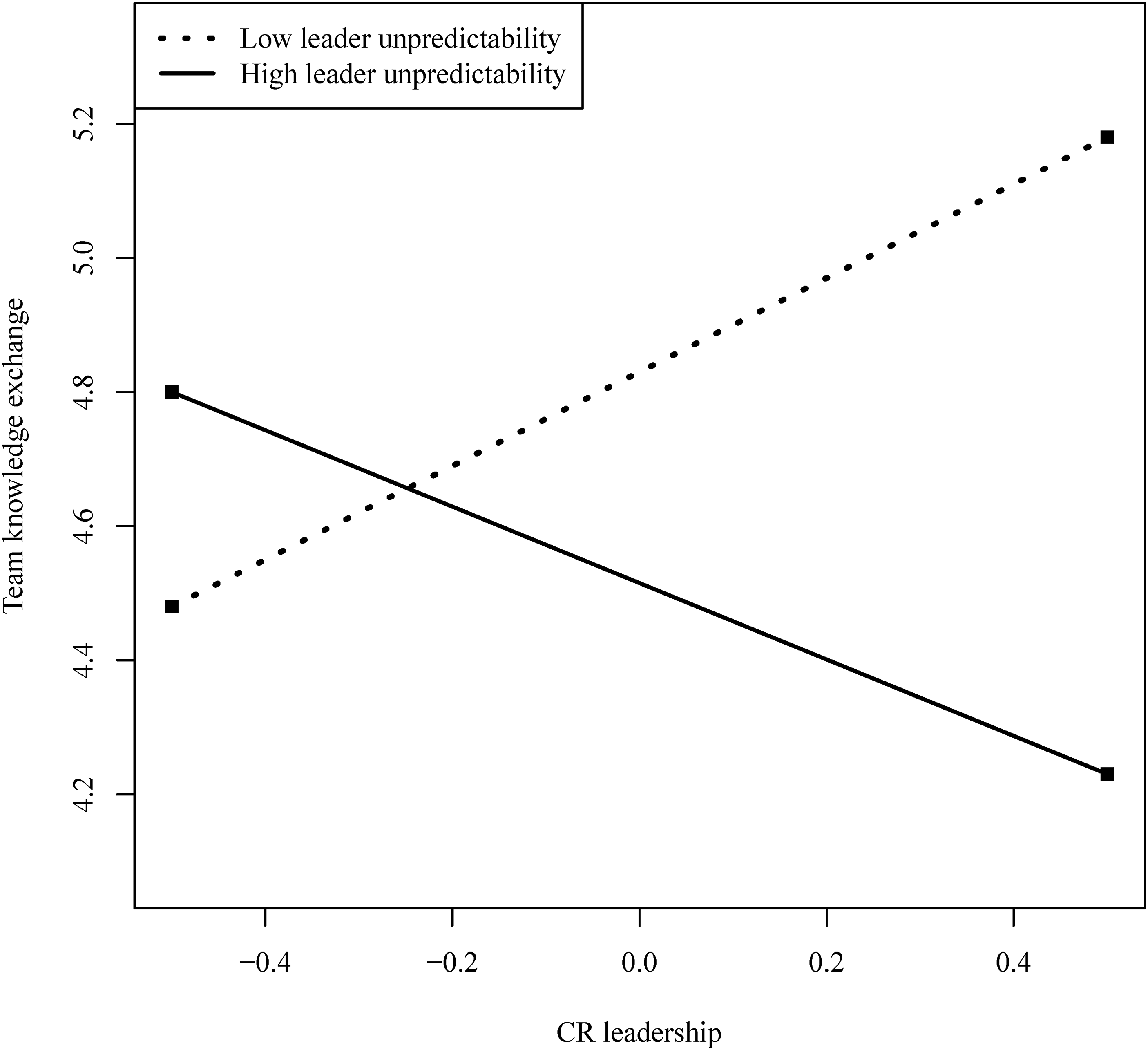
The interactive effect of contingent reward leadership and leader unpredictability on team knowledge exchange.
Results of Hierarchical Regression Analysis.
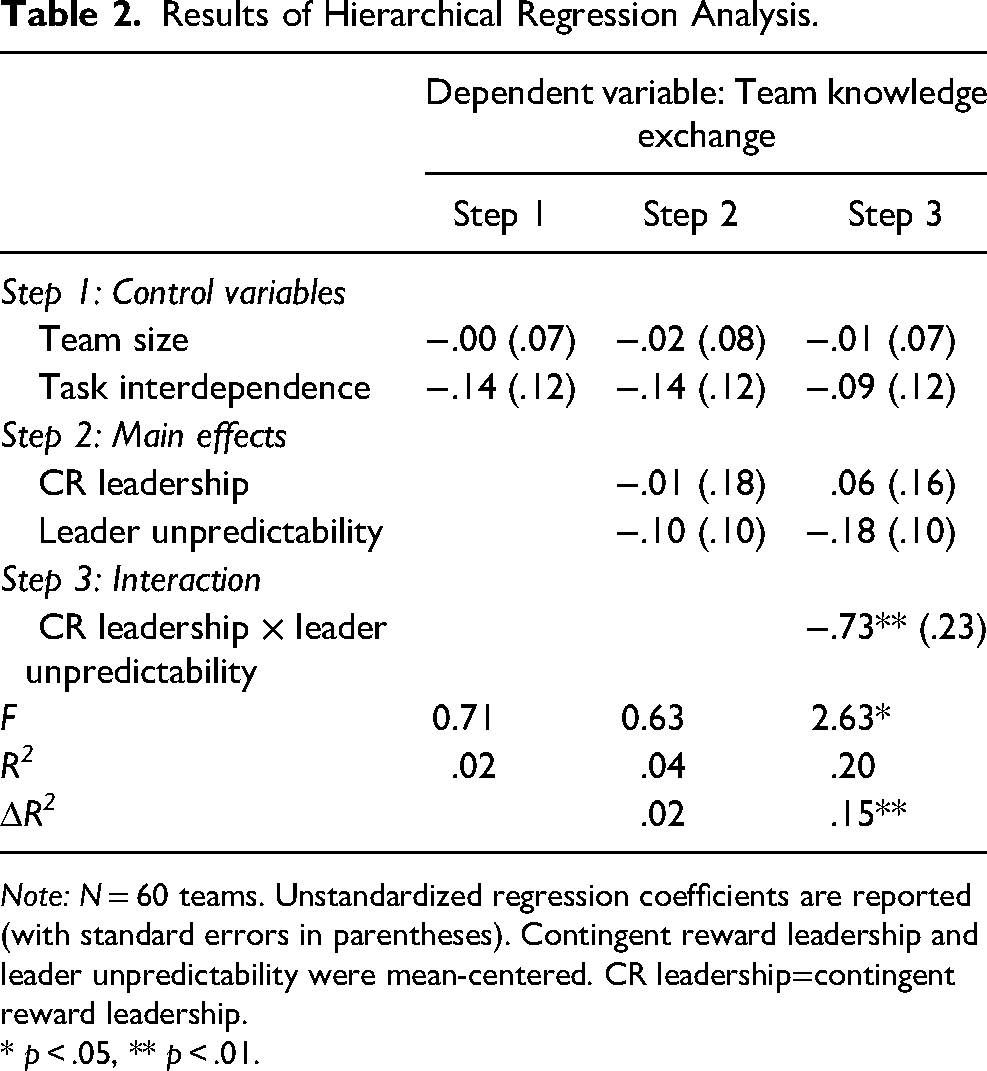
Note: N = 60 teams. Unstandardized regression coefficients are reported (with standard errors in parentheses). Contingent reward leadership and leader unpredictability were mean-centered. CR leadership=contingent reward leadership.
* p < .05, ** p < .01.
Direct and Indirect (Conditional) Effects of CR Leadership on Team Knowledge Exchange and Team Creative Performance.
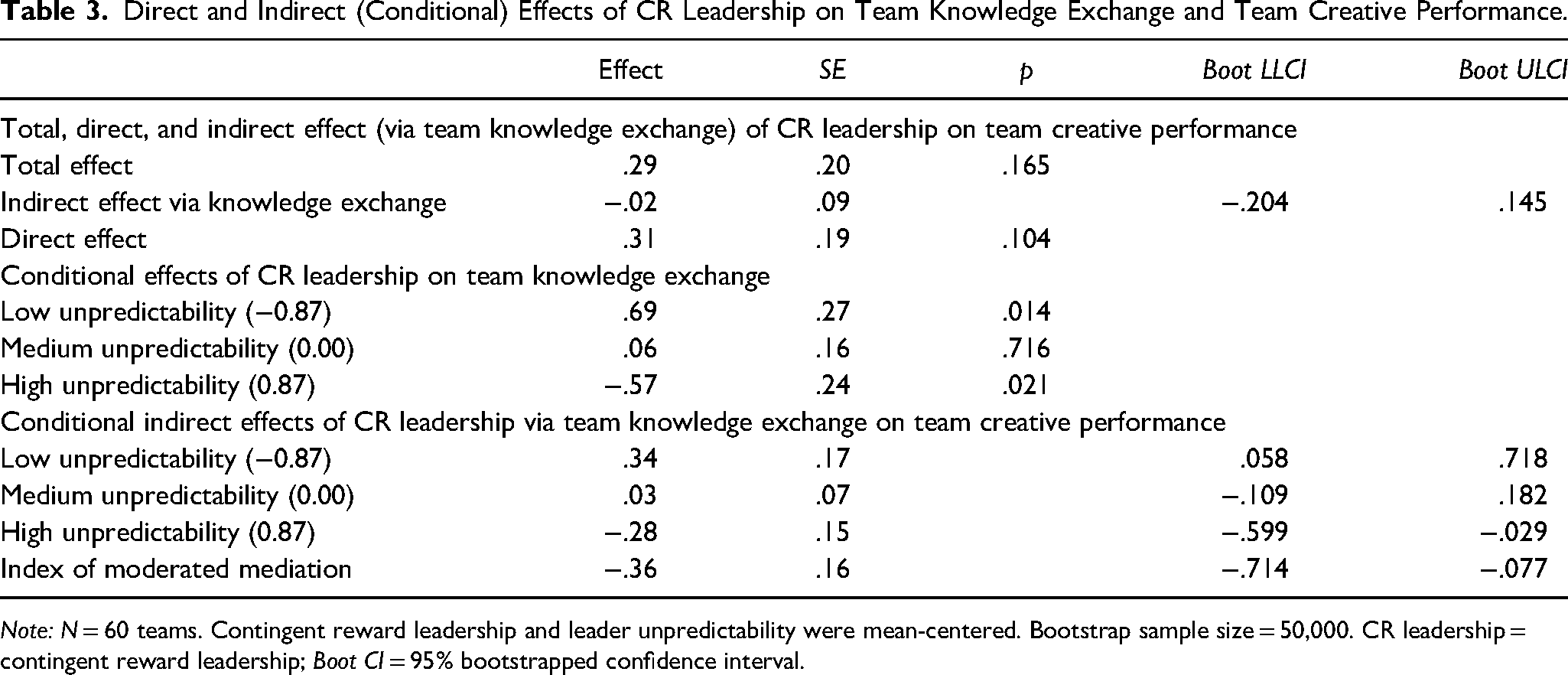
Note: N = 60 teams. Contingent reward leadership and leader unpredictability were mean-centered. Bootstrap sample size = 50,000. CR leadership = contingent reward leadership; Boot CI = 95% bootstrapped confidence interval.
To test whether the indirect effect is related to leader unpredictability, we estimated the index of moderated mediation and the indirect effects at different levels of the moderator, in accordance with Hayes (2022). The results of this analysis are presented in Table 3 and Figure 3. The index of moderated mediation was significant (index of moderated mediation = −.36, SE = .16), as its bootstrap confidence interval (95% CI [−.714, −.077]) excluded zero. The indirect effect of CR leadership on team creative performance mediated by team knowledge exchange was positive when leader unpredictability was low (i.e., one standard deviation below the mean; b = .34, SE = .17, 95% CI [.058, .718]), nonsignificant at the mean level of leader unpredictability (b = .03, SE = .07, 95% CI [−.109, .182]), and negative when leader unpredictability was high (i.e., one standard deviation above the mean; b = −.28, SE = .15, 95% CI [−.599, −.029]). Thus, we found support for Hypothesis 4.
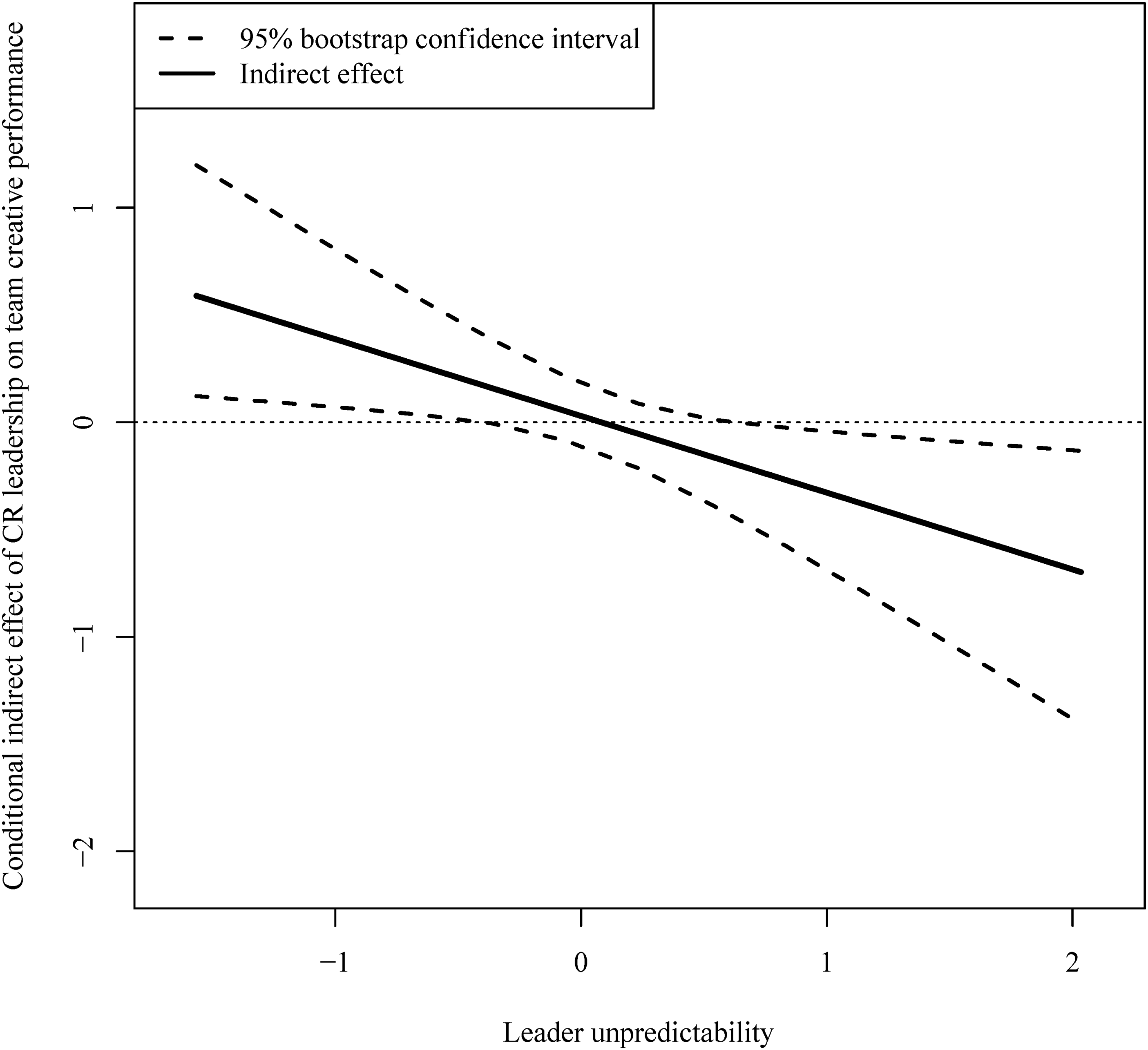
The conditional indirect effect of contingent reward leadership on team creative performance through team knowledge exchange.
Discussion
The main goal of the present research was to examine the process through which and the conditions under which CR leadership is related to team creative performance. We argued that team knowledge exchange mediates the effect of CR leadership on team creative performance and that this relationship is moderated by leader unpredictability. Contrary to our expectations, we did not find a significant indirect effect of CR leadership on team creative performance through team knowledge exchange. However, we found a crossover interaction effect of CR leadership and leader unpredictability. The indirect effect of CR leadership via team knowledge exchange on team creative performance was positive when CR leaders acted in predictable and consistent ways but was negative when CR leadership was paired with high levels of leader unpredictability. With that, our research shows that an effective way to promote team creativity is to use CR leadership in a predictable and consistent way, while CR leadership in combination with leader unpredictability can reverse this otherwise positive effect.
Theoretical Implications
Our research contributes to the literature in three ways. First, few studies have examined the effect of CR leadership on team creativity, and the few existing studies have shown mixed results (Kahai et al., 2003; Liu et al., 2011; Rickards et al., 2001; Wei et al., 2010). Drawing on the theory of learned industriousness, our theoretical arguments and empirical results contribute to the literature on CR leadership by explaining how (i.e., the processes through which) and when (i.e., the conditions under which) CR leadership predicts team creativity.
Second, we add to the literature on unpredictable leader behaviors, especially with regard to its negative effects. Scholars have argued that leadership effectiveness is not only determined by which leadership behavior leaders use but also by the degree to which they use this behavior consistently and have called for more research that examines this idea (Carton, 2022; Schilling et al., 2023). In our research, we found a crossover interaction effect of CR leadership and leader unpredictability. We found that CR leadership only promotes team knowledge exchange and, in turn, team creativity when leader unpredictability is low. In contrast, we found that unpredictable leader behaviors can undermine and reverse the otherwise positive effect of CR leadership. In case of high leader unpredictability, CR leadership then even results in lower levels of team knowledge exchange and, in turn, team creative performance. With this, our research answers these calls and adds to previous research, which has started to highlight the potential downsides of unpredictable leader behavior (Greer et al., 2012; Schilling et al., 2023).
Third, we contribute to the literature on predictors of team creativity by adding to research which argues that clear expectations and repeated and consistent rewards can help foster creativity. Our results show that predictable CR leadership can have positive effects because CR makes knowledge exchange efforts less aversive and frames them as a performance-relevant criterion that will likely be rewarded. This motivates team members to exchange knowledge and, in turn, fosters creativity. With this, we add to previous research by Lee et al. (2004), who found that consistency in organizational conditions, such as reward systems and organizational values, can sometimes also help to create the atmosphere required for high levels of creativity. On the other hand, our findings suggest that unpredictable CR leadership can even hurt knowledge exchange and, in turn, team creative performance because such leadership might cause team members to focus on and protect their own knowledge resources instead of sharing and considering those of other team members. Thus, our research enhances our understanding of leadership behaviors as predictors of team creativity and underscores the notion that consistent and predictable behavior does not necessarily harm creativity, but can even foster it, especially in team contexts where creativity depends on interpersonal processes and individuals need to be motivated to actively share their knowledge.
Limitations and Future Research
Our study has several limitations that could inform future research. First, we relied on subjective rather than objective ratings for our constructs. To mitigate the risk of a common-method bias, we collected data from different sources and at different time points. The good results of our CFA further alleviated our concerns. Additionally, given that most of the teams that participated in our study came from different organizations and industries, it would have been difficult to identify a common objective performance measure that is suitable for all teams. As the respective organizations in our sample rely primarily on subjective ratings to evaluate their teams, these are practically meaningful (Kearney et al., 2019). Moreover, the difference between subjective and objective performance ratings typically tends to be small (Bommer et al., 1995; Wall et al., 2004). Nevertheless, it would be interesting for future research to assess whether our findings can be replicated with other, more objective measures.
Second, caution is needed due to the use of a convenience sample (i.e., accessing sampled organizations through personal connections), which might limit the generalizability of the findings. However, because we were able to recruit teams from various industries, we were less concerned with this issue. Furthermore, all the teams in our sample were located in India. Although we could not think of reasons why our findings should be different when replicated in other countries, we recommend that future research test the generalizability of our findings to other cultural contexts and industries.
Future research could also examine the effects of CR leadership on creativity from a multilevel perspective to further investigate the interplay between intrapersonal and interpersonal creative processes. For example, researchers could examine the moderating role of team members’ personalities in the relationship between CR leadership and knowledge exchange or the effects of knowledge exchange on individual creative performance. Future research could also investigate the specific methods that CR leaders can use to demonstrate to team members that knowledge exchange is a performance-relevant criterion. For CR leadership to foster knowledge exchange, team members must be convinced that their knowledge exchange activities are recognized and considered in performance evaluations. We argued that CR leadership can foster knowledge exchange directly and indirectly by clarifying effort-reward contingencies for knowledge exchange itself and for team outcomes for which knowledge exchange is instrumental. Future research should investigate and empirically test these proposals to determine which techniques are most effective for this purpose.
Practical Implications and Conclusion
Scholars have argued that the labor market of the 21st century faces significant disruptions due to increasing levels of globalization and the unprecedented level and speed of technological innovation (Harari, 2018; Zaccaro & Bader, 2003). Therefore, deploying creativity to secure competitive advantages is one of the key competencies that organizations must develop in volatile, uncertain, complex, and ambiguous environments. Predictable CR leadership provides clarity (specify role and task requirements), consistency (define rules regarding work duties), and stability (provide work teams with material or psychological rewards when goals are achieved), which are likely to be particularly relevant in otherwise uncertain environments. By showing the benefits of CR leadership with high levels of predictability, our study offers a clear and actionable suggestion on how leaders can foster knowledge exchange and, in turn, team creative performance. Arguably, the recommendation to engage in predictable CR leadership may be easier to put into practice for most leaders—especially those at the lower and middle levels of management—than, for example, the suggestion to be charismatic and visionary. In conclusion, our research shows that CR leadership can be a promising method to foster knowledge exchange and creativity in teams, but only if leaders act in predictable ways. Leader unpredictability can undermine and even reverse these effects.
Footnotes
Declaration of Conflicting Interests
The authors declared no potential conflicts of interest with respect to the research, authorship, and/or publication of this article.
Funding
The authors received no financial support for the research, authorship, and/or publication of this article.

Correction (January 2024):
Affiliation 3 has been updated from “Narsee Moonjee Institute of Mangement studies, Mumbai, MH, India” to “School of Business Management, Narsee Monjee Institute of Management Studies, Mumbai, India” since its original publication.