



Abstract
Why do followers’ reactions to perceived paradoxical leader behavior (PLB) differ? To answer this question, we draw from self-regulation theory and argue that making sense of a paradoxical leader’s seemingly contradictory behavior can pose a challenge for followers and requires specific cognitive traits and abilities that enable them to navigate such complex and dynamic environments. We propose that followers who lack these cognitive traits and related abilities find it more difficult to make sense of and navigate their paradoxical leader’s behavior, thereby perceiving them as behaviorally unpredictable. This, in turn, impairs followers’ self-regulation when working with such leaders, and leads to lower well-being. Conversely, followers endowed with appropriate cognitive traits can make sense of PLB and thrive in these environments. To test our propositions, we conducted two multi-wave field studies. In Study 1, we examine the role of followers’ trait cognitive flexibility in interpreting PLB; whereas Study 2 explores the role of followers’ trait self-regulation. The findings from these studies support our hypotheses, with an important implication: the efficacy of PLB may not only solely depend on a leader’s ability to enact these behaviors but also on their followers’ ability to interpret and make sense of them.
Introduction
Modern organizations are permeated by paradoxes – seemingly conflicting or even incommensurable demands (Smith and Lewis, 2011). These organizational paradoxes encompass various themes, such as tensions between control versus autonomy or uniformity versus individuality (Zhang et al., 2015). In this regard, scholars have long reasoned that managing such tensions occurs as a process between different stakeholders and, thus, is inherently a relational phenomenon (Clegg et al., 2002; Keller et al., 2020). Based on this thinking, perceived paradoxical leader behavior (PLB), which refers to perceptions of ‘seemingly competing, yet interrelated, behaviors’ (Zhang et al., 2015: 538), has been forwarded as a promising approach for leaders dealing with these conflicting demands. Instead of fixating on one pole over the other (e.g. being empowering and providing autonomy versus being directive and maintaining control; Lorinkova et al., 2013), paradoxical leaders seek to integrate seemingly divergent perspectives into new behavioral strategies that attend to both demands concurrently and over time (Zhang et al., 2015). Scholars have argued that PLB entails positive consequences for both followers and organizations and have found evidence supporting its positive associations with a plethora of desirable outcomes (e.g. Fürstenberg et al., 2021; Zhang et al., 2015).
However, research has also suggested that followers’ positive responses to PLB may not be uniform. For instance, Zhang et al. (2015: 560) cautioned that some followers ‘may be uncomfortable about following the paradoxical leader’. Indeed, prior research suggests that individual characteristics play an important role in determining how followers react to PLB (Shao et al., 2019; She et al., 2020). Nevertheless, to the best of our knowledge, no study has theoretically explicated nor empirically tested the exact psychological consequences that followers experience as a result of working with a paradoxical leader. This is a critical omission because not understanding why PLB leads to different outcomes for different types of followers leaves us with an incomplete and likely overly positivistic theoretical understanding of PLB. If leaders are meant to put insights from paradox research into practice, theory must capture how PLB is perceived, what psychological processes are triggered when followers work with paradoxical leaders, and whether beneficial or harmful effects are experienced, as a result, under certain conditions.
In this article, we leverage self-regulation theory (Baumeister, 1998; Thau and Mitchell, 2010) to develop and test a model explaining the mechanism underlying followers’ non-uniform reactions to PLB. Following previous research (e.g. Shao et al., 2019; She et al., 2020), we conjecture that this mechanism is contingent on followers’ underlying cognitive traits and abilities that enable them to navigate complex and dynamic environments. Adopting a two-pronged approach, we begin by examining followers’ cognitive flexibility (i.e. the cognitive capacity to modify their cognitive processing strategies to changing situational requirements; Cañas et al., 2006) in Study 1. We argue that cognitive flexibility is a central trait that can support followers in making sense of and deciphering PLB, which is required for effective self-regulation (Gabrys et al., 2018; Schilling et al., 2023). We further propose that cognitive flexibility is a catalyst to followers’ trait self-regulation (i.e. the ability to manage one’s emotions, thoughts, and/or behaviors in complex, ambiguous, and/or demanding environments; Baumeister, 1998), and, that those with greater trait self-regulation can better manage the potential cognitive load of PLB, which we examine in Study 2. We advance the idea that the bright-side effects of PLB ensue when followers can make sense and self-regulate to manage their paradoxical leader’s behavior. Consequently, these followers understand and appreciate their leader’s approach to managing workplace tensions and gain benefit from it. Conversely, we argue that the dark-side effects of PLB manifest themselves when followers are unable to make sense of and navigate their leader’s seemingly competing behaviors. As they cannot understand the reasons underlying PLB, these followers assess their leader as behaviorally unpredictable and experience self-regulation impairment, ultimately leading to detrimental effects on their well-being. Figure 1 depicts our theoretical model.
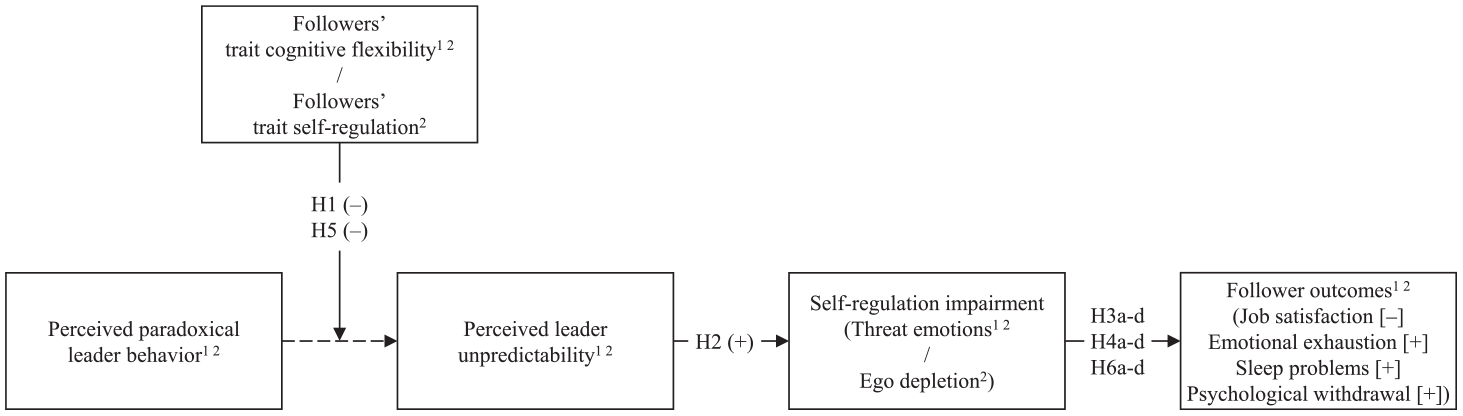
Theoretical model.
Our study makes several important contributions to the literature. First, we fuse the paradox perspective of leadership with self-regulation theory (Baumeister, 1998; Tepper and Simon, 2015; Thau and Mitchell, 2010) to better understand how followers perceive and react to PLB. Our work thereby builds a more nuanced theory around this leadership construct. Doing so is important to develop a holistic understanding of the consequences of PLB and provides researchers and practitioners with a guiding framework that is designed to explain both its benefits and detriments.
Second, although previous studies have shown that follower traits influence their reaction to PLB (e.g. Shao et al., 2019; She et al., 2020), most have focused on temporally and causally distal outcomes, leaving us with little knowledge of the processes that ensue as a consequence of (not) possessing these traits when working in PLB environments. Our research opens this ‘black box’, explaining the non-uniform mechanism through which followers can have positive or negative experiences working with a paradoxical leader. This serves as a springboard for future research to investigate other boundary conditions that help explain the outcomes of PLB for different followers.
Third, our study integrates insights from prior research to explore how followers’ cognitive individual differences affect whether PLB has bright-side versus dark-side effects on followers. Hence, by highlighting that our proposed process is conditional, such that not all followers respond equally positively, and even negatively, to PLB, we help to advance paradoxical leadership theory and inform managers and organizations about the conditions under which its use may be functional or even harmful. We also provide guidance to organizations on how to prepare employees to work effectively in PLB environments.
Finally, our work provides a comprehensive investigation of the hitherto largely overlooked well-being consequences of PLB. This is a crucial point because perceived leader behaviors may not have uniform effects across all outcomes (Martin et al., 2013). Thus, ignoring employee well-being as an indicator of leadership effectiveness may result in misguided leadership theory and practice that neglects the importance of the human side of modern workplaces (Inceoglu et al., 2018). In line with Inceoglu et al.’s (2018) conceptualization of employee well-being, we capture outcomes that are indicative of hedonic (job satisfaction), negative (emotional exhaustion), physical (sleep quality), and eudaimonic well-being (psychological withdrawal), to provide a comprehensive test of the well-being-related consequences of PLB.
Theoretical background and hypotheses
Perceived paradoxical leader behavior in the context of the self-regulation theory
Self-regulation theory speaks to the psychological activities individuals engage in to govern their cognitions, emotions, and behaviors (Baumeister, 1998). Individuals especially engage in self-regulatory efforts when confronted with ambiguous or uncomfortable situations (Tepper and Simon, 2015; Thau and Mitchell, 2010). The theory posits that such situations can elicit individuals’ sensemaking processes in which individuals try to interpret and make sense of the causes and consequences of the situation and their confusion or discomfort (Thau and Mitchell, 2010). Such situations and the self-regulation activities that ensue can be cognitively and emotionally taxing for individuals, particularly after one’s energies are used in attempts to decipher the situational ambiguity or uneasiness and its impact on the self or others (Tepper and Simon, 2015). This can result in self-regulation impairment in which individuals subsequently are unable to effectively think, feel, and/or act (Baumeister, 1998; Thau and Mitchell, 2010; Wagner and Heatherton, 2014). Recently, there has been increasing scholarly understanding that certain leader behavior, such as PLB, that ‘is noticed to be novel, ambiguous, and/or confusing compared with followers’ behavioral expectations for the leader’ (Schilling et al., 2023: 213) may create such uncomfortable situations that increase sensemaking and self-regulatory requirements for followers.
Paradoxical leaders are theorized to synthesize seemingly opposing perspectives, employing a ‘both–and’ rather than an ‘either–or’ approach to leadership (Zhang et al., 2015). This, according to paradox scholars, promotes learning and creativity as well as flexibility and resilience (Smith and Lewis, 2011). For instance, prior research drew from socio-cognitive theories and demonstrated that paradoxical leaders provide role models for dealing with conflicting demands, thereby increasing followers’ creative self-efficacy and perspective-taking abilities (Li et al., 2018; Shao et al., 2019).
Although PLB entails the opportunity to manage tensions in the workplace by attending to competing demands, it also involves constantly and iteratively shifting between the different poles of a paradox (Smith and Lewis, 2011). Paradoxical leaders may be perceived as dynamically iterating between the two poles of a paradox not only in the long run but also within shorter time frames, a phenomenon Smith and Lewis (2011: 392) labeled as a ‘dynamic equilibrium’, which is characterized by ‘consistent inconsistency’. For example, paradoxical leaders might be perceived to shift from granting higher degrees of autonomy to maintaining stricter control over followers’ behaviors and decisions, back to providing leeway – all within the same day, if specific situations call for this course of action (Zhang et al., 2015). Similarly, paradoxical leaders may generally be perceived as amiable toward their followers, but they may also be perceived as signaling to them that they wish to maintain a professional distance (Zhang et al., 2015), which might give out mixed messages and make it harder for followers to anticipate social interactions with their paradoxical leader.
The moderating role of followers’ cognitive flexibility
Self-regulation theory emphasizes the important role of person–environment fit and the processes of sensemaking in explaining variations in how different individuals experience the same situation (Baumeister, 1998). It posits that situations are experienced as unpleasant, thereby requiring self-regulation, when there is a dissonance between expectations and perceived reality (Soane et al., 2018). Furthermore, it posits that individuals differ in their ability to anticipate, detect, analyze, and comprehend environmental cues, which are integral to the sensemaking and subsequent self-regulation process (Gross, 1998; Walwanis and Ponto, 2019).
Drawing from these notions of self-regulation theory (Thau and Mitchell, 2010), we argue that whether self-regulation impairment occurs is dependent on the extent to which followers perceive paradoxical leaders not merely as behaviorally inconsistent but rather as behaviorally unpredictable (Koolhaas et al., 2011). Specifically, behavioral inconsistency refers to followers’ general perceptions of changes in their leaders’ behavior from one situation to another (De Cremer, 2003). To a certain extent, leaders may be expected by followers to behave inconsistently (i.e. dynamically) and vary and adapt their behavior based on situational demands (Schilling et al., 2023). However, leaders are perceived as behaviorally unpredictable when followers fail to gain a clear apprehension of the reasons why their leader engages in seemingly conflicting behaviors (Greer et al., 2013). This, however, implies that leader unpredictability is a perceptual attribution that is dependent not only on followers’ perceptions of leader behavior but also on followers’ abilities to logically link perceived behavioral variations to dynamic situational requirements.
Following these lines of reasoning, we propose that cognitive flexibility is particularly relevant when considering how followers can effectively make sense of and navigate PLB environments. Cognitive flexibility is an emergent and central property of an individual’s executive function that reflects the capacity to interpret and regulate one’s cognitive, emotional, and behavioral responses to novel and changing environmental circumstances (Cañas et al., 2006). Across a diverse range of contexts, prior research has demonstrated the importance of cognitive flexibility as a catalyst for self-regulation (e.g. Amédée et al., 2022; Brevers et al., 2020; Schmitt et al., 2019; Todd and Mullan, 2013). Although research has shown that cognitive flexibility can vary within persons (Walwanis and Ponto, 2019), empirical evidence largely supports its trait-like nature (Tchanturia et al., 2011), expected to change only over extended periods of time. Thus, in this research, we consider cognitive flexibility as an individual trait. Unlike preferential or motivational constructs, such as the need for cognitive closure (She et al., 2020), it reflects one’s trait-based cognitive capacity to identify the underlying reasons for and make sense of changing behavioral cues and to utilize a complex behavioral repertoire (Martin et al., 2011).
Accordingly, we argue that cognitive flexibility capacitates followers to effectively make sense of their paradoxical leader’s potentially ambiguous and confusing communication and behavior, which enables effective self-regulation. This transpires because cognitively flexible followers can detect specific causes and triggers for why their leader needs to engage in seemingly opposing action strategies (Martin and Rubin, 1995) and thus anticipate and can predict the constant and dynamic shifts in their paradoxical leader’s behavior. In fact, Schilling et al. (2023) argue that followers vary in their range of anticipated and accepted variability of leader behavior. Proceeding from this notion, we conjecture that followers with higher trait cognitive flexibility are more cognizant of and sympathetic toward the need to be flexible and, therefore, expect and accept greater variability in their leader’s behavior. As cognitive flexibility enables followers to consider multiple perspectives at once and to adapt to changing environmental circumstances (Martin and Rubin, 1995), they assume the same flexibility from their leader. In other words, PLB corresponds more to the behavior that highly cognitively flexible followers anticipate from their leader than less dynamic leader behaviors. Highly cognitively flexible followers can discount the seeming inconsistency that is entailed in PLB by linking it to changing situational requirements and the need to adapt, rather than interpreting it as a source of confusion (Schilling et al., 2023). Thus, highly cognitively flexible followers, owing to their capacity to more easily switch or change their thinking and their corresponding expectations regarding their leader’s flexibility, fit the relatively complex and dynamic PLB environment. Therefore, these followers are likely to perceive paradoxical leaders as more predictable than non-paradoxical leaders, given the fit between the follower and leadership environment.
In contrast, cognitively rigid individuals possess limited cognitive control and flexibility and, thus, are less cognizant of behavioral alternatives and conflicting requirements that they and/or their leader face in a given situation (Martin and Anderson, 1998). These individuals have a narrower range of accepted variability in leader behavior; that is, they anticipate their leaders to behave in a uniform and consistent manner as they cannot identify reasons to be flexible. Consequently, PLB does not correspond to these followers’ behavioral anticipations of their leader, thereby creating demanding, uncomfortable, and/or ambiguous situations for these followers (Schilling et al., 2023). These experiences, in turn, trigger sensemaking and self-regulation processes (Schilling et al., 2023). Yet, these followers lack the necessary ability to cognitively connect their paradoxical leaders’ seemingly conflicting and dynamic behaviors to competing demands or changing requirements in the work environment. Rather, their inability to identify cues for flexibility and to change their thinking renders them less able to navigate complex and dynamic environments. In other words, these followers do not fit well in environments characterized by PLB as their cognitive characteristics do not match the external circumstances, resulting in a dissonance between their expectations and the perceived reality of their leaders’ behavior. This places low cognitive flexibility followers in a strenuous and cognitively taxing situation as they are unable to effectively appraise and make sense of their PLB context or adequately self-regulate accordingly. Therefore, these followers perceive their leader’s PLB as more unpredictable compared with one-sided and less dynamic leader behaviors.
In sum, we argue that trait cognitive flexibility capacitates followers to make sense of perceived PLB. Those with higher trait cognitive flexibility expect and appreciate the perceived dynamic behavior and communication involved in PLB and have the cognitive capacity, if necessary, to reconcile any leadership behaviors that could appear inconsistent or competing to them, thereby decreasing their perceptions of perceived leader unpredictability. However, when followers’ trait cognitive flexibility is lower, PLB does not match their behavioral expectations of their leader. This mismatch inhibits followers’ ability to make sense of their paradoxical leader’s perceived behavior, thereby increasing perceptions of leader unpredictability. Thus, we posit:
Hypothesis 1. Followers’ trait cognitive flexibility moderates the relation between perceived paradoxical leader behavior and perceived leader unpredictability: this relation is negative when followers’ trait cognitive flexibility is higher, but positive when it is lower.
The relations between perceived leader unpredictability, self-regulation impairment, and follower well-being
Drawing from a self-regulation theoretical lens, we suggest that in their efforts to self-regulate, followers try to process, decipher, and understand their leaders’ behaviors (e.g. Thau and Mitchell, 2010). Assuming functional interpretation, the followers’ sensemaking provides them with a subjective explanation for when and why relevant changes in their work environment will occur (Schilling et al., 2023). Perceived unpredictability, on the other hand, is considered a key feature in stressful situations, eliciting the release of stress hormones (Trapp et al., 2018) while simultaneously impairing self-regulatory processes (Lake and LaBar, 2011). Building upon prior theoretical work (Tepper and Simon, 2015; Wagner and Heatherton, 2014; Wheeler et al., 2013), we conjecture that misfit with the PLB environment and their subsequent inability to make sense of PLB results in self-regulation impairment (Thau and Mitchell, 2010).
The perceived unpredictability of their leader’s behavior violates followers’ normative expectations, thereby instilling ambiguity in followers about the nature of their working relationship with their leader, as well as inhibiting their ability to anticipate social interactions with their leader (Greer et al., 2013; Schilling et al., 2023). Being unable to predict how their leader will behave in a given situation decreases followers’ sense of control and mastery and increases the perceived psychological demands of their work (Schoellbauer et al., 2022). This puts them in a vulnerable state, impairing their ability to maintain positive thought patterns at work (Wagner and Heatherton, 2014). Instead, these followers are hesitant and anxious about their interactions with their leader, which results in impaired self-regulation: this notion that unpredictability inhibits effective self-regulation is well documented in the experimental psychology literature. For example, Davies and Craske (2015) found that the unpredictability of aversive stimuli increased individuals’ startle responses, that is, largely unregulated defensive behaviors, such as involuntary blinking. Similarly, Herry et al. (2007) found that even the unpredictability of neutral stimuli induces unregulated anxiety-like behavior and sustained activation of the amygdala, a brain area typically associated with feelings such as fear or anxiety, indicating impaired emotional self-regulation (Lake and LaBar, 2011). Thus, we posit:
Hypothesis 2. Perceived leader unpredictability is positively associated with self-regulation impairment.
Finally, self-regulation theory contends that self-regulation impairment results in uncontrolled and likely adverse psychological and behavioral outcomes (Baumeister, 1998), such as lower levels of followers’ well-being. To provide a comprehensive test of this idea, we focus on different dimensions of well-being as suggested by Inceoglu et al. (2018). First, individuals whose self-regulation is impaired, are likely to experience lower levels of hedonic well-being at work. We capture this through employees’ job satisfaction. Individuals whose self-regulation is impaired focus more on and recall negative events and experiences at work, making them less likely to maintain positive cognitions about their job (Madrid et al., 2020). Empirical evidence also lends support to the assertion that the inability to regulate oneself is negatively associated with hedonic well-being (Hofmann et al., 2014).
Aside from hedonic well-being, self-regulation theory predicts that impaired self-regulation is emotionally strenuous for employees, leading to negative well-being. This is because the inability to regulate one’s thoughts and emotions preoccupies individuals with emotion-focused coping, which depletes their cognitive and emotional resources (Palmwood and McBride, 2019). In line with prior self-regulation research, we capture this effect induced by the self-regulation process through feelings of emotional exhaustion (Wheeler et al., 2013), which describes ‘physical fatigue and a sense of feeling psychologically and emotionally “drained”’ (Wright and Cropanzano, 1998: 486).
Self-regulation impairment may also manifest in physical symptoms such as sleep problems, which are characterized by difficulties in falling asleep, premature awakening, or restless sleep (Kecklund and Åkerstedt, 1992). Specifically, individuals who experience self-regulation impairment may experience and be unable to control recurring intrusive thoughts (rumination) about the past as well as possible future interactions with their leader (Kuhl and Baumann, 2009). This increases cognitive arousal and activity that interfere with sleep onset as well as quality (Watts et al., 1994). Hence, sleep quality is diminished by self-regulation impairment owing to followers’ unpredictable leader perceptions.
Lastly, self-regulation impairment may negatively affect employees’ eudaimonic well-being, which describes feelings of being able to apply one’s self to work (Inceoglu et al., 2018). Lower eudaimonic well-being is often indicated by feelings of cynicism and disengagement from work (Taris et al., 2001). In this regard, self-regulation theory posits that individuals seek to reduce the misfit between themselves and their environment (Johnson et al., 2013). When employees are able to self-regulate, they can employ cognitive coping strategies, such as reappraising the situation in order to flourish in a PLB environment (Gross, 1998; Smith and Lewis, 2011). However, when employees’ self-regulation is impaired, this limits their ability to control their response and to cope actively and constructively (Dekker and Schaufeli, 1995). Instead, they may react in more unregulated, impulsive, and dysfunctional ways – such as through psychological withdrawal – to protect themselves from this dissonance and depletion. This unregulated and maladaptive response to stressors describes a form of cognitive and emotional disengagement (negative eudaimonic well-being) while remaining physically present, for example via cognitions about leaving their organization or being absent or psychologically detaching themselves from their organization (Lehman and Simpson, 1992). In sum, we leverage self-regulation theory to predict that experiencing self-regulation impairment affects important well-being outcomes. This leads to our next set of hypotheses:
Hypothesis 3. Self-regulation impairment is (a) negatively associated with job satisfaction and positively associated with (b) emotional exhaustion, (c) sleep problems, and (d) psychological withdrawal.
We amalgamate the components of our model to suggest that followers’ perceptions of their leader and their subsequent self-regulation (impairment) serve as mediating links in the relation between PLB and well-being outcomes. Working with a paradoxical leader challenges followers to process, interpret, and understand the causes and consequences of seemingly competing leader behavior to self-regulate (Thau and Mitchell, 2010). In turn, this process affects followers’ well-being. These self-regulatory activities, however, require specific cognitive resources from followers. Thus, combining this mediation argument with our theorizing of Hypothesis 1, we predict that this mediational process operates in different directions under varying levels of followers’ trait cognitive flexibility (moderated mediation). Specifically, having greater cognitive flexibility allows them to identify reasons to be flexible and consider multiple aspects at once (Martin and Anderson, 1998; Martin and Rubin, 1995), which aids in making sense of their paradoxical leader’s perceived behavior, thereby appraising the latter as more predictable. Consequently, PLB matches these followers’ behavioral expectations of their leader. In other words, they fit the environment and are able to regulate their cognitive, emotional, and behavioral responses. This results in a positive indirect effect of PLB on job satisfaction and a negative indirect effect on emotional exhaustion, sleep problems, and psychological withdrawal. Conversely, we hypothesize that followers with limited trait cognitive flexibility do not fit well in a PLB environment; for these individuals, PLB is experienced as unpredictable, resulting in self-regulation impairment and a reversed mediation pattern. In sum, we posit:
Hypothesis 4. Followers’ trait cognitive flexibility moderates the serial indirect effect of perceived paradoxical leader behavior on followers’ (a) job satisfaction, (b) emotional exhaustion, (c) sleep problems, and (d) psychological withdrawal via perceived leader unpredictability and self-regulation impairment: when followers’ trait cognitive flexibility is higher, perceived paradoxical leader behavior has (a) a positive indirect effect on job satisfaction and a negative indirect effect on (b) emotional exhaustion, (c) sleep problems, and (d) psychological withdrawal. When followers’ trait cognitive flexibility is lower, the direction of these indirect effects is reversed.
Study 1: An initial test of the cognitive flexibility-contingent self-regulation mechanism
Sample and data collection
Initially, we contacted 1385 employees from a diverse range of industries via a UK panel provider (pureprofile) to participate in a multi-phase online survey. To reflect the proximal nature of our model, we employed a ‘shortitudinal’ three-wave design (Dormann and Griffin, 2015), separating each measurement wave by one week. In the first wave, participants reported their demographic information as well as perceptions of their leader’s PLB. In the second wave, we captured their cognitive flexibility, perceived leader unpredictability, self-regulation impairment, as well as their positive affect toward their respective leader as an additional control variable. In wave 3, we captured the outcome variables. We gathered informed consent from all participants, assured them about the voluntary and confidential nature of the data collection (Podsakoff et al., 2003), and remunerated them £1 for each survey completed. Upon invitation, 20 individuals decided not to participate. To ensure appropriate data quality, we further screened out 412 participants before the start of the survey who indicated not to be employed and/or working with a direct supervisor and 52 participants owing to having tenure with that respective supervisor of fewer than three months. This resulted in a sample of 901 participants. Of those, 225 failed an attention check (i.e. an instructive response item; IRI) embedded in the first survey and were immediately removed and not reinvited, two were excluded owing to duplicate participant IDs, and 62 dropped out, leaving us with 612 (68%) valid responses. A total of 173 individuals did not participate in the wave-2 survey and another 83 did not participate in the wave-3 survey, resulting in a sample of 356 (response rate 40%). Finally, we removed data provided by 34 participants, because they did not respond correctly to the two IRIs in the final survey. This resulted in a final sample of 322 employees (41.0% female, Mage = 50.27, SDage = 9.88, Mtenure = 5.04, SDtenure = 4.64). 1
Measures
If not indicated otherwise, we used a seven-point Likert scale format (1 = strongly disagree to 7 = strongly agree) to measure employees’ perceptions of each item.
Perceived paradoxical leader behavior
We captured PLB using a global five-item instrument (PLB-5; Fürstenberg et al., 2021) based on the original 22 items by Zhang et al. (2015). A sample item was, ‘Shows a desire to lead, but allows others to share the leadership role’ (α = 0.89).
Followers’ trait cognitive flexibility
We administered the Cognitive Flexibility Scale developed by Martin and Rubin (1995). Sample items were, ‘My behavior is a result of conscious decisions that I make’ and ‘In any given situation, I am able to act appropriately’ (α = 0.89).
Perceived leader unpredictability
We used three items adapted from Greer et al. (2013) to measure perceived leader unpredictability. A sample item was, ‘It is unpredictable what my supervisor will do in a given situation’ (α = 0.94).
Self-regulation impairment
We measured followers’ self-regulation impairment via the experience of threat emotions. Such negative emotions often occur as part of an automatic reaction to adverse stimuli (Wagner and Heatherton, 2014). Thus, they can ‘signify a depleted state of individuals’ self-regulatory resources’, through which individuals find themselves unable to prevent those undesirable feelings from manifesting (Liu et al., 2017: 1245). Indeed, prior research has repeatedly conceptualized such negative emotions as an indicator of self-regulation failure or impairment in different contexts, such as experiencing injustice or customer mistreatment (e.g. Liu et al., 2017). We used three items developed by Folkman and Lazarus (1985) and asked participants to indicate to what extent they felt ‘worried’, ‘fearful’, and ‘anxious’. The response scale ranged from 1 = not at all to 5 = extremely (α = 0.90).
Follower outcomes
We used three items from Cammann et al. (1983) to measure job satisfaction. A sample item was, ‘All in all, I am satisfied with my job’ (α = 0.92). We administered three items by Iverson et al. (1998) to capture emotional exhaustion. A sample item was, ‘I feel emotionally drained from my work’ (α = 0.94). To capture sleep problems, we used four items developed by Kecklund and Åkerstedt (1992). A sample item was, ‘Disturbed/restless sleep’ (α = 0.92). The response scale was 1 = never to 5 = always (five times or more per week). Finally, we administered the eight-item scale developed by Lehman and Simpson (1992) to measure psychological withdrawal. A sample item was, ‘Thoughts of leaving current job’ (α = 0.83). The response scale was 1 = never to 7 = very often.
Control variables
We controlled for employees’ age and tenure with their respective supervisors because those with more life experience or experience working with their supervisor may be more habituated with – and therefore interpret and react differently to – PLB (Shore et al., 2003). We also controlled for employee gender (dummy coded as 0 = male, 1 = female), as research has found that women are more likely than men to experience (or report) stress symptoms such as psychological distress (Matud, 2004). Lastly, we controlled for employees’ positive affect toward their leader, because research has shown that many leadership constructs share substantial variance, which is a function of followers’ affect toward their leader (Martinko et al., 2018). Hence, controlling for positive affect toward the leader helps isolate the variance explained in relevant outcomes by PLB and provides a more conservative test of the effects of PLB (Martinko et al., 2018). We administered Martinko et al.’s (2018) five-item positive leader affect questionnaire (PLAQ). A sample item was, ‘I like my supervisor’ (α = 0.98). Results were similar with and without the inclusion of the control variables (Becker, 2005).
Preliminary analysis
Evidence from confirmatory factor analyses (CFAs) conducted in Mplus 8.9 (Muthén and Muthén, 2017) with maximum likelihood estimators and full information maximum likelihood (FIML) procedures for handling incomplete data supported the differentiability of our latent constructs. The expected nine-factor model yielded an acceptable fit to the data (χ2[953] = 1943.22; CFI = 0.92, RMSEA = 0.06, SRMR = 0.08). χ2 difference tests showed that models combining two or more latent constructs yielded a significantly worse fit. An additional measured cause test similarly indicated no substantial issue of common method variance in our data (for details, see online Appendix A).
Hypothesis testing
The upper half of Table 1 presents the means, standard deviations, alpha coefficients, zero-order, and partial correlations between the study variables. It is noteworthy that PLB was negatively associated with unpredictability (r = −0.46, p < 0.001) but also positively associated with PLAQ (r = 0.64, p < 0.001). Controlling for age, gender, tenure, and PLAQ attenuated the correlation between PLB and other variables, such as perceived leader unpredictability (r = −0.05, p = 0.340). This is in line with prior research and indicates that partial correlations should be analyzed (Martinko et al., 2018).
Means, standard deviations, alpha reliabilities, and correlations of Studies 1 and 2.
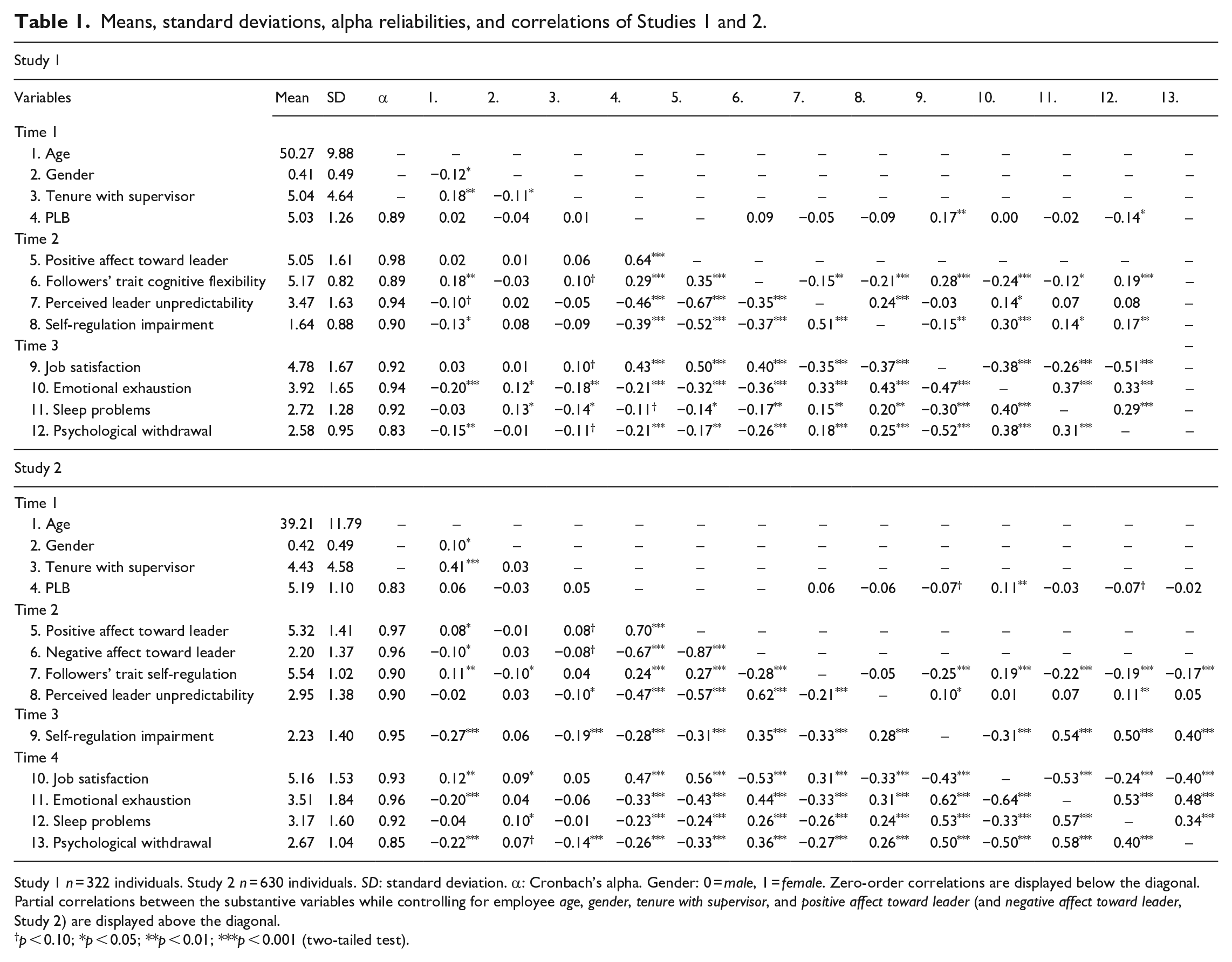
Study 1 n = 322 individuals. Study 2 n = 630 individuals. SD: standard deviation. α: Cronbach’s alpha. Gender: 0 = male, 1 = female. Zero-order correlations are displayed below the diagonal. Partial correlations between the substantive variables while controlling for employee age, gender, tenure with supervisor, and positive affect toward leader (and negative affect toward leader, Study 2) are displayed above the diagonal.
p < 0.10; *p < 0.05; **p < 0.01; ***p < 0.001 (two-tailed test).
We used latent moderated structural equation modeling (LMS; Klein and Moosbrugger, 2000) with maximum likelihood estimators and FIML procedures to test our model. As traditional fit indices are not available in LMS, we applied the approach outlined by Klein and Moosbrugger (2000), following which we obtained χ², CFI, RMSEA, and SRMR values from a model without the latent interaction term (baseline model). We included all direct paths in the mediational chain to avoid spurious estimates (Preacher and Hayes, 2008). In a second step, we added the latent interaction term (interaction model) and used the differences in –2 log-likelihood and Akaike Information Criterion (AIC) values to assess the relative improvement in model fit in comparison to the baseline model (Klein and Moosbrugger, 2000; Sardeshmukh and Vandenberg, 2017). We utilized bias-corrected bootstrap confidence intervals with 50,000 re-samples to assess the (conditional) indirect effects.
The baseline model showed an acceptable fit to the data (χ2[1078] = 2123.08; CFI = 0.91, RMSEA = 0.06, SRMR = 0.09). Log-likelihood (Δ–2 log-likelihood = 20.38, Δdf = 1, p < 0.001; Klein and Moosbrugger, 2000) and AIC comparisons (ΔAIC = 18.38; Sardeshmukh and Vandenberg, 2017) indicated that including the PLB × followers’ trait cognitive flexibility interaction significantly improved the model fit. The final LMS estimates can be found in the upper half of Table 2. In support of Hypothesis 1, the interaction between PLB and trait cognitive flexibility was negatively associated with perceived leader unpredictability (ω = −0.25, p < 0.001, ΔR2 = 0.03). Simple slope tests using ±1 and 2 standard deviations from the mean as values of the moderator, revealed that the relation between PLB and perceived leader unpredictability was positive when followers’ trait cognitive flexibility was lower (γ–2 SD = 0.34, p = 0.006; γ–1 SD = 0.11, p = 0.212) and negative when it was higher (γ+2 SD = −0.57, p < 0.001; γ+1 SD = −0.34, p < 0.001). Figure 2(a) illustrates these results. Results of the Johnson-Neyman technique suggested that the relation between PLB and perceived leader unpredictability was positive and significant (p < 0.050, two-tailed) below the value of 4.03 but negative above the value of 5.28 of follower’s trait cognitive flexibility (see Figure 2(b)).
Results of the latent moderated structural equation modeling of Studies 1 and 2.
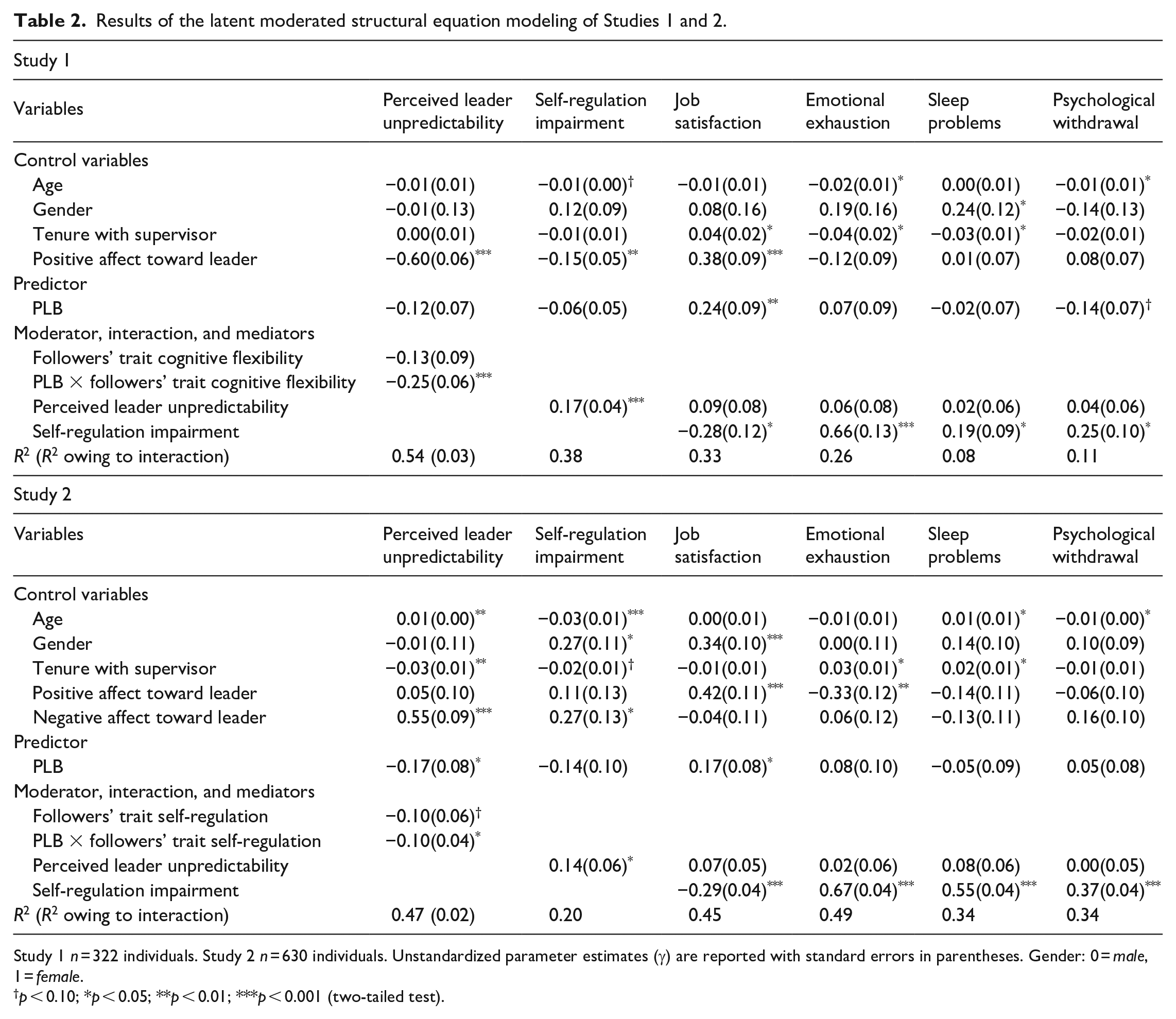
Study 1 n = 322 individuals. Study 2 n = 630 individuals. Unstandardized parameter estimates (γ) are reported with standard errors in parentheses. Gender: 0 = male, 1 = female.
p < 0.10; *p < 0.05; **p < 0.01; ***p < 0.001 (two-tailed test).
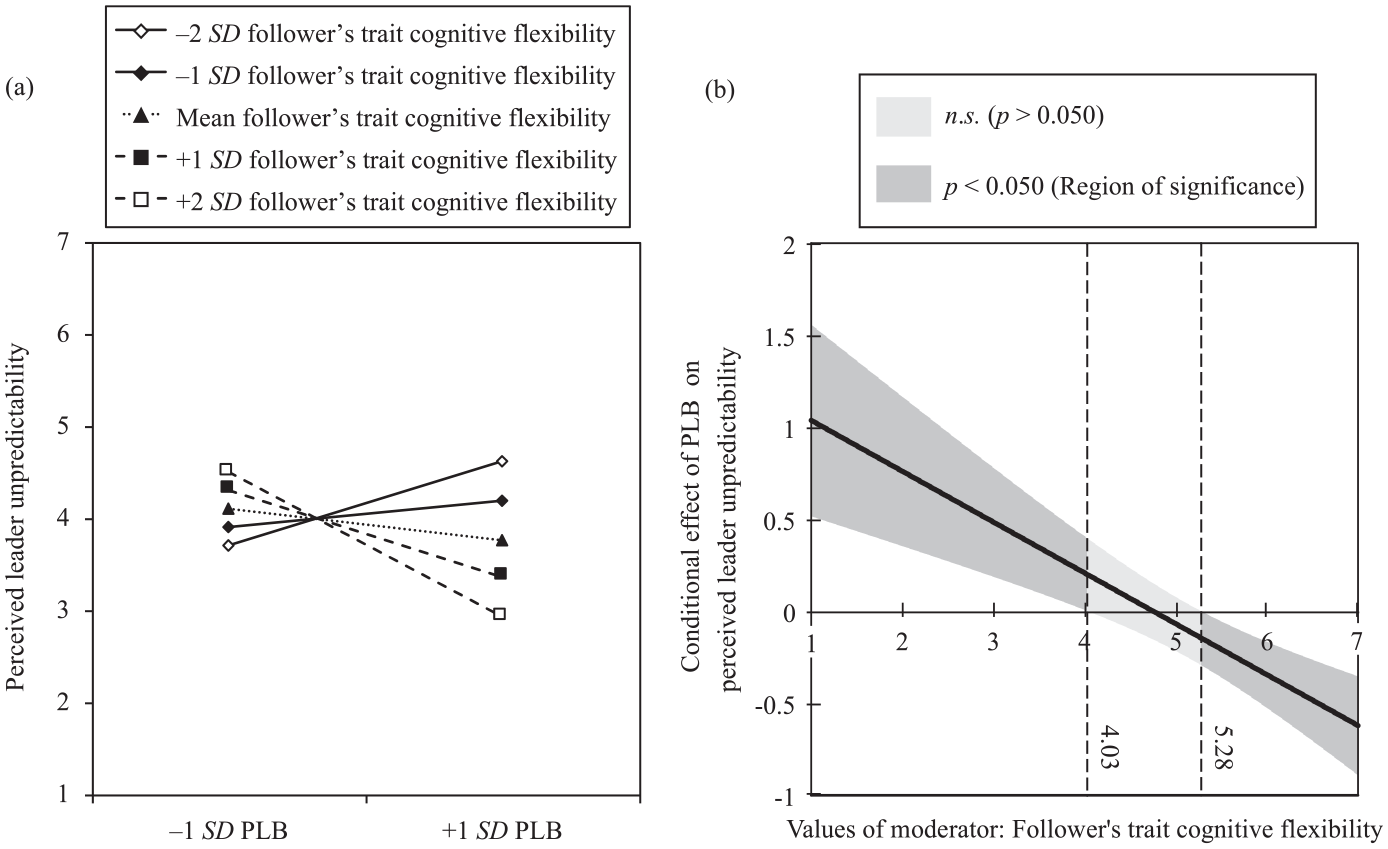
Study 1: (a) simple slopes and (b) Johnson-Neyman plot of the interactive effect between perceived paradoxical leader behavior and followers’ trait cognitive flexibility on perceived leader unpredictability.
In support of Hypothesis 2, perceived leader unpredictability was positively associated with self-regulation impairment, assessed via threat emotions (γ = 0.17, p < 0.001). 2 Supporting Hypotheses 3(a) to (d), followers’ self-regulation impairment was negatively associated with job satisfaction (γ = −0.28, p = 0.024) and positively associated with emotional exhaustion (γ = 0.66, p < 0.001), sleep problems (γ = 0.19, p = 0.031), and psychological withdrawal (γ = 0.25, p = 0.012). All indices of moderated mediation (Hayes, 2015) were statistically significant (ωjob satisfaction = 0.01, 95% CI [0.00, 0.03]; ωemotional exhaustion = −0.03, 95% CI [−0.06, −0.01]; ωsleep problems = −0.01, 95% CI [−0.02, −0.00]; ωpsychological withdrawal = −0.01, 95% CI [−0.03, −0.00]). Johnson-Neyman results (see Figures 3(a)–(d)), further showed that PLB exhibited a significant negative indirect effect on job satisfaction and a positive indirect effect on emotional exhaustion, sleep problems, and psychological withdrawal when followers’ trait cognitive flexibility was below 4.11, 4.03, 3.99, and 4.01. The directions of these indirect effects were reversed when followers’ trait cognitive flexibility was above 5.40, 5.41, 5.37, and 5.37, respectively. These findings supported Hypotheses 4(a) to (d).
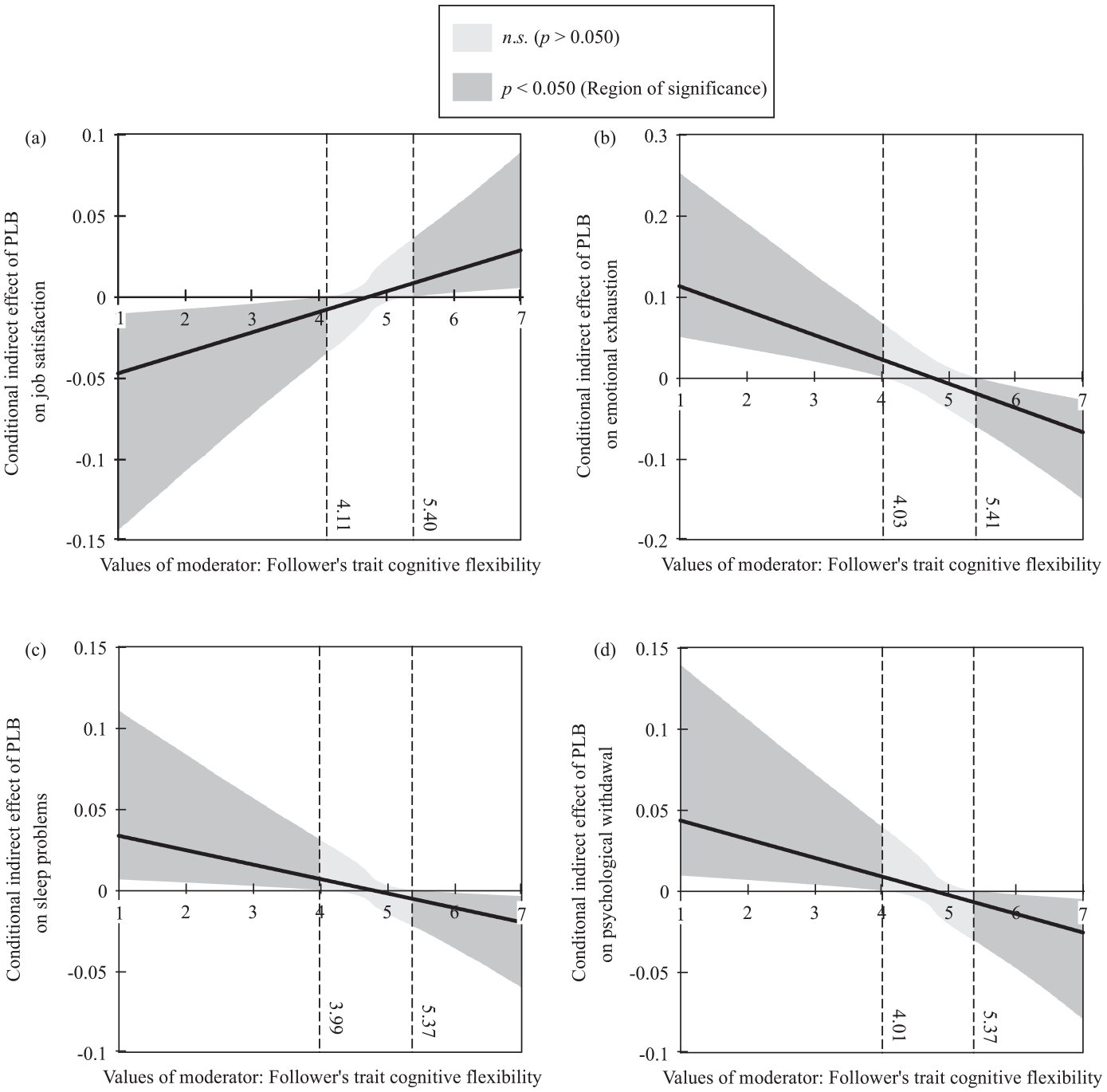
Study 1: followers’ trait cognitive flexibility as a moderator of the indirect effect of perceived paradoxical leader behavior on followers’ (a) job satisfaction, (b) emotional exhaustion, (c) sleep problems, and (d) psychological withdrawal.
Discussion
The results of Study 1 demonstrate that followers’ trait cognitive flexibility moderates the relation between PLB and perceived leader unpredictability, along with its subsequent indirect effects on self-regulation impairment and, ultimately, relevant follower well-being outcomes. Specifically, our findings indicate that PLB is not beneficial for all followers. In fact, it can even entail negative consequences when followers lack the cognitive flexibility required to vary their processing depending on the situational requirements and decipher their leader’s seemingly conflicting behaviors. However, followers endowed with sufficient cognitive flexibility can make sense of the dynamics in their paradoxical leader’s perceived behavior, which enables its positive effects.
Despite these intriguing findings, Study 1 has several limitations. Its generalizability may be limited owing to the specific sample, which consisted only of UK-based individuals. Moreover, collecting both mediators at one point in time limits our ability to assure the temporal order of our variables. These limitations highlight the need for constructive replication. Lastly, although we argue that followers’ cognitive flexibility is an underlying trait influencing their ability to self-regulate in a PLB environment, we did not directly assess followers’ capacity to self-regulate. To remedy these shortcomings, we conducted an additional study, referred to hereafter as Study 2.
Study 2: Constructive replication and extension using trait self-regulation as a moderator
Our current theorizing proposes that cognitive flexibility, as part of the executive function, enables followers to cognitively decipher PLB, laying the groundwork for successful self-regulation (e.g. Booth et al., 2018; Gross, 1998; Ochsner and Gross, 2005). Although cognitive flexibility and self-regulation are not identical – since cognitive flexibility can be employed for other activities – it helps facilitate self-regulation at the cognitive level (Nigg, 2017). This suggests that trait cognitive flexibility may underpin the exhibition of trait self-regulation, defined as followers’ trait-based ability to manage their emotions, thoughts, and/or behaviors in complex, ambiguous, or demanding environments (Baumeister, 1998). Indeed, several studies have conceptually and empirically linked cognitive flexibility to one’s ability to self-regulate (Gabrys et al., 2018; Walwanis and Ponto, 2019). In Study 2, we engage in data triangulation to extend and show the robustness of our theorizing. While in Study 1, we focused on followers’ trait cognitive flexibility, in Study 2, we directly explore followers’ trait self-regulation as the moderator of the PLB–perceived leader unpredictability relation, to enhance our understanding of their non-uniform responses to PLB.
Specifically, research on self-regulation suggests that trait self-regulation is associated with better cognitive processing (Ochsner and Gross, 2005). This association enables followers to deploy targeted attention to understanding the causes and triggers behind their leader’s enactment of seemingly opposing action strategies (Gross, 1998). Additionally, followers possessing higher trait self-regulation have access to a larger pool of cognitive coping strategies (Ochsner and Gross, 2005). These strategies support them in effectively dealing with the ambiguity and uncertainty encompassed by PLB. Instead of becoming overwhelmed by negative thoughts or emotions regarding their leader’s seemingly contradictory behaviors, these followers are capable of exercising emotion control and directing (and maintaining) their attention toward identifying the functionality of these behaviors (Ochsner and Gross, 2005). As a consequence of these activities, these followers perceive their leader’s behaviors as more intentional and predictable, despite the conflicting nature of the behaviors.
In contrast, followers with lower trait self-regulation possess limited cognitive processing abilities, rendering them less able to focus their attention to identify cues for flexibility and to manage their cognitive and emotional responses to PLB (e.g. Gross, 1998). Consequently, these followers are less likely to comprehend the underlying reasons for, and appreciate the variability in, their leaders’ behavior. Instead, owing to their lack of cognitive and emotional control, they are likely to develop negative perceptions of their supervisor’s behavior being confusing and unpredictable. In sum, and building on Study 1, we hypothesize that followers’ trait self-regulation, as an ability contingent on one’s underlying cognitive characteristics, capacitates followers to constructively process PLB. Thus, we posit:
Hypothesis 5. Followers’ trait self-regulation moderates the relation between perceived paradoxical leader behavior and perceived leader unpredictability: this relation is negative when followers’ trait self-regulation is higher, but positive when it is lower.
Hypothesis 6. Followers’ trait self-regulation moderates the serial indirect effect of perceived paradoxical leader behavior on followers’ (a) job satisfaction, (b) emotional exhaustion, (c) sleep problems, and (d) psychological withdrawal via perceived leader unpredictability and self-regulation impairment: when followers’ trait self-regulation is higher, perceived paradoxical leader behavior has (a) a positive indirect effect on job satisfaction and a negative indirect effect on (b) emotional exhaustion, (c) sleep problems, and (d) psychological withdrawal. When followers’ trait self-regulation is lower, the direction of these indirect effects is reversed.
Sample and data collection
Study 2 further builds on Study 1 through several methodological aspects and triangulation of our key constructs. We recruited US-based individuals (versus UK-based individuals in Study 1) via prolific.co in exchange for around US$9.50/hour to participate in a four-wave online survey. As in Study 1, each measurement wave was separated by one week. In wave 1, we captured followers’ demographics and perceptions of their leader’s PLB. In wave 2, we captured followers’ trait self-regulation, perceived leader unpredictability as well as their positive and negative affect toward their leader as control variables. We further temporally separated our two mediating variables and collected self-regulation impairment in wave 3 to corroborate the temporal ordering of our model. In wave 4, we captured follower outcomes. We employed similar screening criteria compared with our first study: eligible participants had to (1) be fluent in English, (2) be employed, (3) work with a direct supervisor, and (4) have a minimum tenure with their supervisor of at least three months. In each wave, participants had to pass two instructive response items (IRI; e.g. ‘To show that you have read this sentence, please answer “Disagree”’).
In wave 1, we recruited 876 individuals. Four individuals decided not to participate in our study, and 20 later withdrew their consent. Of the remaining 852 individuals, we screened out 26 because they did not fulfill the screening criteria and eight because they failed at least one attention check. Finally, we removed eight participants with duplicate IP addresses, resulting in a final sample of 810 wave-1 participants. For wave 2, we again prescreened participants based on the aforementioned criteria, leaving 780 eligible participants. Of those, 761 (94.0% of wave-1 participants) responded to the second survey. We screened out 17 participants because they indicated to have changed their employer and/or supervisor since the beginning of the study and 12 because they failed at least one attention check, leaving 732 valid responses in wave 2. Again, we pre-screened participants using prolific.co’s database and reinvited 700 participants, 100% of which agreed to participate in the wave-3 survey. We screened out eight participants owing to changes in their employer and/or supervisor, two timed out and 11 failed attention checks, leaving 679 valid cases. After applying our pre-screening criteria, we reinvited 656 participants, 640 of which agreed to participate. We removed eight participants because they indicated to have changed their employer and/or supervisor since the last wave and two owing to failed attention checks, resulting in a final sample of 630 participants (41.6% female, Mage = 39.21, SDage = 11.79, Mtenure = 4.43, SDtenure = 4.58, 77.8% of wave-1-participants).
Measures
If not indicated otherwise, we used a seven-point Likert scale format (1 = strongly disagree to 7 = strongly agree) to measure employees’ perceptions of each item.
Perceived paradoxical leader behavior
We again administered the PLB-5 to measure perceived PLB (α = 0.83).
Followers’ trait self-regulation
To triangulate our findings of Study 1, we measured followers’ ability to self-regulate in a PLB environment using a more general trait self-regulation measure. 3 We employed the four-item measure developed by Wong and Law (2002), which has been shown to be important for regulating emotions, cognitions, and behaviors in difficult contexts (e.g. Jiang et al., 2013). A sample item was ‘I am able to control my temper and handle difficulties rationally’ (α = 0.90).
Perceived leader unpredictability
We measured perceived leader unpredictability with the same three-item instrument as in Study 1 (α = 0.90).
Self-regulation impairment
To further triangulate the findings of Study 1, we captured followers’ self-regulation impairment using a cognitive rather than emotional indicator. 4 Specifically, we captured participants’ experienced ego depletion, or ‘reduction in the self’s capacity or willingness to engage in volitional action (including controlling the environment, controlling the self, making choices, and initiating action)’ (Baumeister et al., 1998: 1253) as an important indicator of self-regulation impairment (Thau and Mitchell, 2010). To that end, we used a five-item instrument based on Twenge et al. (2004). A sample item was ‘I feel like my willpower is gone’ (1 = not at all to 7 = very much; α = 0.95).
Follower outcomes
We captured job satisfaction (α = 0.93), emotional exhaustion (α = 0.96), sleep problems (1 = never to 7 = always (five times or more per week); α = 0.92), and psychological withdrawal (1 = never to 7 = very often; α = 0.85) with the same measures as in Study 1.
Control variables
As in Study 1, we controlled for employees’ age, gender, tenure with their supervisor, and positive affect toward the leader (α = 0.97). To further strengthen the robustness of our analyses, we also controlled for negative affect toward the leader using Martinko et al.’s (2018) five-item measure. A sample item was, ‘I dislike my supervisor’ (α = 0.96). Results were consistent with and without control variables (Becker, 2005).
Preliminary analysis
We conducted a CFA in Mplus 8.9 to examine the distinctiveness of our measurement scales. The proposed measurement model fit the data well (χ2[900] = 2215.76; CFI = 0.95, RMSEA = 0.05, SRMR = 0.05) and fit the data better than any other conceivable model. Based on recent methodological research, we also updated our approach to detect common method variance (CMV), which indicated no undue bias in our data (for details, see online Appendix B).
Hypothesis testing
The means, standard deviations, alpha coefficients, zero-order, and partial correlations between the Study 2 variables can be found in the lower half of Table 1. We used the same procedures as in Study 1 to test our model. The baseline model showed a good fit to the data (χ2[1022] = 2459.16; CFI = 0.95, RMSEA = 0.05, SRMR = 0.07). Including the PLB × trait self-regulation interaction significantly improved the model fit (Δ–2 log-likelihood = 6.43, Δdf = 1, p = 0.011; ΔAIC = 4.43). The final LMS estimates can be found in the lower half of Table 2. In line with Hypothesis 5, the PLB × trait self-regulation interaction term was negatively associated with perceived leader unpredictability (ω = −0.10, p = 0.011, ΔR2 = 0.02). The relation between PLB and perceived leader unpredictability was not significant when followers’ trait self-regulation was lower (γ–2 SD = 0.01, p = 0.947; γ–1 SD = −0.08, p = 0.326) and negative when it was higher (γ+2 SD = −0.34, p = 0.001; γ+1 SD = −0.17, p = 0.028).
Results of the Johnson-Neyman technique suggested that the relation between PLB and perceived leader unpredictability was only negative and significant above the value of 5.33, but non-significant below this value of followers’ trait self-regulation. Figures 4(a) and (b) illustrate these results. In support of Hypothesis 2, we found evidence for a positive association of perceived leader unpredictability and self-regulation impairment, assessed via ego depletion (γ = 0.14, p = 0.024). Supporting Hypotheses 3(a)–(d), self-regulation impairment was negatively associated with job satisfaction (γ = −0.29, p < 0.001) and positively associated with emotional exhaustion (γ = 0.67, p < 0.001), sleep problems (γ = 0.55, p < 0.001), and psychological withdrawal (γ = 0.37, p < 0.001). Our moderated mediation hypotheses (Hypotheses 6(a)–(d)) were supported (ωjob satisfaction = 0.004, 95% CI [0.00, 0.02]; ωemotional exhaustion = −0.01, 90% CI [−0.03, −0.00]; ωsleep problems = −0.01, 95% CI [−0.03, −0.00]; ωpsychological withdrawal = −0.01, 95% CI [−0.02, −0.00]). Johnson-Neyman results (see Figures 5(a)–(d)), further showed that PLB only exhibited a significant positive indirect effect on job satisfaction and a negative indirect effect on emotional exhaustion, sleep problems, and psychological withdrawal when followers’ trait self-regulation was above 5.70, 5.78, 5.77, and 5.72. These findings further supported our assumption that self-regulation is required to benefit from PLB.
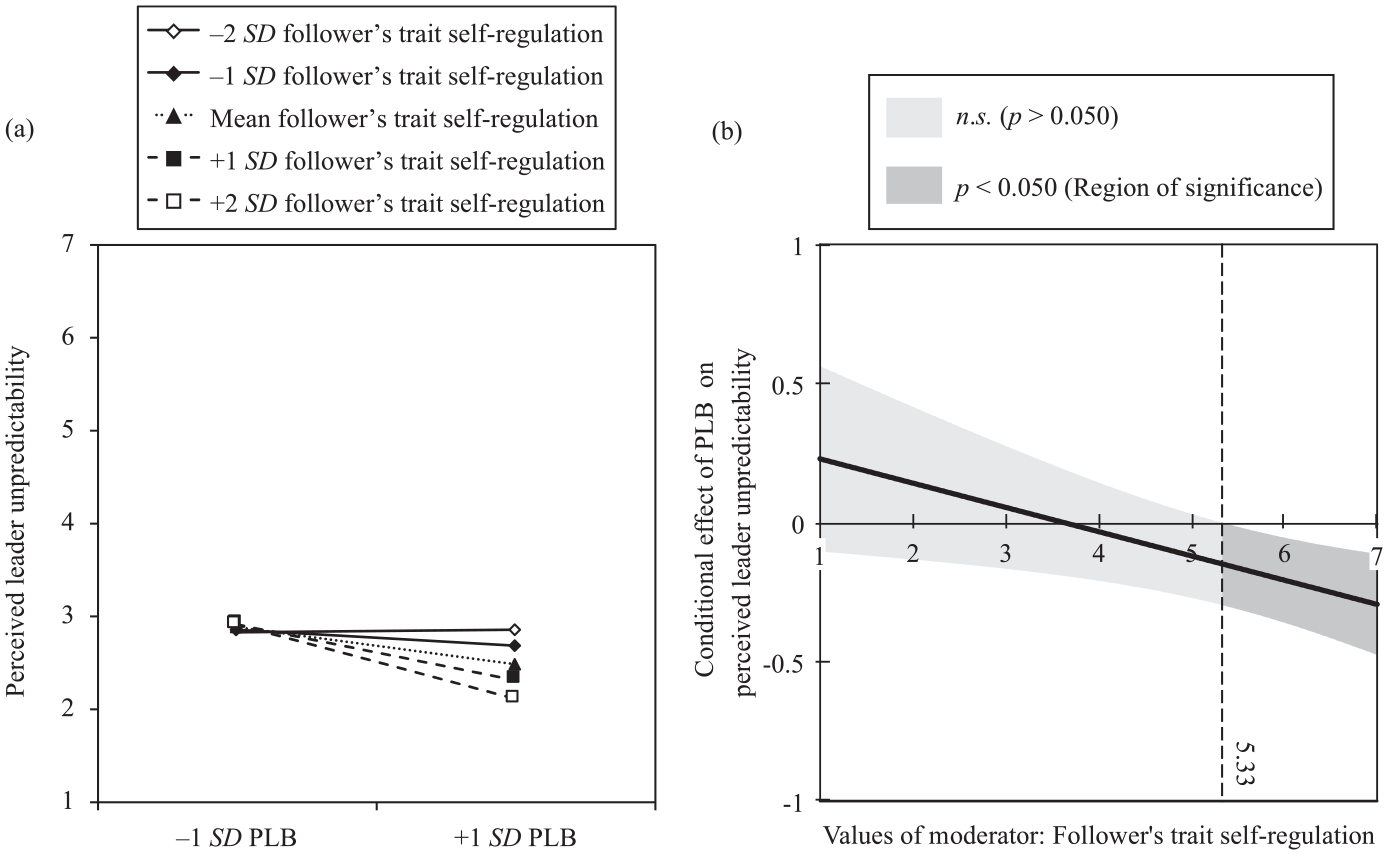
Study 2: (a) simple slopes and (b) Johnson-Neyman plot of the interactive effect between perceived paradoxical leader behavior and followers’ trait self-regulation on perceived leader unpredictability.
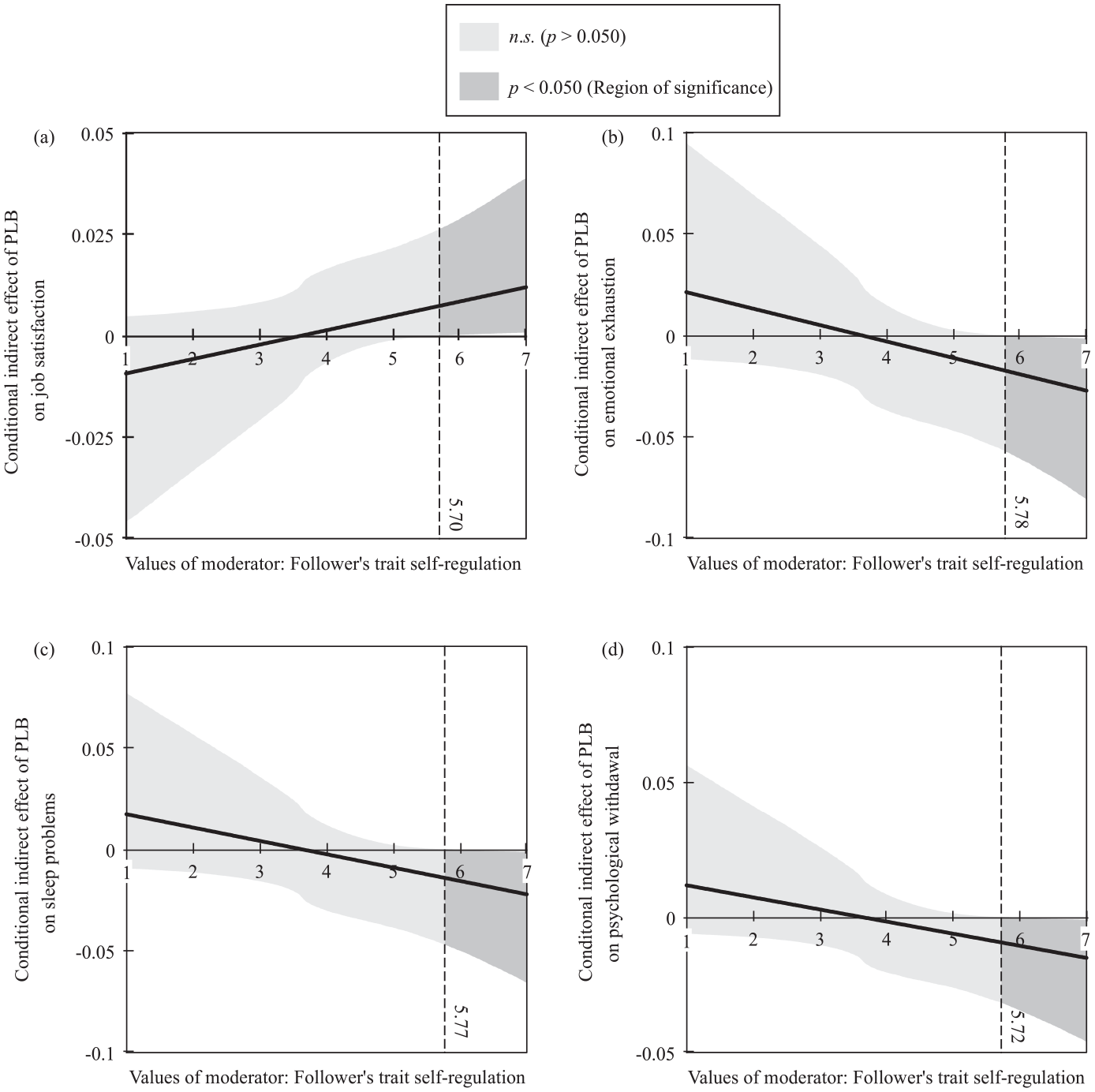
Study 2: Followers’ trait self-regulation as a moderator of the indirect effect of perceived paradoxical leader behavior on followers’ (a) job satisfaction, (b) emotional exhaustion, (c) sleep problems, and (d) psychological withdrawal.
Discussion
Study 2 provides more fine-grained evidence for our self-regulation arguments. In line with our hypotheses, followers’ trait self-regulation affected their interpretation of, and reaction to, PLB. While we did not find a clear reversal in the association between PLB and perceived leader unpredictability, we found that only followers with higher trait self-regulation were able to make sense of their leader’s PLB, reducing their perceptions of leader unpredictability. Study 2 also supported our prediction that perceived leader unpredictability and self-regulation impairment (this time assessed via ego depletion) serially mediate the conditional effect of PLB on follower outcomes (job satisfaction, emotional exhaustion, sleep problems, and psychological withdrawal).
General discussion
Theoretical implications
Our studies advance the literature in several meaningful ways. First, we offer a theoretical extension to the PLB literature by adopting self-regulation theory to conceptualize and predict both the bright- and dark-side consequences of PLB. Specifically, we demonstrate that making sense of PLB requires certain cognitive characteristics from followers. We found consistent support across two multi-wave field studies and four different well-being outcomes that are indicative of hedonic, eudaimonic, physical, and negative well-being, demonstrating that self-regulation is required to benefit from PLB. By integrating PLB theory with an established theoretical framework, namely self-regulation theory, we broaden the theoretical underpinnings of this leadership construct and build a foundation for future research.
We also contribute to an understanding of a specific psychological mechanism via which PLB affects follower outcomes. We report the first explicit empirical test of uncomfortable experiences (captured via perceived leader unpredictability and concomitant emotional and cognitive measures of self-regulation impairment) as an explanation for the indirect relation between PLB and follower outcomes. Our study contributes to the paradox literature by shedding light on employees’ perceptions of, and reactions to paradoxes – and PLB in particular – and showcasing that PLB can entail dark-side consequences under certain conditions. In doing so, our findings help to provide a more granular explanation of previous findings regarding the non-uniform effects of PLB on more distal follower outcomes – such as performance, self-efficacy, or identification (Shao et al., 2019; She et al., 2020; Zhang et al., 2015) – and shed light on the hitherto largely overlooked (potentially negative) reactions to PLB.
Finally, by investigating when PLB entails beneficial or detrimental effects for followers through a self-regulation lens, we also contribute to recent discussions on the dark sides of perceived dynamic and inconsistent leader behavior (McClean et al., 2019; Schilling et al., 2023) and highlight the importance of considering employees’ neurodiversity. Across two studies, we demonstrate how specific cognitive characteristics, namely followers’ trait cognitive flexibility (Studies 1 and 2) and trait self-regulation (Study 2) enable followers to make sense of their paradoxical leaders’ otherwise confusing perceived behavior. This is illustrated by the shape of the conditional (indirect) effects. In both studies, higher PLB leaders were perceived as less unpredictable (i.e. more predictable) by highly cognitively flexible followers than lower PLB leaders. These types of followers seem to thrive in environments in which leaders are perceived to enact complex and dynamic leader behavior, but less so when leaders are perceived to enact one-sided behaviors without considering the need to attend to competing demands. Conversely, followers with lower cognitive flexibility perceived paradoxical leaders as more unpredictable and seem to thrive more when their leaders commit to ‘either–or’ approaches. In Study 2, we extended our investigation by examining followers’ trait self-regulation as a more general moderating variable. The patterns from these analyses were similar to those of Study 1, with a noteworthy difference: in contrast to Study 1, followers with lower trait self-regulation did not directly experience negative consequences from PLB. However, only followers with higher trait self-regulation benefited from it, in terms of higher levels of job satisfaction, lower levels of emotional exhaustion, sleep problems, and psychological withdrawal, limiting its benefits to a selected few. In aggregate, these findings underscore the relevance of specific cognitive characteristics that enable followers to make sense of PLB and self-regulate when faced with it.
Practical implications
Our work also holds value for practitioners. First, our research serves as a reminder to organizations and leaders that the display of PLB requires a strong cognitive basis, not only from leaders but also from followers. Thus, leaders should not only pay attention to their followers’ preferences (She et al., 2020) but also their cognitive characteristics and adapt their communication accordingly, to avoid unintentional adverse effects of their leadership behavior. Here, Human Resources (HR) departments could offer specific training for leaders to enable them to communicate more effectively, depending on followers’ individual needs.
Furthermore, cognitive flexibility and, relatedly, one’s ability to self-regulate, resulting from the brain’s neuroplasticity, represent malleable traits that are not invariant in adults and can be developed or changed over time (Cañas et al., 2006; Yeow and Martin, 2013). Thus, our findings provide actionable insights for practitioners interested in leveraging the potential of PLB in their organizations. Organizations could, for instance, make use of training programs or other interventions to support employees in developing their cognitive flexibility and self-regulation abilities. These could focus on improving situational thinking and developing alternative solutions for complex problems. By doing so, organizations can prepare their employees to work more effectively in PLB environments.
Limitations and directions for future research
Our studies are subject to several limitations. First, all data in our studies were based on self-reports and from a single source, which increases the risk of CMV in the data (Podsakoff et al., 2003). However, given that we were interested in studying followers’ subjective perceptions of paradoxical leaders, individual well-being, and their emotions and cognitions, this approach seems justified and in line with prior research (Linton et al., 2016). Moreover, statistical tests indicated no strong influence of CMV in our findings.
Second, our studies, in line with previous research (e.g. Shao et al., 2019), focused on between-person differences in PLB as well as individual differences among followers, and the consequent outcomes. However, both perceived leader behavior and cognitive characteristics can exhibit state-like fluctuations on a weekly or even daily basis (Kelemen et al., 2020; Walwanis and Ponto, 2019). Therefore, we encourage researchers to employ within-person designs, such as daily or weekly experience sampling studies. These methods may offer more detailed insights into the interaction between more momentary enactments of PLB and more transient cognitive states in shaping followers’ immediate responses.
Third, although we considered followers’ individual differences as an important boundary condition of PLB, systematic differences in work environments, such as job complexity or industry type may affect the efficacy of PLB. It may be more useful in complex environments characterized by conflicting tensions rather than in less complex ones (Miron-Spektor et al., 2018). Although a post hoc analysis considering job complexity and industry type did not support such an effect, we believe more work is warranted to study the specific contexts in which PLB functions in positive or negative ways.
Similarly, our theory proposed that two aspects, dependent on followers’ cognitive characteristics, would affect their reactions to PLB – namely, the expectations these followers have about the variability of their leaders’ behavior, and their subsequent capacity to logically link these dynamic behaviors to situational demands (i.e. sensemaking). Although these mechanisms are both implied in our theoretical framework, we did not explicitly capture them in our research. As such, we recommend that future research should design studies to explicitly investigate how followers’ expected variability of the leader’s behavior and their sensemaking capacity compete in shaping their perceptions of, and reactions to, PLB.
Lastly, we conducted a post hoc analysis regarding the possibility that tenure with the supervisor may moderate the extent to which PLB may be perceived as unpredictable. In both samples, no interaction including tenure with the supervisor reached traditional levels of significance. Notwithstanding, future research should explore potential habituation effects with PLB using, for instance, longitudinal panel data.
Conclusion
Scholars have cautioned that PLB’s effectiveness may be contingent on followers’ ability to embrace ‘both–and’ thinking. Using a self-regulation theoretical perspective, our examination of cognitive characteristics supports this perspective by suggesting that PLB can be perceived as predictable by some, but unpredictable by other followers, which entails heterogenous well-being-related consequences. We hope that our research begets future work on the explanatory mechanisms, boundary conditions, and outcomes of PLB.
Supplemental Material
sj-pdf-1-hum-10.1177_00187267231199644 – Supplemental material for Benefitting or suffering from a paradoxical leader? A self-regulation perspective
Supplemental material, sj-pdf-1-hum-10.1177_00187267231199644 for Benefitting or suffering from a paradoxical leader? A self-regulation perspective by Nils Fürstenberg, Jonathan E Booth and Kerstin Alfes in Human Relations
Supplemental Material
sj-pdf-2-hum-10.1177_00187267231199644 – Supplemental material for Benefitting or suffering from a paradoxical leader? A self-regulation perspective
Supplemental material, sj-pdf-2-hum-10.1177_00187267231199644 for Benefitting or suffering from a paradoxical leader? A self-regulation perspective by Nils Fürstenberg, Jonathan E Booth and Kerstin Alfes in Human Relations
Supplemental Material
sj-pdf-3-hum-10.1177_00187267231199644 – Supplemental material for Benefitting or suffering from a paradoxical leader? A self-regulation perspective
Supplemental material, sj-pdf-3-hum-10.1177_00187267231199644 for Benefitting or suffering from a paradoxical leader? A self-regulation perspective by Nils Fürstenberg, Jonathan E Booth and Kerstin Alfes in Human Relations
Footnotes
Funding
The authors disclosed receipt of the following financial support for the research, authorship, and/or publication of this article: This research was supported by the Basic Research Fund (GFF) of the University of St Gallen, Switzerland (grant number: 1031579).

Supplemental material
Supplemental material for this article is available online.
Notes
References
Supplementary Material
Please find the following supplemental material available below.
For Open Access articles published under a Creative Commons License, all supplemental material carries the same license as the article it is associated with.
For non-Open Access articles published, all supplemental material carries a non-exclusive license, and permission requests for re-use of supplemental material or any part of supplemental material shall be sent directly to the copyright owner as specified in the copyright notice associated with the article.
