




Abstract
The topic of work engagement is moving up on the managerial agenda as it sets the stage for numerous beneficial outcomes for both organizations and their employees. It is clear, however, that not all employees are equally engaged in their job. The current study taps into theory on positive self-fulfilling prophecies induced by leaders’ high expectations of followers (i.e., the Pygmalion effect) and examines their potential to facilitate follower work engagement. By integrating literature on implicit followership theories with the Pygmalion model, we investigate the assumption that leaders’ high expectations are universally perceived as and therefore foster the same desirable results for all employees. We argue and find that the extent to which followers’ work engagement benefits from high leader expectations depends on their implicit followership theory of industry (IFTI; i.e., the general belief that employees are hardworking, productive, and willing to go above and beyond). We also find that when followers hold a high IFTI but feel that their leader does not convey high expectations, their engagement at work suffers. In addition, we examine whether leaders’ IFTI forms the origin of naturally occurring Pygmalion effects. Our results show that a positive IFTI among leaders is especially interpreted as high/positive expectations by followers who also hold a high/positive IFTI. Our study introduces boundary conditions to the Pygmalion-at-work model by revealing the interactive role of leaders’ and followers’ implicit followership theory of industry. We contribute to the advancement of cognitive, follower-centric perspectives on leadership and provide evidence for the importance of schema congruence.
In 2016, Gallup surveyed 1.4 million workers in 192 organizations around the world and showed that only 13% of employees are engaged in their work, representing what Gallup (2016) called a “worldwide employee engagement crisis.” Gallup’s study showed that highly engaged workers outperform their less engaged counterparts by 10% in customer ratings, 21% in productivity, and 22% in profitability. Employee engagement also relates to organizational commitment and job satisfaction as well as return on assets, performance, and sales growth (Harter et al., 2002; Saks, 2006; Schaufeli & Salanova, 2010). In addition, work engagement reduces negative workplace outcomes such as turnover, accidents, and errors (Agarwal et al., 2012; Schaufeli & Bakker, 2004; Towers Perrin, 2003). With an eye on improving these metrics, organizations annually invest approximately $720 million dollars on raising employee engagement (Bersin & Associates, 2012). Likewise, elevating work engagement has become a top priority for leaders and managers, who are identified as one of the key resources of employee engagement (Bakker, 2011; Bakker & Demerouti, 2008; Lee et al., 2020; Schaufeli & Salanova, 2010; Tims et al., 2011).
The popular press indicates that leaders should appeal to followers’ need for esteem and growth (Lomb, 2016), set high expectations and give praise (Whitaker, 2016), and empower employees to make a difference (Fast Company, 2016). Research suggests that the power of such leader behaviors lies in their underlying positive belief and expectation that followers are competent and capable of successful performance (Eden et al., 2000; Kierein & Gold, 2000). The Pygmalion literature indicates that leaders’ high expectations of followers trigger subsequent leader behaviors that relate to setting challenging goals, communicating positive expectancies, and affirming followers’ capacities (Eden, 1992; Kierein & Gold, 2000). By treating followers in way that demonstrates high expectations—for instance, by challenging them to take on greater responsibilities and solve work problems—followers in turn develop high expectations for themselves and build positive beliefs about their abilities (Livingston, 1988; Rosenthal, 1973). Consequently, these high and positive self-expectations can drive intrinsic motivation and increase work engagement, which closes the self-fulfilling prophecy circle (Shuck & Herd, 2012; Zhu et al., 2009). Yet, if inducing Pygmalion-like processes were so straightforward, one would expect that leaders could just convey high expectations and employee engagement would proliferate throughout organizations. Since this is not the case, we expect that there are additional elements at play that codetermine whether leaders’ high expectations will boost employee work engagement.
Based on a cognitive perspective on leadership which emphasizes the active role of followers in leadership processes (Lord & Emrich, 2001; Shamir, 2007; Uhl-Bien et al., 2014), we examine whether and how leaders’ and followers’ implicit followership theories may affect leaders’ expectations and employees’ work engagement. Although it is theorized that implicit followership theories (IFTs; Shondrick & Lord, 2010; Sy, 2010) have important implications for leadership processes and outcomes (Sy, 2010; van Gils et al., 2010), the full extent of their effects lacks clarity and, compared with research on implicit leadership theories (ILTs; Engle & Lord, 1997; Epitropaki & Martin, 2004), the role of people’s IFTs in affecting their perceptions and behaviors at work remains underexamined.
IFTs refer to “individuals’ personal assumptions about the traits and behaviors that characterize followers” (Sy, 2010, p. 74); they reflect people’s cognitive schemas or categories of how employees generally function and perform at work. In his seminal work on IFTs, Sy (2010) distinguishes between positively and negatively valanced dimensions of IFTs (cf. prototypical and antiprototypical followership, respectively). The prototypical followership category includes implicit theories that characterize followers as “industrious,” “enthusiastic,” and “good citizens,” whereas the antiprototypical followership category encompasses implicit theories of followers as “insubordinate,” “conforming,” and “incompetent” (Sy, 2010). Given its close connection to the Pygmalion-at-work literature (e.g., Whiteley et al., 2012) and its conceptual and practical relevance for leaders’ performance expectations and followers’ engagement at work, we zoom in on the implicit followership theory of follower industry (IFTI). This particular IFT-dimension entails the belief that followers generally are hardworking, productive, and willing to go above and beyond (Sy, 2010).
In this study, we explore naturally occurring Pygmalion effects in organizations (Eden et al., 2000; Whiteley et al., 2012) and start from the assumption that both leaders and followers tend to behave in accordance with their implicit beliefs and cognitive categories regarding followers (Sy, 2010; Whiteley et al., 2012). We test the idea that the general IFTI leaders hold affects the expectations they will set for their followers. Furthermore, because followers also use their IFTI as a lens to interpret work situations and a guide for their (re-)actions, we investigate the extent to which their IFTI influences how they come to perceive their leaders’ IFTI—and the signals that result from this IFTI—and feel that their leader has high and positive expectations of them. Last, we examine whether the relationship between perceived high leader expectations and follower work engagement depends on followers’ IFTI (see Figure 1). Based on our results, we suggest that insight into IFTs can raise leaders’ awareness of an underlying source of their expectations of followers and highlight a reason why setting high and positive expectations does not necessarily equally foster all followers’ work engagement.
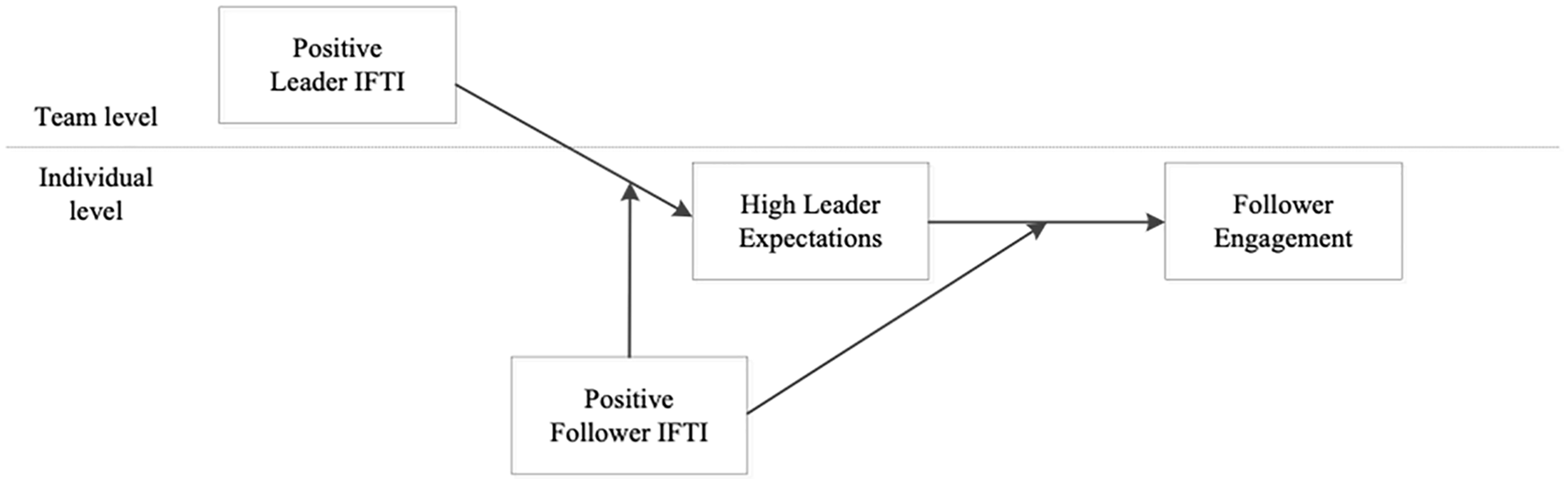
Hypothesized research model.
Our study contributes to existing research in several ways. First, we add to the literature on work engagement by examining how and under which conditions leaders can function as facilitators of follower engagement (Harter et al., 2002; May et al., 2004; Xu & Cooper Thomas, 2011). At the same time, we highlight the active role that followers play in determining their own levels of engagement at work (Zhu et al., 2009). In doing so, we extend the follower-centric view of leadership by demonstrating followers’ active interpretation of and contribution to leadership dynamics (Bligh, 2011; Lord et al., 1999; Meindl, 1995). In contrast to most cognitive leadership research, which has mainly focused on cognitive schemas about leaders (Avolio, Walumbwa et al., 2009; Engle & Lord, 1997; Epitropaki & Martin, 2004; Lord et al., 1984; Offermann et al., 1994), our study focuses on the role of cognitive schemas about followers (Sy, 2010; Whiteley et al., 2012) and stipulates that both leaders’ and followers’ followership conceptions shape leadership processes and outcomes.
Last, we advance Pygmalion theory and research by presenting evidence for naturally occurring Pygmalion effects in organizations (McNatt, 2000; Whiteley et al., 2012). We delve into the role of leaders’ IFTIs as the origin of the expectations they set for their followers. In addition, our proposition that high positive leader IFTIs will translate into desirable follower outcomes especially when followers also hold positive IFTIs reflects an important boundary condition under which Pygmalion effects may arise (Avolio, Reichard, et al., 2009; Eden, 1992; Eden et al., 2000; White & Locke, 2000). In this way, we add to literature on schema congruence in cognitive leadership studies (van Gils et al., 2010; van Quaquebeke et al., 2011). Engle and Lord’s (1997) seminal work showed that congruence in leaders’ and followers’ implicit performance theories influences leaders’ attitudes toward followers. However, we focus on whether and how congruence in implicit followership cognitions—or a lack thereof—affects followers’ work engagement.
Theory and Hypotheses
Linking Pygmalion Theory to Work Engagement
Over the past years, work engagement has been linked to a variety of important individual outcomes (e.g., job satisfaction, extra-role behavior, retention, and performance) as well as to organizational outcomes (e.g., business-unit productivity and profit) (Harter et al., 2002; Salanova et al., 2005; Salanova et al., 2011). Schaufeli and Bakker (2004) define work engagement as employees’ positive state of mind toward their work that includes vigor, dedication, and absorption. More specifically, vigor refers to employees’ high levels of energy, their willingness to invest effort, and their persistence in the face of challenges and difficulties. Dedication is characterized by feelings of enthusiasm, inspiration, significance, and pride. Absorption entails being fully concentrated and involved in one’s work in such a way that time passes quickly and detaching oneself from the work at hand is difficult (Salanova et al., 2011; Schaufeli et al., 2002).
Leaders can contribute to follower engagement since they are important actors in shaping the work context in which followers operate, setting performance expectations, and motivating employees to achieve their goals (Buckingham & Coffman, 1999; Ilies et al., 2006; Lee et al., 2020; Piccolo & Colquitt, 2006; Tims et al., 2011; Tuckey et al., 2012). We contend that leaders’ high expectations can affect followers’ work engagement through Pygmalion processes. The Pygmalion effect is a special case of a self-fulfilling prophecy in which a subject’s (e.g., a leader) expectations of a target person or group (e.g., an employee or team) activate attitudes and behaviors in the subject that are in line with these expectations. In turn, the attitudes and actions of the target(s) are affected in the expected direction (Eden, 1992; Eden et al., 2000; van Bezuijen et al., 2009). Pygmalion studies have been conducted in a variety of organizational contexts—ranging from nursing homes (e.g., Learman et al., 1990) to military settings (e.g., Eden, 1992; Eden & Kinnar, 1991). These studies generally show that leaders with high expectations of followers treat followers in a more positive way, consistent with their expectations. Furthermore, Pygmalion interventions, in which leaders’ expectations for followers are positively altered, appear to be the most effective interventions for enhancing follower job performance due to their motivating potential (Avolio, Reichard, et al., 2009).
Leaders can convey their high expectations of followers in various ways. For instance, by encouraging followers to take on greater challenges and responsibilities, showing them that they can make meaningful contributions to the work at hand, setting positive performance expectations, and instilling confidence to perform beyond average standards (Avolio, 1999; Dvir et al., 2002; Eden et al., 2000; Shuck & Herd, 2012; Sosik, 2006; Zhu et al., 2009). Podsakoff et al. (1990) have argued that demonstrating high expectations for quality, excellence, and/or high performance on the part of employees represents one of the four key dimensions of transformational leadership. According to them, this leader behavior reflects “House’s (1977) notion that transformational leaders have high performance expectations, and convey these expectations to subordinates” (Podsakoff et al., 1990, p. 134).
Whether consciously or unconsciously conveyed, leaders’ high expectations can translate into more positive self-conceptions and increased self-efficacy in followers as well as trigger inherent growth tendencies that form the basis for intrinsic motivation and, in turn, engagement at work (Dvir et al., 2002; Eden, 1990, 1993; Eden et al., 2000; Ryan & Deci, 2000; White & Locke, 2000). In addition, perceiving high leader expectations may facilitate employees’ identification with their tasks, foster feelings of job involvement, and induce higher levels of psychological meaningfulness of the work they do and the tasks they perform (Avolio, 2005; Kahn, 1990; Sosik, 2006; Zhu et al., 2009; van Zyl et al., 2010). Higher levels of perceived meaningfulness of one’s work may consequently facilitate work engagement (Kahn, 1990; van Zyl et al., 2010). High leader expectations may also enhance followers’ belief that they are making valued contributions to their team and the organization at large, which can raise their dedication (Avolio, 1999; Bass, 1998).
In sum, we expect that leaders who convey high expectations of their followers can induce them to develop and internalize beliefs which are in line with these expectations. In turn, followers may be more likely to feel intrinsically motivated and act in accordance with these high (self-)expectations by experiencing and demonstrating higher levels of work engagement (cf. a positive self-fulfilling prophecy). In the next paragraphs we assert, however, that the effects of leaders’ high and positive expectations on follower engagement depend on followers’ IFTI. Moreover, we introduce the idea that leaders’ implicit theory of follower industry affects the extent to which followers actually perceive high/positive expectations and that, again, this relationship depends on followers’ own underlying IFTI.
Followers’ and Leaders’ Implicit Followership Theories
Since the 1980s, an extensive body of research has investigated individuals’ cognitive categories of leaders or (ILTs; Eden & Leviatan, 1975, 2005; Lord, 1985; Lord et al., 1984; Phillips & Lord, 1981). These preconceived schemas about leaders are important cognitive simplification mechanisms that assist individuals in processing incoming information and support them in interpreting, comprehending, and responding to leaders and their behavior (Epitropaki et al., 2013; Lord & Maher, 1991; van Gils et al., 2010). Cognitive schemas and their associated social responses are represented mentally, based on congruent characteristics, and reside as proximal cognitive units within the same associative network (Sy et al., 2010). This proximity increases the likelihood that activation of one cognitive unit leads to the activation of the other cognitive unit (Epitropaki et al., 2013). Moreover, once activated these cognitive categories serve as colored lenses through which stimuli are interpreted (Sy, 2010; Sy et al., 2010). This logic extends to cognitive schemas regarding followers or IFTs: during daily interactions in the workplace, both leaders’ and followers’ IFTs serve as cognitive frameworks that guide and color their social perceptions, (self-)interpretations, judgements, and (re-)actions (Lord & Maher, 1993; Sy, 2010).
In this research we focus on the prototypical, positively valenced IFT-dimension that aligns best with the key elements of the Pygmalion-at-work theory, leaders’ performance expectations of followers as well as people’s engagement at work: the cognitive category regarding follower industry (IFTI). This IFT reflects the cognitive categorization of followers as generally hardworking, industrious, and productive individuals who are willing and able to go above and beyond (Sy, 2010). People develop their IFTI based on social experiences, observations, and interactions. Subsequently, they (implicitly) use this cognitive category to inform and guide their own workplace behavior as well as interpret others’ behaviors, signals, and attitudes toward them (Carsten et al., 2010; Epitropaki et al., 2013). Thus, followers’ IFTI directs their self-expectations and conduct at work, assists in making sense of leader signals and behaviors, and shape interpretations of his/her expectations (Lord & Maher, 1991, 1993; Sy, 2010).
More specifically, employees with a high positive implicit theory of follower industry behave in line with their IFTI (cf. work hard and go above and beyond) as well as interpret their leader’s high expectations as consistent with their own general positive belief that followers are industrious (Whiteley et al., 2012). Since followers’ schemas and self-perceptions permeate their reactions to leader behavior, high leader expectations are in fact expected and desired by these high-IFTI followers (Lord, Brown, Harvey, & Hall, 2001; van Quaquebeke et al., 2011). This induces them to perceive high leader expectations as motivating, supportive, and encouraging. Because followers with a high positive IFTI likely interpret this leader behavior as a positive job resource, they will exert more effort and feel more engaged in their work (Bakker & Demerouti, 2008). In addition, high-IFTI followers may more easily internalize (additional) external high performance expectations since these expectations fit their preexisting followership conceptions and are experienced as an inherent part of their selves (Van den Broeck et al., 2008). Indeed, research shows that when external expectations and reasons for action are internalized, they are more likely to foster engagement (Deci & Ryan, 2011; Ryan & Deci, 2000).
For example, followers with a high IFTI may perceive the utterance from their leader “I believe you’ll push yourself and excel at this project” as a confident assertion that they will do well, a belief in their overall work ethic and capacities, as well as a positive challenge and impetus for engagement in the project. In this case, high leader expectations likely initiate a positive self-fulfilling prophecy since followers perceive alignment between their own schema regarding followers as industrious on the one hand and how they feel they are expected to behave on the other hand. Consequently, it is more likely for them to be intrinsically motivated and feel engaged (Deci & Ryan, 2011; Ryan & Deci, 2000; Van den Broeck et al., 2008).
Followers who hold a low IFTI will also behave in line with their implicit followership schema and therefore may exert less or only the necessary effort and industry at work. Indeed, their low IFTI and the corresponding lower levels of effort are congruent cognitive structures within the same associative network and their proximity increases the likelihood for mutual activation (Epitropaki et al., 2013; Sy et al., 2010). These low IFTI-followers presumably view their leader’s high performance expectations as different from their own IFTI and feel that they are expected to perform in ways that do not match their followership conceptions and self-expectations. For instance, they may perceive high leader expectations as an indication that they should go above and beyond at work (e.g., pushing oneself and excelling at a project) while they actually don’t believe employees should (be expected to) go the extra mile and rise above average performance. In such instances, rather than initiating a positive self-fulfilling prophecy and increasing engagement, leaders’ high expectations may be seen as yet another job demand (e.g., an additional burden or stressor) instead of a job resource (e.g., a positive encouragement or challenge; Bakker & Demerouti, 2008; Baumeister et al., 1985). Furthermore, inconsistency between leader expectations and follower schemas can make it more difficult to form a common understanding about what should be done at work and how followers ought to function, which may reduce work engagement (Engle & Lord, 1997). Last, externally driven behaviors that are not internalized (e.g., leader expectations and reasons for actions that are not aligned or integrated with employees’ beliefs and self-expectations) may even result in lower levels of motivation and engagement (Deci & Ryan, 2011; Gagné & Deci, 2005; Ryan & Deci, 2000).
Thus, we argue that followers’ IFTI affects the relationship between leader expectations and follower work engagement. Employees who possess a highly positive IFTI are more likely than their low-IFTI counterparts to positively interpret and react favorably toward their leaders’ high expectations because they perceive a match between these expectations and their own internal cognitive categorizations concerning followers. Consequently, they approach their work goals and tasks with more engagement. We propose the following:
Thus far, we suggested that leaders’ high expectations and followers’ IFTIs interact in influencing follower engagement. This also raises questions, however, about the source of leaders’ high performance expectations. As is the case for followers, leaders hold general IFTs which shape their judgments of and actions toward followers (Epitropaki et al., 2013; Sy, 2010). Decades ago, McGregor (1957, 1960) argued that leaders’ actions and behaviors are often an expression of the underlying assumptions they hold about the nature of employees. “Theory Y” leaders essentially believe that employees “can be motivated to work hard and find work enjoyable; are capable of self-direction and self-control; often seek to grow and accept responsibility; and can be the source of many useful ideas” (Kopelman et al., 2010, p. 121). In contrast, “Theory X” leaders assume that followers are not inclined to work hard, feel intrinsically motivated, or have the willingness and capacity to go above and beyond at work (McGregor, 1957, 1960). Leaders’ conceptions of followers such as those described by Theory X and Y or by prototypical and antiprototypical IFTs (Sy, 2010) influence their expectations of their current followers because conceptions of “how followers are” are related to expectations of “how well my followers will do” (Sy, 2010). Thus, leaders’ general implicit theory of follower industry may precede and affect the performance expectations they set for their current followers (Sy, 2010).
Relying on the perception-behavior link, we argue that leaders’ IFTI activates behavioral patterns that align with this implicit followership category and sets the stage for how they behave toward their followers and what they come to expect from them (Chen & Bargh, 1997; Epitropaki et al., 2013; Whiteley et al., 2012). Epitropaki et al. (2013, p. 682) indicate that “leaders who internalize and endorse the Industry dimension of IFTs . . . are more likely to have higher expectations for followers and provide them with more autonomy.” As leaders with a high IFTI are predisposed to have a more positive general conception of followers in this regard, they are likely to naturally expect their own followers to be industrious and hardworking. Consequently, they will act in accordance with their cognitive followership category and communicate more positive/higher expectations that their followers can observe and (should) act on (Eden, 1990; Epitropaki et al., 2013; Sy, 2010; Whiteley et al., 2012). We propose the following:
People’s perceived world of work is composed of tightly related cognitive representations and, with experience and over time, the mere presence of relevant stimuli will coactivate certain perceptions, interpretations, and habitual actions (Epitropaki et al., 2013). As indicated previously, followers use their cognitive followership categories to make sense of workplace stimuli and interpret their leader’s signals and behaviors. Over time, employees observe their leader and how s/he treats followers, and get a glimpse of his or her espoused and enacted followership conceptions. Consequently, they come to attribute certain IFTs to their leader and (implicitly) evaluate whether their leader’s conceptions align with their own (Junker & van Dick; 2014; Lord & Maher, 1991, 1993; van Gils et al., 2010). Cognitive research indicates that when individuals hold similar schemas they are likely to perceive situations more similarly because they have congruent cognitive guidelines (Engle & Lord, 1997; Junker & van Dick, 2014). This cognitive congruence fosters agreement among leaders and followers about what is generally expected from followers and serves leader–member relationship quality (van Gils et al., 2010; Riggs & Porter, 2017).
For instance, followers who hold a highly positive IFTI will naturally expect or infer that their leader also holds a positive IFTI. In line with their implicit cognitions, high IFTI-followers will also more easily interpret their leader’s signals as demonstrating high expectations and will be more likely to notice when leaders indicate or display such high expectations (van Gils et al., 2010). In contrast, if followers’ IFTI differs from the IFTI their leader holds, they will have more difficulty registering and making sense of related stimuli since both parties are not (yet) on the same cognitive page (van Gils et al., 2010). In sum, followers who hold a high positive IFTI are more likely to interpret their leader’s signals as high/positive expectations, whereas followers who do not hold a high positive IFTI are more inclined to interpret such signals differently or fail to register them altogether. We propose the following:
Method
Sample and Procedure
The hypotheses were tested in a sample containing data from 45 medium-sized Belgian organizations that provide insurance, financial, and consulting services (22%), social welfare services (59%), or health care services (19%). We asked human resource representatives of these organizations to randomly select a number of followers and leaders functioning in different departments, and provide us with a list containing the email addresses of the respective employees and their leaders. The HR representatives delivered the email addresses of 1,436 followers and 168 leaders. We ensured respondents of the total confidentiality of the information they provided.
On the first measurement time (T1) 108 leaders (64%) rated their IFTI and 711 followers (50%) rated their IFTI as well as the extent to which they felt that their leader displayed high performance expectations. Six months later, on the second measurement time (T2), 418 employees (29%) provided information on their engagement at work. Only the responses of followers who participated at both measurement times were retained in the final sample pool. After excluding unmatched leader–follower pairs, data from 348 followers and 97 leaders could be used to test the hypotheses. Followers’ average age was 40 (SD = 10.25), 69% were women, 22% held a graduate degree and 56% held an undergraduate degree. Their average tenure was 10 years (SD = 9.23). 49% indicated that they interacted with their leader on a daily basis, 43% reported to do so on a weekly basis and 8% on a monthly basis. Leaders’ average age was 44 (SD = 9.01), 59% were women, 30% held a graduate degree and 63% held an undergraduate degree. Their average tenure was 12 years (SD = 9.84). To partially assess whether nonresponse bias was present in the data (Halbesleben & Whitman, 2013), we performed one-way analysis of variance’s to compare respondents who filled out the questionnaire at Time 1 with respondents who participated at both Time 1 and Time 2 on their demographic information and IFTI. No significant differences were found between these respondents’ age, F(1, 567) = .28, p = .60; gender, F(1, 650) = 1.11, p = .29; educational level, F(1, 645) = .06, p = .81; tenure, F(1, 618) = .45, p = .50, contact with their leader, F(1, 648) = .05, p = .82, or IFTI, F(1, 701) = .18, p = .67.
Measures
Implicit Followership Theory of Industry
Both leaders’ and followers’ IFT of industry was measured using the three-item scale developed by Sy (2010). A sample item is: “In general, followers are hardworking.” Items were rated on a 10-point scale ranging from this is not at all characteristic of followers (1) to this is extremely characteristic of followers (10). The internal consistency of these measures was high: Cronbach’s αs were .91 and .90, respectively.
High Expectations
The extent to which followers felt that their leader conveyed high performance expectations was measured using the scale from Podsakoff et al. (1990). Three items were rated on a 7-point Likert-type scale from totally disagree (1) to totally agree (7). A sample item is: “My leader insists on only the best performance.” Cronbach’s α was .89.
Work Engagement
Follower work engagement was measured using the short version of the Utrecht Work Engagement Scale developed by Schaufeli et al. (2006), which defines work engagement as being constituted by the dimensions of vigor, dedication, and absorption. Nine items were measured on a 7-point Likert-type scale ranging from totally disagree (1) to totally agree (7). Sample items are as follows: “At my work, I feel bursting with energy” (vigor); “I am proud of the work that I do” (dedication); “I am immersed in my work” (absorption). The internal consistency of the work engagement scale was high: Cronbach’s α was .81.
Control Variables
Differences between men and women regarding personality, motivational, and attitudinal variables can affect their interpretation of high leader expectations and the mechanisms of the Pygmalion effect (Dvir et al., 1995; Meece & Painter, 2008). Therefore, we controlled for follower gender. Because people at all levels in an organization can experience high leader expectations, we also controlled for the functional level at which followers were executing their job. In doing so, we aimed to rule out the possibility that expectations from leaders are interpreted as higher at higher functional levels. Moreover, we controlled for followers’ account of how often they interacted with their leader in order to eliminate the possibility that experiencing high/positive expectations is simply due to more frequent contacts and interactions with one’s leader.
In addition, we included follower psychological safety as a control variable because it is an important predictor of work engagement (Kahn, 1990). We aimed to rule out the possibility that followers are engaged at work because they feel comfortable to be themselves and express their opinions rather than due to their leaders’ positive/high expectations. Psychological safety was measured by three items based on Kahn’s work (Kahn, 1990; May et al., 2004) and rated on a 5-point Likert-type scale ranging from totally disagree (1) to totally agree (5). A sample item is as follows: “I am not afraid to be myself in my team.” Cronbach’s α was .66. Last, we controlled for the extent to which followers indicated to like their leader in order to eliminate the possible explanation that followers interpret their leader’s signals and expections more positively simply because they generally appreciate their leader. Indeed, the positive affect followers feel toward their leader can color their leadership perceptions and several studies question and discuss whether leadership goes beyond followers just liking their leader (Brown & Keeping, 2005; Gottfredson et al., 2020; Yammarino et al., 2020). The three item-scale from Wayne et al. (1997) was used and rated on a 7-point Likert-type scale ranging from totally disagree (1) to totally agree (7). A sample item is as follows: “I like my leader very much”; Cronbach’s α was .80.
Analyses
We analyzed the data using structural equation modeling in two steps. First, we conducted multilevel confirmatory factor analyses on our measurement model including all measurement variables using the Mplus statistical package (Muthén & Muthén, 1998-2015). Results indicated a good fit of the model to the data (χ2 = 316.09; degrees of freedom = 176; p = .000; comparative fit index = .96; Tucker–Lewis index = .96; root mean square error of approximation = .05; standardized root mean square residual [SRMRwithin = .04; SRMRbetween = .00]; Hu & Bentler, 1998, 1999). In Table 1, a comparison of alternative measurement models is presented. Next, we tested the hypothesized relationships using path analyses in Mplus. We estimated a multilevel regression model with a random intercept and a random slope varying across clusters (i.e., teams), using the “type = twolevel random” specification for analysis (Muthén & Muthén, 1998-2015).
Comparison of Measurement Models.
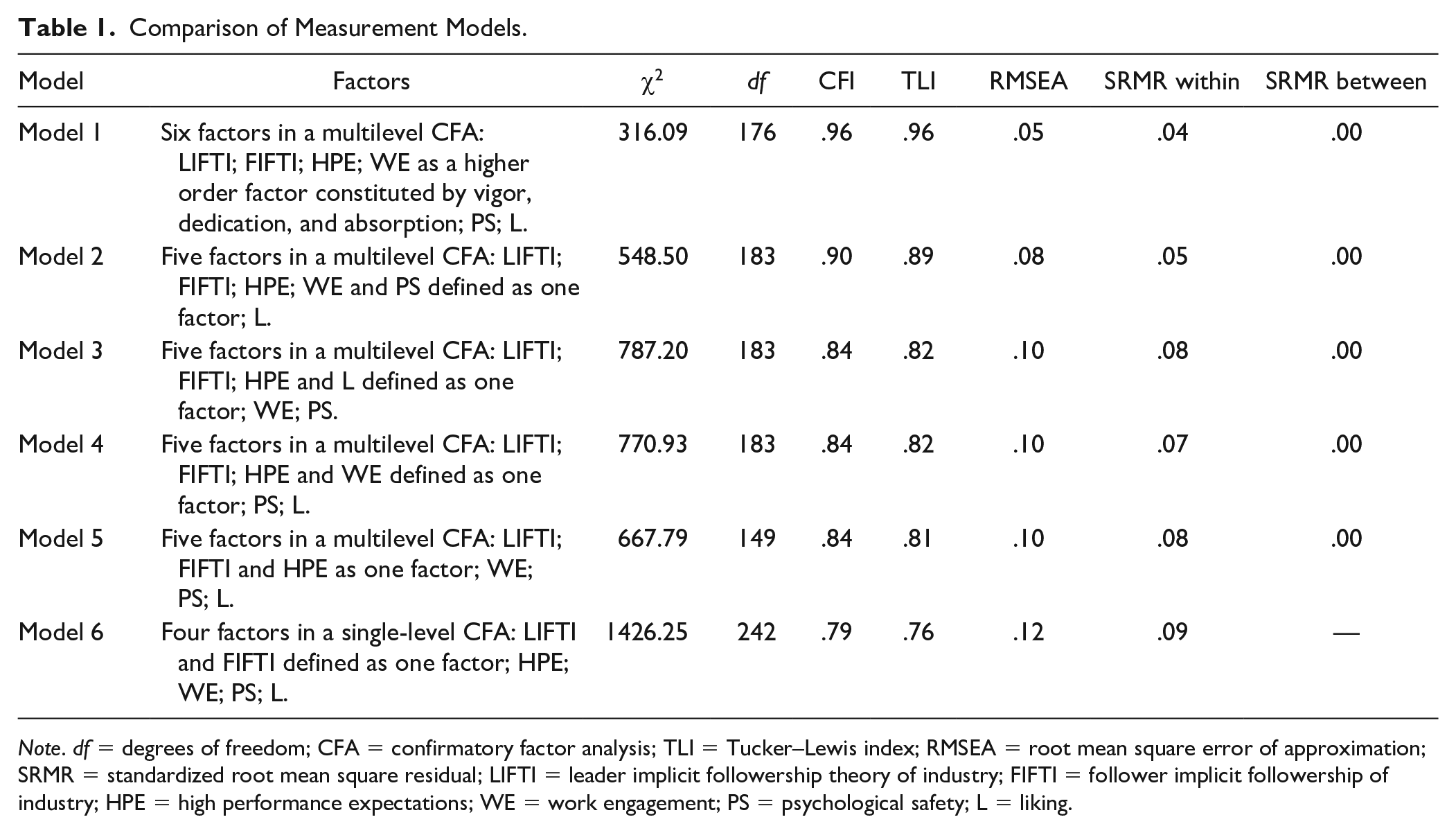
Note. df = degrees of freedom; CFA = confirmatory factor analysis; TLI = Tucker–Lewis index; RMSEA = root mean square error of approximation; SRMR = standardized root mean square residual; LIFTI = leader implicit followership theory of industry; FIFTI = follower implicit followership of industry; HPE = high performance expectations; WE = work engagement; PS = psychological safety; L = liking.
Results
Table 2 presents the means, standard deviations, correlations, and reliability estimates for the study variables. We tested a cross-level path model that estimated the hypothesized relationships shown in Figure 1. Figure 2 visualizes our full research model with unstandardized path coefficients (for models with cross-level interaction effects, coefficients are only available in an unstandardized fashion; Muthén & Muthén, 1998-2015). Furthermore, because our model included a cross-level interaction effect, information on model fit is not available. However, when excluding information on fit indices, the results of a multilevel path model are similar to those obtained through hierarchical linear modeling (Grizzle et al., 2009; Leroy et al., 2015).
Means, Standard Deviations, and Correlations Between Individual-Level Study Variables.
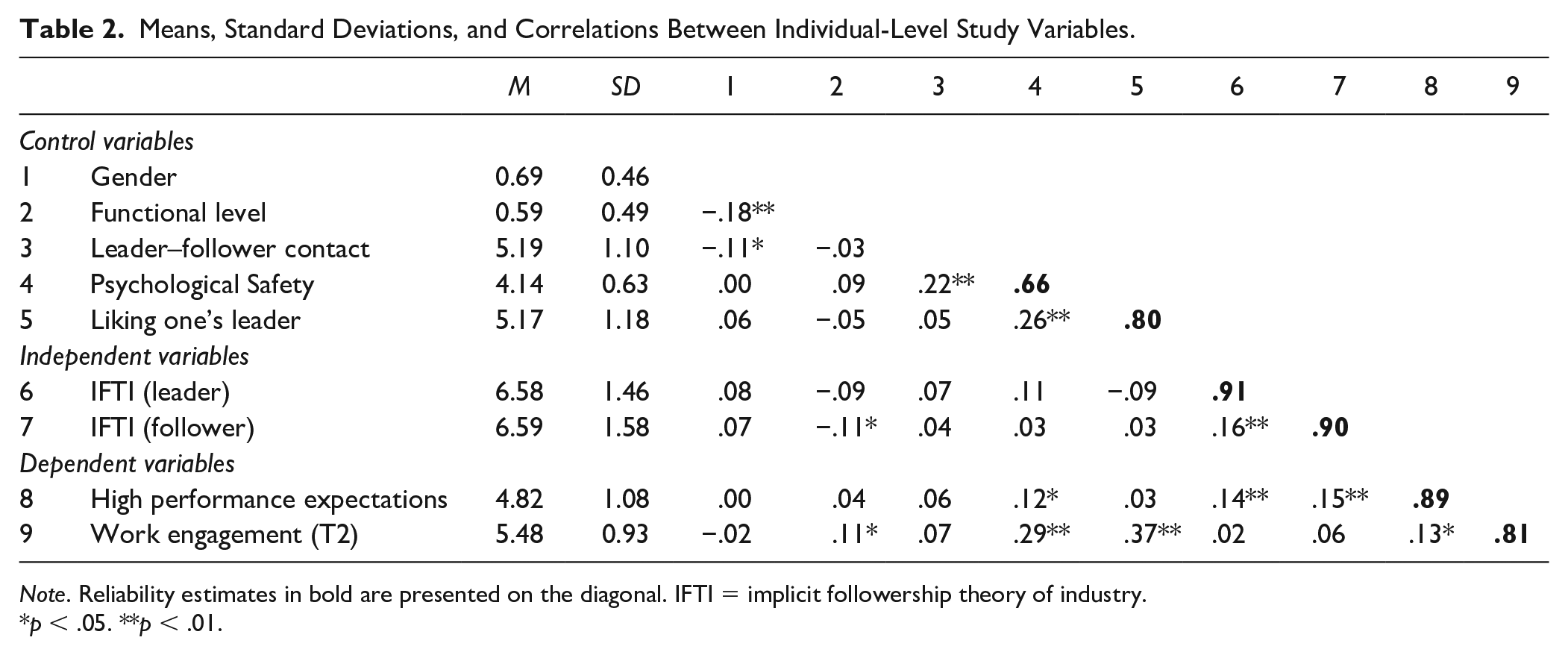
Note. Reliability estimates in bold are presented on the diagonal. IFTI = implicit followership theory of industry.
p < .05. **p < .01.
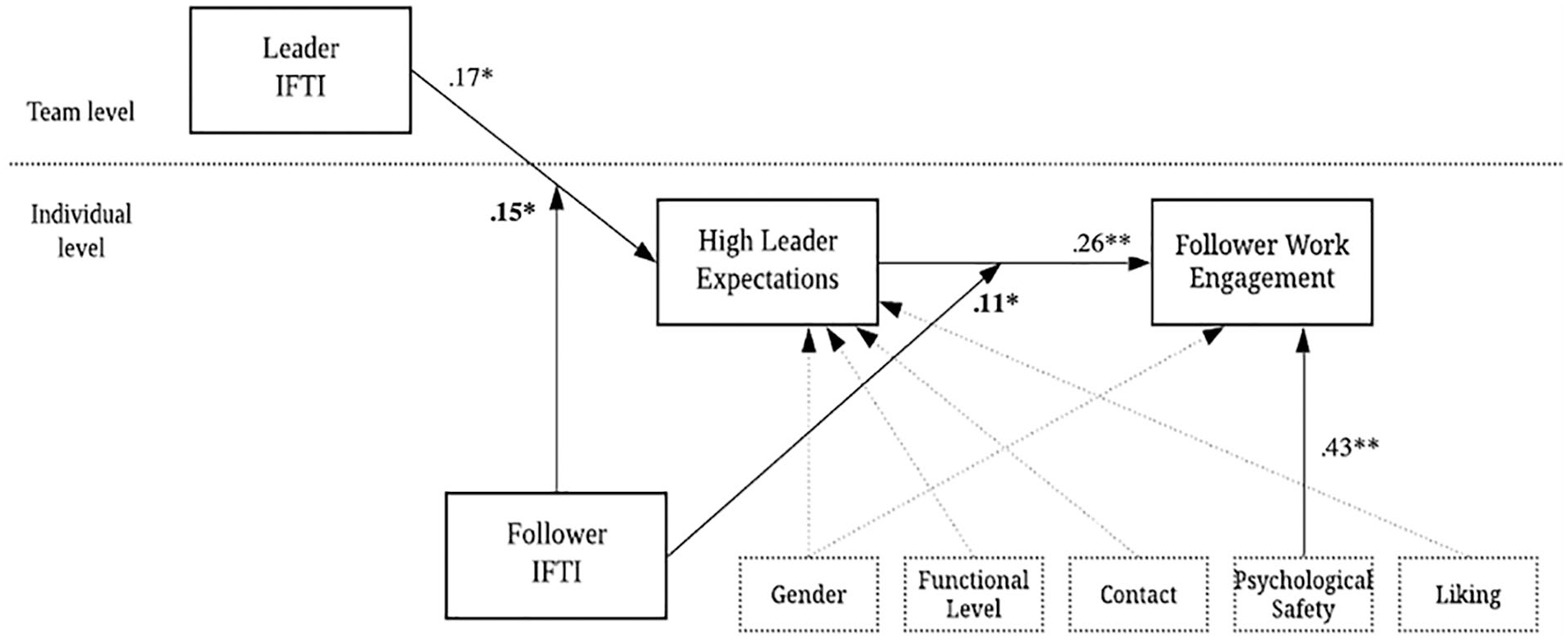
Full research model with unstandardized coefficients.
Except for the path between psychological safety and work engagement, the estimated paths between the control variables and the core variables in our model were not significant. Hypothesis 1 proposed that the positive relationship between high leader expectations and follower work engagement would depend on followers’ IFTI. We found an overall positive relationship between follower perceptions of high leader expectations and their work engagement 6 months later (ŷ = .26; p < .01). This effect depends, however, on followers’ IFTI: the interaction between high leader expectations and followers’ IFTI (T1) on work engagement (T2) is positive and significant (ŷ = .11; p < .05). At high levels of followers’ IFTI (defined at 1 standard deviation above the mean; Aiken & West, 1991), the effect is (ŷ = .37; p < .01), whereas at low levels of followers’ IFTI (defined at 1 standard deviation below the mean; Aiken & West, 1991), the effect is (ŷ = .15; p < .05). Figure 3 visualizes this interaction effect and indicates that the relationship between perceived high leader expectations and follower work engagement 6 months later is stronger for followers who hold a more positive implicit theory of follower industry.
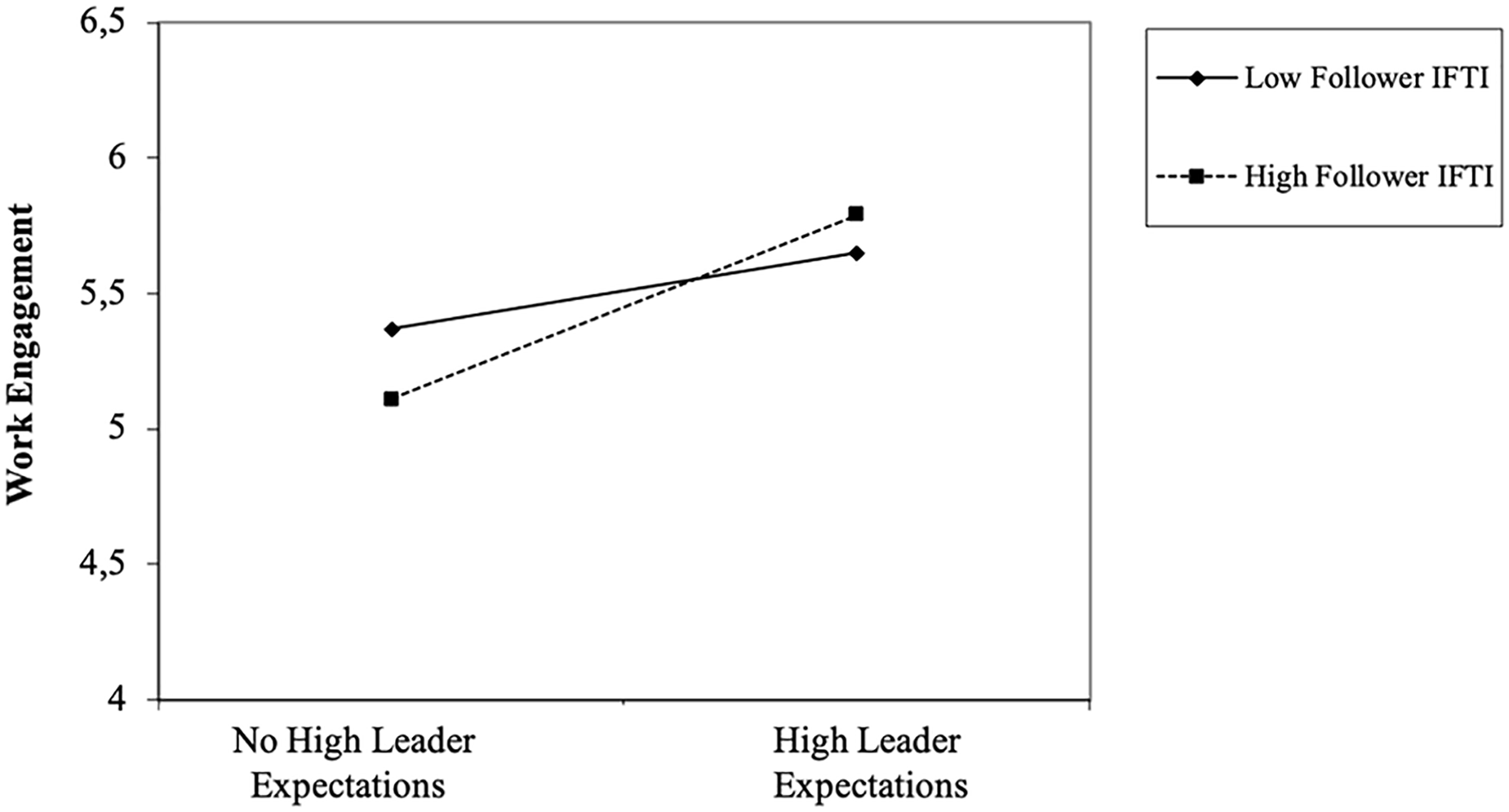
Interaction effect between high leader expectations and follower IFTI on follower work engagement.
Hypothesis 2 was that leaders’ IFTI would relate positively to high leader expectations. In support of this hypothesis, we found a positive effect of leaders’ IFTI on followers perceiving high performance expectations (ŷ = .17; p < .05). Hypothesis 3 proposed that followers’ IFTI would moderate this relationship. In support of this hypothesis, we found a positive interaction effect between leaders’ IFTI and followers’ IFTI on perceived high and positive leader expectations (ŷ = .15; p < .05). The differentiation between high and low levels of followers’ IFTI was defined as 1 standard deviation above and below the mean of the moderator (Aiken & West, 1991). Figure 4 indicates that the positive relationship between leader IFTI and perceived high expectations is stronger when followers also hold high levels of IFTs regarding follower industry. Leaders with a positive/high IFTI were seen as demonstrating more high expectations by followers who also held a high IFTI, but not among followers who held a low IFTI. The slope defined at 1 standard deviation above the mean of follower IFTI was positive and significant (ŷ = .32; p < .01), whereas the slope at 1 standard deviation below the mean of follower IFTI was not significant (ŷ = −.02; p = .89).
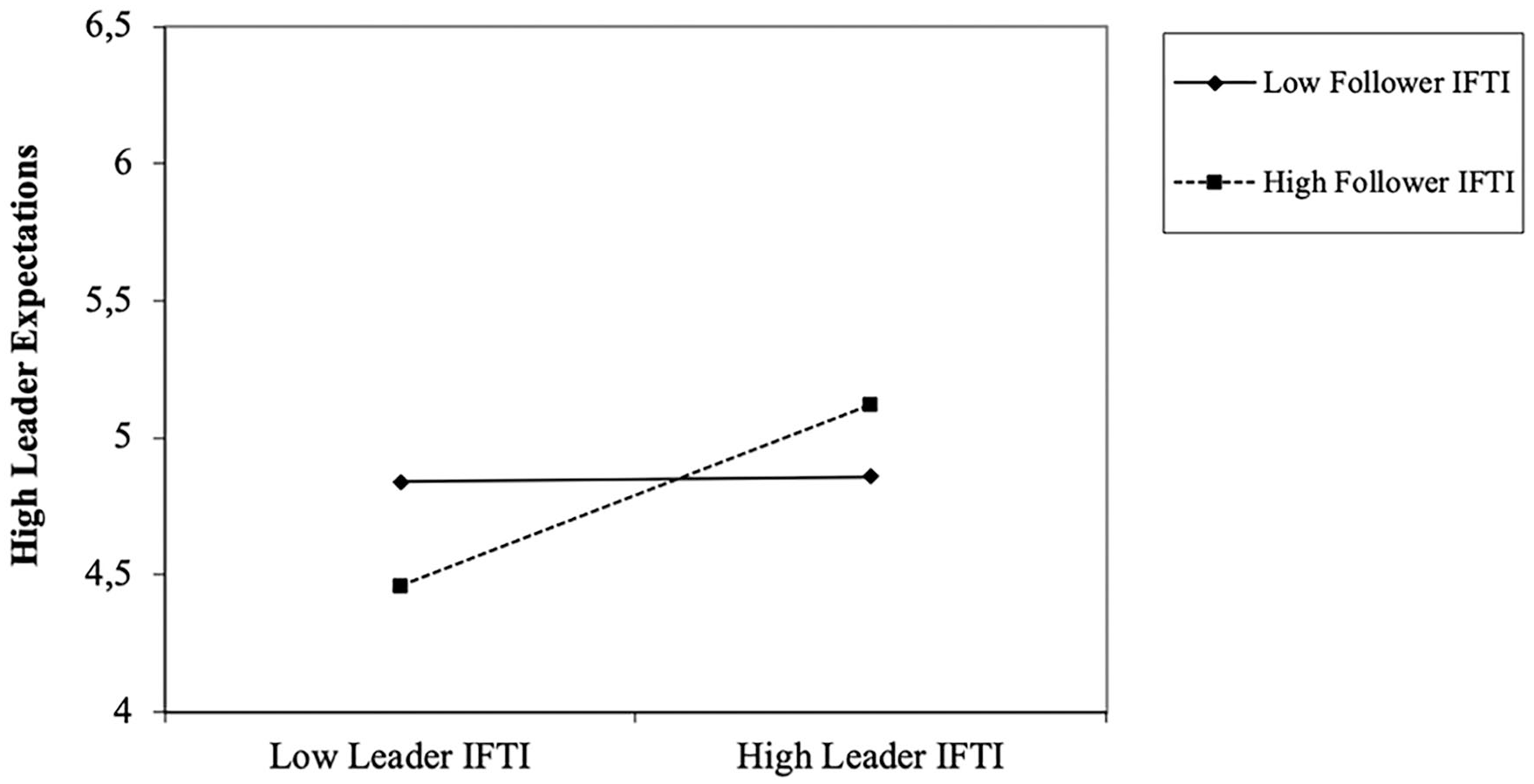
Interaction effect between leader IFTI and follower IFTI on follower perceived high expectations from their leader.
Last, we tested the conditional indirect effects from leader IFTI to follower work engagement through high leader expectations, under different values of followers’ IFTI. We found an indirect effect of leader IFTI on follower work engagement for followers who held a high IFTI (defined at 1 standard deviation above the mean; ŷ = .12; p < .05) but no indirect effect among followers who had an average IFTI (ŷ = .04; p = .08) or low IFTI (defined at 1 standard deviation below the mean; ŷ = −.01; p = .89). In sum, leaders with a high positive IFTI were seen as having higher performance expectations of followers, but this relationship depended on followers’ own IFTI. Moreover, followers who saw their leaders as demonstrating high expectations were more engaged, but this was particularly the case for followers who held a high IFTI.
Discussion
The current study connects the growing literature on IFTs and schema congruence to research on self-fulfilling prophecies and identifies employees’ implicit followership theory of industry as a boundary condition to naturally occurring Pygmalion effects. First, in line with Pygmalion-at-work theory, we theorized and found that leaders’ expectations of their followers are linked to their general underlying IFTI. In addition, we theorized that followers use their IFTIs to interpret leader signals and attribute an IFTI to their leader. When both leaders and followers held a high positive IFTI, leaders’ signals were more likely to be interpreted as high, positive expectations. In contrast, when leaders held a low IFTI their signals were least interpreted as high expectations by high-IFTI followers.
This finding does not only underscore the importance of schema congruence (van Gils et al., 2010), it also relates to Eden et al.’s (2000) argument that when leaders do not really believe that followers are competent, can perform well, and truly have high expectations, they may send automatic, nonverbal signals that are in contrast with the expectations they convey. Avolio, Reichard, et al. (2009, p. 779) noted that: “for a leader′s expectation to become a self-fulfilling prophecy . . . , the leader must truly believe the expectancy and not just try to display they believe it.” Our study indicates that this is partially the case: whether their leader holds a high/positive implicit theory of follower industriousness only appears to matter to followers who hold a high IFTI. Followers who believe that employees generally work hard, are productive and go above and beyond at work, may be especially sensitive to or may more easily register signs of conflicting leader beliefs, signals, and actions in this regard. Whereas high-IFTI followers were less likely to interpret their low-IFTI leader’s performance expectations as high or positive, this was not the case for low-IFTI followers (see Figure 4). Thus, in the context of Pygmalion-at-work processes, especially employees with a high positive IFTI may (implicitly) look for alignment in their leader’s actions and underlying beliefs and care more about his or her authenticity when conveying high expectations (Avolio, Reichard, et al., 2009; Bass & Steidlmeier, 1999; Leroy et al., 2015).
Second, the effect of high leader expectations on work engagement was also dependent on followers’ IFTI. As such, followers’ IFTI again forms a boundary condition to fostering a Pygmalion effect. That is, followers with a high IFTI showed higher levels of work engagement than low-IFTI followers due to perceived high leader expectations. This implies that not all followers may equally internalize or benefit from leaders who convey high performance expectations (Eden et al., 2000; Ryan & Deci, 2000; Van den Broeck et al., 2008). In addition, not perceiving high expectations from their leader was most harmful for high-IFTI followers. Because of their positive followership schema, these followers more naturally go above and beyond at work, but also expect and desire high and positive leader expectations (Lord, Brown, & Harvey, 2001; Whiteley et al., 2012). High-IFTI followers showed the lowest levels of work engagement when they did not feel their leader had high/positive expectations of them. This may be due to to the fact that these followers sensed a misalignment between their own high IFTI and their leader’s conveyed expectations (Junker & van Dick, 2014; van Gils et al., 2010). As a result, leaders may miss out on important opportunities to make the most of these followers’ engagement at work.
Strengths, Limitations, and Future Research
One strength of our study is the use of both leader and follower data to reduce concerns regarding common-method bias (Podsakoff et al., 2003). However, followers rated both their perceptions of their leader’s performance expectations and their work engagement. Although these two variables were measured 6 months apart—which helps justify the directionality of the hypotheses—it would have been possible to have leaders report their expectations of followers in order to alleviate concerns regarding common-method bias to a larger extent. Inherent in our theoretical model, though, is the idea that followers can perceive leader behavior in different ways. In using follower ratings of leader expectations, we underline the active role of employees in shaping leadership processes as a function of their implicitly held followership schemas (Schyns et al., 2012; Sy, 2010).
Another potential limitation is that we only focused on the IFT-dimension related to industry. Although we considered this dimension most relevant to the Pygmalion-at-work process and our focus on employee work engagement, other IFTs—both positive and negative—may influence leader and follower expectations, attitudes, and behaviors. Therefore, future research should consider the role of other IFTs in shaping Pygmalion-like leadership and followership dynamics. For instance, it is worthwhile to investigate the extent to which the implicitly held beliefs that followers are “good citizens” and “enthusiastic” affect people’s expectations, intrinsic motivation, and engagement at work (Sy, 2010). Relatedly, high negative IFTs such as the antiprototypical cognitive categories of follower “incompetence” or “insubordination” may underlie and shape low performance expectations and hinder work engagement (Leung & Sy, 2018; Oz & Eden, 1994). Up to date, organizational research on the drivers and boundary conditions of negative self-fulfilling prophecies such as the Golem effect is particularly scant.
In addition, relying on the Pygmalion model, we considered leaders as the starting point of our theoretical model. It is possible, however, that followers’ work engagement and attitudes affect leaders’ IFTs over time. Future research could consider this possibility and explore the malleability and development of leaders’ and followers’ IFTs over time (Foti et al., 2017). Although the correlation we found between leaders’ and followers’ IFTI was rather low (r = .16; p < .01), we believe that investigating the development of (in-)congruence between different leader and follower IFTs is an important and fertile area for future research. More research is needed to unfold whether and how (mis-)aligned IFTs affect, for instance, leader–member relationship quality, (mutual) liking 1 , and both followers’ and leaders’ engagement at work (Gutermann et al., 2017; Epitropaki et al., 2013).
A last potential limitation concerns our measurement of high leader expectations. This three-item measure is a good assessment of followers’ perception of their leader’s high expectations and forms one of the key dimensions of transformational leadership (Podsakoff et al., 1990). However, it does not explicitly tap into followers’ perceptions of whether their leader is confident that they can or will meet these expectations. Although we argued that this perceived confidence is indirectly reflected in the moderating role of followers’ IFTIs and our theorizing that followers use their IFTs to interpret leader signals, it is possible that some followers may have shown higher levels of work engagement if they felt that their leader explicitly expressed faith in their ability to meet high expectations. Indeed, a leader can communicate high performance expectations without actually articulating confidence that followers can and will fulfill them. Future research can help alleviate this concern by measuring the extent to which followers feel that their leader shows confidence in their ability or potential to meet high performance expectations and how this perception affects their work engagement (Podsakoff et al., 1990).
Relatedly, we found that followers with a less positive IFTI perceived their leader’s conveyed expectations in the same way; whether or not their leader actually held a high positive IFTI did not seem to matter. In contrast, high-IFTI followers seemed to sense that “something was off” when their leader communicated high expectations but implicitly did not believe that followers are willing and able to go above and beyond (cf. actually held a low positive IFTI). This finding points in the direction of high-IFTI followers’ need and search for consistency in their leaders’ actions and underlying beliefs (Fields, 2007; Leroy et al., 2015; Simons, 2002). A leader who displays high expectations without actually holding positive beliefs about follower industry, may be perceived by these followers as unauthentic or fake. In turn, this lack of authenticity can hinder the occurrence of a positive self-fulfilling prophecy (Avolio, Reichard, et al., 2009; Eden et al., 2000). Future research can clarify this issue by examining the role of perceived leader authenticity in the context of naturally occurring Pygmalion effects.
Practical Implications
Our results should be of interest to leaders and organizations because they underline the importance of leader expectations for follower functioning: Pygmalion-like processes occur naturally in organizations in day-to-day interactions between leaders and followers, and research shows that one of the most effective ways to improve leadership and follower outcomes is introducing Pygmalion interventions in organizations (Avolio, Reichard, et al., 2009). Our study provides evidence for the motivational and self-fulfilling role of high leader expectations in fostering follower work engagement (Schaufeli & Salanova, 2010). At the same time, it also indicates that not all employees will interpret or react to leader signals and expectations in the same way. For instance, leaders may actually do high-IFTI followers—employees who are likely more disposed to go above and beyond—a disservice by not setting high expectations.
Our findings also point to the relevance of informing leaders about why and how they (can or should) convey high/positive performance expectations, as well as for which employees such expectations matter the most. Our results indicate that setting high expectations will not harvest the same engagement benefits for all employees and that some followers appear more sensitive to misalignment between beliefs, signals, and actions they attribute to their leaders. Although leader training initiatives often have a behavioral focus in that they aim to integrate certain constructive actions in leaders’ behavioral repertoire, we suggest that interventions should also include a focus on raising leaders’ awareness of their IFTs and how these cognitive schemas subtly form the basis of their expectations, judgments, and behaviors toward their subordinates. Building leader awareness of preexisting implicit theories and how they shape action tendencies can be achieved, for instance, by self-reflection sessions that first bring to light and explore both positive and negative underlying beliefs regarding followership. Another approach is Selective Prototype Activation, in which positive prototypes of followers are repeatedly cued and become more accessible (Schyns et al., 2011; Schyns et al., 2012). Indeed, the more a certain followership schema is readily accessible, the more likely it will shape a person’s actions and attitudes toward followers (Chen & Bargh, 1997; Epitropaki et al., 2013).
Last, raising awareness of IFTs may not only be relevant for improving leader functioning (cf. leader development) but also for optimizing follower functioning and acknowledging the active role of followers in leadership dynamics (cf. leadership development; Day, 2000; Day et al., 2014; Day & Harrison, 2007; Schyns et al., 2012). In the latter approach, the wider context and inherent complexity of leadership and followership are considered. Unfolding and addressing the very cognitive frameworks and implicit beliefs that underlie both leaders’ and followers’ interpretations and behaviors at work stimulates deep-level and transformational learning. In turn, newly acquired insights and actions are more easily transferred to the workplace (Laevers, 2000; Schweiger & Goulet, 2005).
Conclusion
Setting high expectations for followers has become one of the hallmarks of effective leadership. The current research underlines that employees’ implicit followership theory of industry forms an important boundary condition for this practical leadership principle and the occurrence of Pygmalion-at-work processes. Empoyees’ IFTI shapes the relationship between leaders’ IFTI and perceived high expectations amongst followers. In addition, followers’ IFTI codetermine the extent to which leaders’ high/positive performance expectations will set the stage for a more engaged workforce.
Footnotes
Declaration of Conflicting Interests
The author(s) declared no potential conflicts of interest with respect to the research, authorship, and/or publication of this article.
Funding
The author(s) received no financial support for the research, authorship, and/or publication of this article.
