




Abstract
The embeddedness of communities of practice (CoPs)—self-organized groups of practitioners, who engage in the same practices, learn from each other, and innovate together—in contexts of formal hierarchical systems, is characterized through tension. CoPs drive learning and change, while formal systems are focused on stable execution and control, suppressing informality and self-organization. How leadership navigates this tension and shapes embeddedness is of interest to scholars and practitioners alike. In this article, we employ an interpretative research approach to explore how a CoP emerges and interacts with the formal hierarchy of the German Armed Forces. The findings of this study indicate that the embeddedness of a CoP within the formal organizational context molds through the dynamic interplay between administrative leaders and community members. In drawing from complexity leadership theory our grounded, cross-level, process model uncovers how a CoP evolves as individuals experience adaptive pressures in their practices stemming from environmental changes and start to generate new resources in response. Furthermore, it reveals how organizational leaders alternate between administrative leadership and enabling leadership techniques, allowing for both self-organized activities and also the integration of the emergent outcomes. Therefore, the model contributes to our understanding of the processes that unfold at the interface between a CoP and formal hierarchical system.
Keywords
The embeddedness of informal and self-organized communities of practice (CoPs) in formal organizational contexts remains a challenging task for scholars and practitioners alike because it is essentially an attempt to square a circle.
CoPs describe informal, emergent, and voluntary groups of professionals who self-organize to resolve their practice dilemmas and thereby often develop innovative approaches while they improvise, experiment, and probe (Brown & Duguid, 1991; Cox, 2005; Wenger, 1998). These communities, however, do not emerge and operate in a social vacuum (Roberts, 2006). Instead, they are often located in contexts of established organizations (Kerno, 2008) that in vast majority remain organized around the principles of hierarchical structures, are coordinated through centrally imposed formal rules, and are top-down controlled by administrative leadership (Leavitt, 2003). Coupling this two organizational systems, therefore, results in a complex situation because CoPs drive local learning, innovation, and change (Brown, 2004; Brown & Duguid, 1991), whereas formal organizational hierarchy ensures overall efficiency and stability (Stacey, 1995; Thietart & Forgues, 1995).
Embedding these contradictory forces thus creates a conundrum, which is further complicated because the organizational attributes that underlie those two systems are typically considered to be mutually incompatible. CoPs need autonomy from dominant logic to emerge and innovate (Brown & Duguid, 1991), whereas formal systems rely on control of individual behavior to produce results. Yet, too overly rigid formal structures suppress the informality of CoPs (Kerno, 2008; Kirkman, Mathieu, Cordery, Rosen, & Kukenberger, 2011; Thompson, 2005), while on the other hand, exhaustive autonomy can lead to organizational chaos because CoPs are only able to spur local change without some degree of integration (Brown & Duguid, 2001; Duguid, 2008; Tallman & Chacar, 2011).
Given this, understanding the embeddedness of CoPs in formal contexts is critical for contemporary organizations that are striving to unlock their potential for emergent innovation.
Addressing these potentials arising from within the organization, the literature on CoPs is at its core divided into two perspectives. One stream of research recognizes CoPs as informal and organic entities that emerge naturally and tend to resist managerial supervision (Brown & Duguid, 1991; Wenger, 1998). Thus, relations between CoPs and administrative leadership remain mostly obscure (Cox, 2005; Østerlund & Carlile, 2005). In contrast, another stream emphasizes CoPs as tools for knowledge management that managers should intentionally create and control (Bolisani & Scarso, 2014; Probst & Borzillo, 2008; Wenger, McDermott, & Snyder, 2002). Although this literature introduces external leadership of CoPs into the picture, it tends to recommend the formalization of CoPs and thereby often fails to capture the complexities of the cross-level links between CoPs and the formal context (Harvey, Cohendet, Simon, & Dubois, 2013; Roberts, 2006).
Consequently, these lines of research do not sufficiently problematize the inherent tensions between CoPs and their organizational context (Cox, 2005; Roberts, 2006), and thereby offer only limited, empirically grounded theoretical accounts of how organizations can foster the embeddedness of these two contradictory elements. As we argue that focusing on the tensions between formal and informal systems could yield substantive contributions to our understanding of embeddedness and leadership regarding CoPs we ask: How do the tensions between a CoP and its formal organizational context unfold over time? And how do formal, administrative leaders navigate these tensions?
To explore these questions, we draw on interview, observational, and archival data gathered within the German Federal Armed Forces (FAF). The military provides us with an ideal setting to study our research questions since the dynamics between an evolving CoP and formal leadership of the military hierarchy should become transparently observable. More specifically, we were able to investigate the Cultural Advisory Community 1 (CAC), an informal network of soldiers concerned with intercultural competencies in modern warfare scenarios who instigated the development of several new resources such as training programs and educational materials. Based on these observations, we utilized an interpretative research approach (Gioia, Corley, & Hamilton, 2013) to build a grounded, process model (Langley, 1999; Langley, Smallman, Tsoukas, & van de Ven, 2013), which explicates the embeddedness of a CoP within the formal organizational system as the dynamic interplay between self-organized resource generation in a community with several enabling leadership mechanisms.
In building this model and explaining its processes, we draw from research on complexity leadership theory (CLT; Marion & Uhl-Bien, 2001; Uhl-Bien & Marion, 2009; Uhl-Bien, Marion, & McKelvey, 2007). This allows us to theorize the resourcing activities of community members as emergent self-organization in a complex adaptive system (CAS; Chiles, Meyer, & Hench, 2004; Stacey, 1995). In this sense, change (i.e., a renewed resource endowment) arises through the interaction of interdependent agents (i.e., community members), who engage with adaptive challenges based on local knowledge and without intervention of a central decider (Chiles et al., 2004; Tsoukas & Chia, 2002; Uhl-Bien & Arena, 2018). In keeping with complexity leadership theory (Uhl-Bien et al., 2007; Uhl-Bien & Marion, 2009), our model further suggests that this process of self-organized resource generation becomes embedded in the formal system through leaders’ diverse enabling leadership practices. That is, formal leaders, on the one hand, enable community activities, energize them with much-needed assets (i.e., material and immaterial resources) and on the other hand transform the emergent outcomes (i.e., the newly developed resources) into formal structures. These findings contribute to the CoP as well as the complexity leadership literature in several ways.
First, they highlight how the interactions between members and formal leaders sustain the tension between the formal system and the self-organized CoP, and thus dynamically shape the embeddedness. In doing so, they move the discussion in the literature away from viewing communities as either autonomous or formally controlled (Harvey et al., 2013; Kirkman et al., 2011; Thomas, 2017) toward an understanding that situates them in the space between the formal and informal organization.
Second, by outlining the process of how community members generate new resources in practice, they foreground the processual nature of CoPs instead of viewing them as fixed entities (Pyrko, Dörfler, & Eden, 2017). In light of this, we envision CoPs as a meta-resource, that is, an organizational capacity to shape and renew other resources in practice.
Finally, they contribute to our understanding of complexity leadership theory (Uhl-Bien et al., 2007). In particular, we uncover the mutual adjustment of community members’ and managers’ mental models while they negotiate over resources as a precondition for switching between enabling and administrative leadership practices.
Literature Review
Communities of Practice
CoPs describe the social context in which professionals produce and reproduce knowledge by engaging in situated practice (Brown & Duguid, 1991; Lindkvist, 2005). More specifically, Wenger et al. (2002) define them by three structural elements, namely, domain, community, and practice. Domain refers to the knowledge area and specialized expertise held by members. Community describes the net of relationships, the shared identity, and the sense of belonging among members. Finally, practice refers to the actual activities in which members collectively engage. The presence of these three elements creates a social context in which individuals continuously make sense of their practices, negotiate meaning, and exchange perspectives. Regarding the embeddedness of CoPs into formal organizational settings, however, two dominant views become apparent in the extant literature (see Table 1).
The Two Streams in the Community of Practice (CoP) Literature.
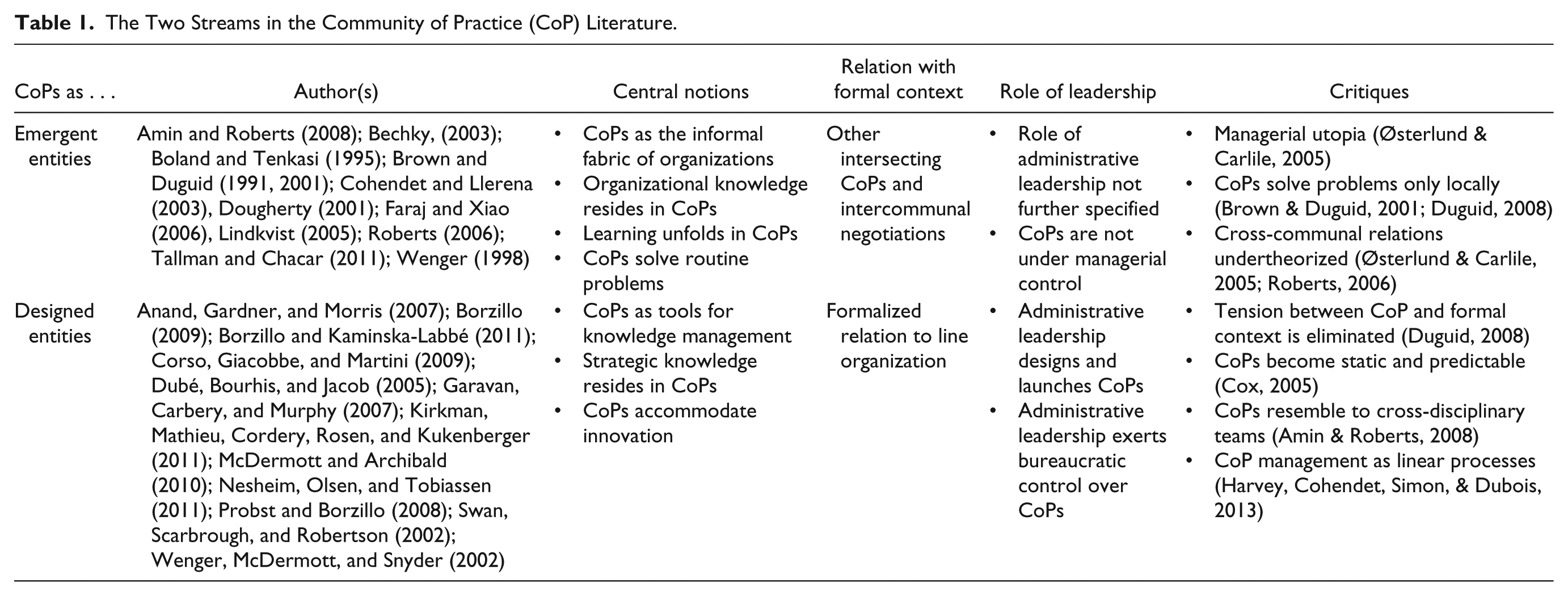
First, early research on CoPs underlines their emergent and spontaneous character, depicting them as natural social phenomena that develop while individuals negotiate meaning along their shared practices (Brown & Duguid, 1991; Cox, 2005; Lave & Wenger, 1991). According to this perspective, the relationship between the informal CoP and the formal organization is one of a conflictive struggle between the formally prescribed and the improvised work practices of a community (Brown & Duguid, 1991; Cox, 2005). Brown and Duguid (1991) describe this tension from the community members’ perspective and illustrate how they feel stifled by managers, who largely reject the frontline workers’ improvisational practices.
This literature, however, remains relatively vague about the cross-communal interactions between members and their surroundings, particularly about administrative leadership (Cox, 2005; Østerlund & Carlile, 2005; Yakhlef, 2017). It traditionally portrays CoPs as autonomous, independent entities that do not need supervision and that instead evade managerial control (Koliba & Gajda, 2009). Furthermore, some scholars argue that the self-organized nature of communities would contradict any attempt to externally influence them (Contu & Willmott, 2003; Fox, 2000). Such a perspective, however, obscures the dilemma that CoPs might solve problems locally and produce local learning and innovation at the expense of global fragmentation, incoherence, and drift, while an organization’s heterogeneous and autonomous CoPs pull in opposing directions without the dissemination and integration of their knowledge (Brown & Duguid, 2001; Duguid, 2008; Tallman & Chacar, 2011). In sum, this literature stream offers only limited insight into the embeddedness of CoPs in formal contexts because relationships with administrative leadership are mostly absent from this perspective (Koliba & Gajda, 2009; Peltonen & Lämsä, 2004; Roberts, 2006).
More recent research offers a contrasting view of this interplay, positing that management should cultivate and integrate CoPs to leverage their full potential (Anand et al., 2007; Dubé et al., 2005; Kirkman et al., 2011; Swan et al., 2002; Wenger et al., 2002). Hence, these studies explicitly focus on how managers can influence these quasi-informal entities (Kirkman et al., 2011). For instance, Thompson (2005) notes that formal managers can construct seeding structures containing shared symbols, artifacts, or boundary objects that enable potential community participants to coalesce. Likewise, Retna and Ng (2011) suggest that management can support and facilitate the emergence of CoPs through indirect interventions. Several other scholars argue for more explicit and direct supervision of CoPs as tools for knowledge management that involves their purposeful creation and alignment with their organizational context (Bolisani & Scarso, 2014; Clegg, Scarso, & Bolisani, 2008; Probst & Borzillo, 2008). Accordingly, some studies seek to establish guidelines, success factors, and lists of governance mechanisms for the launch and management of CoPs without explicating many of the nuances of the actual interactions between CoPs and administrative leadership (Borzillo, 2009; Corso et al., 2009; McDermott & Archibald, 2010; Nesheim et al., 2011; Probst & Borzillo, 2008).
Unfortunately, these studies either focus on organizational groups that are more similar to ad hoc created task forces and cross-disciplinary teams than they are to CoPs (Amin & Roberts, 2008; Thomas, 2017), or lack longitudinal data that would explain the cross-level links between community, formal context, and respective outcomes (Harvey et al., 2013). Although this literature centers on the relationship between CoPs and formal context, it tends to suggest simple solutions such as formalized roles and top-down governance mechanisms. Such controlling measures that aim to preplan, align, and integrate a community’s activities, however, discourage innovation and cause CoPs to become static and predictable managerial tools, instead of being improvisational and organic. To put it differently, this line of research favors the elimination of all tensions between CoPs and the formal system (Contu & Willmott, 2003; Duguid, 2008), thereby attenuating the concept’s essential appeal (Pyrko et al., 2017).
The review of relevant literature thus illustrates that although the embeddedness of CoPs in formal contexts is characterized with tension, we have limited insights into how these tensions evolve and how leaders should maintain them for maximal organizational benefit.
Complexity Theory
Complexity theory originally developed from physics and biology, where scientists found that linear models are increasingly insufficient for capturing the complexities of natural phenomena. Instead of providing cause and effect solutions, complexity theory sees the world as fundamentally unpredictable, unstable, and nonlinear and therefore unable to be explained with reductionist models (Kauffman, 1993; Prigogine, 1997). Some scholars argue that this paradigm shift might have equally dramatic effects on the social sciences, resulting in a growing body of work that applies complexity reasoning to organizational problems (Anderson, 1999). In particular, studying industries, organizations, or organizational subgroups as complex adaptive systems (CAS) has drawn interest from management scholars (Stacey, 1996). 2
In general, CAS describe networks of agents—for example, individuals or groups within social systems—who interdependently interact and learn from each other, share interests or goals and hold similar worldviews due to the history of previous interactions (Marion, 1999). According to Uhl-Bien et al. (2007), “CAS are neural-like networks of interacting, interdependent agents who are bonded in a cooperative dynamic by common goal, outlook, need, etc.” (, p. 299). Dooley (1997) further notes that CAS “behave/evolve according to two key principles: order is emergent as opposed to predetermined, and the state of the systems is irreversible and often unpredictable” (p. 83). That is, in CAS individuals or groups interact in an unpredictable, self-organized fashion, and change (e.g., ideas, innovations, adaptive responses) can spontaneously and nonlinearly emerge from these interactive processes (Chiles et al., 2004; Uhl-Bien et al., 2007). CAS in organizations are thus organic, and their structure is not predetermined by managerial fiat (Marion & Uhl-Bien, 2001).
Complexity theory with its focus on CAS may provide uniquely appropriate tools to understand the interrelationship between CoPs and formal organizational contexts for several reasons.
First, complexity theory portrays organizations as dynamic; that is, they are seldom in states of equilibrium (Stacey, 1995). Such nonequilibrium conditions that lie in between stability and chaos give rise to the complex adaptive system dynamics, when individuals start to interact without a predetermined plan from which novelty emerges (Uhl-Bien et al., 2007). Complexity theory is thus ideally suited to studying informal, emergent social dynamics in organizations such as CoPs (Uhl-Bien & Marion, 2009). Indeed, CoPs display similar properties to CAS (Borzillo & Kaminska-Labbé, 2011). For example, CoPs also comprise interacting experts who are bonded together through reflective feedback loops (Brown & Duguid, 1998).
Second, instead of viewing the relationship between formal and informal forces as mutually exclusive, complexity science perceives them as complementary elements (Uhl-Bien & Marion, 2009) and thereby recognizes the fundamental tensions unfolding between them (Thietart &Forgues, 1995). Complexity theory argues that these seemingly opposing forces work together to create emergence; thus, the tension between them accommodates learning, innovation, and adaptability. In the simplest terms, CAS generate new ideas, whereas the formal, bureaucratic organization converts them into innovations and ongoing results (Uhl-Bien & Arena, 2017, 2018).
Third, unlike the CoP literature that tends to either focuses on internal community processes or external managerial action, complexity theory explicitly recognizes the multilevel nature of the emergent phenomena. Complexity models are therefore always meso, meaning they comprise multiple levels of analysis and their interdependencies: micro-levels regarding individual or group processes and macro-levels involving contextual, organizational processes (Anderson, 1999; Lichtenstein & Plowman, 2009).
In this study, we will employ complexity theory as an interpretative framework to theorize how the Cultural Advisory Community evolved within the German military hierarchy and was able to spur the development of new much-needed resources.
Setting and Methods
Given the undertheorized relation between informal CoPs and administrative leadership, we choose to explore this phenomenon inductively, employing a grounded, interpretative research approach (Gioia et al., 2013) to develop a process theory (Langley, 1999) about the embeddedness of CoPs. Interpretative research aims at building a theory that is grounded in the interpretations of events or social activities of those who experience them (Locke, 2001; Suddaby, 2006). Even though interpretative research foregrounds the point of view of informants, the researchers’ task is to interpret further and structure these interpretations keeping prior theory in mind to build an emergent model (Gioia et al., 2013; Strauss & Corbin, 1990). In our case, this entails developing a model that explains the how and why of the cross-level dynamics between a CoP and its formal organizational context (i.e., in particular, administrative leadership).
Research Setting
Data collection occurred at the FAF. Military organizations are often characterized by their totality, meaning that they strive to control nearly every aspect of the life of their members. Thus, armed forces traditionally have a strong emphasis of bureaucratic characteristics such as a clear division of labor, rigid hierarchies, extensive formalisms, and an explicit delegation of authority (Kark, Karazi-Presler, & Tubi, 2016). In recent years, however, the shift in military warfare scenarios to the full spectrum of operations, the ever-increasing speed of technological developments, and socio-cultural changes at large have caused various adaptive pressures within the armed forces that present challenges, especially for military leadership. In particular, armed forces are compelled to become more responsive to an increasingly uncertain and changing environment, which requires continuous adaptation, innovation, and creativity on tour as well as in garrison. On the other hand, adhering to bureaucratic procedures as well as discipline and order are still political and military imperatives. Within this context of competing necessities and tension, the relationship between informal, self-organizing CoPs that push for change and adaptation with the hierarchical coordination of the military bureaucracy should become “transparently observable” (Pettigrew, 1990, p. 275).
Case Overview
We employ a single case study design to answer our research questions (Yin, 2009). Case study design and interpretative research are ideally suited to studying complex social processes as they generally aim at explicating the what, how, and why of the links among context, processes, and outcomes (Langley, 1999).
To this end, we focused our data collection on the Cultural Advisory Community. This CoP started to evolve alongside the increased engagement of the armed forces in missions abroad during the 1990s. Relatively early on, members of the community recognized the increased importance of intercultural competencies in such missions and informally started to further their knowledge in this domain. Generally, the group consists of approximately 80 to 100 members from several departments and units at multiple hierarchical levels and includes soldiers from other forces as well as civilian experts in the field of intercultural studies. In our findings section, we will discuss in detail what caused the community to evolve and how its members interacted with the administrative leadership of the military hierarchy.
Data Collection
We collected data from a larger research project that centered on questions around CoPs as knowledge sources in the FAF. In the first phase of our project, beginning in September 2013, we introduced the study’s aim and scope to the upper hierarchical levels of each branch to obtain field access. Throughout these conversations, we took extensive field notes that gave us contextual insight and enabled us to identify promising areas for in-depth investigations at lower hierarchical levels. During one meeting with upper echelon generals, we became attentive to the intercultural competence domain and the Cultural Advisory Community. Subsequently, we gathered our qualitative data during a second phase of the project from late 2013 up to mid-2017.
Semistructured Interviews
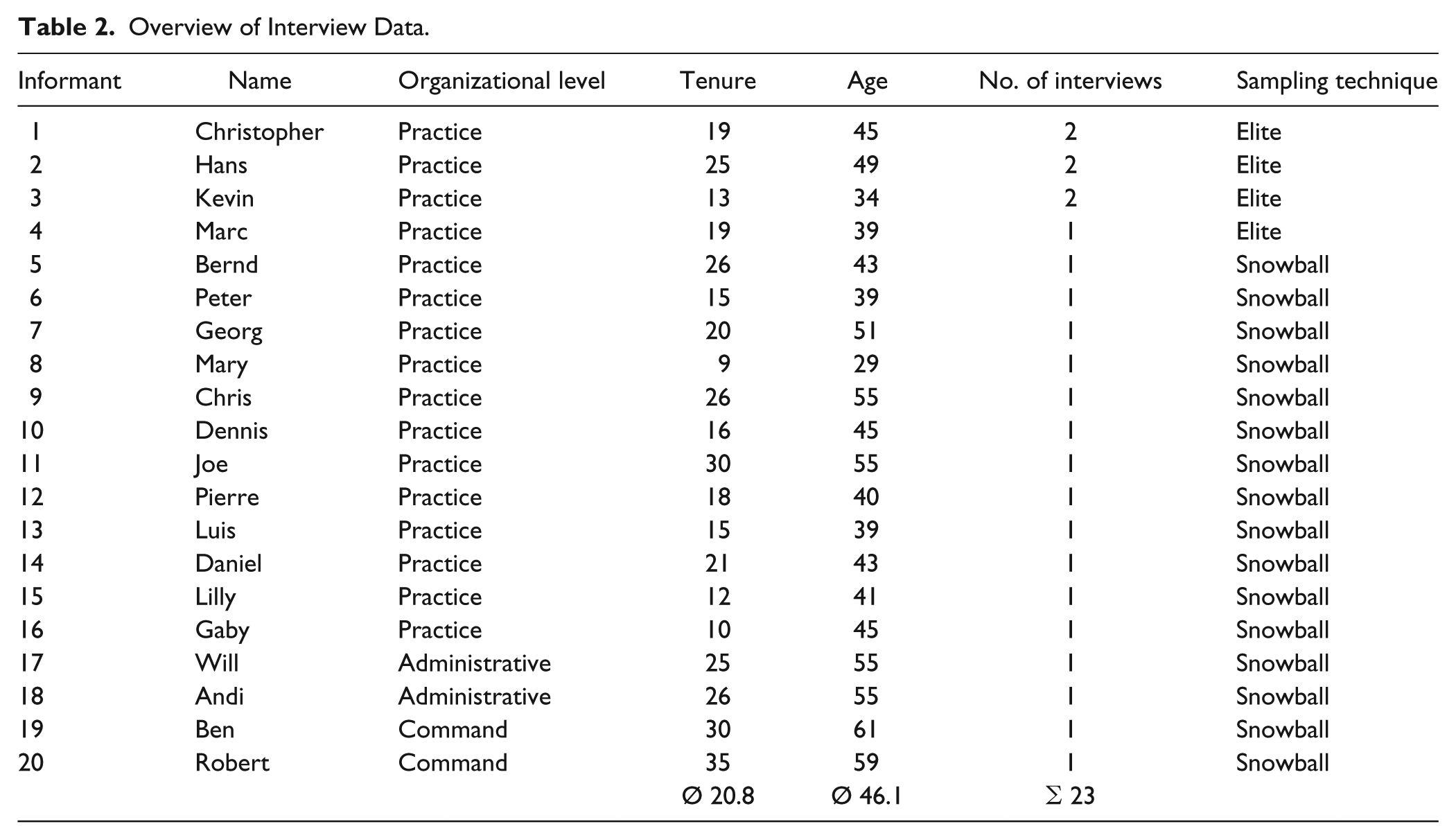
We collected data via 23 semistructured interviews with community members and their formal superiors. We started sampling by selecting an accessible superior within the intercultural competence domain who could provide us with a general overview of the community. From this initial conversation, we learned about the Cultural Advisory Community’s history, its successes, and its main protagonists. Consequently, we were able to shift to an elite sampling approach by interviewing four “native” community members (Wenger et al., 2002), which enabled us to study the community’s dynamics from the most experienced members’ own perspectives (Gioia et al., 2013).
For example, Hans 3 was an active member for over 10 years and was involved with several initiatives of the community, such as the planning of a conference for the intercultural competence domain. After each conversation with such a “native” member, we asked the informant which of her/his colleagues might have additional insights. In this way, we elicited four further informants using the snowball sampling technique (Shah, 2006). Initially, our interview guide broadly focused on the community’s history, the informant’s role in this CoP, and the member’s motivation to participate in such informal interactions. During this first round of interviews, we learned that the CAC not only engaged in knowledge sharing but was also responsible for the development of new resources such as a specialized training course for intercultural mission advisors. Based on this new theme, we started to concentrate our inquiries more on this resource generation process and how it intertwined with administrative leadership. Thus, we conducted a second round of interviews with a more focused questionnaire involving questions on how community members interacted with their formal superiors during this process. To this end, we revisited three of our key informants for follow-up interviews and again asked for further knowledgeable community members. As a result, we conducted 15 second round interviews. In particular, we were able to speak with four formal superiors—commanding officers or officers in higher administrative positions with authority over community members—which allowed us to compare community members’ statements. Overall, the conversations lasted from 60 to 110 minutes, and we transcribed each interview verbatim.
Our sample involved 20 interview participants ranging in rank from sergeant major to general with nine or more years of tenure in the armed forces. The majority of informants held the rank of captain or major at the time of the interview, although some senior noncommissioned officers, as well as one general, were also interviewed. Moreover, except for three informants, the interviewees were male, which represents approximately the same proportion of 12% of female soldiers serving in the armed forces. The sample included active (15) and nonactive soldiers (3) as well as civilian employees (2) between the ages of 29 and 61 years. Additionally, the sample comprised community members located on practice levels (16) and officers in commanding (2) or higher administrative positions (2). Table 2 contains an overview of the interview data.
Overview of Interview Data.
Also, we conducted approximately 20 informal conversations with community members and formal superiors. These discussions occurred while we participated in the community’s annual conference and during our visits to the informant’s units, where we were often introduced to the commanding officer and had lunch together in the officer’s mess. These talks regularly involved discussions of the armed forces, organizational changes and challenges, and conversations about the vital role the CAC plays in this dynamic context. After each session ended, we wrote field notes from our experiences. In sum, these conversations gave us additional contextual insights.
Observational and Archival Data
We also gathered case insights by analyzing documents such as intranet homepages on intercultural mission advisors and their mission experiences. Furthermore, we reviewed handbooks on military leadership, official strategy papers of the armed forces, and prior publications on missions abroad and intercultural competence. For instances, we sighted numerous experience reports from higher-ranking officers in which they provide their experiences of missions abroad and military leadership in general. These documents enriched our understanding of the military context and later helped us to compare informants’ descriptions of the development of their domain as well as their claims about leadership practices.
We also actively participated three times in the annual conference on intercultural issues that was planned and coordinated by community members, allowing us to observe how members interacted with each other during workshops, and in particular, how they worked on developing and implementing a specialized training course for mission advisors. Also, the observations enriched our understanding of informants’ descriptions of specific leadership practices. For example, we were able to observe how a high-ranking general visited the conference and delivered an inspiring speech to community members. These observations helped us to develop a deeper understanding of the case and enabled us to triangulate informant’s descriptions (Eisenhardt, 1989). We summarize the utilized data sources for this article and how they informed our analyses in Table 3.
Overview of Data Sources.
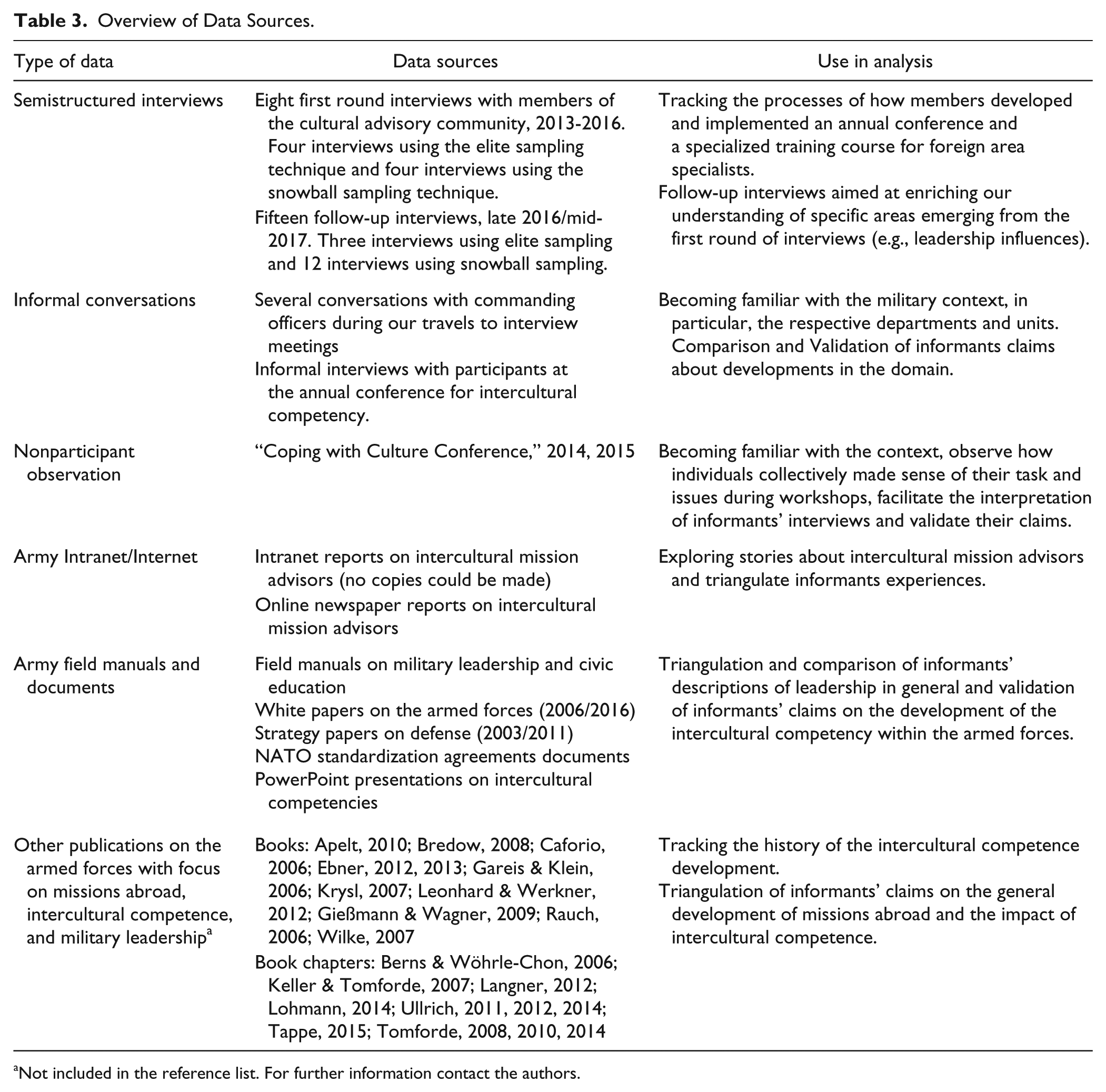
Not included in the reference list. For further information contact the authors.
Data Analysis
The analysis procedure in this study follows the recommendations for qualitative, interpretative research from Gioia et al. (2013). This approach requires data collection, data analysis, and theorizing to be reciprocally intertwined, in the sense that data, emergent concepts, and extant literature are constantly compared and contrasted throughout the research process (Strauss & Corbin, 1990; Suddaby, 2006). The result of this recursive movement is a dynamic, inductive model that is both grounded in informants’ interpretations but also abstracted toward a theoretically relevant level (Gioia et al., 2013; Gioia & Chittipeddi, 1991).
The process of developing a theory on the embeddedness of CoPs within formal organizational context began with sighting the first interview transcripts, archival documents, and observational data to gain an initial understanding of the qualitative material. During this early stage of analysis, we wrote a descriptive summary of the Cultural Advisory Community to familiarize ourselves with the case at hand and reconstruct its history.
Multiple rounds of coding followed this preliminary phase. We began with a first-order analysis (Gioia et al., 2013; Van Maanen, 1979), similar to an open-coding approach recommended by Strauss and Corbin (1990). Open coding involved reading each transcript line by line to identify incidents, events, and statements of possible significance and grouping them into first initial categories. We labeled these themes using primarily informant’s language or simple descriptive phrases reflecting the informants’ level of experience (Corley & Gioia, 2004). Many of these tentative categories emerged around the broad questions of our initial interview guide. As we allowed for additional factors to surface from the data, we identified themes indicating that community members informally started to create new resources. Also, themes emerged describing how this resource generation dynamic intertwined with the administrative leadership of the FAF.
As these themes emerged, we consulted literature around the dynamic between formal and informal parts of the organization, in particular, research on complexity leadership theory (Uhl-Bien et al., 2007) to better make sense of our findings. With a more focused understanding of the data, we recoded our material to the point of saturation, where no additional first-order codes, containing new insights would arise from continued exploration (Glaser & Strauss, 1967 ).
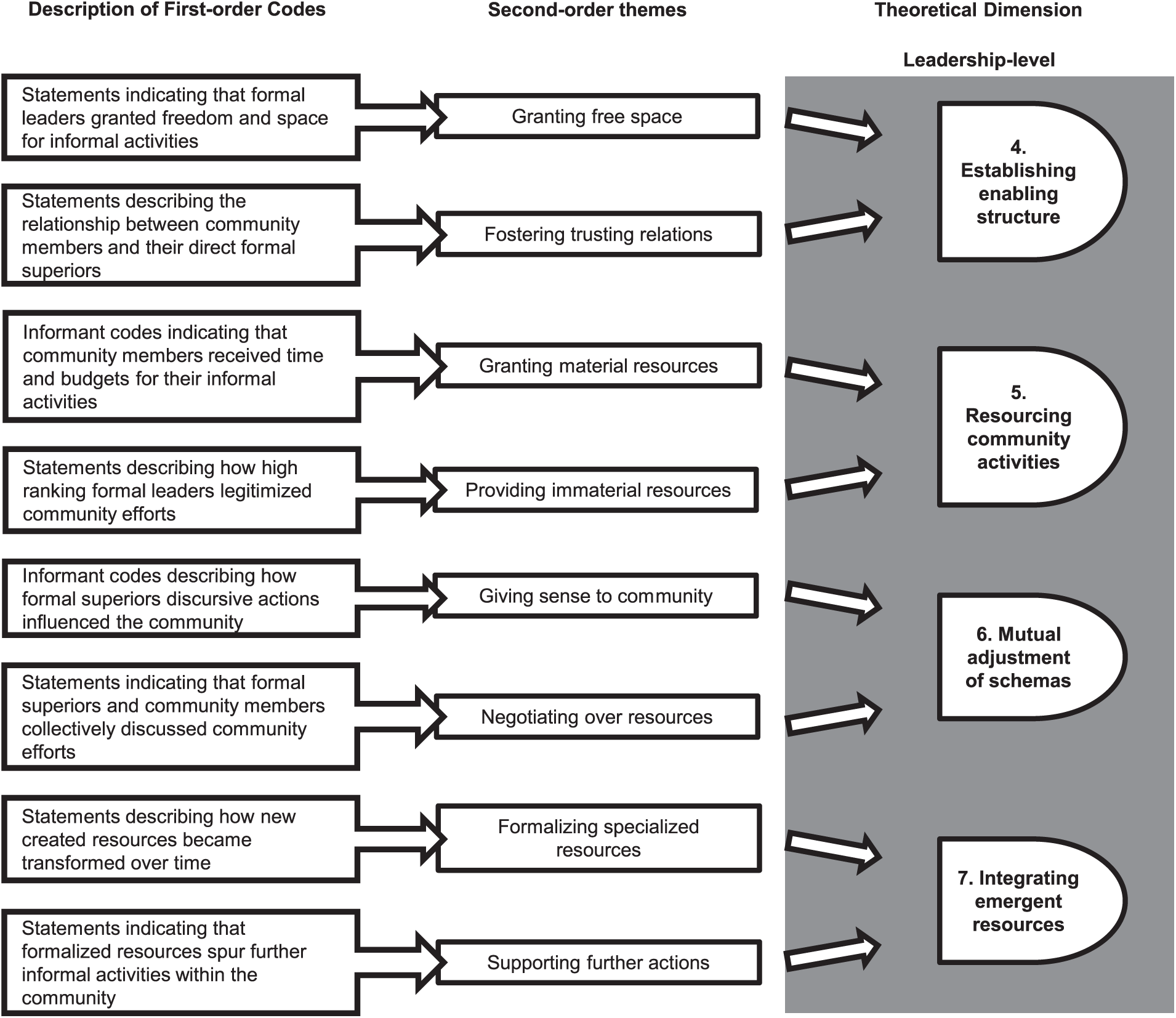
We then conducted a second-order analysis using coaxial coding (Strauss & Corbin, 1990). That is, we related first-order codes to each other by comparing them across the data and searching for similarities and differences between them, thereby assembling similar themes into more general perceptions (second-order themes). For example, we categorized first-order themes such as open communication with superiors and importance of superiors’ trust in community members under the second order theme “Fostering trusting relations.” In keeping with Gioia et al. (2013) we then assessed whether it is possible to even further cluster the second order themes by investigating the relationships between them, a process that yielded seven overarching theoretical dimensions, one of which associates with individual-level occurrences, two reflecting community-level dynamics, and four about the administrative leadership level. Figures 1 and 2 illustrate the resulting “data structures” (Gioia et al., 2013) that display the transformation of raw data to themes and theoretical dimensions.
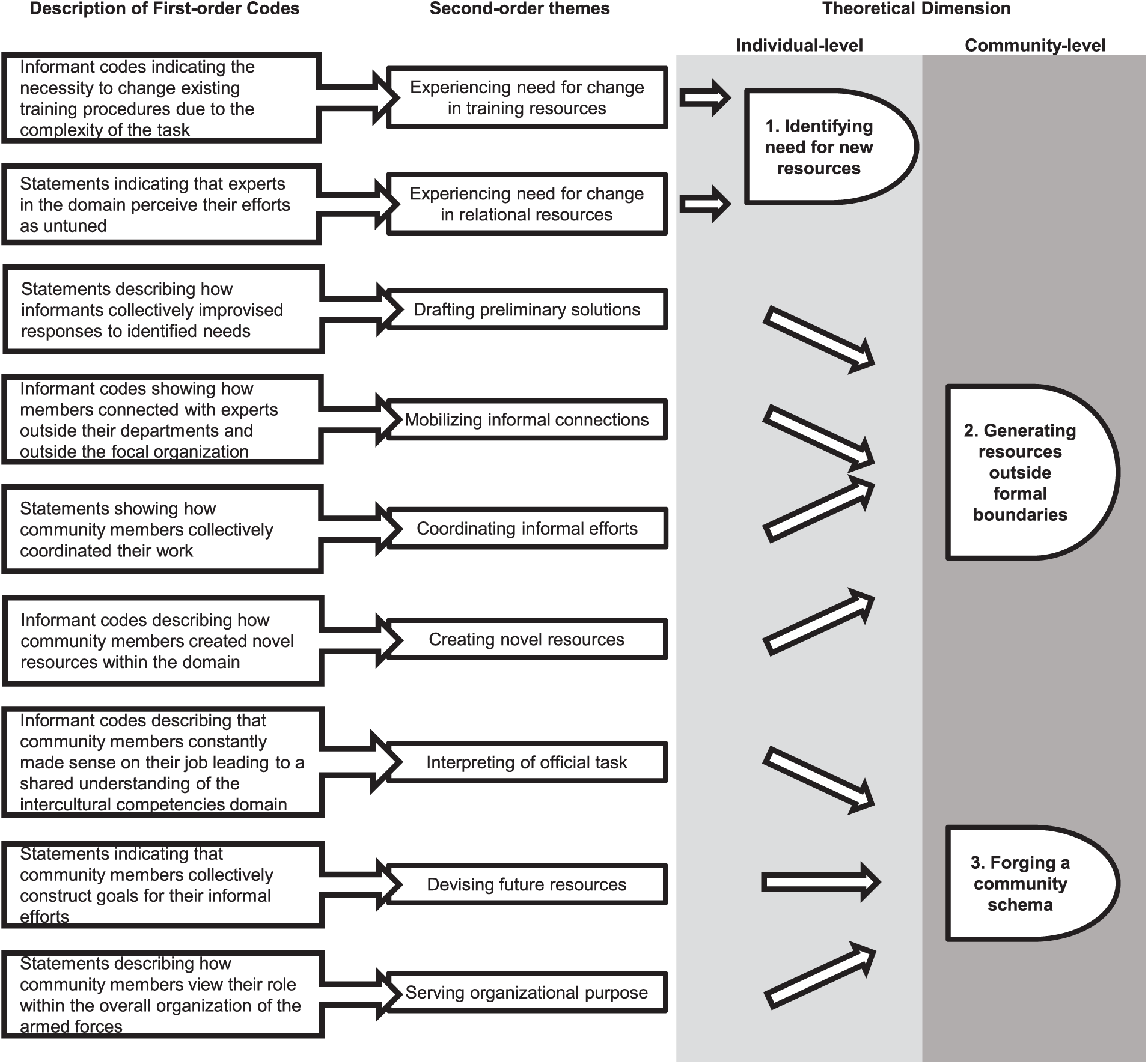
Data Structure 1.
Data Structure 2.
In a final step, we probed the sequential and interactive relations between the theoretical dimensions of the individual, community, and administrative leadership levels, and in doing so, established a grounded, cross-level, process model (Langley, 1999) that captures the dynamism between the CoP and its formal organizational context (i.e., the embeddedness; Patvardhan, Gioia, & Hamilton, 2015).
Findings
Below, we will present our results in two parts. In the first part, covering a pre-study period, we briefly outline environmental changes in the military that shaped the study’s context and present the analysis of how individuals across units and departments made sense of them. In the second part, we offer a detailed analysis of how administrative leaders interacted with the CAC. Together, these two parts provide the basis for the grounded, cross-level, process model of the embeddedness of CoPs within formal organizational contexts presented in Figure 3, which we discuss in the section following the findings.
Findings Part 1: Changes, Needs, and Self-Organized Resource Generation
Prologue
Up to the 1990s, during the east-west confrontation, intercultural aspects were essentially not regarded at any level of military mission planning and conduction. During the 1990s, however, the fundamental shift in military tasks—from national defense to multinational crisis and conflict management—led to more engagement of troops in diverse missions abroad. In the context of such missions, intercultural interactions become a routine aspect of military duty. Cross-cultural communications describe contact between individuals holding distinctively different value conceptions, behaving in dissimilar patterns, and who interpret each other’s actions according to their cultural schemas. For example, troops are in daily contact with the civilian population in the country of deployment during military operations such as reconnaissance patrols, training assignments of local forces, or coordination meetings with local leaders. In such high-pressure situations, a lack of intercultural awareness or training could lead to disastrous outcomes, as many incidents in missions abroad have shown which ultimately can be traced back to cultural misconduct of the involved troops. Although many commanders and high-ranking officers recognized this inherent new aspect of modern missions early on, from an organizational perspective, the armed forces mostly ignored intercultural issues throughout the 1990s.
In the mid-2000, however, several departments began to address the intercultural topics of modern warfare aiming at increasing intercultural knowledge within the troops. In 2006, intercultural education was officially stated to be an integral part of leadership development and civic education within the armed forces in a White Paper. Moreover, in 2008, intercultural competence was defined in the revised handbook on leadership development as a critical organizational capability that is essential for mission accomplishment and own force protection in modern warfare scenarios.
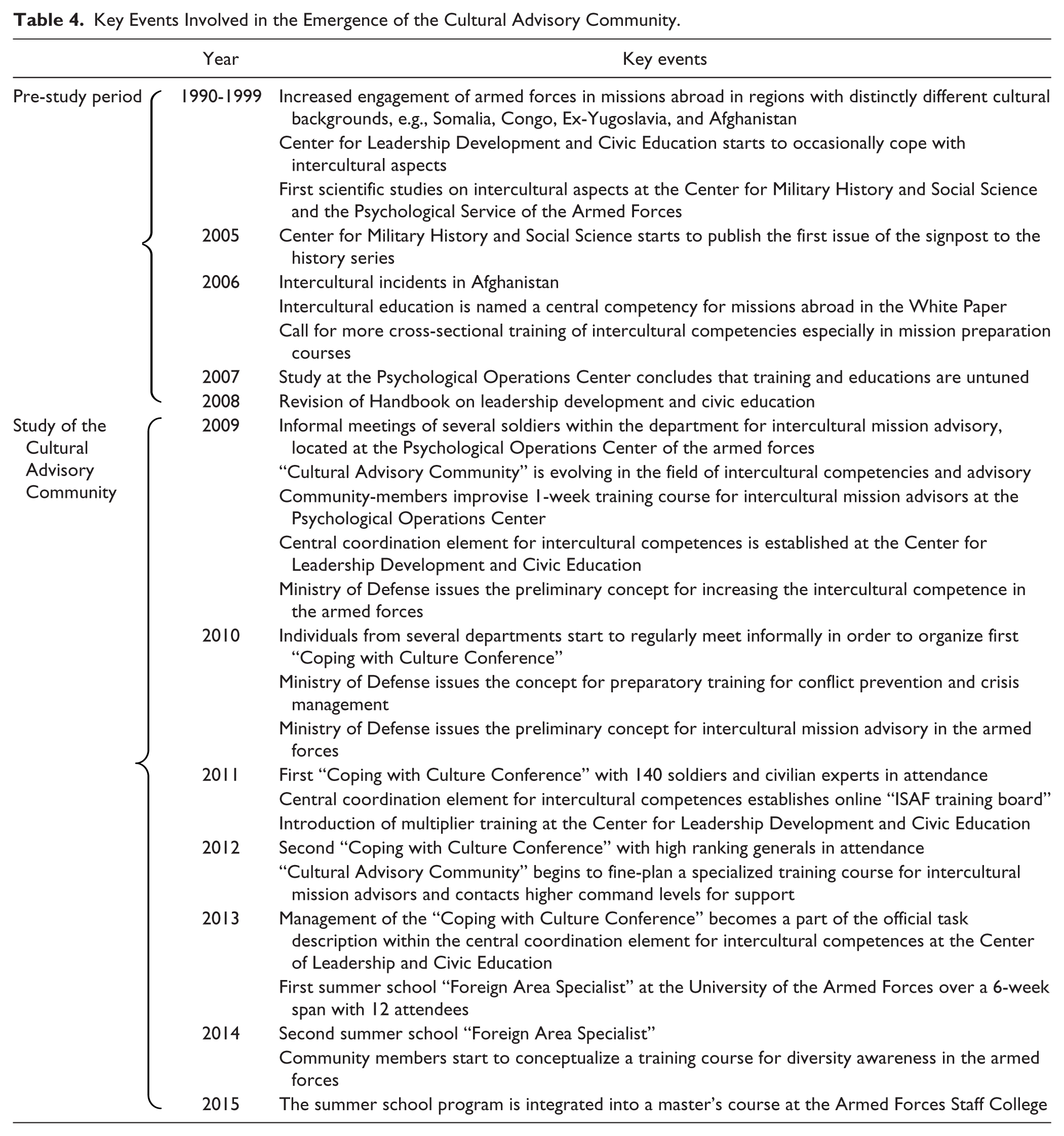
The brief narrative above serves as a prologue to the occurrence of the CAC within the intercultural competence domain, which we introduce below (see also Table 4 for a timeline of events pertinent to the emergence of the CAC).
Key Events Involved in the Emergence of the Cultural Advisory Community.
Identifying the Need for New Resources: Dimension 1 (Individual Level)
Although formal concepts and strategies for intercultural competence developed in 2009, several soldiers and civilian employees perceived the resource endowment in their domain of intercultural competence as limited. Kevin and Marc, for example, were situated in the department for intercultural mission advisory at the Psychological Operations Center. Cultural advisory arose from the first attempts to provide force commanders with regional consultancy during the Balkan missions as one central field of activity within the intercultural competence domain. Their official tasks involved supporting cultural advisors in live missions abroad, writing reports for higher command, organizing daily staff work, and training new advisors. As our informants recurrently pointed out, intercultural mission advisors require in-depth training in multiple disciplines. As Kevin described to us, however, the training situation at the time was that intercultural experts were hired from the civilian market and afterward trained in a 2-week crash course. Our informants experienced this as insufficient for effective consultancy in missions abroad. As Kevin recalled it, We recognized we live here from hand to mouth because there is no real support from the official side and there are no real resources in this domain. Thus, we need to structurally better train our people. As I said before, there were no training guidelines, no training courses. There was nothing to train someone as an intercultural mission advisor.
Similarly, Hans, a lieutenant colonel who held an official position at the Army’s Center for Leadership Development, recognized that several courses aiming at increasing intercultural awareness were in need of improvement. His tasks involved coordinating, standardizing, and harmonizing intercultural training courses and new initiatives in the domain. His field of activity, however, was not formally described in official guidelines and he sensed early on that a multitude of units and departments were involved in intercultural aspects, while there was no mentionable exchange between actors: “And the process started when we realized that there was no coordination in this field. Everyone did his own thing and cooked his own soup” (Hans). Likewise, Kevin noted that to fulfill the practice of advisory, one depends on a broad network of experts because the necessary knowledge for effective consultancy is too extensive: “Networking always was essential for us, this means to stay in contact with other departments. However, we did not know who were the right experts and who had which abilities” (Kevin).
Another informant, Christopher, a former soldier at the Army’s Center for Geographic Information, also described the need for further networking and exchange with other experts to effectively work on his task. Within his focal department, he was more or less on his own with his interest in intercultural aspects.
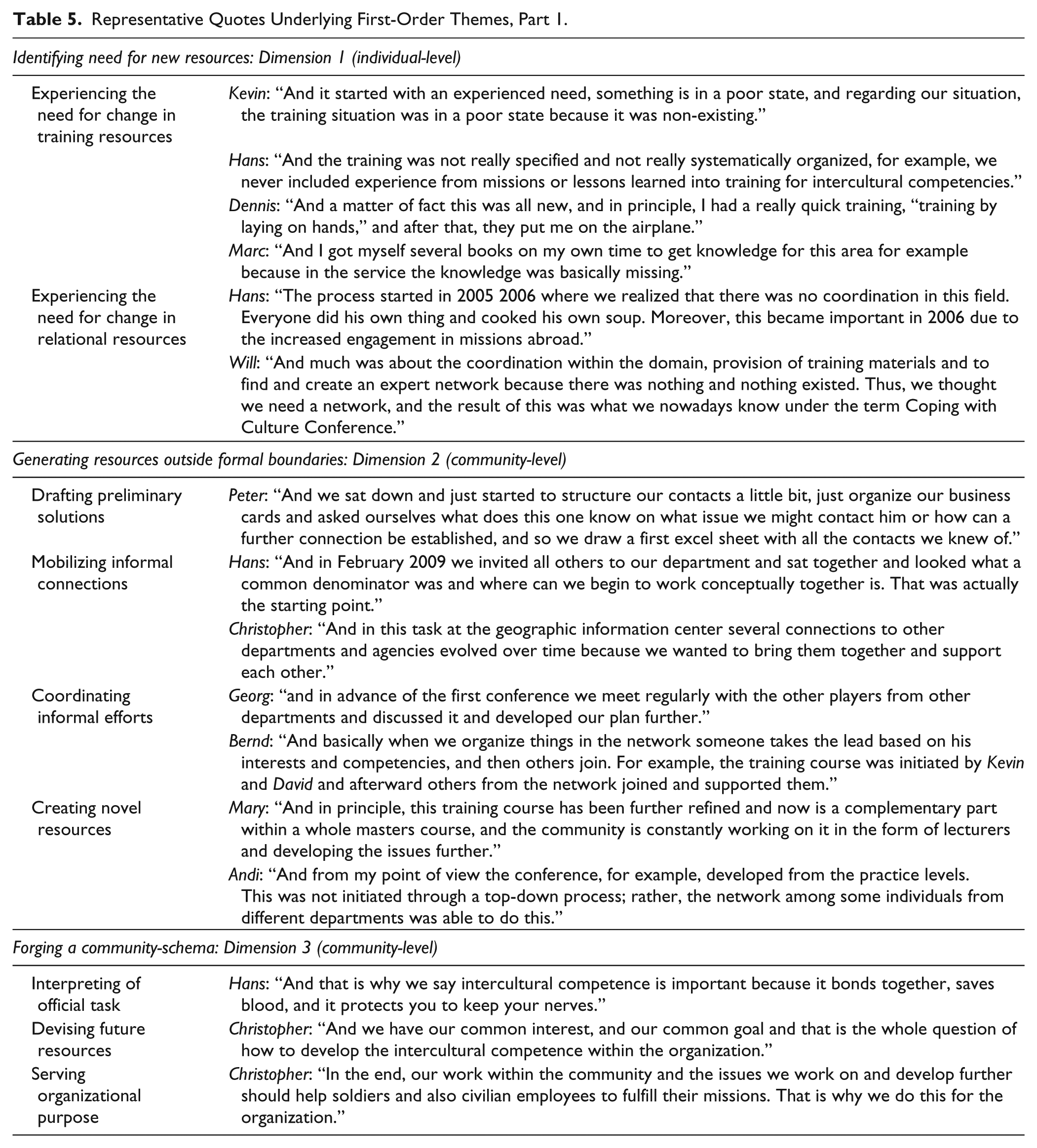
In sum, individuals within the field of intercultural competence identified the need for new relational and educational resources to fulfill their practices appropriately. Table 5 illustrates additional first-order data in support of our themes.
Representative Quotes Underlying First-Order Themes, Part 1.
Generating Resources Outside Formal Boundaries: Dimension 2 (Community Level)
Confronted with these challenges in their practice, individuals began to cross the official boundaries of their units and formed a CoP to resource new activities, relationships, and knowledge. This process started with individuals drafting preliminary solutions to the identified need. Returning to Kevin, he described how he and his comrades initiated their activities, Several things were born out of necessity. We (Marc and two other members of the department) sat down together after official duty with a beer and a cigarette and discussed about how to better structure a network, how to document it, and what kind of experience we had made, whom we actually knew within the domain, and can we bring this into a list.
As this example shows, instead of accepting the status quo, Kevin and Marc started to informally improvise initial quick fixes to organize the relationships in the overall field of intercultural competencies. Additionally, in order to respond to the sensed lack in training resources for advisors, David
4
improvised a 1 week training for newly employed personnel in 2009: “And one of my comrades said, we have to address the training situation and so he knocked off a 1-week training, during which he did a tour de force through the whole field of intercultural advisory” (Kevin). Based on these first efforts, the small group mobilized its informal contacts within the overall domain, thereby further crossing formal boundaries and forming the core of the CAC. As Kevin recalled this process, We decided to plan a network meeting for the whole domain, and to do so we met with five other departments, for example, we invited a professor from a federal college. Additionally, we said what about the Army’s Staff College, they might be interested too. Thus, we won them over. Also, then there was the Center for Geographic Information with one comrade (Christopher), who was thankful that we took him along.
As this quote exemplifies, the community emerged through the cultivation of informal relationships across departments and the mobilization of contacts beyond the focal organization. Within this evolving community, members started to collaboratively coordinate their activities to respond to the perceived resource lack. Returning to Hans, he described how the network worked together in developing intercultural training schemes, for example, small pocket cards on intercultural competencies that explain codes of conduct for countries of deployment: Two departments build the core of the network content-wise. Also, around this core, we have those other departments the Institute for Social Science, Geographic Information Center, and several academies such as the Staff College, the army universities and so on. However, they are not all involved in every project. Consider the training schemes it does not make sense to involve every institute, however, there are synergies if the Center for Military History and Social Science is on board. Also, over time through our network, the Office of Languages got involved too. Therefore, now there are people from 4 departments in this particular project.
Similarly, several community members met regularly to plan and organize the first conference for the domain that would serve as its central networking and coordination opportunity. In particular, Kevin, Hans, and Christopher recurrently met and discussed how this meeting should be structured. As a result, the community held its first Coping with Culture Conference in 2011 with intercultural experts from several allied nations, other public authorities, and multiple scientific professionals in participation.
Moreover, Kevin and Marc reflected on their improvised 1-week training and decided to plan a more in-depth course that should include the significant knowledge areas required for effective consultancy. As Marc recalled this process, We discussed it a lot because we realized that we had to build a specialized training course. After that, we discussed our plans with the Center for Leadership Development because we wanted them on board with this. Also, in 2012 we introduced our ideas at the conference and discussed them with participants, who were excited by it because they too hadn’t had training in this form.
Again, this quote shows that after identifying a need, several individuals mobilized their informal contacts and started to coordinate further activities within the CoP to create new resources. For instance, community members discussed which topics should be involved in the course. Additionally, members informally contacted one of the armed forces universities because the group decided to realize the new training in the form of a summer school assignment. Furthermore, other community members were asked to lecture classes in their fields of expertise. Developing from these dynamics was a 6-week training course—the Foreign Area Specialist—conducted at an Armed Forces University.
Altogether, individuals started to exceed their formal, departmental boundaries as they perceived official resources to be limited. These boundary-crossing activities thus shaped a new evolving informal space—the Cultural Advisory Community—where members collaboratively began resourcing new training courses, training documents, and a conference. That is, the CoP evolves as individuals begin to engage in self-organized resource generation without any formal order or direct supervision.
Forging a Community Schema: Dimension 3 (Community Level)
While community members interacted with each other in creating new resources, they formed a common understanding about their task, goals, and actions. Such a community schema can be defined as a cognitive framework that “map(s) our experience of the world, identifying both its relevant aspects and how we are to understand them” (Bartunek, 1984, p. 355). As individuals collectively interpreted their situation, this schema evolved around the common task of mission advisory and the awareness of intercultural aspects in general. Our informants consistently reported how initially, members came quickly to the understanding that intercultural competence is a critical capacity for military operations. For instance, Kevin pointed out, We promptly recognized the meaningfulness behind this whole thing, that is, that advisors are a valuable asset for officers commanding troops in missions because we prevent friction in operations. When I say frictions, I basically mean to save lives because, for example, if a commanding officer has the idea to conduct a shooting training at a holy site, this has immediate impact, and thus the advisor explains that if we do it this way, we have to lock ourselves in the barracks the next days because there will be riots.
Also, members started to devise possible future states for their domain, in the sense that they pictured how an ideal situation for intercultural mission training might appear. As Marc recalled, “We went about it pretty progressively as we asked ourselves how the system should be structured, what is the best possible condition for effectively and efficiently doing it on the ground.” Members thus organized their interactions around shared perceptions about future resources. As Hans noted, “However, you always have to come to an understanding concerning your goals. That is, why we regularly meet: to guarantee that everyone is still within the target range.”
In addition to deliberately making sense of shared understandings concerning the community’s aspirations, the community schema also entailed profoundly ingrained beliefs about how members viewed their roles within the armed forces. That is, the community members constructed their schema around the shared belief that their duty serves the overall organizational purpose. For instance, informants never viewed their efforts as means to themselves; instead, they interpreted them as direct contributions to the overall system effectiveness. As Bernd noted, “Basically the network helps to utilize this intercultural capacity for the whole armed forces because we bring everything together and make it useful. In particular, for the mission preparations but also standard training.”
Individuals interpreting their task and orienting their actions to an overarching purpose is not surprising, as previous research implies that sensemaking in military contexts starts with developing situational awareness and is influenced by individuals’ general sense of duty (Dixon, Weeks, Boland, & Perelli, 2016). Instead of being mainly induced by leadership, however, individuals within the intercultural competence domain started to make sense of a changing environment and construed ideas on how to react to it without a formal leader. The collaborative activities within the CoP thus evolve because members adjust their interpretative frameworks to resonate better with the new situation.
This schema, and therefore, the community-generated resources became adjusted and fine-tuned in the further course while members started to interact with their formal superiors. We will explain this in more detail in the next section.
Findings Part 2: Administrative Leadership and Its Influence on the CAC
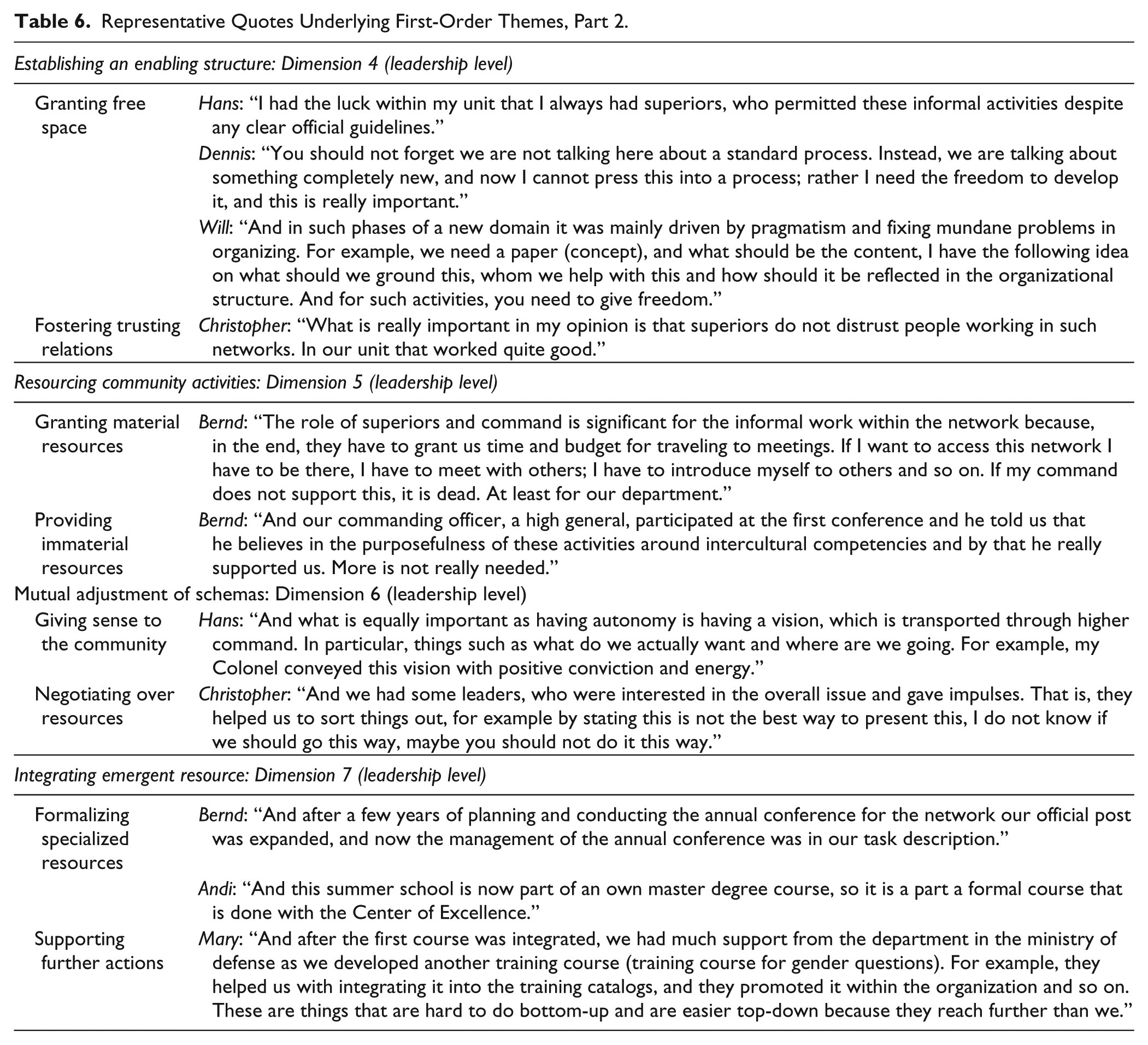
While community members began to resource new training courses, annual meetings, or training schemes, they nevertheless interacted with their superiors throughout their daily service. Our data did not reveal a single superior who influenced the community as a whole; instead, leadership relationships arose whenever community members interacted with their direct superiors, department heads, or upper echelon leaders. Specifically, our data revealed four influencing patterns dynamically occurring in these interactions. Table 6 provides further empirical first-order data in support of our interpretation.
Representative Quotes Underlying First-Order Themes, Part 2.
Establishing an Enabling Structure: Dimension 4 (Leadership Level)
Establishing an enabling structure refers to administrative leaders, who shape the conditions for community activities in their units and departments by providing critical resources to their subordinates. Critical initial assets for the rise of the above-explained resource generation in CoPs are free space and the development of trusting relationships between members and formal superiors. Our informants recurrently noted that especially during the beginning stages, leaders withheld influence in the form of direct instructions. For example, Bernd recalled: “There weren’t any direct interventions from superiors in a sense you have to do this or that within the network specifically.” Also, leaders frequently granted space and freedom to community members. Consider the example from Christopher: I began to develop the first contacts with other units, and this was the starting point. Thus it started to grow because the topic had a great significance for missions abroad. I began to persuade my superiors, and they gave me the freedom to do this kind of work.
Instead of being instructed with direct objectives, Christopher experienced superiors who gave leeway to him. Similarly, Bill, who was then a colonel and head of the Psychological Operations Center, pointed out: “I have always tried to give those new things enough freedom and space to develop.” Furthermore, our informants recurrently stated that superiors often facilitated experimentation, testing, and tryouts as the initiatives developed. For instance, Kevin recalled how he perceived his commander: There weren’t any official instructions from official superiors such as you have to do it this way in this quality to that date; instead, we had implicit agreements with the commander (Bill), who recognized that this is useful and thus gave us space to develop our weird ideas and test them.
Command facilitated experimentation through a high error tolerance, in the sense that leaders dealt with frictions benevolently. Thus, they tolerated unconventional ideas and new ways of thinking. As Hans pointed out: “When I approached my direct superiors with a somewhat strange idea, they did not immediately shoot it down.”
Additionally, informants reported on how trusting relationships with superiors were essential in enabling community activities. In particular, informants perceived trust from leaders in community members’ professional expertise as pivotal for operating outside of formal boundaries. For instance, Hans recalled: “Establishing trusting relationships is a central leadership aspect, in particular within this context of developing something completely new. I for myself experienced this ideal-typical by my superiors.” Such trusting relationships developed along multiple interactions that were regularly initiated through community members as they informed their direct superiors about the latest issues and developments arising from their activities. As Hans stated, “Actually I did a lot of persuasion work with my superiors, but they were open enough to listen to it.” As Hans pointed out, leader-member relationships required superiors, who took their time for discussions about the new issues. Overall, several informants stressed how they regularly informed their superiors about the ideas and initiatives emanating from the practice levels.
Resourcing Community Activities: Dimension 5 (Leadership Level)
In addition to establishing initial enabling structures, another essential leadership practice by formal superiors involved providing community members with further material as well as nonmaterial resources and delegating the decision-making power regarding their use to subordinates once community activities gained traction.
Informants, for instances, frequently mentioned two material resources that were essential for conducting their meetings: time and budgets. Although the initiative for planning an annual conference mainly emerged from informal conversations between two to three soldiers, subsequent meetings with other experts at other departments required time during official office hours and finances primarily used for traveling. As Christopher mentioned, If a unit or department wants these networks and their value in the form of new training and so on, I have to equip them with funds, and that means money, time, and personnel ( . . . ). If, however, I tell my subordinates to stay here and do your official jobs, then it gets critical because the network will fall apart.
As Christopher noted, command facilitated ongoing community interactions by granting additional means and the freedom to use them.
Administrative leadership, however, not only endowed the CAC with material funds but also catalyzed the self-organized resource generation by engaging in symbolic actions that underlined their support of the community’s efforts. In other words, formal leaders equipped the community also with nonmaterial resources, particularly, legitimization and appreciation for community activities. Returning to the training course example, Kevin described how he and his comrades experienced the visit of a three-star general during the first round of the Foreign Area Specialist Course as a form of legitimization for themselves and their work: For example, the commander of another big department, a three-star general, acknowledged our training by saying he will participate in it and teach a lesson himself. Therefore, he took a whole day for us, I mean this is a three-star general, he is always busy, and that means something.
As Kevin pointed out, the symbolic action of an upper echelon leader participating in the course and highlighting its importance provided community members with a basis of legitimacy. Moreover, informants repeatedly expressed how leaders’ appreciation of the community’s efforts served as motivation and legitimation. As Hans summarized, “It is important that our superiors give us the feeling that our work matters and is indeed a core task.”
Formal leaders thus catalyzed the evolving community activities by equipping members with further material and nonmaterial assets. Resourcing community activities, therefore, supports and legitimizes the ongoing enactment of the community schema in practice. In other words, formal leaders support community members’ actual interactions from which the new resources develop over time.
Mutual Adjustment of Schemas: Dimension 6 (Leadership Level)
Mutual adjustment of schemas involves formal leaders who give and negotiate sense over the newly crafted resources with community members. Our informants recurrently mentioned that they initially made sense of the emerging resources such as the training program and their properties on their own; however, as these community initiatives developed and members informed their superiors on them, leaders began to affect the community dynamics. For instance, one of the department’s commanding officers repeatedly provided overall mission narratives to his subordinates. These narratives often involved visions about possible future states for the whole domain. Marc, for example, recalled how he experienced routine briefings with the center’s commander: We had our usual weekly briefings with command where the commander introduced his vision or his agenda, describing where the whole area of psychological warfare is moving and what are new areas and topics. Thereby he provided points for orientation, and now I can say okay, this is the domain, and I know in which direction we want to move and this is how we develop the whole system further.
As Marc noted, instead of directly demanding specific behaviors, sensegiving by higher command was limited to providing perceptions about future developments in the domain, which enabled members to align their activities accordingly.
Informants also noted that community members and their superiors mutually influenced each other’s perceptions while they discussed new emerging issues such as the training course. As we pointed out before, members often informed their superiors of the new initiatives. These discussions now transformed into negotiations over a shared understanding between members and command over the community’s efforts, mainly making sense of the new resource’s primary qualities and purposes. Returning to Kevin, he described how the community and official positions—departmental commanders and the ministry of defense—at first had different notions on the annual conference.
Of course, both sides have to keep each other informed on the things going on so that the other party can get a picture of it and its knowledge is connectable because otherwise, we talk about entirely different things. Thus, we influenced each other. For example, for the department (psychological operations) as well the ministry of defense, the recruitment of advisors was always paramount because of the personnel problems we experienced; we (the community) weren’t aware of this, and thus we incorporated this thought. On the other hand, command has not seen the expert exchange and the training aspects we put in the center of things, and so we introduced those things into their world of thought.
As Kevin pointed out, members and administrative leaders harmonized their underlying understandings by negotiating sense over the conference or the training course.
In sum, formal leaders, on the one hand, influence the evolving community schema more directly by setting broad visions that means that superior’s perceptions about the domain become incorporated into community members’ interpretative framework. On the other hand, leaders and members collectively make sense on the unfolding change and how to react to it. Together, these two processes induce a co-alignment of members’ and superiors’ schemas.
Integrating Emergent Resources: Dimension 7 (Leadership Level)
Integrating the new resources refers to leadership that supports the transition of community-induced initiatives into organizational structures—this final stage of formalizing the community generated resources often required superiors, who held decision-making power over assets such as personnel, finances, or official concepts. For example, our informants described how the training course needed to be verified by agencies responsible for administering the course catalogs of the armed forces and NATO. This process was supported by a high-ranking NATO general, who was approached by a community member. As Marc recalled, We aspired to formalize the course, and this is where the informal and formal world meets each other. You need to have a cause if you want to send someone on a training. That is, the training must be officially approved, and this was a major problem because no one knew anything about it, so we had to make a thousand calls until we finally met the right department and by accident, I landed with a three-star general, who helped us to set this up.
Based on this integration into formal structures, the community conducted its training in 2013 for the first time. Subsequently, members were able to preserve the course with the support of a departmental commander: “And after that, the course was integrated into a master’s course. However, this network continuously worked on it and developed the course even further” (Bernd). The training thus became a persistent organizational resource.
Similarly, informants described how the annual conference transformed into an official meeting backed with official assets. This transition from informal to formal mainly occurred as Hans and Christopher interacted with the Leadership Center’s command and one ministerial department, who in the process created additional posts, altered existing task descriptions, and freed up further funds for the conference. Administrative leadership was therefore instrumental in formalizing the emergent resource. As Will, a colonel positioned at the ministry of defense and responsible for writing conceptual foundations for the intercultural competence domain, explained: “For sure, at one point in time you have to utilize your administrative authority, and that is ‘now I need something’, so now we have to put it into conceptual papers or other official structures.”
By integrating the community generated resources into formal structures, leadership also helped to spur further community activities. For example, informants reported how the community was able to utilize the formalized resource of the new training course to energize other ideas. Kevin recalls: For example, one comrade of mine is now working on establishing an additional training course in the area of gender studies and how this can affect our operations. The whole thing is always changing as the community identifies further problems and discusses them within the network, finds a solution and integrates the solution into the system.
As Kevin pointed out, based on the integration of the training course into the organization, the community was able to adjust and develop its activities further as new challenges occurred, leading to new adaptive pressures.
Altogether, formal leaders help to transform the new resources from community activities into formal structures, and thereby, contribute to retaining a renewed resource base that ultimately enables a more effective practice in an altered environment.
A Process Model About the embeddedness of Communities of Practice in Formal Organizational Contexts
In this section, we present a grounded, cross-level, process model that builds on our empirical inquiry to theorize how the dynamic between members and administrative leadership shapes and sustains a CoPs’ embeddedness (Figure 3 depicts the model).
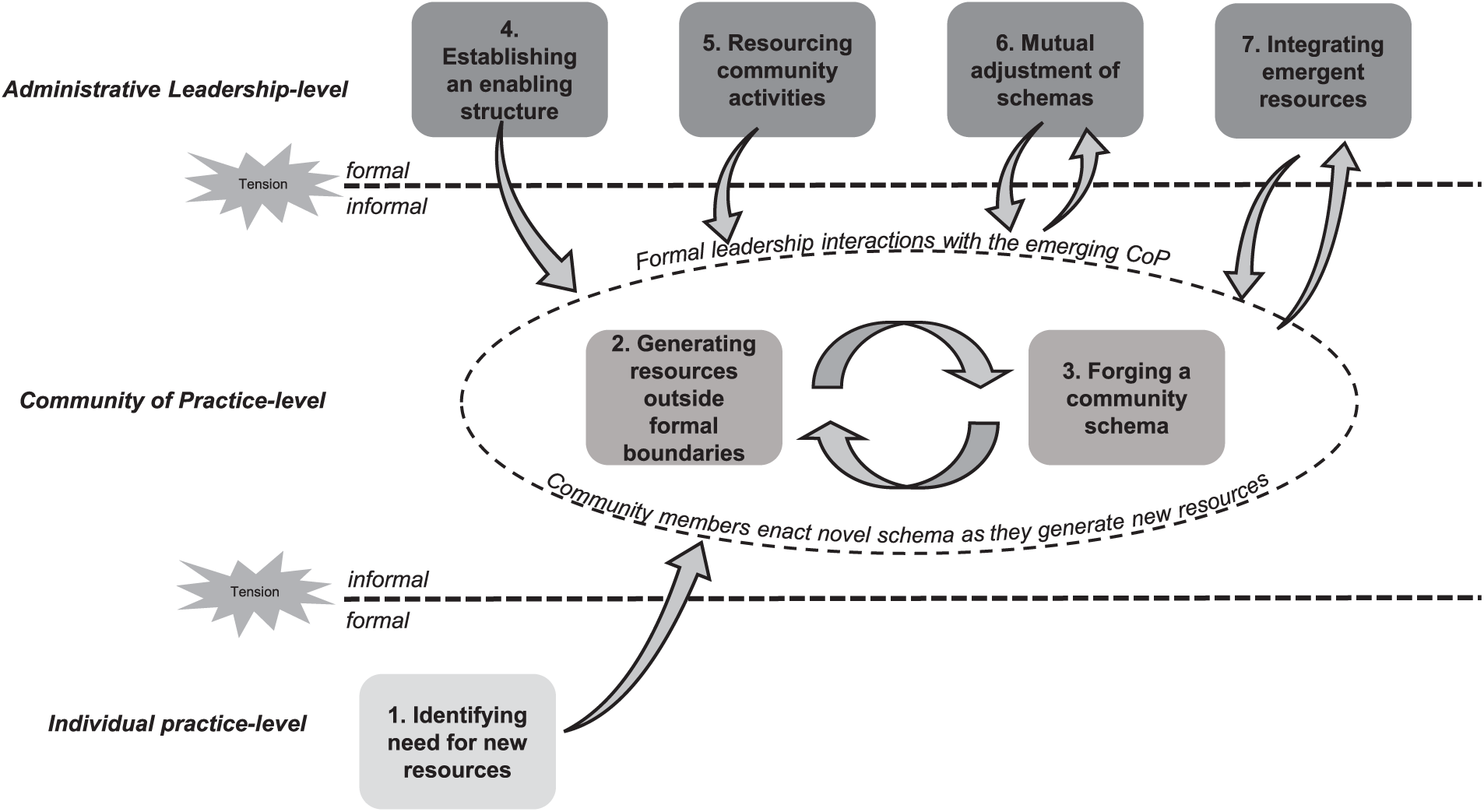
A process model about the embeddedness of communities of practice in formal organizational contexts.
As mentioned before, our process model draws on the growing body of research using complexity theory reasoning to conceptualize organizational change, innovation, and adaptation as emergent phenomena that occur unexpected and bottom-up through the self-organized interaction of networked agents in CAS (Stacey, 1995; Uhl-Bien et al., 2007; Uhl-Bien & Arena, 2018). Building on this, CLT offers a novel perspective on how we understand organizational leadership for enabling such emergent, self-organized dynamics (Lichtenstein et al., 2006; Lichtenstein & Plowman, 2009; Plowman et al., 2007; Uhl-Bien & Arena, 2018; Uhl-Bien et al., 2007; Uhl-Bien & Marion, 2009). In particular, Uhl-Bien and Marion (2009) as well as Uhl-Bien and Arena (2018) argue that the tensions between the opposing organizational principles with bureaucracy and administrative leadership on the one side (i.e., the formal system) and adaptive leadership evolving in self-organized CAS on the other (i.e., the informal system) permeates organizations. Each part could take over either destroying the self-organization by formalized rules and regulations or by decoupling from the formal context into anarchy. The mediation of these poles, while sustaining the tension is described as enabling leadership within the CLT framework (Uhl-Bien & Arena, 2018; Uhl-Bien et al., 2007; Uhl-Bien & Marion, 2009).
Drawing on these ideas, the current model theorizes the embeddedness of a CoP as shaped through the interplay between the self-organized resource generation emanating from a community with several dynamically changing leadership mechanisms at the interface between the formal, administrative and informal, self-organized system.
The process of resource generation begins as several organization members identify adaptive challenges in their practices. In particular, they sense their resource endowment as insufficient to effectively exert their practice (1. in Figure 3). That is, organization members recognize adaptive tensions caused by changes in the environment that push the organization away from its equilibrium (Kauffman, 1993; Marion, 1999). According to complexity theory, such far-from-equilibrium conditions can give rise to emergence when agents on the micro-levels of a CAS begin to grapple with such pressures (Anderson, 1999; McKelvey, 1999).
To be more specific, the emergence of new resources is the result of the two recursive processes of developing a community schema, and the enactment of this schema in informal interactions as members collaboratively elaborate adaptive responses to their practice dilemmas (2. and 3. in Figure 3). As explained by complexity theory, self-organization in CAS occurs as individual agents locally start to respond to their immediate needs and develop localized solutions. These first responses affect related agents as members begin to mobilize their informal connections and start interacting in a broader community. In these informal interactions agents collaboratively build on the initial responses to create more refined solutions (Anderson, 1999; Uhl-Bien et al., 2007; Uhl-Bien & Marion, 2009), for example, new resources. Through this repeated interaction, the agents of a CAS start to correlate, meaning that they adapt their outlooks to each other as they give meaning to unfolding events and share ideas on how to react to the identified needs (Marion & Uhl-Bien, 2001). That is to say, a shared schema develops among the agents of a CAS containing knowledge structures over the goals, beliefs, and perspectives negotiated and shared in a social group (Lichtenstein & Plowman, 2009; Marion & Uhl-Bien, 2001). Based on this schema, agents of a CAS synchronize their activities to each other and act in parallel without outside fiat (Anderson, 1999; Marion & Uhl-Bien, 2001; Uhl-Bien & Marion, 2009). The evolving community, hence, spurs the generation of new resources through self-organized interactions based on a shared schema.
Turning toward the mechanisms observed regarding the interface between this process of resource generation and the formal context, we are on the one hand able to illuminate different leadership practices similar to what complexity leadership theory describes as enabling leadership (Uhl-Bien et al., 2007; Uhl-Bien & Marion, 2009) and a mediating mechanism explaining the establishment of said interface on the other. In keeping with CLT we are observing that at this intersection administrative leadership is amended by an enabling leadership function (Uhl-Bien & Arena, 2017, 2018; Uhl-Bien et al., 2007; Uhl-Bien & Marion, 2009).
Enabling leadership is not to be mistaken with direct influence and control (Uhl-Bien et al., 2007) but instead involves the design of a CAS’s context (Levinthal & Warglien, 1999). In this regard we find that the aforementioned enabling practices are directed at the context of the community, facilitating its members at forging a community schema on how to cope with the novel situation without a superior’s interference (Hazy & Uhl-Bien, 2015).
In our process model, we argue that administrative leaders use establishing, resourcing, and integrating techniques to maintain the level of tension while mediating between the formal and informal system. As indicated in our Model (4. in Figure 3) enabling leadership incorporates the concept of establishing enabling structures that we consider as a necessary condition for self-organized dynamics to evolve. Granting space and autonomy while withholding direct influence allows the CoP to grow from its fragile beginning. Uhl-Bien and Arena (2017) explain that this is necessary as otherwise, the administrative function would likely dominate thus suppressing self-organized activities. In turn, this autonomy here involves the provision of trust, tolerance for errors, hence the encouragement for experimentation. We can see that these influences do not affect the domain of the CoP but its context.
In the sense of CLT, administrative leaders can provide energy into a CAS to uphold and evolve its self-organized state (Uhl-Bien et al., 2007). Energy in this picture describes the force an administrative leader must summon to bend, ignore, or alternate the formal organizational paradigm consisting of rules and regulations that are not or not fully allowing for autonomous activities.
Along this interpretation, we envision resourcing community activities (5. in Figure 3) as another technique of providing energy into the evolving CoP. Providing material resources can again be considered a necessary condition, as beyond a certain degree of interaction—which at initial stages members achieve via the usage of slack or private resources—additional resources are needed to evolve the CoP. On the other hand, we observed that immaterial resources such as official recognition or appreciation and ultimately legitimization are equally vital to facilitate the self-organized processes. Again, this enabling leadership technique is not directed at the domain. Thus, it does not destroy the adaptive function by imposing administrative structures. However, it is directly infusing energy into the self-organized dynamics, thus, allowing them to scale and gain traction as further interactions arise.
Shifting back into their administrative leadership role, formal managers can absorb the new resources generated by the community to the formal level. They are integrating community outcomes into the official processes (7. in Figure 3), thus, making them available to other organizational actors and preserving them. While shifting between administrative and enabling leadership managers are resourcing the CoP in the sense that they embed it as a meta-resource able of producing resources transferable into the formal organization.
However, to answer the question of how this embeddedness is coming into existence or being more precise to answer the question of why managers shift from their administrative to the enabling function in the first place, we are finally turning to the mechanism of schema adjustment (6. in Figure 3). We suggest that this is the core underlying mechanism allowing managers to alter their behavior in the sense that they reduce their administrative leadership techniques in favor of enabling practices as described above. Members from the CoP engage with formal superiors to raise awareness for the new challenges and to explain their initial responses, which could be considered issue-selling, a technique described by Dutton and Ashford (1993). On the other hand, formal superiors, while engaging with the community members, try to ensnare ideas that are too far from the logic of the organization. At that, they communicate official visions and strategies to provide some form of guidance for members. Scholars describe this discursive process as sensegiving (Gioia & Chittipeddi, 1991; Maitlis & Christianson, 2014; Maitlis & Lawrence, 2007).
In the interplay of issue-selling as a bottom-up and sensegiving as a top-down process, we find that formal leaders and informal community members mutually adjust their schemas to a certain degree as they negotiate sense over the new initiatives. While the members are aware of the official procedures and the overarching vision and strategies, leaders are getting a better understanding of the resource under evolution as well as the community itself. It is through these interactions that leaders become part of the CAS (here the community and its practices), and thus, influence it and simultaneously become affected by its developments. They understand that they cannot fully control self-organized resourcing processes, yet they observe that the CoP could very well be considered a resource in itself.
Discussion
We started this study with the aim to understand how CoPs are embedded in formal organizational contexts. For this purpose, we utilized an interpretative research approach to build process theory based on our analysis of the Cultural Advisory Community. In combination with a complexity theory lens, this allowed us to develop a grounded, cross-level, process model that highlights how leadership interacts with the self-organized resource generation of a community, thereby sustaining the tension between formal, controlling and informal, self-organized forces and thus shaping the embeddedness. Below, we describe in more detail how our findings contribute to the community and complexity leadership literature streams.
Contribution to Research on Communities of Practice
Arguably, this study’s most essential insight lays in its grounded, cross-level model that uncovers how the self-organized dynamics of a CoP intertwine with administrative leadership. Prior work in this field either focuses on how an organization’s different communities interact with and learn from each other, without considering much of the interplay with the broader social context (Gherardi & Nicolini, 2002a, 2002b; Oborn & Dawson, 2010). Other studies emphasize governance approaches aimed at strategically exploiting CoPs through assimilating them into formal structures (Borzillo, 2009; Corso et al., 2009; Dubé et al., 2005; Probst & Borzillo, 2008). Some authors, in light of this, suggest a continuum of different degrees of integration beginning with purely informal and self-organized communities up to strategically aligned CoPs (Jeon, Kim, & Koh, 2011; Wenger et al., 2002).
The grounded, process theory of a CoP’s embeddedness developed here, revises such a perspective that distinguishes between either autonomous or strategically integrated communities by offering a more nuanced understanding of how a CoP operates at the interface between the formal and informal spheres of the organization. Embeddedness means that the self-organized dynamics of a CoP are neither entirely informal nor are they wholly formalized but rather become embedded in the space between the two. This space of embeddedness works at the “edge of chaos” (Kauffman, 1993), in the sense that the CoP has its necessary autonomy to generate adaptive responses but is sufficiently coupled to the formal hierarchical system to integrate these solutions. Our model thus reflects the reasoning of several authors in the field of organizational design, who argue that moderate levels of structure are more adaptive and innovative than wholly structured or understructured systems (Brown & Eisenhardt, 1997; Levinthal & Warglien, 1999).
Embeddedness occurs through the interactions between members and administrative leadership. Although scholars acknowledge that organic forms of organizing such as CoPs call for novel approaches to leadership (Kirkman et al., 2011), many contemporary “community management” concepts seem to reproduce traditional, bureaucratic images of alignment and control (Peltonen & Lämsä, 2004; Thomas, 2017). While other studies offer more thoughtful methods for coping with CoPs such as participatory or distributed leadership (Kirkman et al., 2011; Retna & Ng, 2011), they still tend to favor unidirectional influence exerted top-down from formal leaders to members.
The current study’s findings add to this discussion on external leadership for CoPs. In particular, our case study shows that leadership emerges and changes in a net of dynamically evolving relations between members and formal leaders. This finding reveals new insights for how we understand leadership at the interface between communities and formal hierarchy.
First, our evidence suggests that there is not one external leader who influences the CoP (i.e., a sponsor or manager; Borzillo, 2009; Garavan et al., 2007) but instead members interact with several superiors at different levels. Therefore, our findings resemble notions of distributed leadership, which no longer focus on single entities but rather view leadership as a phenomenon distributed and shared among several actors (Brown & Gioia, 2002; Gronn, 2002).
Second, leadership that shapes the embeddedness of CoPs is emergent. That is, influence on the CoP is not formally assigned to a specific person but rather a net of leader-member relations evolves as the self-organized dynamics unravel. This finding takes pointers from a perspective that recognizes leadership as emergent events that unfold in the dynamic interactions of heterogeneous agents, and thus, views leadership more broadly, beyond formal positions (Marion & Uhl-Bien, 2001).
Third, we recognize leadership for a CoP’s embeddedness as dynamic. Prior work on CoPs tends to propose static management concepts either focused on a CoPs’ autonomy (Roberts, 2006; Thompson, 2005) or their formal integration (Clegg et al., 2008; Probst & Borzillo, 2008). Only a few studies go beyond this static distinction and propose balancing enabling and controlling mechanisms (Anand et al., 2007; Borzillo & Kaminska-Labbé, 2011; Harvey, Cohendet, Simon, & Borzillo, 2015). Our grounded model adds to this research strand by illustrating how leadership that dynamically shifts from enabling mechanisms to more administrative mechanisms shapes a CoPs’ embeddedness.
On a more general level, our findings also have implications for how we come to understand the essential nature of CoPs and the outcomes generated by them. In initial theoretical formulations scholars perceive CoPs from a process worldview (Rescher, 1996; Weick, 1979), in this, they emphasize on learning processes which are an inseparable aspect of social practice (Gherardi, Nicolini, & Odella, 1998; Handley, Sturdy, Finchman, & Clark, 2006; Lave & Wenger, 1991; Wenger, 1998). CoPs thus do not describe identifiable informal groupings but rather relate to the social and cultural context in which practices are situated (Lave & Wenger, 1991; Lindkvist, 2005; Østerlund & Carlile, 2005). Central in this notion is that individuals obtain knowledge about the intricacies of such a particular context by constructing an identity through different forms of participation (Handley et al., 2006; Lave & Wenger, 1991).
More recent contributions shift from viewing CoPs as learning processes toward an entitative understanding (Thompson, 2011). From this point of view, CoPs are primarily perceived as social entities that exist in the form of identifiable organizational groups (Brown & Duguid, 2001; Dubé et al., 2005; Wenger et al., 2002). Hence, the focus is no longer on the evolving dynamics but the specific properties and qualities of such social entities (Thompson, 2011). Whit that shift, CoP outputs are argued as having a direct effect on firm-level properties such as innovativeness and adaptability, thus affecting overall firm performance (Brown & Duguid, 1998, 2001; Lesser & Storck, 2001; Wenger et al., 2002). For instance, scholars argue that CoPs can enhance an organizations’ absorptive capacities (Brown & Duguid, 2001), its ambidextrous abilities (Kietzmann et al., 2013), or its dynamic capabilities (Cohendet & Llerena, 2003) mainly by absorbing, generating, and recombining knowledge (Brown & Duguid, 2001; Jarzabkowski, 2004).
The current study’s process model takes pointers from each perspective. On the one hand, we agree with scholars, who understand CoPs from a process ontology (Lave & Wenger, 1991; Thompson, 2011) since we conceptualize the community as the processes of self-organized resource generation unfolding in practice. It is this process that generates a social and cognitive structure among organization members, that is, a CoP (Brown & Duguid, 1991; Lindkvist, 2005). We explain these self-organized dynamics using insights on complex adaptive systems, which aligns well with a process perspective as complexity theory focuses our attention to the generative mechanisms that underlay emergent phenomena (Dooley & van de Ven, 1999), allowing us to identify the processual, unfolding, and organic nature of CoPs instead of viewing them as fixed entities (Pyrko et al., 2017).
On the other hand, our theorizing of a CoPs’ embeddedness, also moves beyond conceptualizations that only tend to recognize a communities’ closed, self-reflexive learning processes (Yakhlef, 2017). Instead, by considering CoP dynamics as self-organized resourcing that in interplay with administrative leaders generates transferable resources that help the organization to better resonate with environmental change, it follows that the CoP itself may represent a meta-resource. Such a meta-resource could be understood as an organizational capacity to process, generate and reconfigure other resources. As we envision CoPs to evolve in a self-organized way moderated by enabling leadership, we content this capacity to be an organizational potential leveraged or impoverished by leadership. Following this logic, we are able to specify the arguments introduced above of CoPs as some sort of dynamic capability (Brown & Duguid, 2001; Cohendet & Llerena, 2003; Jarzabkowski, 2004; Liedtka, 1999), in that they accommodate the capacity to (dynamically) reconfigure and renew an organization’ resource endowment to match environmental changes to ensure a firms’ long-term survival and growth (Eisenhardt & Martin, 2000; Teece, Pisano, & Shuen, 1997). Given this, a CoP envisioned as a meta-resource might also add to our understanding of the organizational micro-foundations of dynamic capabilities (Felin, Foss, & Ployhart, 2015).
Contribution to Research on Complexity Leadership Theory
Our findings also have implications to the complexity theory view. First, we identify that complex adaptive system dynamics of emergent self-organization arise in local practice. Prior research remains vague regarding where CAS dynamics develop in organizations. Scholars relatively broadly point to the informal organization as the sphere where complex dynamics emerge (Stacey, 1995; Uhl-Bien & Arena, 2018; Uhl-Bien & Marion, 2009). For example, Stacey (1996) refers to the shadow network in describing the informal system in which nonlinear interactions lead to discovery, learning, and change. Likewise, Uhl-Bien et al. (2007), discuss “informal emergence,” referring to changes that evolve from any networked interaction within organizations. The informal organization as a whole, however, involves any behavior and relations among individuals that develop as actors pursue their own socioemotional needs (McEvily, Soda, & Tortoriello, 2014). Notwithstanding, that such interactions can produce emergent social change, it might not always be the desired innovation an organization seeks.
In the current study, we explicitly focus on CoPs, and therefore, on the part of the informal organization that evolves around particular (work) practices. In centering on CoPs, this study highlights how CAS dynamics materialize when individuals collectively and purposefully engage in their everyday work practices with the aim of “getting the job done” (Brown & Duguid, 1991, 2001). The findings thus illustrate how emergent self-organization emanates from informal interactions that are driven by specific practice problems and needs. In doing so, this study suggests that CAS dynamics arising in practice are more likely to generate fruitful outcomes.
Second, the complexity leadership theory meta-framework theorizes that enabling leadership operates at the interface between adaptive leadership (i.e., the entrepreneurial leadership of the informal system focused on exploring new ideas and adaptive responses) and administrative leadership, and sustains the tension between the two for organizational adaptability (Uhl-Bien & Arena, 2018; Uhl-Bien et al., 2007; Uhl-Bien & Marion, 2009). Prior work illustrates how enabling leaders aid adaptive processes at this intersection via the techniques of conflicting (i.e., injecting adaptive tension and manage its level, and opening up spaces where agents can coalesce around adaptive responses) and connecting (i.e., brokering between different agents and ideas as well as linking solutions up with the formal system; Uhl-Bien & Arena, 2017, 2018).
Our process model adds to CLT by highlighting how the said interface establishes through what we refer to as the mutual adjustment of schemas between community members and formal leaders. In most contemporary bureaucracies administrative leadership still represents the default form of management, meaning that leaders need to deliberately shift into enabling leadership practices to allow for self-organization and emergence (Uhl-Bien & Marion, 2009). Our findings indicate that leaders’ enabling leadership practices such as shaping an enabling structure and resourcing the community activities are initially encouraged through members’ issue-selling toward their superiors (i.e., adaptive leadership). On the other hand, ongoing negotiations over the resources under development with members give formal leaders a sense for when to switch back into their administrative roles and integrate the outcomes. Mutual adjustment of schemas, therefore, seems to be a central mechanism as, without it, there seems to be no reason for administrative leaders to change their leadership practices.
Finally, our process model illustrates the essential role of resources in enabling leadership. Indeed, prior research on CLT notes the importance of resources and renders resource allocation to emergent structures as a central task for organizational leadership (Lichtenstein & Plowman, 2009; Marion & Uhl-Bien, 2001; Uhl-Bien & Arena, 2017). The current study extends this notion by illustrating the resource flows between administrative leaders and the CoP in more detail. Enabling leadership creates initial structures for self-organized resourcing processes by granting resources such as autonomy and trust. Furthermore, enabling leadership energizes self-organized processes via additional assets (material and immaterial resources), negotiates over the resources under evolution across levels, and integrates the newly generated resources into the formal system. In light of this, we suggest that the enabling leadership function in CLT entails a dynamic of resource allocation, resource negotiation, and resource transformation at the interface between adaptive and administrative functions.
Limitations and Transferability
One limitation is that the single case study design can give rise to questions about the transferability, confirmability, and dependability of the current study’s findings (Lincoln & Guba, 1985). During our investigations within the armed forces, we found several CoPs within other domains that displayed comparable dynamics. We, however, decided to conduct an in-depth inquiry of the Cultural Advisory Community in order give readers rich contextual information and a thick description of the unfolding processes. We believe that the data-rich story of the CAC and the corresponding process model should enable other researchers and practitioners to assess the transferability of our findings to other contexts (Gioia et al., 2013).
Although this study depicts an extreme case of military bureaucracy, we believe that the notion of embeddedness is particularly relevant and of high applicability in other organizational settings that are characterized by steep hierarchies and formal administration. Specifically, given that the vast majority of nowadays business organizations remains structured around these principles (Uhl-Bien & Marion, 2009). A military idiosyncrasy that might limit this transferability is the deeply ingrained belief of serving the organizational purpose as part of member’s schema, which seems to be specific to the military (Dixon et al., 2016). However, other organizations are also intentionally aiming at developing a shared sense of duty among their employees, by encouraging citizenship behaviors that go beyond the initial call of duty (Tinoco & Arnaud, 2013).
Practical Implications and Future Research
Organizations facing high-velocity environments riddled with uncertainty need to increase their capacity to adapt quickly. As scholars from different disciplines such as complexity theory or organizational learning argue and as our study further underlines, the harnessing of complex adaptive system dynamics (CoPs in this case) is one way to approach such challenges. As indeed, the observed Cultural Advisory Community helped to transform parts of the armed forces from a complex, hierarchical system into a complex adaptive system (Stacey, 1995) since through self-organized resource generation external complexity (novel missions abroad) was met with internal complexity (i.e., emergence of a new order based on new resources).
However, as we have also shown, managers should not just leave these self-organizing systems untouched but instead should embed them to tap into this (meta-) resource. In this respect, managers—especially those in bureaucratic forms of organizing—need to understand that they are not only responsible for exerting traditional administrative leadership as a function to preserve current processes but furthermore must recognize their pivotal role in enabling and catalyzing change.
Consequently, managers from all hierarchical levels need to understand their role as alternating between upholding the formal line and engaging with the communities within their reach of authority. The central message here to organizational leaders is to accept the tensions between informally evolving CoPs and the formal managerial system as an adaptive potential that they can nurture, scale, and leverage.
In respect to enabling such dynamics, we want to stress the fact of immaterial support as shown in our study. Often managers could energize self-organized activities by officially recognizing and legitimizing them. However, this enabling leadership practice is dependent on a critical factor. The mutual adjustment of schemas is—as we argue—a precondition for enabling leadership. Thus, managers must be able, willing, and open to engaging with the communities in their administrative domain. This calls for a leadership style based on regular communication outside of formal lines and reporting requirements. In particular, it requires leaders, who regularly listen to the ideas and suggestions of subordinates, openly discuss such new issues without giving too strict guidelines but instead provide a shared sense of purpose or visions in their departments and units, and in doing so, give sense to the emerging changes. The bottom line is that such enabling leadership implicates much less top-down control but simultaneously calls for leaders to be highly involved and not passive bystanders. As General McChrystal so aptly summarized it, leadership in complex environments requires an “Eyes on, Hands off” (McChrystal, Collins, Silverman, & Fussell, 2015, p. 232) approach.
While the formal leaders in our study exhibited these practices exemplary, they often did so unconsciously and unaware of the underlying processes. Also, prevalent leadership images in the armed forces tend to favor the heroic and charismatic troop commander, who in the midst of battle orchestrates his units. Tendencies to micromanage and control are not uncommonly rooted in such traditional notions (McChrystal et al., 2015). Taken together, this cedes embeddedness of CoPs mostly to chance. Therefore, the current studies’ findings imply the need for nuanced leadership development in the armed forces and similar bureaucracies, along which future and current leaders should be trained in how to navigate the intricacies and contingencies of the numerous leadership situations they will face during their careers (Kark et al., 2016).
As it is often the case with qualitative research, scholars must omit interesting avenues in the effort to focus their study appropriately (Milosevic, Bass, & Combs, 2018). Likewise, our data gave rise to several issues that could be worth studying in more detail. For instance, our findings illustrate the process of self-organized resource generation emanating from informal interactions. Feldman (2004) similarly introduces endogenous resourcing, which describes the ability to find and create resources without external inputs. Future research could delve deeper into how such resourcing cycles on different organizational levels intertwine and how such a bottom-up induced resource renewal enhances an organization’s dynamic capabilities (Teece et al., 1997).
Finally, one finding of the current study is that the newly forged community schema involves deeply held organizational beliefs. Further inquiries might focus in detail on how the informal practices of community members relate to the broader cultural context in which they are situated. That is, future research might look into how individuals steer through the cultural ambiguities of being both a member of an emerging CoP and the focal organization.
Footnotes
Acknowledgements
The authors would like to thank the editor Ken Thompson for his guidance throughout the review process, as well as the two anonymous reviewers for their constructive feedback and suggestions. Also, the authors appreciate the comments and advice on earlier versions of this article from Ivana Milosevic, Johann Füller, and Kathrin Rosing. We also thank Mary Uhl-Bien and the attendees of the Mentoring at the Interface Session hosted by the Academy of Management in Atlanta, Georgia, 2017.
Declaration of Conflicting Interests
The author(s) declared no potential conflicts of interest with respect to the research, authorship, and/or publication of this article.
Funding
The author(s) disclosed receipt of the following financial support for the research, authorship, and/or publication of this article: This article is based on a larger research project funded by the German Department of Defense (SKZ PL 30P D 053 U).
