



Abstract
In this article, we extend the understanding of enabling leadership in complexity leadership theory by showing what enables and stifles organizational adaptability. By drawing on a case study of an organizational change related to competence supply in health and care services, we explore what (enabling) leaders do, in the different (i.e. ideation and scaling) stages of an adaptive process, to engage the two complexity (i.e. the tension and the linking up) dynamics that are essential for nurturing and sustaining adaptive processes in organizations. The results show that, in both stages, the way a complexity challenge is framed can determine the type of process it will trigger: if the challenge is framed as a technical one, while trying to eliminate tensions, the likely response is an order one; if the challenge is framed as a complex one, while trying to sustain tensions, the likely response is an adaptive one. Ideation can be held back by not only ‘external’ pressures but also ‘internally’ perceived scaling barriers. In scaling, dividing the implementation of a solution into phases can ‘buy time’ for the organization to ‘mature’ and, accordingly, to be better prepared for its implementation. Involving operational leadership early in the adaptive process, so that they assume certain ownership, can foster connecting and can contribute to navigating the linking up dynamic and thus reduce the risk of ideas “hitting the brick wall”. The support from managers at the ‘top’ of the system is essential for scaling adaptive processes and thus implementing systems change.
Keywords
Introduction
Today’s organizations operate in environments characterized by increasing levels of uncertainty and interdependence, which are typical of complex systems “comprised of dynamic networks of relationships” (Hogue and Lord, 2007: 373). In such environments, organizations often encounter pressures and tensions (Tourish, 2019; Uhl-Bien and Arena, 2018) between the push for change (e.g., innovation, novelty, learning, growth) and the push for stability and results (e.g., status quo, current performance, short-term results) (March, 1991; Uhl-Bien and Arena, 2018). The “burden” of managing these tensions or pressures falls in the domain of leadership (Teece, 2012), which is an integral part of any organization’s practices (Schedlitzki et al., 2023). In the face of such pressures, it is not uncommon to witness leaders doing what they have been taught to do: creating stability and trying to mitigate conflicting interests (Uhl-Bien and Arena, 2018). However, leading a change in complex systems, riddled with uncertainty, through traditional ways—associated with denials and retreats (Uhl-Bien, 2021a, 2021b; Uhl-Bien and Arena, 2018)—is viewed as a threat to organizations’ entrepreneurial abilities and, with time, to their long-term viability (Uhl-Bien and Arena, 2018).
To ensure organizations’ long-term adaptability and survival, complexity leadership theory (hereafter called CLT) (Uhl-Bien, 2021b; Uhl-Bien et al., 2007)—which focuses on adaptive responses rather than denials and/or retreats (Uhl-Bien, 2021b; Uhl-Bien and Arena, 2018)—is heralded as a way of addressing such challenges. Over the last two decades, CLT literature has been extensively developed theoretically (i.e. Uhl-Bien et al., 2007; Uhl-Bien and Marion, 2009; Hazy and Uhl-Bien, 2015; Uhl-Bien and Arena, 2018; Uhl-Bien, 2021b), but it seems to lack a sufficient empirical base (Hazy and Uhl-Bien, 2015; Uhl-Bien and Marion, 2009). Thus, there is a need for empirical research, which can shed further light on the functioning of processes associated with CLT.
In CLT, the role of ‘mediating’ between the push for change and the push for stability and results is assigned or delegated to the function of “enabling leadership,” which serves as a means “to manage the entanglement between the bureaucratic ([operational] leadership) and emergent ([entrepreneurial] leadership) functions of the organization” (Uhl-Bien et al., 2007: 305), where the term function refers to “leadership behaviors rather than individual leaders” (Uhl-Bien and Marion, 2009: 633). Enabling leadership is thus expected to create conditions or “adaptive space” for “adaptive responses”. Creating such conditions is done through nurturing and sustaining two core complexity dynamics, i.e. the tension dynamic to generate viable potential solutions to the challenges the organization faces and the linking up dynamic to bring ideas into realization within the organization (Uhl-Bien, 2021b; Uhl-Bien and Arena, 2018). Despite the overall interest in the processes and dynamics underlying the notion of enabling leadership (Hazy and Uhl-Bien, 2015; Uhl-Bien and Ospina, 2012), however, they remain underexplored in empirical studies engaging with CLT. The understanding of how adaptive responses occur and are sustained in practice and what forms enabling leadership takes remain vague.
Although the responses are reactions to complexity challenges and pressures, they are not determined by the complexity challenges/pressures themselves. We argue that they are influenced by the way leaders frame them. Frames are “rhetorical devices used by actors to try to convince others of the utility of a position by creating a context that determines what constitutes meaningful models of legitimate activity” (Klein and Amis, 2021: 1324). Thus, furthering the understanding of how leaders’ framing of complexity challenges affects the fostering and navigating of the tension- and the linking up dynamics could enable knowing not only the type of (i.e. order or adaptive) response a pressure will trigger but also what leadership behaviors are needed to foster adaptive process in complex systems change. Furthermore, the entangled conflicting-and-connecting process—which is at the core of enabling leadership—goes through stages, such as ideation and scaling (Uhl-Bien, 2021b). Therefore, we aim to explore how leaders frame complexity challenges in different stages and what they do to facilitate the tension dynamic in the adaptive space to ideate adaptive solutions, as well as how they foster and navigate the linking up dynamic to scale adaptive change into the system.
We explore our questions by studying a single-setting case, a project on competence supply in health and care services in a medium-sized municipality in Sweden. A general shortage of different kinds of professionals has urged the municipality to set up a cross-departmental project that seeks to explore new ways of managing staff shortage challenges. Exploring how the people within the municipality, more specifically within the project, respond to these challenges allows us to answer calls to examine how CLT manifests in real-world contexts (Hazy and Uhl-Bien, 2015; Uhl-Bien and Marion, 2009) and to shed further light on “the many and varied ways leaders enable (or stifle) the adaptive process in organizations” (Uhl-Bien and Arena, 2018: 100). We begin by introducing organizational adaptability as well as CLT and its key functions, processes and dynamics. We then discuss the methods we used in this study, before presenting the results of our data analysis. This is followed by a discussion of the results before rounding off with conclusions.
Organizational adaptability in complex systems change
Organizational adaptability
Organizational adaptability, as defined by Birkinshaw and Gibson (2004: 47), is the ability “to move quickly toward new opportunities, to adjust to volatile markets and to avoid complacency” or, in the words of Uhl-Bien and Arena (2018: 89), the ability “to cope effectively with change and uncertainty.” This is done by using a set of dynamic capabilities (Teece, 2012) required to sense and take advantage of the opportunities that could enable organizations to adjust and adapt in a shifting environment (Uhl-Bien and Arena, 2018). Since cultivating such organizational capabilities is seen mainly as a leadership task (Schulze and Pinkow, 2020; Teece, 2012), it becomes crucial to focus on the leadership behaviors that try to foster organizational adaptability.
The key to organizational adaptability is in sustaining “the tension between the need to innovate and the need to produce” (Uhl-Bien and Arena, 2018: 90). This means that organizations need to engage in adaptive, creative, and learning actions to meet current and future challenges while delivering results by implementing these new ideas and initiatives in their core structures and practices (Uhl-Bien et al., 2007). In other words, “[w]hile renewing to adapt for tomorrow requires change, flexibility and creativity, profits for today require order, control and stability” (Cegarra-Navarro and Dewhurst, 2007: 1721). Sustaining this tension, however, is “highly difficult or simply impossible” (Boumgarden et al., 2012: 588). CLT offers a framework that is claimed to address this challenge.
Complexity leadership theory
CLT is a framework of leadership for organizational adaptability (Uhl-Bien and Arena, 2018), theoretically derived from generative emergence (Lichtenstein, 2014, 2021; Lichtenstein and Plowman, 2009). To explain the generative emergence process of leadership for organizational adaptability, Uhl-Bien and Arena (2018; see also Uhl-Bien, 2021b) identified three types of leadership functions: operational, entrepreneurial, and enabling, where the first two were previously called administrative and adaptive, respectively (Uhl-Bien et al., 2007; Uhl-Bien and Marion, 2009). According to CLT, each of these leadership functions is necessary to support the organization as a complex adaptive system (Hazy and Uhl-Bien, 2015; Holland, 1975). Uhl-Bien and Arena (2018: 98) define entrepreneurial leadership as a “leadership that works to create new knowledge, skills, products and processes to sustain the future viability of the firm.” In contrast, they define operational leadership as a “leadership in the formal systems, structures and processes that produces results through selection, refinement, execution and efficiency” (Uhl-Bien and Arena, 2018: 98). In other words, entrepreneurial leadership is about exploration with a focus on innovation, learning, and growth, while operational leadership is about exploitation through administrators or operational managers making sure the organization is delivering results (see March, 1991).
Enabling leadership for fostering adaptive responses
Enabling leadership aims to bridge these two often divergent demands and requires leaders to “respond by adapting, rather than denying or retreating, in the face of complexity pressures” (Uhl-Bien, 2021b: 144). For example, the Covid-19 pandemic forced governments to lean more on digital health services, while employers began to allow more and more “remote” work (Uhl-Bien, 2021a).
In CLT, the adaptive process goes through stages such as ideation and scaling. Ideation is the stage when leaders identify and experiment with solutions on a local level (Uhl-Bien, 2021b). Essentially, to generate new ideas that will be implemented in the operational system as a new adaptive order, leaders need to engage in the processes of conflicting and connecting (Uhl-Bien and Arena, 2018). At the core of the process of conflicting is the introduction of tension into the system. This can be done through pressure (i.e., disruption), which, as shown in Figure 1, does not always necessarily come from entrepreneurial leadership (i.e. “push for change”); operational leadership can also initiate tensions (i.e. “push for stability”). On the entrepreneurial side, “pressures will manifest ideation and experimentation processes around novelty and innovation (i.e. an entrepreneurial response), e.g. restaurants opening ghost kitchens to stay alive during lockdowns”, while on the operational side, “pressures will manifest ideation and experimentation around operating procedures and systems and execution (i.e. an operational response), e.g. the need to rapidly mass produce personal protective equipment (PPE) in COVID-19” (Uhl-Bien, 2021b: 149-150). Such pressures create tensions and challenge the organization. And, when an organization is challenged to change its way(s) of working, it needs to respond, and the common response is a “status quo” one (i.e., continuing operations the current way) rather than an “adaptive” one (i.e., doing things differently) (Uhl-Bien and Arena, 2018). Put differently, in their pursuit of stability or of maintaining the status quo, organizations often try to reduce tensions by eliminating them. However, it takes complexity (Allen et al., 2011) to cope with complexity (Uhl-Bien, 2021b; Uhl-Bien et al., 2020). In complex systems aiming for organizational adaptability, what is needed instead is engaging and sustaining such tensions (Uhl-Bien and Arena, 2018), i.e. engage conflicting and connecting, and the dynamics they serve. The adaptive process in ideation stage (source: “Leading in (and through) complexity.” UNESCO Child & Family Research Centre Lunch & me Webinar Series. University of Galway, Galway Ireland, March 7, 2024. https://www.youtube.com/watch?v=RtDqdedI9sA).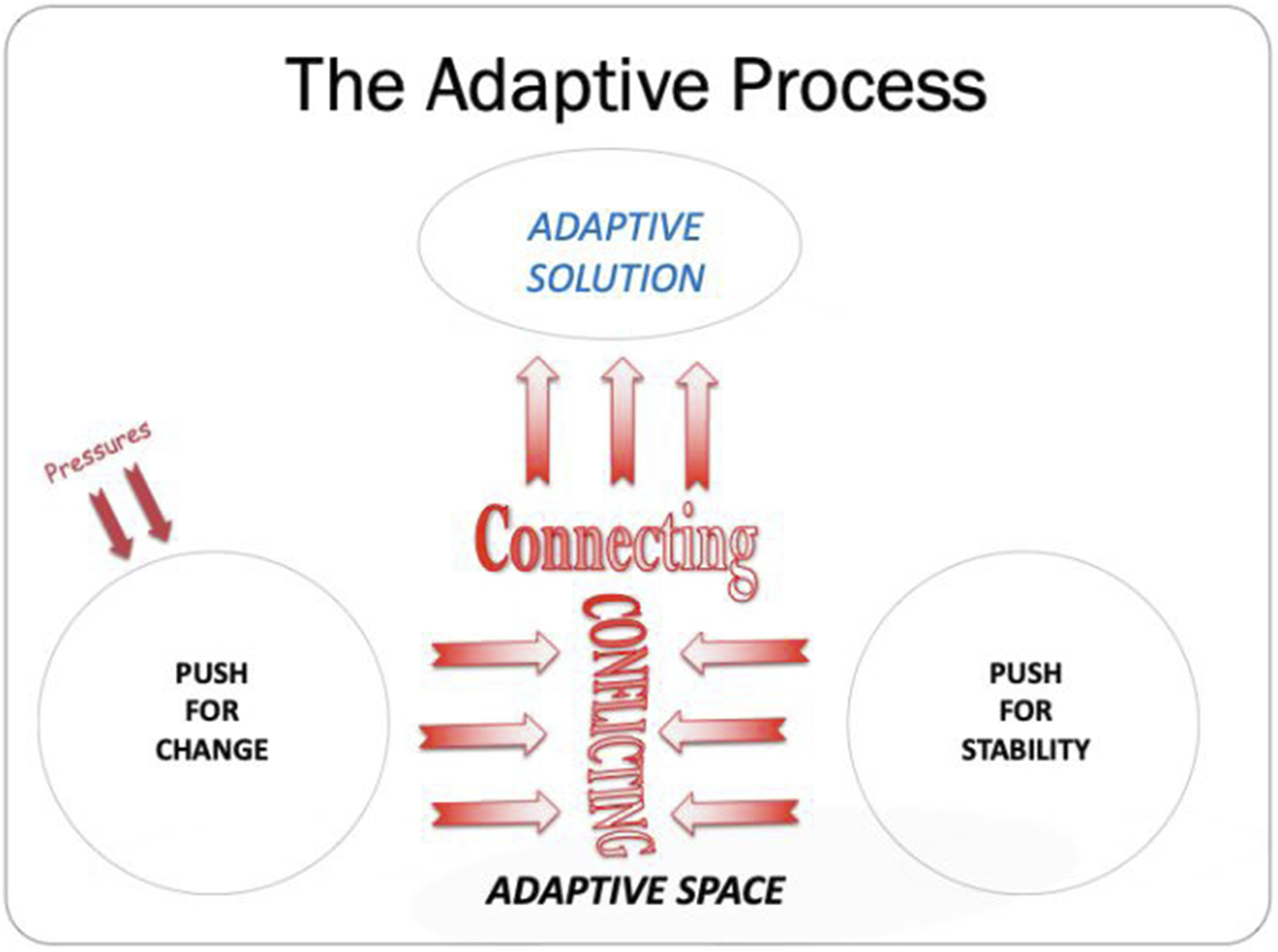
Havermans et al. (2015) argue that contextual ambidexterity emerges in interaction between people and in response to their perceptions of the complexity of stimuli. However, the complexity stimuli or pressure itself does not determine the response that is triggered; rather, it is influenced by the way a pressure or challenge is framed, we argue. To frame is ‘to select some aspects of a perceived reality and make them more salient.’ In this way, frames can simplify and condense aspects of the world in ways that can mobilize potential supporters and ‘demobilize antagonists’” (Klein and Amis, 2021: 1325). In such a context, it helps to understand leadership as “a dynamic that transcends the capabilities of individuals alone [and as] the product of interaction, tension, and exchange rules governing changes in perceptions and understanding” (Lichtenstein et al., 2006: 2). Understanding how leaders’ perception and framing of a complexity challenge affects the potential response to it, we argue, could enable understanding not only the potential response to a challenge but also the potential obstacles to engaging and navigating the complexity dynamics.
Enabling leadership sets the ground for “creating, engaging and protecting ‘adaptive space’ needed to nurture and sustain the adaptability process in organizations” (Uhl-Bien and Arena, 2018: 98). Adaptive space is “what allows individuals and systems to develop and advance new ways of thinking and operating” (Uhl-Bien, 2021a: 1402). Adaptive spaces can be physical, virtual, or headspace (i.e., dedicated time for interaction) (Hansen and Lilja, 2021). The goal of creating such spaces is “to directly foster and maneuver the conditions (e.g., context) that catalyze adaptive leadership and allow for emergence” (Uhl-Bien et al., 2007: 309); that is, adaptive space is the conditions that allow a system to loosen up to accept change and let adaptive processes occur (Uhl-Bien, 2021b). The lack of an adaptive space that will foster the conflicting-and-connecting process leads to “ideas [being] easily shut down (i.e. ‘hitting the brick wall’) and systems stay[ing] in equilibrium” (Uhl-Bien, 2021b: 153). Put differently, nurturing and sustaining an adaptive space is the way to engage the so-called ‘tension dynamic’ which is “at the heart of complexity and the adaptive process” (Uhl-Bien, 2021b: 149; Marion, 1999) – a dynamic which pressurizes adaptive tension to generate novelty when new ideas and initiatives clash with current operations in organizations. It requires facilitation skills – leaders “need to know how to create space that helps people engage across differences and come up with adaptive solutions they can agree upon and move forward” (Uhl-Bien, 2021b: 151). It thus becomes important to know what leaders do to prevent the shutdown of an adaptive space/process.
Ideation stage is followed by the scaling stage during which enabling leaders try to “amplify and scale emergence across the system by navigating the process of conflicting and connecting through adaptive space” (Uhl-Bien, 2021b: 158). When conflicting is sustained, creative and innovative ideas are usually born (Uhl-Bien, 2021b). Once new ideas are born at a local level, for them to affect other parts of the organization and not to remain in a project form, they also need to, as shown on Figure 2, link up and connect through networked interactions (Clifton et al., 2020), flow across the organization, and be amplified and integrated into the operational system. Scaling is about integrating ideas into the organization’s existing structures and practices. Getting ideas to be accepted as potential solutions to the issue(s) faced by the organization is a challenge and requires new forms of effort. This adaptive process (e.g., emergence) requires engaging the linking up dynamic which essentially amplifies adaptive responses into the system; it requires networking skills that enable leaders “to connect and flow ideas and innovations across the organizational system… continually adapt and adjust along the way” (Uhl-Bien, 2021b: 151); it requires “knowing how to dynamically lead and follow, i.e. to ‘follow’ and iterate in response to feedback/pushback, and to ‘lead’ and influence by reaching out to bridge and broker connections” (Uhl-Bien, 2021b: 151); it requires sponsoring by “someone with either authority or strong skills in ‘tipping’ the change into the operational system” (Uhl-Bien, 2021b: 153) – such sponsors “push or pull the change into the operational system” (Uhl-Bien, 2021b: 152) by “aligning and re-aligning … the operational system in ways that accommodate the new order and convert the adaptive solution into beneficial outcomes and/or results” (Uhl-Bien, 2021b: 153). The linking up dynamic is related to the relational and structural bridges required to integrate ideas into everyday practice. Scaling is thus more about negotiating the solutions’ fit into the organization rather than just simply spreading the solutions generated in the ideation stage. The adaptive process in scaling stage (Source: “Leading in (and through) complexity.” UNESCO Child & Family Research Centre Lunch & me Webinar Series. University of Galway, Galway Ireland, March 7, 2024. https://www.youtube.com/watch?v=RtDqdedI9sA).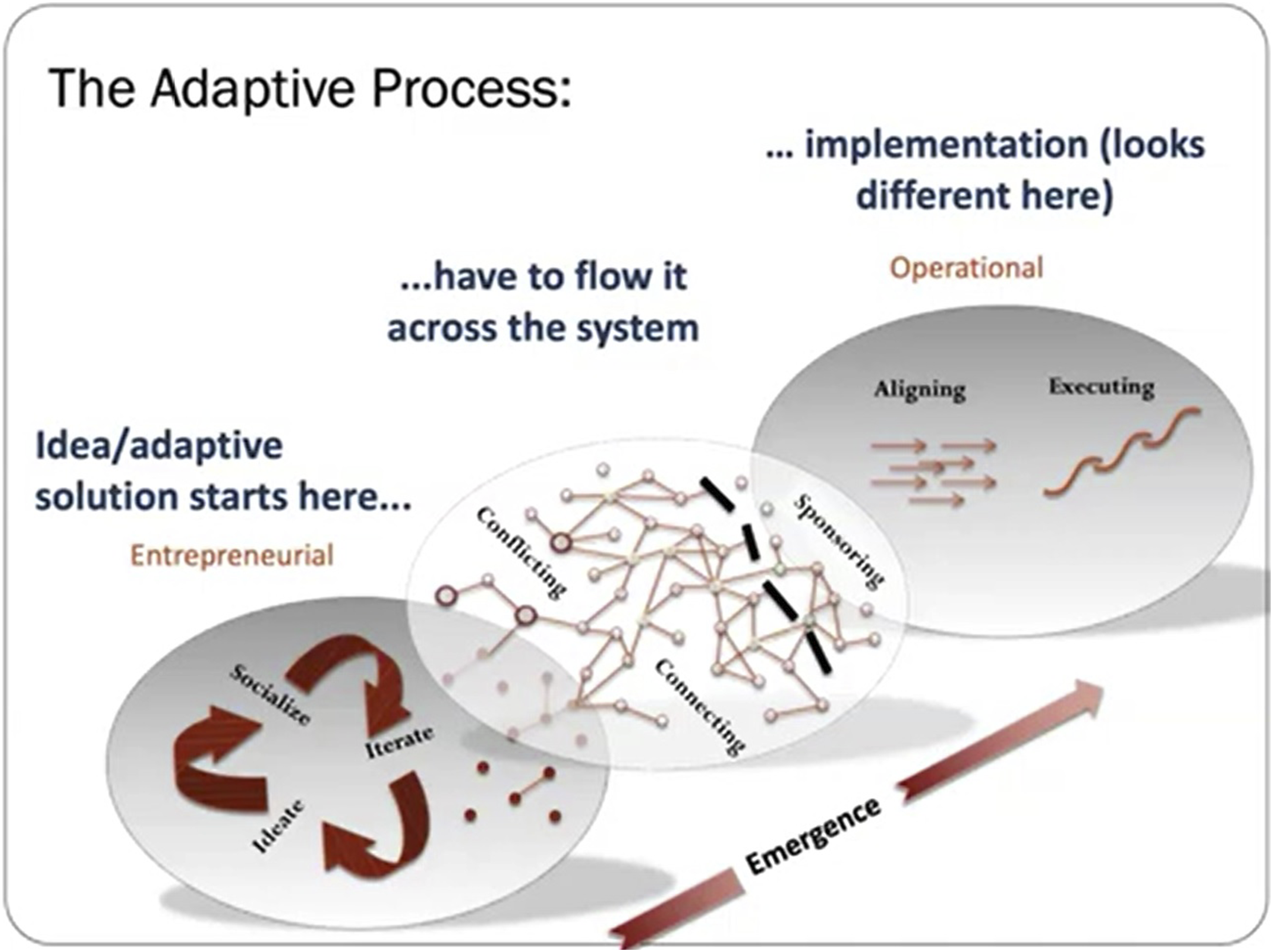
In theory, all this is done by “creating structures and processes (e.g., semistructures, temporary decentralization, collaboration, brokering, network cohesion, adaptive capabilities, absorptive capacity) that effectively engage conflicting (i.e., tension) and connecting (i.e., integration) to trigger and amplify emergence (i.e., innovation, adaptive responses) into new adaptive order (i.e., reintegration) for the organization” (Uhl-Bien and Arena, 2018: 98). How leaders create, support and sustain these structures and processes in practice, however, remains underexplored. Leaders’ behaviors in complex adaptive systems can take many different forms (Lawrence, 2015). For example, Bäcklander (2019: 42) argues that leaders can practice enabling leadership “by increasing the context-sensitivity of others, supporting other leaders, establishing and reinforcing simple principles, observing group dynamics, surfacing conflict and facilitating and encouraging constructive dialogue.” Additionally, Schulze and Pinkow (2020: 1) argue that leaders create adaptive spaces “by providing employees with head space and opportunities to connect with others and promote diversity within their organisations.” Furthermore, Hansen and Lilja (2021: 204) show “how the enabling leadership processes can be facilitated by guiding images”. Yet more empirical studies are needed to understand how leaders create and support adaptive spaces and navigate adaptive responses. More specifically, although it is known that the adaptive process goes through the stages of ideation and scaling, it is less known what leaders do to create possibilities to ideate and to scale up new initiatives during these different stages. In other words, we wonder what leaders do not only to initiate adaptive responses but also to sustain them and scale up the solutions. By exploring these questions, we could extend CLT literature, i.e. shed further light on how the conflicting-and-connecting process occurs and is sustained in practice.
Methods
Systems change in public health and care services
Organizations in the public sector face ever more complex challenges (Brammer et al., 2019; George et al., 2016; Hazy and Uhl-Bien, 2015). One such challenge is competence supply (Wolff et al., 2009), which is an issue that results from the gap between the increasing number of (older) people who need professional help and the limited number of professionals who are able to provide such services. Population aging is a global phenomenon expected to continue affecting all regions of the world (Harper, 2006a, 2011). By 2050, there will be “the same number of old as young in the world, with 2 billion people aged 60 or over, […] accounting for 21% of the world’s population” (Harper, 2014: 587); the number of those aged 80 and above is expected to increase “from about 69 million today to 379 million by 2050” (Harper, 2011: 117).
Additionally, occupations that provide services to older people, for example, are for various reasons characterized by constant staff turnover (Kulik et al., 2014). In the European Union, there is “a shortage of 1 million healthcare professionals” (Pruszyński et al., 2022: 137). These continuous staff shortages, coupled with demographic changes, are expected to put additional strains on already struggling healthcare systems (Harper, 2006a, 2011). In other words, access to—and provision of—health and care services becomes (or already is) a complex challenge (Harper, 2006b; OECD, 2023; Uhl-Bien et al., 2020; Vakili and McGahan, 2016) that can be characterized as a complex systems change challenge (Gell-Mann, 2002; Hazy and Uhl-Bien, 2015).
Individuals alone cannot respond to such pressures while trying to achieve organizational goals (Painter-Morland, 2008). Rather, such efforts need to involve various actors, ranging from state and regional authorities to non-governmental organizations and individuals with different professional backgrounds belonging to different departments (George et al., 2016; Gümüsay et al., 2022). These circumstances set the stage for complex relationships (Bateson, 2000), dealing with bureaucracy and tensions, and coordinating and negotiating across different levels in (and between) organizations (Uhl-Bien and Arena, 2018; Uhl-Bien and Marion, 2009). Systems change is about enabling transformation in the structure and interrelationships of the parts within a complex organization (Ackoff and Addison, 2007). CLT (and the “adaptive process” it focuses on) is apt to be used to understand such a complex systems change challenge since it views leadership as networked interactions of collective (and collaborative) endeavors. Thus, our research could contribute to a deeper understanding of leadership dynamics and systems change amid a spectrum of contemporary challenges.
The case
We studied the case (Flyvbjerg, 2006, 2011) of a cross-departmental project in health and care services in a medium-sized municipality in Sweden with around 140 000 inhabitants. The competence supply challenge “overshadows all other challenges when it comes to social services’ strategic planning for the future” (Municipality, 2022: 4). A forecast produced by the Swedish Association of Local Authorities and Regions suggests that “between the years 2021 and 2031, people of working age in Sweden will increase by a modest 4.1%, while the number of older people (80+) will increase by 47.1%” (Municipality, 2022: 4). The project was planned for six years (starting in December 2022 and ending in the fall of 2028) and included and affected multiple lines of operations within the municipal system, aiming to address their competence supply shortages. Or, as stated in their official reports, the project aimed “to ensure that the competences within social services are used correctly, that the right profession performs tasks within its area of competence, and to identify work tasks that can be carried out by employees with other competences or […] performed by external actors [i.e., outsourcing certain tasks]” (Municipality, 2022: 11).
As illustrated in Figure 3, the overall responsibility of steering the project lied with the “Steering group.” To coordinate all activities within the project, there was a (main) project leader who has been working for the municipality for over 20 years. Throughout her years at the municipality, she has held different roles and worked in different departments. Besides the steering group, the project’s developments were reported to an “Overall reference group” (including the head of development, head of HR, chiefs of staff for the units “Education and competence provision” and “Safety-creating technology,” communication strategist, and controller of the finance unit), and to a “Preparatory steering group” (including Area managers/unit managers from each “operation”
1
together with representatives, chief of staff, the project leader, and sub-project leaders). Organizational chart (Source: Municipality, 2022).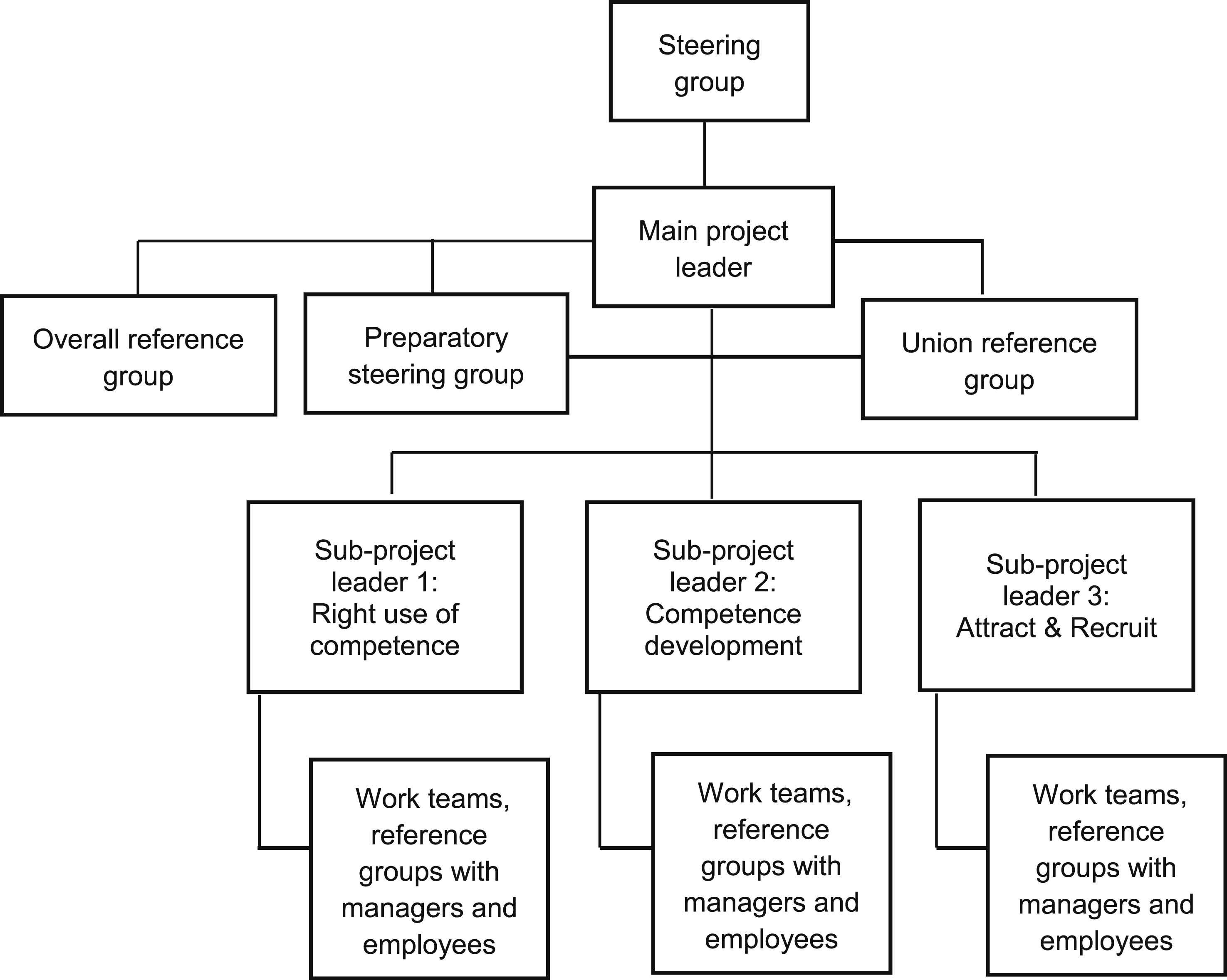
There were three sub-projects (i.e., “Right use of competence,” “Competence development,” and “Attract and recruit”), each one led by a sub-project leader who dedicated 50% (or in one case 30%–40%) of their working time to this project. The project leader worked exclusively with leading the project. They met and discussed ongoing activities in different forums and constellations. Once a week, the project leader and the sub-project leaders met to update each other and to discuss developments and challenges. Every other week, the project leader met each sub-project leader individually. They reported back to the Preparatory steering group and the Overall reference group during planned meetings and in other forums planned together with the Steering group.
Data generation
Data generation activities.
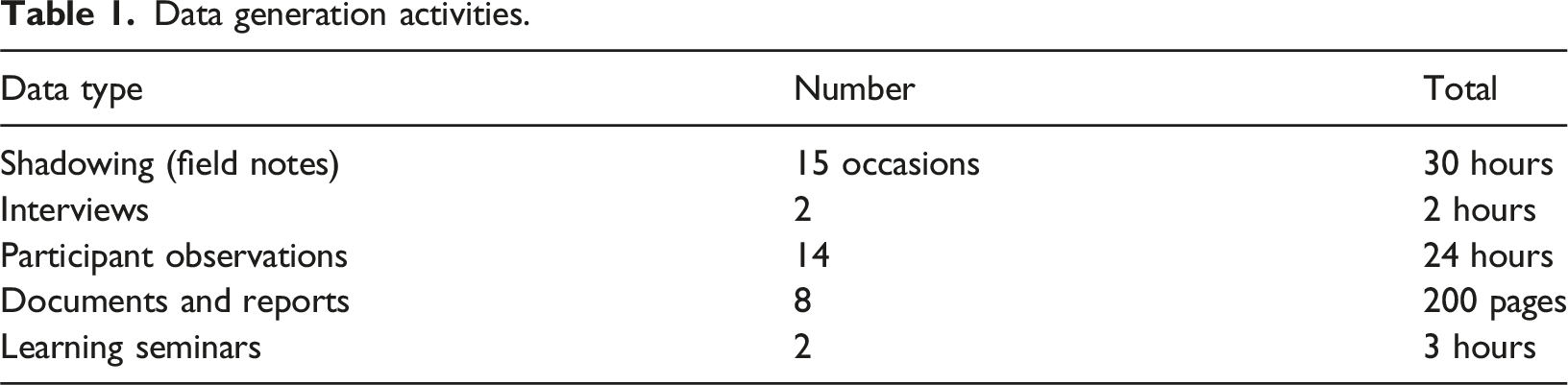
To observe first-hand, fine-grain interactions (Hazy and Uhl-Bien, 2015) occurring between individuals and groups of people, which form the base of the processes of conflicting and connecting, the first author followed the project leader during her daily activities and meetings within the municipality and listened and recorded conversations. The shadowing process started in September 2023 and continued until March 2024. In total, there were fifteen separate occasions of shadowing, with each occasion lasting around 2 hours. This resulted in around 30 hours of shadowing. The first author wrote field notes (Phillippi and Lauderdale, 2018) during and after these shadowing occasions.
In addition to shadowing, two interviews (one in September 2023, another in November 2023) with the main project leader were conducted, each lasting one hour. The interviews helped us go through details that we were curious about and learn more about what lay behind certain activities.
The first author also used participant observations to try to become an insider of the organizational context and the different group constellations. By focusing mainly on observing meetings between the project leader and the sub-project leaders, the participant observations allowed us not only to ask questions to dig deeper into the details of the project but also to clarify certain things noticed during the meetings (DeWalt and DeWalt, 2011), e.g. to find out more about how they dealt with certain pushbacks.
We also collected official documents, reports, and archival data (Ravitch and Carl, 2020) directly connected to the project. We identified eight such documents written in Swedish: six from the municipality in question, one from another municipality, and one from the Swedish Association of Local Authorities and Regions.
Moreover, we generated data by holding learning seminars with the so-called research reference group that consisted of four researchers (i.e., the co-authors of this article), the main project leader, the three sub-project leaders, and an official who leads research-related activities within the municipality.
Each of these meetings and interviews was audio recorded and transcribed verbatim during the first half of 2024, resulting in more than 430 pages of text.
Data analysis
To explore how leaders engaged the tension- and the linking up dynamics, we relied on an abductive analysis approach common in organizational research, with the data and existing theory considered in fusion (Alvesson and Kärreman, 2007). Case studies are useful for exploring the understanding of dynamics present in single settings (Eisenhardt et al., 2016). We chose to follow the mystery-focused approach introduced by Alvesson and Kärreman (2007), which stimulates a dialogue between theoretical assumptions and empirical impressions and in which the researchers’ preunderstandings and imaginations are crucial, as also has been shown in other reflexive analysis approaches (Braun and Clarke, 2022; Glaser and Strauss, 1967).
To start with, all researchers familiarized themselves with the setting in different ways and to different extents. One of the researchers (co-author 2) already held an insider position, while another researcher (co-author 1) used shadowing and participant observations to become familiar with the setting and thus gain an insider perspective (Dwyer and Buckle, 2009). The remaining two researchers (co-authors 3 and 4) became familiar with the overall setting during the initial meetings with the research reference group.
In the next phase, all empirical material (field notes, audio recordings with their transcripts, and official documents) were gathered, structured, and read by co-authors 1 and 2. The data analysis overlapped with data generation. This way, we could use our impressions and preliminary results to adjust our data generation in a flexible manner. Alvesson and Kärreman (2007) highlight handling qualitative data sensitively instead of destroying the data’s meaning by applying intensive coding. Therefore, we then explored contradictions, or interesting breakdowns, in the empirical findings that cannot easily be explained by available theory (e.g., the different ways leaders framed complexity challenges in different stages and the response they triggered). By focusing on how the division of roles and responsibilities between nurses’ aids and nursing assistants 2 has developed as part of the sub-project “Use competence correctly”, we explored how the need for change is framed from idea formulation and testing to organization’s response to implementation efforts. Working with practitioners is an essential part of co-creating solutions, where scholars “become ‘assemblers’ of solutions” (Brammer et al., 2019: 529). Having a practitioner who works at the municipality as one of the co-authors helped us in navigating the data, which otherwise can be hard to decipher for “outsider” researchers; it offered us opportunities to pay closer attention to certain aspects in the transcripts (e.g., dividing the implementation of a solution into phases and the importance of involving different parts of the organization in the change initiative as early as possible), thus adding value to the analysis by establishing validity of interpretations (Abalkhail, 2018).
In the continuation of the research and analysis process, it was important for co-authors 3 and 4 to keep a more “out of the field,” or outsider, perspective. Not immersing all researchers in the case details helped in securing different perspectives on the empirical material (Komalasari et al., 2022). To “anchor” and calibrate our understanding of the ongoing processes in the project, we held two learning seminars (one in late November 2023 and another in mid-May 2024) involving everyone from the research reference group. We shared observations and our preliminary findings, discussed interpretations of these findings, and posed additional questions to clarify certain research results (e.g., why certain ideas are not being raised?). During these meetings, we not only got face validation of certain findings, such as “now I understand what we do in our project” (a quote from one of the sub-project leaders) but also received valuable feedback that correlated with earlier results (e.g., what seems necessary for project management group’s ideas to be accepted by the operational leadership).
In the phase that followed, we concentrated only on the unexpected findings, that is, the breakdowns, that had a strong potential to offer an empirical contribution (e.g., how enabling leaders foster adaptive responses during different stages). Simultaneously, co-authors 1 and 4 continued reading CLT literature and other empirical studies within the field of leadership in complex systems change to think differently about the phenomenon we were studying (Alveson and Sandberg, 2011; Sandberg and Alvesson, 2011). In the final phases of the analysis, we reformulated our mystery by developing new insights that contribute with a further interpretation of enabling leadership and its functioning.
We divided the results into two sections. We first focused on the project leaders’ efforts to understand and frame a complexity challenge, while trying to facilitate the tension dynamic, in the ideation stage. We then focused on how the need for change is framed, while trying to foster and navigate the linking up dynamic to scale adaptive change into the system, in scaling.
Results
Ideation: Framing the challenge as an open question, while facilitating the tension dynamic
The competence supply project is based on long-term macro pressure, namely a feared staff shortage due to demographic changes (SKR, 2022). The efforts to distinguish – and thereby change – the role of nurses’ aids and nursing assistants is based on this (future) challenge. Here is how the project leaders framed the challenge the organization faces: We may not have more people, so to speak, in the end, and then we may have to find other ways to organize these tasks. (Project management meeting, 2023-09-19)
The challenge, rather than being framed as a technical question with a clear answer, is framed as a complex challenge which calls for an adaptive response that requires exploration, continued dialogue and adaptation to different ways of working. Rather than proposing a quick solution and thus killing the tension dynamic, it is kept alive by keeping the interpretations of the challenge wide open. Such a framing allows the project management group to legitimize the need for change and to facilitate the possibility of discussing ideas that might otherwise be perceived as unnecessary. Let us follow further how this framing develops. By describing roles and responsibilities, we’ll split it up a bit then, nursing assistants and nurses’ aids. […] We don’t have enough nursing assistants and then we also have to find a way, purely organizationally, to move over, to do this task exchange/shift. […] Part of it is about looking at how we can best utilize the skills: can nursing assistants do more of the nurse’s work in favor of lifting that profession then? (Project management meeting, 2023-09-19)
Although they seem to develop a common understanding of what is required to meet the pressure of staff shortage and skills mismatch, which includes the need for clearer role description of – and task distribution between – nursing assistants and nurses’ aids, it does not directly lead to quick decisions, but rather to an initiation of a process where enabling leadership creates space to try different paths forward. …because today it’s actually that if you work as a nurses’ aid, you do the same thing as someone who is educated, but you get a little more pay when you are a nursing assistant. What we want to steer towards is that it should also be clear in the tasks, when you have education, you may get to do more of what you are actually educated for and when you are not educated you get to do little different tasks. (Project management meeting, 2023-09-19).
Discussing and reflecting on the everyday tasks of the nursing assistants and nurses’ aids can foster colliding of heterogeneous ideas and perspectives (i.e. conflicting) as well as generating potential solutions (i.e. connecting): I’ve been out a bit at nursing home X. And we’re continuing with the tests there. I walked a bit next to the people who are testing the different activities […] I was struck by a reflection last week of how the work, which is actually quite complex for the nursing staff or for the nursing assistants… is highly routinized. […] And when I asked questions, people paused and went, “Well, now that you mention it, actually, I guess I do feel differently” […] After a session like this that we had together, someone else said, “Now that we’ve talked, I understand that I have to talk to the individual before the time we have together next week.” […] It doesn’t fit within the existing framework in this place that we are testing now. (Project management meeting, 2023-10-10)
The project leader acts as an enabling leader by creating an adaptive space where staff are given the opportunity to stop and reflect. In this ideation, conflicting arises when questions challenge the habitual way(s) of doing things, while connecting occurs in the dialogue when the staff themselves begin to formulate new insights.
However, it is not always the case that project leaders create adaptive spaces. Sometimes, as one project leader expressed it, certain thoughts are not being raised, even though they have been discussed internally: - So, we’ve talked internally, very informally, but it’s not an idea that’s being raised. “Listen, could we reorganize the entire administration [i.e. lines of operation]?” We haven’t promoted it. We’ve talked about it, thought about it, and we’re experimenting with the whole organization in some way. - Then I think there’s this preconceived notion that [the idea] isn’t accepted, so it’s not even brought up. - Yes, exactly. That’s probably an example [where, at least in my] case, I’m censoring myself, because I don’t feel that we, in this preparatory steering group, in the home services or the elderly care, are mature enough to throw around ideas like that. So, that goes against these spontaneous ideas and against having a lot of room for maneuver [in the project] then. We might be operating within quite narrow limits in the end, anyway. (Learning seminar 2024-05-15)
Unlike in the previous excerpts, here, the challenge is framed not as a complex and open dilemma but as something that already has a given limit to what is possible. It is not external obstacles that put a stop to ideation but an internal assumption that certain ideas are too radical or lie outside what can take hold in the organizational system. This becomes particularly clear when another project leader discusses another initiative or idea: My interpretation of what is reasonable is based on my preconceived notion of what the elderly care sector thinks is reasonable and what is within the framework of what can be allowed […] Other proposals for measures are […] rejected; they aren’t even brought up because there is a presumption that they are not […] acceptable paths. (Learning seminar, 2024-05-15)
In these statements, we can see how technical framing takes hold in the adaptive space. The complexity challenge is framed in advance as a question where only certain solutions are considered possible, which reduces the space for alternative interpretations. This technical framing leads to ‘order response’, where ideas are not met with curiosity or further dialogue, but are dismissed even before they have been articulated in common forums. The tension dynamic is interrupted at an early stage, which hinders the possibility of connecting and of furthering the search for adaptive solutions.
Scaling: Framing the challenge as gradual and situational, while fostering and navigating the linking up dynamic
To incorporate or implement ideas—that are tested in smaller, protected, contexts—into regular operations is a challenge. An example of the difficulty of scaling up is made visible in the transition from testing to implementation. A project leader expresses how the challenges grow in scope when the entire organization is involved: We’ve started on a tiny, tiny, tiny scale, we’re testing something […] But the idea is to roll it out more broadly. […] We have booked a special meeting to discuss “how should we do the implementation?”. And now, we have a test on one or two nursing homes, but this is about […] nearly two thousand employees who are nursing assistants or nurses’ aids […] in maybe fifty different units, or operations. […] It requires resources; this project cannot do that. (Learning seminar, 2023-11-28)
Instead of managing the tensions through curiosity and new thinking (which would indicate an adaptive response), the idea is met with doubts about its feasibility in the existing structure (i.e. order response). Although the project has generated knowledge and ideas (in the ideation stage), in scaling, these ideas meet a reality characterized by financial and organizational limitations, which is elaborated in the following statement: The existing schedule or the existing staffing requirements are meticulously planned […] It is so slim/lean that you can’t even bend a little bit. (Project management meeting, 2023-11-07)
The technical framing of the challenge is a pushback (i.e. conflicting) towards the proposed change. Instead of clashing of ideas within a protected test environment, it is now about tensions between the project’s ambition and the organization’s capabilities, i.e. it is a conflicting where what was previously (i.e. in the ideation stage) possible through deviations from staffing norms or their schedules now clashes with a reality where every minute is “meticulously” scheduled. In this next instance, the ideas are pushed back before even testing them. Are we prepared to invest these resources? No, we are not. No, but then there is probably no point in us even going ahead with it; then, we will have to pause it until the resources are available. (Learning seminar, 2024-05-15)
Instead of a complex framing, a typical order response is given, where the change is not questioned in substance, but is rejected with reference to a lack of resources. The connecting that has been built up in the ideation stage thus risks being shut down rather than being transformed into connecting in scaling and helping work through conflicting. What could become a platform for further development and collaboration instead gets stuck in an organization’s return to stability – not because the ideas necessarily lack viability, but because the response is based on a technical framing of what the system “can handle”.
However, not all change efforts are doomed to fail when clashed with organizational realities, which is demonstrated with the following complex framing by a sub-project leader who describes how the challenges do not disappear due to a lack of resources, but on the contrary grow in importance: And these challenges that we’re talking about are not going to go away because of that, they’re just getting bigger and bigger, so it’s such a short-term solution that in 2025 we need to ‘pull the handbrake’ a little. (Learning seminar, 2024-05-15)
By emphasizing the growing nature of the challenge, the linking up dynamic is kept alive, and the possibility of a future adaptive response is preserved. Here is another complex framing of the challenge they face: We don’t need to scale up all at once; one can do ‘pilots’ and sow seeds or test it out to see if it’s possible to scale up […] we can try to do it like this for this operation; we can try to do it like this or like that for that operation… (Learning seminar, 2024-05-15)
The project leaders are aware of the challenges they may face when trying to implement the ideas into the lines of operation. Rather than framing the challenges to implementation as linear rollout (i.e. a technical framing of the challenge), there is an understanding of scaling as an implementation of situationally adapted solutions. It is not about implementing a ready-made solution everywhere at the same time, but about sensitively adapting ideas to the specific conditions of different operations. Furthermore, there is a temporal aspect that becomes important during connecting in scaling: We want to hurry a little slowly because we want to secure certain processes and the resource issue. (Learning seminar, 2023-11-28) We are doubtful that […] we should ‘pull off the band-aid’ – and make these changes – all at once. Perhaps together we can find… a way to gradually work with changes; we can perhaps have some interim goals once every six months[, for example,] to take us in that direction. (Project management meeting, 2024-03-19)
Enabling leadership, rather than pushing for quick decisions, seeks to create the conditions for long-term change (i.e. connecting) by adjusting the pace of the process. By ‘hitting the brakes’ and slowing down, the enabling leaders foster and navigate the linking up dynamic. The project management is thus promoting the scaling by actively formulating interim goals and temporalizing (e.g., dividing into stages, buying time for implementation) the change process. Even after dividing the process into stages, however, it remains unclear who is going to drive the change process further across the organization, as pointed out in the next statements: Now that decisions are being made, you notice that it was the area managers, i.e. the functional management group for elderly care, who should have been [in] the working group […] because now we are working on their questions: why should we stand behind this decision? or how did [we] arrive at this point? […] It was not enough for the working group to simply inform the preparatory steering group, because there was something there that the functional management group did not manage to engage with or was unable to reflect upon. (Learning seminar, 2024-05-15)
It becomes visible how the adaptive space created within the project management group has functioned relatively decoupled from the organization’s operational structures (i.e. the preparatory steering group). Unlike how it was in the previous stage of ideation, where there was a certain understanding of the challenge by those involved in the idea generation stage, in scaling, there is a lack of understanding of why the change is necessary and how it has been formulated. While the ideas are met with an active resistance (i.e. conflicting) due to operational leadership not actively participating in the ideation stage and only coming in when the proposals are fully formulated, the scaling lacks connecting. As the next excerpts demonstrate, this separation leads to lack of ownership and legitimacy: I think we need to get that holistic perspective together. (Project management meeting, 2024-03-19) It’s not just a document we hand over. (Project management meeting, 2023-10-24) It’s an HR [human resource] issue and then it’s like “Should you own it in the project, or should the lines of operation own it, who should push it?” It’s also a consequence of the fact that we generally work in a project format. So, taking responsibility without owning the issue is never good… And when it comes to implementing this, elderly care [management group] needs to own the issue… Then the project can be there as support. (Learning seminar, 2023-11-28) I mean the preparatory steering group and the representatives [of different lines of operation], they have to support the content of it, because it will be a broad introduction and then it would be strange if the support is lacking, while we try to drive some form of change. That would not work. And we have talked to the elderly care management group about the fact that, here, the managers have to own this issue, you have to own it, not just support it, you have to drive it and own it. Now, we are in the implementation phase, and this is where the lines of operation have to step up and own the issue and that is not easy when it involves hundreds of unit managers. (Learning seminar, 2024-05-15) There needs to be designated people who are involved and [actively] working with this. (Project management meeting, 2023-11-07) All managers must own the issue, otherwise there will be no change. (Project management meeting, 2024-04-09)
Discussion
Our findings illustrate what (enabling) leaders do to engage the tension- and the linking up dynamics in the ideation and the scaling stages. In the project we followed, leaders were able to maintain the tension dynamic in the ideation stage but struggled to foster and navigate the linking up dynamic in the scaling stage.
Our study provides a more nuanced understanding of the issues around framings of complexity. First, in the ideation stage, the leaders managed to facilitate the tension dynamic (i.e. protecting the adaptive space) by framing the challenge in a way that is open to different interpretations and possible solutions and needs local adaptation rather than general directives. Furthermore, probing questions and support for reflections enabled questioning of habitual ways of working (i.e. conflicting) as well as formulating new insights (i.e. connecting), where new understandings and action options can arise. All these behaviors sustained an adaptive space. However, we also saw that, in the process, “ideas [were] easily shut down (i.e. ‘hitting the brick wall’)” (Uhl-Bien, 2021b: 153). And the shutting down was shaped not only by ‘external’ pressures but also by the project leaders’ own perceptions of what is legitimate idea or solution to articulate within the project. It became clear that certain ideas were never openly discussed, because they were judged in advance as organizationally unthinkable, i.e. the ideas were framed as unrealizable, which led to an order response.
Second, in the scaling stage, ideas, tested in local, protected, contexts—with allocated resources, dedicated time, and an adaptive space—met the organization’s existing structures and priorities. However, what was previously possible within the framework of a project turned out to be an arduous challenge when trying to implement it into the current operations. Dialogues are useful for reflection and the learning processes (Bäcklander, 2019) but not always good enough for taking concrete actions (Lawrence, 2015; Mitki et al., 2008). To overcome this, to preserve the conflicting, and thus the linking up dynamic, in scaling, enabling leaders framed the challenge as something which requires attention and effort no matter how costly or resource-intensive it is. In complex systems with various lines of operations with different needs and capabilities, understanding and framing the scaling up challenges as something that needs to be worked through gradually and systematically (i.e. situationally adapted solutions) is a step in reducing the risk of the project ideas being framed as technical and thus rejected in their transition into organization’s practices. In our case, by framing the challenge as something which will require more time before solutions are implemented, enabling leaders made a temporal delay in decision-making, with the intention to allow the organization to ’mature’ and be better prepared for the new ideas to be implemented across the organization.
However, to understand the emergence of the new behaviors and functionality required for achieving organizational goals, it is crucial to understand “the links and interactions between the elements that comprise a whole system” (Ackoff and Addison, 2007: vi). In an organization, with multiple lines of operations, there is a risk of keeping operational leadership away from (or not close enough to) the ideation stage – a risk of creating solutions in isolation. When operational leadership is not involved in the generation of ideas, the adaptive space risks remaining isolated; it becomes difficult to translate new ideas into concrete changes in practice when they are not anchored in the operational structures responsible for implementation. Research has shown that the implementation of co-produced ideas requires, from the early stage, an understanding of how they can be implemented (Kjellström et al., 2024). Without an iterative process where operational leadership is involved early in the change process, the adaptive space (created in the ideation stage) risks remaining a parallel structure rather than an integral part of the organization’s development capacity.
Systems change values “communication at, and between, all levels [and parts of the organization]” (Ackoff and Addison, 2007: vi). Besides communication, however, systems change requires collaboration and bonding between the different parts and functions in the organization. Fostering the bonding between the operational leadership and the entrepreneurial leadership (i.e. scaling) requires more than support; it requires the line(s) operation(s) to take clear ownership of the ideas generated in ideation – a need for a more integrated model where operational leadership is involved earlier in the adaptive process. The lack of ownership by the operational leadership can become an obstacle to enabling leadership, especially when solutions are perceived as external rather than jointly developed. Put differently, when those who will have to live with the changes have not participated in their creation, it leads to a lack of legitimacy (cf. Kjellström et al., 2024) and of connecting in scaling.
Interestingly, six months after our data generation, the project “hit a brick wall”. A newly appointed leader had evaluated the program and concluded that the current project form was not adequately designed to address the challenges. As a result, it was decided that the project needs to be redesigned. Yet, the competence supply challenges remain and, albeit in a new form, the work to address them goes on.
Lichtenstein and Plowman (2009: 628, emphasis in original) stated that “we simply do not yet know the right role and degree of influence that formal leaders do and perhaps should have in enacting a leadership of emergence”. One thing seems necessary though – those (such as formal leaders and, in our case, functional management group or preparatory steering group) who, later in the process, will have influence on the decision need to be involved in the emergence of a system-level order from the early – or ideation – stage. Additionally, the implementation of new ideas depends on sponsors who “align the operational system to accommodate the new approach” (Uhl-Bien and Arena, 2018: 100). The lack of sponsorship from different managers, due to various departments having different needs and capabilities and the viewing of the project as centralized rather than locally adapted, were some of the reasons for its redesign (also confirmed in conversations we had with the municipality representatives long after our data generation for this paper). To succeed in such cases, the sponsors need to work with other high-level managers with sufficient authority in the organization to get them to help enable the change (i.e. linking up dynamic). This way, new ideas can be recombined with existing structures, which is important to enable real change.
Conclusions
Our study extends the understanding of enabling leadership in CLT by showing what enables and stifles adaptive processes. The results show that, in both stages, the framing of complexity challenge is of utmost importance for the response the organization will generate. It became clear that if the challenge is framed as a technical one, while trying to eliminate tensions, the likely response is an order one; if the challenge is framed as a complex one, while trying to sustain tensions, the likely response is an adaptive one.
Framing the complexity challenge as unrealizable, for example, can kill the tension dynamic at a very early stage (before even discussing the ideas). This shows the entanglement not only of conflicting and connecting processes but also of ideation and scaling stages. Such self-censorship, where ideation is held back not by external resistance but by internally perceived scaling barriers, can become a real obstacle for organizational adaptability. If an organization is to counter self-censorship and to keep the door open for various solutions, it needs to keep the framing of the challenge open for various interpretations. Facilitating the tension dynamic requires welcoming probing questions and reflections, while keeping the adaptive space as a safe place where unconventional, and even ‘extreme’, ideas can be raised.
Framing the complexity challenge as something which needs to be addressed no matter the financial cost, can sustain the conflicting in scaling; it can also help in building a shared understanding that is necessary for overcoming pushbacks (i.e. conflicting) and in driving innovations further into the organizational structures and practices (i.e. connecting). Navigating the linking up dynamic is possible through slowing down the pace of the change process, setting up partial goals or milestones, i.e. ‘buying time’ for implementation. Put differently, sometimes, slowing down could be a way to scale up.
However, to achieve systems change, while it could help with multiple small-scale locally adapted projects running at their own pace, there is also a need to have a holistic approach to the changes necessary to achieve organizational goals, where the collaboration and bonding between entrepreneurial and operational leaderships starts as early as in the ideation stage, not just in scaling. In other words, to increase the chances of successful scaling and, consequently, systems change, solutions could be created in collaboration where operational leadership actively participates in forging ideas and has a sense of ownership.
Furthermore, our results show that, in CLT, the sponsor role is critical. The success of an adaptive process is dependent on engaged sponsorship from top-level managers within the organization. Without such sponsorship, the adaptive process is almost always doomed to “hit a brick wall” – regardless of how experienced and versatile the enabling leaders at the ideation stage are. The support from managers at the ‘top’ of the system that is being changed is therefore essential for scaling the adaptive process and thus implementing systems change.
Footnotes
Acknowledgements
We thank the municipality executives for allowing us to follow the work within their organization. We thank Anselm Schneider (Stockholm Business School) for his comments on an earlier version of the manuscript. We express our gratitude to the participants of the 21st International Studying Leadership Conference on “The Leadership Dynamics of Systems Change” in Copenhagen for their feedback. Last, but not least, we are grateful for Eric Guthey’s guidance in this process and for the comments from both anonymous reviewers whose patience and willingness to help were essential for the publication of this paper.

Funding
The authors disclosed receipt of the following financial support for the research, authorship, and/or publication of this article: Jönköping Municipality, JU 2023/5409-123.
Declaration of conflicting interests
The authors declared no potential conflicts of interest with respect to the research, authorship, and/or publication of this article.