



Abstract
Visuospatial neglect (VSN) is a negative, strong, and independent predictor of poor outcome after stroke, and is associated with poorer upper limb (UL) motor recovery in terms of function or capacity (ie, in standardized, lab-based testing). Although the main aim of stroke rehabilitation is to re-establish optimal functioning in daily life, the impact of VSN on UL performance (ie, in unstructured, everyday environments) is largely unknown. In this proof of principle study, the impact of VSN on the strength of the association between UL motor function (Jamar Hand Dynamometer) and UL performance (Upper Limb Lucerne ICF-based Multidisciplinary Observation Scale) was investigated in 65 (hyper)acute first-ever stroke patients. In a moderator analysis, the interaction term was negative and significant, showing that VSN suppresses the use of UL motor function in daily life (ie, performance). This finding suggests that, when considering UL performance in the (hyper)acute phase after stroke, interventions aimed to reduce deficits in both UL motor function and visuospatial function should already be started in the acute stroke unit setting.
Visuospatial neglect (VSN) is a very frequent and disabling disorder after stroke. As a negative, strong, and independent predictor of poor outcome, 1 VSN is also associated with poorer upper limb (UL) motor recovery in subacute and chronic stroke patients.2,3 However, previous studies mainly investigated the impact of VSN on UL motor function or activity capacity, that is, what patients do in a standardized, laboratory-based environment (World Health Organization). The impact of VSN on UL performance (ie, how patients use their UL in their current environment [World Health Organization]) is largely unknown. Accordingly, the relationship between UL motor function and performance in patients with VSN is ambiguous. 4 However, as the main aim of stroke rehabilitation is that patients function optimally in daily life, knowing the moderating impact of VSN on the relationship between UL motor function and UL performance is essential for targeted intervention. The need of further research in this area has been highlighted by recent systematic reviews. 2
Therefore, we aimed to describe the interrelationship of UL motor function, UL performance, and visuospatial function within 72 hours after stroke. Our hypothesis was that the presence of VSN moderates the association between UL motor function and UL performance. VSN could suppress the use of UL motor function during daily life, as real-world situations are often more complex, and less quiet and supportive than testing situations, thereby enhancing deficit expression.
For this proof of principle study, a representative convenience sample from a larger prospective observational cohort study with a cross-sectional design (acute stroke unit of the Luzerner Kantonsspital, Switzerland, 07/2022–06/2023) was used. Patients within 72 hours after a first-ever stroke were included. We purposefully did not consider any other inclusion/exclusion criteria (eg, impairment severity and lesion localization) to prevent a selection bias. Patients were assessed within 72 hours after onset for motor function of the paretic UL (grip strength) and VSN (mean gaze position [MGP] on the horizontal axis during free visual exploration [FVE] using video-oculography 5 ) by 1 trained assessor (RH). Grip strength (kg) of the paretic UL was determined with the Jamar Hand Dynamometer, and the mean of 3 attempts was taken. During the video-oculography (performed bedside with the EyeLink Portable Duo system, SR Research, Canada), patients were asked to freely explore 12 images in random order (6 original, 6 mirrored versions) for 7 seconds each. Offline fixation data preprocessing, analysis, and MGP computation were identical to Kaufmann et al. 5 Accordingly, the presence of VSN was defined as an MGP value of <−1.36 for left-sided neglect and >1.33 for right-sided neglect. The MGP is an ecologically valid measure of neglect in everyday behavior, showing good correlation with scores of its gold-standard, the Catherine Bergego Scale. 5 UL performance was observed by trained multidisciplinary team members on our acute stroke unit using the Upper Limb Lucerne ICF-based Multidisciplinary Observation Scale (UL-LIMOS). 6 The UL-LIMOS allows to systematically observe and quantify the dependency on others during 5 daily life activities involving the UL in a non-standardized setting (hand and arm use, fine hand use, washing oneself, lifting and carrying objects, and dressing). 6 The score ranges from 0 to 20, with higher scores meaning a better performance. The Cantonal Ethics Committee Northwest and Central Switzerland approved the study, which was in line with the Declaration of Helsinki, on July 19, 2022 (BASEC ID 2022-01079). Patients provided written informed consent prior to testing. Reporting adheres to the STROBE statement.
Data of 65 out of 72 patients (median age = 68 years, quartile 1 = 59, quartile 3 = 79; 36.9% female) were available for analysis (see Supplemental Figure 1 and Table 1). Twenty-one (32.3%) patients had VSN (Figure 1). In a moderator analysis (multivariable linear regression analysis with enter method), the dependent variable was UL performance (UL-LIMOS), the independent variables were UL motor function (Jamar Hand Dynamometer, % of the lower limit of the age- and sex-related reference values 7 ), VSN (MGP during FVE), and their interaction. The interaction term was significant (β = −.02, standard error 0.01, P = .04; Table 1). We thus show, for the first time, that VSN changes the relationship between UL motor function and UL performance.
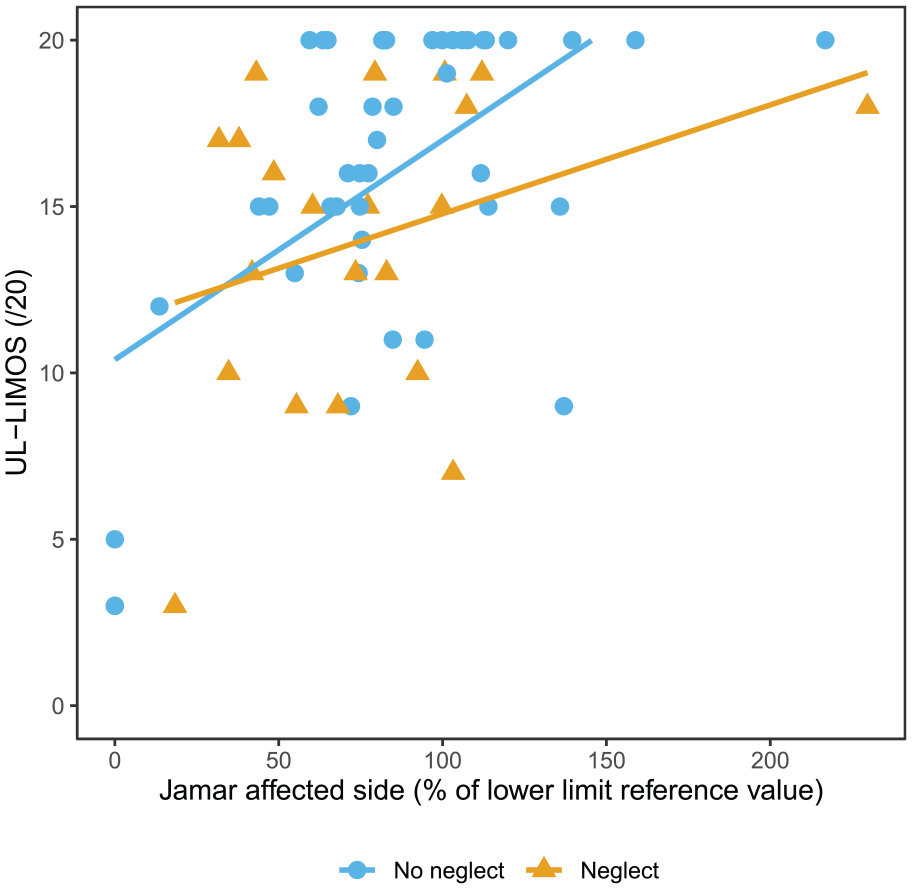
Impact of visuospatial deficits on the relationship between upper limb motor function and upper limb performance.
Moderator Analysis for UL Performance.

Abbreviations: MGP FVE, Mean Gaze Position during Free Visual Exploration; UL, upper limb; SE, standard error. R2 = .297, adjusted R2 = .263; F(3,61) = 8.61, P < .001.
% of the lower limit of the age- and sex-related reference values.
In previous work, we demonstrated that the patient’s performance on the acute stroke unit is highly predictive of discharge destination. 8 For patients requiring rehabilitative treatment, it is crucial to understand how underlying impairments in body functions affect performance, in order to develop specific interventions. The current findings suggest that—when looking at UL performance—deficits in both UL motor function and visuospatial function need to be already addressed in the (hyper)acute phase after stroke. Specifically, visuospatial deficits leading to underuse of UL motor function make specific interventions aimed at reducing VSN particularly important. 9 Its relevance is underlined by the high number of (hyper)acute patients with UL motor impairment (~50% 10 ) and VSN (~34%, ie, ~45% for right- and ~23% for left-hemispheric stroke 11 ).
One could argue that visual field loss might influence neglect assessments by means of video-oculography. The literature shows that this is unlikely, as during visual exploration, stroke patients with visual field deficits but without neglect show a symmetrical visual exploration pattern in the acute phase, 12 or even a contralesional bias in the subacute phase. 13 This means that these patients do not fulfill the criteria for a VSN as applied in the current work.
Although having a proof of principle character, our approach offers several advantages: (a) data were prospectively obtained in a heterogeneous, unbiased sample of (hyper)acute, first-ever stroke patients without further restrictions by inclusion/exclusion criteria; (b) the use of FVE during video-oculography allowed us to capture VSN in a more ecologically valid and sensitive way than commonly used paper-and-pencil tests 5 ; and (c) the FVE approach is suitable for the application in an acute stroke unit setting, requiring less than 10 minutes. However, our approach also has some limitations and opens new aspects that should be addressed in future studies. First, to investigate the impact of VSN on the association between UL motor function and UL performance in a longitudinal manner. Second, FVE as assessed in this study captures the most affected visual dimension of VSN. A meaningful addition would be to also consider other modalities or spatial planes in more detail, such as personal neglect and somatosensory neglect. Third, as we opted for a quick motor function assessment in the (hyper)acute phase, we did not use the Fugl-Meyer Assessment, which was recommended by the first Stroke Recovery and Rehabilitation Roundtable, 14 and could be included in future work. Finally, as neglect can arise from a wide range of lesion locations, investigating the impact of lesions (size and location) on the presence and severity of neglect, as well as its interaction with UL motor function would be of high future interest.
Supplemental Material
sj-docx-1-nnr-10.1177_15459683241304329 – Supplemental material for Impact of Neglect on the Relationship Between Upper Limb Motor Function and Upper Limb Performance in the (Hyper)acute Poststroke Phase
Supplemental material, sj-docx-1-nnr-10.1177_15459683241304329 for Impact of Neglect on the Relationship Between Upper Limb Motor Function and Upper Limb Performance in the (Hyper)acute Poststroke Phase by Janne M. Veerbeek, Henrik Rühe, Beatrice Ottiger, Stephan Bohlhalter, Thomas Nyffeler and Dario Cazzoli in Neurorehabilitation and Neural Repair
Footnotes
Acknowledgements
We thank all the patients who took part in our study as well as the clinical team at the Kantonsspital Luzern for their assistance and support.
Author Contributions
Janne M. Veerbeek: Conceptualization; Data curation; Formal analysis; Investigation; Methodology; Project administration; Visualization; Writing—original draft; and Writing—review & editing. Henrik Rühe: Data curation; Investigation; and Writing—review & editing. Beatrice Ottiger: Methodology and Writing—review & editing. Stephan Bohlhalter: Methodology and Writing—review & editing. Thomas Nyffeler: Conceptualization and Writing—review & editing. Dario Cazzoli: Conceptualization; Funding acquisition; Investigation; Methodology; and Writing—review & editing.
Availability of Data and Materials
The conditions of our ethics approval do not permit the public archiving of the data supporting the conclusions of this study. Based on the Swiss Human Research Act, the HRA (Humanforschungsgesetz) in Switzerland, readers seeking access to the data and the study materials must therefore complete a formal data sharing agreement to obtain the data. Interested readers should contact the corresponding author for more information and help.
Declaration of Conflicting Interests
The author(s) declared no potential conflicts of interest with respect to the research, authorship, and/or publication of this article.
Funding
The author(s) disclosed receipt of the following financial support for the research, authorship, and/or publication of this article: Swiss Heart Foundation (grant number FF21037 to D.C.), Swiss National Science Foundation (grant number 32003B_196915 to T.N.).

Supplementary material for this article is available on the Neurorehabilitation & Neural Repair website along with the online version of this article.
References
Supplementary Material
Please find the following supplemental material available below.
For Open Access articles published under a Creative Commons License, all supplemental material carries the same license as the article it is associated with.
For non-Open Access articles published, all supplemental material carries a non-exclusive license, and permission requests for re-use of supplemental material or any part of supplemental material shall be sent directly to the copyright owner as specified in the copyright notice associated with the article.
