



Abstract
We describe a simple alternative method to hold a fork when the fingers are too weak to grip it.
A 56-year-old right-handed man became tetraparetic 21 months earlier, following a traumatic C7/T1, ASIA grade A, spinal cord injury. He had no useful movement in his right hand, but had voluntary left wrist extension against gravity and could extend and flex his fingers if gravity were eliminated. Left-hand sensation was moderately impaired; tone was normal. He ate with a fork held in a utensil strap on his left hand with much effort. Because of frequent spills and the associated social stigma, he often relied on his wife to feed him. He was unable to use adapted or broad-handled cutlery. The couple contacted the rehabilitation service in search of an alternative feeding technique.
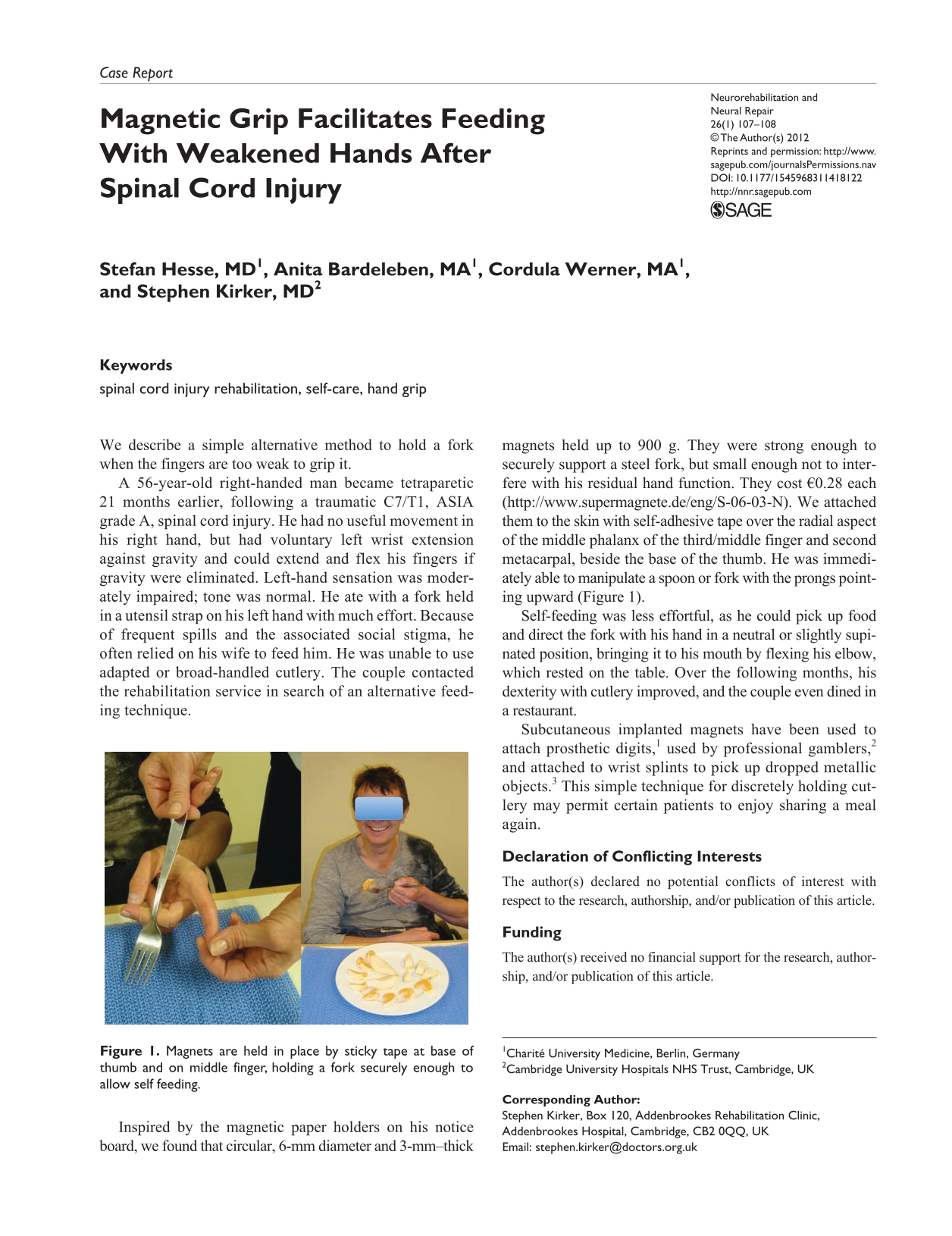
Inspired by the magnetic paper holders on his notice board, we found that circular, 6-mm diameter and 3-mm–thick magnets held up to 900 g. They were strong enough to securely support a steel fork, but small enough not to interfere with his residual hand function. They cost €0.28 each (http://www.supermagnete.de/eng/S-06-03-N). We attached them to the skin with self-adhesive tape over the radial aspect of the middle phalanx of the third/middle finger and second metacarpal, beside the base of the thumb. He was immediately able to manipulate a spoon or fork with the prongs pointing upward (Figure 1).
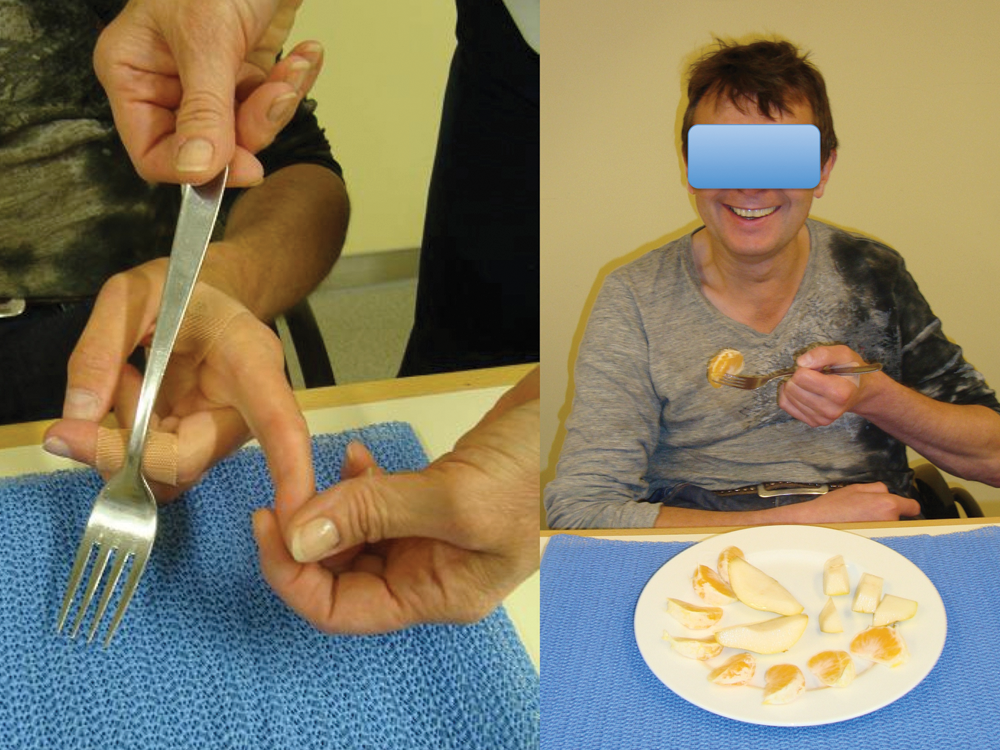
Magnets are held in place by sticky tape at base of thumb and on middle finger, holding a fork securely enough to allow self feeding.
Self-feeding was less effortful, as he could pick up food and direct the fork with his hand in a neutral or slightly supinated position, bringing it to his mouth by flexing his elbow, which rested on the table. Over the following months, his dexterity with cutlery improved, and the couple even dined in a restaurant.
Subcutaneous implanted magnets have been used to attach prosthetic digits, 1 used by professional gamblers, 2 and attached to wrist splints to pick up dropped metallic objects. 3 This simple technique for discretely holding cutlery may permit certain patients to enjoy sharing a meal again.
Footnotes
The author(s) declared no potential conflicts of interest with respect to the research, authorship, and/or publication of this article.
The author(s) received no financial support for the research, authorship, and/or publication of this article.