




Abstract
Background:
The quality of life of people living with HIV and AIDS (PLWHA) is becoming increasingly important--a fact that is also reflected in extensive research efforts. Owing to the almost complete lack of systematic integration of research findings, it is hardly possible to provide an overview of the current status of research, or to derive valid statements about research results.
Methods:
A literature search regarding the quality of life of PLWHA was performed in two international research databases. After checking their relevance, 852 publications appearing in scientific journals and explicitly measuring the quality of life of PLWHA were categorized on the basis of various study characteristics.
Results:
The number of publications per year in our study pool has been rising steadily since 1989. Well over 40 established instruments were used to determine the quality of life, most frequently the MOS-HIV, followed by the SF-36. The great majority of the studies are correlation studies. CD4 cells, gender, and age are the most common variables for which correlations with quality of life are reported.
Conclusions:
Our descriptive review stresses both the increasing significance and the challenges of research into quality of life of PLWHA such as the great variety of instruments used. The limits of this review are discussed and we conclude with the formulation of research desiderata concerning comparative review studies on instruments and systematic reviews of frequent research questions.
Keywords
Background
Since the advent of antiretroviral treatment for HIV infection, the image of HIV/AIDS has changed from a certain death sentence to a controllable and treatable, chronic disease. As a result, the treatment and care of people living with HIV and AIDS (PLWHA) is no longer aimed solely at prolonging their life span but increasingly also at improving their (health-related) quality of life (QOL).
The large number of publications on this subject makes it difficult to provide an overview and assessment of the status of research in regard to specific research questions. Methodological problems, such as the lack of a standard definition of the concept and insufficient theoretical foundations, 1 additionally exacerbate the assessment and review of the current status of research.
Up to now, only a few reviews are available regarding the QOL of PLWHA. Their aim is mainly to compare and discuss instruments for measuring HIV-related QOL. 2 –5
Reviews on specific research areas (eg, refer to Lamping and Mercey 6 and Guaraldi et al 7 ) are far more seldom and rarely meet the criteria for a systematic review. 8,9 One exception is the systematic review of the correlation between QOL and adherence in HIV-infected patients by Geocze et al. 10 Similarly, QOL is only rarely taken into consideration in reviews and meta-analyses of interventions aimed at HIV-infected patients. 11 –13
To obtain an initial overview of the state of research into the QOL in HIV/AIDS, we carried out a descriptive review of the published empirical studies that measure the QOL of PLWHA. The aim of this review is to allocate quantitative data on the methods, instruments, and research questions of this research and identify essential questions and directions. These results can function as a starting point for further discussions and research efforts with the aim of an aggregation and evaluation of the cumulative knowledge on QOL in HIV/AIDS.
Methods
At the beginning of 2011, we conducted a search in 2 international databases, PubMed and PsycInfo, using the keywords “HIV/AIDS,” “quality of life,” and related concepts, like “well-being,” “life satisfaction,” and the names of established QOL instruments.
This search yielded 6364 hits, which were checked for duplicates and subjected to a rough assessment of relevance. We examined whether the article really did address QOL and HIV or AIDS. The result was a study pool of 1306 studies, which were then obtained in full wherever possible, and otherwise in the form of abstracts.
Two members of the project team each examined half of these studies more closely, deciding on inclusion of the studies on the basis of the following criteria: (1) relevance (see the following); (2) empirical, quantitative article; (3) magazine article or book contribution as the form of publication; and (4) availability of an abstract in English in the case of articles not written in English.
Articles were considered relevant when the authors explicitly claimed to measure QOL regardless of the methods and instruments they used to achieve this aim. We used this operational working criterion instead of a definition of the QOL construct because no generally accepted definition exists up to date.
A total of 852 articles remained in the final study pool after excluding all publications that did not meet the above criteria. For each article the year of publication, language of publication, questions addressed, instruments, and other variables were recorded and subsequently analyzed using the SPSS 19 software (IBM, Somers, NY).
It is important to note that the goal of this review is not to derive conclusions about the psychometric properties, the content of the QOL measures, or about the results of the empirical studies. Rather, the goal is to give a comprehensive summary of the methodological approaches that were used to study the QOL of people with HIV and AIDS.
Results
General Information
The first empirical study we were able to identify measuring QOL in PLWHA was published in 1989. The number of publications per year in our study pool has risen steadily since that year, most recently reaching a total of 70 publications in 2010 (see Figure 1).

Number of publications by year of publication.
Almost all the studies in our study pool, namely 808 (94.8%) are available in English. The United States clearly prevailed as the country in which the leading author works (n = 460, 54.0%) and the country of the data survey (n = 439, 51.5%), with Spain (workplace of first author: n = 54, 6.3%; country of data survey: n = 58, 6.8%) and France (n = 44, 5.2%; n = 45, 5.3%) both following well behind in second and third place.
Instruments
In the 852 articles, we identified more than 40 established instruments used to record the QOL of people with HIV/AIDS. In some cases, up to 5 different instruments were used in parallel in a single study. It was not possible to determine the exact number of instruments used, since also self-designed scales and modified, established ones as well as single item measures were used. The 14 most frequently reported instruments are shown in Table 1, for all studies and broken down by the questions addressed (see section Questions Addressed). By far the most frequently used instrument in this study pool is the Medical Outcomes Study HIV Health Survey (MOS-HIV). 14 Totally, 211 studies (24.8%) used this instrument. The second most common instrument is the 36-Item Short Form Health Survey (SF-36), 15 which is used in 128 studies (15.0%). This list is continued by the EuroQol Group Health Questionnaire (EQ-5D), 16 the World Health Organization Quality of Life-BREF (WHOQOL-BREF), 17 and the Functional Assessment of Human Immunodeficiency Virus Infection. 18 Of the 14 most frequently used instruments, 8 are of a generic nature, while 6 were specifically developed for HIV/AIDS.
The 14 Most Frequently Used Instruments for Measuring the Quality of Life for the Entire Study Pool and by Questions Addressed.
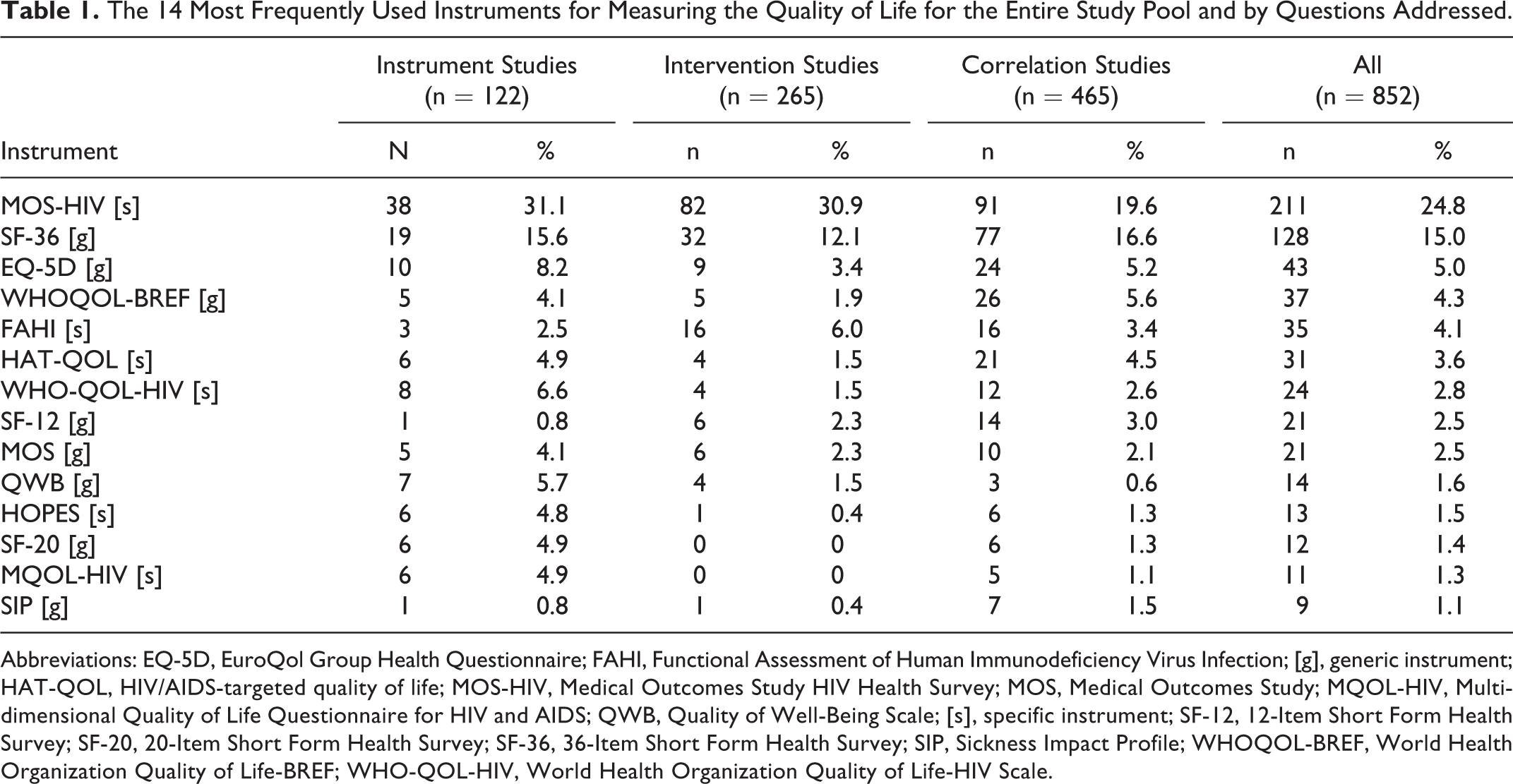
Abbreviations: EQ-5D, EuroQol Group Health Questionnaire; FAHI, Functional Assessment of Human Immunodeficiency Virus Infection; [g], generic instrument; HAT-QOL, HIV/AIDS-targeted quality of life; MOS-HIV, Medical Outcomes Study HIV Health Survey; MOS, Medical Outcomes Study; MQOL-HIV, Multidimensional Quality of Life Questionnaire for HIV and AIDS; QWB, Quality of Well-Being Scale; [s], specific instrument; SF-12, 12-Item Short Form Health Survey; SF-20, 20-Item Short Form Health Survey; SF-36, 36-Item Short Form Health Survey; SIP, Sickness Impact Profile; WHOQOL-BREF, World Health Organization Quality of Life-BREF; WHO-QOL-HIV, World Health Organization Quality of Life-HIV Scale.
Questions Addressed
Three types of questions addressed were identified in the study pool: studies dealing with the development and psychometric testing of QOL instruments, intervention studies, and the remaining studies which we classify as correlation studies.
Studies dealing with the development or psychometric evaluation of instruments constitute the smallest group in the study pool: 122 papers were assigned to this group. Most frequently to be found in this category are papers reporting the psychometric evaluation of existing instruments (n = 52, 42.6%). Other studies deal with the translation of instruments (n = 21, 17.2%), a comparison of the psychometric qualities of different instruments (n = 20, 16.4%), the development of instruments (n = 19, 15.6%), and the evaluation of the use of an instrument in a certain population (n = 10, 8.2%; studies could be categorized into more than 1 category).
Totally, 265 of the studies are intervention studies that use an instrument to record the QOL in order to assess the effect of the intervention. More than 70% of these intervention studies examine the effect of medication: 93 intervention studies on antiretroviral medication (35.1%) and 98 intervention studies on other medication (37.0%). The remaining intervention studies address the effect of sports/activity, stress management/coping, psychotherapy, counseling, surgery, and other interventions.
The 465 studies in the largest of the 3 categories are subsumed under the label “correlation studies.” Most of these studies (n = 384, 82.6%) report correlations between the QOL and other variables (for examples see next section). Much fewer studies deal with the comparison of HIV-related QOL and QOL of patients with other diseases or the general population (n = 43, 9.2%), with variations in QOL over time (n = 43, 9.2%), with the comparison of subpopulations among PLWAH (n = 38, 8.2%) or the exclusive description of the QOL in a certain population of PLWAH (n = 28, 6.0%; studies could be categorized into more than 1 category).
Variables
A host of variables for which correlations with the scores of the quality-of-life instruments are reported were identified in the 852 studies. Here, we only report the 3 most common variables in the study pool for each of the 4 areas: sociodemographic, medical, behavioral, and psychological variables. The most frequently reported sociodemographic variables reported are correlations between age (n = 144, 16.9%), sex (n = 144, 16.9%), education (n = 97, 11.4%), and QOL. The CD4 counts (n = 166, 19.5%), HIV symptoms (n = 129, 15.1%), and US Centers for Disease Control and Prevention disease stages (n = 125, 14.7%) are the most common medical parameters. Adherence to antiretroviral therapy (n = 52, 6.1%), substance use (n = 37, 4.3%), and alcohol use/abuse (n = 17, 2.0%) prevail among the behavioral variables. The most common psychological variables with QOL correlations are depression (n = 78, 9.2%), social support (n = 73, 8.6%), and coping (n = 40, 4.7%). Altogether 33 variables could be identified that were reported in at least 1% (n < 8) of the studies in the study population, ranging from income, ethnic group, viral load, comorbidities over disclosure, sexual risk behavior to stress and stigma.
Discussion
The results of this descriptive review based on 852 empirical studies on the QOL of PLWHA show an increase in literature publications over the past 20 years, indicating the growing importance of this area of research. The research field is dominated by US-American researchers. The results reveal the large number of both generic and HIV-specific instruments used to measure QOL in PLWAH. More than half of the studies were correlational in nature, instrument studies and intervention studies together represented less than half of the studies. A multitude of medical, sociodemographic, behavioral, and psychological variables were correlated with measures of QOL across the PLWAH population.
The variety of different instruments used in QOL research on HIV/AIDS points to a major issue in QOL research in general. The use of diverging instruments as well as single items and self-designed instruments is a key obstacle to the comparability and thus the integration and evaluation of research findings. This is also indicative of the insufficient theoretical foundations of the concept of QOL and a lack of a universally accepted definition.
However, our results show that 2 instruments are used particularly often: the HIV-specific MOS-HIV and the generic SF-36 instrument. These 2 instruments are among those instruments for which use in clinical studies was already recommended in a review some years ago. 4 In order to advance the comparability of results from different studies, it would be useful if a consensus could be reached regarding the use of these 2 instruments in future research.
A number of limitations restrict the validity of the results presented. The operational definition of QOL used in this review in agreement with recommendations of other scientists 19 may represent a pragmatic solution for conducting a literature search, but it most probably also results in underinclusion of relevant publications. Also, restriction to the 2 databases, PubMed and PsycInfo, further increases the probability of relevant publications not being included.
We conclude from our descriptive review of study characteristics and methodological approaches the following desiderata for the research on QOL in PLWHA.
More comparative research on the psychometric qualities, the dimensions, the applications, and the advantages of instruments used to measure QOL in PLWHA should be carried out. The aim of this comparative research should be the identification of a small number of instruments which are recommended to be used in empirical research on QOL in PLWHA. Our review indicates a number of frequently used instruments that can be used as a starting point for further research.
Research into the QOL of PLWHA has examined numerous questions, but so far there is a lack of integration of research findings, such as systematic reviews or meta-analyses, which would permit a summary assessment of the research status in relation to these questions. However, we found a great number of variables, for which sufficient research exists on the relationships with QOL in PLWHA to perform systematic reviews and meta-analyses. Especially the identification of variables predicting QOL in PLWHA can benefit from research integration that compares various potential predictors. Research of this kind can also inform the building of a framework explaining QOL outcomes in PLWHA like Heckman’s Chronic Illness Quality of Life Model. 20
Footnotes
Declaration of Conflicting Interests
The author(s) declared no potential conflicts of interest with respect to the research, authorship, and/or publication of this article.
Funding
The author(s) disclosed receipt of the following financial support for the research, authorship, and/or publication of this article: Jochen Drewes and Burkhard Gusy received financial support from the Federal Centre for Health Education (BZgA), Cologne, Germany, for conducting the research.