



Abstract
This study investigates the late Mozambican artist Malangatana Valente Ngwenya's mural in Zimpeto as an art object that contributed to peacebuilding in Mozambique during the devastating internal conflict known as the Sixteen Years War (1976–1992). The article draws on an interview with Malangatana Valente Ngwenya recorded while shooting the BBC TV film Homeland, the raw footage used as ethnographic material and recent interviews with the artist's sons, Mutxhini and Manguiza Ngwenya. Our sources show that the mural was more than a mere conveyor of meaning but an agent with a social biography. As such, it carried a powerful message of peacebuilding in war-torn Mozambique. We argue that Malangatana's construction of the mural was a tomada de posição (taking of position) about peace further afield than Zimpeto because of its communitarian approach, which challenges top-down, neoliberal framings of cultural activity and peacebuilding both in Mozambique and worldwide. The article opens perspectives on works that might not be art objects according to Western conventions but are embedded in complex peacebuilding activity in conflict-torn locations.
Introduction
It's not just a wall. With destruction all around, it's a symbol of construction—and hope. I’m doing it with the local people, especially the children. Sometimes, we hear bombing, but we can’t sit down and wait for the war to end. We need to make something now for the future. We must walk side-by-side. I’m educating the local people, bringing out their culture to put against the bombing. When we’re linked in this way, you can destroy as much as you want, but new things will come. The Zimpeto mural is a stimulus for those who pass by, to make them discuss not only symbols familiar from everyday life but also new things they will see in it … (Malangatana interviewed by Richard Gray January 1990).
The epigraph above, which is from an interview with the late Mozambican artist Malangatana Valente Ngwenya, born in Matalana, Maputo province, serves as a stepping stone to understanding the significance of a mural that he erected in January 1990 in Zimpeto, 19 km from Maputo city amid severe civil war devastation in the country. Specifically, the article focuses on the artist's discourses about the mural and its entanglements with the historical moment of conflict-torn Mozambique and rural Maputo.
Malangatana is arguably Mozambique's most famous artist and his artworks have been extensively studied in Mozambique and worldwide. Those studies have described him as a modernist and surrealist (Mings, 2021; Pennink, 1990), national symbol (Costa, 2012), traditionalist (Pissarra, 2019) and ethnographer (Petridis, 2021). However, few studies exist investigating Malangatana's contribution to peacebuilding and development in conflict-torn Mozambique. Albie Sachs wrote a short book about the images of revolution. In that book, Sachs depicted public murals made by Mozambican artists, including Malangatana, in the context of the socialist regime and postcolonial Mozambique (Sachs, 1983). Mario Pissara's thesis on Malangatana detailed different instances of Malangatanás participation in peacebuilding, development, and education in the country to situate Malangatana's aesthetic as part of his practice of “articulating deeply ambivalent, often unsettling provocations” (Pissarra, 2019). In this study, however, we follow the opening created by those studies to understand the role of arts in peacebuilding in Mozambique and worldwide, with a special focus on Malangatana's narratives and performances of peacebuilding around the mural in postcolonial and postsocialist Mozambique.
Mozambique's journey to peace has been rocky. After having been colonized by Portugal for more than 500 years, Mozambique attained its independence in 1975 after a ten-year armed struggle (1964–1974). One year afterwards, the country experienced a civil war that lasted for 16 years until the peace agreement between Frelimo (Mozambique Liberation Front) and Renamo (Mozambique National Resistance) in 1992. By this time, the war had devasted the country's economy and infrastructure and resulted in many thousands of deaths and refugees. After a period of relative stability, amid poverty and social inequalities, the country experienced even more turbulence. In 2016, Renamo's leader, Afonso Dhlakama, returned to the bush in Sofala province, central Mozambique, after contesting election results. He initiated a series of attacks that led to a conflict with government troops. Dhlakama died in 2018. After his death, a new Renamo leader signed a peace agreement with the government, and the conflict was halted. However, later a Renamo dissenting group called Junta da Renamo formed in 2019 and, led by Mariano Nhongo, took to the bush in Sofala, where it initiated attacks against civilians and villages in total disregard of the new peace agreement. Nhongo was shot dead in combat in October 2021. Currently, Mozambique is facing terrorism in the natural resource-rich area of northern and central Mozambique, calling for different actors to engage creatively in peacebuilding and healing in the country. As of January 2025, violent postelectoral conflicts are ravaging the country dividing Mozambicans between those who are in favor of the Frelimo ruling party and those who are in favor of a new opposition leader, Venancio Mondlane, who claims to have won the 2024 elections. These postelection conflicts are not new nor are the calls for the spheres of society to engage in peacebuilding and nurturing democracy.
This study is relevant in that context and explores the role of the arts in Mozambique's much-needed sustainable peacebuilding efforts. It does so by attending to Malangatana's peacebuilding legacy and paying special attention to his discourses and narratives around a mural—an artefact that has received little attention in scholarly analysis. In our literature search, we found Albie Sachs’ book Images of a Revolution: Mural Art in Mozambique, which features some of Malangatana's murals and their role in combating colonialism (Sachs, 1983) and the booklet titled Os Murais e Painéis de Malangatana that sought to create an archive of those artworks in Mozambique (Costa, 2012). Artists place murals in public spaces to engage with the nonspecialized public about topical issues of their time and surroundings. In that way, we can state that murals convey meanings embedded by the artists that can engage with the public depending on the audience, space, and time. Finally, as we will show, Malangatana's approach to building the mural and peace in Zimpeto foregrounds a communitarian and grounded approach that challenges the hegemonic top-down and neoliberal framings of arts and peacebuilding. It also brings to the fore issues about artistic creations in the African continent, instead of dwelling on individualized and commoditized forms of production that are prevalent in the Global North.
Malangatana made over 30 murals and panels in Mozambique, one in Beira city (1972), Sofala province, central Mozambique, and the rest in Maputo (1967–2003). He also made murals and panels in, for example, South Africa, the USA, Brazil, Italy, Sweden, Colombia, Swaziland, France, Spain, Portugal, and the United Kingdom. They all tell stories, some of which we investigated in the “Revising Malangatana” project, which ran from September 2022 to March 2023. During that project, we decided to focus on the mural in Zimpeto because it was one of the few murals that had extensive documentation, including first-hand accounts about the process of bringing it to life. It was also one of the few murals that Malangatana made in Mozambique during the above-mentioned 16 Years War, in which he supported Frelimo, the ruling party. All these aspects made him an artist who engaged in peacebuilding as a militant whose words and actions showed that he did not love guns, but dialogue. It was also clear for him that Renamo, which he viewed as a creation of the South African Apartheid regime, was the cause of the conflict. The mural was Malangatana's attempt to contribute to peacebuilding in Mozambique, Africa, and the world, while communicating with his vewers in terms of the culture that had long inspired his art.
This work is relevant in the context where scholars are increasingly calling upon multiple actors at different levels (mostly local) to engage in peacebuilding and development beyond the traditional centralized actors like the state, intergovernmental and international bodies to incentivize peacebuilding activities that produce sustainable peace and local appropriation (Leonardsson & Rudd, 2015, p. 826). Studies in peacebuilding in Mozambique have been dominated on the one hand by neoliberal and western-centered and top-down approaches which focused mostly on international actors like the UN and bilateral donors (Manning & Malbrough, 2010) and domestic elites on the other hand (Vine, 2021), overshadowing, in the process, the various local actors who have been instrumental in peacebuilding in Mozambique.
Against that backdrop, Alcinda Honwana (1997) examined traditional practitioners’ crucial role in peacebuilding in rural Mozambique by bringing back balance, harmony, and social stability through spiritual cleansing. Similarly, Paulo Granjo and Beatrice Nicolini (2006) undertook research focusing on cleansing rituals conducted by so-called traditional healers as a process of peacebuilding, reconciliation, and healing in post-war Mozambique. Jeffrey Haynes (2009) also examined churches in Mozambique, Nigeria, and Cambodia and found out that religious groups played a key role in establishing peacebuilding. In Mozambique, religious leaders like Don Dinis Sengulane, the Anglican Bishop of Libombos, whom Malcom McVeigh (1999) calls a “peacemaker extraordinaire”, have played a central role in peacebuilding. Musicians have also been key figures; several Mozambican artists composed a song titled “Somos pela paz” (We are for peace) in 2011. The refrain of the song goes like this: É a nossa paz (It is our peace) Paz do povo (people's peace) Somos pela paz (We are for peace) Cantando com o povo (Singing for the people) Sim a paz (Yes to peace) Sim a vida (Yes to life) Somos pela paz (We are for peace) Sim ao amor (Yes to love)
The words in the chorus of the song cited above make a clear call for togetherness, for a collective appropriation of peacebuilding, using music as a tool for peacebuilding and the growth of peace, love, life and unity among Mozambicans. This highlights that there have historically been multiple actors working locally towards peacebuilding and national unity. These practices are consistent with Malangatana's view in saying that the Mozambican people, including artists, healers, and church leaders, were not waiting for peace to be handed over to them. In his view, they were doing something in the name of peacebuilding and collective dreaming for the future of the nascent nation. This article adds to the scholarship that foregrounds the agency of local actors in peacebuilding in Mozambique by focusing on Malangatana's discourses on his mural and artwork as an instance of peacebuilding and future-making in Mozambique and elsewhere.
Literature Review
Peacebuilding and Multiplicity of Actors and Levels
As discussed above, peacebuilding activities have been conducted by multiple actors domestically and internationally. However, before delving into the crux of this study it is pertinent to provide an operational definition of peacebuilding. The UN Secretary-General Boutros Boutros-Ghali defined peacebuilding in a report as “action to identify and support structures which will tend to strengthen and solidify peace in order to avoid relapse into conflict” (1992, p. 7). This definition has been appropriated by academics, institutions, etc., in ways that frame peacebuilding as an external intervention. Consistently, initial studies on peacebuilding have centered their analysis on familiar actors such as the state, international organizations, and other centralizing agencies. However, as discussed above, a growing number of studies have started shifting their focus to multiple actors that engage on an everyday basis in peacebuilding activities (MacGinty & Richmond, 2016; MacGinty & Firchow, 2016; MacGinty, 2021). In this latter development, arts and artists have also become central to understanding and practising peacebuilding in different contexts. The shift in scholarship towards daily and multiple decentralized actors in peacebuilding has been come from different angles. Some scholars have approached it from the standpoint of a “local turn” that emerged in the mid-1990s as a call for subnational governments to act as the pillars of peacebuilding and the inclusion of “voices from below” (Leonardsson & Rudd, 2015, p. 826). Such scholarship has emphasized a shift from top-down to bottom-up stances that include communities and individuals. The bottom-up approach has facilitated the sustainability of peace by rooting peacebuilding in local communities and their culture, hence making it more legitimized (Leonardsson & Rudd, 2015). It is noteworthy to highlight that by 1992, Mozambique was already starting a rollout of neoliberal policies imposed by the World Bank and Monetary Fund International (FMI). Hence, most of these bottom-up approaches became operational and possible within the neoliberal, human rights, market, with the accompanying democracy-based values that were gaining traction at the time.
Other scholars have approached the move towards decentralization from the “hybrid turn” standpoint. Hybridity is a concept that explains “informal and non-standard systems of governance that have arisen in conflict-affected contexts” (MacGinty & Richmond, 2016, p. 219), also within a liberal framework. Moreover, according to MacGinty and Richmond, “hybridity offers a mix of grand-theory, mid-level theory and ethnographic/sociological approaches through which the ‘habitus’ of everyday emancipatory forms of peace, connected to networks of legitimacy across scales, may be imagined and simultaneously reached”(MacGinty & Richmond, 2016, p. 220). Exemplified by Malangatana, this approach is best explained, as will be discussed later, as a hybrid, because while his mural was erected in Matalana with the local community and children, his efforts for peacebuilding wove together various actors, local, national, and international. Specifically, he constructed the Zimpeto mural with the local community in the context of a BBC TV documentary series about artists who did not leave their home countries even in life-threatening circumstances. Subsequently, in 1997, his hybridity enabled him to be named a UNESCO international ambassador for peace. The result of such hybrids in peacebuilding is a hybrid peace, meaning a framework in which “power circulates between its constituent actors, who are involved in a range of discussions of how conflict can be resolved or transformed at related local, elite, state, regional and international levels” (MacGinty & Richmond, 2016, p. 229). In summary, peace emerges from a network of distributed actors across different levels and scales.
Different from the “local turn,” the “hybrid turn” moves away from the apriorist bottom-up or top-down binaries and invites scholars and practitioners to embrace a more connected world in which the local and the global, the social and the natural and other binaries are not easily predefined but emerge in social intra- and inter-actions. The local and hybrid turns open space for making visible artists and their arts as crucial actors in peacebuilding in conflict-torn contexts, an aspect that traditional peacebuilding approaches cannot account for.
In this study, we therefore focus on Malangatana's Zimpeto mural considering him as a peacemaker who while acting in the local (Zimpeto) also mobilized the international and global. We trace his engagement with peacebuilding during the colonial period, active participation in the liberation struggle and commitment to peacebuilding in postcolonial Mozambique to situate the Zimpeto mural and contextualize our argument. We do so to foreground how this work of 1990 emerged from Malangatana's longstanding passion for peacebuilding and extensive peacebuilding networks. It materialized his commitment to collective building amid the devastation of the 16 Years War (1976–1992). However, we do away with peacebuilding's neoliberal and individualistic framings (Aubyn, 2020) to reclaim Malangatana's communitarian approach. As we will later discuss, he always credited the people and culture of his birthplace, Matalana, in particular his mother and grandmother, for his artistic and aesthetic inspiration.
Murals, Spatiality, and Materiality for Peacebuilding
After establishing the relationship of arts and peacebuilding by drawing on the notion of hybridity and Malangatana's communitarian ideals, it is now crucial to make another analytical move—to look specific murals as objects that embody and generate meaning and thus their spatiality and temporality. These factors need to be highlighted. We thereby seek to explore what makes a “wall more than just a wall,” as Malangatana puts it.
Studies about artefacts and peacebuilding have focused much of their attention on the meanings they convey. One could, for example, look at Malangatana's Zimpeto mural and interpret the various images and symbols present in the composition to discern how the artwork connects to peacebuilding. While that approach is significant in art history and criticism, at best, it conceals, and at worst, it denies the materiality of artworks and in the case of murals, also their spatiality and temporality. Murals generate and communicate meaning in relation to the space where they are located in a specific historical time. Therefore, one must also address the artist's motivations for establishing a mural at a specific place and time to understand its presence. Materiality, spatiality, and temporality are crucial elements when theorizing about the artefacts of peacebuilding.
Speaking about the importance of things for social theorization within Anthropology, Amiria Henare, Martin Holbraad, and Sari Wastell stated that “things constitute meaning in their terms and should not be used as entry points to free-floating cultural systems” (Henare et al., 2007, pp. 1–3). That is, murals and other artworks constitute meaning as objects with presence and they do not only work as stepping-stones into culture and meaning. In this study, we explore the meanings that the mural in Zimpeto materializes rather than the symbols it conveys. Many studies exist exploring the meanings and temporality of Malangatana's artworks (Mings 2021; Pereira 2017; Petridis 2021; Pissarra 2019). While that scholarship is important, it has not addressed the materiality and spatiality of Malangatana's artworks because it has focused mostly on his oil paintings. This is important because, if we were faced, for example, with a statue, we would not ask if the figure were standing or sitting, a male or female, animal or human, or making peaceful or aggressive gestures, but rather why it was made and why and when it was placed in the locale that it stands. In short, we prioritize its presence, “out thereness,” temporality and spatiality. As will be argued later, our focus on “out thereness” creates room to include significant objects created for peacebuilding that would not otherwise be classified as art. In the context of the local turn in peacebuilding studies (Ejdus, 2021; Mac Ginty & Richmond, 2016; Leonardsson & Rudd, 2015), this is relevant because it mobilizes human and nonhuman actors for peacebuilding. It emphasizes the visibility of objects created or placed in locales at specific times with the aim of peacebuilding or resistance to aggression. We return to this in the discussion and conclusion section.
Methodology
Drawing on the theoretical framings above, we examine the mural as a presence and agent that embodies and generates meaning by drawing on an interview with Malangatana provided for the BBC's film “Homelands: Malangatana” in 1990, during the making of which he also built the mural. This is granular, first-hand material about Malangatana's involvement in peacebuilding in Mozambique. As mentioned above, the film was in a series featuring renowned artists who preferred to stay in their conflict-torn home countries instead of seeking safety in exile. Malangatana was among them because his life was in danger in Mozambique. For example, the authorities forbade him to travel the short distance (42 km) from central Maputo to Matalana, the village of his birth, without an armed escort to protect him from Renamo attacks. The mural was built in Zimpeto because this outlying suburb of Maputo was as close to Matalana as he could safely go. We supplemented the interview with the personal experiences of joint-author Richard Gray during the making of the mural and film (December 1989 to January 1990). At this time the director, Adrian Pennink, employed Gray as the film's researcher and lead interviewer.
Additionally, we used documents and videos available on YouTube to understand Malangatana's viewpoint on peacebuilding and war in colonial and postcolonial Mozambique. The use of photography was also integral in data gathering and communication. Using recorded zoom calls, we interviewed both of Malangatana's sons on two occasions in October 2022 as representatives of Malangatana's four children, the Malangatana Valente Ngwenya Foundation and the Hloyase Gallery, recently renamed the Casa Museu Malangatana. We also interviewed three scholars who worked with Malangatana. This bringing together of various actors and materials provided us with a holistic picture connecting his life history, personal views on war and peacebuilding, artmaking and community life in Mozambique and beyond. We thus provide invaluable insights for further research on the role of arts for peacebuilding in Mozambique and more widely.
Malangatana and Peacebuilding in Mozambique
Malangatana Valente Ngwenya's life and artistic works are deeply connected to Mozambican history. Gaining a reputation as an upcoming artist in Maputo city (then Lourenço Marques) in the 1960s, his works denounced the oppression and injustice of Portuguese colonialism and supported the national liberation movement. He placed them in the context of the history and culture of his birth community, the Rongas of southern Mozambique, drawing on these from early in his artistic trajectory and widening his terms of reference to include the whole future nation of Mozambique, which he and his contemporaries, in particular the poet José Craveirinha, first imagined in the colonial 1940s, 1950s and 1960s.
Malangatana described artists’ works on different occasions as reflecting on their historical circumstances and the human condition. Hence, in his view, his involvement with the liberation movement formed in 1962 and known as Frelimo came “naturally.” During his youth, Malangatana was exposed to liberation struggles in other colonial contexts through his personal networks and reading. Clandestine activities in and around Lourenço Marques in support of Frelimo resulted in his imprisonment, with Craveirinha and others, by the colonial police from late 1964 to 1966. For him, colonialism robbed people of their sense of self and ownership of their country, land, and home. These aggressions warranted the liberation war. Speaking of the liberation struggle, Malangatana spoke as follows. For me, it's very sad. There is no phase of war which I would call good or less grave. I condemn all war. I’ve been anti-war since I found out what happened in the 1960s in Congo, in Vietnam and in other parts of the world. When revolutionary violence came to Mozambique, I used to say, even then, that though it was necessary to free the country, it was sad to get our independence like that. The War of National liberation brought the cultural freedom we were seeking. It had to happen, and it did, but it was still sad. I have continued to condemn war (Malangatana interviewed by Richard Gray January 1990).
After independence, Mozambique was brutally attacked, with ferocity worse than in the war against the Portuguese. The fury of those who hate Mozambique did not end with the liberation of Zimbabwe. South Africa, using the same enemies of the people as Rhodesia, created Renamo, the so-called ‘Resistência Nacional Moçambicana’ and gave them a base at Phalaborwa in South Africa. They are attempting the destruction of generation upon generation of my people. It's a huge tragedy. I sense that their objective is to destroy our future, everything that can be a tomorrow bearing witness to what we were yesterday and what we are today (Malangatana interviewed by Richard Gray January 1990).
The statement above demonstrates Malangatana's love, through his art, for construction amid the devastation of the war and the importance of artwork in eliciting debates about peace, humanity and local culture in Mozambique and globally. It also foregrounds his idea that the future should be built even amid the damaging effects of the war by bringing different actors, including artists, together, while maintaining his pro-Frelimo stance.
In 1977, Malangatana adhered to the socialism adopted by Frelimo at its Third Conference. He was appointed to different government positions by the socialist state, such as National Director of Arts and Crafts. Like other artists, he was tasked with making art conducive to the revolutionary ideology of socialism (Sachs, 1983; Schneider, 1972). According to Malangatana, he did so without becoming a pamphleteering artist for the regime (Schneider, 1972). While Frelimo's socialism embraced a modernist stance whereby secularism and science were the main building-blocks for the new nation, Malangatana's artworks remained committed to depicting Mozambican experiences using the longstanding worldviews of Mozambicans including songs, dances, languages, and religious practices, always in dialogue with modernity. Even though the socialist state sought to kill the tribe to build a nation (Chichava, 2013), Malangatana's artworks arguably highlighted the tribe to build a nation—meaning that they sought to build unity through difference. For him, it was important for a person to speak from and, more importantly, to their culture and homeland and the arts played a central role in the process. Malangatana's stance led some to consider him an ethnographer (Petridis, 2021) Figure 1.
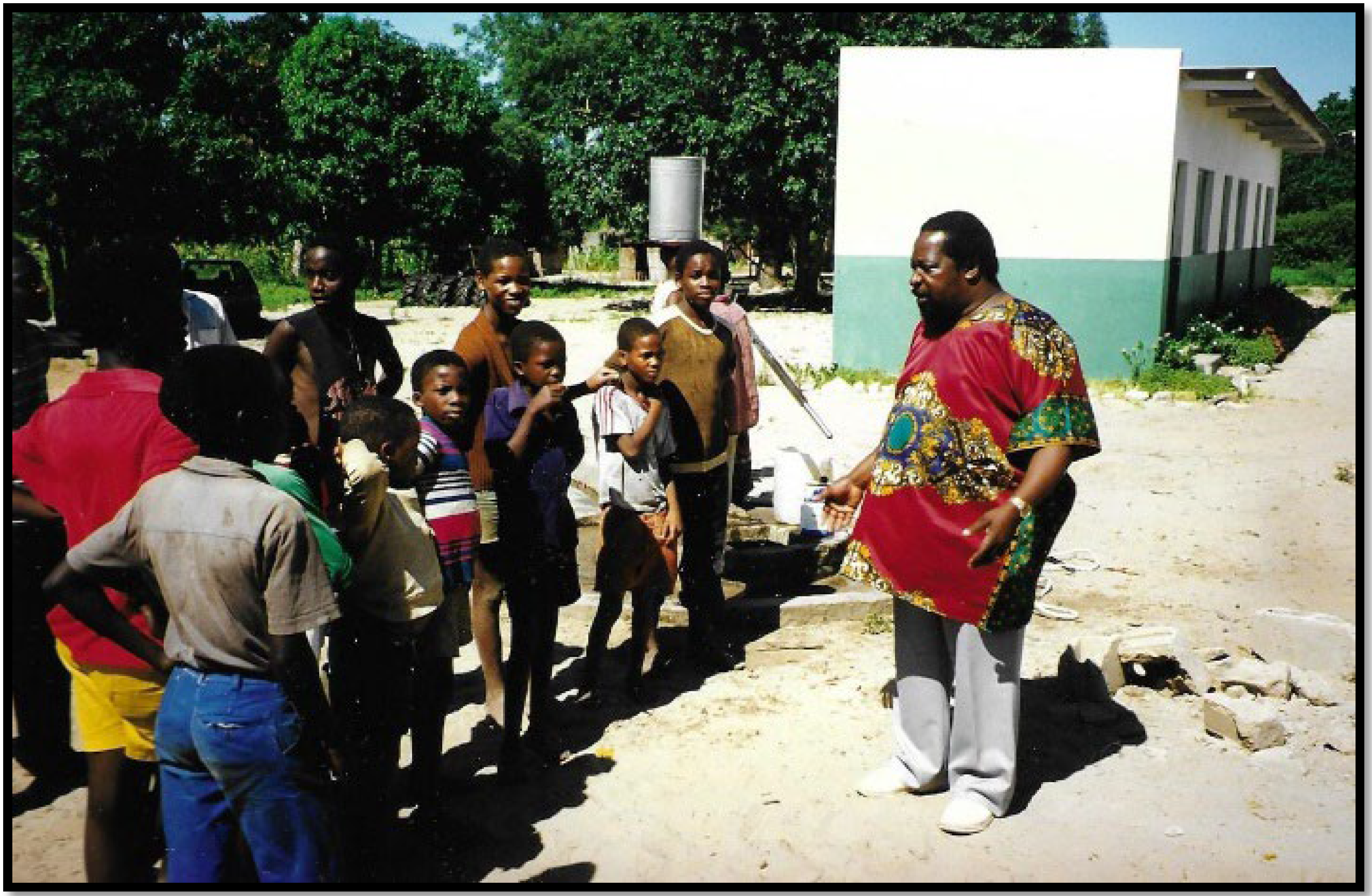
Malangatana talking with children by the water pump and school (photo credit: Richard Gray 1990).
According to the account of Malangatana given by Mario Pissarro, the devasting effects of colonialism and the civil war on postcolonial Mozambique infused his paintings with dystopian aesthetics tempered with symbols of hope (Pissarra, 2019). However, our study of his mural in Zimpeto shifts the focus to its materiality and leads us to argue that this work was mostly filled with utopian thoughts, seeking to build for future generations without ignoring the horrors of the present. In other words, the mural's physical existence embodied that utopia. It was a construction created amid the destruction and devastation of the civil war. The materiality of the mural gained more meaning because of Malangatana's decision about where to build it—Zimpeto—after his preferred location—Matalana—was ruled out.
On Place, Mural, Amid Civil war: From Matalana to Zimpeto
While Malangatana was a painter of the Mozambican nation and the world, his love for and indebtedness to his home village of Matalana, its people and culture were omnipresent when he spoke about his art. Only 42 km from central Maputo, it was not only Malangatana's birthplace as an individual but also as an artist. Matalana was where he grew up, under the strict but loving care of his mother, Hloyase Xirindza, and his grandmother, Mwamba. According to Malangatana, they introduced him to storytelling, artmaking (for example beadwork and tattooing) and to music and dance, among other cultural activities. He had these experiences at an early age notwithstanding the prolonged absence of his father, who worked initially in the mines and then as a cook for an English-speaking white family in South Africa. In the same interview with Richard Gray, Malangatana stated the following about his mother and grandmother: She [his mother, Hloyase] had—still has, though she died a year ago—a great influence on my artistic life, not only in the way she brought me up but because she created my interest in culture. She taught me about the land, the earth. I often went with her to the fields to work alongside her. At the end of the day, she would teach me what, in other families, women do—bring home wood and fungi to eat. Edible fungi make sauce for today and other days because they can be dried and eaten for months or years. My mother had this influence not only, shall we say, on my social education but also, with my grandmother's help, told me many traditional stories. I became extremely close to her, thanks to all the work that she did on me, never knowing that her son would one day be a painter or artist of any kind. The cultural education she gave me was very important (Malangatana interviewed by Richard Gray January 1990).
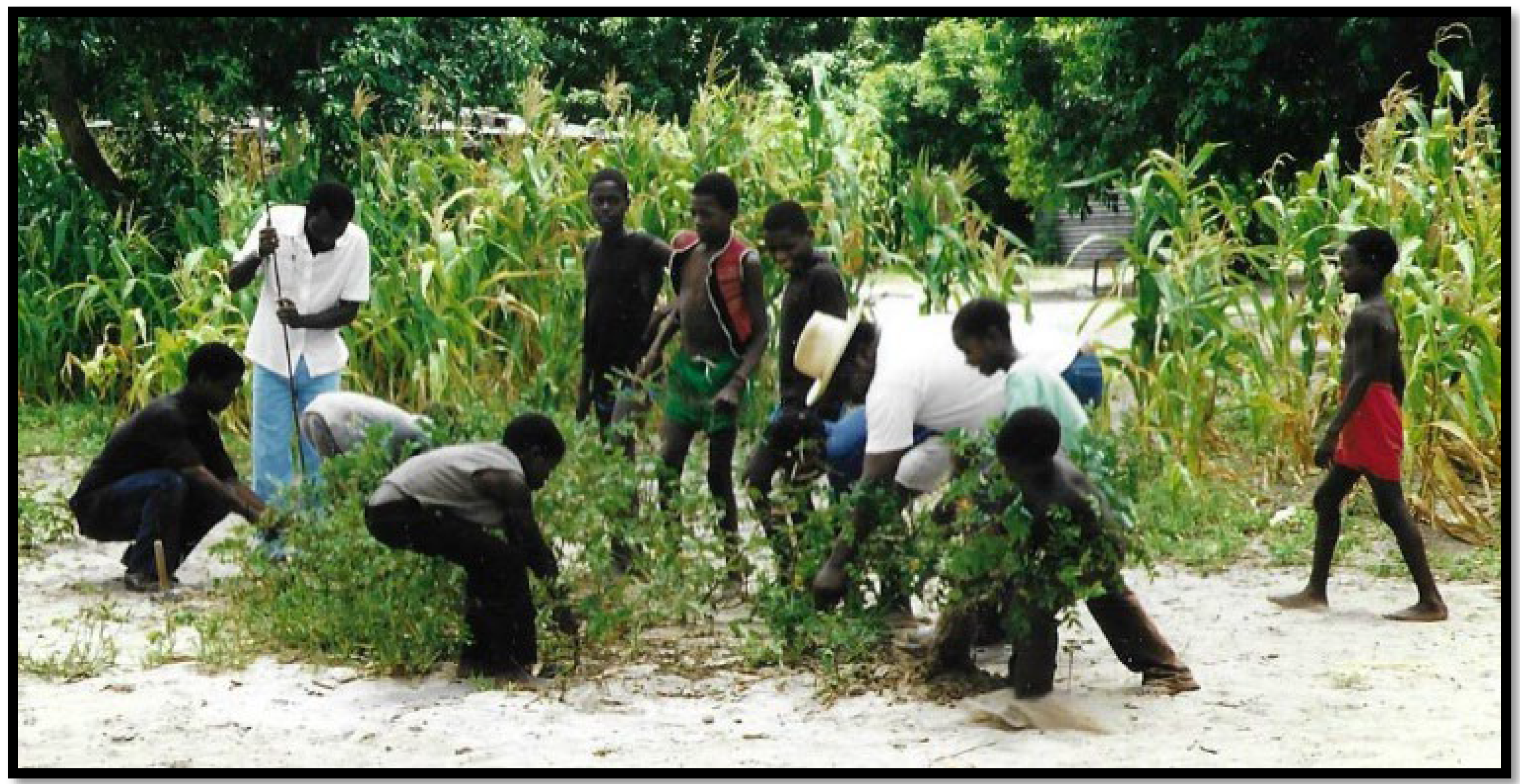
Children help clear the space where the mural will be erected (photo credit: Richard Gray, 1990).
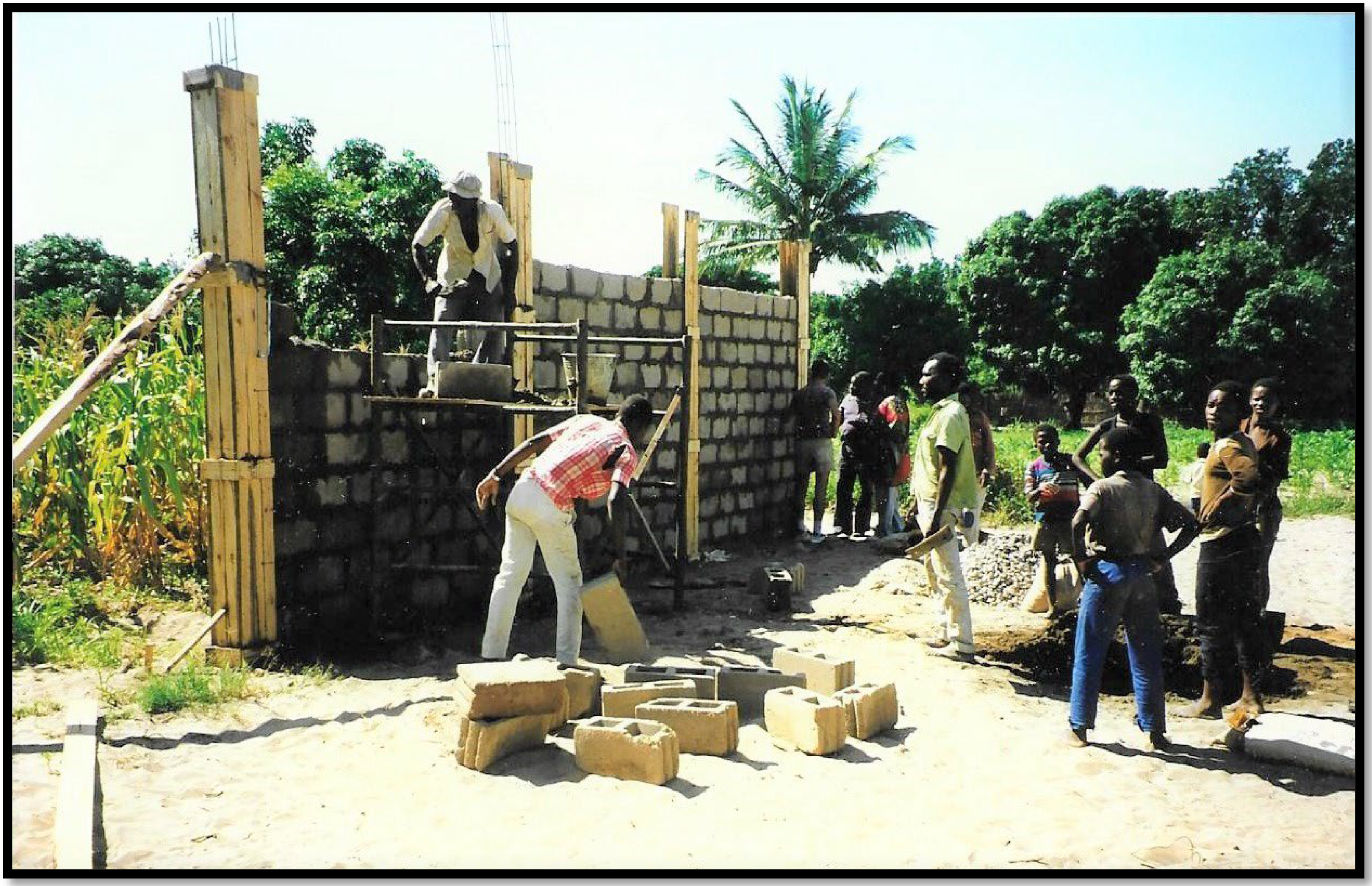
Three young men erect the wall while children watch (photo credit: Richard Gray, 1990).
Malangatana's love and attachment to Matalana resulted in the village regaining a primary school after many years after its previous one, at the Swiss Presbyterian Mission, was closed down by the colonial authorities. It also gained a health post. These developments resulted from the first Matalana Cultural Festival, which was visited in 1968 by the then-governor of Mozambique, Baltazar Ribeiro de Sousa, at Malangatana's invitation. The governor-general's interest in Matalana continued in postcolonial Mozambique and has been carried on by his son, Marcelo Rebelo de Sousa (President of Portugal, 2016 to date).
However, when the civil war intensified and Renamo attacks in Matalana and the surrounding area were frequent, Malangatana's visits home were reduced, as stated above. Speaking of those attacks while staring sadly at the ruins of the house which he built next door to that of his parents in 1957, when he got married, Malangatana spoke of his 19-year-old nephew, who was brutally killed in a night attack on Matalana on January 9, 1986, by what he called “the bandits.” He continued by saying that “he [his nephew] was not the only victim. Many people were killed here.”
However, Zimpeto was halfway home. It was a location where Malangatana could build and paint a wall to express his feelings about Matalana. More than just a place, he acknowledged that it was the wellspring of his art; hence he wished his artistic output to speak to the inhabitants. His preoccupation with this followed a previous project carried out in the Zimpeto area during 1989, when he built his largest sculpture at the now defunct Mabor Tyre Factory. The work was called A Casa Sagrada da Familia Mabjaia—The Sacred House of the Mabjaia Family. It paid homage to the precolonial ruling dynasty of the territory between Zimpeto and Marracuene, including Matalana.
Arts as Peace and Community Building
Malangatana executed his plan for the Zimpeto mural during the second and third weeks of January 1990. He took care to make it not just his individual work, but to include local children and adults. Speaking about building and community-affirmation in Ronga culture, he said that “when people want to build a house, people in the community come to help. And that was [historically] a way of showing that the person was part of a community” Malangatana interviewed by Richard Gray January 1990). This factor was strongly present in the construction of the wall, which was next to a primary school and water pump. This was because school pupils and women (mainly) fetching water would have easy access to the mural and be able to engage with its narratives. The building included collective work. Up to five assistants, helped by members of the local community, took part with the artist in digging the foundations. He and his team of assistants then built the wall and executed the painting. Children helped by bringing water and clearing the space. At other times they watched how the wall was built and painted. Their presence was a good example of Malangatana's love of the younger generation as the building blocks of the future. It echoed the Escola Vamos Brincar (Let's Play School), the children's weekend art workshop which he founded in the early 1980s on the street outside his atelier and family home in Maputo's Bairro do Aeroporto. He replicated the same educational model during his visits abroad, for example in the USA and Sweden, and sought funding from UNICEF to support the project (Manguiza Ngwenya, interview, 21 October 2022). At the time of writing, his son, Mutxhini Ngwenya, continues to carry out Escola Vamos Brincar art workshops with young people in Maputo. Malangatana's example has also inspired artists in other places to engage in youth and community-oriented activities. For instance, “Homelands: Malangatana”, watched in Scotland, led the South African artist, Thami Jali, to make his first mural in KwaNgcolosi, in the Ethekiwni Municipality, Durban, and, in November 1990, to go on to work with the Community Mural Projects group.
For Malangatana, arts and community building went hand in hand with peacebuilding, navigating modern and traditional cultures and linking Mozambique's future with that of the world. All those elements made the Zimpeto mural more than a mural. When Richard Gray asked him why he was building it, he said, as stated at the beginning of this article “It's not just a wall. With destruction all around, it's a symbol of construction—and hope.”
These words invite us to consider the mural as an agent for creating collective meaning, a nonhuman agent that communicated sorrow and loss, but also hope. That hope was foregrounded, as stated, by Malangatana's inclusion of children and young people in the construction process. The work thereby spoke to an imagined future community in a time of peace, when its everyday life would be informed once more by the longstanding cultural practices that first colonialism and then the civil war had disrupted. In this future, they would flourish and benefit from modern education, material culture and mores.
The motifs in the mural highlighted what was at stake. Malangatana drew them from the everyday life of the Ronga community, which he knew from his childhood. He focussed on examples of activities which Renamo violence and sabotage restricted or made impossible. His images of them made the case for peace. For example, a prominent bird deity towards the left of the mural watched over women coming from their machambas (fields) with overflowing baskets of produce. One woman carried vegetables and fruits, another a pot of kanyu (wine brewed from the fruit of a tree which characterises the area). Despite colonial attempts to suppress it, the annual ceremony in the lands of the Mabjaias at which the indunas (senior warriors) presented the first cup to the chief celebrated community cohesion. Less formally, two men of a certain age paused to chat when they crossed paths in the bush, an example of peaceful sociability which the war curtailed. As for links with the future, excited children on the way home from school discussed their lessons, quizzing each other about the contents of the exercise books in their satchels Figure 4.
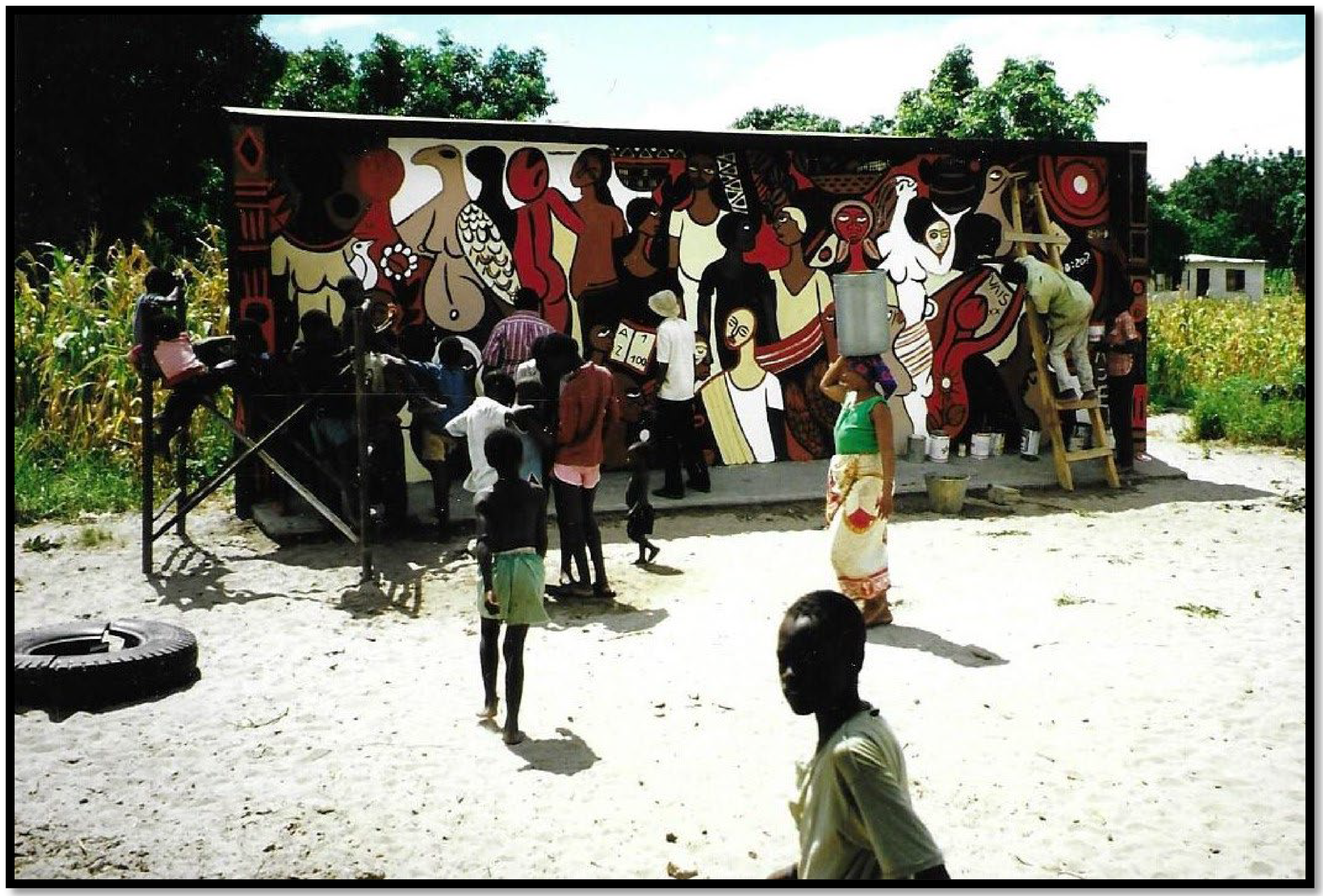
Malangatana and two of his assistants finish the painting on the mural while local children watch (photo credit: Richard Gray, 1990).
In our understanding, the mural conveyed more than the cultural content on which most art historians focus. Following Malangatana's line of thought, it was a generator of meanings—hope amid destruction—a utopia amid the dystopian reality of Mozambique since independence. Above all, it was both a literal and metaphorical act of regeneration, an act of resistance to cast off the straitjacket that the civil war placed on people's lives and aspirations. Talking about the importance of building amid war in general and, in particular, resisting the restraints of Frelimo's internecine war with Renamo, Malangatana spoke as follows. We Mozambican artists are not waiting for the end of the war. We are working in many fields. I personally have never stopped working. I have begun to express myself in a new way to leave something people can see, such as the mural I was just talking about. Look, we’re working very hard. We want to work. We don’t want to reach a point where we stop. We are not stopping. We are working. This is something the world cannot understand. When I go to the West, I don’t say, ‘Look down, see how we’re suffering in Mozambique. Give us help, etcetera, etcetera.’ I take something with me. I make my contribution. I’m a painter. For me, it's sad when people in England, in America, say, ‘What kind of help do you need?’ What we need, really, is for people to understand that we are doing something, not only for Mozambique or Southern Africa but for the world Malangatana interviewed by Richard Gray January 1990).
Conclusion
I want to say to people in the West that we want to share what we have with you. We love your culture—your art, your music—so you must love what we do. It's part of your development, mentally and also technically. Doctors, architects, engineers - they have a lot to do in Mozambique. They have a lot to gain, too (Malangatana interviewed by Richard Gray January 1990).
This article contributes to the study of Malangatana's murals and peacebuilding, both of which have hitherto remained marginal in scholarly studies. While the number of systematic studies of Malangatana's paintings in specialized galleries, libraries, archives, and museums (GLAMs) is growing, we have found only two that address his murals. Unlike the paintings in the GLAMs, this artform embodied Malangatana's determination to grow ever closer to his people via a dialogue between their longstanding cultural practices and modernity in its Mozambican, late twentieth-century iterations.
As shown above, the Zimpeto mural was an expression of Malangatana's hope for the future, an attempt to reach home amid the devastating effects of civil war on the red earth of Mozambique, without which, he said that he was nothing (Malangatana interview with Richard Gray, 2025, p84). The mural was the way in which he thus felt he could combat attempts to separate him from his art, his homeland, and his culture, and realize his vision of the future brick by brick, brush stroke by brush stroke, in communion with local people and children. By attending to the presence and materiality of the mural, we make possible an understanding of its meaning-making capabilities and visceral connection with Malangatana's view of peacebuilding. To reach this point, we have focused on Malangatana's intentions and the specific time and space of the mural's erection.
By attending to the presence of objects, their spatiality and temporality, we have thereby been able to expand the fields of analysis which can address artefacts that would not pass as artforms, traditionally speaking, but are crucial interlocutors and enablers of peacebuilding in Mozambique, Africa and worldwide. Even though Malangatana built the mural in Zimpeto, its existence in that particular place showcased his thwarted desire to build it at his home in Matalana. Zimpeto was therefore a location away from home, but as close as he could approach in the current state of the war.
Malangatana's achievement and communitarian views of the arts and peacebuilding, manifested in the mural, open room to challenge the neoliberal and individualistic approaches to studying arts and peacebuilding that characterize western thought and replace them with an interpretation more appropriate to their Mozambican context. Yet his achievement and perspective are not only relevant in this way. They provide insights, grounded in the local, of value to more general peacebuilding studies which avoid a top-down approach, meaning a viewpoint which situates the global North as the top and the South as subaltern. When Malangatana painted the Zimpeto mural, the North was called the First World and the South the Third. He saw his works as “an opening of doors between the Third and First World.” 1 This is an important reason why he insisted that the wall in Zimpeto was more than just a wall.
Footnotes
Acknowledgments
This study was funded by the Social Sciences Research Council (SSRC) African Peacebuilding Network (APN). Previous versions of this work were presented at a workshop organized by SSRC APN in Morocco. We would also like to thank the Malangatana Valente Ngwenya Foundation (FMVN) for its support. We extend our sincere gratitude to the two anonymous reviewers for their invaluable feedback on earlier versions of this work. The views expressed in this article represent those of the authors, not necessarily the SSRC and the FMVN.
Declaration of Conflicting Interests
The author declared no potential conflicts of interest with respect to the research, authorship, and/or publication of this article.
Funding
The author disclosed receipt of the following financial support for the research, authorship, and/or publication of this article: This work was supported by the Social Sciences Research Council (grant number APN Individual Fellowship 2022).
