



Abstract
In 2012, 20 years after the end of the 16-year war between Renamo and the Frelimo-led government, Mozambique witnessed the resumption of armed confrontations between the two former belligerents. The renewed hostilities ended in 2019 when Renamo and the government signed the Maputo Accord for Peace and Reconciliation, hailed as a ‘global exemplar’ of liberal conflict resolution. Nevertheless, the peace process occurred in the context of increasing autocratisation in the country. Accordingly, this article examines the implications of authoritarian politics for an ostensibly liberal peacebuilding process. It argues that while the ruling elites resist attempts at building liberal peace, authoritarian conflict management has been complicated by state incapacity and the resistance of liberal actors. Therefore, the article concludes that attempts at rebuilding peace in a context of entrenched tensions between liberalisation and autocratisation in Mozambique delivered a precarious peace.
Introduction
When the post-independence 16-year (1976–1992) war between the Mozambique Liberation Front (Frelimo)-led government and the Mozambican National Resistance (Renamo) ended, the international community came together to implement in Mozambique one of the most robust liberal peacebuilding projects ever undertaken (Alden, 2001; Manning & Malbrough, 2010). With international assistance, Mozambique had a formal triple transition: from a single-party rule to a multiparty democracy, from a socialist economy to a market economy, and from war to peace (Sambo, 2022). During the 20 years that followed the war's end (1992–2012), the absence of armed confrontations, a growing economy, and regular elections prompted some scholars to hail post-war liberal peace(building) in Mozambique as a success story (Barnett et al., 2014; Manning & Dendere, 2018; Moran & Pitcher, 2004). Nevertheless, others insisted that peacebuilding in the country was fragile or even failed (Bueno, 2019; de Brito, 2014; Hanlon, 2010; Macamo & Neubert, 2003; Maschietto, 2016; Muchemwa & Harris, 2019; Sambo, 2022, 2023).
In 2012, military confrontations between the old foes, the Frelimo-led government and Renamo, resumed. Nevertheless, the recurrence of the conflict and the subsequent peace process remain largely under-researched, and scholars are now turning their attention to the Islamic insurgency in the northern region of the country (e.g., Alden & Chichava, 2020; Heyen-Dubé & Rands, 2021; Ngoenha, 2020). The few existing studies examined the causes of the conflict resumption, unsurprisingly pointing to the cracks in post-war peacebuilding (Regalia, 2017; Vines, 2021). Others discussed the subsequent peace-making as an ‘elite bargain’ that exchanged Renamo's complete disarmament for deepened governance decentralisation (Vines, 2021) or from the lens of adaptive peacebuilding, highlighting its endogeneity (Saraiva, 2022, 2023). The international community claims the peace process is ‘a global exemplar of the potential for resolving armed conflicts through dialogue’ (Manzoni, 2023). However, this study contends that the peace process is embedded in Mozambique's larger political dialectic of liberalisation and autocratisation.
In fact, despite all the efforts undertaken to democratise Mozambique since the 1990s, the country derailed into authoritarian politics. Studies have posited that Mozambique's autocratisation is facilitated by the ‘growing Frelimo monopoly on power at all levels’ (Manning, 2010, p. 151; see also de Brito et al., 2017; Nuvunga, 2017; Nuvunga & Salih, 2013) in the face of international donors’ inaction or complicity (Jett, 2020; Macamo, 2003). In times of tension or when the government's authority is challenged, studies have shown how the government has resorted to a combination of ‘repression and accommodation’ to respond to popular protests or strikes (de Brito et al., 2017, pp. 167–170), surveillance (Nhanale, 2021), and even extrajudicial killing of opponents (Muchemwa & Harris, 2019). These insights are thought-provoking; however, they omit the definition of autocratisation and how it is measured, leaving a blind spot on the extent of Mozambique's autocratisation. Moreover, although it has been recognised as one of the reasons for the resumption of conflict, the literature has not yet explored how autocratisation affected the process of rebuilding peace in Mozambique. Despite all the efforts undertaken to democratise Mozambique since the 1990s, the country derailed into authoritarian politics
Therefore, this article aims to suggest a fresh understanding of peace and violence in Mozambique that appreciates illiberal or autocratic tactics overt or covertly embedded in the quest for ‘peace’. In doing so, the article is theoretically indebted to the flourishing scholarship on the current ‘autocratization waves’ (Boese et al., 2022; Lührmann & Lindberg, 2019; Maerz et al., 2020). It is also indebted to the conceptual and theoretical lenses of illiberal peacebuilding (Cheung, 2019; de Oliveira, 2011; Mitchell, 2023; Smith et al., 2020) and ‘unashamedly authoritarian’ conflict management (Lewis et al., 2018, p. 488; see also Owen et al., 2018). Thus, the study also aims to empirically enrich the debate on the emerging forms of peace(building) that, in many aspects, deviate (often diametrically) from the dominant liberal paradigm.
The analysis draws on a combination of primary and secondary data. Primary data was gathered through in-depth interviews with seven key informants conducted in Maputo in May and June 2022 to assess the dynamics of the peace process. The respondents were identified based on their significant roles as negotiators (four) or mediators (two) in peace talks and one representative of a watchdog civil society organisation. Informed consent was obtained from each interviewee, emphasising the voluntary nature of their involvement and allowing them to remain anonymous or identified in the final analysis. Secondary data sources such as reports (especially from Varieties of Democracy and Afrobarometer), news articles, and relevant documents in both Portuguese and English were extensively consulted, minimising language-related biases in the analysis. This methodological choice strengthens the robustness and credibility of the study by corroborating insiders’ views obtained through interviews with existing knowledge from reputable secondary sources.
The article argues that the rebuilt peace in Mozambique is precarious because it lies at the crossroads of the inherently conflictual forces of liberalisation and autocratisation. In other words, on the one hand, domestic elites resist attempts at building liberal peace. On the other hand, while in some countries ‘the illiberal model was effective at building […] a relatively stable peace’ (Smith, 2014, p. 1521), in Mozambique, the illiberal alternative has been complicated by state incapacity and the resistant forces of liberalisation. Theoretically, the study's contribution is to bridge the divide between liberal and illiberal peacebuilding, exploring their intertwined dynamics in practice. Empirically, it enhances our comprehension of peace and violence in Mozambique, shedding light on the often-concealed autocratic strategies employed in the pursuit of ‘peace’. Moreover, it enriches our empirical knowledge by analysing a largely neglected and minimally documented case. The rebuilt peace in Mozambique is precarious because it lies at the crossroads of the inherently conflictual forces of liberalisation and autocratisation
The article unfolds in four sections. The first section introduces the debate on the liberal and authoritarian peacebuilding models, laying the conceptual and theoretical groundwork for our empirical analysis. The second section briefly discusses the liberalisation and autocratisation processes in Mozambique. The third section examines how liberal and authoritarian strategies shaped the recent peacebuilding in Mozambique. The last section questions the nature of the post-conflict peace.
Liberalism, Authoritarianism, and Peacebuilding
Liberalism, historically associated with Western thinkers such as Hobbes, Smith, Mill and Montesquieu, is a political and economic philosophy based on ideas of equality, individual rights and freedoms, private property, a market economy, and a government constrained by the rule of law and consented by the people. Although not consensual (e.g., Mousseau, 2013), for many decades, liberal ideas, especially liberal democracy, have been correlated with lasting peace (e.g., de Mesquita et al., 1999). Drawing from this belief, since the 1990s, Western donors came to form a ‘peacebuilding consensus’ (Richmond, 2005) that interventions based on liberal values could produce peace in post-war societies. In essence, liberal peacebuilding entails the promotion of democracy, the rule of law, human rights, and a market economy as a foundation for sustainable peace (Paris, 2002, 2004; Richmond, 2006).
Since the end of the Cold War, several robust interventions aimed at building liberal peace have been undertaken in countries such as Namibia, Mozambique, East Timor, Kosovo, and Afghanistan, to mention a few. Nevertheless, critics claim that liberal peacebuilding is flawed for being top-down, linear, universalist, and too interventionist (Chandler, 2017). Disappointed with the methods and outcomes of liberal peacebuilding, scholars have proposed frameworks such as hybrid peace (Mac Ginty, 2011), post-liberal peace (Jackson, 2018; Richmond, 2009), adaptive peace (de Coning, 2018), and perpetual peace (Paffenholz, 2021). These concepts propose significant changes in liberal peacebuilding but maintain foundational liberal values such as individual rights and freedoms, democratic governance, and the rule of law.
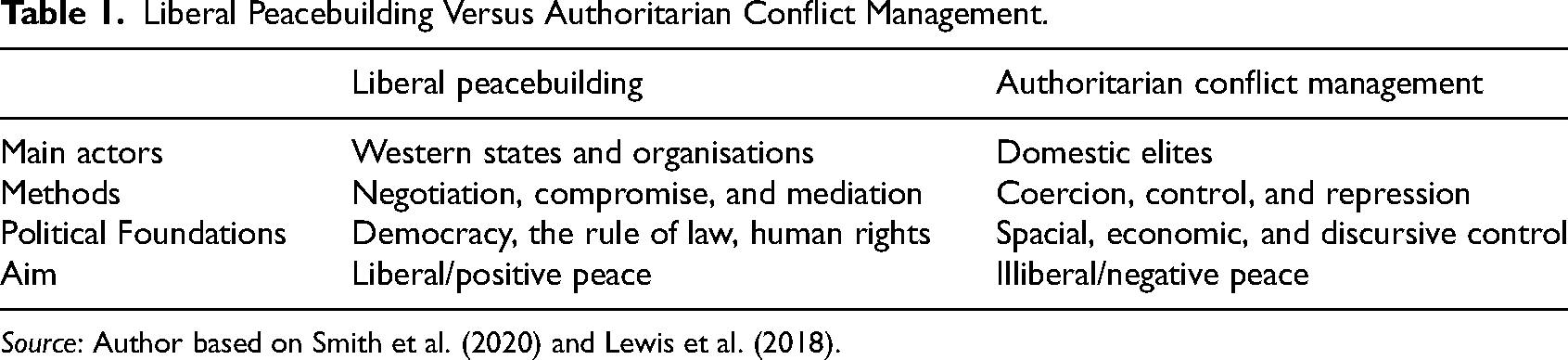
An emerging scholarship has studied peacebuilding initiatives that largely deviate from the liberal paradigm under the concepts of ‘illiberal peacebuilding’ and ‘authoritarian conflict management’ (ACM). These concepts refer to situations where conflicts are managed and controlled through authoritarian or illiberal means, often without addressing the underlying causes of the conflicts. Given their proximity, the two concepts have been used by some scholars almost interchangeably (e.g., see Mitchell, 2023; Owen et al., 2018). For Smith et al. (2020), illiberal peacebuilding differs from liberal peacebuilding in three aspects. First, instead of Western powers, illiberal peacebuilding is primarily influenced by internal actors. Second, instead of economic neo-liberalism, illiberal peacebuilding relies on clientelism, cronyism, and corruption. Last, in contrast to liberal principles of equality and liberty, illiberal peacebuilding prioritises illiberal norms of inequality and control. The ACM goes further. According to Lewis et al. (2018, p. 491), ACM entails the: De-escalation or termination of organised armed rebellion or other mass social violence such as inter-communal riots through methods that eschew genuine negotiations among parties to the conflict, reject international mediation and constraints on the use of force, disregard calls to address underlying structural causes of conflict, and instead rely on instruments of state coercion and hierarchical structures of power.
Although violence is seen as ‘a core necessary precondition for stability’ (Abboud, 2021, p. 331), Lewis et al. (2018) argue that violence is insufficient in the long term and outlines three strategies authoritarian regimes utilise during post-conflict governance: discursive, spatial, and economic practices (see Table 1). Regarding discursive practices, Lewis et al. explain that authoritarian conflict management seeks to suppress opposing views and advocates a dominant narrative aimed at discrediting armed adversaries of the state as viable negotiation partners. On the one hand, this means that authoritarian regimes use coercion or repression to silence alternative sources of information and interpretations of events, aiming to control the dissemination of news and knowledge production. On the other hand, this means the creation of official narratives that discredit opponents and challenge the legitimacy of rebel campaigns, denying claims of legitimate grievances. Through labels such as ‘terrorist’, authoritarian governments not only delegitimise their opponents but also create conditions for targeting non-governmental organisations or international organisations that support the opponents as enemies of the state.
Liberal Peacebuilding Versus Authoritarian Conflict Management.
Source: Author based on Smith et al. (2020) and Lewis et al. (2018).
Concerning spatial practices, in Lewis et al.'s theorisation, authoritarian conflict management implies control of physical, political, and symbolic spaces. The methods of spatial control may range from military patrols to infrastructure projects in urban centres. The rationale for restricting or dominating spaces is that these may serve as places for mobilisation against the established order. Finally, in contrast with liberal peacebuilding, the political economy of authoritarian conflict management views economic growth as a means for ruling elites’ enrichment and the consolidation of clientelist and patronage networks, and poverty reduction as a secondary goal.
The insights of illiberal peacebuilding and authoritarian conflict management enlighten peacebuilding practices overlooked in Mozambique's peacebuilding discussions. However, Mozambique's case demonstrates that liberal and illiberal or authoritarian practices often exist side by side. Moreover, while scholars have long questioned the effectiveness of liberal peacebuilding, the effectiveness and nature of the outcome of illiberal peacebuilding and ACM also remain debatable. Some scholars argue that, in some cases, the illiberal mechanisms are effective (Lewis & Sagnayeva, 2020, p. 88; Smith, 2014, p. 1521) other content that they ‘rarely tend to lead to long-lasting stability, much less anything that could be described as ‘peace’’ (Jones, 2018, p. 175). In Mozambique, the coexistence of liberal and authoritarian strategies produced an unstable and illiberal order that can best be described as precarious peace (Sambo, 2023). The insights of illiberal peacebuilding and authoritarian conflict management enlighten peacebuilding practices overlooked in Mozambique's peacebuilding discussions
The Autocratisation of Mozambique's Politics
Upon its independence in 1975, Mozambique embraced an authoritarian single-party rule and a socialist economy. In its foreign policy, Mozambique supported liberation movements fighting against minority regimes in the southern region of Africa and beyond, especially the Zimbabwe African National Union in former Rhodesia (now Zimbabwe) and the African National Congress in South Africa. Mozambique's post-independence policies enraged many both domestically and abroad. Rhodesia and South Africa's Apartheid regimes sponsored Renamo's creation and operations, which waged a 16-year war against Frelimo's Mozambique (Andersson, 1992). With the collapse of the minority regimes in Zimbabwe and South Africa and the end of the Cold War, Renamo and Frelimo signed the General Peace Agreement (GPA) on 4 October 1992.
Concomitant with the transition from war to peace, Mozambique experienced significant liberalisation. International donors pushed for a multiparty democracy by, inter alia, sponsoring elections, Renamo's transformation into a political party, and the development of an active civil society (Manning & Malbrough, 2010; Turner et al., 1998; Wood, 1999). However, for decades, Renamo maintained its militaristic leadership and an armed wing (Vines, 2013), while Frelimo has sought to tailor the liberal democratic system to retain its dominant position (Morier-Genoud, 2009). Thus, while some scholars believed that Mozambique ‘successfully transitioned to peace and democracy’ because domestic elites had a ‘genuine desire’ for the country's democratisation (Barnett et al., 2014, p. 614), others warned that democratisation was too fragile to succeed (Braathen & Orre, 2001; Wood, 1999).
Indeed, in the last two decades, studies have noted that Mozambique has been following the path of autocratisation (de Brito et al., 2017; Manning, 2010; Nhanale, 2021; Nylen, 2018). A notable limitation of these studies is that it is unclear how they define and measure autocratisation. To overcome this limitation, we take a two-step approach. On the one hand, in line with the flourishing scholarly debate on autocratisation (Boese et al., 2022; Lührmann & Lindberg, 2019; Maerz et al., 2020), we assess autocratisation tendencies in Mozambique based on the Varieties of Democracy Index (V-Dem). 1 Drawing from Lührmann and Lindberg (2019), we operationally define autocratisation as a ‘substantial’ decrease in the Electoral Democracy Index (within one year or a linked time frame). Although widely used, the V-Dem Index's methodology is limited in that it relies on a handful of experts (usually five) who assess the state of democracy in each country. Thus, on the other hand, to establish the validity and reliability of the V-Dem Index, we triangulate the index with the Afrobarometer data on Mozambique's popular perception of democracy. In contrast with V-Dem, Afrobarometer surveys ordinary people in a representative way, with samples that range from 1200 to 2400 respondents. Combining V-Dem and Afrobarometer allows us to balance our analysis by building on expert and popular perceptions.
V-Dem data in Figure 1 reveals that electoral democracy in Mozambique started to decline just a decade after the 1990 constitution introduced it. With variations over time, at its highest level in 1995 and 2005, Mozambique had 0.48 points (1 represents the highest possible value). The sharpest rises or declines are registered in electoral years or the year following elections. This is easily understandable. Electoral politics in Mozambique have been crucial in defining the political (in)stability that affects the other components of democracy (Pitcher, 2020). For instance, a sharp decline was registered in 2000 following the highly contested general elections held in 1999 and the subsequent electoral violence that erupted in 2000. In 2005, electoral democracy rose following relatively more peaceful general elections held in 2004.
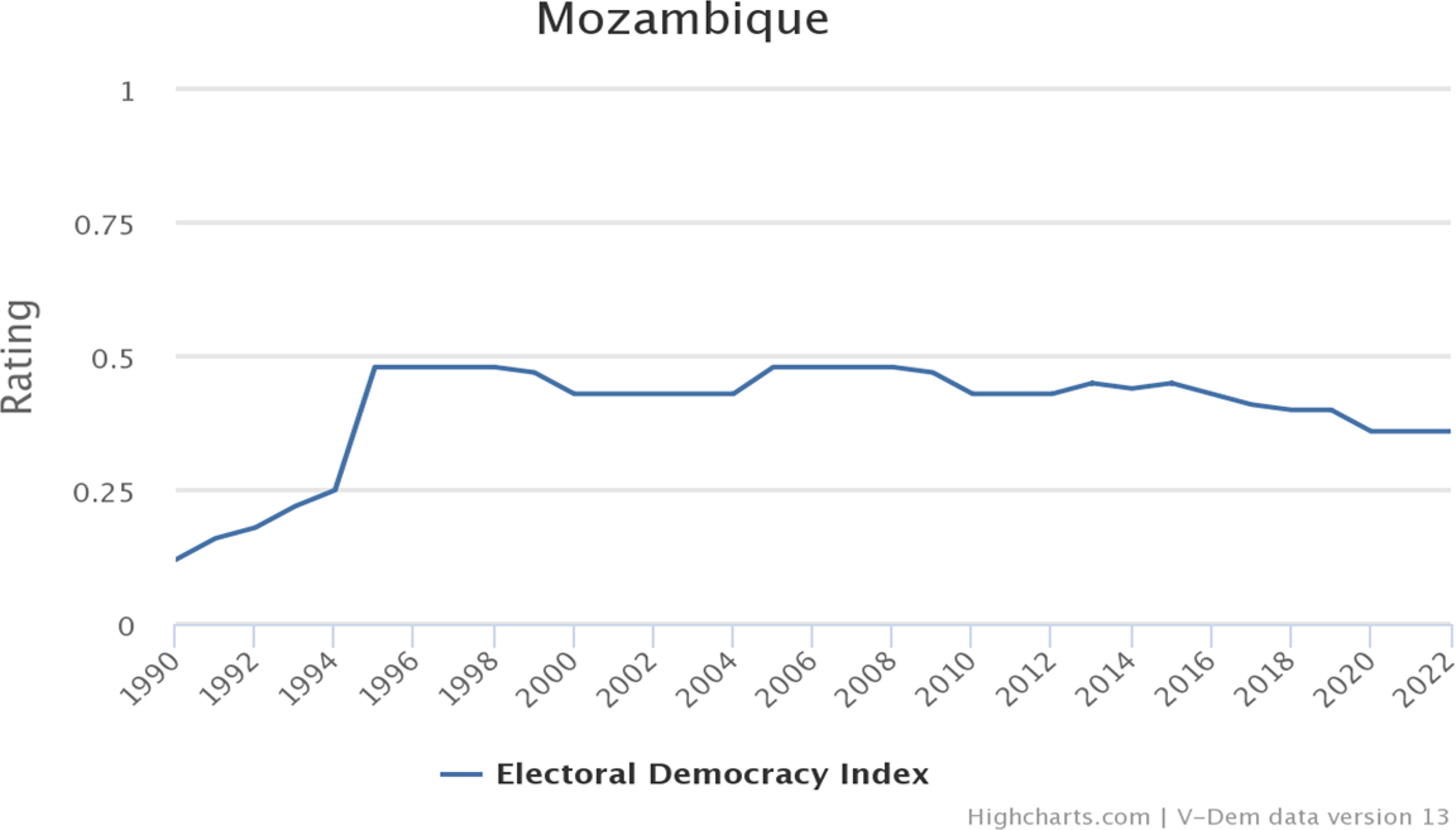
Mozambique’s electoral democracy index (1990–2022). Source: Coppedge et al.
Since 2020, Mozambique has been at its lowest level of democracy. In that year, the index declined to 0.36 points. Put in a long-term perspective, democracy in Mozambique has declined by 0.12 points. This decline is substantial and amounts to autocratisation. Indeed, Lührmann and Lindberg (2019, p. 1100) consider a decrease ‘substantial’ if it equals or exceeds a drop of 0.1 on the index. There are some notorious discrepancies between the V-Dem and Afrobarometer data. For instance, while in 2015, V-Dem registered an improvement in Mozambique's democracy index, the Afrobarometer survey shows a rising trend of people believing Mozambique is not a democracy (Figure 2). Another example, for 2018, V-Dem shows a decline in democracy while Afrobarometer data reveals that fewer people perceived that Mozambique was not a democracy (Figure 2). Since 2020, Mozambique has been at its lowest level of democracy
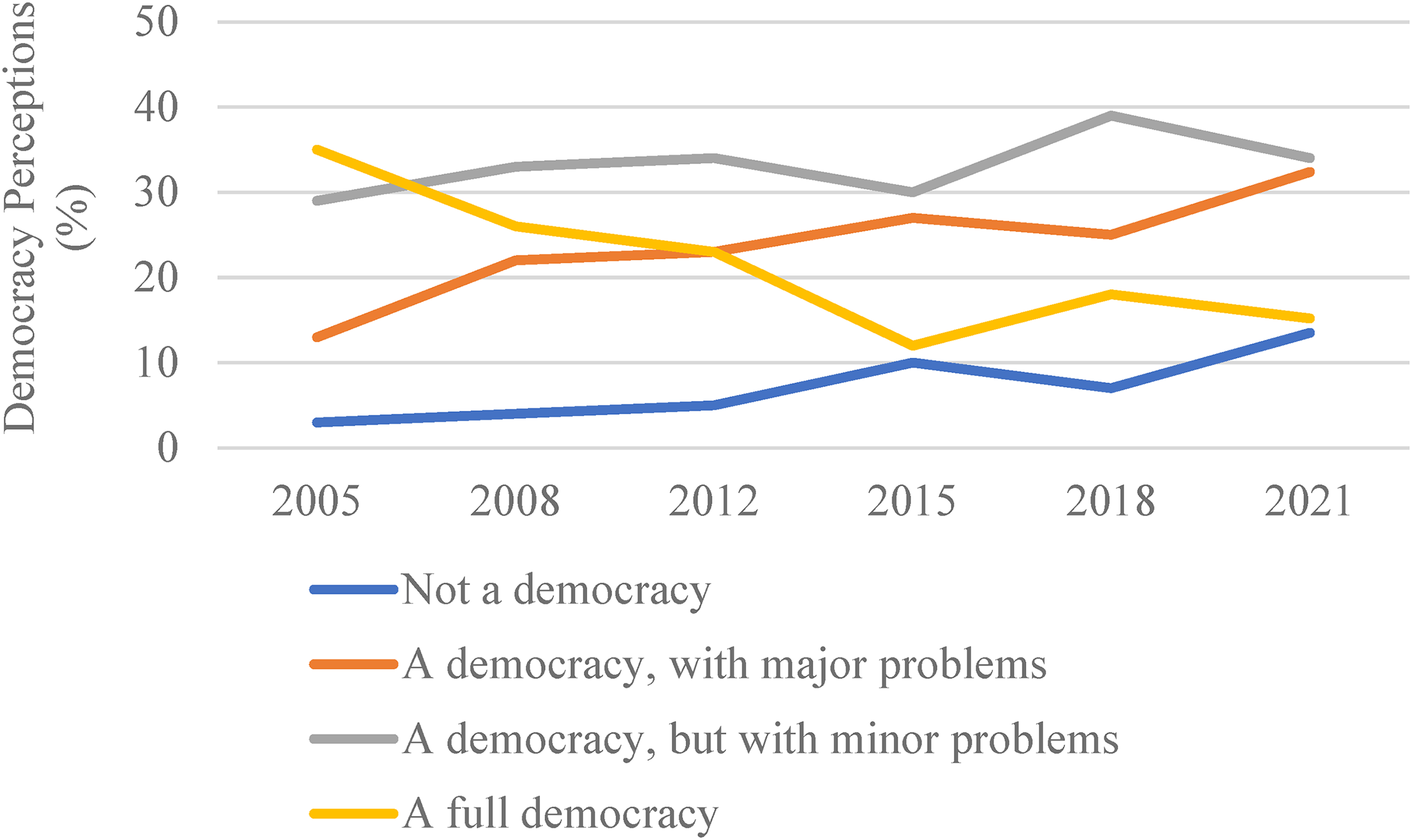
Popular perception of democracy in Mozambique. 6 Source: Afrobarometer data (available at https://www.afrobarometer.org/countries/ accessed February 8, 2023).
Despite the incongruences in a year-to-year comparison, viewed in the long term, the V-Dem data on Mozambique's autocratisation tendency is consistent with the popular perception of the state of democracy in the country. Figure 2 reveals that, while in 2005, only 3% of Mozambicans believed the country was not democratic, the percentage increased consistently over time up to more than 13% in 2021. Correspondingly, the percentage of people who think that Mozambique is a full democracy declined sharply from 35% in 2005 to just 15.2% in 2021. The growing negative perception of the state of democracy in Mozambique is also evidenced by the ever-increasing number of people who believe democracy in the country is problematic. This view has been held by the majority of the population, and in 2021, it represents more than 66% of those surveyed.
Whereas autocratisation used to be a sudden occurrence, marked by drastic political events such as military or executive coups or even civil wars (e.g., Huntington, 1991; Linz, 1978), there is a growing consensus that currently, ‘ruling elites shy away from sudden, drastic moves to autocracy and instead mimic democratic institutions while gradually eroding their functions’ (Lührmann & Lindberg, 2019, p. 1096; see also Bermeo, 2016, p. 6). Correspondingly, ‘Mozambique's democratic reversal has been more gradual, a matter of sustained decay more than sudden rupture’ (Manning, 2010, p. 152). To erode Mozambique's democratic institutions, first, checks and balances that maintain the separation of powers are weakened or compromised, opening the door for power consolidation in the hands of a few. Teodato Hunguana, a former minister of justice and member of parliament, commented: From a system of ‘ultra-presidentialist’ democratic centralism, we have today ended up in a system that we can call ‘absolute presidentialist centralism’. In such a system where everything revolves around this absolute presidentialism, the autonomy of the institutions is relativised, and, therefore, there is effectively no independence, control, or accountability. There are no checks and balances, and everything is, directly or indirectly, dependent on the will of those in power.
2
Second, Civil Society Organisations (CSOs) are coerced or co-opted. Put straightforwardly, ‘civil society is utilised for authoritarian legitimisation’ (Lorch & Bunk, 2017; see also Manning & Malbrough, 2013, p. 2; Wischermann et al., 2018, p. 102). Also, the regime monitors political figures and individuals whose dissenting viewpoints make them seen as regime adversaries (Nhanale, 2021, p. 4). Lastly, Frelimo has reduced the impact of rival challenges by skilfully and adeptly manoeuvring within the legal frameworks that oversee elections while also exercising far-reaching control over the accessibility of economic assets, which span from employment and credit to investment prospects (Manning, 2010, p. 154).
Liberal Peacebuilding and Authoritarian Conflict Management in Mozambique
At the turn of the 2010s, Renamo increased the claims that there were breaches in the 1992 GPA, leading to the renewal of military confrontations. At first, Renamo demanded the creation of a government of national unity, full integration of its former combatants into the Mozambican army and police, the despartidarização do estado (separation between the ruling party and state institutions), and the reformulation of the National Commission of Elections. Later, the demand for a national unity government was dropped and substituted by demands for further decentralisation.
The conflict did not escalate into an outright war, as seen in the 1970s and 1980s; however, its consequences are not underestimated. Displacement flows increased as civilians fled violence and destruction, straining humanitarian resources. The influx of refugees affected Mozambique's neighbouring countries, especially Malawi (Shimo, 2016). Additionally, the conflict threatened regional energy projects, including the strategic importance of the Beira corridor, a vital transport route connecting landlocked countries to the Indian Ocean. The conflict also hampered foreign investment and economic growth, as investors feared instability.
Attempted Authoritarian Conflict Management
In liberal thoughts, ‘through democratic institutions, social conflicts that might become violent are resolved by voting, negotiation, compromise, and mediation’ (Rummel, 1995, p. 4). This formula rests on the assumption that liberalism breeds tolerance and mutual acceptance. Moreover, it leads to ‘the development of democratic culture and norms that emphasise rational debate, toleration, negotiation of differences, conciliation, and conflict resolution’ (Rummel, 1995, p. 4). However, when tensions between the government and Renamo erupted, controlling the physical space, combined with the discursive delegitimisation of Renamo, became central to the government's authoritarian conflict management.
The most significant physical and symbolic space the government sought to control was the Gorongosa district in the central province of Sofala. On 16 October 2012, Renamo's leader, Afonso Dhlakama, left the capital city, Maputo, and returned to Santungira, one of his former main military bases in the Gorongosa district. The Santungira military base is highly symbolic since it was the first fixed military base of the then-Renamo rebel movement in the 1980s. News outlets at the time reported that in Gorongosa, Dhlakama remobilised around 800 former Renamo combatants from Sofala and Manica provinces and restarted military training (A verdade, 2012; see also Wiegink, 2015). Renamo's move turned Gorongosa into a highly contested space, both for its symbolism and as space for anti-government mobilisation.
Consequently, in a significant military operation, on 21 October 2013, a year after Dhlakama's return to Gorongosa, the Mozambique armed forces launched an assault on Renamo's Gorongosa military base. The government forces sought to weaken Renamo's military capabilities and assert their control of the military base, highlighting the intense struggle for dominance of physical spaces. As Lewis et al. (2018, p. 495) argued, ‘authoritarian regimes […] seek to penetrate, close or dominate space through military patrols, encampment and occupation’. Addressing reporters following his visit to the base, the then Defense Minister Filipe Nyusi stated that the military operation was necessary to neutralise what he called an internal ‘hub of terrorism’ (VOA, 2013). He further indicated the potential conversion of the base into a Mozambican army facility to thwart its recapture by insurgents from the principal opposition party (VOA, 2013). By resorting to the language of ‘terrorism’, the government sought to legitimise the use of military force and delegitimise Renamo as a threat to national security rather than a partner with whom to negotiate.
The government delegitimisation of Renamo is entrenched in Mozambique's politics. As Igreja (2008, p. 550) argues, historically, ‘there is a strong tendency among Frelimo cadres (unlike their Renamo counterparts) to use the present rather than the past tense to describe Renamo: “Renamo is a terrorist party” or Renamo “belong to the racists”’. In this sense, the delegitimisation of Renamo is part of Frelimo's attempts at building a hegemonic discourse that elevates Frelimo as the only legitimate party that can govern Mozambique. The discourse resorts to the official history based on what Dorman elsewhere calls the ‘exclusionary language of liberation’ (Dorman, 2006, p. 1092) that in Mozambique frames Frelimo as the liberator of the country and Renamo as the rebels, bandits, or even terrorists that undermine Mozambique's sovereignty and development.
Liberal Actors Crafting Space for Dialogue
The government's attempts at managing the conflict with Renamo through spatial and discursive control failed partially because of the state armed forces’ incapacity to neutralise Renamo's leader. More importantly, Mozambique's CSOs and the international community pushed for a liberal conflict settlement. Indeed, upon the government occupation of Gorongosa, 20 Mozambique's CSOs voiced objection to using armed forces to resolve the conflict with Renamo (A Verdade, 2013). While CSOs may have limited leverage in Mozambique (Lorch & Bunk, 2017; Wischermann et al., 2018), the international pressure made the calls for dialogue more audible. In October 2013, the then-UN Secretary-General Ban Ki-Moon issued a statement urging the government and Renamo ‘to fully engage in an inclusive dialogue to resolve differences within the established democratic order’ (The Main & Guardian, 2013). Being an aid-dependent country (de Renzio & Hanlon, 2007; Manning & Malbrough, 2010, 2013), Mozambique's government had sufficient reasons to portray an image of tolerance and democracy to please the international audience. Accordingly, President Armando Guebuza shifted the discourse to a liberal approach, underscoring the need for dialogue. In a rally in Metuchira, Sofala province, for instance, Guebuza stated: At this moment, we must have a solution [to the conflict], and that solution is in the dialogue. We must all continue to commit to dialogue. If we dialogue with conviction, we will be strong and continue the [country's] development (RTP, 2013).
In December 2011, Guebuza met with Dhlakama in Nampula province for the first time since he took office as the President of Mozambique in 2005. In our conversation about the meeting, Lourenço do Rosário, a Mozambican scholar and peace mediator, emphasised that ‘Guebuza went as a Head of State and not an interlocutor’. 3 With this observation, he highlights the widely held perception that, in contrast with Chissano, Guebuza was not interested in constructive dialogue with Renamo. Nevertheless, the mounting pressure for peace talks eventually led the government to start peace negotiations with Renamo at the Joaquim Chissano International Conference Centre in Mozambique's capital city, Maputo. The peace negotiations lasted for over 100 rounds with little progress. Eventually, Renamo and the government reached a cease-fire agreement, which was signed on 5 September 2014.
In 2015, disagreements over the 2014 general elections reignited the military confrontation between Renamo and the government. In May 2016, Western donors suspended aid to Mozambique due to a debt and corruption scandal, severely constraining the state's capacity. Accordingly, Filipe Nyusi, who won the 2014 elections and took office in 2015, had few choices if not to embrace dialogue with Renamo. Nyusi radically challenged Frelimo's hardliners, who used to delegitimise Renamo, by calling Dhlakama his ‘brother’. Furthermore, on 6 August 2017, Nyusi made a historic visit to Gorongosa to meet Dhlakama in his strongholds. The international community and local CSOs hailed the meeting (DW, 2017). Afonso Dhlakama died in May 2018 and was substituted by Ossufo Momade as Renamo's leader. Direct dialogue between Filipe Nyusi and Dhlakama (and later with Momade), assisted by some domestic and international mediators (for more, see Saraiva, 2022), resulted in the Agreement on the Definitive Cessation of Military Hostilities signed on 1 August 2019 in Gorongosa and the Maputo Accord for Peace and National Reconciliation signed on 6 August 2019 in Maputo. The dialogue outcomes cemented faith in the liberal principles of conflict resolution. For Mirko Manzoni, the Personal Envoy of the UN Secretary-General for Mozambique, ‘Mozambique has demonstrated the remarkable achievements that can be attained through negotiated solutions, serving as a global exemplar of the potential for resolving armed conflicts through dialogue’ (Manzoni, 2023). Nevertheless, the peace process did not alter Frelimo's quest for an authoritarian order.
Towards an Illiberal Peace?
Spatial Practices
Centralism plays a pivotal role in the control of the political space. Faced with increasing demands for decentralisation, Frelimo has sought to safeguard centralism through local state institutions controlled by the central government (Weimer & Carrilho, 2017, p. 205) and by resorting to informal power structures (Bunk, 2018; Maschietto, 2016; Morier-Genoud, 2009). Such a centralised system implies a reduced space for the participation of other actors in political life. The Maputo Accord for Peace and Reconciliation attempted to reshape the Mozambican state and make it an inclusive space. Indeed, Renamo and the government agreed on significant decentralisation reforms. The Mozambican constitution was revised to introduce the election of provincial governors and district administrators appointed by the government.
Nevertheless, Frelimo sought to retain control of political spaces through (re)centralisation of political power, not least because, as stated by Lewis et al. (2018, p. 496), decentralisation ‘threatens a state's capacity to maintain political control’. With effect, Frelimo's government subtly reverted the decentralisation agreed upon in the peace dialogue in two moves. First, following the prevailing strategy of prioritising centrally controlled structures at the expense of decentralised organs (Weimer & Carrilho, 2017), Frelimo introduced the role of secretary of state, appointed by the president of Mozambique, to effectively govern the provinces despite having elected governors. As a local CSO noted, ‘Despite the apparent devolution of power to the Provincial Executive Council and Provincial Assembly, resources remain under the control of the central Government, represented by a Secretary of State in the Province’ (CDD, 2020, pp. 1–2). Second, on 3 August 2023, through its majoritarian control of the parliament, Frelimo passed a new constitutional revision that postponed sine die district elections initially scheduled for 2024.
Also importantly, the nature of the state is central to the nature of post-conflict peace. Liberal peacebuilders try to reshape the nature of the state in post-conflict countries through statebuilding interventions. According to Barma et al. (2017, p. 192, emphasis added), ‘The logic connecting statebuilding to peacebuilding seems straightforward: endowing governments with the capacity to perform their basic governance functions, including the unbiased delivery of essential public services and collective public goods, lays a crucial foundation for stable, peaceful societies.’ Nevertheless, in authoritarian peacebuilding, the ruling regimes use the state in eminently biased ways (de Oliveira, 2011; Lewis et al., 2018). Frelimo has managed to use the state to maintain a political order that benefits its interests through the fusion of the party with state institutions, known locally as partidarização do estado. The partidarização do estado gained traction during the Guebuza presidency, who is credited with creating party cells in state institutions.
The partidarização do estado has been raised by Renamo as a major hindrance to an inclusive and sustainable peace in Mozambique. Indeed, the issue was one of the key aspects of the peace negotiations. A joint declaration between the Renamo and Frelimo-led governments was signed on 22 June 2015 to remove the ruling party's influence over state institutions. However, despite the expressed intention to build an unbiased state, the reality is the continued use of the state to strengthen an illiberal order based on patronage and clientelism. As a civil society member commented: Under the rule of Frelimo, the primary condition for reaching a position of leadership [in state institutions] is to have a red card [Frelimo members’ card] […] Oftentimes, an official or agent of the state can lose their job just because they share the ideals of the opposition parties.
4
By the same token, Anastacio Chembeze, a religious leader and peace mediator, recalled that Frelimo's unwavering state control is linked to the country's political history, specifically the post-independence single-party rule. In his words: If you investigate the whole [Mozambique's political] structure after independence until today […], you will realise that Frelimo is in everything because of how the nation-state was built. Today, we start to change this and that, but the philosophy and the ethos are the same.
5
Paradoxically, Frelimo's continued control of the state is enabled by international liberal actors through foreign aid. By strengthening the state's capacity to deliver public services, Western donors strengthen Frelimo's capacity to extend its influence over society.
Economic Practices
With assistance from the Bretton Woods institutions, in the 1980s, Mozambique was subject to extensive marketisation, a radical shift from its post-independence socialist economy (Castel-Branco et al., 2003; Pitcher, 2002). Nevertheless, critics of the liberal economic programmes in Mozambique claim that economic liberalisation enriched the political elites and increased the gap between the rich and the poor (Hanlon, 2010; Marshall, 1990; Maschietto, 2015).
Mozambique's political economy (although still dependent on foreign aid) has turned to the extractive industry in the last two decades. The discovery and exploitation of resources such as coal (Tete province) and natural gas (Inhambane and Cabo Delgado provinces) led to an increase in large-scale foreign direct investments (Toews & Vezina, 2017) in what is commonly called mega-projects. While this windfall of investment has the potential to accelerate economic growth and poverty reduction, in reality, it increases competition over resource rents among the political elites (Macuane & Muianga, 2020; Macuane et al., 2018). The competition for resource rents contributed to the renewed hostilities between Renamo and the Frelimo-led government (2012–2019). In Dhlakama's words, ‘only Frelimo members participate in mega-projects in Mozambique’ (DW, 2011). Accordingly, in the recent peace process, the redistribution of wealth was one of the critical aspects raised by Renamo.
Although the Personal Envoy of the UN Secretary-General Mirko Manzoni hailed the Maputo Accord for Peace and National Reconciliation as a process ‘based on ensuring a peace dividend’ (Manzoni, 2023), the agreement failed to lay down mechanisms of disrupting Frelimo's clientelist and patronage networks. Simply put, while the agreement envisages the payment of pensions to the demobilised Renamo combatants, it preserves the post-GPA political economy controlled by Frelimo. In this order, Frelimo uses natural and state resources to compensate loyalists and punish dissents by denying them economic and financial benefits.
Conclusion
This article examined Mozambique's autocratisation and its implication for the pursuit of peace. Focusing on the most recent peace process (2012–2019), the study reveals a nuanced situation. The findings suggest that unable to enforce a victory's peace and seeking to maintain an image of democracy and tolerance, the government embarked on a peace process ostensibly founded on liberal principles such as dialogue, decentralisation, and equality. However, resorting to what can be read as authoritarian conflict management tactics, the process was shaped and subverted to conform to the country's gradual and significant shift towards autocratic governance. Consequently, Mozambique's peace is increasingly illiberal (with remarkable control over political spaces and a clientelist political economy). However, while illiberal peace is often conceptualised as a stable order without a liberal democracy, Mozambique's illiberal peace is unstable and unpredictable (precarious). Besides recurrent violence and tensions in electoral periods, popular contestation is met with increasing political repression, which (together with the persistent extremist violence in the northern region) perpetuates the instability and uncertainty nationwide.
Surely, such a complex interplay of liberalisation and autocratisation forces could not be exhausted in this study. However, the study highlights a significant implication for the existing literature. It underscores the need to recognise that liberal peacebuilding and illiberal/authoritarian peacebuilding strategies do not always exist in isolation; instead, they may coexist in a dialectical relationship that needs further theorisation.
This nuanced understanding is also crucial for formulating effective peacebuilding approaches that acknowledge the complex interplay of political dynamics in countries like Mozambique. It emphasises the importance of adopting a holistic and context-specific approach to foster enduring peace and stability in such regions. In the case of Mozambique, a critical but overlooked area for peacebuilding intervention would be the decoupling of the state with the ruling Frelimo (despartidarização do estado). Without a state perceived as impartial, unbiased and impersonal, peacebuilding and development efforts in Mozambique are more likely to strengthen the current autocratisation trend and inadvertently fuel more contestation with the potential for violent conflicts.
Footnotes
Declaration of Conflicting Interests
The author declared no potential conflicts of interest with respect to the research, authorship, and/or publication of this article.
Funding
The author disclosed receipt of the following financial support for the research, authorship, and/or publication of this article: The research behind this article was conducted during a doctoral program supported by a scholarship from Japan's Ministry of Education, Culture, Sports, Science and Technology (MEXT).
