




Abstract
Conflict-related violence against women and girls (VAWG) has drawn increasing attention, yet scholars, policymakers, and practitioners focussed on conflict-related VAWG and those focussed on post-conflict statebuilding and peacebuilding have largely worked separately. Less attention has been given to VAWG during post-conflict transitions than during conflict itself. This article makes three major contributions to guide researchers and policymakers in addressing VAWG in post-conflict contexts. First, it identifies critical gaps in understanding the intersection between VAWG and post-conflict statebuilding and peacebuilding processes. Second, it presents an ecological model to explore the drivers of VAWG during and after armed conflict. Third, it proposes a conceptual framework for analysing and addressing the intersections of VAWG with both post-conflict statebuilding and peacebuilding. The article concludes that application of this framework can help policymakers shape statebuilding and peacebuilding processes to more effectively institutionalise approaches to VAWG so that post-conflict transitions advance sustainable, positive peace.
Keywords
It is increasingly acknowledged that post-conflict transition processes need to respond to the gendered experiences of women and girls during conflict and when seeking peace. Building on established peace theory that views sustainable, positive peace as more than the absence of violence (Galtung, 1969), feminist approaches suggest that sustainable peace cannot be attained whilst violence against women remains unaddressed and that a fulsome peace for women should be understood as “women’s achievement of control over their own lives” (Enloe, 1993, p. 65). It is important to consider a range of women’s rights’ concerns, including violence against women and girls (VAWG) when seeking sustainable, positive peace for all. Post-conflict transitional mechanisms have, however, been routinely ignored VAWG (Castellijo, 2012; Handrahan, 2004; Zuckerman & Greenberg, 2004). Transitional reforms must engage with the forms of VAWG that occur during the conflict period as well as in its aftermath to achieve peace for all.
This article addresses critical gaps between the perspectives of scholars, policymakers, and practitioners focussed on conflict-related VAWG and those focussed on post-conflict statebuilding and peacebuilding processes. For the purposes of this article, statebuilding is understood to encompass “constructing or reconstructing institutions of governance [to make them] capable of providing citizens with physical and economic security” (Chandler, 2006, p. 1). Peacebuilding is understood to encompass measures that both “precede and follow formal peace accords” (Lederach, 2004, p. 20) and can extend from conflict prevention prior to the outbreak of armed violence, through the duration of conflict and into its aftermath (Porter, 2007). Whilst closely aligned, statebuilding and peacebuilding are largely examined and addressed in scholarship and policy as separate concepts or processes (Wolff, 2011). Whilst both are addressed concurrently in this article, the authors do not conflate these concepts but see them as overlapping elements of post-conflict transitional processes that have relevance for addressing VAWG.
This article proposes an integrated approach that practitioners and policymakers can use to better understand VAWG in conflict and post-conflict contexts and to establish programmes to prevent and respond to VAWG within statebuilding and peacebuilding processes. It presents three major contributions to addressing VAWG through statebuilding and peacebuilding. First, a literature review identifies critical gaps in understanding the intersection between these distinct issues. Second, an ecological framework is presented to explore interlinked drivers of VAWG during and after armed conflict. Third, a Combined Analytical Framework for understanding and addressing linkages between VAWG, statebuilding, and peacebuilding is presented. These contributions advance understanding of conflict and post-conflict VAWG and ways to address this issue through statebuilding and peacebuilding.
Linkages Between VAWG, Statebuilding, and Peacebuilding
A literature review was conducted through a systematic keyword search of databases including PsychINFO, MEDLINE, PubMed, PAIS International, and Worldwide Political Science Abstracts and a wider Google search for grey literature. A very limited body of literature exists that specifically examines the intersections of VAWG with post-conflict statebuilding and peacebuilding processes. One set of literature substantively focusses on conflict-related and post-conflict VAWG, whilst another separately examines post-conflict statebuilding and peacebuilding processes. There is a further distinct body of work that theorises connections between gender and the efficacy of statebuilding and peacebuilding, such as gender analysis of disarmament, demobilisation, and reintegration (DDR) programmes; however, these rarely explore wider issues of VAWG. This separation of research and theory has kept statebuilding and peacebuilding processes relatively isolated from knowledge generated on VAWG and vice versa. Bringing these fields together is important to establish linkages across these three concepts and to generate cohesive policy that addresses their critical interrelationships in practice. An overview of key findings from the review is discussed below.
VAWG in Conflict and Post-Conflict Settings
A growing body of evidence shows that women and girls experience mass public sexualised assault enacted by parties to armed conflict during warfare (Heineman, 2011), and this is used as a deliberate tactic by armed groups in some armed conflicts (Eriksson Baaz & Stern, 2013; Wood, 2009). Emerging research also evidences the broader forms of VAWG, such as intimate partner violence, that are enacted opportunistically in both public and private contexts during wartime (Stark & Ager, 2011; Swaine, 2015).
Feminist scholarship theorises that women experience continuums of gendered harm from conflict to peace and from public to private spheres (Cockburn, 2004; Kelly, 1998; Moser, 2001), but there is less empirical attention paid to the ways that women experience violence after conflict. Little quantitative data are available on forms and patterns of post-conflict VAWG, though useful studies are emerging (Bartels et al., 2011; Global Women’s Institute and International Rescue Committee, 2017). However, qualitative data theorise and evidence the ways that women and girls continue to experience violence, both directly and indirectly linked to the conflict (Meintjes, Turshen, & Pillay, 2001; Swaine, 2018).
There is a growing evidence base of the unique drivers of VAWG in conflict and post-conflict settings that compound the prevailing gender inequalities and patriarchal norms that underlie VAWG in all contexts (Davies & True, 2015; Global Women’s Institute and International Rescue Committee, 2017). These drivers include, for example, changes in traditional gender roles and increases in controlling behaviours and constraints on the liberty of women and girls (Bukuluki, Kisuule, Makerere, & Sundby, 2013; Global Women’s Institute and International Rescue Committee, 2017; International Rescue Committee, 2015); the political or military aims of armed actors who want to dominate or eliminate opposition groups (Isikozlu & Millard, 2010); leadership that encourages or condones the abduction of women and girls into armed groups including for sexual slavery and forced marriage (Isikozlu & Millard, 2010); the breakdown of the rule of law, governance, security, and justice mechanisms (Global Women’s Institute and International Rescue Committee, 2017); cultures of impunity (Bukuluki et al., 2013; Global Women’s Institute and International Rescue Committee, 2017); and loss of economic, familial, and social capital (Bukuluki et al., 2013; Global Women’s Institute and International Rescue Committee, 2017; International Rescue Committee, 2015). Further, the application of political economy analysis lends critical insight into how inequalities within global political and economic systems have contributed to women’s vulnerability to violence (True, 2012).
There is voluminous literature examining the adoption of international legal and policy instruments addressing conflict-related VAWG (Engle, 2014; Merger, 2016; Otto, 2010). The literature shows that efforts to document and acknowledge conflict-related VAWG focus disproportionately on strategic rape by armed actors rather than on wider VAWG, socio-economic harms, or addressing the broader social context of the causes of violence (Buss, 2007; Davies & True, 2015; Heathcote, 2012; Mibenge, 2010; Ní Aoláin & Turner, 2007). VAWG is most often addressed at country levels through domestic policy instruments, but these are often developed due to the influence of international actors and frameworks, such as the United Nations (UN) Security Council’s Women, Peace, and Security resolutions (Swaine, 2018; Tripp, 2010). Post--conflict reforms often present countries with opportunities to adopt new legal and policy frameworks pertaining to VAWG, compared to countries that have not experienced political upheaval. However, implementation of these laws appears to be lacking (Tripp, 2010) whether due to lack of will or lack of resources (Abugre, 2008; Castillejo, 2011).
Gendered Approaches to VAWG in Statebuilding and Peacebuilding
Feminist scholars analyse the global political system, militarism, and social orders in which armed conflict, statebuilding, and peacebuilding take place (Enloe, 2014; Runyan & Peterson, 2014; Segal, 2008; Sjoberg & Via, 2010). Feminist scholars find that gender “hierarchically structure[s] relationships among different categories of people, and human activities symbolically associated with masculinity or femininity” (Cohn, 2013, p. 4). Armed conflict and gender power relations are understood as “mutually constitutive,” with gender and broader social, economic, and racial norms forming the basis for how conflict takes place and influencing the roles that women and men are expected to play and the conflict-related harms they may experience (Cohn, 2013, p. 1; Kaldor & Chinkin, 2013; Sjoberg, 2014). In respect to statebuilding and peacebuilding, this means that high levels of gender disparities and other overlapping social, racial, identity, and economic inequalities and structural violence characterise states transitioning from conflict (Castellijo, 2012; Crenshaw, 1991). These structural inequalities and unequal power dynamics reduce the ability of women to seek political power, limit political attention to women’s rights such as VAWG, and result in the exclusion of women from peacebuilding efforts such as DDR, transitional justice and peace processes (Castillejo, 2011; Cohn, 2013; Manchanda, 2005; True, 2013). This is reflected in a lack of acknowledgement of women’s rights and VAWG in these processes. For example, in 1,187 peace agreements from 1990 through 2017, only 5% referenced VAWG (Council of Foreign Relations, 2018). More specific attention to conflict and post-conflict VAWG is needed in post-conflict statebuilding and peacebuilding processes.
Whilst gender equality and VAWG are not fully considered in existing statebuilding and peacebuilding processes, they are important considerations for the success of post-conflict reforms. The Organisation for Economic Co-operation and Development (OECD) lays out four primary reasons why integrating gender into peacebuilding and statebuilding is important: (1) Gender equality is important in its own right for the rights of women and girls, (2) gender-sensitive approaches can enhance the achievement of statebuilding and peacebuilding goals, (3) gender-sensitive approaches are required to ensure statebuilding and peacebuilding efforts do not harm women and girls, and (4) gender equality advances both statebuilding and development (OECD, 2013, pp. 20–22). In addition, the participation of women in peacebuilding efforts and governance can lead to more equitable and sustainable peace and stability (Castellijo, 2012; Erzurum & Eren, 2014). For example, previous research has found that the participation of women in peace processes is correlated with the likelihood of a peace agreement lasting at least 15 years (Stone, 2014).
Addressing gender relations is central to a holistic conceptualisation of peace incorporating aspects of economic and social justice, equality, and human rights. Acknowledging gendered power relations, therefore, is critical to the success or failure of statebuilding and peacebuilding (Strickland & Duvvury, 2003). The combined potential of statebuilding and peacebuilding to address gender inequality and VAWG rests on how much they encompass and respond to the gendered realities of the systemic social order in which transition from conflict is advanced. Statebuilding and peacebuilding should aim to achieve an enhanced social position for all that accords “full citizenship, social justice and empowerment based upon respect for standards of women’s human dignity and human rights” (Chinkin, 2003, p. 11).
Framing the Intersections of VAWG With Statebuilding and Peacebuilding
To foster integrated approaches, a new conceptual framework is proposed here to illuminate the intersections of VAWG (and its drivers) with key elements of post-conflict statebuilding and peacebuilding processes. This consists of two parts: Ecological Framework for Addressing Drivers of Conflict and Post-Conflict VAWG and a Combined Analytical Framework for Statebuilding, Peacebuilding and VAWG to address the linkages of VAWG with statebuilding and peacebuilding processes.
Ecological Framework for Addressing Drivers of Conflict and Post-Conflict VAWG
Research on the drivers of VAWG has focussed on Intimate Partner Violence (IPV) in stable, high- and middle-income countries. The predominant “ecological model” establishes that an individual’s experience of violence results from the complex interplay of factors arising from an individual’s own biology and life history, and how these interact with external influences such as personal and wider social relations (Bronfenbrenner, 1979; Heise, 1998). This model has advanced understanding of the drivers of VAWG in non-conflict settings and has been used to inform programming that both prevents and responds to VAWG.
As policy and programming responses to VAWG during conflict have advanced globally, there has been an absence of a similar model to underpin effective prevention and response approaches specific to conflict and post-conflict contexts. An “Ecological Framework for Addressing Drivers of Conflict and Post-Conflict VAWG” (Figure 1) is presented here to address this gap. The model brings together empirical and theoretical knowledge on drivers of VAWG related to conflict/post-conflict contexts as well as those evidenced outside of and prior to an armed conflict from the original ecological model. 1 The purpose of the model is to improve the development of prevention strategies to address VAWG in conflict and post-conflict settings based on deeper understanding of the forms and drivers of VAWG in these environments. It cannot, however, exhaustively capture all drivers and risk factors of VAWG in conflict given the complexity of different contexts and therefore would be most effective when adapted to specific contexts based on a full gendered conflict analysis (Swaine, 2018).
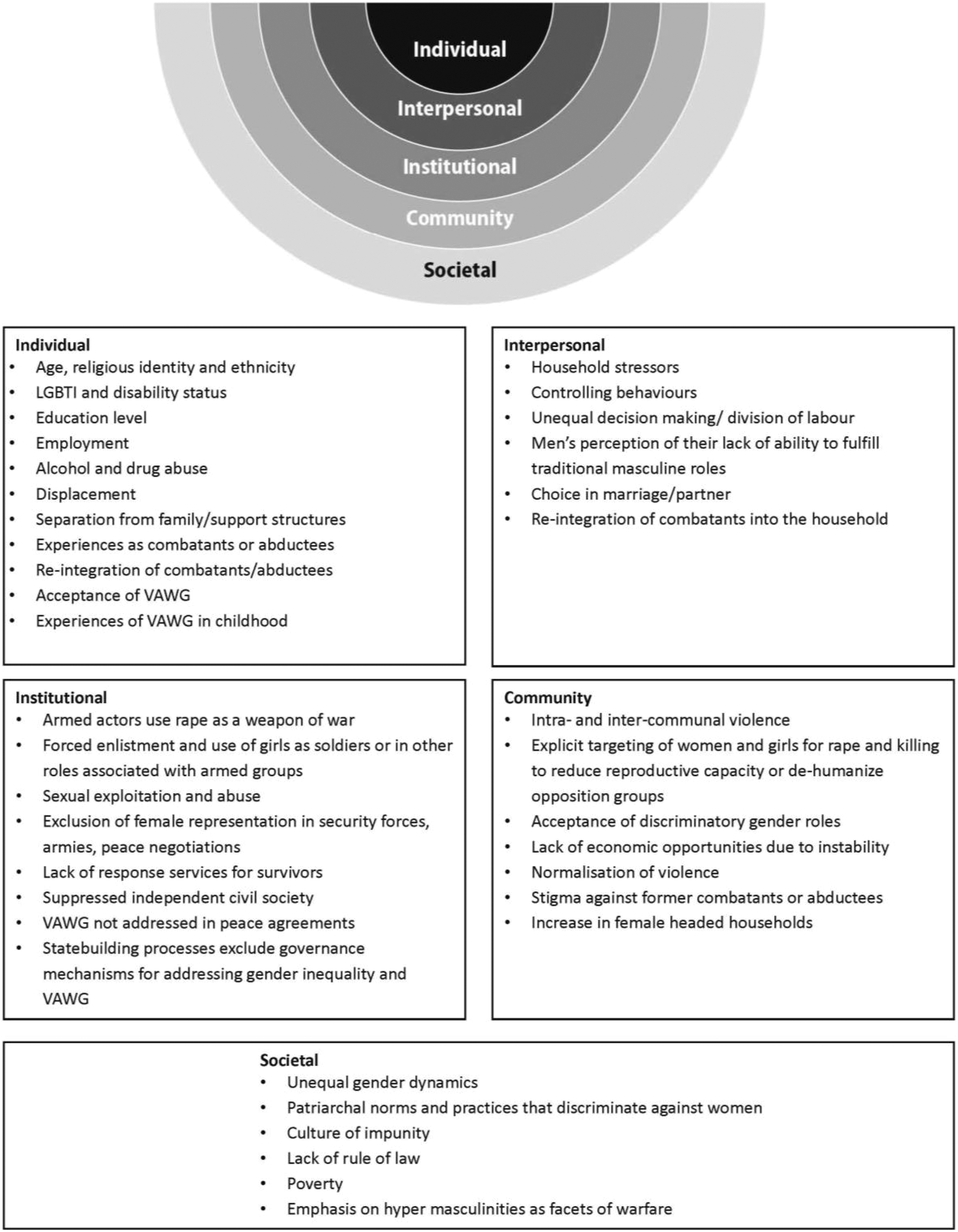
Ecological Framework for Addressing Drivers of Conflict and Post-Conflict VAWG.
At the societal level, social and cultural norms that discriminate against women and girls and a culture of impunity are risk factors for gendered violence in conflict-affected contexts (Eriksson Baaz & Stern, 2010; Global Women’s Institute and International Rescue Committee, 2017). Recognition is required of economic, political, and social grievances that are at the root of specific forms of violence in armed conflicts, as well as key systemic issues of warfare, such as the evolution of hypermasculine and violent roles expected of men, that will contribute to forms of VAWG. In addition, for post-conflict contexts, lack of attention to conflict-related VAWG by all actors (in peace agreements, transitional justice measures, etc.) may compound cultures of discrimination and impunity and enable continued forms of VAWG after the formal cessation of hostilities (Sigsworth, 2008).
At the community level, poverty remains a factor which may be exacerbated by displacement, loss of homes and livelihoods, and increased risks for female-headed households (Bukuluki et al., 2013; International Rescue Committee, 2015). In addition, violence becomes “normalised” amongst both civilians and ex-combatants and the targeting of women and girls may lead to cycles of revenge attacks (Bartels et al., 2011; El-Bushra & Sahl, 2005; Global Women’s Institute and International Rescue Committee, 2017).
At the institutional level, state and non-state armed groups may use sexual violence as a tactic. Lack of response to VAWG through statebuilding or peacebuilding mechanisms, such as security sector reforms and transitional justice where women are under-represented or marginalised, may exacerbate tolerance of VAWG, compound stigma, and risk of further victimisation (Bastick, Grimm, & Kunz, 2007; Holvikivi, 2015). Informal institutions, such as customary justice processes or traditional and religious leadership structures, may compound blame on women and girls for the public harms they experienced and generate risk of re-victimisation through social punishment and ostracisation (Global Women’s Institute and International Rescue Committee, 2017).
At the interpersonal level, conflict may increase household stresses due to poverty and displacement, which in turn may increase IPV (Global Women’s Institute and International Rescue Committee, 2017). Gendered poverty patterns may also lead men to target female-headed households or adolescent girls for exploitation and abuse, and men’s controlling behaviours towards wives and/or daughters may increase (Ferris, 2007; Global Women’s Institute and International Rescue Committee, 2017). In conflict, this may be exacerbated by the re-integration of former combatants or abductees who may have normalised violence or adopted negative coping strategies (Elbert et al., 2013; Eriksson Baaz & Stern, 2010). A perpetrator’s membership in an armed group may provide an additional layer of implicit impunity, authority, and communal protection, which extends to the post-conflict context, presenting barriers to women’s ability to seek help, redress, and/or leave violent relationships (Swaine, 2018).
Finally, at the individual level, a range of factors including age, education, employment/livelihoods status, childhood exposure to violence, own acceptance of VAWG, and drugs and alcohol affect risk of violence in non-conflict settings and will continue to influence women’s experiences of violence in the post-conflict context (Hotaling & Sugarman, 1986; Kantor & Straus, 1989; Leonard & Quigle, 1999; Testa, Quiley, & Leonard, 2003). Through the ecological framework, we can see how these individual-level factors intersect with the overall identity of women and girls as a group with less power in society, which can lead to compounding vulnerabilities and unique experiences of VAWG for different subgroups such as women and girls of different racial or ethnic backgrounds (Crenshaw, 1991). In conflict-affected settings, individual identity factors, such as ethnicity and race, religious affiliation/identity, disabilities, sexual orientation, and gender identity, may result in deliberate targeting by some armed actors (Isikozlu & Millard, 2010).
Combined Analytical Framework for Statebuilding, Peacebuilding and VAWG
Several overarching conceptual frameworks for statebuilding and peacebuilding have been developed including the Department for International Development and UK Aid (DFID, 2016) Building Stability Framework and the Government of Norway Peacebuilding Palette (Royal Norwegian Ministry of Foreign Affairs, 2004). Post-conflict statebuilding and peacebuilding frameworks should respond to the systemic social gendered order in which conflict takes place and specifically address women’s rights and VAWG as key components of positive peace. However, existing frameworks, whilst largely comprehensive and complementary, miss critical elements related to gender and VAWG (Castillejo, 2011).
To address these gaps, this article presents a new analytical framework. It builds on the Ecological Framework for Addressing Drivers of Conflict and Post-Conflict VAWG above by setting out how VAWG can be addressed through key post-conflict statebuilding and peacebuilding processes. The Combined Analytical Framework for Statebuilding, Peacebuilding and VAWG (Table 1) follows the structure of DFID’s Building Stability Framework. The DFID framework sets out five building blocks that are theorised to contribute to long-term stability (see these five components listed in Table 1 and under “column 1” in next paragraph). This framework was selected as the basis for the proposed analytical framework because it captures relevant aspects of both statebuilding and peacebuilding. It includes the need to balance building state structures with people-centred approaches such as inclusivity and fairness, the need to address both local and national state structures and to acknowledge the roles that are played by of international actors and regional/global processes. In this way, it provides a solid basis for identifying entry points for addressing VAWG.
Combined Analytical Framework for Statebuilding, Peacebuilding, and VAWG.

Note. VAWG = violence against women and girls; OECD = Organisation For Economic Co-Operation And Development.
The Combined Analytical Framework for Statebuilding, Peacebuilding, and VAWG is set out in Table 1. The five DFID building blocks structure the areas of statebuilding and peacebuilding that the framework addresses (horizontal), whilst three columns set out areas of intervention, strategy, and outcomes (vertical), as follows.
Column 1: Statebuilding and peacebuilding processes
Key elements of post-conflict peacebuilding and peacebuilding processes are detailed under the structure of each building block of DFID’s Building Stability Framework: (i) conflict resolution processes, (ii) inclusive economic growth, (iii) fair power structures, (iv) capable and legitimate institutions, and (v) supportive regional/global environment.
Column 2: Strategies addressing VAWG
Related to each stratified domain of post-conflict statebuilding and peacebuilding, this column details strategies that actors may adopt to address the drivers of VAWG or to improve their ability to prevent and respond to VAWG.
Column 3: Positive outcomes of stability and peace strategies to address VAWG
This column articulates the potential positive outcomes of statebuilding and peacebuilding strategies for VAWG in conflict and post-conflict settings. The framework draws from the critical findings of the literature presented earlier. The thematic areas of intervention presented within the conceptual framework provide a sample of ways that statebuilding and peacebuilding address VAWG and are not meant to be exhaustive.
Application of the Combined Analytical Framework should be based on a gender analysis of the pre-, during, and post-conflict gender norms in each context. Global normative frameworks should also be considered and incorporated as relevant. For example, the OECD Principles for Good International Engagement in Fragile States and Situations provides guidance for engagement with fragile states (OECD, 2005/2008). Especially relevant are Principle 1: “Take Context as a Starting Point” and Principle 6: “Promote non-discrimination as a basis for inclusive and stable societies” directly applicable to addressing structural inequalities and VAWG. Application of this Combined Analytical Framework will aid conflict analysis, identification of entry points for addressing VAWG through statebuilding and peacebuilding processes, and promotion of a holistic approach to VAWG across post-conflict transition.
Application of the Framework: A Case Study of Nepal
To date, the framework has been piloted in a comparative research project across Nepal, Sierra Leone, and South Sudan. Systematic application of the framework shaped this research process to allow holistic analysis across different components of statebuilding and peacebuilding in the three case study contexts (Swaine, Spearing, Murphy, & Contreras, 2018). In Nepal, for example, Sections 1, 3 and 4 of the Combined Analytical Framework were used as the conceptual frame for gathering and analysing qualitative and secondary data for this research.
Through the application of the framework, the research found that the Nepalese conflict had explicit gender equality issues. For example, gender roles shifted as a result of women’s participation in the conflict, and the peace agreement prioritised some issues of women’s rights, equality, and VAWG to a greater degree than in other countries transitioning from war to peace. However, the application of this framework highlighted that despite relative advances, women and girls were still marginalised during peace talks and in subsequent transitional processes, whilst VAWG was not sufficiently addressed in practice in most statebuilding and peacebuilding processes. Application of Component 1 of the framework (conflict resolution and peace processes) in the research identified that whilst there was attention to certain forms of VAWG (such as IPV), this masked inattention to conflict-related sexual violence present in the transition period. For example, the Interim Relief programme, which offered financial reparations for those affected by the war, did not offer assistance to survivors of sexual violence (Ganguly, 2014). In addition, Nepal’s Truth and Reconciliation Commission (TRC) Bill initially allowed for a loose interpretation of amnesty for human rights violence, though it was amended to specify that rape and sexual violence were not eligible (Ganguly, 2014). Nevertheless, of the almost 60,000 cases submitted to the TRC, only about 300 were regarding cases of sexual violence (International Center for Transitional Justice & Martin Chautari, 2017), suggesting that stigma and other systematic barriers still prevent women from seeking justice through these mechanisms. Use of the framework evidenced the need for all forms of conflict and post-conflict VAWG to be addressed in these processes.
Application of Component 3 of the Combined Analytical Framework (fair power structures and the policy environment) and Component 4 (capable and legitimate institutions) of the framework to research in the Nepal context helped to identify that policy-level change, and public discourse on VAWG has been notable and resulted in the establishment of the Human Trafficking Act, Domestic Violence Act, Sexual Harassment in the Workplace Act, and Elimination of Torture and Witchcraft Act during the post-war period. In addition, the development of a National Action Plan on Women, Peace, and Security was identified as a successful development during the transition. However, the use of the framework for the case study research was also able to identify that despite these legal and policy advances, implementation is lacking and institutions such as the Ministry of Women, Children, and Social Welfare require specific supports.
In the Nepal context, this framework showed that conflict-related VAWG was not comprehensively addressed within conflict resolution and peace processes. This contributed to distrust within broader efforts to bring reconciliation to the country, such as through the TRC. The framework illuminated the policy and legal advances that were made, whilst also evidencing the reality of lacking implementation and its affects both on the legitimacy of government structures and on the lives of women and girls at the grassroots (Swaine et al., 2018).
The experience of applying these frameworks through this research project allowed us to identify the key questions that can guide their further application to differing contexts globally. Researchers and policymakers can use these (and other) questions to guide their own adaptation of the frameworks to their work: What are the ways that pre-conflict gender relations and norms influenced the conflict and its violence? During the conflict, how did VAWG manifest? What were the particular factors that contributed to distinctive conflict-related forms of VAWG occurring? In a conflict-affected country, how is VAWG related to efforts to achieve peace and stability? How can VAWG be integrated and addressed within post-conflict statebuilding policy and programming? What effect do security and justice (and other) reform processes have on VAWG and on the lives of women and girls?
Conclusion
VAWG is a central issue to be addressed as both a driver and an outcome of conflict and fragility, and therefore a critical issue to be addressed within post-conflict statebuilding and peacebuilding processes. The interrelatedness of VAWG with statebuilding and peacebuilding requires an analytical framework through which these concepts and their impacts on peace and stability can be more closely examined. The Ecological Framework for Addressing Drivers of Conflict and Post-Conflict VAWG (Figure 1) provides researchers, policymakers, and service providers with a critical frame through which to develop analysis, understanding, and responses to VAWG during and after conflict. The Combined Analytical Framework for Statebuilding, Peacebuilding, and VAWG (Table 1) presents a framework for researchers, policymakers, and practitioners to conceptually and practically address the linkages between VAWG, statebuilding, and peacebuilding and to tackle VAWG whilst advancing peace and security. In addition, application of these frameworks within academic and action research will improve knowledge and understanding of the gendered nature of conflict and its aftermath and will lead to improved strategies for addressing VAWG in statebuilding and peacebuilding. The conceptual frameworks presented in this article present critical entry points to enhance statebuilding and peacebuilding interventions by ensuring that they address critical gender issues and women’s rights violations such as VAWG. Further, the research and the frameworks successfully bridge the gap between currently siloed efforts of policymakers and practitioners in the statebuilding and peacebuilding fields, and those working to prevent and respond to VAWG. Going forward, it will be critical that these frameworks are used to advance comprehensive and integrated approaches to addressing VAWG across post-conflict statebuilding and peacebuilding and programming on VAWG.
Footnotes
Declaration of Conflicting Interests
The author(s) declared no potential conflicts of interest with respect to the research, authorship, and/or publication of this article.
Funding
The author(s) disclosed receipt of the following financial support for the research, authorship, and/or publication of this article: This research is an output of the DFID What Works to End Violence Against Women and Girls (What Works) research programme. What Works is an international multidisciplinary partnership led by the International Rescue Committee (IRC) with George Washington University’s Global Women’s Institute (GWI) and CARE International UK (CIUK). Additional academic and research partners include the London School of Hygiene and Tropical Medicine (LSHTM), the Africa Population Health Research Center (APHRC) in Nairobi, Kenya, and Forcier Consulting in Juba, South Sudan.