




Abstract
For 50 years positive peace has served as an aspirational goal for many scholars and practitioners of peace. However, much recent scholarly literature evidences a substantial ambivalence toward this ambition, suggesting that prominent theories, policies and practices in the field have failed to support positive peace. This article argues that a key reason for this shortcoming is the field’s failure to respond adequately to the evolving character of conflict (latent and overt) related to technological, legal and economic changes associated with the consolidation of globalization over this period. This consolidation has served to shrink the distances between previously remote actors, to expand exponentially the influence of many institutions, norms, practices and projects as they penetrate new societies, to concentrate power into the hands of ever fewer actors, and to reify instead of deconstruct endemic inequality and marginalization within states, between states, and across the globe. The failure of the field to respond robustly to these changes also prompts concerns about its ability to face sweeping challenges soon to come related to technological innovation, climate change, demographic shifts, labour automation and the search for new governance models. This article, therefore, reaffirms the aspirational goals of peace and conflict studies by building on Lederach’s earlier Peacebuilding Triangle to propose a Trans-Scalar Peace System which would recognize the need for coherent and supplementary policies and actions across scales (global, regional, international, nation and local) and utilize a backward-mapping approach to promote a parity of esteem for actors, institutions and decisions at each scale which would, at the same time, privilege the voice of those with the most pertinent knowledge, experience and capacity for action in support of any given policy or practice. Such an approach would honour the lessons of the ‘local turn’ while developing a global trans-scalar peace system.
Introduction: Ambition and ambivalence in contemporary peace and conflict studies
Peace and Conflict Studies (PCS) has long been recognized as an inherently normative discipline (Boulding, 1978: 343–344). PCS scholars certainly seek to understand the dynamics of peace and conflict through empirical study, but they also seek to develop, communicate or apply methods for reducing the extent or intensity of violent conflict and broadening and deepening peace. The field has grown over the past 70 years, incorporating lessons from a diverse set of disciplines. These include Social-Psychology (Kelman & Cohen, 1976; Nadler, Malloy & Fisher, 2008), International Relations (Azar & Burton, 1986; Richmond, 2003), Sociology (Coser, 1956; Kriesberg & Dayton, 2012), Anthropology (Avruch, 1998; Nordstrom, 2004), Economics (Collier & Hoeffler, 2005; Garfinkel & Skaperdas, 2012), Law (Teitel, 2000; Menkel-Meadow, 2004), and Theology (Philpott, 2009). As it developed, it also benefited from the activist energies of the Cold War era antinuclear proliferation movements (see Marullo, Pagnucco & Smith, 1996) and incorporated an array of theories and approaches from various subfields of scholarship and practice – such as alternative dispute resolution (Barrett & Barrett, 2004) and negotiation (Fisher, Ury & Patton, 1991). These subfields have all contributed ideas and approaches to the contemporary ‘peace industry’ (Mac Ginty, 2012: 289), which attempts to build peace in conflict affected states around the world.
However, while a great diversity of influences contributed to PCS, there are a handful of core theories which are central to the field. Although scholars might disagree somewhat on which theories would be included in any PCS canon, certainly among the top contenders for inclusion would be Allport’s (1954) work developing the intergroup contact hypothesis, Coser’s (1956) consolidation of Georg Simmel’s ideas regarding the functions of social conflict, Sharp’s (1973) influential work regarding the politics of nonviolent action, and Lederach’s (1995) more recent proposals regarding elicitive conflict transformation. But perhaps the theories most likely to be recognized by all PCS scholars as central to the field (for better or worse) would be those of Johan Galtung. Here we would certainly include his ABC triangle, which describes all conflict as being composed of a combination of attitude, behaviour and contradiction (Galtung, 1996: 72), as well as the distinction between direct, structural and cultural violence (1990). But Galtung’s most enduring contribution is probably the related distinction between negative and positive peace, imagined most appropriately as two ends of a spectrum wherein negative peace is the absence of direct violence and positive peace is a more holistic experience of social justice, reconciliation and community (1969).
An array of mechanisms are administered today in societies affected by either latent conflict (characterized by indirect or structural violence that marginalizes or harms individuals or communities) or overt conflict (characterized by direct violence perpetrated by one group or individual upon another), with positive peace as a nominal, if often under-theorized, end goal. Included here are processes such as judicial reforms, socioeconomic restructuring, inter-group dialogue processes and political decentralization. Such mechanisms, and many more, are often legitimated, discursively, by their purported contribution to positive peace. However, over the past 15 years, dozens of studies have evidenced how the social orders to which such interventions give rise are overwhelmingly built on sociocultural norms and assumptions emerging from liberal philosophies largely of Euro-American origin (Autesserre, 2014). Such interventions assume implicitly that peace throughout the world must be built on institutions which mirror those of Northwest Europe and North America, or what is described today as the ‘liberal peace’ (Doyle, 2005).
The vast majority of these cases fail to achieve anything close to positive peace, and have instead led to ‘fragile’ outcomes (Paris, 1997), instances of ‘no peace, no war’ (Mac Ginty, 2006), or ‘quasi-states’ (Milliken & Krause, 2002: 763), all of which fall on the negative peace end of the spectrum, ending the overt conflict but with continuing structural and cultural violence (Luckham, 2018). These manifest failures, and the tendency of interventions to lead (at best) to continuing latent and (at worst) to further overt conflict, have led to a great amount of ambivalence in contemporary PCS, perhaps most evident in the subfield of IR often labelled ‘critical peacebuilding’. This literature questions the implicit assumptions within the field and critiques the ability of PCS to understand conflict in diverse settings (the positivist tendency within PCS), and to intercede for the purposes of building peace (the normative ambitions of PCS) (see Mac Ginty & Richmond, 2013). In the most unsympathetic contributions from this subfield, peace interventions, and those individuals and institutions who promote and administer them, are considered the unwitting agents of a neoliberal global order (Chandler, 2006; Sabaratnam, 2013; Pugh, Cooper & Turner, 2016). These anxieties within the field have led to a pessimistic turn and have even prompted calls for more consideration of a withdrawal from intervention altogether (Bargués-Pedreny & Randazzo, 2018).
However, as will be discussed in detail below, a series of international crises in the first two decades of the 21st century, and a worrying number of emerging challenges to peace, evidence the continuing need for peace work to overcome both latent and overt conflict. The most obvious of these challenges are those posed by climate change, but this article also recognizes the substantial challenges which will be posed in the coming decades by changing military technologies, by demographic trends, by labour automation, and by the search for new modes of governance (each of which will be further elaborated below). Individually, but even more so collectively, these challenges call not for a withdrawal, but for an ambitious new framework to encourage new theories and to guide peace work appropriate for the 21st century. This article, therefore, builds on my earlier work theorizing a Trans-Scalar Peace System (Millar, 2020) to propose an extension to Lederach’s Peacebuilding Triangle (1997) which would meet those ends. Such a system would respond robustly to these onrushing challenges by recognizing the need for coherent and supplementary policies and actions across scales (global, regional, international, nation and local) while utilizing a backward-mapping approach to promote a parity of esteem for actors, institutions and decisions at each scale which would, at the same time, privilege the voice of those with the most pertinent knowledge, experience and capacity for action in support of any given policy or practice. A key goal of this approach, therefore, is to learn the lessons of the ‘local turn’ while developing a trans-scalar peace system which can respond to truly global challenges to peace.
The first section will briefly note the contemporary ‘simple’ challenges to peace and human security which, by themselves, urge an active PCS agenda, before then discussing the emerging challenges which face PCS in the coming decades and give rise to complex conflict dynamics across scales. The key lessons to be communicated in this section are the ongoing needs both for specific interventions for the purpose of conflict resolution, transformation, and peacebuilding, and for a more robust PCS agenda guided by an understanding of the complex interactions between these various emerging challenges across scales. The second section will present an initial proposal for this framework, taking as inspiration Lederach’s (1997: 39) earlier top-down, middle-out, and bottom-up model of conflict transformation and expanding this into a trans-scalar peace system.
Emerging challenges to peace
Before progressing to discuss the emerging challenges to peace, it is important to note that many problematic historical dynamics still generate violent conflict today. We see this in the humanitarian disasters in Syria, Yemen, Algeria and Libya, ongoing since the ‘Arab Spring’ (Vogt, Bormann & Cederman, 2016), in the instability of Iraq, Afghanistan and Pakistan in the wake of the USA’s War on Terror, in the ongoing violent conflicts in the Democratic Republic of Congo or South Sudan, and in the continuing need for peace work in, for example, Haiti, Mali and Myanmar. While certainly not ‘emerging’ challenges, all of these cases indicate the importance of a robust PCS agenda. In addition, there are also ongoing violent conflicts in states of critical regional importance (such as India, Brazil, South Africa, Nigeria and Indonesia), as well as the global insecurity associated with the new multipolar global order currently materializing after the relatively peaceful post-Cold War period (Schweller, 2011). Particularly worrying features of this re-emergence of great-power rivalry include the USA’s ‘pivot’ towards Asia (Campbell & Andrews, 2013), and Russia’s newly assertive posture towards Europe (Treisman, 2016). While my focus in this article is on ‘emerging’ challenges, these examples illustrate that many historical problems remain important.
A cynic might argue that this list of ongoing challenges evidences the failure of PCS. Such a perspective, however, overlooks many positive trends in recent decades in fields directly impacted by much peace work, such as advances in human rights, women’s empowerment, children’s protection, global development and the interconnection of nonviolent movements across the globe. Such a view also underestimates the strength of the forces arrayed against peace work at various scales and the conflict dynamics at local, national, international, regional and global levels, which have not remained stable over time. Indeed, the laws and rules regarding, technologies available for and deployed in, resources used and acquired during, and underlying motivations for violent conflict have shifted significantly over the past 70 years. Existing or emerging violent conflicts, therefore, are not clear evidence of a failure of PCS, but should serve as lessons regarding the fluid character of peace and conflict dynamics over time. It is also true, however, that the evolution of the character of both latent and overt conflict is something which PCS must become far more aware of and responsive to if it is to successfully face the more complex conflict dynamics of the 21st century, some of which I now describe.
Military technology
Changes in military technology have always driven new forms of violence. But PCS scholarship rarely recognizes the fundamental character of these changes and the manner in which technological evolution influences other aspects of conflict. The transition away from relatively short-distance killing between the start of the 20th century and the start of the Cold War, for example, not only increased exponentially the distance at which the authors of violence could target their victims – from the range achieved by cannons to that achieved by intercontinental ballistic missiles (ICBMs) – but it also increased exponentially the extent of damage and the number of deaths possible, while achieving a never before imagined psychological distancing from that damage and death (Gregory, 2011). This increasing possibility of ‘death from a distance’ altered the normative, moral and ethical dimensions of war (Gregory, 2011: 192).
A similar revolution seems upon us today. This is evident in the increasing prominence of cyber warfare (Valeriano & Maness, 2014), in the capabilities of drones and ‘smart’ weapons (Hammes, 2016), and, perhaps most worrisome, in the emergence of autonomous weapons systems (Krishnan, 2009). All of these new developments in the capabilities of military technologies – leaving aside the terrifying implications of more speculative technologies such as virtual warfare, space-based weapons platforms, or nano-biological weapons (Altmann, 2004, 2007) – are also altering the normative and ethical principles of warfare, much as ICBMs did in the last century. They raise questions about the meaning of security and peace, the moral accountability of individuals, groups, states and society for new forms of violence, the necessity and viability of new tactics and strategies for defence, and how the character of social conflict will evolve in response.
Climate change
While a handful of PCS scholars have been calling for more attention to climate change for some years (Homer-Dixon, 1991, 1994), this research has only recently gained traction. Indeed, PCS scholarship is still at odds about whether climate change is related to violent conflict at all (Gleditsch, 1998; Adams et al., 2018). However, as climate scientists predict that the changing climate will impact many of the variables most fundamental to social conflict dynamics – such as the availability of water, food, and arable land (Hanjra & Qureshi, 2010; Turral, 2011) – it is very likely that this will, at the very least, contribute to the various motivating factors prompting such conflict. It is very hard to imagine wholesale changes to the availability of resources, predicted to impact some of the world’s most impoverished regions (Rosenweig & Parry, 1994; Roberts & Parks, 2007), not resulting in increased social conflict, either directly or indirectly (Barnett & Adger, 2007).
Indeed, the recent cases of ‘climate refugees’, particularly from small and low-lying island nations in the Indian Ocean and South Pacific, may be the first clear sign of what is to come (Farbotko & Lazrus, 2012). A less direct, but nonetheless worrying crisis can be seen in the recent trans-Saharan and trans-Mediterranean migrations, which, while driven also by other factors, have been exacerbated by changes to the productivity of land and the availability of food and water (Werz & Hoffman, 2016). Similarly, although disputed (Selby et al., 2017), many have linked the conflict in Syria with the rising price of food, driven by prolonged drought conditions (Cole, 2015; King, Schrag & Dadi, 2015: 121). While the influence of climate change on social conflict is yet to be settled, and may be a contested issue for some time as it is an economically and politically divisive topic, many scholars today are coming to believe that the character of peace and conflict over the coming decades (both latent and overt) will be fundamentally influenced by these dynamics.
Demographic shifts
A further challenge often overlooked is the global ‘youth bulge’ (Urdal, 2006; Sommers, 2011) and the divergence in demographic trends between the Global North and the Global South. Rates of reproduction have long since peaked in much of the former, and many wealthy countries of the North are today home to ageing populations and service-dependent economies (Sukarieh & Tannock, 2014). Alternatively, many countries of the Global South are experiencing substantial population growth. It has been reported that 62% of the population of sub-Saharan Africa is under 25 (Bongaarts, 2009: 2988), the natural growth rate of the continent is still far ahead of any other region of the world (Gerland, Raftery & Ševěiková, 2014), and the population density is set to more than double by 2050 (Cohen, 2003: 1173). These dynamics are mirrored, although less starkly, in Latin America and South and Southeast Asia. Much like climate change, the overall impact of these demographic trends over the coming decades is hotly debated.
While some see a youth bulge as an opportunity for economic growth (Bloom et al., 2007), others see an expanding population of youth as a threat to peace (Urdal, 2006; Sommers, 2011). Certainly, there is good reason to be concerned, particularly as those states and regions with the largest youth bulges are also those on the periphery of the global economy, and often characterized by high unemployment rates, extreme poverty, massive inequality and endemic corruption. Such states are more likely to be quite weak and weak states are exactly those without the institutional strength to turn a youth bulge into an economic dividend (Ashford, 2007) and are more likely to become the focal point for organized criminal networks and terrorist organizations, while the dynamics they exemplify spur wider ‘internationalized’ conflict across whole regions (Patrick, 2011). There is good reason, therefore, to be worried about the co-incidence of weak state institutions and a large youth population.
Labour automation
The unclear impacts of labour automation on patterns of global production, employment and inequality are yet another emerging challenge. While some have studied this for quite some time (Rifkin, 1995), it has only recently emerged as a real concern for policymakers as studies have considered the implications of whole industries switching to automated machine labour (World Bank, 2019). One of the most substantial concerns here, unrecognized so far within PCS, is the potential exponential growth in inequality as the owners of capital capture all of the added value of production processes with little redistribution occurring even through the traditional mechanism of wage labour (Harris, Kimson & Schwedel, 2018: 37). If such an automated model is truly the future of many service and manufacturing jobs, as many predict (Chui, Manyika & Miremadi, 2016), then even the wealthy states may play host to substantial social conflict in the coming decades and alternative models of resource distribution, currently being tested (Tondani, 2009), may be required.
But if this is a challenge for the wealthy Global North, in states unable to afford such schemes it will be a disaster. Such states, particularly many in Asia and Central America, have become the factories of the world in the past 30 years (Kollmeyer, 2009), and manufacturing of export goods is today the lifeblood of hundreds of millions who have become dependent for employment on the expanding manufacturing sectors in and around cities in those countries (Henderson, 2010). In such cases, where recent and rapid urbanization of the society and liberalization of the economy have removed populations traditionally dependent on farming from their land, the impact of a mass move towards automation would be catastrophic. The sudden loss even of those precarious and badly paid employment opportunities would compound existing inequalities, increase marginalization and disempowerment (Norton, 2017; Schlogl & Sumner, 2018), and increase ‘waste life’ (Duffield, 2007: 9). This, yet again, is a challenge made only more troubling given the institutional weakness of most of the states in which these problems are likely to unfold.
Alternative governance
Finally, the emerging search for alternative forms of governance capable of managing all of the above seems a challenge onto itself. We see evidence of this in discussions of the decline of the liberal model in the wake of the 2008 financial collapse (Hans, 2013; Harcourt, 2013), the emergence of an alternative centralized Chinese model (Li & Wang, 2013), or the re-emergence of nationalist and authoritarian forms of governance (Saull, 2015). What we are facing, in short, over the coming decades and in the wake of this disruption of the post-Cold War status quo, is likely to be a sustained period of contestation between models of governance (which has already begun and has recently been accelerated by the Covid-19 pandemic), which may at times be violent, but which will also include periods of less violent but nonetheless conflictual relations – likely quite similar to but also distinct from Cold War. In short, this is unlikely to be a peaceful process.
Indeed, there have been periods of tension historically when global powers have waned relative to their emerging competitors (Ikenberry, 2008). But the coming shift may be more difficult to navigate because it will not be a shift of relative power between states within a stable system (the nation-state system), but a shift in response to the transition and evolution of the system itself as the influence of the state wanes. Multinational corporations, supranational institutions and global civil society organizations (CSOs) have emerged as key actors on the international stage; they have increasingly penetrated the subsystems of global politics, economics and social engagement over the past 25 years, and the impacts of this penetration foster new interactions and many of the trends noted above (Risse, 2007). Any new form of governance, therefore, must be capable of understanding and managing not only the relationships between nation states, but also those between these newly emerging global actors. This challenge is yet to be sufficiently addressed.
Complex global conflict dynamics
A key point that needs to be highlighted, however, is that these trends (and there are certainly more) interact and coalesce in dynamic ways, leading to nonlinear interactions, feedback loops, and emergent self-organization – dynamics which characterize the entire system, as they do all complex adaptive systems. As should be evident in the short descriptions above, each of these five challenges interacts with the others; their impacts are comingling, their effects compounding. Climate change and demographic trends may interact to multiply their individual influences on urbanization and the demand for employment in cities. This multiplied demand may contribute to social inequalities resulting from mass automation and spark increased demand for alternative models of governance and resource distribution. Governments attempting to respond may deploy new military technologies either positively, to respond to these demands, or negatively to quell dissent and maintain power via means of surveillance or repression, for example.
Therefore, while each of these trends will itself be a substantial challenge for PCS, it is the complexity derived from their interactions that is the real concern. It is this complex interaction across the global, regional, international, national and local scales that so complicates efforts towards positive peace employed at any particular scale or in any specific case. This is because, as the literature on complexity within PCS has made clear, the nature of such complex systems seems to breed unpredictable outcomes (Chandler, 2013; de Coning, 2016; Millar, 2020) and, thus, to fundamentally disrupt any linear plans for supporting positive peace. It is this complexity of interaction across scales which inspired this rethinking of positive peace as a trans-scalar peace system. And, indeed, as will be described below in the discussion of ‘attractor dynamics’ (Vallacher et al., 2011), this approach can go some way to addressing the unpredictability inherent in complexity.
A trans-scalar peace system
It is hardly original to note that PCS (theory, policy and practice) has been experiencing a crisis in the past 15 years. Indeed, after the optimism of the post-Cold War period – in which the contemporary form of peace intervention became standardized (Sending, 2009) – the ‘peace industry’ has come under a withering critique. Much of this critique has been focused on the nature of peace interventions as externally imposed processes designed, funded, planned and executed by a variety of international actors, including various supranational institutions such the UN, the EU, the African Union and the World Bank, as well as the international development agencies of many powerful states of the Global North. Included here also are the thousands of CSOs and nongovernmental organizations (NGOs) which have formed in the past 25 years for the explicit purpose of building peace, or have folded this purpose into earlier missions such as international development or humanitarian relief.
One point shared by many of the critiques is that such externally driven peace projects fail to engage with or understand the needs and expectations within local communities impacted by violent conflict, or the inherent capacities within local societies for building a sustainable peace (Lederach, 1995). Many early contributions to this critique focused on the lack of ‘ownership’ of the process in local communities (Donais, 2009), and a substantial literature has described the problematic outcomes of peace interventions of this type, which rarely produce what liberal peace proponents imagined they would (Doyle, 2005). Many authors highlight the hybrid nature of such outcomes (Mac Ginty, 2010; Millar, 2014), the frictions inherent in the interaction between international and local actors (Björkdahl et al., 2016), and the unpredictable nature of both the processes and results of peace work within what are always complex contexts (de Coning, 2016). Scholarship in this vein is often broadly labelled the ‘local turn’ (Mac Ginty & Richmond, 2013; Paffenholz, 2015), as it consistently argues that understanding local context and culture and empowering local actors must be central to the processes and outcomes of peace work (see Bräuchler, 2015; Millar, 2018a).
However, as much as this refocusing on the local was completely necessary, it is also recognized that the field cannot only focus on the local and exclude the global, regional, or international actors (Richmond, 2011; Millar, 2020). Indeed, while most violent intergroup conflict is facilitated by, or even directly fostered by regional and international actors (Kaldor, 2012), those actors have also sometimes been central to peace. Indeed, the complex dynamics described as producing global systems of conflict operate to incentivize violence across scales (Keen, 2006), so it holds that ensuring positive peace for all will demand peace work not within, but across scales. The very local dynamics that have been shown to drive violent conflict in dozens of specific contexts, such as inequality, lack of opportunity and marginalization (Archibald & Richards, 2002; Kalyvas, 2006), are mirrored across scales, wherein certain states and populations are less than equal to and marginalized from others. Purely localized bottom-up peace processes or efforts will not overcome these dynamics.
It should be clear, of course, that what we are talking about here are experiences – across scales – of structural violence. There may be few (often no) actual wars between states in any given year, and even the number of intrastate conflicts has declined since the 1990s, but neither is there positive peace. This is true within many states, where inequality and marginalization are common, but it is even more true between states, and particularly between regions, as some hold most of the power, resources and influence (North America, Europe, East Asia), while others hold almost none. At the scale of the state this situation of gross inequality is evidenced in manipulative bilateral trade deals between nations differently positioned in this structure, in the hugely varying levels of influence such states wield even in ostensibly democratic global bodies such as the UN, and in global differentials of military might. But even on an individual scale, this is evident in the greater value assigned to the Lederach’s peacebuilding pyramid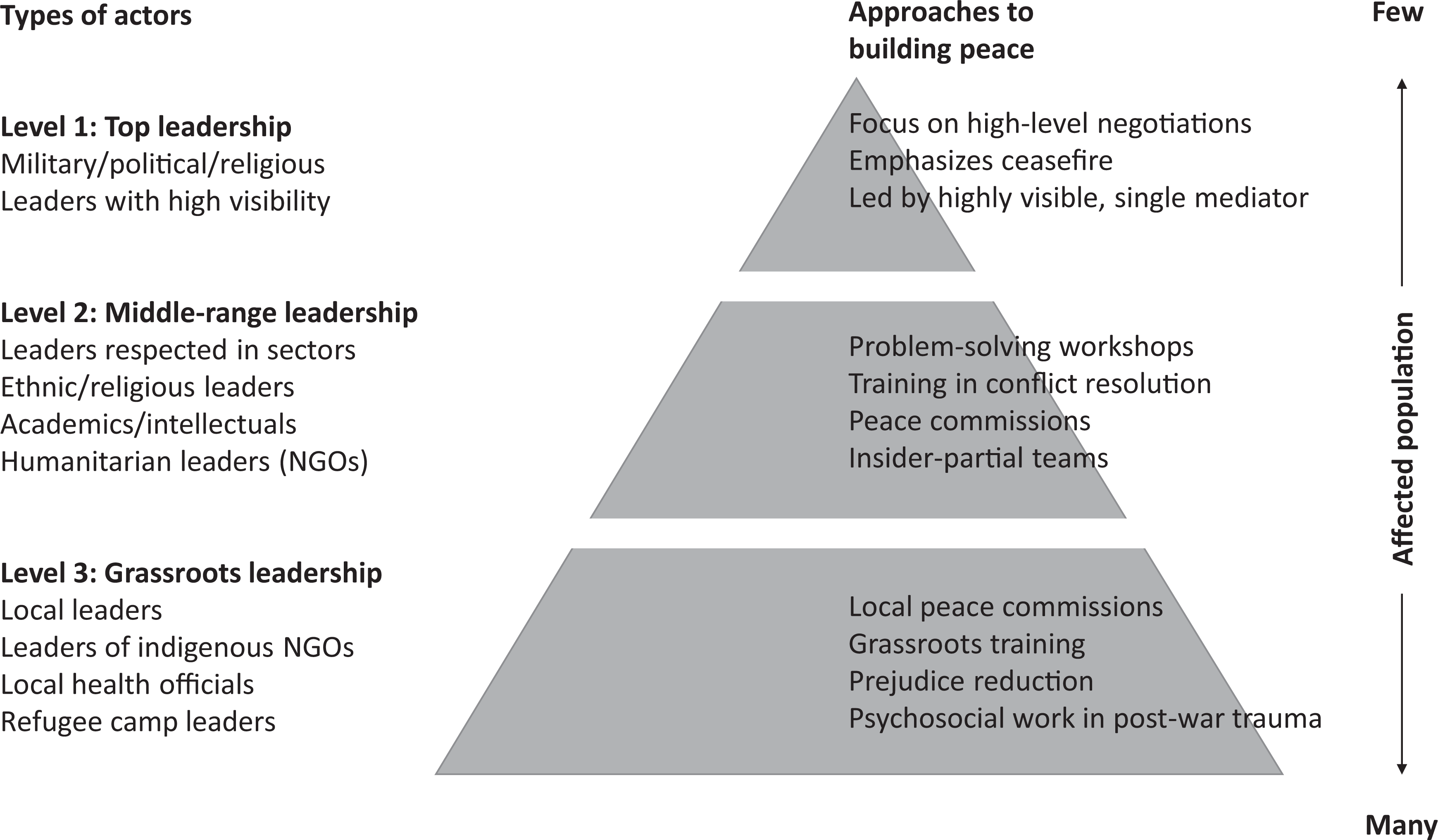
In short, across scales, structural inequality ensures that negative peace is the prevailing order of the day, and even as the structural violence of the global system has become clear, PCS theory, policy and practice, whether top-down or bottom-up, has remained focused on building peace within states instead of on challenging the unequal structures at the global or international level. While the theoretical literature largely recognizes today that conflict systems are global, PCS has not provided many ideas about how peace practice might overcome these scalar limitations (see Millar, 2020). But if the above argument is correct, then the only way to generate experiences on the positive peace end of the spectrum is to implement peace processes within supportive global and regional structures which are facilitative of national and local peace projects. If the structures at the higher scales are not consistent with and supportive of the practices and projects implemented at the more micro scales, then positive peace outcomes are highly unlikely. Such a trans-scalar peace system, therefore, is hugely ambitious in demanding convergence across scales, but this proves necessary to have any real hope of building positive peace within an interdependent global system. Indeed, while ambitious, the trans-scalar peace system I propose has precedent within PCS theory, both as it builds on the tradition of establishing aspirational goals and frameworks for the field, and as it borrows from one of the most influential such approaches: Lederach’s top-down, middle-out, bottom-up model (Figure 1).
This earlier approach, and its later development into a ‘web’ structure (Lederach, 2005), demanded similar consistency of purpose from actors across scales and illustrated the need for policies and decisions on the higher scales to provide the structure to facilitate action and commitment at lower scales (1997: 39). Lederach’s model also evidenced the clear importance of those in the middle connecting the efforts of the ‘top-down’ and ‘grassroots’ bottom-up approaches and argued in support of a holistic approach to achieving a more positive or socially just peace. As such, this model served, at the time, both as a new framework for theorizing about peace, and a model for how to better implement peacebuilding processes. However, one of the key limits of this model is that it is purely focused on domestic dynamics within a single state (see Paffenholz, 2014: 16). It was not developed for reaching outside the nation to the broader structures of the global system which must today be recognized as among the most powerful drivers of contemporary violence. What I propose, therefore, is to build on this model in two ways. First, to expand the model from a purely intrastate approach to one that can also address dynamics of structural violence at the Trans-scalar peace system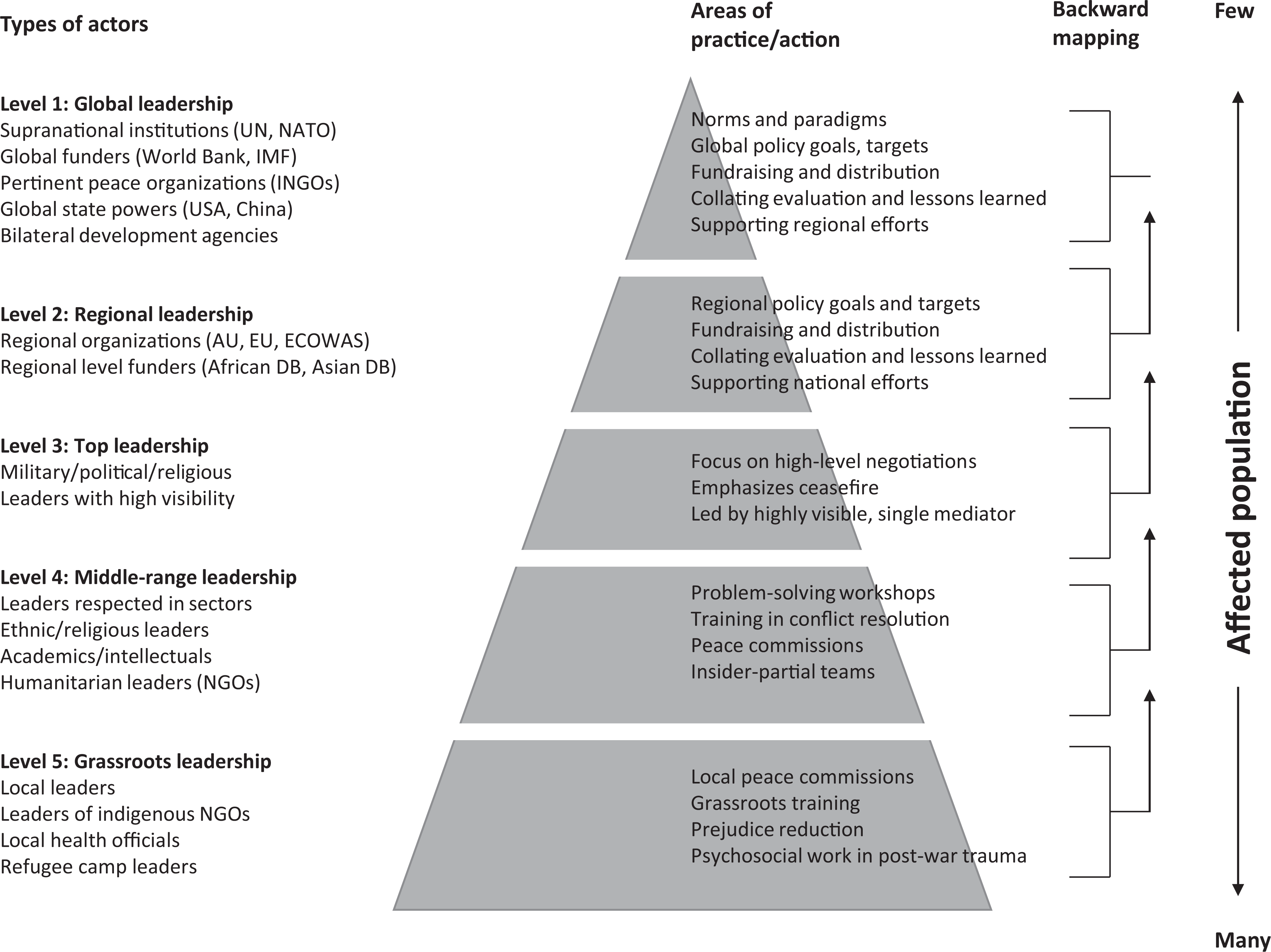
While the challenges to such an approach are enormous (as was true also for both Galtung’s ‘positive peace’ and Lederach’s ‘elicitive approach’), the development of such a trans-scalar peace system should be seen as an appropriately ambitious or aspirational goal for PCS in the 21st century. To put it bluntly, conflicts of the 21st century are already being driven by deeply complex and truly global dilemmas, including evolutions in military technology, climate change, demographic shifts, labour automation, and the search for alternative models of governance. To address these emerging challenges to peace it is, therefore, imperative that peacebuilders understand such complex interactions. Our global systems of communication, transport, production and consumption are trans-scalar, and while these systems have driven enormous expansion in levels of production and consumption – increasing the accessibility of imported foods and finished goods for many – they have also resulted in increased exploitation and expropriation of resources (Sassen, 2013; McMichael, 2013) and the manipulation of individuals and communities (Millar, 2016). In other words, the global system today tends to produce negative peace and, too often, contributes to conflict trends. It is in desperate need of reform, and this is perhaps why so many countries are today struggling with questions of representation, inequality, and the challenges of post-liberal governance in an age of advanced globalization.
The trans-scalar peace system proposed (see Figure 2) provides one way to conceive of such an alternative form of peace work that neither ignores the challenges of a complex interdependent global society (as seems the wont of contemporary nationalists), nor falls victim to the overconfident exuberance that became the hallmark of the neo-liberal peacebuilding model that dominated the post-Cold War years. But I cannot stress enough that key to striking this balance and avoiding this approach simply being another means of resource capture and exploitation, or liberal peace 2.0, is recognition of and respect for the central lessons of the ‘local turn’. It is imperative that understanding local context and culture is central to the processes and outcomes of peace work, so that the voices, experiences, capacities and needs of global, regional, international, or even national actors can never be allowed to indiscriminately outweigh those of the local. Instead, the individuals, communities, institutions and organization most likely to influence peace and conflict dynamics at each scale (whether positively or negatively), must be those most engaged and involved in making decisions and taking actions at particular sites and at each scale of peace work. A trans-scalar peace system, therefore, must incorporate something more akin to a parity of esteem for the ideas regarding, capacities for, and approaches to peace across the scales.
The ambivalence experienced in the field today is a reflection of the negative findings regarding the outcomes and impacts of peace work in many countries over the past 25 years. As noted, the disjunction between what powerful and influential actors plan, fund and implement for the purpose of supporting positive peace, and the unpredictable and often unexpected nature of the eventual impacts and experiences of those projects at various scales (primarily local and national), has undermined the normative ambitions of PCS, generating instead a worrying pessimism, perhaps even nihilism, within the field. The primary drivers of these anxieties, in short, are issues of power and complexity. By power I mean the distinctly uneven influence over decisions about or the ability to incentivize or enforce certain practices or processes. By complexity I mean the unpredictability of emergent self-organization within adaptive social systems. I propose this trans-scalar model not in an effort to ignore or dismiss these anxieties, but as a means by which to circumvent the challenges from which they arose (power and complexity). The trans-scalar peace system achieves this by incorporating the process of ‘backward mapping’ as a means of empowerment and a focus on ‘attractor dynamics’ in response to complexity.
To explain how the model can serve to overcome anxieties in the field, let us first imagine an intergroup conflict between ethnic communities within a small region of one country, which is being effected by cross-border coethnics and driven by intergroup inequalities of wealth intensified by global resource exploitation. There will clearly be many dynamics across scales which must be addressed in order to build peace in this case. There are those at the very local level of the two communities, as well as the international level across borders, and at the global level at which commodities are exchanged. But in the primary models available today solutions to such conflict are generally developed either by international actors who then impose them on those local communities, or – in the ‘transformative’ tradition – within the state and across the domestic scales of elites, mid-range leadership and local people. They either privilege the insight and practice of the international and perceive the local as the problem (Richmond, 2009: 152), or they limit the sphere of intervention to the subnational level and ignore the global and international structures. What these models clearly do not do is provide a coherent approach which allows the global, regional, international, national and local scales to work in a complementary fashion and which might therefore serve to provide macro structures to support or facilitate micro processes or actions for peace.
One way to accomplish this is through ‘backward mapping’, which privileges those actors located most in proximity to implementation at each scale in planning, designing and implementing policy action at that scale (Elmore, 1979/80). Actors at the scale most pertinent to the specific policy to be implemented are privileged in informing and designing the eventual structure of policy or the necessary procedures to address the challenge at that scale. In this way, backward mapping provides a means to provide, overall, a parity of esteem across scales – although for any specific problem at a given scale, a particular actor or institution must necessarily be privileged. In the conflict example outlined above, that might mean privileging international actors in devising policies to ensure more equal distribution of wealth from resource exploitation, privileging national-level leaders in developing plans to establish a less antagonistic interaction between ethnic groups across borders, privileging local-level ethnic leaders in shaping efforts towards reconciliation between ethnic communities, and privileging individuals and communities on the ground in choosing how exactly to carry forward such efforts. As such, backward mapping would provide greater influence in the design and planning to conflict-affected communities, including substantive input into the ‘telos’ or purpose of peace work itself (Denskus, 2012: 151).
Incorporating backward mapping into the trans-scalar peace system proposed, therefore, means that the global or international actors distanced from the scale of implementation would not be empowered to set agendas for programmes and define the end goal of peace, but would be required to take their lead from those at the scale of implementation. In a reversal of the usual power dynamics in which formal authority travels from the top down, but therefore also fails to have predictable outcomes on the ground, in the trans-scalar model proposed authority would derive ‘from expertise, skill, and proximity’ and travel ‘in the opposite direction’, from the bottom up (Denskus, 2012: 606). Backward mapping, in short, would demand that we recognize and privilege expertise for policy implementation and practice not at the higher scale of funding, but on whatever scale the implementation will occur, and that we would, therefore, very often need to privilege local or indigenous knowledge because ‘the problem-solving ability of complex systems depends not on hierarchical control but on maximizing discretion at the point where the problem is most immediate’ (Elmore, 1979/80: 605).
But backward mapping cannot, on its own, provide a solution to the broader challenges posed by the complexity of conflict systems (whether latent or overt) and, indeed, the problems associated with non-linearity, feedback loops, and emergent properties would remain even if local, indigenous, or marginalized groups were newly empowered to make central decisions regarding peace work. Indeed, it is distinctly possible, given the social and cultural divergence between actors operating at different scales, that backward mapping could work against the principle of convergence and eventual coherence across scales. What is necessary instead is some way to combine a privileging of the most pertinent actors at the scale of project implementation, with a collective and coherent vision for peace work in a given case which can guide activity across the scales within the system. This is where the notion of ‘attractor patterns’ may be of assistance, particularly as they allow us both to imagine how systems settle into specific patterns of violence or peace (Coleman et al., 2017; Vallacher et al., 2011), and to theorize about how peace work might encourage systems to shift from one attractor state (characterized by violence) to another (characterized by peace).
Attractor patterns can be thought of as stable or equilibrium states at which systems settle, and which are defined by or develop their characteristics as a result of the interaction between the multiple elements of the system itself and the broader systems in which it is nested and with which it is interrelated. Such attractor patterns are like the comfortable rhythms, habitual behaviours or everyday routines that we all follow, maintained by the mundane schedules and requirements of our lives – the reasons (surely multiple) that you engage in particular chores on a given day each week, or run into a neighbour on the street at approximately the same time each morning. The adaptive social system that encompasses your lifeworld has settled into a particular attractor pattern and any elements of that system, and the systems in which it is nested, collaborate (although with no intentionality) to maintain that stable or equilibrium state. The ‘elements’ of the system unknowingly fall into this pattern and then maintain it over time.
Building awareness of this idea into trans-scalar peace systems is one way to promote the convergence of goals and motivations across the scales and so to promote a commitment among actors on the higher scales to facilitate a consistency with and support for the practices and projects implemented at the more micro scales. Developing such coherence, however, is a slow iterative process by which initially intentional convergence becomes habitual coherence that results in the system as a whole settling into a peaceful attractor pattern which, by its very nature, would then function to reaffirm and reassert the established rhythms of that pattern, that is, of a stable trans-scalar peace system. While the recognition of the implications of complexity for peace work have largely inspired ambivalence within the field, this reflects the focus over the past 15 years on the failures of top-down planning and implementation, and not a full recognition that peace systems too are complex. It downplays or even ignores the fact that there are many promising examples of stable peace systems in the world today (Verbeek & Peters, 2018), and that we can, with foresight and effort, develop our capacity as peace workers to assist in the development of trans-scalar peace systems elsewhere. It is certainly true that any habitual coherence to a trans-scalar peace system requires an unlikely revolution in the thinking of global power holders. But in the face of truly global challenges such as climate change and the Covid-19 pandemic, we are already seeing revolutionary ideas take root in the form, for example, of the Green New Deal and calls for more coherent global health policies. The time is ripe, in short, for revolutionary ideas.
Conclusion: Peace and conflict studies in the 21st century
The key lessons from this article are simple. First, while there is today quite a lot of ambivalence regarding the ability of PCS as an academic field, and peacebuilding as a practice, to contribute to positive peace, the most critical arguments suggesting that we consider a withdrawal from peace work must be resisted. As discussed above, many contemporary conflict-affected societies evidence the continuing need for engaged PCS theory, research, policy and practice, to the extent that a withdrawal would be hugely detrimental. Further, as discussed, there are also many more complex and emerging dynamics which will be major drivers of both latent and overt conflict in the coming decades (five specific examples were described here) and which, in their mutual interaction, call not for the restraint of our ambition, but for robust engagement with the forthcoming challenges of the 21st century. The challenges of today, and certainly those of tomorrow, are substantial. New generations of PCS scholars and practitioners must be prepared to meet them.
As was made clear in the final section, while we must recognize the failures of the overly top-down and imposed nature of the ‘liberal peace’ model and acknowledge the central importance of bottom-up needs, expectations and capacities, conflict systems are today global. No longer are conflicts (latent or overt) best seen as intra- or interstate, and even the accepted middle ground idea of the ‘internationalized conflict’ fails to capture the truly complex global dynamics that are driving the prominence of negative peace (mass inequality and marginalization) which inspires and exacerbates specific cases of direct violence at different scales. The long-recognized changes in technology, law and economics which have driven the evolution in the character of conflict over recent decades have resulted in a truly trans-scalar conflict system which reifies unequal systems of power and resource distribution (both domestically and globally), and the only way to tackle such challenges and work towards a truly positive peace, is to work, somehow, at a global scale to encourage the evolution of trans-scalar peace systems.
I recognize the apparent paradox of this argument – that we must take fully on board the lessons of the ‘local turn’ and prioritize the needs, expectations and capacities of those in settings of conflict while, at the same time, working to develop global trans-scalar peace systems. But, as articulated, Lederach’s model for trans-scalar conflict transformation within a conflict-affected state can serve as a very useful starting point for developing a global trans-scalar peace system. Such a model recognizes the manner in which structures from higher scales delimit actions and options on lower scales, and how actors at middle levels can serve to communicate and translate between levels. If such a model is extended out to include also the international and the global, and if the needs, expectations, capacities, desires, opinions and ideas of actors at specific scales are given priority in framing the policies and practices for which they are responsible for implementation, then such a trans-scalar peace system may knit together the many scales necessarily involved in peace interventions with an initially intentional convergence across scales developing into a more habitual coherence, and, thus, avoiding the imposition and neo-colonial tendencies common in the post-Cold War years dominated by the liberal peace model.
The hope is that such a trans-scalar peace system can unite specific local needs with broad global norms. In so doing, we might manage to craft locally salient but globally applicable peace theory and practice which positions those at scales distant from implementation only as facilitators of or advisers to others’ peace, conceived, planned and built by those others, but within the context of structures, norms and systems which are designed to actively support what those at the level of implementation consider desirable. This is the central purpose of the ‘backward-mapping’ approach: to have decisions regarding norms, rules and structures guided by those at the coalface (Millar, 2018b). This demands, it must be recognized, a level of humility, openness, reflexivity and self-critique which has thus far seemed extremely difficult for many policymakers, scholars and practitioners, and this will prove a formidable challenge. Such a model is, therefore, keeping with the best of PCS tradition in asking us to accept ambitious goals in the face of overwhelming challenges. Indeed, while positive peace has often been critiqued as ill-defined and unattainable, it is exactly as an aspirational goal that it has been most useful. In times of powerful global anxieties, PCS must move forward with genuinely global aspirations and rethinking positive peace as a trans-scalar peace system can be a first step.
