




Abstract
Research on strengths and violent behavior in justice-involved youth suggests that the prevalence and predictive validity of strength factors vary as a function of gender. Interviews conducted between 2009 and 2012 with 185 justice-involved Canadian youth (N female = 84, N male = 101; 67% violent index offence) were coded retrospectively using two strength measures for violence prediction: the protective domain of the Structured Assessment of Violence Risk in Youth (SAVRY), and the Structured Assessment of Protective Factors-Youth Version (SAPROF-YV). Males exhibited more protective factors than females across measures. Both tools were strong predictors of general recidivism in males but not females. The SAVRY protective domain was predictive of violent recidivism in males, but the SAPROF-YV was not; neither was predictive of violent recidivism in females. This study demonstrates gender differences in the prevalence and predictive validity of strengths in justice-involved youth and highlights the need for more female-focused research and measures.
Identifying who is most likely to engage in future criminal conduct, particularly violence, is a key objective in youth justice settings. As such, risk factors associated with general and violent reoffending have been examined among justice-involved people as a function of age and gender (Bonta & Andrews, 2017; Dowden & Andrews, 1999; Lipsey, 2009). The parallel study of strengths 1 , which are hypothesized to predict decreases in recidivism, has increased over the past several decades (Brown et al., 2020; Scott & Brown, 2018; Ward, 2002). Despite the increase in academic attention, this area of research has not yet fully examined all sub-groups of justice-involved people or more specific outcomes. In particular, there is a dearth of research which addresses the relationship between risk, strengths, and violent criminal behavior in youth and whether gender 2 differences exist. The goal of this paper is to address this gap and to inform future strength-based assessment for both male and female justice-involved youth.
Risks, Gender, and Assessment
Historically, the criminal behavior of female youth and adults has been under-studied (Belknap, 2015). In particular, violent behavior in female youth has been overlooked, in part due to the significantly lower rates of violence among females compared to males (Murdoch et al., 2012). In 2019, about 25% of all youth crime in Canada was perpetrated by females. Male youth were twice as likely to be charged with a violent crime (30%) in comparison to their female counterparts (15%) (National Crime Prevention Centre, 2012; Savage, 2019). While these lower rates of violence may help to explain the relative lack of academic attention afforded to justice-involved female youth, it is nonetheless surprising that few studies have explicitly explored the correlates or predictors of violent female crime. This topic is important because the research that exists indicates that those female youth who do engage in violent behavior often become entrenched in the justice system and are at high risk for a variety of other negative health and social outcomes, such as psychiatric disorders, and exposure to violence in their homes and communities (Odgers et al., 2007). Furthermore, studies have demonstrated that violence can be transmitted intergenerationally; females who are exposed to violence at a young age are more likely to go on to exhibit violent behaviors themselves, reinforcing cycles of violence (e.g., Black et al., 2010; Moretti et al., 2014). Even fewer studies have considered how the relationship between strengths and violent behavior may be different—or the same—for female youth in comparison to males.
The importance of gender in violence risk assessment is a divisive issue. Many scholars and justice professionals support a gender neutral approach to risk assessment and intervention. This approach focuses on the central eight risk factors outlined in the general personality and cognitive social learning theory (GPCSL) and underscores using interventions and assessment approaches that are similar for all genders (Bonta & Andrews, 2017; Schwalbe, 2008). In contrast, feminist scholars assert the pathways to crime for girls and women differ substantially from those of boys and men. Histories of victimization and abuse, a lack of safety in their families of origin, and poverty with subsequent involvement in criminal behavior as a means of survival, are hypothesized to be more important in understanding and predicting females’ justice-involvement (Salisbury & Van Voorhis, 2009). As a result, this perspective posits that risk assessments and interventions for girls and women should prioritize hypothesized female-specific risk factors and approaches; albeit certain aspects of gender neutral assessment and intervention are not entirely discounted. Historically this paradigm has been coined gender responsive (i.e., female responsive) (Belknap, 2015; Salisbury & Van Voorhis, 2009). A review of the existing literature suggests that both positions have merit and evidence exists to support both views, at least in part.
In support of a gender neutral approach, Schwalbe’s 2008 meta-analysis compared the predictive accuracy of three risk assessments for male and female youth evaluated across 19 studies. The results indicated that there were no significant gender differences in the predictive accuracy of tools. Schwalbe asserted that the results of the meta-analysis were accurate, and that earlier findings of gender differences in predictive accuracy (i.e., Schwalbe et al., 2004), may be attributed to gender-based bias in the justice decision-making process. In contrast, the results of a 2018 meta-analysis conducted by Scott and Brown indicated that while global risk domain scores (e.g., antisocial peers, antisocial attitudes) were similarly predictive for both male and female youth, significant differences emerged for some individual items within domains. For example, while substance use as a domain predicted recidivism equally well for males and females, chronic alcohol use was a stronger predictor for female recidivism, while chronic drug use was a stronger predictor for male recidivism. This study only examined general recidivism; gender differences in risk factors associated with violent recidivism were not assessed.
With respect to violent re-offense specifically, in their 2011 longitudinal study, Topitzes et al. examined the relationship between childhood maltreatment and a variety of justice outcomes in adolescence and early adulthood. Their results indicated that while gender did not moderate the relationship between childhood maltreatment and general offending, childhood maltreatment did increase the risk of arrest for violent crime in females, but not males. Several other studies have examined risk factors associated with violent behavior in youth and have found some support for gender differences in risk factors for female youth. Among those risk factors that have been found to be more relevant for female youth are violent victimization and witnessing violence (Chauhan & Reppucci, 2009; Spano et al., 2008), and mental health issues such as ADHD or conduct disorder (Wolff et al., 2017). Taken together, the available evidence suggests that there may be some risk factors that predict equally well for males and females, and other risk factors that may be more, or less relevant in one gender versus another.
Strengths, Gender, and Assessment
Notwithstanding the inability to reach consensus regarding what terminology should be used when discussing strengths (see Jones et al., 2015; Wanamaker et al., 2018), we conceptualize strengths broadly, as all positive (individual and environmental) factors that in theory, are believed to exert a positive influence on an individual. There is no empirical litmus test required to identify a strength, face validity is the only prerequisite (Brown et al., 2020). Subsumed within strengths, the defining feature of promotive factors are that they must be empirically related to recidivism such that the presence of promotive factors is associated with less recidivism (i.e., negatively correlated with recidivism). Protective factors also can only be delineated using empiricism. They emerge when a statistical interaction appears between risk level (or a risk factor) and strength level (or a strength factor) such that the presence of strength reduces the likelihood of recidivism in one group (e.g., higher-risk group) more so than another group (e.g., lower-risk group). For more nuanced definitions and an overview of the challenges in defining strengths see Brown et al. (2020) or Farrington et al. (2016).
The Strengths Debate
Strengths-based assessment and intervention was first formally introduced to the field of correctional psychology with the Good Lives Model (GLM; Ward, 2002). Rooted in the concept of resiliency from the fields of developmental and positive psychology (e.g., Luthar et al., 2000; Seligman & Csikszentmihalyi, 2000), GLM offers a strengths-based framework to approach rehabilitative efforts and has been applied across a variety of sub-groups of justice-involved people (e.g., Barnao et al., 2016; Van Damme et al., 2017). Few would disagree with the utility of strengths in establishing a therapeutic alliance and building motivation with justice-involved clients (de Vries Robbé & Willis, 2017; Tafrate & Mitchell, 2013; Ward et al., 2007). The widely accepted risk-need-responsivity (RNR) model of rehabilitation (Bonta & Andrews, 2017) also highlights the importance of strengths and conceptualizes strengths as responsivity factors, meaning they should be used to maximize the effectiveness of correctional case plans. However, there remains ongoing debate regarding whether strengths can enhance the predictive accuracy of risk assessments beyond risk factors (Dickens & O’Shea, 2018; Stouthamer-Loeber et al., 2002).
Several studies have concluded that strengths do not add incrementally to the prediction of recidivism (e.g., Dolan & Rennie, 2008; Harris & Rice, 2015). In their 2017 meta-analysis, Dickens and O’Shea sought to evaluate the utility of including strengths in the estimation of risk for a variety of negative outcomes in youth, including substance abuse, victimization, and recidivism. The inclusion of strengths did not improve prediction for any of the negative outcomes, including violent recidivism. Notably, the results were not disaggregated by gender. In contrast to Dickens and O’Shea (2018), other studies illustrate that strengths can improve the accuracy of risk assessments in predicting both general and violent recidivism, albeit in male or predominately male samples. These studies have demonstrated that strengths, as measured by the Structured Assessment of Violence Risk in Youth (SAVRY; Borum et al., 2006) or the Structured Assessment of Protective Factors-Youth Version (SAPROF-YV; de Vries Robbé et al., 2015) have utility in attenuating risk factors, and thus can be incorporated into traditionally deficit-based risk assessment to improve the accuracy of risk estimates (e.g., Chu et al., 2020; Lodewijks et al., 2010).
To date, very few studies have examined strengths in justice-involved female youth and even fewer have examined their ability to offset violence. The Scott and Brown (2018) meta-analysis found that some strengths (family relationships, education, and employment opportunities) predicted general recidivism in male youth, but not female youth. Conversely, prosocial values and attitudes were identified as strengths for females, but not males. More recently, Scott et al. (2019) found that while mean protective scores on the Youth Assessment Screening Instrument (YASI; Orbis Partners, 2008) were similar for male and female youth, YASI protective scores were more effective in predicting general recidivism in males than in females. While such results support some gender differences, the use of any recidivism as an outcome measure potentially masks nuanced gender differences regarding violence.
The few studies which have explored the relationship between strengths and violent behavior in both male and female youth have been conducted with the SAVRY (Borum et al., 2006). The SAVRY includes a protective domain comprised of six protective factors that are scored dichotomously (i.e., present or not present), including: prosocial involvement, strong social support, strong attachments and bonds with one or more prosocial adults, positive attitudes towards intervention and authority, strong commitment to school, and resilient personality traits. Thus far the majority of SAVRY research has focused on male youth. However, research examining gender differences is growing. Schmidt et al. (2011) found gender differences in a sample of 112 youth (48 female, 64 male) who were referred for a mental health assessment as part of court proceedings in central Canada. While mean SAVRY protective domain scores were similar across gender, the predictive validity of the protective domain varied considerably. Violent recidivism was predicted by the protective domain in males but not in females. A more recent study conducted with justice-involved youth in Western Canada found similar results. Muir et al. (2020) assessed the predictive validity of the SAVRY in a sample of 744 youth (168 female, 576 male). The SAVRY protective domain was predictive of violent recidivism in White male youth but was not predictive for females of any race, nor was it predictive for Indigenous male youth. However, unlike Schmidt et al. (2011), female youth had lower mean protective scores than male youth.
Some authors have criticized the SAVRY protective domain as inadequate and unable to capture enough meaningful information about protective factors in a youths’ life given the few items and dichotomous scoring (e.g., Kleeven et al., 2020; Viljoen et al., 2018). As such, another measure is gaining traction as a supplement to risk-focused measures: the SAPROF-YV (de Vries Robbé et al., 2015). The SAPROF-YV is comprised of 16 protective items encapsulated within resilience, motivational, relational, and external domains. While the research available to date has been conducted with predominantly male samples, the results suggest the SAPROF-YV may be a useful addition to risk assessment protocols (e.g., Chu et al., 2020; Koh et al., 2021).
Only one published study compared gender differences in the predictive validity of the SAVRY protective domain, with the SAPROF-YV. In a sample of 261 justice-involved youth (85 female, 176 male), Finseth et al. (in press) found that females had significantly lower protective scores than boys on both the SAPROF-YV and SAVRY. The SAPROF-YV was predictive of any recidivism in both female and male youth; however, the SAVRY protective domain was predictive of recidivism in males but not females. Replication is needed, however, and as only general recidivism was examined, further study is required to understand if a similar pattern will be observed when predicting violent recidivism.
In sum, the following conclusions appear to be supported by the literature. First, there is some evidence that male youth have higher protective scores than female youth (Finseth et al., in press; Muir et al., 2020). Second, protective scores are moderately predictive of violent behavior in male youth, but not in female youth, regardless of the measure used (Muir et al., 2020; Schmidt et al., 2011). Third, the SAPROF-YV may be a more effective predictor of recidivism than the SAVRY protective domain, particularly among female youth (Finseth et al., in press). Ultimately, these results must be interpreted with caution as few empirical studies have addressed the relationship between youth violence, strengths, and gender.
Given the above conclusions, our study sought to examine gender differences in the prevalence of strength factors in a sample of justice-involved youth, and how these factors relate to violent recidivism. Four hypotheses were evaluated: (1) protective factors, as measured by the SAVRY and SAPROF-YV, will be prevalent at higher rates in male youth, and it is expected that the endorsements of strengths in both genders will be low (e.g., Schmidt et al., 2011); (2) both measures will more effectively predict male recidivism than female recidivism both general and violent (e.g., Finseth et al., in press; Muir et al., 2020); (3) the SAPROF-YV will have greater predictive validity (general and violent) than the SAVRY (e.g., de Ruigh et al., 2021; Finseth et al., in press); and (4) strengths, as measured by both the SAVRY protective domain and the SAPROF-YV, will add incrementally to the prediction of recidivism above and beyond risk (e.g., Kleeven et al., 2020).
Method
Participants
Participants included 84 female and 101 male youth who were recruited from one of six sites across Ontario serving justice-involved youth. These interviews were conducted as part of the Gendered Pathways to the Justice System study (Brown et al., 2021). Participants in our study do not overlap with those recruited for the Finseth et al. (in press) study. Participants were between 13 and 21 years of age (82.2% between 16 and 18), with a mean age was 16.94 years old; males (M = 17.13) were older than females (M = 16.71, t(183) = 2.32, p = .022, d = .34). The racial composition of the sample varied significantly as a function of gender (χ2 = 13.17, p = .04, φ = .27). One hundred participants were White (54.1%; n male = 44, 43.6%; n female = 56, 66.7%), 37 were Black (20%; n male = 24, 23.8%; n female = 13, 15.5%), 7 were Indigenous (3.8%; n male = 3, 3.0%; n female = 4, 4.8%), and 41 were other persons of color (22.2%; n male = 30, 29.7%; n female = 11, 13.1%).
In this sample, the proportion of youth with a violent index offence, particularly female youth, was quite large given the relative rarity of female youth violence. Of the total 185 participants, 124 (67%) had been accused of a violent index offence (n male = 78, 77.2%; n female = 46, 54.8%), 146 (78.9%) had been accused of a non-violent index offence (n male = 82, 81.2%; n female = 64, 76.2%), and 8 had been accused of a sexual index offence (n male = 8, 7.9%; n female = 0, 0%). Dispositions of youth also varied significantly as a function of gender (χ2 = 11.00, p = .004, φ = .24). Forty-six (24.9%) were on probation (n male = 16, 15.8%; n female = 30, 35.7%), 13 (7%) were in open custody facilities (n male = 6, 5.9%; n female = 7, 8.3%), and 126 (68.1%) were in closed custody facilities (n male = 79, 78.2%; n female = 47, 56.0%).
Measures
Structured Assessment of Violence Risk in Youth (SAVRY) Protective Domain (Borum et al., 2006)
The SAVRY is a structured professional judgment measure of youth violence risk, which is comprised of three risk domains (historical, social/contextual, and individual/clinical) and a protective domain. Only items in the protective domain were coded given the focus of the study. The protective domain of the SAVRY is comprised of six strength factors, which are coded as either present (1) or absent (0), based on the guidelines contained in the SAVRY professional manual. These factors include: prosocial involvement, strong social support, strong attachments and bonds with one or more prosocial adults, positive attitude towards intervention and authority, strong commitment to school, and resilient personality traits. Previous research has demonstrated the SAVRY to be a reliable and valid tool, with good predictive validity (Borum et al., 2010; de Vries Robbé et al., 2015; Shepherd et al., 2016; Soderstrom et al., 2019; Viljoen et al., 2018). Inter-rater reliability in this sample was acceptable, with an ICC of .71 for SAVRY total scores (Koo & Li, 2016).
Structured Assessment of Protective Factors-Youth Version (SAPROF-YV) (de Vries Robbé et al., 2015)
The SAPROF-YV is a structured professional judgment tool intended for use alongside additional risk-focused measures, to measure protective factors for violence in justice-involved youth. The SAPROF-YV is comprised of 16 items across four domains, including the resilience domain (social competence, coping, self-control, and perseverance), the motivational domain (future orientation, motivation for treatment, attitude towards agreements/conditions, medication, school/work, and leisure activities), the relational domain (parents/guardians, peers, and other supportive relationships), and external items (pedagogical climate, professional care, and court ordered treatment). Each item is coded on a three-point scale (0 = absent, 1 = somewhat present, 2 = fully present) and summed to create a total strength score. As medication information was missing for 118 participants (64%), this item was excluded from analyses, resulting in scores ranging from 0 to 30. Several studies have found the SAPROF-YV to have strong internal consistency, and convergent validity with other measures such as the SAVRY (e.g., Bhanwer, 2016; de Vries Robbé et al., 2015; Kleeven et al., 2020). Additionally, several studies have demonstrated the SAPROF-YV to have moderate to strong predictive validity for both violent and non-violent reoffending (Bhanwer, 2016; Chu et al., 2020; Kleeven et al., 2020). Good inter-rater reliability was found in this sample, with an ICC of .80 for SAPROF-YV total scores (Koo & Li, 2016).
Youth Level of Service/Case Management Inventory (YLS/CMI 2.0; Hoge & Andrews, 2011)
The YLS/CMI is a widely used standardized measure of youths’ criminogenic needs and is used to estimate a youth’s risk of reoffence. It is comprised of 42 items across eight domains: offence history, family circumstances/parenting, education, peer relations, substance abuse, leisure/recreation, personality/behavior, and attitudes/orientation. Items are coded dichotomously as either present or absent and may be summed to create a total risk score, which can range from 0 to 42. Studies have demonstrated that the YLS/CMI is a good predictor of general and violent recidivism in both male and female youth, though AUC values tend to be lower for female youth (e.g., female AUC = .68, male AUC = .79; Olver et al., 2012).
Criminal Recidivism
Official recidivism records were obtained from the Ontario Ministry of Community Safety and Correctional Services and the Royal Canadian Mounted Police (RCMP). Any new criminal conviction, not including technical violations, was coded as general recidivism (0 = no, 1 = yes) over a three-year fixed follow-up period. Convictions involving threats of harm or actual bodily harm were coded as violent recidivism (0 = no, 1 = yes). Violent offences included homicide and related offences, robbery, assault, sexual offences, threats, kidnapping, and weapons-related offences.
Procedure
Once all required ethics and legal clearances were granted, trained research assistants engaged consenting youth from participating youth justice programs across Ontario in semi-structured interviews. Participants in custody received $30.00 of canteen money and community participants received $30.00 in gift certificates. Assessments took between 8 and 10 hours for each participant, including in-person interviews, file reviews, the administration of self-report questionnaires, and scoring of relevant measures (e.g., YLS/CMI).
Results
Preliminary Analyses
Base rates of recidivism were generally high in the present sample. One hundred and nine participants were charged with new non-violent offences (i.e., general recidivism; 58%; n male = 70, 69.3%; n female = 39, 46.4%), and 82 were charged with new violent offences (i.e., violent recidivism; 44.3%; n male = 52, 51.5%; n female = 30, 35.7%). YLS/CMI total scores ranged from 1 to 37, with a mean score in the moderate risk range of 20.33 (SD = 7.97) in the full sample. No significant differences were observed between YLS/CMI scores for males (M = 20.59, SD = 8.19) and females (M = 20.00, SD = 7.74; d = .07).
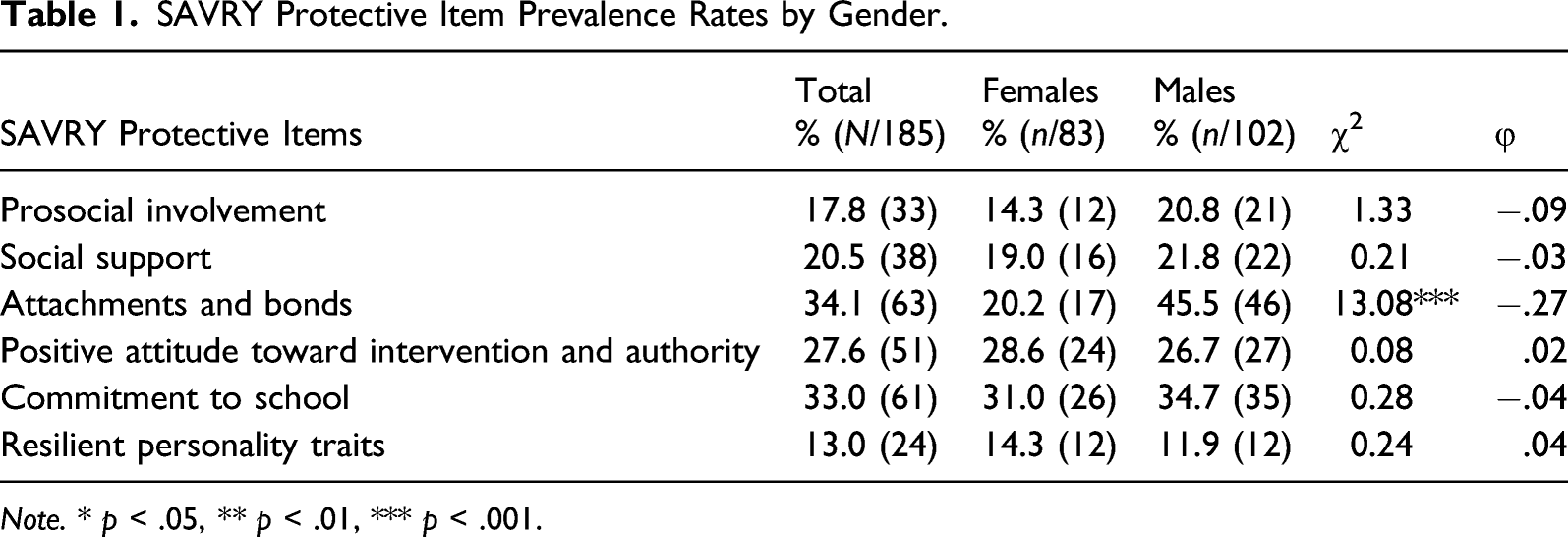
Prevalence of Protective Factors
SAVRY Protective Item Prevalence Rates by Gender.
Note. * p < .05, ** p < .01, *** p < .001.
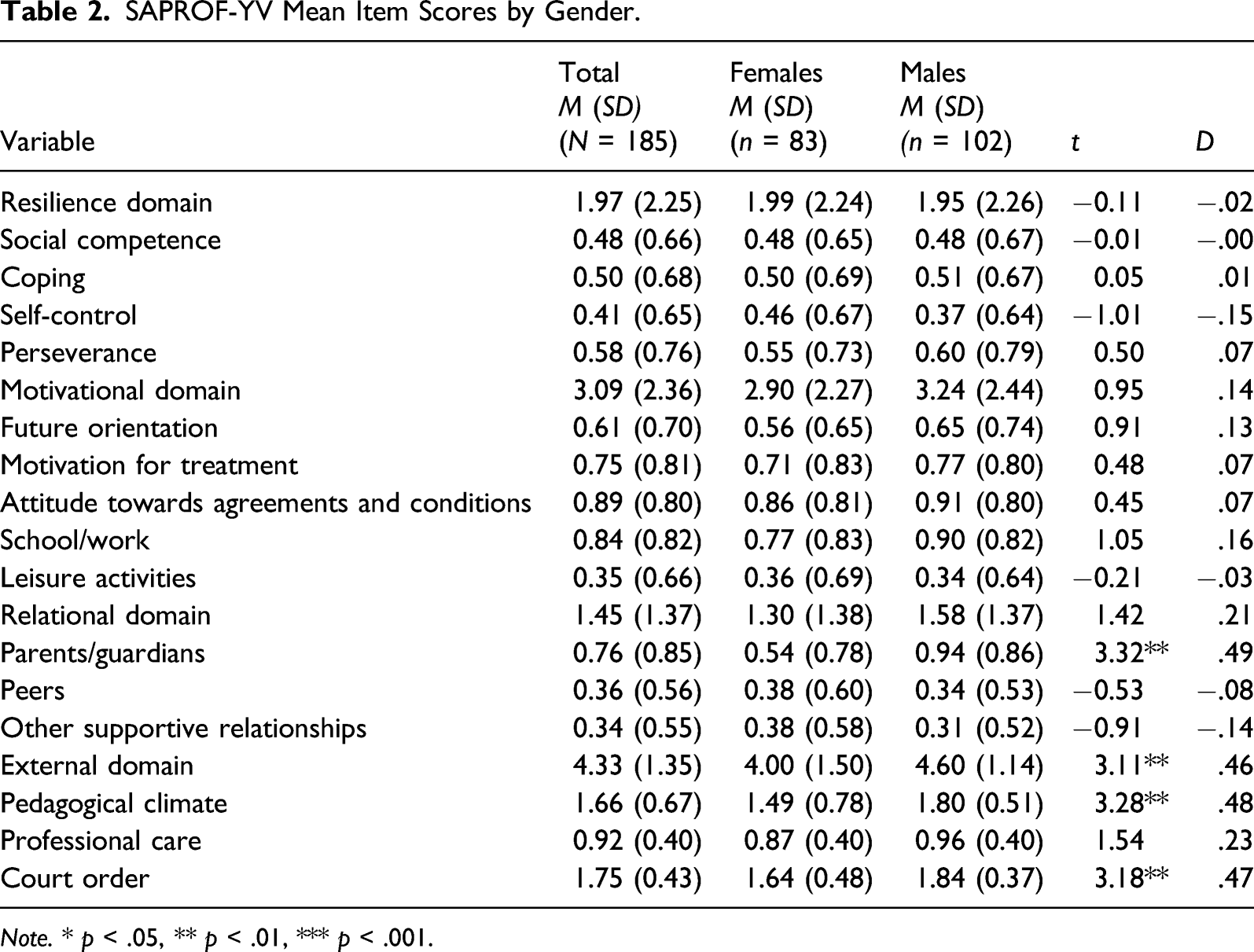
SAPROF-YV Mean Item Scores by Gender.
Note. * p < .05, ** p < .01, *** p < .001.
Predictive Validity
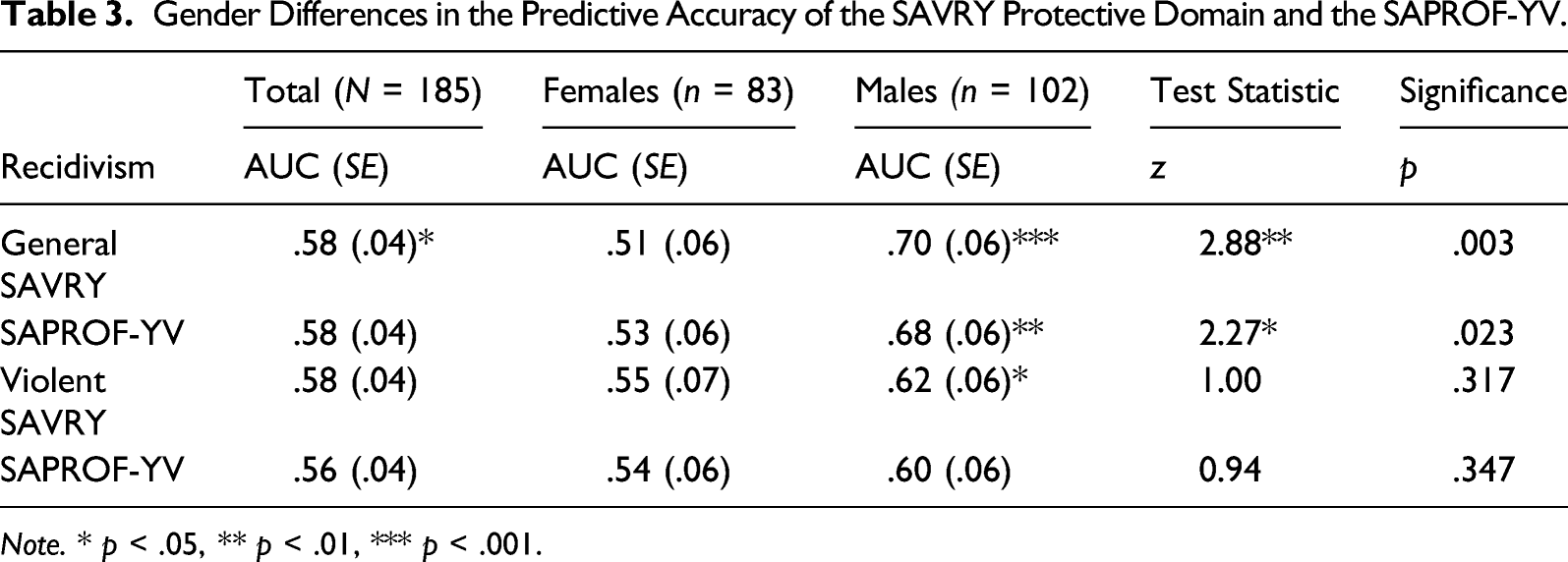
Gender Differences in the Predictive Accuracy of the SAVRY Protective Domain and the SAPROF-YV.
Note. * p < .05, ** p < .01, *** p < .001.
Generally, neither the SAVRY protective domain nor the SAPROF-YV performed as well in predicting violent recidivism. Small, non-significant effects were observed in the full sample for both the SAVRY protective domain (AUC = .58) and the SAPROF-YV (AUC = .56). Once the sample was split by gender, the SAVRY protective domain became a significant predictor of male violent recidivism, however this effect remained small (AUC = .62). No significant gender differences were observed in the efficacy of either the SAVRY protective domain or the SAPROF-YV in predicting violent recidivism.
When the sample was not split by gender, the SAVRY protective domain and the SAPROF-YV performed similarly. In the full sample, AUC values for general recidivism were identical between the SAVRY and the SAPROF-YV (AUC = .58), and only a negligible, non-significant difference was observed for violent recidivism (SAVRY AUC = .58, SAPROF-YV AUC = .56). Additionally, as seen in Table 3, only small differences (all non-significant) in the predictive accuracy of each tool were observed within genders.
Combining Strengths and Risks
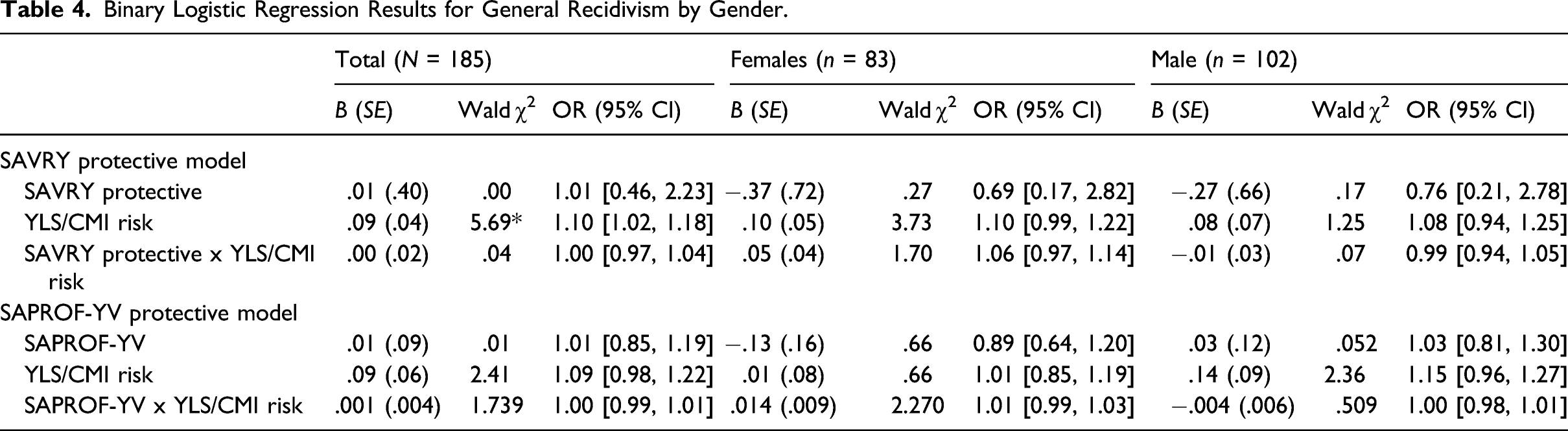
Binary Logistic Regression Results for General Recidivism by Gender.
Binary Logistic Regression Results for Violent Recidivism by Gender.
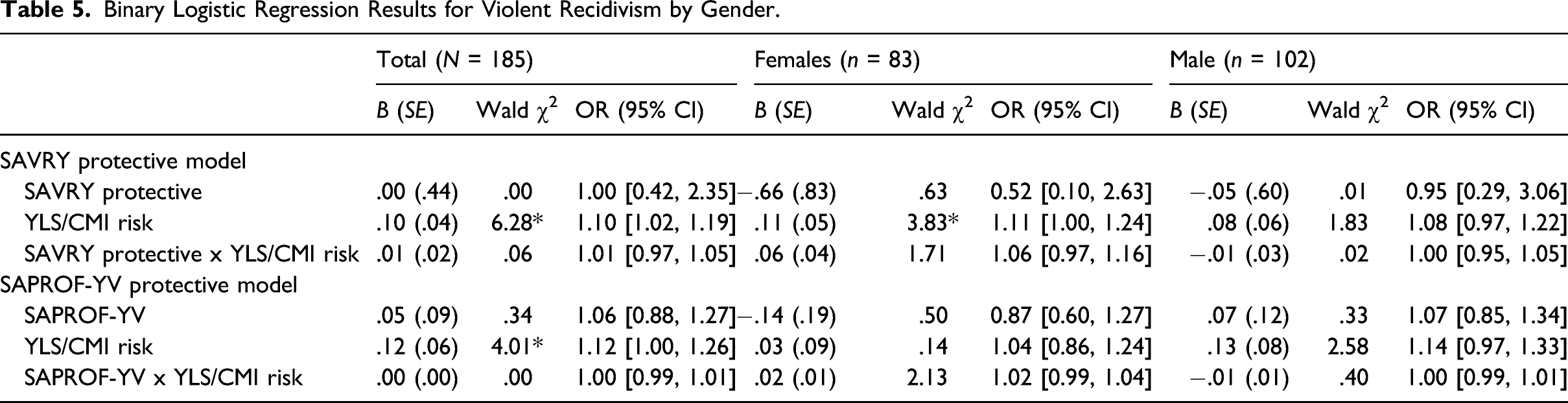
Notably, none of the interaction terms between strengths and risk, as measured by the YLS/CMI, were significant. Of the six models created to predict general recidivism, only one coefficient was found to be statistically significant: the YLS/CMI total risk score in the SAVRY model for the full sample (OR = 1.10, 95% CI [1.02, 1.18]). A similar pattern of results emerged in the models used to predict violent recidivism. In the full sample, the YLS/CMI risk score was a significant predictor in both the SAVRY protective model (OR = 1.10, 95% CI [1.02, 1.19]) and the SAPROF-YV model (OR = 1.12, 95% CI [1.00, 1.26]). Thus, as there were no significant main effects of strengths and none of the risk-strength interaction terms were statistically significant, our hypothesis remains unsubstantiated. Interestingly, neither the SAVRY protective domain nor the SAPROF-YV were significant predictors in these models where risks were accounted for by the YLS/CMI.
Discussion
Over the past several decades, gender responsive scholars have devoted a great deal of research to understanding gender differences in risk factors for antisocial and violent behavior (Salisbury & Van Voorhis, 2009; Scott & Brown, 2018). The parallel study of gender differences in strengths is only just beginning. The present study adds to the research base examining risk and strengths in justice-involved samples of male and female youth and importantly assessed the predictive accuracy of two measures of strengths designed to aid in the prediction of future violent behavior in justice-involved youth: the SAVRY protective domain, and the SAPROF-YV. Unique to this study was the large proportion of participants with a violent index offence (67%), which allowed us to evaluate how these strength measures performed in a sample of youth who had already engaged in violent behavior. The risk principle states that these higher-risk youth with violent histories are those who will benefit the most from intervention, and thus are important subjects to study (Bonta & Andrews, 2017). The goal of the present study was to address the gap in our understanding of the relationship between gender, strengths, and both violent and non-violent criminal behavior in justice-involved youth.
A consistent pattern of results emerged with both strength measures. As hypothesized, endorsements of strengths were low in both genders. Despite these low levels of strength, males exhibited more strengths than their female counterparts, both overall and at the item level. While effect sizes were small, some important differences were noted. Several studies have similarly found that, at the domain level, males exhibited more protective factors than females (e.g., Finseth et al., in press; Muir et al., 2020). In the present study, two of the items for which the gender difference was statistically significant were both related to the quality of familial support. This result is intriguing and may offer a partial explanation for the poorer predictive accuracy observed with female youth, as relationships are hypothesized to be particularly relevant to female crime and desistance (e.g., Petrillo, 2019). No prior studies with justice-involved youth have conducted item-level analyses of gender differences in either the SAVRY protective domain or the SAPROF-YV. While firm conclusions cannot be drawn on these results alone, it is evident that further research using larger samples is needed to tease apart these gender differences in the prevalence of strengths. However, the prevalence of strengths was not the only area in which gender differences were identified.
Our hypothesis that both tools would be better predictors of male versus female recidivism was largely supported. Both the SAVRY protective domain and the SAPROF-YV were good predictors of males’ general recidivism, however, neither was effective at predicting females’ general recidivism. This is consistent with the findings of previous studies, in which both the SAVRY and the SAPROF-YV have been found to be less effective in predicting female recidivism (e.g., Muir et al., 2020; Schmidt et al., 2011). Unfortunately, neither tool performed as well in predicting violent recidivism. The SAVRY protective domain was an effective predictor of violent recidivism in male youth only, with a smaller effect than that observed with general recidivism. These results are noteworthy, given that the SAVRY and SAPROF-YV are tools designed specifically to support the prediction of future violent behavior in justice-involved youth (Borum et al., 2006; de Vries Robbé et al., 2015). Several studies have found the SAVRY protective domain and the SAPROF-YV predict general recidivism more effectively than violent recidivism (e.g., de Ruigh et al., 2021; Muir et al., 2020), while others have found minimal differences in their predictive accuracy for general and violent recidivism (e.g., Kleeven et al., 2020; Shepherd et al., 2016).
Combined with the finding of lower prevalence of protective factors among female youth previously discussed, another important finding in this study is that strengths—as measured by the SAVRY and the SAPROF-YV—were not useful in predicting future justice-involvement among female youth. Two potential explanations for these results have been identified. First, it is possible that the strengths found in the SAVRY and SAPROF-YV do matter for girls, but that females in this sample had such relatively low levels of strengths, particularly in the area of familial support, that their impact was too small to be measured. As prior studies conducted with less violent samples have found similarly poor predictive accuracy for females, but good predictive accuracy for males—even in samples where males and females had similar strength scores (e.g., Kleeven et al., 2020; Schmidt et al., 2011)—this explanation may not be sufficient.
An alternative interpretation for these results is that the SAVRY protective domain and the SAPROF-YV, both tools developed with male samples, do not capture those strengths that are most relevant to justice-involved female youth, and thus may be insufficient as strength measures for female youth; therefore, some caution in using these measures with female youth is warranted. Feminist scholars have long advocated that the tools and practices used with justice-involved females should be tailored to their unique needs (e.g., Chesney-Lind, 1997). For example, some suggest that factors such as relationships with others, human capital, and parenting may be particularly important for women and girls (Belknap, 2015; Petrillo, 2019; Salisbury & Van Voorhis, 2009). Others discuss the importance of agency, autonomy, and self-efficacy in girls’ and women’s desistance from crime (Giordano et al., 2002; King, 2012; Petrillo, 2019). Future research must explore what strengths may be more important for female youth, without the sole reliance on prior research conducted with males. Armed with the results of such primary research, perhaps a new tool, built from the ground up for female youth, is warranted rather than continuing to try to adapt male-centric tools for use with females.
In keeping with our hypothesis, the SAVRY protective domain and the SAPROF-YV performed similarly in predicting general and violent recidivism. The presence of females in the full sample appears to have reduced the overall predictive accuracy of both tools, so that they were similarly poor predictors. However, even when results were disaggregated by gender, the differences in AUC values observed between the SAVRY protective domain and the SAPROF-YV remained negligible. Thus, contrary to what has been seen in some studies (e.g., de Ruigh et al., 2021; Finseth et al., in press), our results suggest the SAVRY protective domain is as effective at predicting recidivism as the SAPROF-YV.
Our final hypothesis was that both measures of protective factors would add incrementally to the prediction of recidivism, even once risk had been accounted for (Kleeven et al., 2020). This hypothesis was not supported. Indeed, while all omnibus results were significant, the stand-alone strength coefficients and the risk-strength interaction terms in all twelve regression models were non-significant predictors. These results suggest that SAVRY and SAPROF-YV strengths are not protective, in that they do not moderate the impact of risk factors on future justice-involvement. Instead, these factors may be described as promotive (i.e., negatively correlated with recidivism), at least among male youth where strengths were found to be directly related to future justice-involvement. However, given our small sample size, further diminished when results are disaggregated by gender, it is possible that interaction effects simply could not be detected. Taken in combination with the findings of other studies with similar (e.g., Dickens & O’Shea, 2018) and contrasting results (e.g., Chu et al., 2020; Lodewijks et al., 2010), the only firm conclusion that may be drawn at this time is that further investigation is needed to understand the relationship between risks, strengths, and criminal behavior.
While the results of the present study offer valuable insights for shaping future research and practice with justice-involved youth, several limitations are worthy of consideration. First, the retrospective coding of strengths from interviews based on other risk assessment tools does represent a limitation, albeit one that is common to studies of relatively new measures (e.g., Schmidt et al., 2011). Second, while the unusually high rate of violent criminal histories in the present sample allowed us to give attention to a relatively under-studied population, this also limits the generalizability of results to other, similarly moderate-to high-risk youth. Additionally, our sample of female youth, while large in comparison to many studies, was still small for some of our analyses, particularly for analyses where the sample was disaggregated by gender. Unfortunately, small samples are typical of studies of justice-involved youth, and samples of justice-involved female youth tend to be particularly small (e.g., Schmidt et al., 2011). The results of post-hoc power analyses indicated that all models had acceptable power, suggesting that our small sample did not have a significant impact on the validity of our results.
Finally, with respect to limitations that impact this study, but also the field generally, it is important to highlight that the way information about sex and gender are collected and operationalized must be adjusted in future research. While trans and non-binary individuals account for a small portion of the general population, what little research is available suggests that these individuals may become justice-involved at a higher rate than cis-gendered people, and that their pathways to justice-involvement may be best understood through a feminist criminological lens (e.g., Rogers & Rogers, 2021). It is inappropriate to continue discussions of gender responsive assessment or treatment without providing participants in these studies the opportunity to self-identify or giving attention to the unique experience of those who exist outside of the gender binary in our justice system.
Conclusion
This study is among the first to examine gender differences in the prevalence and predictive validity of strength factors in justice-involved youth, with particular attention to the relevance of strengths in predicting future violent behavior. The extant literature suggests that existing tools do not adequately capture the strengths of female youth, particularly those youth who engage in serious, violent offending behavior (e.g., Muir et al., 2020). Our current risk assessment tools appear to perform poorly with female youth, at least in part because they over-predict future violent behavior (i.e., many female youth assessed as high risk do not re-offend). It is logical to conclude that some individual or environmental factors must contribute to their desistance; these factors simply may not be captured by existing strength assessment tools. A theoretical approach may help identify those strengths that may have a more direct impact on recidivism.
Many commonly applied criminological theories of risk assessment and intervention emphasize the importance of strengths and protective factors as a means to build positive relationships with clients and to support case management (e.g., General Personality and Cognitive Social Learning Theory, Bonta & Andrews, 2017; the Good Lives Model, Barnao et al., 2016). However, these theories do not suggest that strengths should be considered to enhance the prediction of recidivism. Instead, we must turn to the desistance literature for a theoretical perspective on the relationship between strengths and recidivism. Theories of desistance have evolved considerably over the past 20 years, building on the concepts of informal social control (Sampson and Laub, 2001) and cognitive transformation (Giordano et al., 2002). The social support theory of desistance synthesizes these concepts into an overarching approach which conceptualizes desistance as a process of behavioral change which is facilitated by the formation of prosocial bonds with others (Chouhy et al., 2020). In their systematic review of the literature, Rodermond et al. (2016) found support for the influence of many factors subsumed within social support theory. Many of the factors reviewed were similarly important for males and females, though several, such as having children and supportive relationships, were more important for females’ than males’ desistance from crime. It would be beneficial for future strengths assessment research to integrate the theoretical perspectives and findings of the desistance literature.
Larger samples, and samples with greater diversity in risk level, may allow future studies to clarify the observed pattern wherein female youth appear to have fewer strengths than their male counterparts. Furthermore, as the strengths measured in both the SAVRY and SAPROF-YV appear unrelated to future justice-involvement in female youth, prospective and exploratory research is needed to determine what strengths—if any—are protective against future violent or criminal behavior in females. While this study focused on the utility of protective factors in predicting recidivism, identifying female-specific protective factors is important for more than prediction. Protective factors may be an essential starting place for intervention and treatment planning and building motivation for change in justice-involved clients (Bonta & Andrews, 2017; de Vries Robbé & Willis, 2017; Ward, 2002). This study highlights the divergent patterns of justice-involvement of male and female youth, and the importance of taking gender into consideration in the process of conducting risk and strength assessments.
Footnotes
Declaration of Conflicting Interests
The author(s) declared no potential conflicts of interest with respect to the research, authorship, and/or publication of this article.
Funding
The author(s) received no financial support for the research, authorship, and/or publication of this article.
