




Abstract
Teachers of young children with moderate to significant support needs may have insufficient training to implement naturalistic instructional practices such as contingent responding. Naturalistic instructional practices are well researched, but limited studies exist on training teachers to use contingent responses to support children increasing child-initiated social participation behaviors during centers. We used a multiple baseline design across four special education teachers to measure the effects of a training package incorporating behavior skills training (BST) and emailed performance feedback (EPF) on increasing teachers’ contingent responses to children with limited child-initiated social participation behaviors during centers. Results indicate that BST with a checklist and EPF with graphs increased the four teachers’ percentage of contingent responses, and similar levels were observed during maintenance probes. Programming common stimuli during BST resulted in all teachers providing contingent responses to at least one other child in their classroom who had few child-initiated social participation behaviors.
Keywords
Social participation behaviors are an important aspect of early childhood education because these skills are associated with children’s learning in other domains, which enhances success in school and later in life (National Association for the Education of Young Children [NAEYC], 2009; Noonan & McCormick, 2014; Sandall & Schwartz, 2008). Social participation behaviors are defined as behaviors used to communicate and interact with one another through a variety of modalities, both verbally and nonverbally, through gestures and body language (Noonan & McCormick, 2017), and include skills such as requesting, rejecting, sharing, turn-taking, greeting, and maintaining interactions (Drasgow et al., 2008; Noonan & McCormick, 2017). Social participation behaviors are predictors of future learning, occur within natural environments, and increase inclusion opportunities for children (Odom et al., 2011). Children with a range of social participation behaviors are empowered by their independence to make choices, develop friendships, and navigate their settings. Children with limited social participation behaviors are less likely to engage in the same frequency of these behaviors when compared with their peers (Beirne-Smith et al., 2006; Brown et al., 2016).
Evidence-Based Practices and Contingent Responding
Fortunately, the literature on evidence-based interventions for young children with limited social participation behaviors, including those with autism, has grown significantly in recent years. Hume et al.’s (2021) systematic review identified 28 focused evidence-based practices (EBPs) that may be effective for increasing the frequency of their already existing social participation behaviors. These EBPs include naturalistic instruction, prompting, and reinforcement (Hume et al., 2021). However, despite progress in identifying EBPs, research suggests that teachers may have limited knowledge of EBPs (Morin et al., 2021), feel unprepared to implement EBPs (Hamrick et al., 2021), and infrequently use EBPs in practice (Brock et al., 2020). For example, Brock et al. (2014) found that 45% of over 450 school professionals working with students with autism were not at all, a little, or only somewhat confident implementing reinforcement, which is a critical intervention for increasing target behaviors.
There are several potential barriers to teachers’ use of reinforcement for young children with moderate to significant support needs. First, teachers may be unaware of the influence children have over their own teaching behavior (Rathel et al., 2008). For example, the teacher may respond to a child’s inappropriate behavior during child-directed center activities (e.g., standing on a table) by coming over to lift him off the table while inadvertently providing tickles and hugs (i.e., potential reinforcer). The cessation of the child’s challenging behavior may also reinforce the teachers’ behavior (i.e., negative reinforcement). If the child continues the behavior in the future, the teacher’s response reinforced the child’s inappropriate behavior. Second, teachers may not systematically identify potential reinforcers for each child (Rapp et al., 2010; Sautter et al., 2008). For example, one child may prefer physical contact (e.g., hugs, tickles, high fives, and sitting in the adult’s lap), whereas another may prefer verbal language (i.e., praise). Third, teachers may inadvertently delay delivery of reinforcers for social participation behaviors (Cooper et al., 2020). Finally, teachers with limited planning time may not prioritize systematically preparing individualized reinforcement contingencies to support social participation behaviors during natural routines (DeLeon et al., 2013; Strain et al., 2011).
One naturalistic instructional strategy that teachers can implement is contingent responding. Contingent responding is an instructional strategy that can be conducted during unstructured activities when the child shows motivation with materials, activities, or other children. The child’s initiation serves as a motivational opportunity for the teacher to prompt, shape, or expand a child’s social skill (Sigafoos et al., 2007). Contingent responding is a procedure where an adult provides consistent feedback to a child when he or she engages in an act that has some social or communicative potential (Sigafoos et al., 2007). The feedback should be a potential reinforcer for the child and needs to occur within seconds of the child performing the behavior. The teacher’s response must be immediate to develop a contingent relationship between the child’s behavior and the teacher’s response (Cooper et al., 2020; Dunst et al., 2008). By delaying reinforcement, teachers may unintentionally increase undesired behavior emitted by the child immediately before reinforcer delivery. For example, a child may have matched a puzzle piece and then started biting her hand. Then the teacher rubs the child’s back. If the back rub was a reinforcer for the child, this may result in the future frequency of hand biting increasing instead of puzzle matching skills. Instead, when the child matched a puzzle piece the teacher should immediately provide a back rub, which is a contingent response, and if the contingent response is a reinforcer, then the child’s puzzle matching would increase in the future.
Training Teachers to Use Evidence-Based Practices
One way to increase teachers’ contingent responses to child-initiated social participation behaviors is the use of a brief training, such as behavior skills training (BST), with follow-up performance feedback. BST is an effective instructional strategy that has been used within the special education training literature (DiGennaro Reed et al., 2018; Miltenberger, 2008) and includes the following components: (a) instruction, (b) modeling, (c) rehearsal, and (d) feedback. Researchers have also embedded components including (a) checklists (Oliver et al., 2015), (b) flowcharts (Graff & Karsten, 2012), and (c) graphs (Rathel et al., 2014) within BST. Following initial training, researchers have found that providing ongoing performance feedback (PF), or information specific to teacher implementation based on data from an observation, can increase teachers’ procedural fidelity of instructional strategies (DiGennaro et al., 2007; Hemmeter et al., 2015). However, in many studies, PF has been delivered daily or weekly, during individual, in-person meetings (Fallon et al., 2015). The resources required to deliver PF in this manner may be prohibitive for many schools (Barton et al., 2013; Fallon et al., 2015).
Emailed performance feedback (EPF) is one effective option to reduce both teacher and trainer time requirements (Hemmeter et al., 2011, 2015; Krick Oborn & Johnson, 2015; Rathel et al., 2008, 2014); and may alone effectively increase teacher fidelity of implementation for some intervention strategies without additional follow-up coaching (Barton et al., 2013). Researchers have found that emailing graphs of the teachers’ performance during observations has been effective at increasing fidelity outcomes (Barton et al., 2013; Hall et al., 2010; Rathel et al., 2014). Some researchers require the teachers’ response to comprehension probes to assess whether the teachers read the email (Krick Oborn & Johnson, 2015), but this places another responsibility on teachers with already limited time. Potential solutions to reduce the burden on teachers may be to embed the graphs of a teacher’s performance into the email so that they do not have to open an attachment and require only a low-effort response, such as confirming receipt of the email. Likewise, teachers’ perspectives of EPF have been solicited through a social validity survey in only one out of the five studies (Hemmeter et al., 2011); therefore, additional evidence is needed to determine teachers’ preference for this PF format.
A limited number of studies have focused on whether training teachers to use an instructional strategy geared toward a specific child’s strengths and needs would generalize to other children with the same instructional needs (Mouzakitis et al., 2015). Children with limited social participation behaviors may have different communication modalities and preferences just as all children have different preferences and preferred communications. Therefore, training a teacher on one child’s specific communication attempts along with the child’s individualized preferences may not result in the teacher’s behavior generalizing to other children.
We investigated the use of BST and EPF to teach teachers to use contingent responding for at least one child’s self-initiated social participation behaviors. We also evaluated the effect of the training on the child’s self-initiated social participation behaviors and determined if the teachers generalized their learning to children with similar needs. Our specific research questions included the following: (a) Does a performance feedback training package consisting of BST, a checklist, and EPF with graphs increase teachers’ contingent responding on a child’s self-initiated social participation behaviors during centers?; (b) Do teachers maintain their contingent responding to child-initiated social participation behaviors after they reach mastery criterion for six consecutive days?; (c) Does teachers’ contingent responding to child-initiated social participation behaviors increase the frequency of child-initiated social participation behaviors?; (d) Do teachers generalize contingent responding learned from a performance feedback training package to other children with few child-initiated social participation behaviors?; (e) Do teachers believe the training and the intervention to contingently respond to child-initiated social participation behaviors is feasible, acceptable, and effective?
Methods
Teacher Participants
Criteria for teacher selection included the following: (a) having a teaching certificate aligned to the state’s certification board, (b) employed as the lead classroom teacher, (c) teaching at least three children with moderate to significant support needs between 3 and 8 years old, and (d) teaching in a self-contained classroom with a schedule that included centers, which consisted of free access to materials without direct instruction from the adults. We selected four teachers from two schools who did not plan instruction or have a common lunch hour with each other to prevent treatment diffusion. All teachers taught in a self-contained classroom, had similar materials available during centers, and had children who required the same amount of support.
Ms. Yelton was a 29-year-old White female who taught in a self-contained preschool classroom that served seven students with a range of moderate to significant support needs. She had worked in her current classroom for 4 years and taught young children with disabilities for 6 years. She had an undergraduate degree in elementary education and a graduate degree in early childhood education. In the state where the study occurred, the teacher was required to have only an early childhood certificate to teach children ages 3 to 8 with moderate to significant support needs. Ms. Melillo was a 28-year-old White female who taught in a kindergarten through fourth grade self-contained classroom that served eight students with moderate to significant support needs. She had worked in her current classroom for 4.5 years and was in her fifth year of teaching. She had a Bachelor of Arts in special education. Ms. Senn was a 31-year-old White female who taught in a kindergarten through second grade classroom that served 12 students with moderate to significant support needs. She had worked in her current classroom for 3 years. She had a bachelor of arts degree in special education. Ms. Kelly was a 37-year-old White female who taught in a preschool classroom that served eight students with a range of developmental delays and moderate to significant support needs. She had worked in her current classroom for less than 1 year, but she had 14 years of teaching experience. She had a bachelor of arts degree in early childhood education and a graduate degree in special education.
Child Participants
We included children who (a) were 3 to 8 years old, (b) the school psychologist reported that the child had moderate to significant support needs and/or Individualized Education Program (IEP) category was an intellectual disability in the moderate to severe range, and (c) had 4–10 independent child-initiated social participation behaviors during 20-min pre-baseline observation periods occurring over 2 months. We included children from 3 to 8 years because those children had the same access to centers, similar learning social goals, and required moderate to significant supports during play. We identified 4 to 10 social participation behaviors in a 20-min observation period as an appropriate inclusion criterion based on interviews with current teachers and observations of same-aged peers. First, to identify social participation behaviors that were functional within the context of centers, we interviewed current teachers, who identified the behaviors they wanted children to engage in during centers. Then, the primary researcher observed same-aged peers’ frequency of self-initiated social participation behaviors in the general education classroom. Peers emitted over 100 social participation behaviors within a 20-min center. Therefore, we determined that children with 4 to 10 social participation behaviors during that same time period may benefit from contingent teacher responding.
Children were excluded if they did not have any child-initiated social participation behaviors or had behavior intervention plans. Children were selected through researcher observations and teacher nominations (see the pre-baseline section). The selected children were randomly assigned to be a target child or a generalization child.
Target Children
Sammy was a 4-year-old Black male with autism. He was nonspeaking and sometimes used one picture to request a preferred item. Sammy was observed to push a car during centers. John was a 7-year-old White male with an intellectual disability. He was nonspeaking and inconsistently used an iPad app with one picture to request a preferred item. In terms of play skills, John stacked some blocks on occasion. Dalton was a 7-year-old White male with an intellectual disability. He was nonspeaking and sometimes used gestures or proximity to a peer to obtain peer or adult attention. In terms of social interaction skills, Dalton walked over to peers. Maya was a 4-year-old Black female with autism. She utilized between 20 and 30 words; most of her language was echolalic. She rarely used her language to request or label. She sometimes picked up balls during centers.
Generalization Children
The first group of generalization children is described, respectively. Evie was a 4-year-old White female with autism. She utilized between 30 and 40 words; most of her language was echolalic. She rarely used her language to request or label. During play, she was observed giving items to a peer. Larry was a 6-year-old White male with an intellectual disability. He used approximately 20 words, and inconsistently used words to obtain functional wants and needs. He was observed to walk and pick up objects during centers. Jaden was a 6-year-old Black male with an intellectual disability. He used approximately 40 to 50 words; most of his language was echolalia. He was observed to take items out of a bucket. Marcus was a 4-year-old Black male with a developmental delay. He was nonspeaking, inconsistently used gestures to request preferred items. He picked up items during centers.
The second group of generalization children are described as follows. Kejuan was a 4-year-old Black male with a developmental delay. He had a range of 40 to 50 words; most of his language was echolalic as he sometimes used his language to request or label. He put items in a doll house during centers. Mills was an 8-year-old White male who had an intellectual disability. He used fewer than 20 words to request. During centers, he took items from others. Nieko was a 6-year-old Black male with an intellectual disability. He used over 50 words communicate, inconsistently used language to request, and picked up dolls during centers. Tommy was a 4-year-old White male with autism. He used over 50 words communicate, inconsistently used language to request. He did on occasion label items and hold up to a peer during centers.
Setting
Each classroom consisted of a certified teacher and one to two paraprofessionals with a range of six to 14 children with disabilities. The classrooms included a variety of defined learning spaces (e.g., centers, small group, large group, and snack). Each classroom had an area for centers that included low shelving where children had access to various child-friendly materials (e.g., puzzles, blocks, games, and trains).
Dependent Variables and Recording Procedures
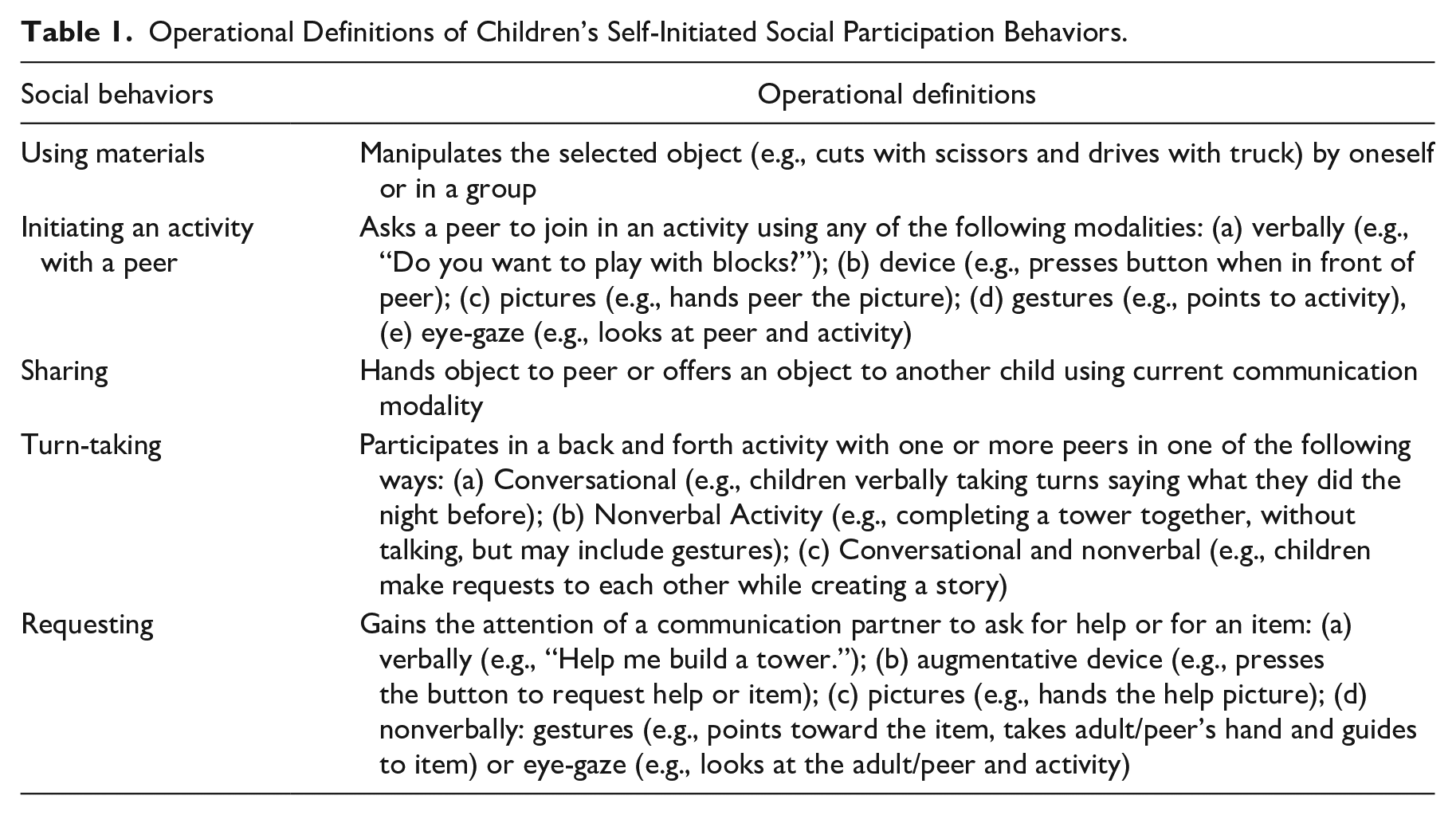
Our study had two dependent variables: (a) teacher responses and (b) child-initiated social participation behaviors. Teacher responses were classified into three categories: contingent, noncontingent, or missed opportunity, based on each teacher’s response to the target and generalization children’s child-initiated social participation behaviors. A contingent response was defined as (a) providing praise or physical contact during or within 3 s of the child’s self-initiated social participation behaviors, or (b) providing requested item or help during or within 3 s of the child’s request. A noncontingent response was defined as providing praise, physical contact, item, or help either (a) 4 s after the child’s self-initiated social participation behaviors or (b) in the absence of the child’s self-initiated social participation behaviors. A missed opportunity was defined as when the teacher was out of sight, or ignored or rejected (i.e., said “no”) the child’s self-initiated social participation behaviors. Child self-initiated social participation behaviors were defined as the child spontaneously initiating any of five social participation behaviors during naturally occurring routine observation. See Table 1 for operational definitions of child-initiated social participation behaviors.
Operational Definitions of Children’s Self-Initiated Social Participation Behaviors.
Teacher Responses
We used response-per-opportunity recording to determine the percentage of contingent teacher responses to child-initiated social participation behaviors for teacher responses. Teacher responses were dependent on child-initiated social participation behaviors; therefore, for each observed child-initiated social participation behavior, the researcher counted the approximate number of seconds from the end of the child’s behavior to the teacher’s response and classified it as contingent (within 3 s), noncontingent, or a missed opportunity. We calculated the percent of teacher contingent responses by dividing the total number of teacher contingent responses by the total number of child-initiated social participation behaviors and multiplied by 100.
Child-Initiated Social Participation Behaviors
We used event recording (i.e., frequency) for child-initiated social participation behaviors. Child behavior was a secondary area of interest in our study, and their data were collected along with the teacher responses. Data on each child’s self-initiated social participation behaviors were collected to determine whether or not the child’s self-initiated social participation behaviors increased in frequency as a result of the teacher’s immediate contingent response.
Experimental Design
We employed a concurrent multiple baseline design (Kazdin, 2011) across four teachers to assess changes in teacher behavior and identify any functional relations between the independent and dependent variables in our study. Three experimental conditions were included the following: baseline, BST and EPF, and maintenance. The first participant entered intervention when all participants’ contingent responding had a flat trend with little variability for a minimum of 5 days. We randomly selected the first participant to enter intervention. When the first participant demonstrated a visually apparent change in contingent responding, and the remaining three participants’ baseline data were stable, we randomly selected a second participant to begin intervention. We followed the same procedures for determining when to introduce the intervention with the third and fourth participants. For teacher contingent responses to the generalization children, the design was identical to the teacher responses to her target child, except that the teacher was not trained on or certain of who the generalization children were.
Procedures
Pre-Baseline Procedures
The researcher observed teacher and child behavior during each teacher’s center-time for 2 months prior to beginning the study. The secondary observer also observed multiple times during this period to reduce the likelihood of reactivity to the presence of additional people.
Child Selection
Children were selected for participation in the study through a multi-step process. First, the researcher attended each classroom and informally collected data on the number of times each child emitted a social participation behavior, and then requested the teachers nominate children who they believed would benefit from increasing self-initiated social participation behaviors. Each teacher nominated four to six children. The primary researcher then identified three children who met all inclusion criteria. Then the researcher randomly assigned each child to be either the target child, who the teacher received specific instruction on during BST and EPF, or one of two generalization children, who the teacher did not receive specific instruction on, but on whom the researcher collected data to determine if the teachers generalized their learning from the training. All teachers nominated at least four children, and knew the identity of the target child, so they knew that two of the remaining three to five nominated children were the generalization children, but we did not disclose the identity of the generalization children.
Recording Potential Reinforcers
The researcher recorded the frequency and type of behaviors the target children displayed, both appropriate and inappropriate, and teacher responses. If the child emitted the behavior during current and future observations after the teacher’s response to that behavior, the researcher recorded the teacher’s response as a potential reinforcer (e.g., vocal praise, physical contact, and providing item or action requested). If the child approached or requested items, activities, or help, the child’s communicative modality was recorded.
Baseline
Baseline occurred during typical classroom center time and entailed recording the teacher’s response to the occurrence of each child’s self-initiated social participation behaviors and categorizing whether it was contingent or noncontingent. Teacher and child observations occurred simultaneously, as the teacher behavior was dependent on the child-initiated behaviors. During baseline, researchers were positioned on the corners of the rooms. The researchers did not respond to a child if they approached them during observation and did not interact with the teacher about the study, target behaviors, or intervention in any way (i.e., in-person or via email).
Intervention: BST and EPF
The intervention consisted of two separate components: BST and EPF. BST focused on training the teacher to contingently respond to her target child and consisted of one 30-min session without children present. We programmed common stimuli (Stokes & Baer, 1977) by conducting BST in the teacher’s classroom with everyday materials found in centers.
During Instruction, the researcher provided the teacher with written and verbal instructions for how to use the one-page two-sided checklist and flowchart. The checklist included the operational definitions of child-initiated social participation behaviors, and the flowchart directed the teacher to the type of contingent response she should provide with a place to personalize the child’s communicative responses. When reviewing the operational definitions side of the checklist, the researcher provided time to discuss additional examples of the target child’s self-initiated social participation behaviors. Then, the researcher explained side two, a flowchart to prompt the teacher to select an appropriate response within 3 s of her target child’s self-initiated social participation behaviors. For the requesting behavior, the researcher explained that the teacher should provide the requested item but could also deliver praise or physical contact. The teacher was provided additional blank copies of the checklist and flowchart.
Next, the researcher Modeled how to use the checklist and flowchart while the teacher played the child’s role. The third component was Rehearsal with a graph of the teacher and child’s performance during baseline. First, the researcher showed the teacher the graph of her contingent responses and the frequency of her target child’s self-initiated social participation behaviors in baseline. They discussed the results and the goal of reaching 50% contingent responses to the target child’s self-initiated social participation behaviors. The researcher explained that 50% was selected as the goal because it would be difficult to reinforce every response in a classroom setting, and children also need to learn that sometimes their requests are not reinforced. Next, the researcher played the child’s role by demonstrating each of the child’s self-initiated social participation behaviors interspersed with other behaviors. If the teacher did not provide an appropriate contingent response within 3 s, then she was prompted to look at the operational definitions on her checklist. If she delivered an incorrect potential reinforcer, then she was prompted to review the flowchart to select an appropriate response. The rehearsal procedures were repeated for each of the child-initiated social participation behaviors until the teacher demonstrated two correct contingent responses for all five social participation behaviors.
The final training component was Feedback, which occurred during and following the rehearsal portion of BST. The researcher and teacher discussed what the teacher did well and areas for improvement. Then the researcher explained that following her observations before 8:00 p.m. on the same day, she would provide EPF with graphs and explained the teacher should reply to her email to confirm her receipt and or ask questions.
EPF began after the teacher training and after each observation during intervention. EPF included the following: (a) embedded graphs with percentage of teacher-contingent responses and number of the target child’s-initiated social participation behaviors, (b) a greeting, (c) positive comment, (d) corrective feedback, (e) opportunity to ask questions, and (f) closing. The teachers were required to send an email prior to the next observation to verify they received the performance feedback. EPF continued until the teacher reached 50% criteria for six consecutive days. Once the teacher met the mastery criterion, she received an email that included (a) a graph, (b) greeting, (c) congratulations, (d) a statement stating the researcher would be back, but no specific timeline was provided, (e) the social validity survey link, and (f) a closing.
Maintenance
Maintenance began the day following the sixth consecutive day at or above 50% contingent responses. During maintenance, the researcher collected data, but did not provide EPF or graphs of teacher performance or interact with the teacher about the study, target behaviors, or intervention in any way (i.e., not in-person and not by email). Maintenance occurred five school days following the mastery criterion, and then 10 school days following the first maintenance check.
Inter-Observer Agreement
A clinical assistant professor at a local university collected inter-observer agreement (IOA) data. IOA training consisted of virtual and in-vivo training formats. During virtual training, both observers reviewed a series of videos that included children with the same selection criteria (i.e., not study participants) and classroom design. Both observers used the operational definitions to record teacher responses and children’s behaviors and the virtual training was complete once we reached 90% agreement on occurrence of behaviors for three consecutive video observations.
The researcher recorded teacher responses using a per-opportunity measure and child behavior using a frequency measure during a 20-min center time. We recorded responses in 10, 2-min intervals for the purpose of calculating IOA. The researcher recorded teacher responses to all three children’s self-initiated social participation behaviors simultaneously. If the teacher or target child was not present, data were not recorded that day. However, if a generalization child was absent, the researcher collected data.
Following the training, IOA was recorded in-vivo. During baseline, intervention, and maintenance, IOA was calculated using the frequency within interval method described by Barton et al. (2013). Within each 2-min interval, we counted the number of teacher (or child) behaviors recorded by the first observer and the number of teacher (or child) behaviors recorded by the second observer and divided the smaller number by the larger number and multiplied by 100 for the interval. To obtain IOA for an observation, we took the average of the IOAs for all intervals for that observation. This method has similar limitations as frequency ratio IOA, but has the advantage of limiting the comparison period to intervals to get a slightly more precise measure of IOA (though not as precise as if we had time stamps).
Teacher Responses to Target Children
IOA for Ms. Yelton’s teacher responses during baseline was 100%, during intervention was 98%, and during maintenance was 97%. Ms. Melillo’s IOA was 90% during baseline, 97% during intervention, and 97% during maintenance. Ms. Senn’s IOA was 88% during baseline, 96% during intervention, and 90% during maintenance. Ms. Kelly’s IOA 91% during baseline, 96% during intervention, and 94% during maintenance.
Target Children’s Self-Initiated Social Participation Behaviors
IOA for Sammy’s self-initiated social participation behaviors during baseline was 100%, during intervention was 96%, and during maintenance was 89%. John’s IOA was 90% during baseline, 97% during intervention, and 100% during maintenance. Dalton’s IOA was 88% during baseline, 96% during intervention, and 93% during maintenance. Maya’s IOA 91% during baseline, 98% during intervention, and 97% during maintenance.
Generalization
IOA for teacher responses to generalization children was similar to IOA for teacher responses to the target children. IOA for Ms. Yelton ranged from 83% to 93% across phases, IOA for Ms. Melillo ranged from 91% to 100% across phases, IOA for Ms. Senn ranged from 90% to 97% across phases, and IOA for Ms. Kelly ranged from 87% to 94% across phases.
IOA for the generalization children’s self-initiated social participation behaviors was similar to IOA for the target children. IOA for generalization children ranged from 85% to 100% in baseline, 87% to 100% during intervention, and 91% to 100% during maintenance. Full IOA results for generalization data are available from the first author.
Treatment Fidelity of BST and EPF
BST fidelity checks were conducted remotely by the secondary observer for all four BST sessions. Prior to the initial training, video consent was received for each teacher. The researcher trained the teacher in-person and recorded each training. Procedural fidelity was conducted using a task analysis and all four BST sessions were implemented with 100% fidelity.
The observer used the EPF checklist to ascertain if the researcher included all components by reviewing the email correspondence: (a) initial email components, (b) teacher receipt, and (c) teacher questions with the researcher’s response by the next observation. All initial email components for each teacher were at 100% and each time a teacher asked a question in her emailed receipt, the researcher responded to her question prior to the next observation.
Teacher Social Validity Questionnaire and Feedback
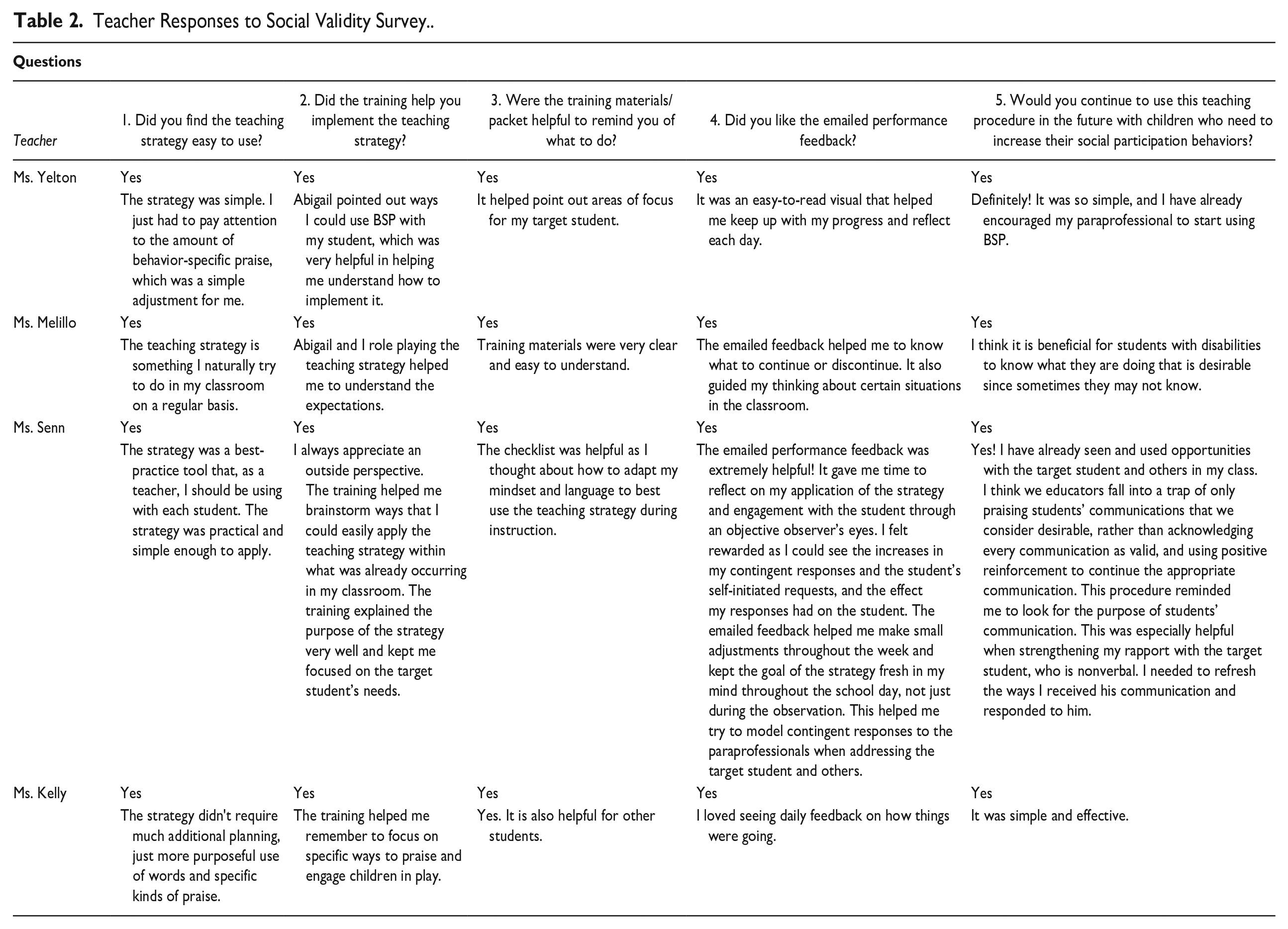
At the conclusion of the intervention, the teachers were given an online survey with yes/no response options and comment boxes to assess social validity. Questions were related to the following components: (a) ease of use, (b) helpfulness of BST, (c) use of training materials, (d) satisfaction with EPF, and (e) need and continued use of intervention.
Results
We used Kratochwill et al.’s (2010) standards to analyze the level, trend, variability, overlap, and immediacy of the effect of BST and EPF.
Teacher Contingent Responding
Figure 1 presents teacher contingent responses to the target child’s self-initiated social participation behaviors. Ms. Yelton displayed a low level of contingent responding at around 10% during baseline with a flat trend and low variability. When the intervention was introduced, there was an immediate increase in Ms. Yelton’s contingent responding with an increasing trend during intervention, an overall level around 50%, and no overlap between baseline and intervention. The other participants’ contingent responding during baseline remained stable or decreased after the intervention was introduced with Ms. Yelton, providing evidence of a basic effect. Similarly, Ms. Melillo’s baseline contingent responding was low with some variability and an overall flat trend. Upon introducing the intervention, her data showed a large immediate level change, an increasing trend during the intervention phase, with an overall level around 60% and no overlap between baseline and intervention. The remaining participants’ data remained low and stable during baseline. This is evidence of a second basic effect. Ms. Senn’s baseline contingent responding was at 0% during baseline for all but 1 day, with no variability and a flat trend. She also demonstrated an immediate increase in the level of her contingent responding when the intervention was introduced, and continued improving with an increasing trend throughout the intervention phase, with her last 5 days of intervention at 50% contingent responses, and minimal overlap between baseline and intervention. Ms. Kelly, who was still in baseline, showed a small increase during baseline after session 11 when the intervention was introduced with Ms. Senn, but this increase was in the range of her previous performance and her contingent responding decreased during the last session of baseline. Thus, Ms. Senn’s data provide evidence of a third basic effect. Finally, Ms. Kelly’s baseline data were relatively stable with a level of around 10% and a flat trend. Her data also show a large and immediate increase in level following the intervention, with an overall level of around 60% contingent responding and no overlap between baseline and intervention. Her data provide evidence of a fourth basic effect, supporting the documentation of a functional relation between BST+EPF and teacher contingent responding.
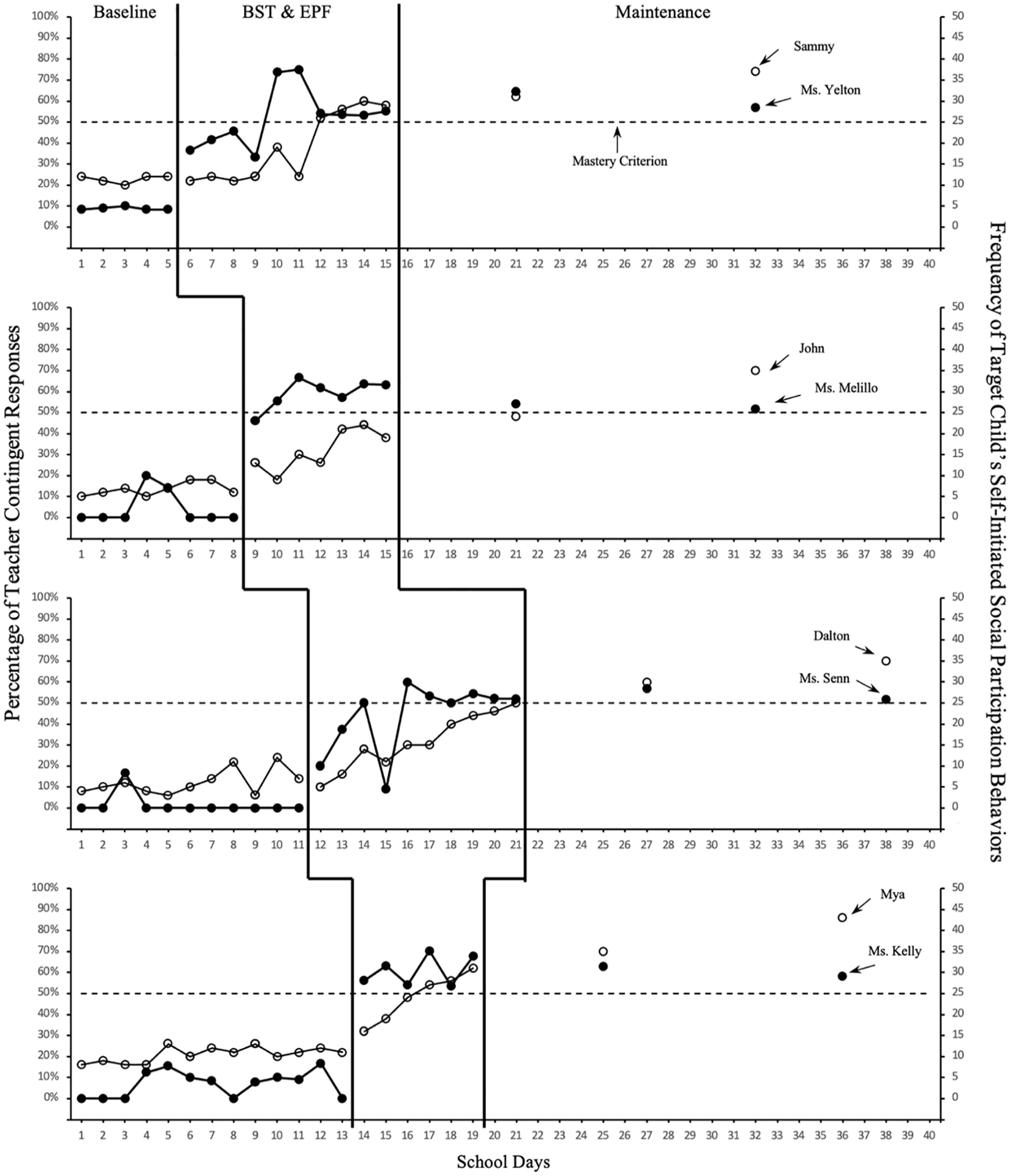
Percentages of Teacher Contingent Responses to the Target Child’s Self-Initiated Social Participation Behaviors During Baseline, BST & EPF, and Maintenance With the Frequency of the Target Child’s Self-Initiated Social Participation Behaviors.
We implemented the maintenance condition once each teacher met the mastery criterion during intervention for six consecutive days. All four teachers’ contingent responses remained at or above the 50% mastery criterion, with a level similar to their final intervention data point, at both the 1- and 3-week maintenance checks. The maintenance condition across all four teachers provides evidence that feedback for six consecutive days at or above the mastery criterion may maintain teacher-contingent responses after the intervention was withdrawn.
Child Social Participation Behaviors
Figure 1 also depicts the target child’s self-initiated social participation behaviors. Sammy’s level of social participation behaviors during baseline was around 15 with a flat trend and low variability. When the intervention was introduced, there was no immediate increase in Sammy’s social participation behaviors; however, there is a marked increase after session 11. Given the substantial overlap between conditions, the delayed effect, and the fact that the intervention was introduced with the second participant before an effect was demonstrated, this is not evidence of a basic effect. John’s level of social participation behaviors was around 10 in baseline, with a flat trend and low variability.
There was an immediate increase in level when the intervention was introduced, an increasing trend during intervention, an overall level around 15, and no overlap between baseline and intervention. The other participants’ contingent responding during baseline remained stable or decreased after the intervention was introduced with John, providing evidence of a basic effect. Similarly, the level of Dalton’s baseline social participation behaviors was around 5–10, was low with some variability and an overall flat trend. Upon introducing the intervention, his data showed a steady increasing trend during the intervention phase, with an overall level around 15 and moderate overlap between baseline and intervention. The remaining participant’s data remained stable when the intervention was introduced with Dalton. This pattern is evidence of a second basic effect. Mya’s baseline data are similarly stable with a flat trend and a level around 10. Upon introducing the intervention, her data showed a steady increasing trend during the intervention phase, with an overall level around 25 and no overlap between baseline and intervention. Her data provide evidence of a third basic effect, and with the one noneffect, we conclude that there a functional relation between BST+EPF and child social participation behaviors.
Generalization of Teacher Contingent Responding
Figures 2 and 3 display teacher contingent responses to their first- then second-generalization child, respectively, and Generalization Child 1 and 2’s self-initiated social participation behaviors, respectively. Patterns of results were similar across both first- and second-generalization children.
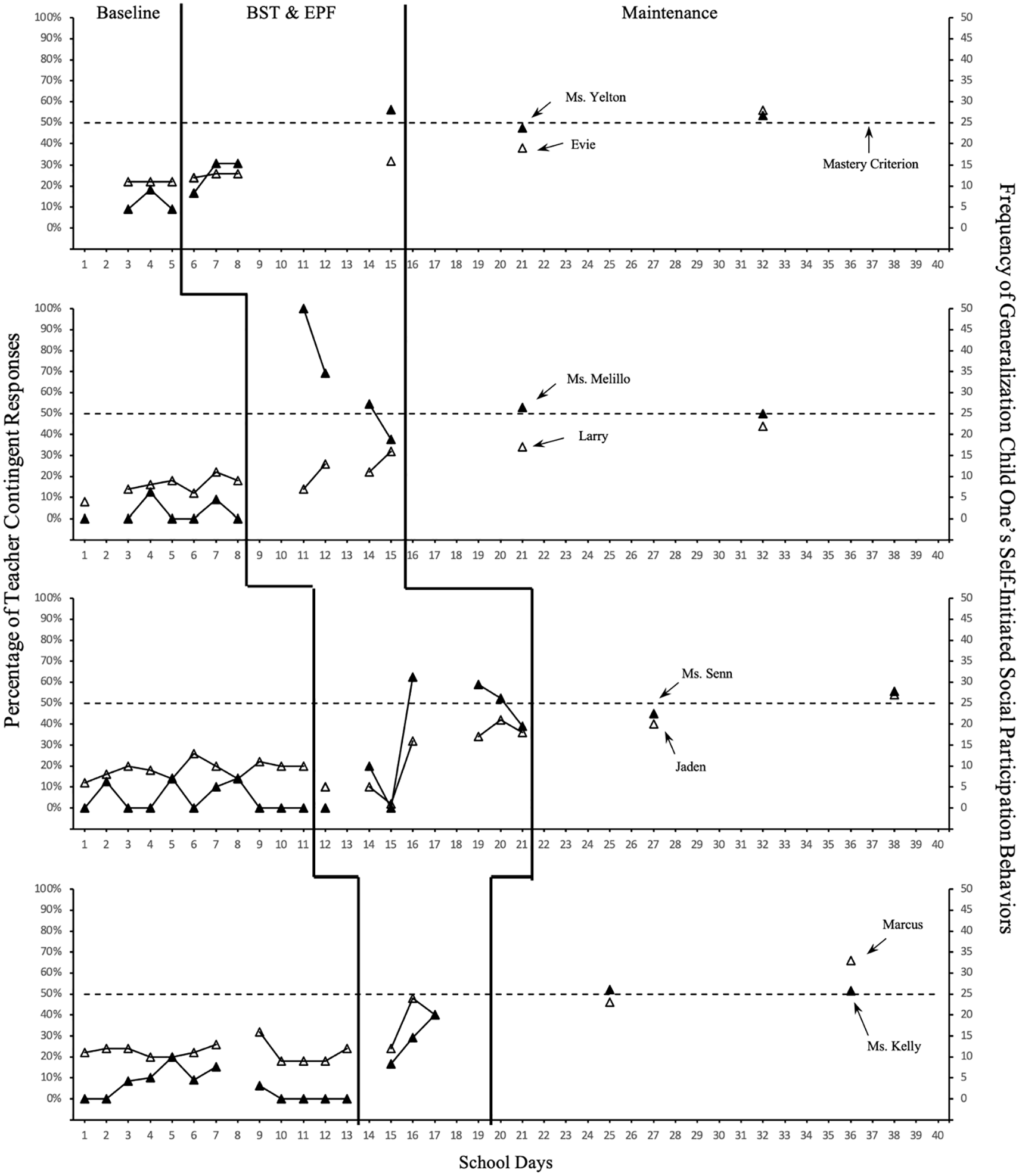
Percentages of Teacher Contingent Responses to Generalization Child 1’s Self-Initiated Social Participation Behaviors During Baseline, BST & EPF, and Maintenance With the Frequency of Generalization Child 1’s Self-Initiated Social Participation Behaviors.
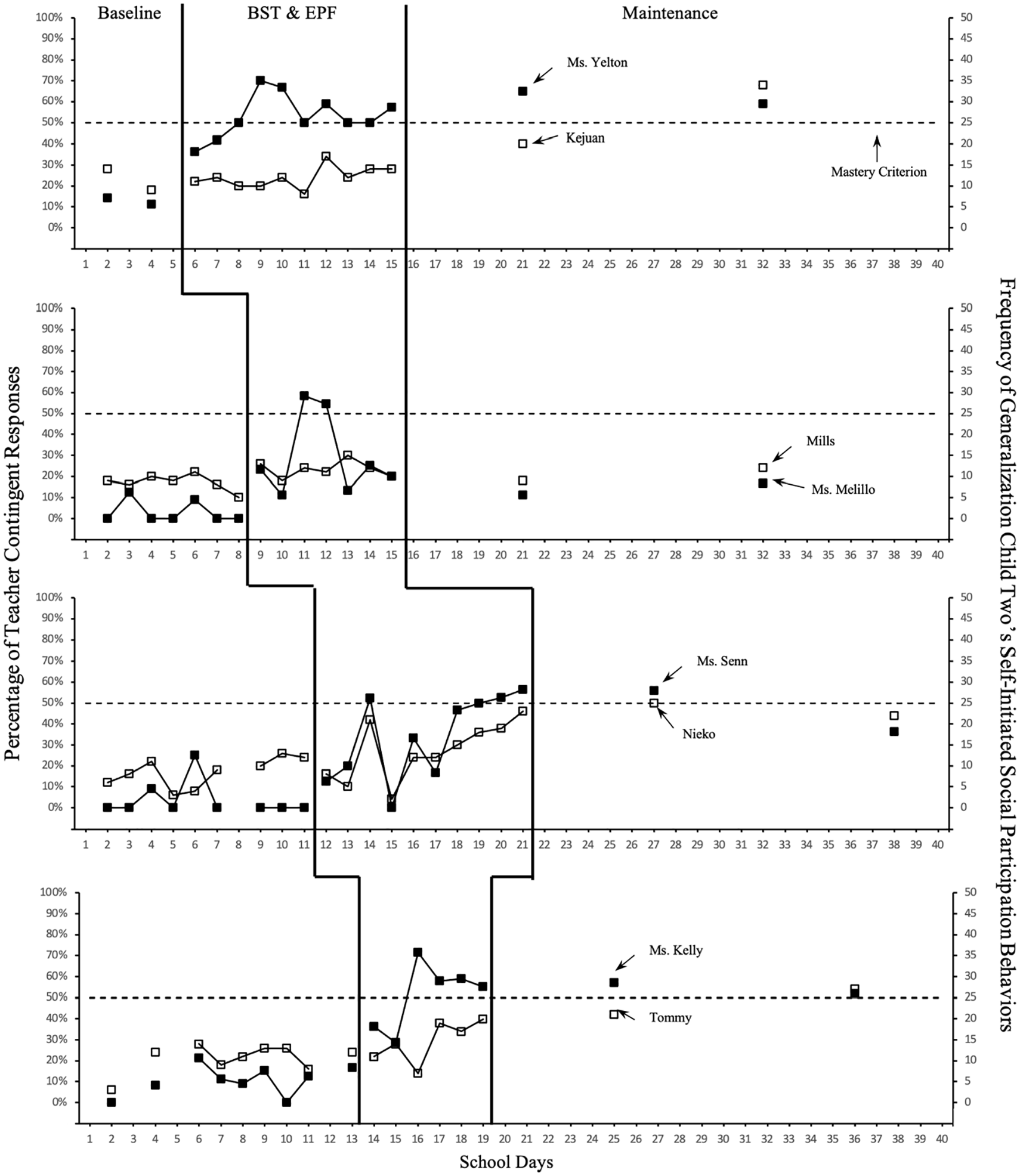
Percentages of Teacher Contingent Responses to Generalization Child 2’s Self-Initiated Social Participation Behaviors During Baseline, BST & EPF, and Maintenance With the Frequency of Generalization Child 2’s Self-Initiated Social Participation Behaviors.
All four teachers’ contingent responses to both generalization children were low during baseline (i.e., below 14%). When intervention focused on the target child was introduced, each teacher immediately increased from their final baseline data point for at least one of their generalization children. During intervention, the level of all teachers’ contingent responses increased for both generalization children. Three of the four teachers provided contingent responses above the mastery criterion for Generalization Child 2 for at least three consecutive days; however, none reached the mastery criterion during intervention with Generalization Child 1. Many of the Generalization Child 1 children were absent during the intervention for the target child, and this absence could have affected teacher performances.
During maintenance, all teachers either reached their 50% mastery criterion of contingent responses (Ms. Kelly), increased from their final intervention data point (Ms. Melillo and Ms. Senn), or maintained their 50% mastery criterion of contingent responses (Ms. Yelton) with at least one of the generalization children. With Generalization Child 2, three of the four teachers generalized their behaviors during intervention for the target child, and two of the three teachers who generalized their new behavior maintained those contingent responses.
Social Validity
All teachers responded “yes” to every question and provided comments about why they responded yes. The results demonstrated that the teachers thought contingent responding was feasible in their classroom, BST helped them learn the strategy (particularly the rehearsal portion) and the materials were helpful as well as the graphs and feedback after each observation. They all indicated that they would use contingent responding in the future (see Table 2).
Teacher Responses to Social Validity Survey.
Discussion
The purpose of our study was to evaluate the effect of a training package using BST and EPF on teachers’ contingent responding to children’s self-initiated social participation behaviors during center time. Systematic introduction of BST with a checklist and EPF with graphs produced increases in teachers’ contingent responding. Programming common stimuli during BST produced generalization of contingent responding to at least one other child in their classroom. Furthermore, teachers likely maintained their contingent responses to their target child’s self-initiated social participation behaviors after removal of EPF as evidenced by the increased frequency of their target child’s social participation behaviors, though a direct measure of the maintenance of teacher behavior is needed to confirm this. Finally, teachers found the training and feedback to be useful and practical.
Our results extend the research on EPF by including graphs of both teacher and child behaviors. Few studies have included graphs within performance feedback on teacher behavior (Martin et al., 2015; Reinke et al., 2007; Sweigart et al., 2015) as a part of EPF. Sweigart et al. (2015) suggested that continued teacher implementation of the independent variable may increase if student behaviors were also graphed. Therefore, our study included graphs of teacher and child behavior. Teachers were provided with feedback about increases in their target child’s self-initiated social participation behaviors and their associated contingent responses throughout the intervention; in previous studies (Martin et al., 2015) researchers only provided this feedback the day before the teachers entered maintenance. Children with moderate to significant support needs often acquire skills more slowly than their same-age peers, and such gradual change can be subtle and may not function as a salient consequence for maintaining teacher behavior (Halle et al., 2004). Providing teachers with graphs of their own performance alongside graphs of the target child’s performance throughout intervention may have assisted teachers in seeing the potential relations between increases in their contingent responding and the increases in their target child’s self-initiated social participation behaviors.
Several previous studies have focused on whether teacher training on an instructional strategy geared toward a specific child’s strengths and needs would generalize to other children with the same instructional needs (Mouzakitis et al., 2015). In an attempt to increase the efficiency of the training, we decided to focus the training on only one target child. However, we did program for generalization to other children by programming common stimuli and by training the teachers in their classroom with everyday materials found in centers. Programming common stimuli proved to be an effective strategy when training the teachers as most generalized their training to other children.
Our extended feedback to teachers was a novel approach to enhance maintenance of the teachers’ contingent responses. Most studies (e.g., DiGennaro et al., 2007; Hemmeter et al., 2011, 2015; Krick Oborn & Johnson, 2015) investigating effective ways to train teachers set the mastery criterion for the intervention’s acceptable performance at two or three consecutive days prior to withdrawing the intervention. The two to three consecutive days may only allow teachers to reach acquisition, which is the ability to perform the motor components of the behavior (Drasgow et al., 2017), but not fluency, which is the ability to perform the behavior quickly and accurately (Miltenberger, 2008). It is possible that by increasing the mastery criterion to six consecutive days, the teachers were able to attain fluency with responding contingently and therefore were able to maintain the skill over time.
An interesting finding occurred in maintenance. Children’s behaviors continued to increase as the teachers maintained their contingent responses at or above the mastery criterion. If the teacher did not provide contingent responses when the trainer was absent, then the target child’s behavior would be placed on extinction; therefore, we would expect the child’s self-initiated social participation behaviors to decrease over the two maintenance observations. However, the opposite occurred, and all target children’s self-initiated social participation behaviors continued to increase in frequency during the maintenance condition, which suggests the teachers were continuing to provide contingent responses in the trainer’s absence. This finding may address a common concern that teachers may perform the behavior only when the trainer is present and stop when the trainers leave.
Feedback on the target child’s self-initiated social participation behaviors serves as another plausible explanation that may have contributed to the maintenance of teacher performance. Maintenance is enhanced when the teacher has opportunities to use this behavior and the behavior produces motivating consequences at least intermittently (Drasgow et al., 2017). Because feedback on child performance was not systematically manipulated, it is unclear whether this component of the training package functioned to maintain teacher performance. Feedback on child performance appears to be an advantageous approach for sustaining teacher performance (Krick Oborn & Johnson, 2015; Martin et al., 2015) when the reported improvements function as reinforcers for teacher behavior. However, experimental analysis of this feedback procedure is necessary to support it as an effective maintenance strategy.
Limitations and Future Research
One limitation in our study was that the researcher was the person who implemented BST and EPF. In schools, professional development models are the most common form of teacher training and have been found to be ineffective in changing teachers’ behaviors (Brown et al., 2014; Horrocks & Morgan, 2011). Therefore, future research should investigate training district personnel (e.g., a district behavior specialist) to implement the independent variables in our study to determine if it is feasible and practical in the applied setting without a researcher’s presence instead of using professional development models. Another limitation in our study was that the teachers volunteered to participate in the study. This could have increased the teachers’ fidelity of implementation as they were interested in finding a way to increase their children’s social participation behaviors. It would be interesting to determine whether teachers other than those who volunteered to participate would still find this intervention feasible within their classrooms. In addition, though our procedures stipulated that the researchers did not interact in any way with teachers during baseline and maintenance, we only measured fidelity during the intervention phase and thus do not have documentation that no interactions occurred during these other phases.
Finally, although we measured generalization of teacher behavior across students, we measured the effects of our intervention on a context-bound child behavior (Ledford et al., 2022; Sandbank et al., 2021); in other words, we measured the child behavior only in the context in which the intervention was implemented. However, the intervention was implemented in a naturalistic context (i.e., typical classroom, typical implementer, typical materials, and typical activities) and child gains maintained over time, both of which provide evidence of generalized behavior change and support the external validity of the study.
Our results also suggest additional avenues for future research related to teacher training. We examined the effects of brief BST and EPF on teacher contingent responding; other researchers may examine the utility of these interventions for training teachers to implement other instructional strategies (e.g., precorrections; Barton et al., 2013). It would be interesting to investigate additional strategies (e.g., prompting) for which this relatively simple and efficient intervention is generally effective. Furthermore, researchers could investigate whether follow-up EPF increases the effectiveness of traditional methods of professional development (e.g., workshops).
Implications for Supporting Teachers
Our results have several implications for supporting teachers to deliver contingent responding. First, providing teachers with graphs of their own implementation along with graphs of child outcomes may be an effective way to communicate the effects of teacher behavior on student behavior and thus, increase teacher buy-in for an intervention. Second, focusing teacher training on one target child, while programming for generalization of teacher behavior by conducting the training in the natural environment, supported generalization of teacher contingent responding across students. Third, teacher trainers may consider requiring consistent teacher performance of a strategy over an extended period of time to build fluency, which may support maintenance.
Supplemental Material
sj-docx-1-rps-10.1177_15407969241237809 – Supplemental material for Training Teachers of Children With Moderate to Significant Support Needs to Contingently Respond to Child-Initiated Social Participation Behaviors During Centers
Supplemental material, sj-docx-1-rps-10.1177_15407969241237809 for Training Teachers of Children With Moderate to Significant Support Needs to Contingently Respond to Child-Initiated Social Participation Behaviors During Centers by Ashley K. Holt, Erik Drasgow and Katie Wolfe in Research and Practice for Persons with Severe Disabilities
Footnotes
Declaration of Conflicting Interests
The author(s) declared no potential conflicts of interest with respect to the research, authorship, and/or publication of this article.
Funding
The author(s) received no financial support for the research, authorship, and/or publication of this article.

Supplemental Material
Supplemental material for this article is available online.
Editor in Charge: Elizabeth Biggs
Author Biographies
References
Supplementary Material
Please find the following supplemental material available below.
For Open Access articles published under a Creative Commons License, all supplemental material carries the same license as the article it is associated with.
For non-Open Access articles published, all supplemental material carries a non-exclusive license, and permission requests for re-use of supplemental material or any part of supplemental material shall be sent directly to the copyright owner as specified in the copyright notice associated with the article.
