



Abstract
Despite the repeated documentation of the positive outcomes for students with extensive support needs (ESN) when they are included in general education settings and receive access to state-adopted general education standards, there has been little systemic progress on the inclusion of students with ESN across most states. The purpose of this exploratory survey was to find out how experts in the field of ESN describe the reasons why access to general education curriculum is important, the legal requirements for access to the general education curriculum, the meaning of access and the processes by which education teams can provide access, the ability to address individualized needs within the general education setting, and the barriers and facilitators of access. The findings from our thematic analysis of experts’ responses demonstrated strong agreement that “access to the general education curriculum” meant access to state-adopted general education standards; access to general education settings; and access to curriculum, teachers, and instruction that facilitate meaningful inclusion. In addition, themes related to why access is important generated thoughtful reflections on Individual Education Program (IEP) priorities for students with ESN. Barriers and facilitators are also described, as well as a discussion including suggestions for systemic changes.
Keywords
Over the past 10 years, numerous articles and studies have documented limited movement of students with extensive support needs (ESN) from self-contained to general education classrooms and, thus, limited access to and progress in state-adopted general education standards (e.g., Agran et al., 2020; Ballard & Dymond, 2017; Brock, 2018; Kurth et al., 2019; Morningstar et al., 2017; National Center for Education Statistics, 2018; Sauer & Jorgensen, 2016). There also has been considerable research and discussion reviewing the negative conditions of segregated classroom contexts and the positive outcomes for students with ESN when they are included in general education classrooms and receive instruction to meet grade-level state-adopted general education standards (e.g., Gee et al., 2020; Jackson et al., 2022; Kurth et al., 2016; Mansouri et al., 2022; Ruppar et al., 2018; Ryndak et al., 1999). Taub et al. (2017) defined students with ESN as students who need ongoing pervasive supports in academic and daily living domains; who might be classified as having a significant intellectual disability, autism, multiple disabilities, or deaf-blindness; and who are eligible for participation in the alternate assessment.
When the Individuals with Disabilities Education Act (IDEA, 2004) was re-authorized in 2004, language was added to state explicitly that all children with disabilities should have access to and make progress in the general education standards. Guidance on Grade-Level Standards from the U.S. Department of Education (2015) indicates that “IEP goals must be aligned with grade-level content standards for all children with disabilities” (p. 1). The state-adopted general education standards can be defined as each state’s officially chosen educational standards that all school districts in that state must address for all children. For example, many states have chosen the Common Core English Language Arts and Math Standards (National Governors Association Center for Best Practices & Council of Chief State School Officers, 2010) and adopted the Next Generation Science Standards (NGSS Lead States, 2013). School districts, in turn, design curricula or adopt published curricula intended to align with their state’s standards. Thus, there is a difference between the state-adopted standards and the general education curricula (GEC) adopted by various districts within the state. The Every Student Succeeds Act (ESSA, 2015) permits, but does not require, states to develop alternate academic achievement standards for students with the most significant cognitive disabilities. In some states, school districts have adopted “alternate curricula” advertised as being aligned with Common Core Standards to address their alternate academic achievement standards. Studies have shown, however, that these alternate curricula do not, in actuality, align with state-adopted general education standards (Bowman & Taub, 2022; Kearns et al., 2020; Vandercook et al., 2021).
There appears to be confusion in the field relative to understanding access to state-adopted general education standards, as well as where that access should occur for students with ESN. In addition, less precise words frequently are used, with the field discussing “access to grade-level general education curriculum” instead of “access to grade-level general education standards.” This lack of clarity appears to have led to an unintended consequence of education teams identifying goals from alternate academic achievement standards for students with ESN who are on the alternate assessment. Then, in turn, when teams use alternate curricula to teach those standards, some use those alternate curricula as a rationale to exclude students from general education classes because the alternate curricula are not the same as the curricula taught in general education classes (Bowman & Taub, 2022; Vandercook et al., 2021).
To begin to address these issues, we conducted an exploratory survey study to examine how “experts” in the field of education for students with ESN view access to the GEC based on state-adopted general education standards for students with ESN. For this purpose, we defined experts as individuals who conduct research and/or engage in personnel preparation in the field of special education for students with ESN. The following research questions guided our work: What are the perceptions of experts in relation to (a) the legal requirements related to access to the GEC, (b) why access to the GEC is or is not important for students with ESN, (c) the best ways (e.g., processes, strategies) to provide access to the GEC, (d) addressing individualized needs/essential skills in general education settings, and (e) barriers and facilitators of access to the GEC?
Method
We conducted a thematic analysis (Braun & Clarke, 2021) of open-ended responses to a survey to examine the perspectives of experts in relation to access to the GEC for students with ESN. Prior to the study, we obtained Institutional Review Board approval from our respective institutions. We developed an anonymous online survey using Qualtrics (2021), a web-based survey development and management tool, and distributed the survey to experts over approximately 4 months. In the sections that follow, we describe the respondents, survey instrument, data analysis procedures, and positionality of the researchers.
Potential Participants and Respondents
We recruited potential participants who had expertise in education for students with ESN in the United States. Initially, we emailed invitations to all individuals listed on the editorial board of the journal Research and Practice for Persons with Severe Disabilities (RPSD) and all authors who had published in RPSD between 2010 and 2020. We selected authors and editors in RPSD because this journal is specifically focused on the population of focus for the study. We selected these years because of the increased emphasis on access to and progress in the state-adopted general education standards for students with ESN in the last decade. Initially, we sent 212 email invitations on April 6, 2021, 15 of which were undeliverable. Subsequently, we asked respondents to provide names of others with expertise in this area who should be invited to participate. This resulted in 19 additional experts, for a total of 216 experts who received email invitations. Periodically, we sent follow-up email reminders until the study concluded at the end of July 2021. The total number of experts who consented to participate was 77, for a 35.6% response rate. Of those, 46 experts completed questions related to both demographic information and perceptions related to access to the GEC for students with ESN. We excluded two of these respondents because one expert did not live in the United States and one requested that their responses not be included in the study. This resulted in responses from 44 experts included in the data analysis.
Survey Instrument
Respondents first electronically answered a series of demographic questions (see Table 1) and then answered a series of closed- and open-ended questions related to their perceptions of access to the GEC for students with ESN (see Table 2). Respondents could opt to audio record their responses to the open-ended questions through Qualtrics. Two respondents selected the audio-recording option and we used Happy Scribe (2021), which uses HIPPA-compliant measures, to transcribe their responses.
Participant Demographics.
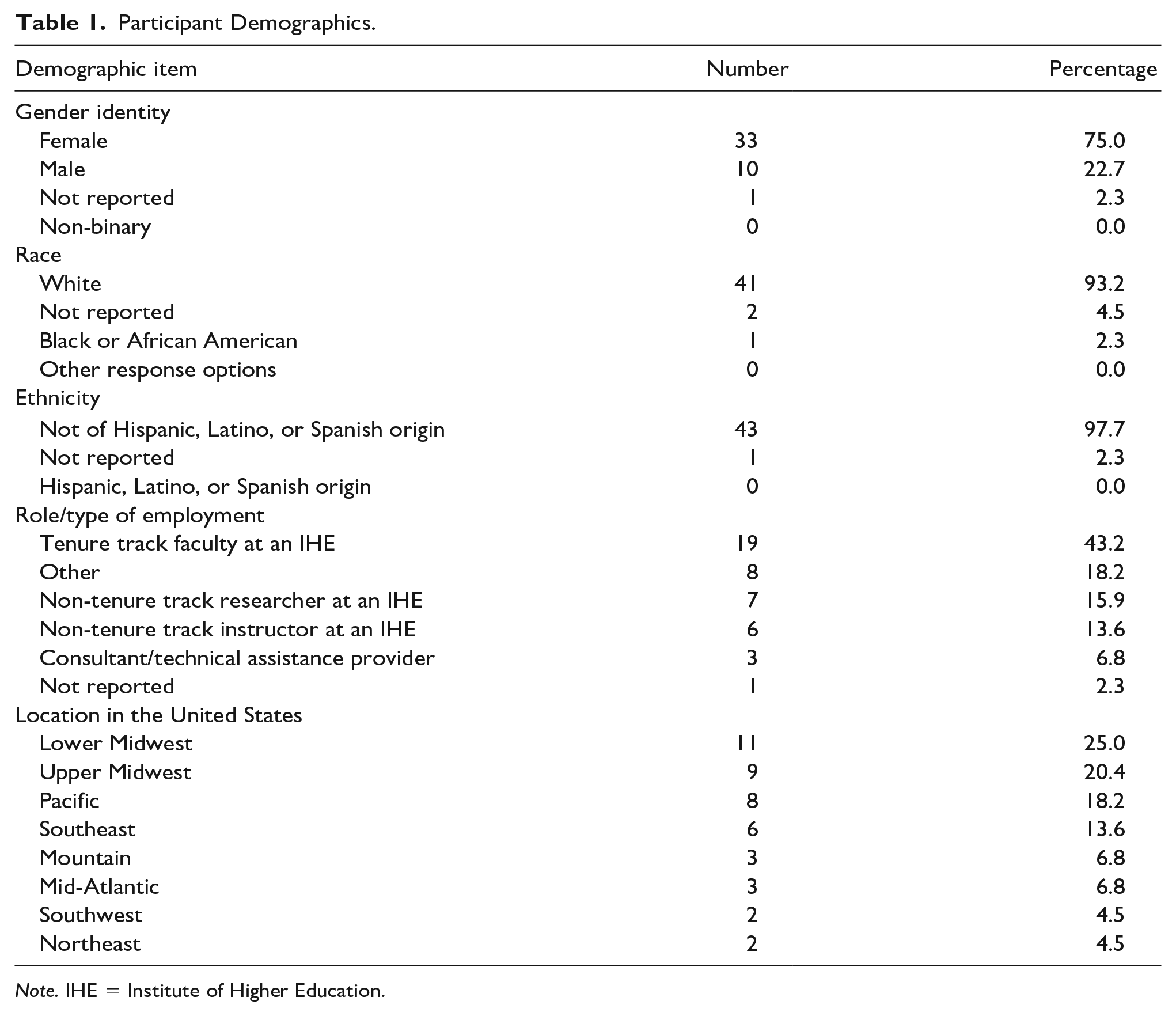
Note. IHE = Institute of Higher Education.
General Education Curriculum Survey Items.
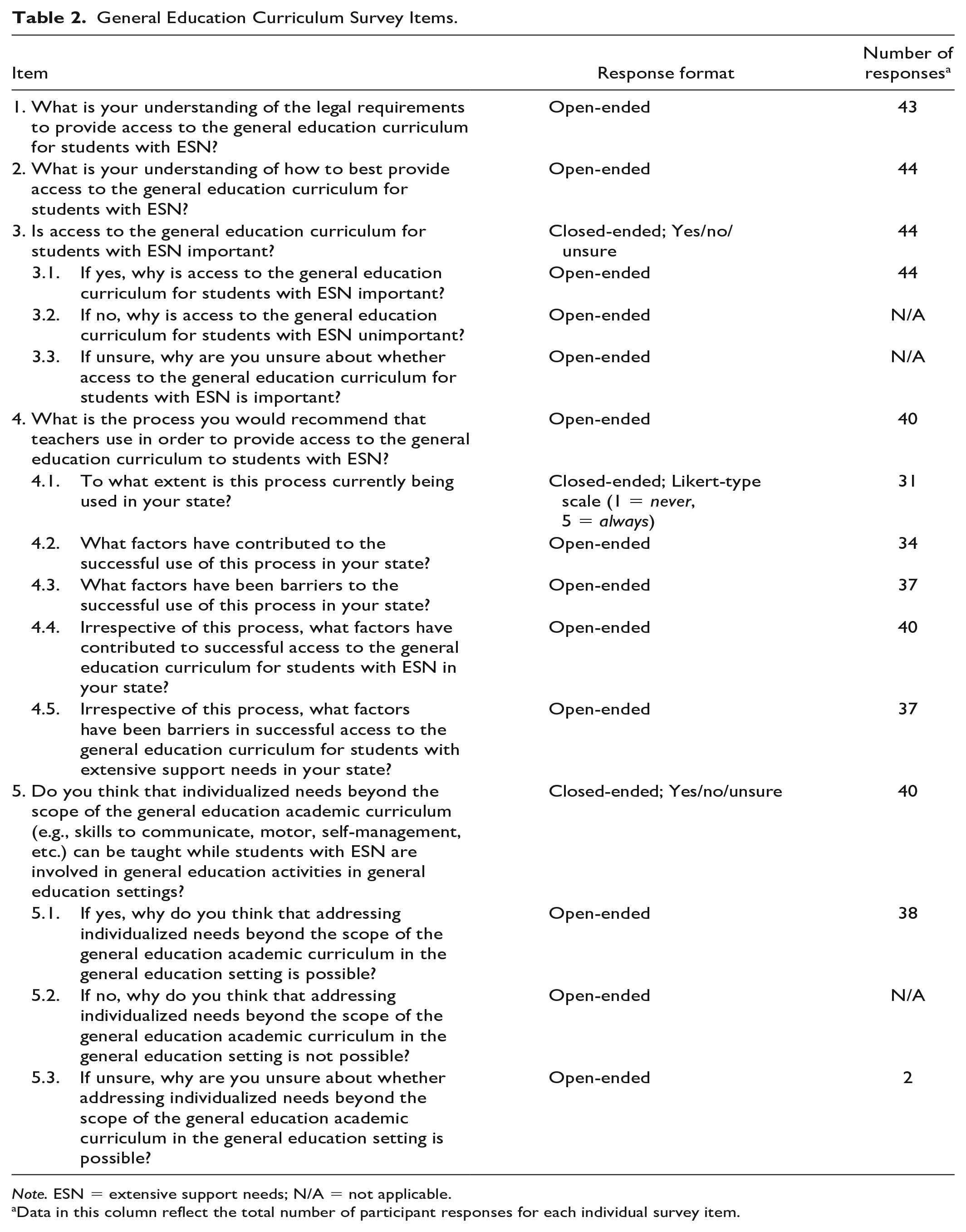
Note. ESN = extensive support needs; N/A = not applicable.
Data in this column reflect the total number of participant responses for each individual survey item.
Data Analysis Procedures
We conducted a thematic analysis (Braun & Clarke, 2021) that began with an iterative process of coding the responses to open-ended questions (Saldana, 2016). The first analysis consisted of a question-by-question review synchronously by all four researchers, resulting in the identification of 11 codes, as well as sub-codes for several of these codes (see Table 3). We then individually reviewed the coded content and used analytic memos (Miles et al., 2020) to generate individual assertions related to groups of questions and shared these assertions among team members. Next, two team members completed a second analysis of the entirety of each respondent’s answers across questions and generated respondent-by-respondent assertions to develop a holistic sense of their perceptions. This was shared with the other two team members and a first set of themes was generated from this process.
List of Codes and Definitions.
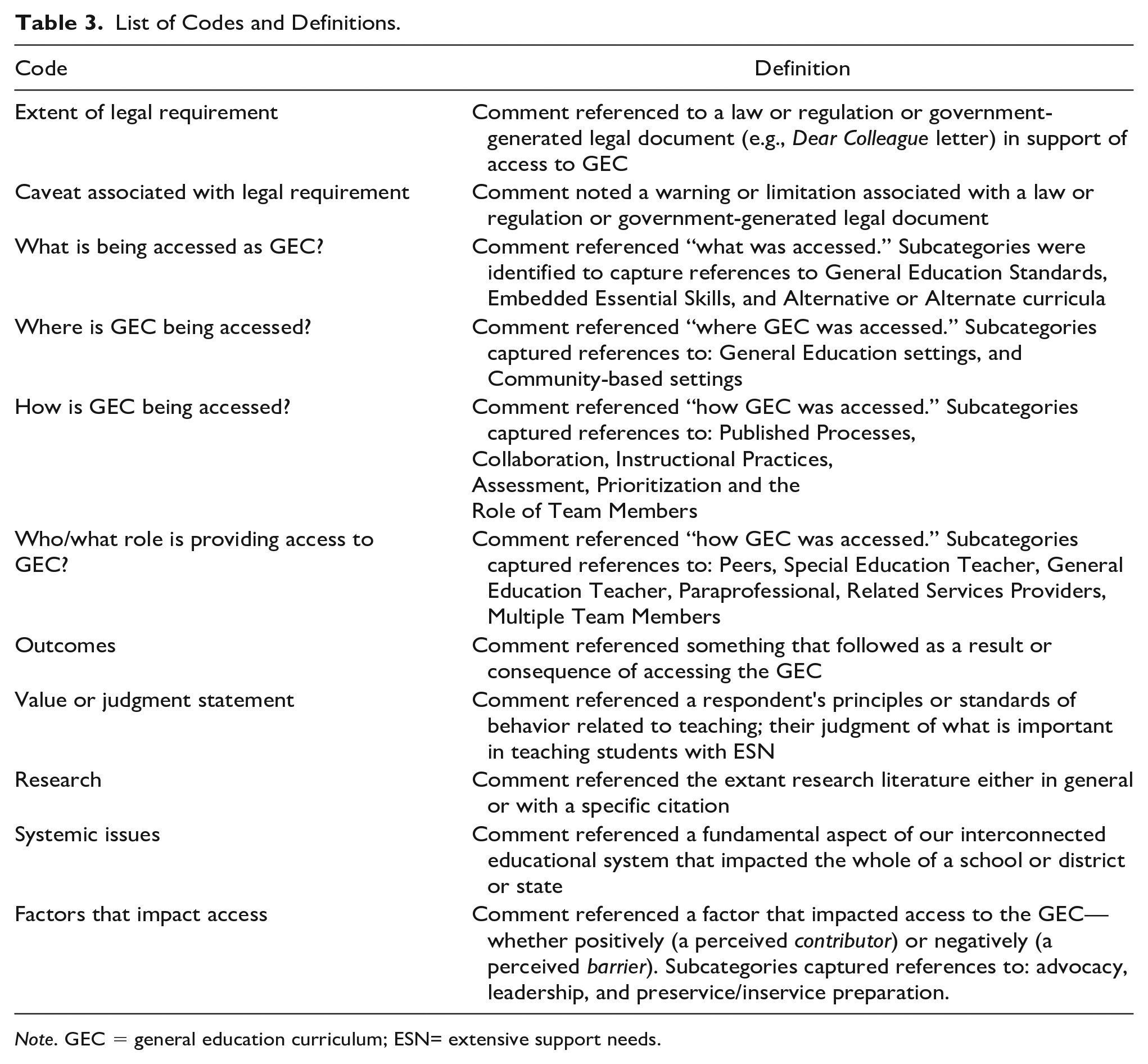
Note. GEC = general education curriculum; ESN= extensive support needs.
The final analysis integrated the respondent-by-respondent assertions and the responses-by-question assertions to generate final themes deemed illustrative of the data related to each research question. This resulted in 13 themes, total. To ensure trustworthiness and credibility (Brantlinger et al., 2005), we first independently analyzed content, then compared our assertions in groups of two, and then discussed the results of those analyses among the full research team. We structured debriefings and research meeting discussions to continually check for our own biases related to access to the GEC for students with ESN. We questioned the codes, themes, and overall messages from respondents by continuously posing alternative meanings (e.g., if there was a difference of opinion, the researchers went back to the raw data and memos to reach a consensus).
Positionality of the Research Team
At the time of the study, we identified as White, cisgender women in the field of special education with an emphasis on students with ESN. We had 17 to 47 years in varied roles of teaching, research, teacher preparation, professional development, and systems change. We worked in three different states and had worked in several other states during our careers.
Findings
Table 1 depicts respondents’ demographic information pertaining to gender identity, race, ethnicity, role/type of employment, and location in the U.S. The majority of respondents were White and female. Forty-three percent were tenure track faculty members at Institutions of Higher Education (IHEs). Additional roles included “other” (18.2%), non-tenure track researchers (15.9%), instructors (13.6%), and consultant/technical assistance providers (6.8%).
We organized our findings based on our five research questions. For each question, we identified one to three themes that emerged from the coding and analysis process.
Research Question 1: What Are the Perceptions of Experts in Relation to the Legal Requirements Related to Access to the GEC for Students with ESN?
We identified three themes related to the legal requirements. The first theme was the mandate and the respondents’ interpretation of the legal requirements. All respondents viewed access to the GEC as a requirement mandated by federal law, with more than half of the respondents specifically referencing IDEA or a component of IDEA (e.g., Free and Appropriate Public Education [FAPE] or Least Restrictive Environment [LRE]). Several noted access was required based on current legislation, regulations, and case law; for example, “Together, IDEA, ESSA, and Endrew F. provide legal support for the provision of instruction in GE [general education] settings for students with ESN.” Respondents also indicated a concern that there is wide latitude with respect to the interpretation of the legal requirement. For example, one respondent shared: “Schools and teachers can ‘mix and match’ as they see fit, such that the law’s emphasis on [GEC] taught by qualified teachers (general educators) is lost in most cases.”
The second theme captured responses that highlighted the importance of how and where the GEC is accessed and whether progress is being made. Respondents noted that the level of curricular content should align with that of their grade-level general education peers and be provided in general education settings. One respondent stated, “Access to grade level academic content at an accessible level for the individual student, which should happen in a general education classroom.” Another respondent stated, “LRE means learning with nondisabled peers in the general education setting with the general education curriculum as much as possible . . . Progress needs to be measured in IEP goals, but also (and more importantly) in the general education curriculum.” Another noted that “IDEA and the Every Student Succeeds Act both are clear that all students, including students with ESN, should be accessing and making progress on the general education curriculum.” One respondent emphasized the importance of assessment, noting their understanding of the mandate for access presumes a balance “ . . . between individualized instruction for functional skills paired with academics that are informed by state standards.”
Finally, a third theme that emerged related to values. Comments from many of the respondents framed their understanding in a manner that reflected their personal judgments. For example, one respondent stated that their understanding is:
. . . that all students are general education students, inclusive of SWSCD [students with significant cognitive disabilities]. Access, engagement in grade-level standards, and SDI [specially-designed instruction] within general education environments and curriculum is the law and, furthermore, absolutely do-able for each and every student.
Research Question 2: What Are the Perceptions of Experts in Relation to Why Access to the GEC Is Important for Students with ESN?
When asked whether access to the GEC was important for students with ESN, all 44 respondents said yes. Three themes emerged during our analysis of their responses about why it was important. The first theme related to fairness and equity. Respondents stressed access to experiences available for all students. For example, one respondent stated:
It may be more of a challenge for us as practitioners to assess students’ understanding and abilities, but to project our challenge on to the student by removing opportunities is the antithesis of our education system. Much of the general education curriculum, when taught well (meaning, not rote memorization of facts), provides a set of skills allowing students to develop personal interests, navigate and engage in their different environments, pursue meaningful employment, build relationships based on common interest, and so much more.
Another respondent noted: “They deserve to have access to rich and meaningful curriculum just as their peers without disabilities have.” And, another respondent wrote: “Why is access to general education important for any child? It’s important for students with ESN for the same reasons. Essentially, these are the agreed upon topics that ensure children become adults with the skills needed to be self-sufficient.” As stated by another respondent, “If we believe this content is important and relevant to the needs of the general population, then I don’t think its relevance should be questioned for students with disabilities . . . ”
Some respondents specifically stressed the robust nature of the state-adopted general education standards in that they lead to a rich and meaningful curriculum based on a scope and sequence for all learners that is not available in a self-contained classroom. This is reflected in comments such as the following:
The GE [general education] curriculum follows a scope and sequence that progresses across the year with new and exciting content, as well as opportunities to cycle back to target previously taught skills. Special education classes for students with ESN are often hyper focused on IEP goal work in isolation . . . working on the same skills/content for years if they [students] don’t show mastery.
The second theme related to access to membership in a variety of inclusive groups in school, community, and after-school experiences. Access to membership was described as an opportunity to gain social capital through sharing a common set of learning experiences and assuming valued social roles within those experiences. One respondent wrote: “Access to content that their peers receive will ensure [students with ESN] learn important content that also promotes their social capital and opportunities to engage in activities like and with their peers.” Some respondents also tied membership to quality of life, inclusive societies, and the importance of equitable educational experiences. As one respondent stated: “. . . that also increases the number of relationships that they can have in their lives, . . . especially relationships with people who aren’t paid to be with them.”
The third theme that emerged was related to the opportunity to achieve both short- and long-term outcomes. This came out in statements about having high expectations for all students, developing students’ personal interests, achieving post-school employment outcomes, acquiring academic skills, and gaining higher-level thinking skills. For example, one respondent wrote: “Access to the general curriculum can provide opportunities for all students, including those with ESN, to make connections between their world, their lives, and each other.” Some respondents also identified more global outcomes. One respondent wrote: “Design[ing] and teach[ing] to the edges in our educational institutions prepares students to live and support multi-generational, abled, diverse communities to live productive, connected adult lives.”
Research Question 3: What Are the Perceptions of Experts in Relation to the Best Ways to Provide Access to the GEC, and the Processes and Strategies Recommended for Teachers to Promote Access to the GEC?
Respondents overwhelmingly emphasized four variables that must be incorporated for the best way to provide access to the GEC for students with ESN. These included: (a) the general education class is the context in which access to the GEC occurs; (b) the state-adopted grade-level standards are the content that comprises the GEC; (c) embedding instruction within general education lessons, activities, and routines is important for students with ESN; and (d) the meaningful outcomes that should be measured include the performance of a wide range of skills within general education lessons, activities, and routines.
In addition to these variables, three themes emerged related specifically to processes and strategies. The first theme, ensure that the where is the general education class and the what is the GEC, was noted by nearly all of the respondents when asked how to provide access and what processes they would recommend. The overwhelming first response was inclusion in general education classes. It was essentially step one of the “how-to” responses, alongside alignment with the grade-level standards and curriculum. For instance, respondents wrote: “Place the students in general education classes and provide the appropriate level of support,” and “You HAVE to begin with the grade-level standards and curriculum in the general education classes.” Most emphasized that general education standards should be the starting point for how to provide access to the GEC. Several respondents discussed the depth of state-adopted general education standards and the ways in which important skills for all students are embedded within those standards. For example, one respondent wrote:
My belief of the best way to provide access is through a thorough IEP team discussion about what the grade-level standards are and what the student’s individual skills and needs are. Many standards across many content areas revolve around critical thinking, problem solving, using evidence to support a claim, building language and effective communication skills, etc. – all of which are important life skills for individuals with extensive support needs.
Similarly, another respondent stated: “Start with a Universally Designed for Learning (UDL) gen[eral] ed[ucation] curriculum and standard[s] within the general education class.”
Some respondents emphasized what access should not include. For example, one respondent stated: “Alternative (sic) curriculum are (sic) not in use, and alternate assessments take a back seat to the authentic curriculum of the general education class; i.e., alternate assessments are not used to develop IEP goals, nor do they drive instruction.” Another wrote: “You HAVE to begin with grade-level standards. Beginning with alternate or extended standards . . . is often limited in its scope and removed from the big picture of the standard.” One respondent stated: “A student’s IEP should be based on the age-appropriate common core standards and these IEP objectives should be infused or integrated within their general education courses.” Another respondent said: “Access to the general education curriculum means access to rigorous content to participate fully with peers in the general education context.”
The second theme that emerged was the use of effective instructional design practices. Respondents recommended the use of ecological assessments, participation and support plans, and UDL. For example, one respondent stated: “UDL designed classrooms, with learner centered activities to master the content—high quality individual, small group, focused instruction interwoven with plenty of activities that support . . . communities of practice around literacy, humanities, and stem curriculum.” They also stressed the ecology of both the general education settings and content. One respondent stated: “Start with the standards, look at the essential learning within each standard, also look at ways in which IEP objectives can be embedded into the general education lesson as well.” Another respondent described: “Standards-based IEP’s. . .begin with the standards and look for content centrality and similar performance.” A third respondent wrote: “This relies on student-centered planning, starting with ecological assessment to determine when and what supports are needed.” A fourth respondent reflected on the meaning of access and prioritization:
. . . access to [all] the content. And in some ways, that’s almost more important than picking out the specific subskill that you’re going to teach . . . by making sure students have access to the entire activity, we’re not limiting them in any way.
The importance of embedded instruction of essential skills, peer-mediated learning, accommodations, modifications, and adaptations were also reported as important components of instructional practices. One respondent noted:
Identify the key content that the general educator thinks is important for the student to learn. Develop appropriate accommodations . . . systematic instructional plans to teach the content . . . [and] peer support structures to promote the student’s participation in activities provided by the general educator.
Another respondent provided this example: “. . . a teacher’s time is better spent creating a picture supported vocabulary list for a science unit than adapting a worksheet that will be used for one lab session.”
Systematic instruction and data-based decision-making were also emphasized as key components of effective instruction. One respondent wrote: “Collect data on the student’s progress toward learning the targeted content and positive social interactions with peers. Special and general educators meet regularly to analyze the data and make modifications to instructional strategies and peer support structures.” Another respondent provided this summary statement:
Place the students in general education classes and provide the appropriate level of support (e.g., evidence-based practices for teaching academic skills . . . ELA/reading, mathematics, science, social studies). In general, use systematic instruction . . . data-based decision making.
The third theme that emerged was an emphasis on collaborative practices and adjusted professional roles. Collaboration between general and special education teachers, and interactions among multiple team members, was deemed critical for providing access to the GEC for students with ESN. Respondents named co-teaching, co-planning, teacher knowledge and skills, and flexible school structures that allow for collaboration as highly important. One respondent stated the need for: “School professional development in the area of UDL, inclusion, and adaptations with follow-up and coaching; collaboration with special education teachers and general education teachers to ensure adaptations are being made.”
Respondents emphasized the unique role of the special education teacher, or an inclusion support teacher. They indicated the importance of skills the special education teacher needs to collaborate successfully with multiple general education teachers who have unique styles for planning and to provide instruction in their general education classes across several grade levels. As stated by one respondent,
Once there, students will need individualized adaptations . . . Thus, special educators . . . need to be available to do this and/or help general education teachers to do it. This also means both ample prep time and regular common planning time . . . thus systemic supports for inclusive education.
Although these three themes represented nearly all of the responses, it is important to state that a few respondents shared the perspective that (a) access to the GEC could be provided in self-contained special education classes, and (b) instruction on “alternate” standards taught with “alternate” curricula in self-contained special education classes could provide acceptable access to general education standards. For example, one respondent said: “. . . school districts have adopted specific curricula that uses [sic] evidence and research-based strategies for use by special educators.” Another respondent stated: “IDEA is very clear that students with disabilities, including those with ESN, should have access to the GEC regardless of setting. This is outlined in FAPE and the congressional findings. In addition, case law repeatedly supports this.” In addition, these respondents focused first on evidence-based practices, over context and content. One respondent stated: “For example, a student may receive target and intensive academic instruction within a segregated special education classroom while also provided opportunities to engage in learning within an inclusive general education classroom.” Another respondent stated: “Ground your instruction in systematic instruction and other evidence-based practices, incorporate experiential (hands-on) and inquiry-based activities grounded in real-world application, and collaborate with general education teachers to promote access to inclusive classrooms.”
Research Question 4: What Are the Perceptions of Experts in Relation to Whether Students’ Individualized Needs Can Be Addressed in General Education Settings?
The primary theme that emerged related to this research question was that research has demonstrated that individualized needs, often called essential skills, can be addressed in general education settings, and their own experiences in schools further support this assertion. Respondents referenced the concept of embedded instruction (Johnson et al., 2004) and pointed to research evidence. One respondent wrote: “The literature on communication is CLEAR—inclusive classrooms support the use of AAC [augmentative and alternative communication] and other communication forms, encourage social interactions which provide opportunities to communicate.” Another respondent stated:
Individualized needs may include skills that typically fall in what is often called the ‘hidden curriculum’—for example, following rules/expectations and procedures, cleaning, organizing, sorting, which are all very much a part of general education settings. Also, skills like eating, hygiene, and dressing are all a part of any student’s day.
Responses also included critiques of special education practices. For example:
Skills should be taught/embedded in the context of naturalistic instruction within the GE [general education] content in order to promote generalization and avoid the boredom brought on by monotony. Imagine learning to identify coins for 10 years when all everyone you know uses a credit card to pay. I would also throw a chair or run out at that point.
Another respondent wrote: “. . . think about the typical child. Much about social and self-care/life is learned by being connected with peer groups . . . We don’t change the child’s curriculum because he or she has social difficulties!” Many mentioned the experiences of teachers in the field—including themselves. As reflected by one respondent: “Because I’ve done it and I’ve seen others do it even better than I managed to during my teaching career.”
Research Question 5: What Are the Perceptions of Experts in Relation to Factors That Facilitate or Create Barriers to Access to the GEC in Their State?
Respondents were asked to estimate the extent to which their recommended process to provide access to the GEC was used in their state. Only one respondent said most of the time, about half said sometimes, just under one third said rarely, two indicated never, and a few indicated they were “not sure” either because they were new to their state, or they worked in other states.
When considering what facilitated successful access and what the barriers were to access, two themes emerged. First, the respondents noted systemic factors that could both facilitate access and be barriers to access at different levels (e.g., school level, district level, and state level). Systemic variables specifically mentioned included leadership, personnel preparation, and professional development. Representative responses related to facilitation of access included: “Systems change activities focused on expanding and sustaining inclusive education programs for students”; and “when SE [Special Education] Departments at the district level see themselves as ‘Departments of Integrative Services’ rather than defining themselves in relation to the curriculum.” Such systemic facilitators also included flexible and creative use of funding by district administrators.
Conversely, systemic factors that functioned as barriers were described as “the lack of a system-wide effort to address this very particular problem,” and “[the] lack of ongoing support to troubleshoot/brainstorm as necessary.” Respondents noted continued resistance to change, given the perceived “workability” of existing models. As one respondent noted: “Districts continue to run segregated categorical models for students with IEPs with actual responses from administrators being ‘That is where those students belong’.” Similarly, another respondent wrote: “Segregated classroom models are ‘what we have always done’ or ‘we don’t offer inclusion for students like this’.” Respondents also noted systemic issues tied to IDEA and concerns about the design of our educational system:
Having a law that requires the identification of a disability label . . . is a significant barrier because it embeds the abled/disabled dichotomy throughout the institution. . .The current education system isn’t designed to embrace human variation and instead seeks to remediate deficits.
Nearly half of the respondents identified the preparation and training of both administrators and teachers as a systemic factor that had contributed to access in some cases and impeded access in others. Many comments were general regarding facilitators of access, such as: “teachers and administrators who are knowledgeable regarding best practices.” Other comments were more specific, pointing to the stance or emphasis of a preparation program. For example, one participant shared: “I am proud of how much change many of my students have made based on their training and the social justice lens I bring to teacher preparation.” Another respondent highlighted “key experiences in their teacher preparation programs that position inclusion as an aspect of social justice and works in alliance [with] other justice efforts (e.g., racial justice, linguistic justice)”; another noted the importance of the “quality of field experience sites”; and yet another referenced the state’s contribution, saying “Our state’s alternate assessment training emphasizes this [recommended] process.”
Comments that noted how personnel preparation and professional development was a barrier to access included comments on the “limited knowledge of general educators in regard to general education access for students with ESN,” as well as a lack of preparation specifically tied to knowledge of curricular content. One respondent noted the following: “. . . understanding that the choice of a life skills curriculum is not at odds with access to the general curriculum, but that life skills can be embedded into the general curriculum.” Respondents also pointed to a lack of knowledge about the standards and how to adapt instruction to address standards. Several respondents also highlighted preservice teacher placements as being problematic. One respondent noted that “Preservice teachers are often placed in field experience/student teaching placements with in-service teachers who do not provide access to the general curriculum.”
Positive leadership at all levels was considered a key systemic element. These comments pointed to the facilitative impact that resulted from having “administrative support” and “local districts/leaders wanting to lead this work.” One respondent noted that “. . . leadership by a principal, supporting fully inclusive processes, has been the most important contributor to success.” Some respondents indicated that “administrative leadership and Board of Education support are critical.” Leadership included parents and family members: “Parents are important team member[s] who can keep the emphasis on access to the general education curriculum. . . If parents don’t emphasize access as their priority, teams may shift the focus to other things or lower expectations.”
Respondents’ comments comprised concerns with both actions and inactions of leaders. For example, one respondent discussed the “administrative commitment to a cascade of services” as problematic and limiting. Others identified leaders’ inaction:
Leaders who lack a vision of a more inclusive school system . . . who are instead convinced that students with [ESN] require special classes . . . Often these leaders cling to the concept of the “requirement of a continuum of alternative placements.”
Another respondent stated: “To me it is all about will. My state has lots of separate programs and they are always filled up with students. The state gives lip service to inclusion, but does nothing to incentivize or prioritize it.”
Still other respondents highlighted possible misunderstandings about curriculum. For example, one respondent noted the following barrier:
There are not set curricula. This [curriculum] is adopted county by county and, even in counties where there are curricula using EBP [evidence-based practices] for this population [students with ESN], many teachers go for the “easy” [resort to printing off worksheets . . .] since there is no regulation.
The second theme that emerged was the importance of values, beliefs/expectations, and advocacy as factors that facilitated or impeded access to the GEC. As a contributing factor, respondents mentioned principles such as presuming competence, the importance of having enlightened principals, and the need for educators who demonstrated the “right mindsets or attitudes.” Respondents also emphasized the importance of advocacy by not only leaders, but also “teachers and parents who advocate for students’ access to general education settings.”
Values, beliefs/attitudes, and expectations were also identified by respondents as a barrier. One respondent noted the “Attitudes of educators that students with ESN cannot be appropriately educated in general education,” and another noted that “a lack of willingness on the administration or teacher’s part to presume competence and try something new” could impede student access to the GEC. Respondents also focused on the educational stance of those who work in teacher preparation: “Teacher preparation efforts that remain siloed and reflect different ideological paradigms are a current and ongoing barrier.” Additional comments were tied to narrow or limited expectations and understandings about the type and/or breadth of curricular content that could or should be accessed by students with ESN. For example, one respondent stated that “Alternate assessment and alternative curriculum driving IEP goals and instruction” was a barrier; other respondents noted that “access to specific subject areas is usually limited to social participation and incidental interaction with content, without attention to actual learning of curriculum subject matter.”
Discussion
With the emphasis on access to and progress in the GEC for all students with disabilities, there has been an increased focus on the curriculum content on which instruction is provided for students with ESN, what comprises “access” to the GEC, and what comprises “progress” on that curriculum. Research is beginning to shed light on the impact that different definitions of these aspects of educational services have on the learning opportunities and outcomes for students with ESN across the various settings in which services are provided (Jackson et al., 2022).
Discussions also have begun to articulate the unintended connection being drawn in schools between a student’s eligibility to participate in their state’s alternate assessment, the content of their IEP, the curricula on which they receive instruction, the opportunities provided them to learn that content, and the setting(s) in which those opportunities to learn are provided (Bowman & Taub, 2022; Vandercook et al., 2021). Because a student is eligible for their state’s alternate assessment: (a) their IEP frequently is developed using some version of “extended” state standards or “entry points” to the general education standards; (b) “special curricula” are used to provide instruction on IEP content; and (c) the reliance on those “special curricula” is used as a rationale to keep the student segregated in self-contained classes or separate schools. In other words, despite the insurmountable evidence that students with ESN have better outcomes when educated in inclusive schools, our educational system is still designed in such a way that creates barriers and continues to segregate students with ESN based on their disability. As one respondent stated: “It is difficult that we are still having these conversations with as much as we know about the limitless potential of these valuable humans.”
In light of these current discussions, it is noteworthy that, when we reviewed each survey as a whole, we found the vast majority of respondents made it clear that access to age-appropriate state-adopted general education standards requires access to the GEC context and content. Specifically in relation to the context in which access to the GEC occurs, the respondents overwhelmingly stated that it occurs in grade-level general education classes and that the ecology that exists in general education classes is critical to the effectiveness of instruction on the GEC. Viewed from another lens, there is evidence in the literature that various models of co-planning, co-teaching, and co-assessing the effectiveness of instruction by collaborative teams of general and special educators are effective in general education contexts. Yet, there is no evidence in the literature that these collaborative models have been implemented or studied in any self-contained special education classes. In addition, there is no evidence in the literature that general education contexts have been duplicated successfully in self-contained special education classes. Finally, it is noteworthy that the respondents overwhelmingly mentioned context of instruction prior to content, instruction, and outcomes when describing aspects of access to the GEC. Although the LRE mandate embedded in federal law has had very limited impact on the placement of students with ESN nationally, it is clear that the legal mandate for access to and progress in the GEC finally has called to question the viability of placement in contexts other than general education classes.
In relation to the content on which students should receive instruction to have access to the GEC, the respondents overwhelmingly stated that students should receive instruction on the GEC scope and sequence. Furthermore, the same respondents emphasized that this content should be the same as that taught to grade-level classmates. When providing information on recommended processes to identify specific general education content to teach, the respondents supported beginning with the unit and lesson content the general education teacher was planning to teach, identifying the “big ideas” or “key concepts” for the unit and lessons, and then selecting those that were most important for the student with ESN and were likely to result in the student’s engagement with their classmates. The focus for the majority was not placed on content in an alternate curriculum. In fact, some respondents clearly stated that neither the state’s alternate assessment nor alternate curricula should be used to identify content to be taught; that is, using the alternate assessment or alternate curriculum would not lead to access to and progress in the GEC.
In addition, respondents questioned how the field conceptualizes “functional activities” and “ecologically” identified skills. Historically, many in the field have used ecological approaches to identify meaningful activities for a student to learn based on the contexts in which they are engaged (e.g., home, community, work). Respondents in this survey affirmed the conceptualization of relevant ecology to include general education settings and state-adopted general education standards discussed in the literature for decades (Downing, 2008; Gee, 2004; Ryndak & Alper, 1996). In addition, the respondents challenged the field to think differently about functional activities and sets of skills that cut across settings, such as communication and independent functioning. Their responses indicated that nearly all such skills are needed by all students across settings encountered during the general education day; thus, instruction on such skills should be embedded within activities that teach both the planned and “hidden” curriculum.
Specifically in relation to instruction that facilitates access to and progress in the GEC for students with ESN, respondents largely recommended the use of evidence-based instructional practices within general education instructional activities. This finding is interesting when considering the type of research that continues to be done in relation to evidence-based practices for students with ESN. Although recent research does focus on identified evidence-based practices (e.g., system of least prompts, time delay) applied to academic content (e.g., math, science, reading), the majority of this research continues to be conducted in self-contained schools, self-contained special education classes, or resource rooms outside of general education settings (see reviews by Hudson et al., 2013; Spooner et al., 2019). Given the respondents’ clear emphasis on embedding instruction within general education instructional activities, it is important to note that the settings in which research on instructional practices is conducted have not shifted entirely to grade-level general education settings, instruction co-planned and co-taught by grade-level general education teachers, and grade-level general education instructional activities and materials. This shift in research on instructional practices is just beginning to occur, as evidence mounts demonstrating the increased progress being made by students with ESN when they receive services within general education classes, units, lessons, and activities.
Another important finding was the respondents’ emphasis on outcomes that were not only related to specific skills such as communication and literacy but also related to much broader skill development. Respondents wrote about being part of a larger integrated society, being involved in the “hidden curriculum” for all children, and learning social norms such as making decisions about how you relate to others. One respondent wrote that participation in general education classes and curriculum was important “. . . in order to gain critical academic skills, gain friends and relationships, learn social skills and interactions, achieve one’s personal best, access employment and independent living, and have a personally meaningful life.” Others stressed independent functioning and self-determination. Perhaps this means re-thinking what is emphasized when educational teams are setting IEP goals. If the ecology of the general education class and curriculum are truly considered key components during the planning process, teams might move past a historic focus on narrowly defined skills.
One additional issue on which the findings of this study shed light warrants attention. Literature is beginning to describe an unintended consequence of federal policies related to alternate assessment (Bowman & Taub, 2022; Vandercook et al., 2021). In essence, both researchers and practitioners are noting that students’ eligibility to participate in their state’s alternate assessment has led to students in many states being tracked onto alternate content standards (i.e., extended standards, entry points, alternate learning outcomes) instead of alternate academic achievement standards, and education teams using alternate curricula to teach that alternate content. Although described by publishers as being aligned with the GEC and standards, critical reviews indicate that such alignment does not exist (Taub et al., 2020, 2021). Unfortunately, alternate curricula have become the rationale for why students cannot be engaged in general education classes; that is, the students’ curricula do not match the GEC and, thus, instruction in general education classes. Instruction on the students’ alternate curricula, therefore, must occur outside of general education classes, units, lessons, activities, and routines. The respondents confirmed that this is an ongoing barrier which supports the need for future research on this phenomenon and strategies to dismantle it, as well as the LRE placement decision-making process.
As discussed above, there are many barriers that experts have identified related to why we do not see change, the primary ones being systemic in nature. It is time for our field to address the unintended consequences of separate laws for general education and special education. IDEA did give all children access to education, however, it has led to silos for administration, licensure, personnel preparation, and service delivery. Systemic segregation of students, especially those with the most complex disabilities, still exists in most states. Who benefits from the segregated systems? As research has shown, it is not the students. Professionals who are comfortable in the segregated systems they have created benefit, as do professionals who continue to perpetuate medical model interventions, the use of outdated psychological assessments, and prerequisites to gain access to GEC. ESSA has given us the focus on access to and progress in the state-adopted GEC. Now we need to discover and take steps to start an era of schools that do not discriminate based on labels or learning challenges.
It is important to acknowledge several limitations in this study. The invitations to participate were sent to editors and authors in one journal focused on individuals with ESN, and from only the last decade. Although we asked for recommendations for additional names from invited individuals, we might have missed experts we should have been included. The number of individuals who responded to the full survey also might have been limited by the open-ended nature of the items and the perceived amount of time it would take to respond adequately.
Conclusion
We offer a few ideas for starting points, including (a) explore the merger of IDEA and ESSA so that all children are served under one system without giving up the important rights that were gained by IDEA; (b) redefine special education as a continuum of needed supports and services vs. a continuum of placements; (c) provide incentives to states and districts to dismantle current systems and re-build their service delivery models; (d) prepare state, district, and school leaders to engage in sustainable systemic change that facilitates inclusive education for students with ESN; (e) mandate the inclusion of all students in the state-adopted GEC, and ensure that all students have goals on their IEPs which are based in the core content subject areas; and, (f) align IEP dates/meetings with the calendar of the academic school year versus a student’s birth year, so that planning for an entire school year of inclusive instruction on state-adopted general education standards makes sense to education teams. This is just the “tip of the iceberg”—more would require another manuscript. We urge our thoughtful colleagues in the field to join us in making the existence of one unified system a reality.
Footnotes
Declaration of Conflicting Interests
The author(s) declared no potential conflicts of interest with respect to the research, authorship, and/or publication of this article.
Funding
The author(s) received no financial support for the research, authorship, and/or publication of this article.

Editor-in-Charge: Fred Spooner