




Abstract
Cryptoaltruism refers to the ways in which distributed ledger technologies, especially blockchains, are changing the nature of the nonprofit sector. This study specifically investigates how the blockchain technology has been used by Ukrainian nonprofits during the current Russia-Ukraine War. To link this to the more general literature on blockchains, we consider whether blockchains are used primarily as a general-purpose technology or as an institutional technology which redefines how nonprofits coordinate activities. Our analysis of Ukrainian nonprofits provides evidence supporting both perspectives. Widespread acceptance of cryptocurrency suggests blockchains are an efficiency-enhancing new technology. We also show that novel applications on nonfungible tokens to preserve art and culture and to raise funds, as well as uses of blockchains to address challenges with trust, lend support to the idea of blockchains as an innovative institutional technology that is transforming the nature of the nonprofit sector. This study intends to motivate further development of the emergent agenda on cryptoaltruism and its role in the nonprofit sector.
Introduction
Blockchains are databases that record information including the history of transactions in a decentralized way that makes information available to the public in a network. Once the information is validated, it cannot be manipulated or changed (Chen & Murtazashvili, 2023; De Filippi & Wright, 2018). Put differently, blockchain technology can establish trust where it is lacking because of its immutability.
The nonprofit sector is an important segment of economy and provides vital services in areas that government and traditional for-profit businesses do not sufficiently address (Anheier, 2014). It heavily relies on individual charitable donations (Salamon et al., 2017). However, over the recent years, a growing number of nonprofit scandals have been found involving fraud and misuse of funds (Chapman et al., 2023). As a result, recent trends indicate declining trust in nonprofits, which is a key factor contributing to the challenge many nonprofits face in soliciting donations and sustaining their daily operations (Lilly Family School of Philanthropy, 2022).
In this paper, focusing on the current Ukraine war, we examine how blockchains are used by nonprofits to organize philanthropic activities. Cryptoaltruism, or cryptogiving, is a newly emerging concept in the cryptocurrency and blockchain space referring to philanthropy and social good enabled by these technologies (Novak, 2023). These names reflect the significance of cryptocurrencies, though blockchains do much more than enable peer-to-peer currency transactions. Cryptocurrencies like Bitcoin and Ethereum are applications utilizing blockchain technology to create decentralized digital currencies and payment systems (Bailey et al., 2021; Narayanan et al., 2016). Cryptocurrencies enable fast and borderless donations that circumvent financial institutions, making them well-suited for crisis relief (Chen & Murtazashvili, 2023).
The use of cryptocurrencies as a more efficient payment mechanism is an example of a general-purpose technology. A significant question is whether blockchains are mainly a better ledger, or whether they are fundamentally redefining how organizations do business, including the nonprofit sector. In other words, are blockchains an institutional technology that redefines the way nonprofits operate, or new ways of fundraising? For example, the use of nonfungible tokens (NFTs) to make, donate, and preserve artwork is a novel application of blockchains that operates more as an institutional technology (Pereira et al., 2022).
Our specific case study is the use of blockchain by Ukrainian nonprofits since the start of Russia’s war with Ukraine that began in February 2022. 1 Since Russia’s invasion of Ukraine in early 2022, the world has witnessed an outpouring of cryptocurrency donations to support humanitarian relief efforts in Ukraine. Within the first few days of the war, Ukraine raised over $30 million in crypto donations, and a large proportion went to Ukrainian nonprofits. 2 Our goal is to better understand to what extent blockchain matters for countries experiencing a massive humanitarian catastrophe and whether blockchains are mainly a new general-purpose technology or are a new institutional technology that dramatically changes the way nonprofits are organized.
We find that blockchains provide new ways to receive humanitarian funds, especially during crises. Evidence from the Russian-Ukraine War shows that blockchains are a significant new general-purpose technology. This is especially the case with crypto, as nearly all significant Ukrainian nonprofits are accepting crypto. Hence, it can be thought of as changing how nonprofits engage with donors as available evidence suggesting that the nonprofit sector sees crypto as an efficient way to engage donors. We also see some evidence that blockchain is an innovative institutional technology that enables nonprofits to operate in different ways: nonprofits can preserve art and culture while also and encouraging donations through use of AI art which can be placed on blockchains (and hence monetized) with NFTs. More generally, cryptogiving and cryptoaltruism in the nonprofit sector is not well understood, but they can be a significant research agenda for public administration and nonprofit scholarship.
The blockchain revolution
The emergence of blockchain technology has sparked a revolution in how we think about data, transaction, collaboration, and governance. Blockchain has disruptive potential across many industries and areas of society. This innovation allows for decentralized networks where transactions can take place directly among individuals and organizations without the need for intermediaries.
A common way to describe blockchains is that they combine openness, immutability, transparency, persistency, and resilience. A single ledger that combines these features is what makes blockchains unique. Rozas et al. (2021) offers additional insight in arguing that the affordances of blockchains include tokenization, self-enforcement of rules, autonomous automatization, increasing transparency, decentralization of power of infrastructure, and codification of trust. Tokenization refers to the process of transforming rights to perform actions on an asset into transferable data elements, or tokens, on blockchains. Self-enforcement and formalization of rules refers to the way in which blockchains enable communities of users to encode rules in ways that are unambiguously understood by machines and self-executing. Autonomous automatization refers to the ability of machines, once humans program them, to communicate with themselves. Due to blockchains’ decentralized nature, they enable third-party development on their networks to establish different rules to govern networks. Finally, blockchains codify trust in that third parties do not have to verify agreements: once prespecified conditions are met, contracts are automatically executed.
Blockchains, in this regard, are more than a better ledger; they are an architecture for governance that enables the ledgers to communicate with themselves. The blockchain networks and platforms leverage smart contracts to determine contractual conditions. They still have a human element, as they are established by humans, and they require an interface with the world to get the data that is necessary to determine when conditions have been met (these interfaces are known as “oracles,” and they constitute a link from the blockchain to data in the world).
In a permissionless blockchain, anyone can contribute to the good or service provided. Like Wikipedia, Open Education Resource, and open access journal publications, the blockchain technology is open to anyone and provides for shared creation of knowledge such as how to deploy resources and assets quickly and efficiently, also known as “knowledge commons” (Frischmann et al., 2014; Hess & Ostrom, 2007; Murtazashvili et al., 2022). Anyone can participate in the network as a miner of Bitcoin, the first cryptocurrency, as long as they have the computing power. Likewise, anyone can use Bitcoin if they have the means to buy it, but blockchains can also have definitive rules on who can participate or have a hybrid public-private form. Permissions, or boundaries on participation, can be desirable when there are concerns about who should participate, such as a network used by a government. In a case such as this, some information may be publicly available, but there may be a desire to limit who has access to data.
Cryptocurrencies are not the only way blockchains are changing the nonprofit sector. According to Investopedia, NFTs are “non-interchangeable units of data stored on a blockchain that can be traded.” 3 Wikipedia provides a similar definition: “a unique digital identifier that is recorded on blockchain” that is “used to certify ownership and authenticity.” 4 Usually, NFTs represent an asset, including digital images, gifs, and art. Each asset has a digital signature that makes it impossible for NFTs to be exchanged for one another. For this reason, they are considered “nonfungible,” though they can certainly be traded. Interestingly, NFTs have emerged as a new way for nonprofit organizations to engage donors, raise funds, and achieve their missions further. 5 For instance, some nonprofits have organized charity NFT art auctions, and the proceeds earned from those auctions went to support their causes. In addition, NFTs also can represent exclusive access to some arts events which have attracted more donors to participate in their fundraising events. Interestingly, NFTs also allow nonprofits to grow their brands by collaborating with artists (Theis, 2021).
There are in general two ways to think of the impact of blockchains. One is as another new technology. The “new technology” view is that blockchains are a new general-purpose technology, which allows us to do things faster and more efficiently. New technology is considered a major explanation for growing prosperity, though they are oftentimes coupled with additional costs (Acemoglu & Johnson, 2023). On the other hand, new technologies can improve the ability of organizations to achieve their goals, including the voluntary and nonprofit sector.
Blockchains have also been described as an institutional technology. The “institutional technology” view is that blockchains are essentially a new building block of the economy, one that reduces reliance on large firms or governments. From this perspective, blockchains stand alongside firms, governments, and relational contracting as organizational innovations (Davidson et al., 2018). The view of blockchains as an institutional technology sees them as a fundamentally new way to coordinate activities for exchange, collaborate, and build communities because blockchains fundamentally alter the information and transaction costs confronting individuals and organizations. As an organizational technology, blockchains can be deployed in small businesses and redefine how business operates, enable individuals and organizations to trade talents and skills in an environment devoid of big business (Berg et al., 2019).
Blockchains and the nonprofit sector
The nonprofit sector consists of self-governing and tax-exempt voluntary organizations that pursue various social, cultural, educational, religious, or other missions to benefit the public (Anheier, 2014). In a 1970 essay in the New York Times, Milton Friedman famously argued that the social responsibility of business is to maximize profits for shareholders. Without getting into the veracity of this claim about business, maximizing profits that can be distributed to shareholders or owners is not the nonprofit sector’s primary purpose. Rather, the nonprofit sector represents organizations that utilize resources to pursue social, cultural, religious, and other public benefit purposes and to address underserved needs. These organizations include charities, foundations, hospitals, schools, etc. to provide public services and goods through philanthropy, voluntary action, or contractual agreements (Salamon & Anheier, 1996; Salamon et al., 2017). Therefore, revenues generated by nonprofits cannot be distributed as profits to owners or directors, and any surplus revenues must be plowed back into the mission (Hansmann, 1980; James & Rose-Ackerman, 1986; Salamon & Anheier, 1996). Another distinguishing feature of nonprofits is that over a third of their revenues come from charitable donations and philanthropy as a major revenue source (McKeever, 2018). According to Giving USA (2018), individual giving makes up the largest share of this philanthropic support for nonprofits.
There are several reasons to consider blockchains in the nonprofit sector. First, as aforementioned, transparency is one of the major affordances of blockchains. Organizations may use blockchains to provide information to donors and anyone else who works in the network. This transparency can build trust in a nonprofit organization, increasing their ability to receive donations. According to a recent study with a sample of over 14,000 nonprofit organizations, nonprofits that are more transparent receive 53% more in contributions compared to less transparent nonprofits (Harris & Neely, 2021). In other words, donors do not simply give based on a nonprofit organization’s mission and goals; the availability and clarity of a nonprofit’s financial and performance reporting plays an important role in their decision-making.
As a digital ledger that records data in a verifiable way, the blockchain technology provides nonprofit organizations with the opportunity to track their transactions and present how the funds given by donors reach beneficiaries as well as the impacts they make. Consequently, donors can be reassured that their funds have been correctly given to those in need. If funds seem to disappear or unclear or misused, donors can hold these organizations accountable.
Additionally, blockchains increase efficiency. For instance, by using blockchains, nonprofits can simply make their wallet addresses public instead of publishing lengthy financial reports that are oftentimes hard for the public to follow to validate the accuracy of data and to track donations in real time. Cryptocurrency is another efficiency-enhancing approach. It is known that an increasing number of individuals, especially among the younger generation, do not want to carry cash anymore, and some of them may distrust banks. Moreover, crypto transfers are almost instantaneous. The blockchain technology takes these traditional intermediary organizations such as banks and payment services out of the equation. Hence, crypto provides a new way to donate. This not only helps nonprofits to reduce administrative costs, but also speeds up the process of donation and transaction, which is especially helpful during wars or natural disasters.
The role of crypto in the Russia-Ukraine War
In February 2022, Russia invaded Ukraine unprovoked. Prior to and during the full-scale war, Ukraine had initiated many successful democratic and economic reforms, and several reforms demonstrate the significant innovation in Ukrainian civil society. More specifically, these reforms increase openness, transparency, and strengthen its civic tech society. For instance, ProZorro is a web portal that publishes tender announcements and provides free access to all public purchasing data. 6 ProZorro was a grassroots response in 2015, shortly after the Revolution of Dignity in 2014, a pro-reform movement in response to challenges including corruption and lack of respect for civil rights and liberties. Subsequently, ProZorro was implemented by the Ukrainian government. Within a few years, the government began using ProZorro for most of public procurement—a direct result of civil society working together with business and government to establish transparent procedures for public procurement. More recently, in 2023, the Ukrainian DREAM (Digital Restoration Ecosystem for Accountable Management) was announced as a new major portal to provide transparent information on all reconstruction projects. It collects and publishes open data in real time so that anyone can monitor the effectiveness and efficiency of project delivery. 7
The open government systems mentioned above—ProZorro and DREAM—illustrate some of the ways in which nonprofits have contributed to new uses of technology. Ukraine has also been supportive of crypto. A New York Times headline proclaimed Ukraine “The Crypto Capital of the World.” 8 For example, it ranked third in crypto adoption in the ChainAnalysis Global Crypto Adoption Index. 9 Nonprofit foundations like Come Back Alive, which provides aid to the Ukrainian military, saw a surge in small crypto donations from global contributors (Lau, 2022). Ukraine’s proactive call for crypto donations also tapped into a decentralized global community motivated to directly support Ukraine through grassroots giving. 10
In what follows, we consider several uses of blockchain: cryptocurrency, NFTs, and the extent to which Kyiv School of Economics, one of the leading nonprofit fundraising organizations in Ukraine, has leveraged blockchain in its effort to raise funds to support Ukraine’s military and humanitarian response.
Cryptoaltruism during the Russia-Ukraine War
The available evidence suggests that blockchains played very positive role in the Ukrainian defense against Russia’s invasion. Bloomberg’s headline is perhaps most apt: “Ukraine Crypto Donations Pour in After Russian Invasion.” 11 Indeed, since the start of Russian-Ukraine conflict, over $225 million in cryptocurrencies have been donated to Ukraine as of summer 2023, and the major crypto coins include Ether, Bitcoin, and Tether.12,13 The Washington Post noted “Cryptocurrency was expected to be a key variable in the war—both as a potential vehicle for Russia to evade sanctions and as a tool for supporters to fund the Ukrainians. But in the days since Russia invaded, the Ukrainian government’s embrace of crypto has grown more overt, attracting Western crypto evangelists who see a chance to battle-test their claims that blockchain technology can promote open societies.” 14
Almost immediately after the invasion began, the Giving Block set up a Ukraine Emergency Relief Fund which enables support for multiple organizations providing humanitarian aid in Ukraine using cryptocurrency. 15 The charity helps nonprofits accept crypto donations and allows donors to quickly identify and donate to crypto-ready charities. 16 Save the Children initially donated $19 million to Ukraine which included crypto. This donation was given through their crypto donation page which accepts more than 60 types of cryptocurrencies including Bitcoin (BTC), Ethereum (ETH), USD Coin (USDC), Cardano (ADA), and even Dogecoin (DOGE). The interface allows donors to dynamically create crypto wallets, state how much they wish to send, and include “for Ukraine” in the notes. 17 Binance committed at least $10 million in support to Ukraine through the Binance Charity Foundation, split between major organizations on the ground already, including UNICEF, UNHCR, iSans, People in Need, and others, to support displaced children and families. 18 Binance also launched the Ukraine Emergency Relief Fund, a crypto-first crowdfunding site to support relief and to support logistics, including food, fuel, and supplies to refugees. 19
According to Support Ukraine Now, an information system and an ecosystem of diverse projects in the economic, diplomacy, crypto assets “proved extremely helpful in facilitation of funding flows to Ukraine” and hence “will be a useful resource for many.” 20 In addition, Crystal, a crypto investigative tool, lists verified Ukrainian donation programs. 21 Their website lists crypto/Web3 initiatives in two categories: military and humanitarian help (Table 1).
Crypto-accepting nongovernment organizations in Ukraine.
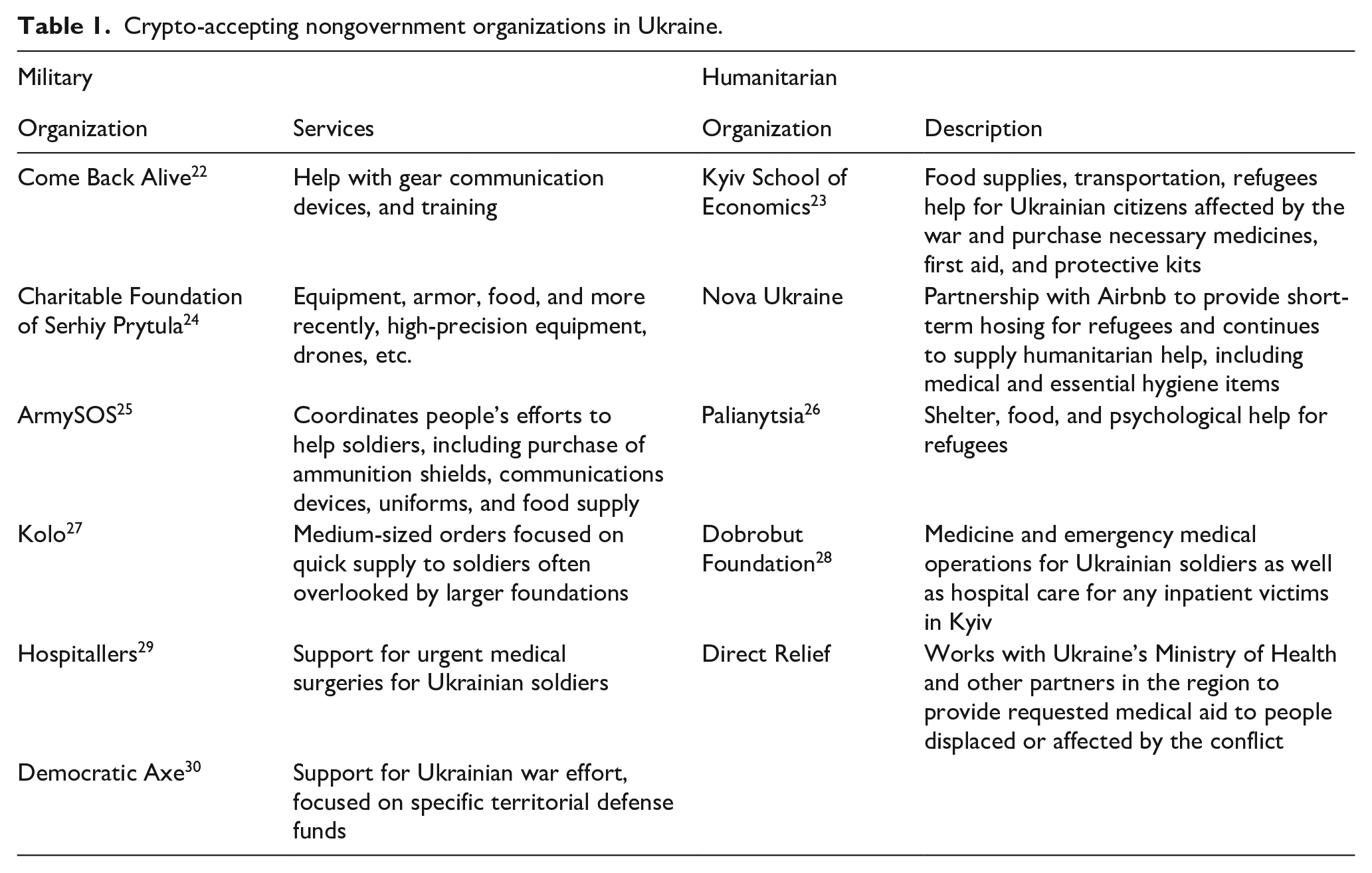
Here, we specifically examine the Serhiy Prytula Charitable Foundation. Since June 2022, this foundation has worked with WhiteBIT, a Ukrainian company providing crypto solutions for businesses and charity, including setting up payment pages. WhiteBIT offers solutions to provide aid for Ukrainian armed forces, the Ministry of Health of Ukraine, and humanitarian aid. 31 It was able to solicit donations from thousands of crypto users. 32 The company cooperates with over 50 foundations, including most of the nonprofits listed above. It also offers different reasons regarding why nonprofit organizations accept crypto. Some of these reasons include that cryptocurrency donations are highly secure and safe, crypto is accepted from anywhere in the world, donors can transfer crypto direct rather than donating with cash, donors can remain anonymous if they wish, crypto is quick and easy, and people who are active in crypto prefer to donate in digital currencies. 33
By December 2022, over 21 million UAH (Ukrainian Hryvnia crypto) had been raised. Roan Sinicyn, the Military Coordinator for the foundation, said that crypto allows for much more rapid donations in addition to convenience as blockchain donations can also take place on popular social media platforms such as Facebook. 34 Since the outbreak of the war, they have received Tether, Bitcoin, and Ethereum tokens.
Similarly, soon after Russia invaded, the Crypto Fund of Ukraine was started. According to Blockchain Association of Ukraine (bau.ai) President Mike Chobanian, the fund raised $50 million as of March 3, 2022. 35 As Figure 1 shows, information such as what coins have been donated and how much are easily available to donors and the public. Since crypto fluctuates, its value changes. That, too, is almost immediately apparent, as is the total donated to the fund.
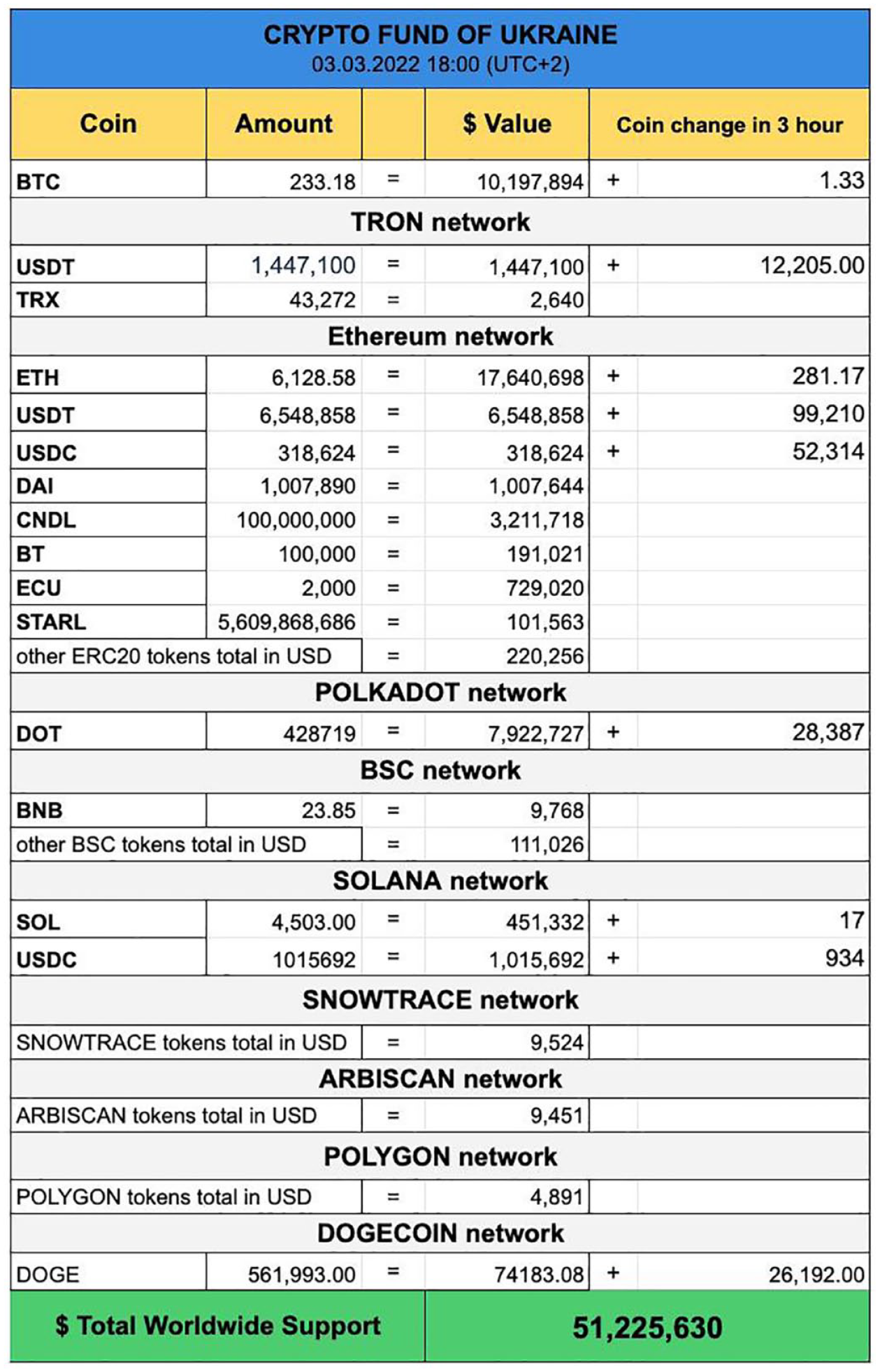
Crypto fund of Ukraine donations, March 2022.
NFTs and fundraizing for Ukraine’s War effort
In Ukraine, NFTs have had a significant impact that complements the extensive acceptance of cryptocurrency. This has especially been the case with Ukrainian art during the war. An example is MintForUkraine, which announced a global challenge to mint 1 million unique NFTs that record Ukrainian art on blockchains. The goal was to place Ukrainian work on blockchains, as well as to encourage people to make AI art inspired by famous Ukrainian artists. Once people have created new art, they can donate it, after which it could be bought and sold, with proceeds going to charity. Ukraine’s Vice President and Minister of Digital Transformation, Mykhailo Fedorov, tweeted “All funds as always will contribute to the Ukrainian victory. Ready, steady, NFT.” 36 The funds are used on cultural projects (10%) and to support military as well as people in territories affected by Russia’s invasion (90%). People can mint for free or donate their art.
In this realm, blockchains enable a new way to preserve culture. As the founders of the movement explain, “One may be able to destroy museums, but for every piece of culture destroyed, thousands will emerge in its place.” 37 In this way, blockchains provide a new way to preserve culture and a new way for people to participate in art. With AI, essentially anyone can be an artist. Another example is RELI3F, a Web 3 initiative started by artists to support Ukrainian artists. One hundred percent of primary sales of the AI art go to relief efforts in Ukraine and secondary royalties are distributed from second sales to those same charitable efforts or toward supporting Ukraine’s artists and art culture. 38
Organizational adaptation: The Kyiv School of Economics Charitable Foundation
The Kyiv School of Economics (KSE) Charitable Foundation is an education foundation with 20 years of fundraising experience. It was established in 2007 “as a subsidiary of its non-profit corporation in the United States, with a focus on humanitarian aid.” 39 According to Forbes, KSE Foundation is among the top fundraisers in Ukraine. KSE Charitable Foundation transformed into a wartime fundraising organization with a humanitarian aid campaign for Ukraine. 40 It provides military supplies, transportation, and medicines for those in need during the war. Its approach is innovative, including considering making everyone a KSE advisor who donates a certain amount. Donations incude vests, armored plates, protective helmets, first-aid kits, medical touniquets, and SUVs. 41 Companies and individuals around the world have joined the campaign and supported Ukrainians during the war.
When accepting donations, in addition to conventional bank transfers, KSE Foundation especially encourages cryptogiving. Currently, donors can give to support Ukraine through two crypto networks including the USDT ETH network and USDT TRX network. 42 The foundation provides for accountability and transparency with contributions during the war and reconstruction. It puts all the donations on a blockchain so that anyone can track, in real time, how their money has been used. This organizational use constitutes a new way of providing transparency. KSE Foundation has also provided NFTs, and Figure 2 is an example.
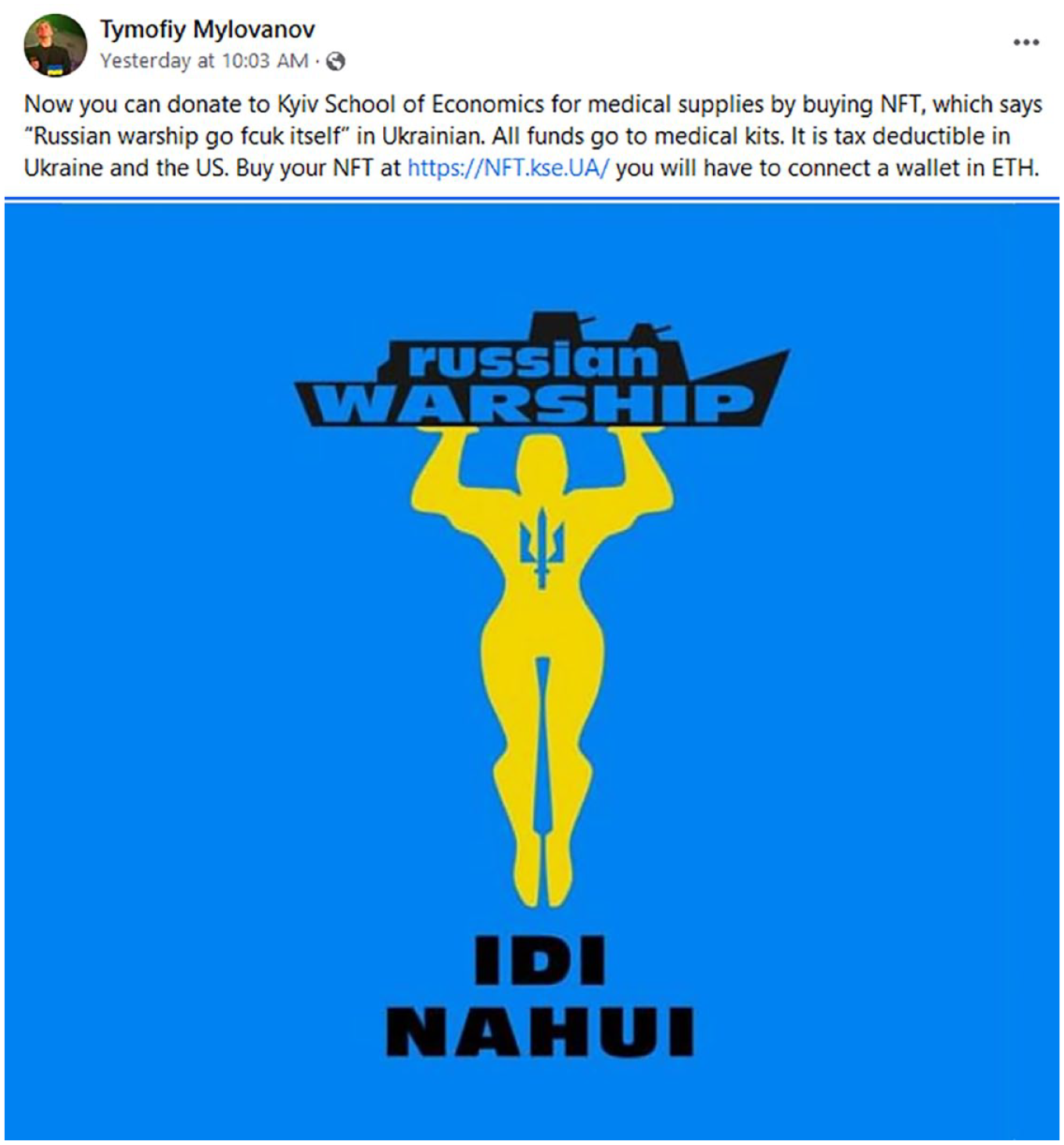
Ukrainian NFT from KSE.
According to Tymofiy Mylovanov, president of the Kyiv School of Economics in Ukraine, his daily routine now includes collecting crypto donations and NFTs “because they are raising a lot through crypto and NFTs.” 43
Discussion
Implications for nonprofits
Blockchain has created new opportunities for nonprofits and new ways to give. One of the major benefits of cryptocurrencies lies in its decentralization. It does not rely on central authorities like banks or governments to operate. By not going through any intermediaries, cryptocurrencies enable transactions between parties like donors and nonprofits without paying fees to middlemen (Makarov & Schoar, 2022). Cryptocurrencies are also much quicker to transact, which is beneficial during any emergency or natural disaster giving (Chen & Murtazashvili, 2023).
More importantly, cryptocurrencies can keep users’ information anonymous (Jafari et al., 2018). In the case of donation, cryptocurrencies can protect donors’ identities. The anonymity feature of cryptocurrency allows marginalized groups to transact freely (Folkinshteyn & Lennon, 2016). Additionally, an increased number of potential donors have lost their trust in nonprofits that have run into problems with corruption, but blockchains can make transactions more transparent by allowing donors to track their donations.
In addition, accepting donations in cryptocurrency will allow nonprofit organizations to increase their potential donor base, as there are currently more than 295 million crypto users around the world. 44 Put differently, nonprofits now have the potential to reach donors located all over the world. Similarly, crypto donations also attract younger donors like tech-savvy millennials and Gen Zs. In fact, 83% of millennial millionaires invest in crypto. 45
As aforementioned, lowered public trust in nonprofits has resulted in lowered donation amounts. For instance, the United Kingdom saw over 400 cases of charity fraud in 2022. 46 Nevertheless, the transparency of cryptocurrencies allows donors to track their charitable contributions. Blockchains can also enable donors and nonprofit organizations to measure impacts of donations.
Between 2020 and 2021, cryptocurrency donations jumped from $4.2 to $69.6 million. 47 According to the Fidelity Charitable study, “nearly half of cryptocurrency owners donated $1,000 or more to charity in 2020, compared to one-third of all investors.” In other words, crypto users are more likely to donate than other typical investors. 48 Nevertheless, 46% of crypto donors found it was hard to find nonprofits that accept cryptocurrency donations. 49 With the development of the blockchain technology, nonprofit organizations should take the opportunity to learn about cryptogiving, educate potential donors about cryptogiving, build infrastructure to accept cryptogiving, and build trust with their donors.
Regulating blockchain
There is a large literature which argues that blockchains should be regulated (Government Accountability Office, 2023; Werbach, 2018). Various fraud and bankruptcies involving blockchain-related products and services have been found. One major concern is that crypto assets threaten financial integrity (Narain & Moretti, 2022). Some crypto assets such as stablecoins could potentially replace official national currencies (Adrian et al., 2023). Some countries have attempted to ban crypto or have laws to limit crypto (Hendrickson & Luther, 2017). Ukraine, as noted, wanted to establish a crypto-friendly regime. However, it is not clear if there are any regulations on use of crypto by nonprofits. Hence, an issue to consider is whether there should be more development of a law for nonprofits that use blockchains, including crypto.
Because many nonprofits are tax exempt, some argue that new tax laws should be required for nonprofits to properly report crypto donations as tax-deductible charitable contributions. There is also a concern about the uses of blockchain during wartime. On the one hand, bitcoin and ether are providing humanitarian support. On the other hand, these same “blockchain for good” applications for humanitarian causes can also be used to support and prolong conflicts. During the current Russia-Ukraine War, crypto has been used by Russian militias, as well as to evade sanctions. But the available evidence as of February 2023 demonstrates a large increase in Ukrainian crypto compared to Russia since Russia’s full-scale invasion. 50 Hence, while blockchain provides some ability to evade policies by Russian forces, it has on balance appears to have been used much more by Ukrainians.
Future research
Blockchain for good applications sees blockchains as a technology of liberation. More generally, there are potentially two main ways blockchains matter. One is improving efficiency. The other is in redefining organizations. Both can be significant for understanding the success of the nonprofit sector in doing good for society. While there is a growing interest in using blockchain technology for charitable donations, not much literature among public administration and nonprofit scholars exists on blockchains. Hence, the extent to which blockchain provides good is not entirely clear.
There are many areas for future research on cryptogiving. More specifically, what is the impact of crypto on charitable donation? Does it increase donation amount, or is it just another way to donate? More research is needed to examine cryptocurrency’s effects on donor acquisition, retention and lifetime value, and whether blockchain technology introduces new donors or maintains existing philanthropists. In other words, understanding donor behavior and motivations will provide insight into whether blockchain donations expand charitable revenue streams or largely substitute for donations that would have occurred through traditional channels.
Researchers may also examine the connection between changes in donor demographics and cryptogiving. As we know, younger generations including millennials and Gen Z are more likely than older generations to engage with and donate using new technologies like cryptocurrency and NFTs (Bhilawadikar & Garg, 2020). A recent survey conducted by YouGov Omnibus indicate that half of American millennials are interested in using cryptocurrency. 51 Gen Z is also entering the workforce with high rates of familiarity and interest in blockchain and crypto finance. 52 Organizations like UNICEF have raised millions from Millennial and Gen Z donors through cryptocurrency donations to support Ukrainian children during the current war.53,54 Therefore, it would be interesting to investigate how change in donor demographics impacts cryptogiving and which, if any, specific strategies nonprofits should take to attract new and younger donors.
Another key question is whether blockchain donations are displacing other donation types. We can track the amount of cryptocurrency donations received, but there are limited data on whether these donors would have contributed through other methods if crypto was unavailable. For example, crowdfunding is another decentralized approach of online giving (Chen, 2023). Comparison between donations via blockchain versus crowdfunding in order to understand crypto donors’ motivations is an area to consider in future research.
In addition, it remains unclear as to how cryptocurrency affects donor trust and behavior. Why do some use blockchains for transparency, and others do not? This is especially significant if we consider many of the big organizations are the ones where corruption has been an issue. Another area to consider is whether those organizations are the ones least likely to adopt blockchains.
Moreover, from an organizational perspective, studies on integrating cryptocurrency into nonprofit operations, accounting, IT systems, and controls are lacking but essential for adoption. For instance, future research may examine the challenges balancing transparency, privacy, and security. As regulations evolve, analysis on the impacts of cryptocurrency oversight and transparency requirements for nonprofits will be valuable, including balancing compliance costs with accountability benefits.
There is not much existing research on the longer-term impact of NFTs on nonprofits beyond some evidence that some nonprofits are using them. Some donations, if the market for NFTs declines, may not be as valuable. There is also the concern raised about making AI art and how that may not be doing justice to the artists. While AI can make anyone an artist, the source of the open data is the product of individual artists. This raises issues with use of intellectual and creative property. While NFT charity auctions are growing, research on appropriate cause selection, platform partnerships, auction formats, and bidding dynamics is sparse but could optimize nonprofit strategy. Partnership opportunities between artists and nonprofits merit study as well.
Additionally, there are risks that should be considered. Is there a need for regulation of nonprofits that use blockchain? Does blockchain create a race between good and bad uses? For example, while crypto can be used to make more efficient transactions for “good” nonprofits, it can also be used to support those seeking to evade “good” sanctions, or to support criminal organizations. Hence, anyone interested in the good would do well to consider the potential bad applications of blockchains.
Technology enables us to see what is happening more than ever before. Blockchains are a proven technology of coordination, one with unprecedented openness. For this reason, a critical question for scholars interested in the nonprofit sector is why and how blockchains are deployed by NGOs that often play a leading role in crisis management and response. Along these lines, a significant question is to explain variation in how nonprofits use blockchains. Who leads in accepting cryptocurrencies? From the discussion above, we have seen that some national “cultures” appear especially amenable to blockchain use for crises. There is also recognition that cultures influence altruism (Cai et al., 2022). Future research might consider what constitutes a “civic tech” culture and how those norms and values contribute to more adapt uses of novel technologies.
Since the public good of crisis response is coproduced, the question above cannot be separated from public administration. How are governments responding to opportunities to work with NGOs that are using blockchains for their activities? Blockchains promise opportunities for government to coordinate with NGOs. Though there are such opportunities, governments appear to have been slow to adopt blockchains for crisis response. Public administration scholars can offer further insight into why and provide actionable strategies for the public sector.
Contributions and conclusion
Despite increasing emphasis on how blockchains are administered, there is a comparative lack of emphasis on the ways blockchains are deployed in the public and nonprofit sector. The nonprofit sector plays a critical role in civil society. However, nonprofits have been suffering from a lack of accountability and transparency, which has ultimately led to decreased donations. As blockchain technology can fill in this gap and enables new cryptocurrencies and NFTs, scholars also call for a better understanding of cryptoaltruism or cryptogiving (Novak, 2023). The subsequent use of crypto by nonprofits is another significant example of how technology is being used to contribute to collectively provided goods. This paper, therefore, answers the call and contributes to the literature on cryptoaltruism.
We also contribute to research on Ukraine. Our study examines the way Ukrainian civil society has responded to Russia’s unprovoked war, which provides insight into how blockchain matters for nonprofits. As the examples from Ukraine illustrate, nonprofits there are extensively using blockchain. They do so by accepting cryptocurrencies and through innovative use of NFTs to raise funds to respond to crises. Blockchains are used to address challenges with transparency and accountability.
More importantly, the finding of this paper suggests that blockchains matter to nonprofits and civil society in general, especially during crisis times. The nonprofit sector also provides opportunities to consider more general questions with blockchains. Are they a general-purpose technology or an institutional technology that redefines opportunities for collaboration? Our case study of the Russia-Ukraine War suggests that there is clearly evidence that blockchains are a new technology that contributes to more efficient activities of nonprofits. They also provide something unique and novel. The use of NFTs to preserve culture and to raise funds is innovative, as is the use of this technology to improve trust. There is less evidence that blockchains are fundamentally redefining the organization of the nonprofit sector. Still, what is clear is that blockchain communities are a network and that network, which arises around blockchain, can be quickly mobilized to provide support.
Ukraine’s rapid deployment of crypto to respond to challenges posed by Russia’s unprovoked invasion are useful to illustrate the promise of blockchains in the nonprofit sector, as well as the significance of the emergent fields of cryptoaltruism and cryptogiving. However, this single case, and the experience from Ukraine may not generalize. Further, uncertainty remains surrounding how much these uses will “stick,” or whether nonprofits will return to more traditional ways despite these initial experiments with blockchain technology. Therefore, it is necessary to continue to extend the emergent agenda on cryptoaltruism and its role in the nonprofit sector.
Footnotes
Declaration of conflicting interests
The author(s) declared no potential conflicts of interest with respect to the research, authorship, and/or publication of this article.
Funding
The author(s) received no financial support for the research, authorship, and/or publication of this article.