




Abstract
The article presents a content analysis of assessments of the International Monetary Fund (IMF) and World Bank in parliamentary debates in Russia (1998–2008) and Ukraine (2010–2019) in order to understand the position of domestic actors in cases of conditionality-based international support. Russia and Ukraine offer the opportunity to compare periods with and without an active loan agreement with the IMF for domestic actors across the full political spectrum. In addition, the World Health Organization and the International Labour Organization are included in the analysis to allow a comparison with international organisations not working with financial conditionality. The analysis examines the general image of international organisations and differentiates between political camps and policy fields, with a special focus on social policy.
Introduction
International organisations (IOs) are seen as major actors in transnational policy-related knowledge transfer. 1 In this context, academic research on social policy has strongly focused on the content 2 and policy implications of the ‘Washington Consensus’ – a set of neoliberal policy prescriptions promoted by, among others, Washington-based international financial organisations as part of conditional loan agreements (e.g. Appel and Orenstein, 2018; Babb, 2013; Ban and Gallagher, 2015; Béland and Orenstein, 2013; Broome, 2015; Farnsworth and Irving, 2018; Kentikelenis and Seabrooke, 2017; Li et al., 2015; Sabatovych, 2016; Schlaufer, 2019; Vadlamannati, 2019).
The role of the Washington Consensus and related conditionality in national political debates and decision-making processes has gained much less attention in academic research. A major reason for this is most likely that ‘the structural adjustment policies of the World Bank and International Monetary Fund (IMF) have long been criticised as a coercive form of economic reform measures’ (Stone, 2012: 491), a state of affairs which – by definition – does not give agency to the recipient state.
In order to highlight the agency of domestic political actors this article examines the position and role of political elites in Russia and Ukraine in relation to neoliberal conditionality. The analysis is based on a content analysis of parliamentary debates in Russia (1998–2008) and Ukraine (2010–2019). The two countries offer the opportunity to compare periods with and without an active loan agreement with the IMF for domestic actors across the full political spectrum. In addition, the World Health Organization (WHO) and the International Labour Organization (ILO) are included in the analysis to allow a comparison with IOs not working with financial conditionality. The analysis differentiates between political camps and policy fields, with a special focus on social policy.
This articles starts with a brief summary of the state of research. It then elaborates on the case countries and the research design. Next, the presentation of results looks at the general image of the four IOs included in the analysis, at the positions of different political camps and at the role of social policy in the debates about the IOs. The implications of the results for political decision-making processes and related transnational knowledge transfer are discussed in the conclusions.
State of research
The messages delivered by the IMF and like-minded IOs have already been scrutinised (most recently by Farnsworth and Irving, 2018; Schlaufer, 2019). The role of the IMF as one actor among many in specific national policy debates has also gained some attention in the academic literature, namely in the context of austerity measures (as exemplified by Moury and Standring, 2017). As the Washington Consensus was a driving force in post-socialist economic reforms in Central and Eastern Europe, the role of IOs, and most notably the IMF, has also been broadly analysed in the respective area studies literature.
One major feature in this literature is the unpreparedness of IOs in the face of socialist legacies.
The end of subsidies, full employment, and enterprise-based social provision created enormous pressure for welfare-policy reform. Yet neoliberal economic advisors – long used to dealing with developing countries that lacked extensive social policies – largely ignored state welfare programs aside from unemployment insurance (a key element of neoliberal reform programs in Central and Eastern Europe). [. . .] The neoliberal ‘Washington Consensus’ was clear on trade policy, market liberalization, and privatization, but had little to say on the social-sector restructuring that was to become such a large part of postcommunist transformation. (Orenstein, 2008: 84–85)
Again, the focus of the academic literature is much more on the content and policy implications of the respective advice than on national debates and decision-making. As Manning (2003) summarises for Russia: ‘For others, and in particular Russia, the heavy hand of the International Monetary Fund (IMF) made loans and credits dependent on following a liberal ideology in which an American-style residual welfare state was paramount’ (p. 20).
At the same time, some authors point to broad differences when comparing the policy outcomes in post-socialist countries in Central and Eastern Europe. Beazer and Woo (2016) argue that [r]ather than universally benefiting or harming reforms, the effects of stricter IMF conditionality depend on domestic partisan politics. More IMF conditions can pressure left-wing governments into undertaking more ambitious reforms with little resistance from partisan rivals on the right; under right governments, however, more conditions hinder reform implementation by heightening resistance from the left while simultaneously reducing leaders’ ability to win their support through concessions or compromise. (p. 304)
Obviously, partisan politics between different political camps unfold and gain force in national political debates.
However, the literature that includes national political arenas in its analysis mainly focuses on the ‘translation’ of neoliberalism, not on challenges to it or outright rejection. Thus, Bönker et al. (2002) claim, [It] cannot be said that the neoliberal discourse was forced on the post-communist countries from the outside, even though the international financial institutions very soon assumed the mandate for overseeing the economic reform process in Eastern Europe. The ‘elective affinity’ between East European reformers and Western advisers probably runs deeper than is often assumed. (pp. 5–6)
This was partly by design, as Darden (2009) argues on the example of Ukraine: The country ‘was the beneficiary of numerous training programs for midcareer officials, an active Western diaspora, and copious amounts of Western aid designed to promote liberal ideas and policies within the administration’ (p. 177). 3
In a slightly different perspective, Hirt et al. (2013) state that ‘through a “ritual of listening to foreigners”, these elites [in Central and Eastern Europe] skilfully directed Western aid, thus influencing both the implementation and the design of aid programmes’ (p. 1245). They speak of a rich variety of national and local responses, which modify the mainstream theory and convert it into ‘actually existing’, context-dependent realities. These realities are produced by the intersection of the neoliberal credo with local, inherited and path-dependent institutional structures, regulatory regimes and cultures. (Hirt et al., 2013: 1245)
In summary, the ways in which IOs are perceived in national politics, that is, their broader ‘image’, have so far been addressed only partially, with reference to neoliberal domestic elites (Bönker et al., 2002; Broome and Seabrooke, 2015; Darden, 2009) and in relation to domestic partisan politics (limited to the left-right cleavage by Beazer and Woo, 2016). That is why, this analysis aims to add to the literature the broader picture of how the role of IOs is perceived by national political elites. At the core of the analysis are the IMF and the World Bank, as they are often treated as synonymous with the conditionality-based promotion of the Washington Consensus. For comparison, the WHO and the ILO are included. Both often support similar projects, but do not use broad conditionality and are portrayed as more technocratic (and therefore less ideological) in the related literature (on the WHO see e.g. Chorev, 2013; Clift, 2013; Fee et al., 2016; Gautier et al., 2014; Gostin et al., 2015; Ruger, 2014; on the ILO see Bellace, 2019; Gironde and Carbonnier, 2019; Hovary, 2018; Maul, 2019; Sinclair, 2019: part I).
Case countries
The perception of IMF and World Bank in national politics is most likely dependent on the relation of a specific country with them (first of all in terms of conditionality-based agreements or their absence) and on the political orientation of domestic political forces (i.e. more or less inclined to the neoliberal agenda advanced by these IOs). That is why two countries have been selected for the analysis, which have experienced distinct episodes of cooperation and rejection in relation to the IMF and which have a pluralist political party system. As a result, the analysis comprises four cases: For cooperation Russia in 1998/99 (abbreviated RF+) and Ukraine from 2014 to 2019 (abbreviated UA+), and for rejection Russia from 2000 to 2008 (RF–) and Ukraine from 2010 to 2014 (UA–).
When Russia was facing financial default, it agreed to a US$23b financial package with the IMF and World Bank in Summer 1998, which included far-reaching economic and social reforms (cf. e.g. Gould-Davies and Woods, 1999). When Vladimir Putin was elected president in 2000, his agenda included the restoration of Russia as a great power (e.g. Rutland, 2000). Realisation of this aim was strongly promoted by a long-lasting economic recovery based on exports of natural resources. In US dollar terms the country’s gross domestic product rose more than eight-fold between 2000 and 2013. As part of a larger strategy to pay down foreign debts, Russia had fully repaid its debt to the IMF by 2005. A similar approach of emancipation from foreign support was embraced in relation to international knowledge transfer, leading ‘to the ousting of Western donors, whose place was taken by Russian government structures’ (Belyaeva, 2019: 402).
The period under investigation covers the IMF agreement during the presidency of Boris Yeltsin and the first two terms of President Putin. While the political party system underwent considerable change in this period, there consistently existed a left-wing opposition (most prominently in the form of the Communist Party), a populist right-wing party (the LDPR) as well as parties loyal to the government, the so-called parties of power (which underwent several re-configurations). The liberal opposition was no longer represented in parliament after the 2007 elections. Russia’s political regime became increasingly authoritarian over the period covered in this analysis. Moreover, political parties and formal institutions in general were not the major loci of political power. However, concerning cooperation with IOs parliament was the major arena of debates and freedom of expression was not restricted on related issues (cf. e.g. Noble, 2019, for a broader assessment Hale, 2015).
Due to its vulnerable financial position, Ukraine has been in regular negotiations with the IMF since independence. As a result, the country has become one of the biggest recipients of IMF support on record. In 2010, the IMF approved a new US$15b loan for Ukraine. However, the Ukrainian government was not willing to enact the required reforms and as a result did not receive any financial support from the IMF after the first tranche had been paid. Instead, the political leadership under then president Viktor Yanukovych opted for a loan agreement with Russia. The situation changed in 2014. After the Euromaidan protests, the new Ukrainian leadership promoted increased integration with the ‘West’ and IOs. In 2014, the country received over US$4b as part of a stand-by agreement with the IMF. In the following year, a new broader package was arranged, which was substantially enlarged by the EU and others, providing total support of US$40b. As a result, Ukraine’s relation with the IMF (and in consequence the World Bank) as well as the EU was clearly dominated by conditionality (cf. e.g. Kirchner et al., 2015).
The period under investigation covers the presidency of Viktor Yanukovych from 2010 to 2014, marked by de facto rejection of the IMF agreement, and the presidency of Petro Poroshenko, which started with the conclusion of a new agreement. Ukraine’s political party system was rather fluid, but over the whole period there was a group of parties in favour of ‘Western integration’ (the so-called Orange Camp) and a party opposed to that integration – the Party of Regions and its successor the Opposition Bloc (the so-called Blue Camp). The Communist Party lost its parliamentary representation in 2014, while a right-wing populist party was represented since 2012 (first ‘Svoboda’, later the ‘Radical Party’). While Ukraine’s political regime has been described as competitive authoritarian for the Yanukovych presidency and can be described as defective democracy afterwards, concerning cooperation with IOs parliament was the major arena of debates and freedom of expression was not restricted on related issues (cf. e.g. Pleines, 2016).
Research design
In order to assess the perception of the IMF, World Bank, WHO and ILO, the transcripts of all parliamentary debates in the period under study were searched for their names (including all grammatical cases as well as abbreviations). 4 While media reporting about any topic is more visible in the public arena than parliamentary debates, parliamentary debates offer direct access to the position of political actors. In this context, it is important to note that the parliamentary debates do not only feature representatives of the main political parties but also prominent members of the state executive, including ministers and prime ministers. They thus give a comprehensive overview of the public statements of leading politicians on their perceptions of the four IOs under study.
Rhetoric can, of course, be tactical, but as Rutland (2013) elaborates on the case of Russia, this does not mean that it is just ‘cheap talk’: ‘Neoliberalism’ was invoked for tactical reasons by both sides of the political divide. [. . .] The Russian case shows that in times of tumultuous change, broad and bold theories about how economies work can gain a ready ear amongst harassed politicians desperate for solutions to the challenges they face. However, the political exigencies under which those ideas are taken up and implemented typically carry the resulting policies far beyond the initial conceptions of economic advisers. [ . . .] Hence, the Washington Consensus is best understood as a highly conflictual interaction between the dominant transnational policy paradigm and the specific political challenges facing leaders in individual countries such as Russia. (p. 358)
In such a situation, the interpretation of policy agendas and normative assessments voiced in parliamentary debates is a research challenge (Slapin and Proksch, 2014: 135–141). In order to allow for generalisation and comparison, references to the four IOs were analysed through the coding of frames. Following Entman (1993), To frame is to select some aspects of a perceived reality and make them more salient in a communicating text, in such a way as to promote a particular problem definition, causal interpretation, moral evaluation, and/or treatment recommendation for the item described. Typically frames diagnose, evaluate, and prescribe. (p. 52)
In this analysis, references to the role of IMF, World Bank, WHO and ILO have been grouped into three general frames deductively.
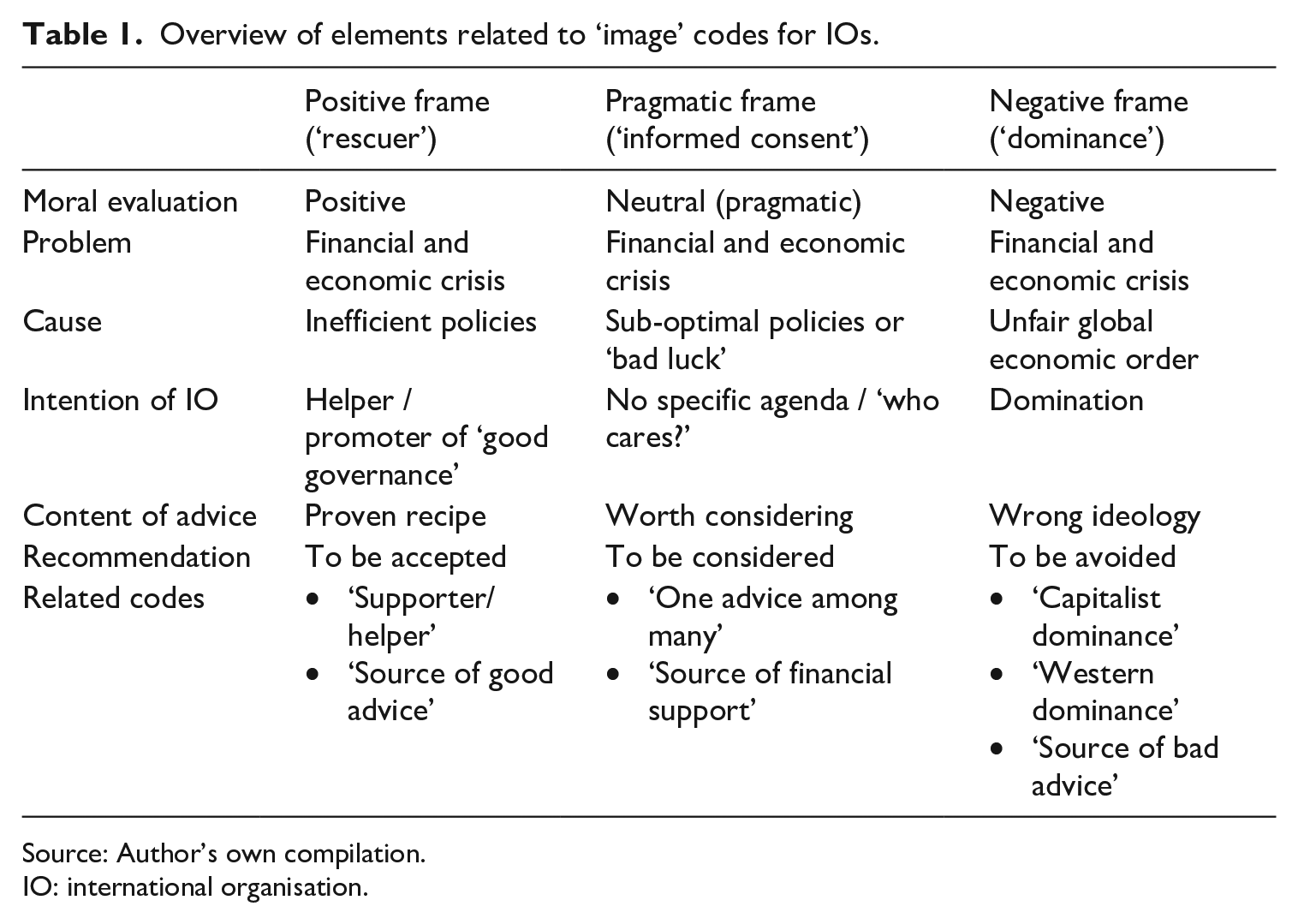
The standard positive frame is the one produced by the IOs themselves, which sees them as offering sound advice promoting ‘best practices’ and ‘good governance’. This credits them with the potential to help countries back on a track of sustainable development. The IOs give active advice when countries are in need of support, so that they assume the role of a ‘rescuer’. Respective codes are ‘supporter/helper’ and ‘source of good advice’.
In sharp contrast, the common negative frame sees their policy advice as based on a harmful ideology or lack of country-specific knowledge, which often leads to counterproductive results and which is forced upon countries. This can be presented as global hegemony of neoliberal ideas or as a form of ‘neo-colonialism’, as the leadership of those IOs is dominated by ‘Western’ countries. Respective codes are ‘capitalist dominance’, ‘Western dominance’ and ‘source of bad advice’.
Assigning less power to IOs, the pragmatic frame would argue that their financial support as well as policy advice might be helpful, but that, in the end, it is down to individual countries to make their choice. This frame could thus be termed ‘informed consent’. Respective codes are ‘one advice among many’ and, for IMF and World Bank, also ‘source of financial support’.
Important elements of these frames relate to perceived intentions of the IOs and to an assessment of the content of their advice (i.e. the design and potential impact of specific policy measures). An overview of core elements of the respective frames is given in Table 1.
Overview of elements related to ‘image’ codes for IOs.
Source: Author’s own compilation.
IO: international organisation.
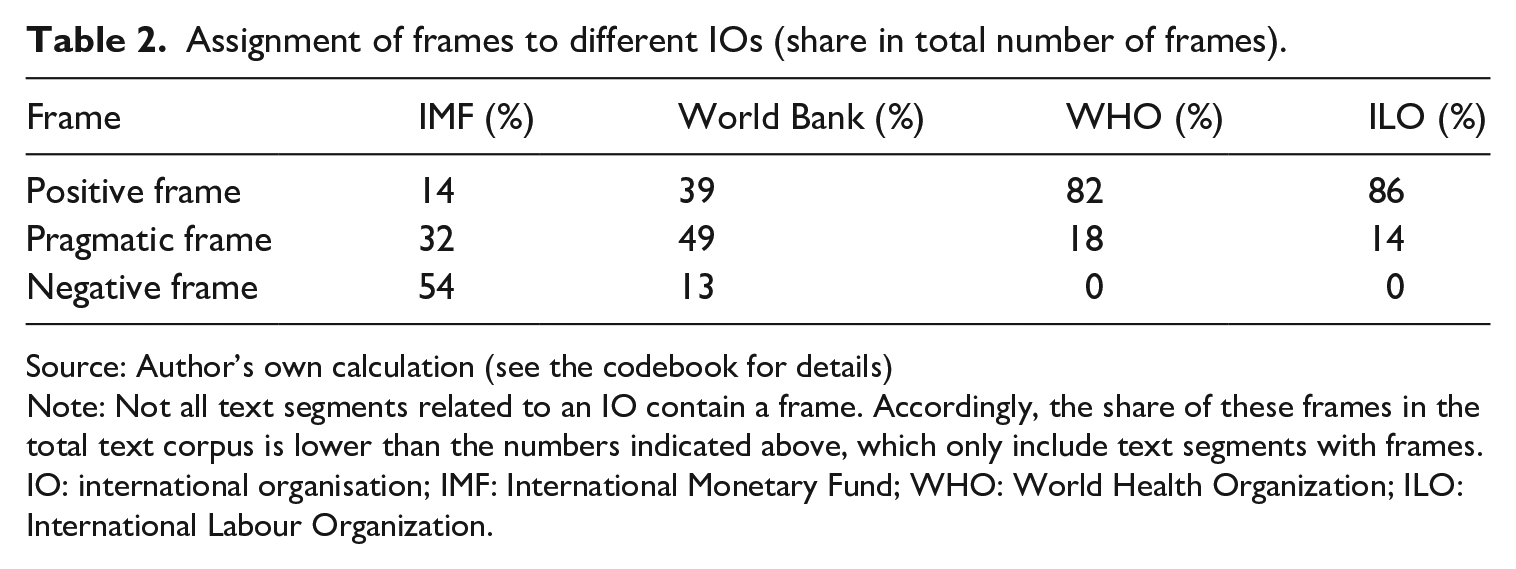
A minimalist approach to frames was used in the content analysis, which requires only a clear identification of a distinctive element in order to assign a frame, but not necessarily a broader description of different elements of that frame. Table 2 provides an overview of the assignment of the three frames to the four IOs in the overall text corpus of Russian and Ukrainian parliamentary debates.
Assignment of frames to different IOs (share in total number of frames).
Source: Author’s own calculation (see the codebook for details)
Note: Not all text segments related to an IO contain a frame. Accordingly, the share of these frames in the total text corpus is lower than the numbers indicated above, which only include text segments with frames. IO: international organisation; IMF: International Monetary Fund; WHO: World Health Organization; ILO: International Labour Organization.
However, a substantial number of references to the IMF, World Bank, WHO or ILO in parliamentary debates did not relate to the deductive frames presented above. Based on the actual text corpora, an inductive list of further codes was compiled. They are, in principle, compatible with all three of the above-mentioned frames, but in the text corpora studied they are often used without any specific framing attached. They can be ordered into three groups:
IOs as source of data and economic forecasts and as source of standards and rules (e.g. in the form of international conventions, but also in the form of bi- or multilateral international agreements). Respective codes are ‘source of data/forecasts’ and ‘source of standards/rules’.
Administrative issues related to the IOs, namely membership fees and rights, as well as the organisation of events. Respective codes are ‘role as member state’ and ‘event organiser or participant’.
Demanding information in order to hold to account the IO or the national government for its relations with the IOs. This typically concerns either perceived secrecy around negotiations and agreements or alleged embezzlement of financial payments made by the IOs to the country under study (i.e. Russia or Ukraine). The respective code is called ‘asking for account’.
In addition to frames, the speaker (i.e. the person making the respective statement in a parliamentary debate) and all policy fields related to the discussion of the role of IMF, World Bank, WHO or ILO have been coded. 5 The codebook and quantitative results of the content analysis will soon be available online at www.discuss-data.net (for details on Discuss Data see Heinrich et al., 2019; Heinrich and Klein, this issue).
Results
In all four cases, the IMF is by far the most often mentioned of the four IOs included in the analysis. For obvious reasons the IMF is more visible in the periods with an active loan agreement, but it is also much more visible in the debates in Ukraine than in Russia. There are on average 167 individual speech segments per year referring to the IMF in Ukraine’s parliamentary debates during the period with an IMF agreement (UA+), while the same measure stands at 94 segments for Ukraine without an active agreement (UA–). For Russia during the years with an agreement (RF+) the figure is 82 and without an active agreement (RF–) just 11 segments per year could be found.
The World Bank receives less attention in parliamentary debates. Moreover, in a third of all references (112 out of 323) the World Bank is mentioned in tandem with the IMF. References to the WHO (only 115 in total) focus on WHO conventions. For example, most of the references to the WHO in the Russian parliament during the second period (RF–) refer to the WHO Framework Convention on Tobacco Control. References to the ILO are more frequent (277 in total) and mostly relate to different ILO conventions.
The general image of the IOs
Concerning the image of the IMF, the negative frame, as described above, is generally prominent. In the case of Russia with an IMF loan agreement, 41% of the speech segments related to the IO links it to the negative frame. The figure drops to 33% for the following eight years without an agreement. In the case of Ukraine, the same figure stands at 41% for the period without active cooperation and at 44% when there was a new agreement.
Though not explicitly employing the negative frame for the IMF, the code ‘asking for account’ nevertheless casts cooperation with the IMF in a bad light. The argument made in the respective speech segments often refers to secrecy, implying that the national government must have bad intentions when it is not willing to provide information about the relations with the IMF. Equally common are accusations of corruption, where the national government is accused of embezzling funding provided by the IMF. Of course, this aspect is especially relevant in the periods with an active IMF agreement. In the respective years for Russia (i.e. RF+ in 1998/99) ‘asking for account’ is part of 32% of all speech segments related to the IMF.
Any positive framing of the IMF, however, is largely absent. In the case of Russia, it appears in less than 3% of all speech segments dealing with the organisation. In Ukraine’s parliamentary debates the respective figure is 6% for the time without agreement and 15% for the period with an active agreement. The overall difference between Russia and Ukraine in the assessment of the IMF is in line with the broader foreign policy stance of the two countries, as outlined in the section on the case countries above.
In the parliamentary debates, the pragmatic approach is seldom used as a full frame. In the case of Russia, only 2% of the speech segments related to the IMF contain it, and in the case of Ukraine 6%. Instead, references to the pragmatic frame are part of a technocratic discourse linked to conditionality and lack of alternative sources of funding. This discourse focuses not on ideology, specific policy measures or quality of advice but simply on ways to finance the state budget. It appears in 37% (RF+), 53% (RF–), 30% (UA–) and 10% (UA+) of the IMF-related speech segments. This issue is obviously more often discussed in periods when funding from the IMF is not available, but considered desirable by some political actors.
Even further away from a full frame as defined above are references to the IMF as source of data, economic forecasts or standards. They appear in 2% (RF+), 19% (RF–), 10% (UA–) and 25% (UA+) of the IMF-related speech segments. These references implicitly perceive the IMF as a reliable or important source, but this does not necessarily have broader implications for the image of the organisation.
For the World Bank, the overall framing follows a very similar pattern, especially in the case of Russia. In the case of Ukraine, the major difference is that the negative frame is not prominent, appearing in only 5% of all World Bank–related speech segments, compared to over 40% for the IMF. The same is true for the code ‘asking for account’. Accordingly, in Ukrainian World Bank–related speech segments the positive frame is much more visible, standing at 36% (UA+) and 21% (UA–), as are references to data, economic forecasts and standards from the World Bank with 37% (UA+) and 44% (UA–).
For the WHO a completely different picture emerges. There is not a single reference to the negative frame. In the periods with a larger number of WHO-related speech segments the share of the positive frame stands at 19% (RF–) and 23% (UA+). However, the WHO is first of all perceived as a source of data and standards, with a share of 89% (RF–) and 57% (UA+), in the relevant speech segments.
Similar to the WHO, the ILO has only four references to the negative frame in the whole text corpus, while the positive frame accounts for 32% of all speech segments (even higher in Ukraine and lower in Russia). Like the WHO, the ILO is first of all perceived as a source of data and standards, with a total share of 59% in all ILO-related speech segment (again the share is higher in Ukraine and lower in Russia).
The perspectives of different political camps
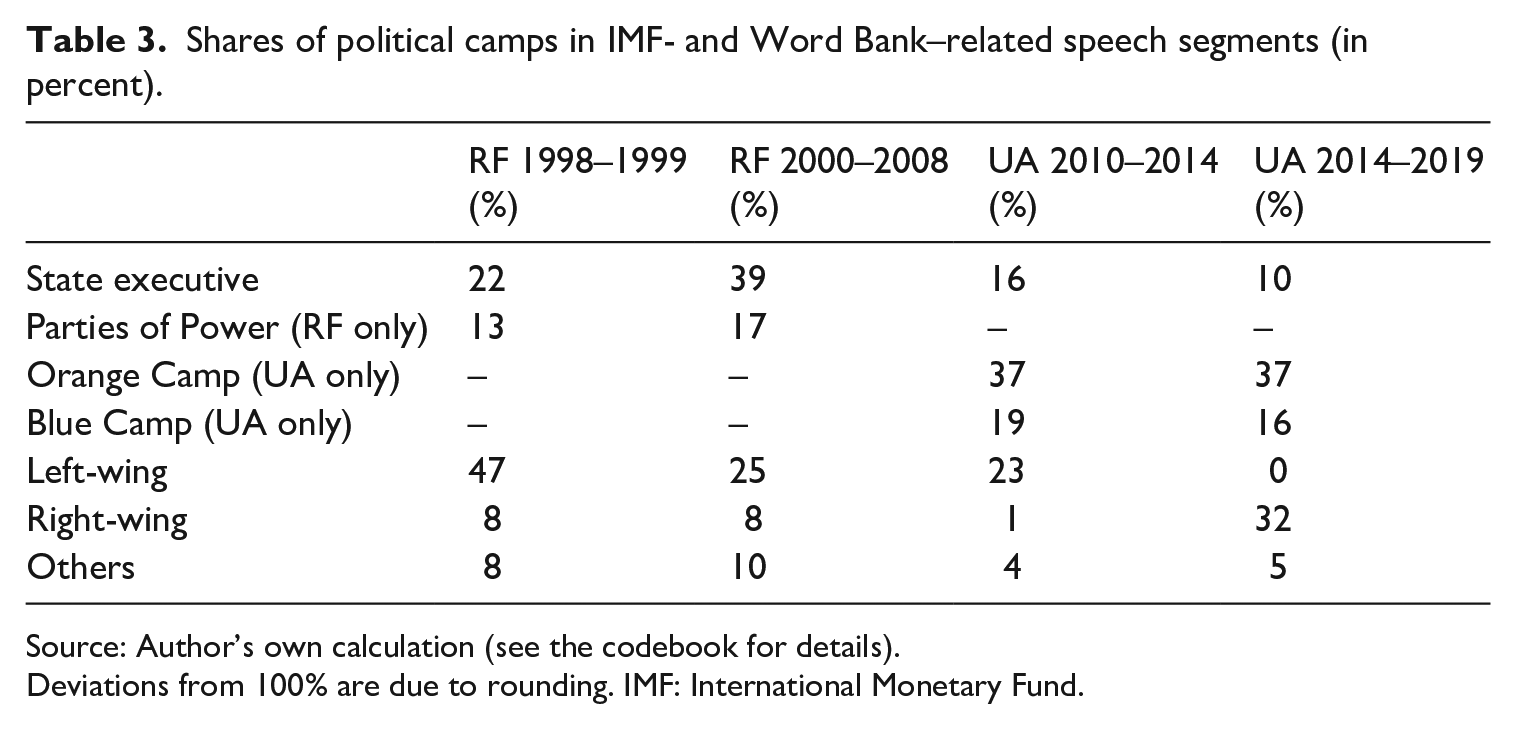
In the Russian parliament, left-wing parties dominate the discussion of the role of the IMF and World Bank, being responsible for about a third of all speech segments. Their dominance is even stronger in 1998/99, standing at close to 50% at a time when they also accounted for nearly half of all deputies and a member of the Communist Party served as Speaker of the Duma. In the discussions about IMF and World Bank, members of parliamentary factions close to the government – the so-called ‘parties of power’ with a centrist position – also play a prominent role with a share of 20%. Representatives of right-wing populism – namely the LDPR – account for another 7% of the speech segments. It is telling that even in 1998/99, when their share of Duma seats exceeded 10%, liberal deputies were largely absent from the debate about the role of IMF and World Bank, accounting for just 2% of the relevant speech segments. At the same time, representatives of the state executive have a substantial share in parliamentary debates (for an overview see Table 3).
Shares of political camps in IMF- and Word Bank–related speech segments (in percent).
Source: Author’s own calculation (see the codebook for details).
Deviations from 100% are due to rounding. IMF: International Monetary Fund.
The representatives of the state executive strongly focus on the technocratic discourse when discussing relations with IMF and World Bank. Two-thirds of all their speech segments related to the two institutions deal with the IOs as source of financial support. On a distant second place are references to data, economic forecasts and standards with only 14%. A mere 7% of all speech segments contain references to the positive or negative frame. In the case of the parties close to the government, the picture is very similar. Technocratic speech about the role of financial support accounts for half of all relevant speech segments. However, the negative frame is much more prominent, with a share of 28%.
Left-wing parties clearly favour the negative frame, referring to it in 45% of their IMF- and World Bank–related speech segments. The other dominant code is ‘asking for account’ with a share of 30%. This mainly takes the form of accusations of embezzlement against the national government and the central bank. The right-wing populist party LDPR focuses nearly exclusively on the negative frame, which accounts for two-thirds of all speech segments, with all other codes in single-digit numbers.
In the case of Ukraine, power changed between the two major political camps during the two periods under study: in 2010–2014 (UA–), the Party of Regions (referred to as Blue Camp in Ukraine) was in power, while in 2014–2019 (UA+) some parties of the Orange Camp formed the government. The Blue Camp presents itself as the defender of Russian culture, and promotes an open foreign policy and an active role of the state in the economy and social policy. In this respect it is very close to the Communist Party, which lost its parliamentary representation in the 2014 elections. The Orange Camp comprises a large number of pro-Western political parties, united around EU integration, but with significant infighting. In addition, since the 2012 elections a small populist right-wing faction is represented in parliament (for an overview of their shares in IMF- and World Bank–related speech segments, see Table 3).
During the Yanukovych presidency, representatives of the state executive focused in their speech segments on the IMF and World Bank as source of data, economic forecasts and standards (35%), on the technocratic aspects of financial support (30%) and on the positive frame (21%). The pro-government faction in parliament, however, gave more attention to the negative frame (21%) than to the positive one (14%). It also used the pragmatic frame (17%). In addition, it questioned the IMF negotiations of the preceding government, holding it to account in 15% of all relevant speech segments. It also referred to the IMF as source of finance (17%) and to both IOs as source of data and standards (14%).
The oppositional Orange Camp had a similarly diverse perspective on IMF and World Bank. The positive frame was strongest with 22%, but the negative frame (11%) and the pragmatic one (8%) also featured. In addition, IMF and World Bank were often mentioned as source of data and standards (32%) and financial support (21%). In sharp contrast, the Communist Party focused nearly exclusively on a negative framing of the IMF (88%).
During the Poroshenko presidency, representatives of the new state executive presented a clear picture. The positive frame (32%) was combined with references to the two IOs as sources of data and standards (37%) and finance (25%). The parliamentary factions of the Orange Camp, however, were more diverse. The positive frame (26%) was accompanied by references to the negative frame (9%) and the pragmatic one (also 9%). References to the IMF and World Bank as sources of data and standards dominated with 36%. References to financial support accounted for 15%.
The now oppositional Blue Camp focused on the negative frame (45%), while the positive frame (7%) and the pragmatic one (also 7%) received only limited recognition. Moreover, the dominance of the negative frame is reinforced by 11% of IMF-related speech segments holding the state executive to account. At the same time, references to the two IOs as sources of data and standards (18%) or finance (10%) were relatively few. The most critical assessment, however, came from the populist right-wing party, which concentrated on the negative frame (73%). Apart from references to IMF and World Bank as sources of data and standards (12%), all other codes have a share of less than 5%.
The picture is much more uniform for the WHO and ILO. There is hardly any discernible difference between the political camps, as all focus on the WHO and ILO as sources of standards and give some prominence to the positive frame. The only notable exception are WHO-related statements by Russian left-wing parties (accounting for a total share of 22% of all WHO-related speech segments in the Russian parliament), which are limited to referencing the WHO as a source of data and standards without any mention of any frame, as defined above.
The role of social policy
In line with the prominent role of the technocratic discourse about the IMF and World Bank as sources of funding, 44% of all relevant speech segments addressing a specific policy field relate to the state budget and monetary policy. As the negative frame of the IMF and World Bank, which is also rather common in the parliamentary debates examined here, is related to the neglect of people’s needs and demands for strong cuts to social security provisions, social policy plays an important role in related debates, too. About a third of all relevant speech segments that address a specific policy field deal with social policy.
The major issue in the case of Ukraine is pension reform, which alone accounts for 10% of all IMF- and World Bank–related speech segments. Health policy is discussed in both countries (with a share of about 3% in both countries). References to social policy are mostly employed by advocates of the negative frame. In Ukraine from 2010 to 2014, half of all references to social policy come from the Communist Party, with less than 8% of seats and a share of 23% in IMF- and Word Bank–related speech segments in general. Most of the Communist Party’s statements related to social policy deal with pension reform. In a typical statement the head of the party, Petro Symonenko, declared in the parliamentary debate on 25 October 2013 that the aim of the pension reform is to free oligarchs (i.e. big business) from any responsibility for the elderly and to fulfil the demands of the IMF for interest payments. 6 In this line of reasoning, there would be no problem to finance proper pension payments, if business would meet its obligations and Ukraine would not pay the IMF. However, in the respective debates the faction of the Communist Party does not present any specific proposals for an alternative pension reform. All statements focus on blame attribution.
In the following period from 2014 to 2019 nearly half of all references to social policy within the debates about IMF and World Bank come from the right-wing populist party with less than 5% of seats and a share of 32% in IMF- and Word Bank–related speech segments in general. The major message concerning social policy is summarised by the party’s head Oleg Lyashko in a statement on 20 November 2018, where he claims that the end of the government’s ‘shameful’ policy of dependence on foreign capital would mean ‘the return of jobs to Ukraine, a fair gas price, increased wages and a new calculation of pensions’. Again the simple claim is that stopping exploitation of Ukraine by foreign interests would be enough to finance an adequate social policy.
In Russia during the active loan agreement with the IMF, the dominance of the negative frame in the discussion of social policy is even stronger. Left-wing parties alone account for two-thirds of all references to social policy in IMF- or World Bank–related speech segments. It has to be noted, though, that the discussion was focused on specific policy proposals. During the crisis of 1998 the faction of the Communist Party, when discussing social reforms, referred to drafts it had introduced to the respective parliamentary committees, 7 while a deputy of the left-wing Agrarian Party highlighted social equality as argument against pension increases for specific social groups. 8 However, after the crisis, statements from left-wing deputies are largely limited to blame attribution.
At the same time statements from state officials are restricted to the financial needs of the state budget. In April 1998 Prime Minister Sergei Kirienko simply explained to the deputies that if the government had not rushed through its agreement with the IMF, ‘we would risk not to get the financial means which are foreseen in the budget which you have agreed to’. 9 In 2000 Finance Minister Aleksei Kudrin declared – in a typical statement – that ‘we simply did not get them [loans] – the IMF did not give one, the World Bank did not give one, and we were forced to replace them to finance planned expenditures of the state budget of 119 billion [rubles]’. 10
In the case of Russia, the WHO only gains prominence in parliamentary debates after 2000, that is, after the end of the IMF agreement. The key issue is the WHO Framework Convention on Tobacco Control, which features in 60% of all WHO-related speech segments. In the case of Ukraine, the WHO gains prominence only after 2014, when the new IMF agreement starts. Tobacco control is also an issue, but a minor one, with a share of 15%. Accordingly, the Ukrainian parliamentary debate deals with broader health aspects in relation to the WHO.
While the ILO is primarily associated with labour policies, a third of all ILO-related speech segments address other policy fields, most notably pensions (10%) and health (4%). Pensions are especially relevant in the case of Russia from 2000 to 2008, where they account for 18%. Health is especially relevant in Ukraine from 2010 to 2014, with a share of 11%. With the focus on a specific issue, the positive frame gains prominence in both cases, while the dominant image is generally related to source of standards, namely in the form of international conventions.
Conclusion
The analysis of national political debates about IOs demonstrates that domestic political forces engage in a critical discussion of the support on offer. This is most visible through the high share of statements ‘asking for account’.
While Beazer and Woo (2016) interpret these debates through a left-right cleavage, the case studies of Russia and Ukraine show a more differentiated picture. In both countries, the left and right of the political spectrum are equally opposed to any cooperation with the IMF, referring to a negative frame of bad advice and sometimes even insinuating intentional destruction. In addition, they accuse their domestic governments of collaboration, conspiracy and embezzlement. As a result of this principled opposition, their contributions on social policy–related issues usually do not propose alternative solutions, but mainly attribute blame for perceived policy failures.
At the same time there are hardly any relevant political forces defending the IMF and its policy message. The only partial exception is the Ukrainian state executive under President Poroshenko. In all four cases, the parliamentary factions close to the respective government have a more negative view of the IMF than the representatives of the state executive. Without any real support for the IMF from parliament, the state executive (of whatever political orientation) focuses its argumentation on a technocratic discourse linked to conditionality and lack of alternative sources of funding. In this context, unpopular social policy measures are mostly presented as a necessity. This perspective is reinforced through some of the references to the IMF as source of standards.
This means that neoliberalism in Russian and Ukrainian parliamentary debates is translated by its proponents into simple austerity measures for the state budget. The question of appropriateness is largely restricted to the implications of financial support for the state budget, and does not address the broader implications of policy measures (at least not in the context of references to the IMF and World Bank).
This is in sharp contrast to the perception of the ILO and WHO, which are treated as a source of standards to be followed by a large majority of deputies from different political camps. This is partly due to their focus on less controversial issues and to the lack of financial conditionality, which means that their standards can be ignored more easily. At the same time, the contrast with the ILO and WHO also demonstrates the damage financial conditionality can do to the image of the IMF and (to a somewhat lesser degree) the World Bank.
Footnotes
Funding
The author(s) disclosed receipt of the following financial support for the research, authorship, and/or publication of this article: Funded by the Deutsche Forschungsgemeinschaft (DFG, German Research Foundation) in the context of the Collaborative Research Centre 1342 “Global Dynamics of Social Policy” (Project No. 374666841) as Subproject B06 “External reform models and internal debates on the new conceptualization of social policy in the post-Soviet region”.
