



Abstract
Given the overwhelming importance of energy governance in the transition toward energy sustainable economy in the U.S., empirical studies that aim at understanding the governance mechanism of sustainable energy in the states are needed. This paper will fill the lacuna by examining how state governments manage sustainable energy in the following ways. First, I will first describe and categorize the administrative structure of the energy office in the states. Second, based on 42 policy instruments that the state governments, a state sustainable energy policy index is developed to evaluate the policy commitment of the state governments in energy sustainability. Last, a typology is developed to evaluate the sustainable energy governance in the states.
Introduction
In the United States, the state governments play an important role in meeting the challenges of energy sustainability, climate change, and energy security (Drummond, 2010; Rabe, 2008). Energy policy is increasingly considered by state governments as an important policy area (Chapman et al., 2021; Cole et al., 2021), in which multiple policy instruments could be applied simultaneously to mitigate climate change through reducing Greenhouse Gas emissions, diversifying the energy supply by stimulating the deployment of clean energy capacities, securing energy independence from excessive energy import, and stimulating economic development by creating green jobs (David, 2020; Yao et al., 2023). Available to and adopted by state governments are policy instruments, such as tax incentives, rebate programs, grants, loans, standards, education programs and lead-by-example programs that apply to renewable energy, energy efficiency, transportation, and buildings and so on (DSIRE, 2010).
The complexity of the energy policy arena poses policy makers in the states both opportunities and challenges (Galik et al., 2021; Kelli & Julia, 2021; Liang et al., 2023). Energy policy presents an opportunity for state governments, in that once well-designed bundles of policy instruments are in place, direct and indirect policy benefits could be realized in an efficient manner that achieves economic development, environmental protection, and energy sustainability goals (Cao & Liu, 2022; Sean & Sanya, 2018). Energy policy is also challenging the states, because policy benefits could only be realized through a well-designed governance structure of the policy instruments (Prehoda, 2016; Yackee & Yackee, 2020). Without a competent administrative agency that administers and monitors the various programs, the goals of policy instruments could hardly be achieved. This is especially true when the United States is experiencing a major transition to a green economy with the stimulus package from the Federal Government. Local governments have taken an increasingly prominent role in the use and promotion of so-called “green” technologies (Yi & Matkin David, 2023). Some of those governments invest significant levels of resources on energy efficiency programs (Hällström & Bosch, 2020). Many energy programs that are funded by the stimulus funds, especially EECBG (Energy Efficiency and Conservation Block Grant) program, needs effective administration and coordination from the state governments (Brudney & Deil, 2010).
States have a significant degree of autonomy in shaping their energy policies, and thus different states have adopted varying governance mechanisms in terms of administrative structure and policy commitments (Alizadeh et al. 2020; Tolliver et al., 2020). The United States was one of the first countries to incorporate energy policy into its economy (Ji et al., 2023). The development of the national energy policy is closely related to the times. From relying on fossil fuels to a diversified sustainable energy system, the United States has adopted legislation and policy making to promote the development of renewable energy, and has formed an increasingly sound energy policy framework (Lu & Rana, 2022; Tang et al., 2022). A diverse set of state governance agencies (e.g. environmental protection department, public utilities department, department of commerce, department of natural resources, etc.) are active in the sustainable energy policy arena (Yi, 2018).
Presented with opportunities and challenges, states administrate the sustainable energy programs in different ways (Doran, 2005; Farmer, 2022; Hawkins et al., 2016). First, states adopt different agency forms in administrating sustainable energy (Qin & Wang, 2021; Vasseur, 2016). Some states establish state department-level independent agencies or offices, while some develop agencies under the supervision of another major department, such as department of environmental protection, department of commerce, or department of natural resources (Buechler & Martínez-Molina, 2021). Second, states differ from each other in terms of the scope of programs under the jurisdiction of the energy office (John et al., 2016; Vora et al., 2020). This difference in scope of the programs can be observed through the types and combinations of policy instruments being promoted and administered under the state energy office.
Given the overwhelming importance of energy governance in the transition toward energy sustainable economy in the U.S., empirical studies that aim at understanding the governance mechanism of sustainable energy in the states are needed. This paper will fill the lacuna by examining how state governments manage sustainable energy in the following ways. First, I will first describe and categorize the administrative structure of the energy office in the states. Second, policy instruments in seven policy bundles are selected to form the state sustainable energy policy index. Based on 42 policy instruments that the state governments, a state sustainable energy policy index is developed to evaluate the policy commitment of the state governments in energy sustainability. Last, a typology method is developed to evaluate the sustainable energy governance in the states along the two dimensions of administrative capacity and policy commitment.
The contribution of this article lies in the connection between governance structure and policy commitments. Governance structure determines the administrative capacity and policy commitments determine the implementation potential. Both are essential for the communication and coordination of energy policies. Exploring the connection between governance structure and policy commitments can help us better understand the varying governance mechanisms for energy policies in the United States.
Administrative structure of sustainable energy in the states
In the United States, each state government in the 50 states has developed their energy governance structure (Yi & Yuan, 2023), which is generally composed of the administrative agencies that manage the various sustainable energy programs and the policy instruments and programs that are managed and coordinated by the administrative agency (Mocca, 2018; Sun, 2020). Energy policy is such a complicated policy issue that no single department could exert the full influence over the spectrum of energy problems that need to be addressed by government (Fowler et al., 2017; Zhang et al., 2023). For example, in California, the state agencies that are involved in energy include California Air Resources Board, California Biodiversity Council, California Conservation Corps, California Environmental Protection Agency, California Independent System Operator, California Department of Resource Recycling and Recovery, California Natural Resource Agency, California Public Utilities Commission, California Environmental Resources Evaluation System, Department of Conservation, Department of Fish and Game, Department of Water Resources, Office of Traffic Safety, State and Consumer Services Agency, Water Resources Control Board, and so on. This complicated structure of government agencies that have jurisdiction over energy not only exists in California but also is present in other 49 states.
Stimulated and partly funded by the State Energy Program by the Federal Government, state energy offices are designed to strategically plan the energy policies in the state, coordinate the energy policies and programs across the state agencies, manage the federal funds and state energy incentive programs, as well as the educational programs. State energy offices are generally a coordinating agency that coordinates the energy-related activities in other state agencies. The state energy office manages the various tax incentives, rebates, loans and grants programs, for energy efficiency for residential, transportation, and buildings sector, as well as similar instruments for renewable energy (Cheng & Ali, 2023; Daley et al., 2013). For example, the energy office in Iowa “sets the strategic direction for Iowa’s clean energy future by identifying goals to achieve desired results. The office will align state government efforts for achieving energy independence through partnerships with business and industry, community leaders, government and public agencies, and other stakeholders.”
The energy offices in different states differ from each other in two major aspects. First, the level of independence of the state energy offices is different for each state energy office. Some states establish state energy office as an independent office responsible to the governor, independent commission, or department. While some states institute their state energy offices as a subsidiary agency under the Department of Commerce, Department of Environmental Protection, or Public Utilities Commissions. The level of independence is high for those independent state energy offices, and low for those under the supervision of other state departments. Those state energy offices that are under the supervision of other state departments are highly influenced by the departmental orientation and ideology in dealing with energy issues. For example, state energy offices that are instituted under the Department of Commerce could focus more on energy-based economic development, while state energy offices under the supervision of the State Public Utilities Commission focus more on energy policies as part of the utilities regulatory process. But for state energy offices under the supervision of environmental protection, the focus would be renewable energy and energy efficiency as part of the carbon reduction efforts.
Second, the ranges and scopes of programs and policy instruments that are managed and coordinated by the state energy offices are different for each state. The most committed states to sustainable energy adopted policy instruments in a very extensive and comprehensive manner, such as California and New York. The least committed states to sustainable energy only have a limited number of policy instruments under the management of state energy office, for example, Mississippi.
There are six types of state energy offices in the 50 states, including independent state energy office, state energy offices under the Department of Commerce, the Department of Environmental Protection, the Department of Natural Resources, the Department of Administration, or the State Public Utility Regulatory Commissions. Twenty out of 50 states, including California, Colorado, Florida, New York, and so on, have independent state energy offices or commissions. Another 16 states, for example, Illinois, Kansas, and Minnesota, have state energy offices under the supervision of the Department of Commerce or Economic Development. Four states have their state energy offices under the management of the Department of Environmental Protection, another three under the Department of Administration, six under the Department of Natural Resources, and two under Public Utility Regulatory Commissions. The detailed classification is shown in Table 1. In Figure 1, the geographic pattern can be easily identified.
Structure of state energy office.
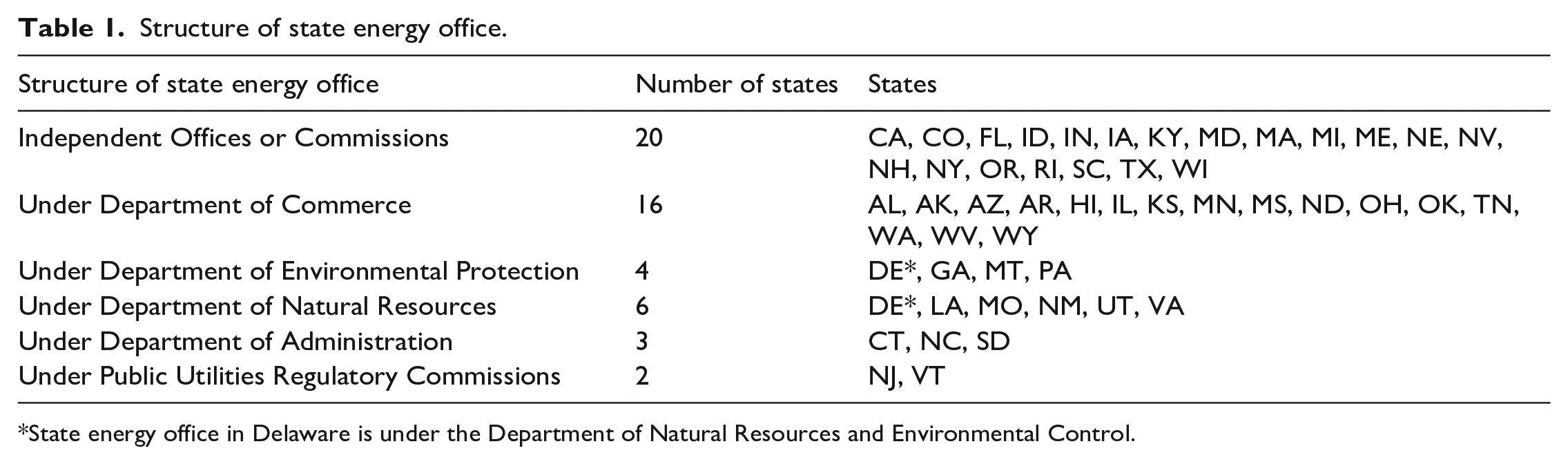
State energy office in Delaware is under the Department of Natural Resources and Environmental Control.
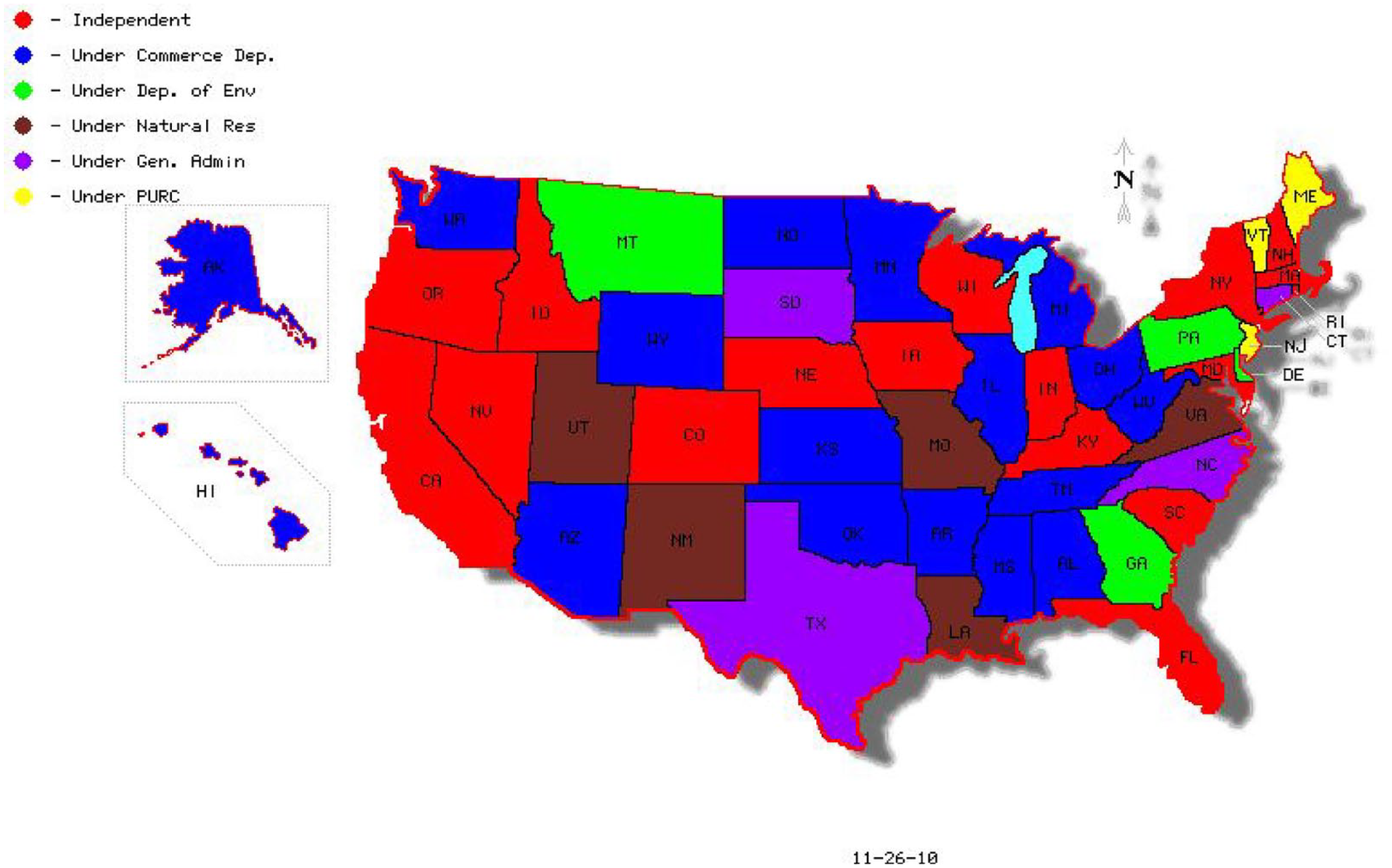
Structure of state energy office.
Independent state energy offices and commissions
By year 2010, 20 states have established their independent state energy offices and commissions either by legislation or executive order. The independent state energy offices and commissions share the characteristics of strong planning capacity, abundant resources, and a comprehensive approach to energy sustainability. First, the independent state energy offices and commissions are the agencies that are responsible for drafting the overall state energy plan, based on collecting baseline energy data, analyzing and predicting the supply and demand of the energy market, and the cost-effectiveness of incentive programs. The state-level policies and actions are generally based on the policy advice and analysis that are generated in these offices and commissions. Second, the independent state energy offices also enjoy a high status due to their direct access to governors and leaders in the legislature. The abundant political resources of the independent energy offices could gain them more capabilities in successfully coordinating the implementing various programs. These two characteristics grant the independent state energy offices a much stronger planning and administrative capacity, compared with agencies that located within a functional department. Third, the independent state energy offices and commissions generally are prone to an overall approach to energy sustainability, by integrating energy sustainability with economic development, environmental protection, market stability, as well as energy security and independence. This comprehensive approach is much different from state energy offices that are located within a functional department that has a focus on environmental protection, economic development, or natural resources.
State energy offices under Department of Commerce
Another important administrative form of state energy offices is those located within Department of Commerce and Economic Development. Located within the department that aims at economic development, these energy offices generally have a heavy focus on economic development. For example, the Office of Energy and Recycling in Illinois “seeks to demonstrate the economic development benefits, including job creation, of energy efficiency, renewable energy, and recycling through a variety of programs and services.” 1 In Mississippi, the Energy Division has a goal of encouraging “an environment that enhances the State’s access to cost competitive, available energy resources, ultimately benefiting economic development in Mississippi.” 2 The economic orientation of the energy office would influence the comprehensiveness of the policy instruments that could be considered and adopted by the state government. The lower level of the agency status means that it plays a much weaker role of coordinating agency. In addition, its role in energy policy and planning is also much weaker, and it is more or less an implementer of policies and decisions made by higher-level government agencies and legislature.
State energy office under the Department of Environmental Protection
Four other states developed state energy offices under the Department of Environmental Protection. These state energy offices have a stronger preference toward labeling sustainable energy governance as “green” and “clean,” which is influenced by the departmental orientation of pro-environmental ideology. However, this is compromised by the lack of comprehensiveness of the policies; the heavy emphasis on environmental protection sacrificed or lessened the opportunity to integrate economic development strategies into the overall energy policy and planning. For example, Pennsylvania’s Office of Energy and Technology Deployment (OETD) states its goal as serving “as DEP’s principal office for energy policy, the assessment of energy and environmental technology and the promotion of the use of appropriate technology to address environmental problems” and to “effectively work with citizen’s groups, businesses, trade organizations, local governments, and communities to help them reduce pollution and save energy.” 3 Similar to the weakness of state energy offices under Department of Commerce, state energy offices under Department of Environmental Protection plays a weaker role of coordinating agency. In addition, its role in energy policy and planning is also much weaker, and be more or less an implementer of policies and decisions made by higher level government agencies and legislature.
State energy office under Department of Natural Resources
Six states established their state energy offices under the Department of Natural Resources. These state energy offices generally have a strong planning capability, since most of them directly conduct energy policy analysis and planning. Locating state energy office within the Department of Natural Resources means that these state energy offices have knowledge bases of the natural energy systems, indicating a stronger capability of policy analysis and planning. For example, the Missouri Department of Natural Resources’ Division of Energy collects and reports Missouri energy data, and conducts energy policy research and analysis, and maintains Missouri’s plan for energy emergencies. These state energy offices also maintain a relatively balanced approach to energy sustainability, integrating economic development, environmental protection, and energy security. In New Mexico, the Energy Conservation and Management Division “develops and implements effective clean energy programs—renewable energy, energy efficiency and conservation, clean fuels, and efficient transportation—to promote environmental and economic sustainability for New Mexico and its citizens.” 4 Similar to the weakness of state energy offices under the Department of Commerce and Department of Environmental Protection, state energy offices under the Department of Natural Resources play a weaker role of coordinating agency.
State energy office under Department of Administration
Three states, Connecticut, North Carolina, and South Dakota, established their state energy offices within the Department of Administration. Locating state energy offices under the Department of Administration gives these energy offices more of an internal focus on state government facilities, instead of a community orientation. The state energy office in South Dakota “advises institutions on the implementation of economical energy savings activities for state facilities and assists them in developing energy management strategies like load shaping and long-term efficiency plans.” These states are actively engaged in “lead-by-example” programs by with programs, services, and technical expertise focused on advancing energy efficiency in the public sector. These offices have a medium level of communication and coordinating capacity.
State energy office under State Public Utilities Regulatory Commission
Two states, New Jersey and Vermont established their state energy office under the state Public Utilities Regulatory Commission (PURC). PURC is a regulatory commission that regulates the public utilities sector in the states. The areas under the regulation of PURC include electricity, water, natural gas, and so on. Energy efficiency programs have been implemented in the electric utilities since the 1980s. PURC has rich policy experience, regulatory resources, and intergovernmental connections to successfully govern state-wide energy policies. When located within the PURC, the state energy office could utilize the policy analysis expertise from other offices and divisions of PURC, as well as the regulatory capacity of the PURC. In general, the state energy office is a non-regulatory agency, but when located under PURC, the regulatory capacity of PURC could enhance the administrative capacity of the state energy office.
Evaluating the sustainable energy governance capacity for the state energy offices
Based on the above analysis, a framework is proposed here to evaluate the capacity of sustainable energy governance for the state energy offices. The criteria used here are planning, advice to the legislature, program management, comprehensiveness of policy orientation, inter-agency coordination, and citizen education. Planning refers to the capacity to conduct energy policy analysis and energy planning. Advice to the legislature refers to the access to legislative process, measuring the extent to which the policy advice could be heard by the legislature. Program management refers to the capacity in implementing and managing federal and state energy programs. The comprehensiveness of policy refers to the balance of policy orientations within the state energy office between economic development, environmental protection, and energy security. Inter-agency coordination refers to the capacity of the state energy office to facilitate inter-agency coordination in energy policy-making and implementation. Education refers to the extent to which citizen education programs are implemented by the state energy office. In Table 2, various kinds of state energy offices are evaluated based on this framework.
An evaluation framework for state energy office.
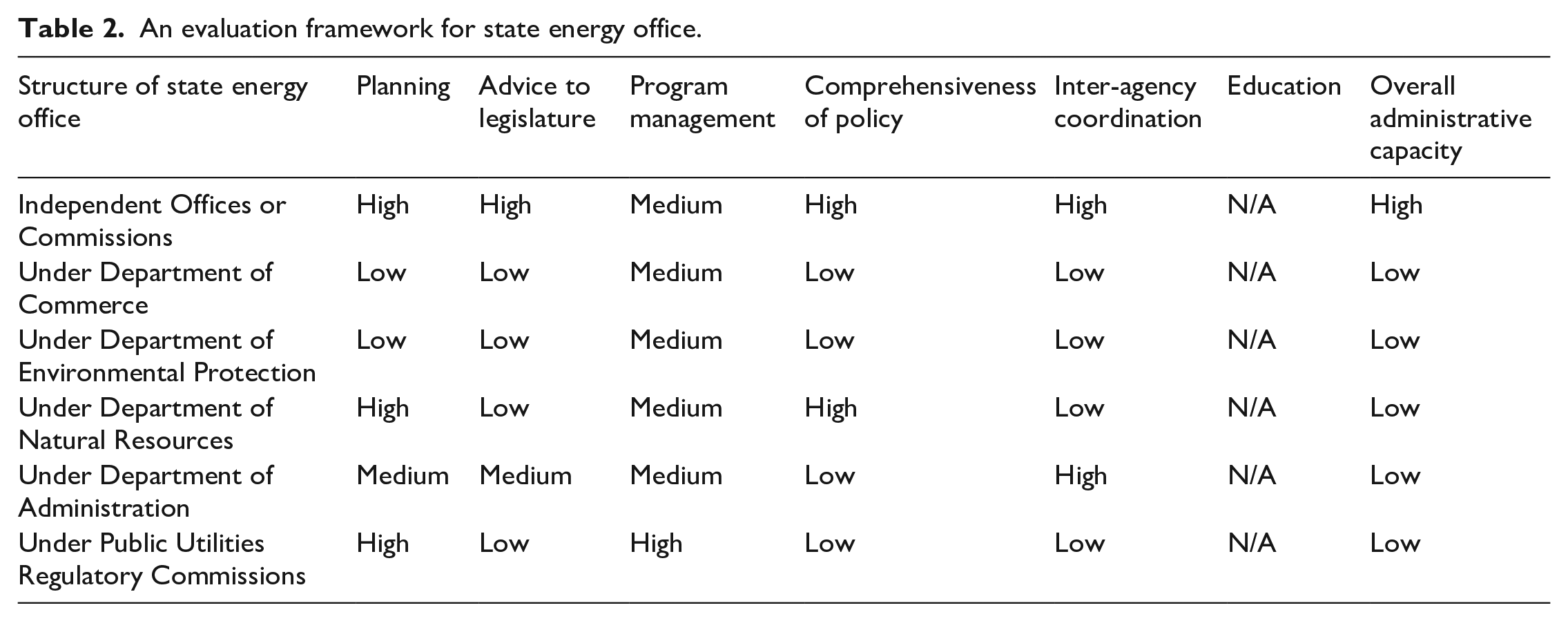
According to the summary of Table 2, independent energy office and commissions are found to have higher overall administrative capacity, while other forms of state energy office have lower overall administrative capacity. This differentiation in administrative capacity is later used to categorize state sustainable energy governance together with state sustainable energy policy index developed below.
State sustainable energy policy index
In the U.S. states, state governments adopted multiple policy instruments to address energy sustainability from different aspects, including renewable energy, energy efficiency, building efficiency, and transportation fuel efficiency. In each of the policy areas, both financial incentives and policies are adopted in the form of policy bundles. State energy administration and state energy policies are two pillars of sustainable energy governance. While the state energy office represents the administrative capacity of the states to govern sustainable energy, the policy instruments adopted in the states represent the actions and commitments that state governments made to energy sustainability. This state energy policy index is inspired by Portney’s (2003) work on Taking Sustainable Cities Seriously Index. The state energy policy index is developed below to examine the extent to which the state governments in the U.S. take energy sustainability seriously. The data on energy policies are gathered from DSIRE (Database of State Incentives for Renewables and Efficiency) and the US EPA (Environmental Protection Agency).
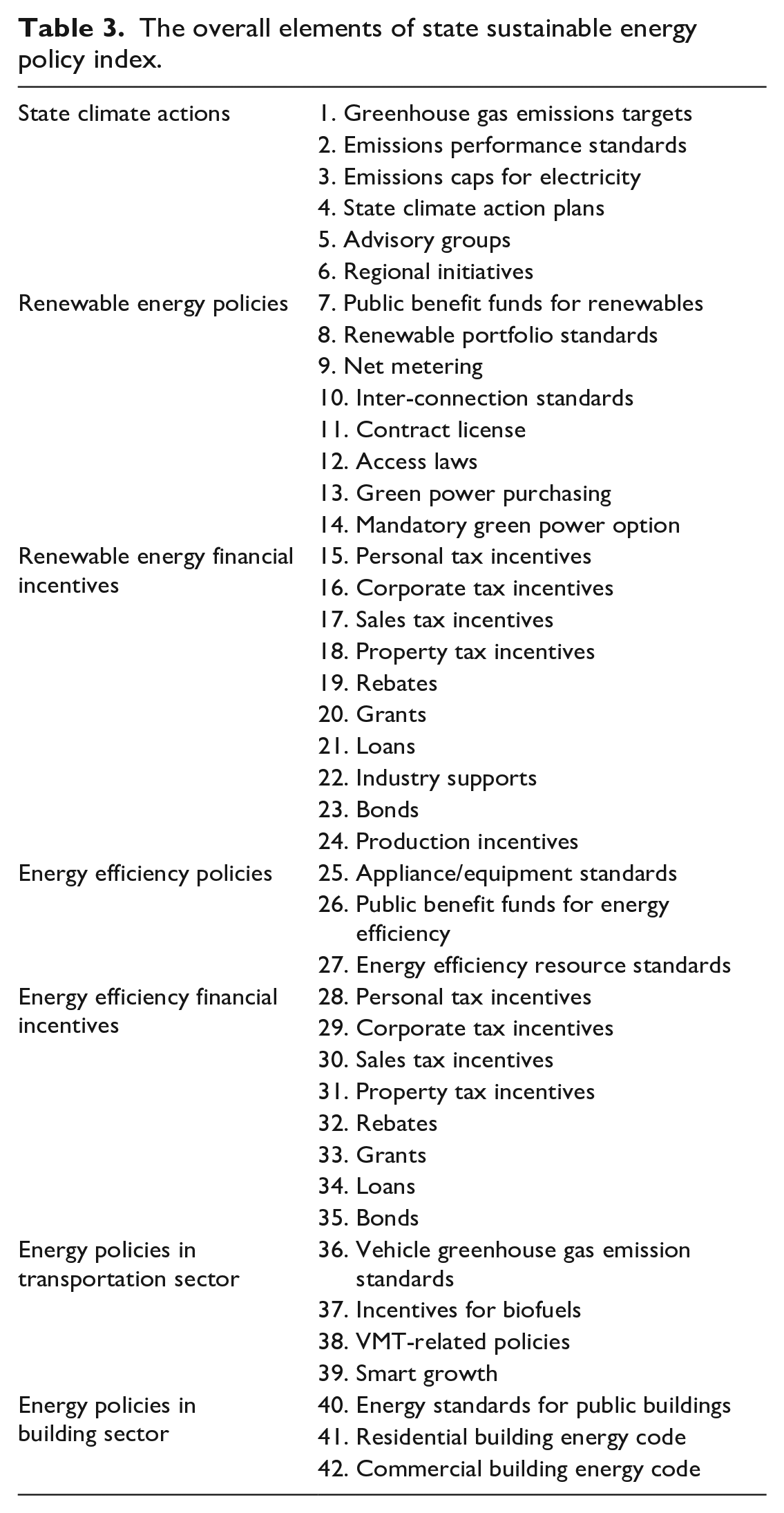
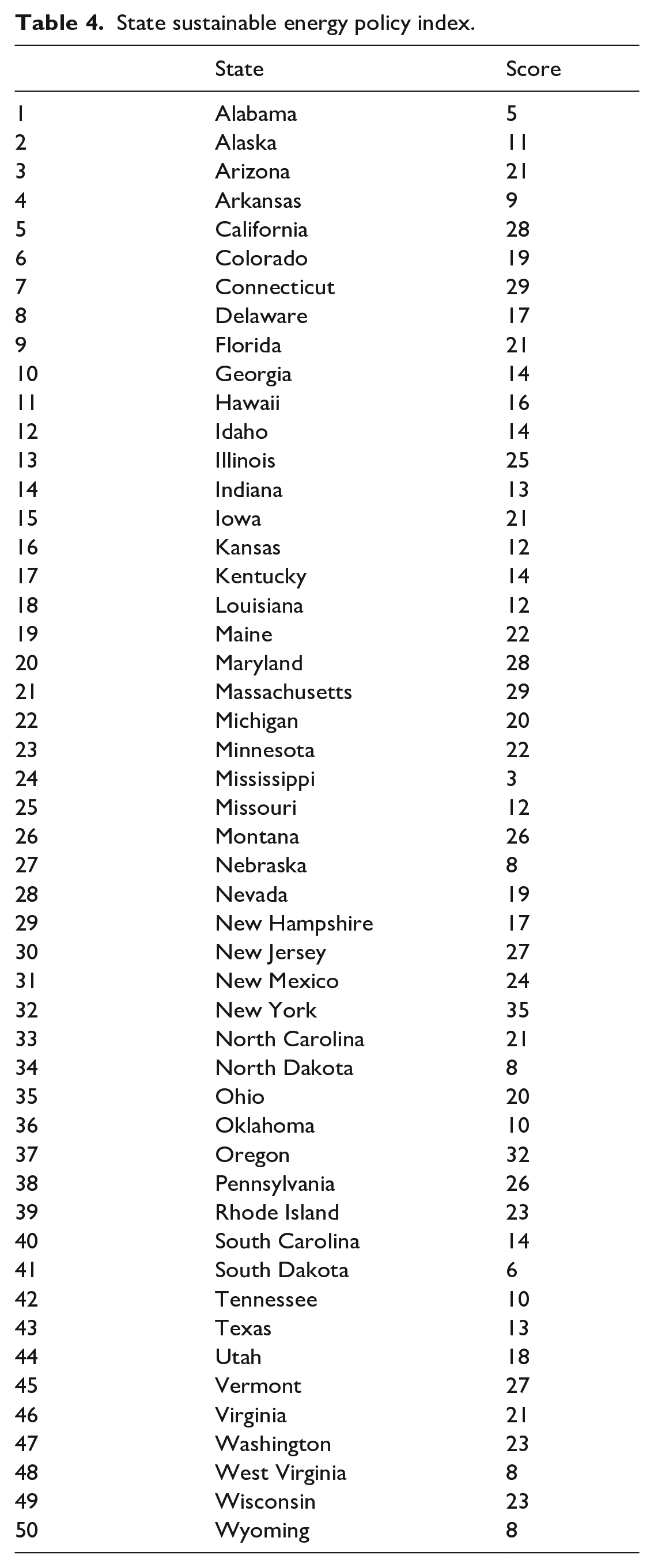
Policy instruments in seven policy bundles are selected to form the state sustainable energy policy index. The seven policy areas are climate actions, renewable energy policies, renewable financial incentives, energy efficiency policies, energy efficiency financial incentives, energy policies in the transportation sector and energy policies in the building sector. Forty-two policy instruments are identified to be included in the state sustainable energy policy index (Tables 3–5).
The overall elements of state sustainable energy policy index.
State sustainable energy policy index.
A typology of state sustainable energy governance.

The index scores are calculated by adding the policy instruments together. The result of the score shows significant variation among state governments in the commitment to energy sustainability. The scores range from the lowest scores of Mississippi and Alabama (3 and 5 respectively) to the highest scores of New York and Oregon (35 and 32 respectively). Almost half of the states (24 out of 50) have scores no less than 20, while another 26 states have scores lower than 20. This difference in index score among state governments reflects the policy commitments that state governments made to energy sustainability.
A typology of state sustainable energy governance
A typology of state sustainable energy governance could be developed along the two dimensions of administrative capacity and policy commitment to sustainable energy. States can be categorized into four groups: high administrative capacity and high policy commitment, high administrative capacity and low policy commitment, low administrative capacity and high policy commitment, low administrative capacity, and low policy commitment. Characteristics of each category are discussed in detail in the following sections.
High administrative capacity and high policy commitment
Eleven states fall into this category of high administrative capacity and high policy commitment. These states have independent energy offices and commissions and have large numbers of policy instruments adopted for energy sustainability. These states are the leading states in sustainable energy governance. They set examples to other states by developing independent energy offices and adopting multiple policy instruments.
High administrative capacity and low policy commitment
Nine states belong to the category of high administrative capacity and low policy commitment. The orientation to strengthen their administrative capacity made these states strong in policy planning, coordination, and policy implementation. However, the low score in the policy adoptions indicates that their strength in administrative capacity might not be used to its full potential. This means that these states have a slack administrative capacity, that once more policy instruments are in place, the state energy office is able to manage the programs, monitor the implementation and coordinate the inter-agency relations to achieve the policy outcomes. The mismatch between administrative capacity and policy commitment indicates that these states should do more to strengthen their policy instrument adoptions, in order to catch up with states in the high administrative and high policy commitment category.
Low administrative capacity and high policy commitment
Thirteen states can be categorized into the low administrative and high policy commitment group. These states have strength in the policy instruments adoptions to promote energy sustainability, but the weaker administrative capacity of the state energy office compared with other states would weaken the capability of these states to achieve the goals of the policy instruments. These states should strengthen their state energy office to better organize and manage and synergize the policy instruments and programs, so as to achieve desirable policy outcomes.
Low administrative capacity and low policy commitment
Seventeen states fall into this category of low administrative capacity and low policy commitment. These states have neither independent state energy offices nor many policy instruments related to energy sustainability. States in this group should work on establishing an independent state energy office and adopt more policy instruments related to energy sustainability.
Conclusions
In this paper, I examined how state governments manage sustainable energy in the following ways. First, I described and categorized the administrative structure of the energy office in the states. There are six types of state energy offices in the 50 states, including independent state energy offices, state energy offices under the Department of Commerce, Department of Environmental Protection, Department of Natural Resources, Department of Administration, or State Public Utility Regulatory Commissions. The characteristics of each type of state energy office are described and analyzed based on an evaluation framework for state energy office. The result showed that independent energy office and commissions are found to have higher overall administrative capacity, while other forms of state energy office have lower overall administrative capacity. This differentiation in administrative capacity is later used to categorize state sustainable energy governance together with state sustainable energy policy index. Second, the programs and policy instruments that the state governments adopted are also presented and discussed. A state sustainable energy policy index is developed to evaluate the policy commitment of the state governments in energy sustainability. Policy instruments in seven policy bundles are selected to form the state sustainable energy policy index. The seven policy areas are climate actions, renewable energy policies, renewable financial incentives, energy efficiency policies, energy efficiency financial incentives, energy policies in the transportation sector, and energy policies in the building sector. Forty-two policy instruments are identified to be included in the state sustainable energy policy index. Last, a typology method is developed to evaluate the sustainable energy governance in the states along the two dimensions of administrative capacity and policy commitment. States can be categorized into four groups: high administrative capacity and high policy commitment, high administrative capacity and low policy commitment, low administrative capacity and high policy commitment, low administrative capacity and low policy commitment.
There are also several limitations to this paper. First, the evaluation of the state energy office by separating between independent state energy office and that under another department is a very crude demarcation. State energy office under the governor’s office may not be as independent as state energy commission. Further evaluation is needed to separate the independent energy office from state energy offices under the governor’s office. Second, although the level of independence is a crucial dimension of the administrative capacity, it cannot fully capture the administrative capacity. More dimensions are needed to measure the administrative capacity in future research. Third, the typological approach to sustainable energy governance is very preliminary in that no causal mechanisms are tested for why some states adopt a particular form of state energy office. Further research is needed to develop empirical hypotheses to test the causal mechanisms that lead to the adoption of a specific administrative form.
Footnotes
Acknowledgements
I would like to thank the anonymous reviewers and editors for their invaluable comments and suggestions.
Declaration of conflicting interests
The author(s) declared no potential conflicts of interest with respect to the research, authorship, and/or publication of this article.
Funding
The author(s) received no financial support for the research, authorship, and/or publication of this article.