



Abstract
This article examines the work of Catherine Bauer from 1953 to 1963, an overlooked period in her life, when she engaged with questions of ‘Indian urbanization’ alongside the formation of an urban research institute in India. Her unique interdisciplinary vision for planning research and practice in this period was co-produced through her concurrent work on California and resulted in multiple reports on Californian urbanization as well as a seminar and book on Indian urbanization. The institute in India did not materialize; however, in 1962 an urban institute was set up in the newly formed College of Environmental Design at Berkeley.
Prologue
In April 1958, after a 4-month Ford Foundation funded tour of India, Charles and Ray Eames stopped in Delhi to write what they would call ‘The India Report’. 1 The India report and ultimately the National Institute of Design (NID) in Ahmedabad, set up on the basis of their recommendation, would go on to become a significant legacy, incorporating modern design training with a sensitivity to document and think with vernacular craft and context. But as the pair, unaware of all this future pedagogical success, wrote the report in the comfort of Hotel Cecil amid the blistering Delhi summer, they must have been thanking another American couple – Catherine Bauer Wurster 2 and William W. Wurster who recommended the “rambling hotel” in Delhi to them. 3
Although little known in architectural or planning histories, Catherine Bauer and William Wurster had taken a one and half month tour of India roughly a year before the Eameses’ trip, as part of their sabbatical from the University of California, Berkeley. This was followed by a solo research trip to India in 1959 by Bauer for roughly 3 months to pursue her research project on Indian urbanization. 4 Before the Eameses started their tour in India in 1958, the Wurster’s had already made, between them, multiple recommendations to the Ministry of Works, Housing and Supply of the Indian government via the Ford Foundation. One of them was the setting up of an interdisciplinary urban research institute in India, which was for a while also conceived as an ‘Institute of Environmental Design’ and another an extensive research project on vernacular architecture using “architecture as a frame” to document everything from “clothing, jewelry, household furnishings” to “bazaars…rural villages…and all aspects of community design.” 5 , 6 Even as the Eameses took the lead from Wurster and Bauer by focusing on graduate education in ‘design’ that would attempt to revive and reinvent India’s vernacular arts and crafts, Bauer actively pursued the proposal of setting up an urban research institute in India. Meanwhile, she continued her research project on Indian urban living conditions and involvement in urban planning and development in India till her death in 1964. While NID was established in 1962, the Institute of Environmental Design/Urban Research Institute based in India failed to materialize. However, thanks to her contemporaneous efforts, an Institute of Urban and Regional Development (IURD) was established in 1963 at the newly formed (1959) College of Environmental Design (CED) at the University of California, Berkeley.
Introduction
The subject of this article is the work of Catherine Bauer Wurster from 1953 to 1963, an overlooked but immensely productive period in her professional life. During this period Bauer spearheaded two intertwined research trajectories on India – one urban, which she as a professor of city planning pursued as the primary researcher, and the other architectural, in which she helped set up a systematic program for research and documentation of vernacular buildings in the architecture department. 7 This article will focus on the first trajectory, specifically the beginnings of her research project on Indian urbanization and planning including her agenda of setting up of an urban research institute in India. The thematic thrust of the article is to show, from the Catherine Bauer archives at Berkeley, how her involvement in urban planning, research and education in India in this period was co-produced with similar work in California – the urban research institute in India alongside the emerging institutional frame of ‘environmental design’ at Berkeley’s CED and her conception of Californian urbanization parallel to the construction of ‘Indian urbanization’ as an object of research. This had important implications in that it both developed and reinforced her thinking about planning practice and the necessity of interdisciplinarity in both research and training of graduate students.
The extent of Bauer’s involvement with Indian urbanization was quite broad (Image 1). This included, to mention only the highlights, her informal involvement in the Delhi Masterplan Project beginning in 1956, 5 months spent in India between 1957 and 1959, recommendations made for the Calcutta masterplan in 1960,
8
and guiding UPenn’s Institute of Urban Studies and UC Berkeley’s Department of City and Regional Planning (DCRP) on long-term research aspects of the latter masterplan. Her involvement with the Delhi Masterplan project directly led to the “Seminar on Indian Urbanization” of 1960 at Berkeley and the publication in 1962 of India’s Urban Future, an edited book based on the seminar.
9
By then she had intensified her research on Californian urbanization (done in parallel through the 1950s) and tapered off her involvement with India, marking a natural book end to her involvement with India before her death in 1964. Catherine Bauer with students at the ‘Delhi town planning school’, New Delhi, ca. 1959. Source: Catherine Bauer, Environmental Design Archives, Berkeley.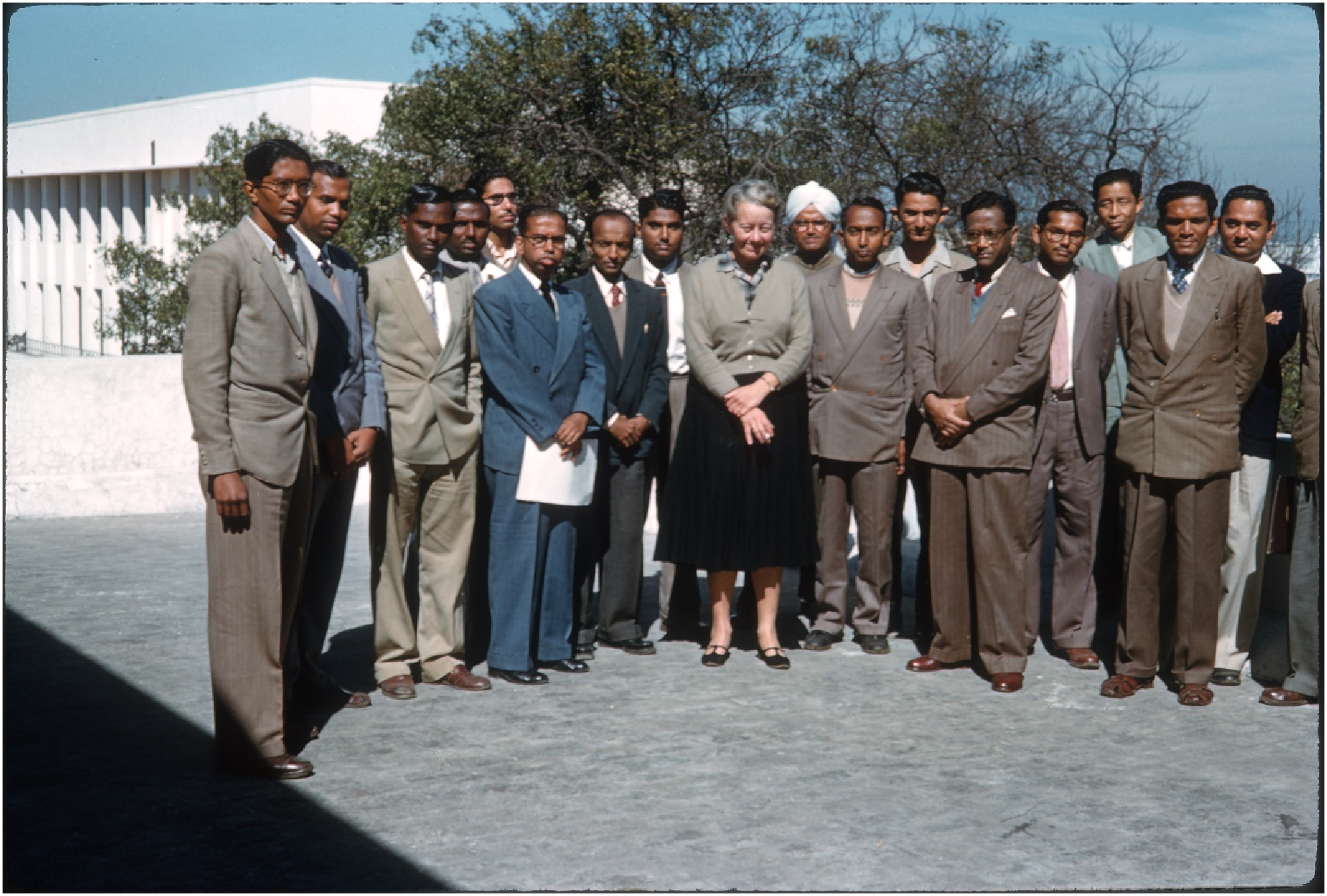
This article makes three points in narrating this lesser-known history of both Bauer and CED’s passage through India. First, it shows how Catherine Bauer’s interest in spatial structure and urban community development through much of the 1950s was co-produced with her research into India as a ‘developing area’, a term which she was simultaneously using to categorize California. This in turn became one of the initial agendas of the IURD – the study of ‘urban laboratories’ of California and similar developing areas like India. There is indeed significant scholarship on the histories of the colony as a ‘living laboratory’, combining both the supposed “authority of laboratory knowledge” and the expertise of field sciences for ‘development’, aiding the joint construction of Empire, Nation and Science. 10 Historians probing into the work of organizations like MIT-Harvard Joint Center for Urban Studies (est. 1959) and MIT Urban Systems Lab (1968) have not been amiss in noting a neo-colonial parallel in mid-century urban planning especially in the rhetoric of similarity of urban problems in US and third world cities. 11 However, as this article will show, Bauer’s comparison was earlier, far more qualified, and distinguished California from the rest of the US and Europe. Her conception of California and India as ‘developing areas’ which could potentially point to substantially different alternatives for urban living through a program of systematic interdisciplinary research had far reaching consequences for urban studies. Starting with the publication of Explorations into Urban Structure in 1962 that featured famous essays by Melvin Webber, Donald Foley and Bauer among others, this agenda of hers would begin an important trajectory of research into the frontier urbanization of California. Within a decade, it would become globally known through the Los Angeles School of Geography. 12
Second, Bauer’s attempt to frame Indian urbanization within the institutional framework at Berkeley shows how it constructed and shaped ‘research’ – an ambiguous but pivotal term directly connected to the projection of expertise in mid-century American academia. Bauer and Wurster’s passage through India helped build urban research expertise at Berkeley’s CED and at IURD, even as this purported expertise was assumed by developmental agencies like Ford Foundation as something already existing in American universities. The sequence of events that this article narrates is part of the larger story of how expertise was constructed in a transnational, and contingent way in the still modernizing mid-century era, built through “black box” 13 categories, such as ‘urban’, ‘development’ and ‘expertise’. Earlier scholarship has charted this history of the “techno-social moment” and the construction of architectural and urban research through Ford, RAND and other foundations at institutions like the Massachusetts Institute of Technology (MIT). This happened in part through projects pursued in third world countries, reminder of the complex and persistent links between modernization and colonialism. 14 Scholars have noted that the ambition (and result) of this new era of research was not merely making “urban research intellectually respectable” 15 but a disciplinary attempt by city planning and architecture departments in the US to “re-assert their authority over…spatial planning…already claimed by other disciplines.” 16
Catherine Bauer’s passage through India – both a research object and a physical location – must be similarly critiqued. Research into urban development in the ‘underdeveloped’ third world was the “obligatory passage point” through which American institutions and institutional actors like her generated urban research expertise. 17 , 18 However, her case is also notably different. Bauer’s subjectivity as a self-taught non-expert woman without a specific social science, architecture or planning degree as well as her role as an activist in the public sphere had made her a lifelong outsider to strict disciplinary affiliations. As she put it herself, “I’ve been heckling planners, architects, housers and public administrators all my life.” 19 Her practice and teaching of interdisciplinarity in urban planning 20 and her advocacy for basic research “cross-cutting academic specializations” which could better inform public decision making process in urban development alternatives was pioneering, especially when compared to architects and city planners of her generation. 21 Interdisciplinarity appears to have been less of a keyword and far more of a practical method for Bauer. As early as 1955, when she had started connecting California and India as places that needed alternate models of planning practice and research, she co-authored a remarkably clairvoyant but unpublished paper titled “Values in urban research as related to planning problems.” 22 In a document that remarkably pre-figures aspects of Webber and Rittel’s “Dilemmas in a General Theory of Planning” 23 from 1973, Bauer and McEntire laid out a case for how both ends and means - planning goals as well as seemingly neutral planning techniques and concepts - have implicit value judgments and are entangled with each other. Far more optimistic in outlook than Webber and Rittel’s conception of “wicked problems,” the paper endorsed interdisciplinary cooperation as a critical tool - to both expose “value laden concepts of a discipline” and create a “more comprehensive view of alternatives” available to the public for a more democratic decision making process. 24 This approach also meant that she broke with some dominant planning ideologies of her contemporaries, like the idea of metropolitan planning specifically with respect to the Calcutta masterplan. Instead, she chose to learn from what she termed the “Implications of the Delhi [Master Plan] experience.” 25 In the planning debates of the 1940s and 50s, metropolitan planning had become the focus and preferred scale of city planning and was often understood as a central urban core with a periphery of neighborhoods and zones interdependent on each other, connected by transportation networks. 26 Bauer preferred a slower, long term “state-wide plan for urban-industrial development, closely related to economic policy and available resources” formulated with field-tested research generated through feedback from “immediate” and “systematic experiments” to deal with the pressing problems of housing, sanitation and transportation in Calcutta and West Bengal. 27 This was to be a “learning through doing” which she hoped would “arouse popular interest and participation” and “stimulate greater public and expert understanding” of the planning challenges by “dramatizing experiments” and presenting them as alternatives for public decision making. 28 These ideas, an early but previously unnoticed departure from modernist top-down planning, came together most concretely in what Bauer conceived as an experimental, action-research and public participation oriented low-income housing project in West Bengal to be undertaken by the Ford funded Calcutta Metropolitan Plan Organization.
The third point is embedded deeper within the narrative, within the structure of the archive itself. Bauer operated through a thick web of networks made up of expert-friends, spread out widely over American academia, some of whom worked on India and many who were developing networks and contacts in India as well (Image 2).
29
Like them, Bauer also attempted to build up a network among the Indian bureaucratic and technocratic elite. Bauer’s India archives are filled with hundreds of letters, contact cards, mailing addresses, phone numbers of numerous individuals, many well-known and most not, from various cities. The dual role of data in the construction of expertise is a point to note – it is to be understood not merely as depth or extent of knowledge, but as the ability to readily access a (hierarchical) network of contacts and influence them to act. Yet, many of these relationships were warm and even joyful with invitations to Christmas dinners at her home, recipes shared and favors offered and done willingly.
30
These connections also point to Bauer’s own subjectivity as she operated within the overwhelmingly white, masculine world of American academia in the 1950s which was a critical period when South and Southeast Asia was a hub for birthing Western experts on urbanization and development.
31
Bauer’s photograph of William Wurster (left) with Jean Joyce and Douglas Ensminger of the Ford Foundation at New Delhi’s Central Vista, ca. 1957. Her shadow can be seen in the foreground, falling partially on Wurster. Source: Catherine Bauer, Environmental Design Archives, Berkeley.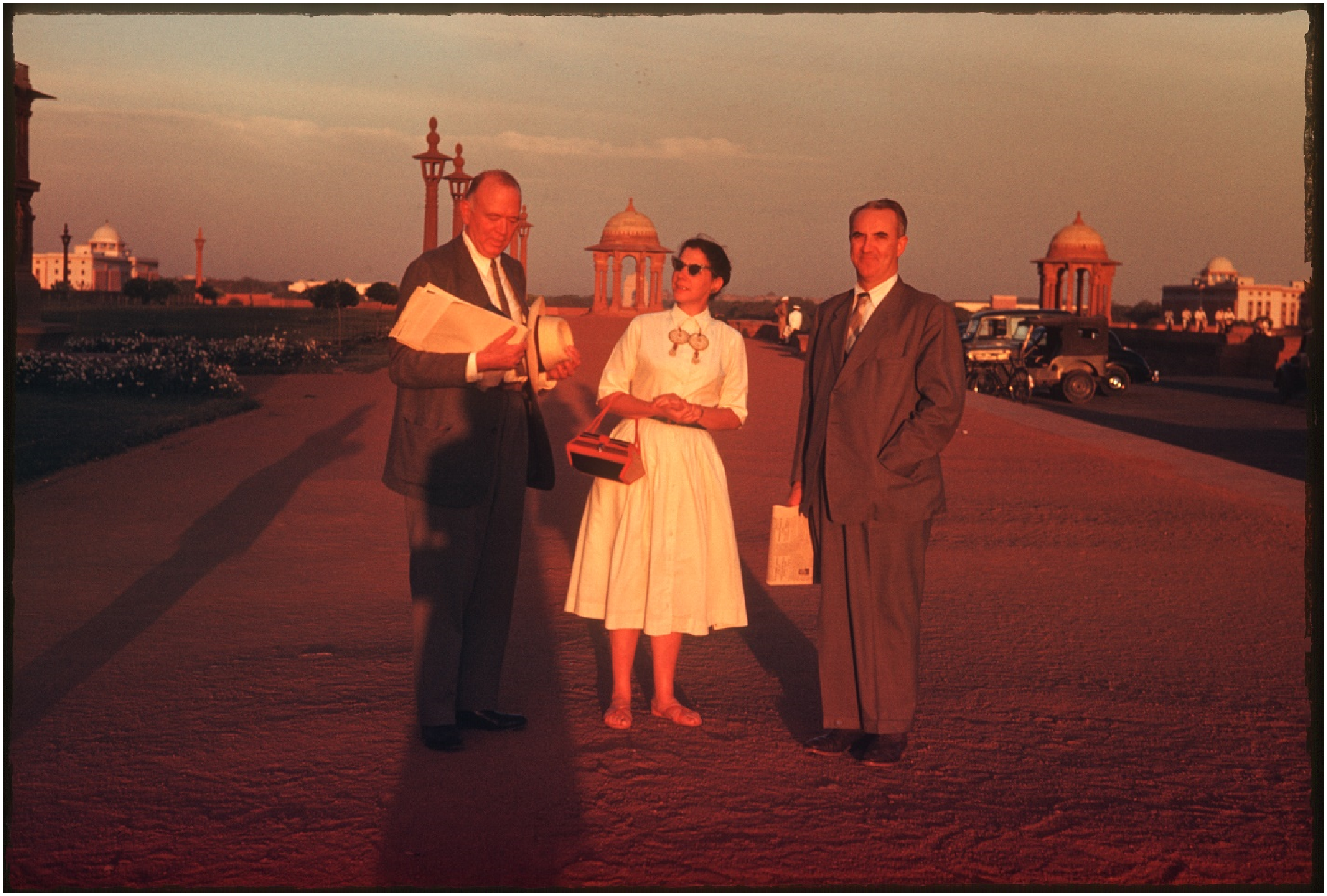
Beginnings: Bauer’s Urban Research on India, 1949–1956
Catherine Bauer was a pivotal faculty member of the Department of City and Regional Planning, joining it in 1950 a year after its founding. She was the first female faculty of city planning at Berkeley and earlier in the 1940s at Harvard. Bauer was even better known as an activist and reformer before her academic career, as the author of Modern Housing (1934) and the principal architect of the Federal Housing Act of 1937. An autodidact, her formative years were in the late 1920s and early 30s when she had been the secretary of the Regional Planning Association of America (RPAA) and worked closely with Clarence Stein, Lewis Mumford, Albert Mayer and others. 32 She had initially moved to California in 1939 to lecture on housing at the Department of Social Work at Berkeley and consequently met and married William Wurster in 1940. By this time, however, she was already one of the most important academics and activists in housing and regional planning, penning important articles both in architectural magazines and academic journals. William Wurster was a leading architect of the Telesis group, practicing what Lewis Mumford championed as the “Bay Regional Style” of Coastal California – a regional alternative to the cold, machinic international style. 33 In the early 1940s Bauer and Wurster moved east to Harvard University where he enrolled for courses while Bauer started teaching as a lecturer in regional planning at the Graduate School of Design. 34 Wurster would discontinue his studies shortly thereafter, upon being appointed Dean of the architecture school at MIT. He would reorganize MIT’s school of architecture into the school of architecture and planning. Later he would repeat it at Berkeley, bringing together the departments of architecture, planning and landscape architecture to form the College of Environmental Design in 1959. By 1950, he and Catherine Bauer had moved to Berkeley where he became the Dean of the College of Architecture and she a faculty in the department of city and regional planning (DCRP), working towards their common agenda of bringing together architecture, planning and landscape architecture under a new college.
Bauer had started working on housing, community and regional planning issues in the developing world for the UN from 1949 while at Harvard, editing the third Housing and Town Planning Bulletin for the UN Housing and Town Planning Division in 1953 and a research document for the UN in 1955. 35 , 36 Her growing interest in international development and especially India is evident in papers like Economic Progress and Living Conditions written in 1953 for the MIT Bemis conference on Economic Development and Housing Abroad and later published in The Town Planning Review. 37 This was not a drastically sharp turn from her earlier work. In 1951 she had published a seminal article in the Journal of Social Issues called “Social Questions in Housing and Town Planning”, published later as a booklet, where she outlined a program of critical research. 38 Largely related to the socio-spatial connection of which this article is an early and significant statement, it raised questions of urban living conditions, minimum housing standards, “the physical pattern of social life” and questions of centralization and decentralization, all of which became the primary themes in her work on ‘developing areas’. 39
It is safe to assume that Bauer and Wurster’s decision to spend much of their sabbatical tour in India was Catherine Bauer’s idea, given her growing interest and publications on themes related to planning in developing nations – economic development, change in social and spatial structure and the need for regional planning. Much of this interest is obvious in her frequent correspondence and work for Ernest ‘Ernie’ Weissman, the head of the UN Housing and Town Planning division, from the two UN reports mentioned above. Weissman led an organization that solely focused on the developing world, of which India was the prime test case. The reasons are not difficult to imagine. India was a populous subcontinental democracy led by erudite statesmen who believed in economic planning and most importantly possessed a robust National Planning Commission that made Five-Year economic plans for comprehensive planned national development. This was the developmental-technocratic fantasy of post war economics, American modernization theory and planning come true. 40 It naturally followed that agencies like the Ford and Rockefeller foundations had become active in India almost immediately after independence.
While India was becoming the focus of developmental expertise through the 1950s, Bauer had been receiving, from at least 1949, Albert Mayer’s ‘India Bulletins’ which were sent to his professional friends and associates and documented his experience as a development planner in Ettawah village in Uttar Pradesh. 41 Ettawah was a test program in a larger scheme of village community development to modernize villages, a project close to the concerns of the Indian Prime minister, Jawaharlal Nehru. Mayer, who enjoyed a close friendship with Nehru and was being funded by the Ford Foundation to work in India, had a long association with Bauer as part of the RPAA intelligentsia and had written a glowing review of her Modern Housing at the time of its publication. 42 Mayer had also contributed to the UN Housing and Town Planning Bulletin that Bauer had edited in 1953.
In April 1956, the same month that Catherine Bauer sent a research proposal to the Ford Foundation backed Resources for the Future (RFF) for studying spatial structure in metropolitan areas in California, she received a letter from Mayer soliciting her thoughts about the Delhi Master Plan Project. 43 Catherine Bauer replied, while acknowledging that her knowledge was as a removed observer, outlining a program of planning research for India. 44 A few months later in July, the Overseas Development Program of the Ford Foundation wrote to T.J. Kent, Chair of the Department of City and Regional Planning (DCRP) at Berkeley, outlining that the Government of India had “asked The Ford Foundation for support in providing an urban planning team to study the conditions and needs of Delhi; to train Indians in how to prepare surveys and studies for urban planning; and to make recommendations for the preparation of a comprehensive plan for the development of the Delhi region.” 45 The letter announced that the preliminary idea was that a team consisting of, “an architectural planner, an economic planner, an urban sociologist, an administrative specialist, an industrial planner and a transportation and traffic specialist” would work in Delhi for 6 months to create the Delhi plan, and simultaneously “assist in the training” of a team of Indian town planners already working to produce an Interim Delhi Plan. 46 Wood’s letter informed Kent that the letter to him was part of several letters sent to universities to enquire “whether they would be equipped and interested” on “working on such a planning study and on what basis.” 47 The Ford foundation also informed DCRP that they had already obtained the “temporary services” of Mayer to discuss and frame the scope, requirements and cost of the project, while the actual team was being hired. 48
The Delhi Master Plan at Berkeley, 1956–57
Much scholarship has been produced over the last decade about how the Ford foundation funded Delhi Master plan of 1962, produced by a team of American experts (led by Albert Mayer) and the first comprehensive master plan for an Indian city, became the template of post independent Indian urban planning and development. This scholarship has been intensely critical, and rightly so in the way it overlaid a modernist, automobile-oriented, state-controlled, expert-led, centralized scheme while largely ignoring local people, economy and patterns of Indian urbanism. 49 However, this early moment of search for experts within American academia is as instructive about the formation of urban planning expertise within American universities as much as the failures on the ground in Delhi. Incidentally, all six of the Indian team of planners who were at work in Delhi producing the Interim Master plan had graduate degrees in planning – four of them having graduated from top American Universities, including Bonny G. Fernandez from DCRP at Berkeley (Bauer and Kent’s student) and the other two from the U.K. 50
None of these figures appear prominently in Bauer and Mayer’s correspondence. When references to them do appear, for example, by Mayer who was on the ground, he seemed unimpressed with their expertise. 51 However, Bauer exchanged warm personal letters with many including Fernandez who not only provided her with planning data for her research but accompanied her on her research trips around Delhi. In any case, Kent replied to Ford Foundation mentioning that he would speak in person soon to Bauer “who has talked with Mr. Mayer concerning the project.” 52 While Ford Foundation had sent similar letters to MIT, Georgia Tech and North Carolina, 53 it is reasonable to guess that Berkeley’s headway in the project was owed largely to the Bauer-Mayer connection from the Regional Planning Association days reinforced by Bauer’s role in bringing Mayer to Berkeley 54 for a series of lectures on India in early 1954. 55
In October 1956, a meeting of leading Berkeley faculty from Economics, Anthropology, Transport Engineering, Political Science, Business Administration, Sociology and Social Welfare, in addition to Architecture and City Planning, was called by Kent to discuss the “New Delhi Project” on the advice of Catherine Bauer and Paul S. Taylor. 56 Vernon De Mars was the sole faculty member representing architecture while Donald Foley, Mel Scott and Melvin Webber (who joined in 1958) represented DCRP. This interdisciplinary group would go on to be called the “Berkeley Study Group on the Delhi Regional Development Project,” but its primary actors would remain Catherine Bauer, Paul S. Taylor from Economics and Richard L. Park of Political Science interfacing with both Ford Foundation administration and Mayer till 1961. 57 Taylor and Park were natural choices for a Berkeley-Ford Foundation project in South Asia. Paul S. Taylor, the chair of the economics department till 1956, was already a consultant for the Ford Foundation and UN working in multiple countries in South and Southeast Asia, and he was soon set to assume Directorship of the Institute of International Studies at Berkeley. Richard Park, on the other hand, had won a $100,000 grant from the Ford Foundation in 1954 for a “Modern India Project” and used the grant to set up and head the “South Asia Studies Program” at Berkeley. 58 , 59
In October, Bauer and Park met separately with Albert Mayer and Ford Foundation officers in New York. In Bauer’s account, she and Park discussed the need for “basic research’, the working relationship between research and plan preparation and the potential role of a University (including its limitations).” 60 By this time, Mayer had already assumed charge of the project and had communicated in his meeting with Park (only a few days before Bauer’s meeting) that Berkeley’s involvement would depend on how it could contribute to ‘short range’ Delhi Master Plan needs. Mayer had by then made his preference clear for a team that could be quickly assembled and begin the work in Delhi immediately. Bauer persisted, following a line of argument from her letter to Mayer in April about the lack of data for urban planning in India, to stress the “gaps in knowledge and even awareness” in the urban field by citing her experience from authoring the UN reports. 61 In her account to Taylor she wondered if uninformed (i.e., plans that lack grounded data) planning efforts, like that of Bombay which Mayer participated in, “isn’t almost worse than nothing.” 62 Bauer was more interested in the longer term urban research component and clearly skeptical of the short term act of quickly producing a master plan. She would hone and express this critique even more clearly when the Calcutta Metropolitan Planning efforts began after the Delhi project.
By late October, Richard Park, representing the South Asia Studies division now directly under the Institute of International Studies at Berkeley, wrote to the Ford Foundation with exactly such a proposal. He stated that the shorter-term Delhi Master Plan component would be left best to Albert Mayer and proposed that Berkeley faculty were more interested in “longer range urban and regional research” specifically establishing an “Urban Research Institute” in India, administered by an Indian university. 63 For the Delhi master plan project, Park suggested, Berkeley faculty could only provide “informal” advice. 64 However, for the longer range research the Berkeley faculty group could co-operate with Indian “opposite numbers” on “the general problems of urban planning and development and urban and regional research” focusing not only on “immediate urban problems, but also with the whole problem of urbanization and its relation to regional and national problems.” 65 If the urban research institute plan were to be accepted and “Berkeley were the American University co-operating,” Park proposed, “it would be advisable to establish at Berkeley an urban and regional research organization” not only for urban research work on India but as a “center to co-ordinate other campus research on urban and regional problems, abroad and in the United States.” 66
Richard Park made it clear to the Ford Foundation that Berkeley wanted to separate the short-term work for the Delhi master plan from the longer-term interdisciplinary urban research project and the latter could be done by setting up mirror urban and regional development research organizations in California and India. In the list of Berkeley faculty that Park proposes to the Ford Foundation for doing this long term research, Catherine Bauer’s name is at the very top. It is logical to deduce, given Bauer’s close friendship and working relationship with him, that Park’s recommendations closely reflected Bauer’s opinions and research interests. 67 Scholars have noted that Bauer, who did not have a degree in either social sciences or planning nor a graduate degree, was a consummate and accomplished researcher who posed “riddles” as a way of thinking. 68 These riddles were always posed as interdisciplinary challenges to be answered between the social sciences and spatial/built environment professions. It is perhaps because of this that Bauer’s impact on urban scholarship was, by the time of her death in 1964, far more wide reaching than any American academic and certainly any other faculty at Berkeley’s DCRP. 69 For most of her time at Berkeley she taught research classes that were dedicated to investigating a specific question, often related to her research agendas. In a resume that she sent to the UN in 1952, while negotiating her contractual employment for authoring the Bulletin, she mentions that “although a ‘lecturer’, I am mainly concerned with research activities…conduct a research seminar…and represent the department in various activities concerned with interdisciplinary research programs.” 70 Moreover, her ‘longer range’ research interests in India were amply clear in letters to Albert Mayer in April and to Paul Taylor in October 1956. An urban research institute thus fit firmly within the trajectory of urban research questions that had marked her ‘Social Questions’ essay and her stated research agenda at Berkeley at the turn of the 1950s and had only deepened as she explored those questions in relation to developing countries through her work with the UN through the early 1950s. 71
Bauer continued to champion (to the Ford Foundation) the creation of the Urban Research Institute in India till as late as the fall of 1960. With the establishment of NID in 1961, following the Eamses' proposal, it was clear the urban research institute in India would never come to be. However, the idea of the mirror ‘Urban Research Institute’ at Berkeley had taken hold and, as this paper will show, its conception always had an Indian connection. In the letter proposing the Institute, Park also suggested a conference in New Delhi in 1957 to reach an agreement about the nature of urban research work to be undertaken. Simultaneous with the conference proposal (originally proposed to be held in New Delhi), the negotiations for which began in 1957, Bauer pursued her own research interest in Indian urban development. In 1958, Bauer was awarded a research travel grant administered by the newly formed Institute of International Studies at Berkeley (itself administering a Ford research grant) “to explore the question of urban living standards…under Indian social-economic conditions, in relation to the scale and pattern of future urban development.” 72 The thoroughness of her research is evident in the quantum of data she collected during her subsequent fieldwork in early 1959 – from population growth and distribution statistics to case studies of existing housing including its economic, sanitation and transportation aspects down to space standards. 73
Meanwhile, throughout this hectic research trip to India and the rest of 1959 Catherine Bauer continued to play a pivotal role in organizing the conference. This was no mean feat, since almost everything had to be negotiated, from the Ford grant allowance to the list of invited Indian officials to obtaining permissions for them to attend that included putting in a word with the Indian Prime Minister. 74 By August 1960, with increased Ford funding, the ‘Seminar on Urbanization’ of India was held at Berkeley with 28 papers, including one from Bauer. Among the 33 attendees half were American academics, including Ford Foundation planners working on the Delhi plan, and the other half were Indian bureaucrats and academics. By 1962, most of the papers of the conference was published as India’s Urban Future by the University of California Press, becoming one of the earliest publications on urbanization in India. 75
Parallel Ventures: College of Environmental Design, Berkeley and the Institute of Environmental Design, India
The first of Catherine Bauer’s two trips to India was with William Wurster and their daughter where they spent approximately 2 months in India and Nepal as part of a 6-month world tour starting out in February 1957. Her second trip, from January to March 1959, was focused on her ‘urban living standards’ research and included visits to multiple town planning departments across northern and southern India to collect data on housing and new industrial towns, a 2 week stay in the Indian Statistical Institute in Calcutta and delivering multiple talks like on “Housing Problems” at the Indian Town Planning Institute (ITPI) meeting in Delhi. 76 On her first family trip, Bauer and Wurster visited major cities like Bombay, Delhi, Calcutta and emerging architectural tourist spots like Chandigarh and lesser known places like Albert Mayer’s village development project at Ettawah. They also travelled to smaller towns and villages like Trivandrum, Cochin, Madurai and Wai. Bauer’s travel notes from India handed to the Eameses’ in 1958 were only a part of more extensive notes and hundreds of photographs that she took on their trip of both modern and vernacular architecture.
One of the only jointly authored research output of their joint India trip was an article Bauer and Wurster published in Perspecta in 1959 titled “Indian Vernacular architecture: Wai and Cochin,” richly illustrated with her photographs.
77
Given the modernist discourse of the period, the article stands out in its admiring tone towards what it saw as unique instances of “anonymous unsung architecture” and its rootedness in its local culture, geography and climate as well the authors’ argument for its continuing relevance in housing and community development.
78
In fact Bauer’s larger photographic collection from the trip gives us a window not only into Bauer’s appreciation of the scale and richness of everyday spaces key to her conception of urban living (Image 3). These photographs, read alongside the proposal on ‘urban living standards in India’ as well as her published research, make her interest in the complex scalar connections between the architectural artefact, housing, social life and the urban development pattern of regions very tangible. This sensitivity is also apparent in her championing of the vernacular architecture research project (that CED’s Architecture faculty renamed as a ‘tropical housing project') which sought to learn from the existing forms and patterns of housing. More importantly, it is evidenced in both her championing of design and architectural education alongside social sciences within a joint research institute as well as her attempts to incorporate the vernacular architecture project as an ‘action-cum-research project’ to solve the problem of housing through field-tested research within the auspices of the Calcutta Plan. One of many examples of her eye for everyday spaces of community life, Catherine Bauer’s note under this image of Old Delhi reads, “OD, Elegant Med. Street.” Source: Catherine Bauer, Environmental Design Archives, Berkeley.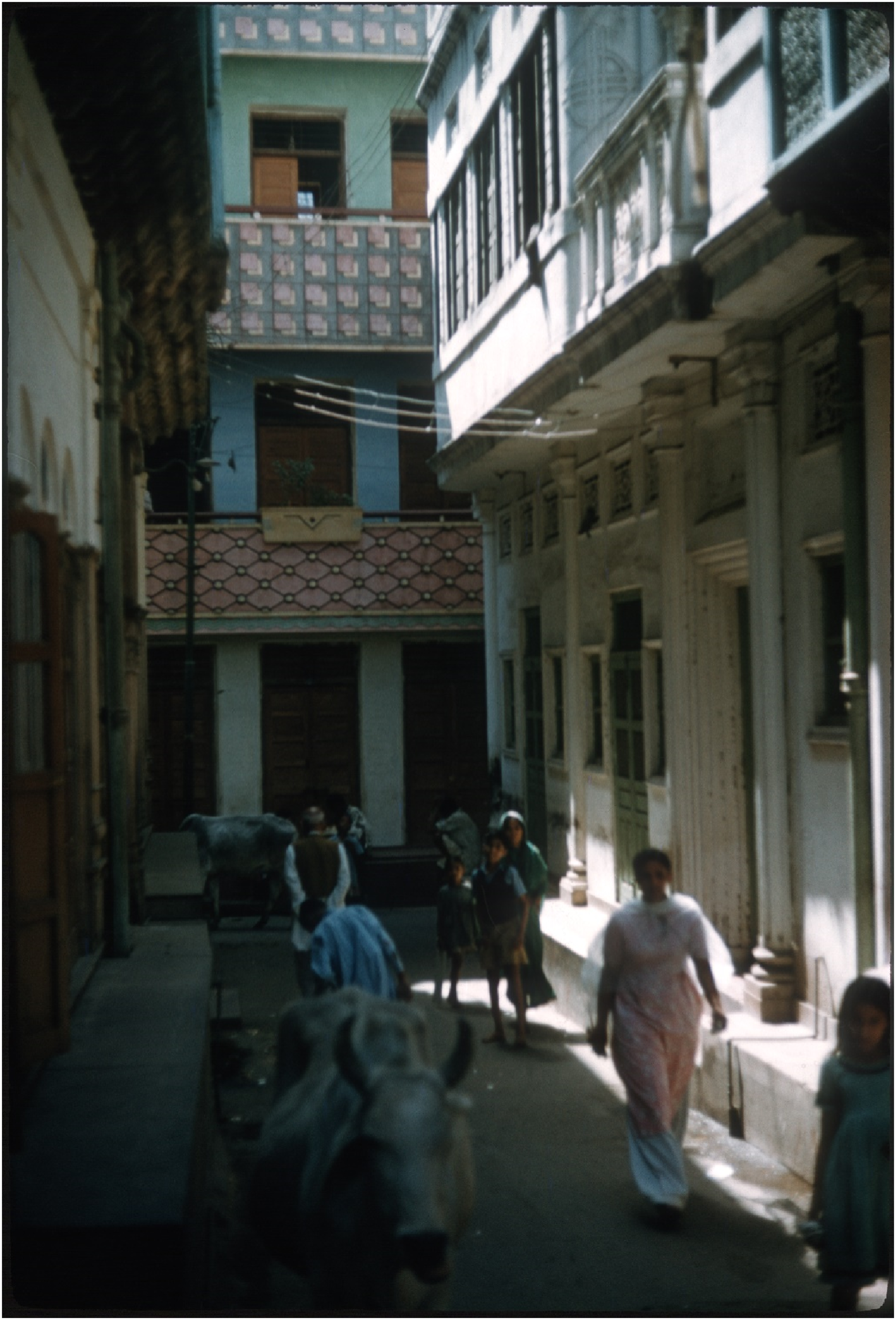
When the couple got back to Berkeley from their first trip in 1958, William Wurster re-immersed himself into the work of re-organizing of the College of Architecture as the College of Environmental Design. Following William Wurster’s initial letter to Ford Foundation in 1959 outlining a research program (referred to in the prologue), Catherine Bauer took charge of pushing the idea of the ‘Urban Research Institute’ in India. By then she had forged close connections by then with the Ford Foundation’s chief executives in India, Douglas Ensminger and Jean Joyce ( See Image 2). This relationship had been strengthened by even more correspondence with them in preparation for her second visit to India to conduct research fieldwork and the visit itself in 1959. Bauer attempted to make the urban research institute part of the Eameses’ Design Institute proposal, suggesting an “Institute for Research in Design and Physical Planning” to Joyce, the Executive Associate of Ford Foundation in India. True to her research disposition, Bauer proposed that this institute could combine industrial design, town planning and regional planning, stressing the need for cultivating interdisciplinary “teamwork that includes
This was the time when Vilhelm Wohlert and Ernest Scheidegger, a Danish and a Swiss design consultant, respectively, were supposed to visit India. 82 They had been hired by Ford to prepare a more detailed second stage report to follow the Eameses’ India Report and help the Government of India create the Design Institute that the Eameses had recommended. Bauer by this time had involved Joseph Allen Stein, an old Bay Area Telesis member who was practicing architecture in Delhi, and got him on her side in the discussion with Ford Foundation in her push to create an interdisciplinary institute that would be focused on research. 83 Jean Joyce wrote to Catherine Bauer in January 1960, “he [Rasmussen] could talk with Wohlert (whom he certainly must know) and others about the possibility that you, Eames, Joe Stein and others propose: i.e., having the high-level institute of design feed not only “industrial” design, but environmental design, and thus act as a ‘training’ institute for architects here” [emphasis mine]. 84 Clearly, as the negotiations to birth the CED and pass it through the Berkeley Academic Senate were occupying Wurster (and Bauer), Bauer had enlisted Eames, Stein and the Ford officials in India and had convinced everyone – except the Indian government – that a ‘high-level’, environmental design institute had to be created in India.
Wohlert and Rasmussen produced reports on their respective subjects in May and June of 1960, but they were substantially different. The cover page of Wohlert’s report, “Proposals for an Institute of Design, Training, Service and Research” in Bauer’s files is scribbled with comments in pencil clearly outlining her disappointment: “Very Superficial – disappointing – Eames much better.”
85
The source of this disappointment was that her advice had not been incorporated. “Practically ignores social science aspects… No attention at all to
Rasmussen assumed the new design institute would be an “Institute of Environmental Design” and referred to it throughout the report as such. 91 Clearly this was part of the briefing he had received from Joyce and certainly from Wurster and Bauer. However, he recommended that the best way to improve architectural education was through a 5-year undergraduate degree and not through a graduate degree. In this Rasmussen seemed to be agreeing with Wurster, and he recommended that the new undergraduate school “could naturally form a part of the proposed Institute for Environmental Design.” 92 But this presented a problem for Bauer, who had argued for a graduate interdisciplinary research institute, in keeping with the graduate focus of the Eames Report. Moreover, as she admitted in a letter to Joyce, there were “fundamental differences” separating industrial design and craft production on one hand and building construction and land use planning on the other. 93 Even if the architecture school were not part of the Institute of Environmental Design, Bauer insisted, it needed “as an integral part of its program, responsible teaching and research by engineers and natural and social scientists….and cannot be an independent-architect dominated enclave.” 94 Bauer’s persistence on this matter is significant because she recognized that while industrial design was in the jurisdiction of the Ministry of Commerce and Industry, architecture and urban research was managed by the Ministry of Works, Supply and Housing (with which she was pushing the vernacular/tropical architecture research project, in parallel). 95 This meant that while the former ministry agreed to a small graduate school that would train students in industrial design, they were uninterested in urban research. As for the latter ministry, a separate institute of environmental design was out of the question since such a school (for them), the School of Planning and Architecture, had already been set up in Delhi in 1955. Thus, by the close of 1960, Bauer’s plan for an interdisciplinary urban research institute in India was effectively quashed. Around the same time, despite her intensive lobbying with Ensminger and Joyce, funding prospects for a Ford foundation funded vernacular architecture research project would also end because of lack of reciprocal funds from a cash strapped Ministry of Works, Supply and Housing. 96
Forming the Institute of Urban and Regional Development
As Bauer was attempting to revive the flailing hopes for an Indian Urban Research Institute with Ford in 1959, the fortunes for its mirror institute in Berkeley were looking up. Although one can trace the seeds of such an institute in Bauer’s research program from 1950, 97 we find it taking shape in the Bauer influenced proposal by Richard Park to the Ford Foundation to set up an “urban and regional research organization” in connection with the Delhi Masterplan in 1956. 98 It remains absent in the Catherine Bauer archives till October 1959 when it surfaces simultaneously in two memos, one by Catherine Bauer and the other co-authored by Bauer and Melvin Webber. 99 The first memo, titled “Notes on DCRP’s Experience with Efforts, to Develop Comprehensive Programs of Research on Urban and Regional Problems,” recounted the history of research projects at the department from 1950. 100 It was critical and described largely failed efforts, except for two interdisciplinary conferences funded by Ford. The memo went on to recommend the creation of an interdisciplinary Institute that would be dedicated to “a comprehensive program of urban and regional studies focused on the physical planning and developmental problems in California” and that would in time support the establishment of a Ph.D. program. 101
The second eight-page memo with Webber was titled “Purpose and Scope of Proposed Institute for Urban and Regional Development” and made an emphatic case for a new institute with its own director to be set up at Berkeley. 102 These proposals reappear in the “City and Regional Planning Expansion Program” report of November 1959 by T.J. Kent. This program was produced in “response to a specific request received by Department Chairman Francis Violich from the leadership of the University of California - Vice-Chancellor Edward Strong, on behalf of Chancellor Glenn Seaborg and President Clark Kerr.” 103 Out of Kent’s five-point expansion plan the very top one was the Institute of Urban and Regional Development (IURD), for which Kent promptly requested a budget of a hundred thousand dollars annually. 104
The origins of the UC leadership’s interest in expanding DCRP might have been due to many reasons. Some of it certainly might have carried over from the second Ford-funded “California Conference on Metropolitan Affairs” in 1957 that intended to recommend, as Bauer recounted in her memo, “a State-wide research program on California’s metropolitan problems, and it was understood that several million dollars might be available to carry out such a program due to California’s significance as a Metropolitan Laboratory.” 105 Perhaps for these and other reasons, “in July 1960 President Kerr expressed his tentative approval of the proposed institute” and encouraged a more detailed proposal. 106 In April 1961, T.J. Kent, who was by then the acting chair of DCRP, produced such a report to establish an “Institute of Urban and Regional Development,” jointly authored by Catherine Bauer, Melvin Webber and himself, and passed it on to William Wurster, Dean of the CED. 107 A series of bureaucratic back and forth ensued through 1961 to 1962, oddly mirroring the bureaucratic problems related to the Indian Ministry of Works and Housing approval. At Berkeley this seemed to be less about lack of money than for the simple reason that there were multiple disciplines represented in the “Chancellor’s Metropolitan and Urban Studies Planning Committee” and multiple centers and institutes which did work on urban studies. It was not quite clear who had primary claim to the expertise of urban development. While the titles and proposals of governance structures and relationship to other University institutes and centers changed, the core proposal remained the same. Ultimately, in 1963 the Institute of Urban and Regional Development was created largely in the form proposed by the DCRP faculty, interdisciplinary and designated a spot in the new CED building. The Californian half of the mirror institutes had become real.
California and India: Frontier Urbanization and the ‘Interdisciplinary’ Critique of Expertise
It is not just the concurrent formation of the CED and IURD and the never realized Institute of Environmental Design in India that is of interest here. The larger epistemological mirroring of California and India within Catherine Bauer’s attempt in the 1950s to construct interdisciplinary urban research needs to be carefully understood. In 1952, at the very beginning of her interest in India, discussing the UN Bulletin for which she was the editor, she expressed to Weismann, “What I want your reaction to, mainly, in the outline is the emphasis on the tie-up between housing and community development policy, and regional planning and economic development. As I said in New York, it is living in California, which is itself a
Again in 1952, explaining some of the arguments that she was making in the UN report to another friend and UN official, she argued that Western experience is, “in large part, a history of difficult and expensive, post facto remedies” and that similar forces were now operating in underdeveloped areas which could in turn avoid some of the same mistakes with coordinated “resource development and long-term civic planning.” Bauer continues in the next sentence, “You can see what I’m getting at, and you can also understand all too readily why a Californian sees it this way.”
109
The argument in both these instances of course was that the American ‘West’ was quite unlike the ‘West,’ or in other words California was unlike the Eastern United States and Europe and similar to ‘underdeveloped’ areas of the world. In a letter dated 1955, discussing research on metropolitan structure in California, she repeats this idea, “I spent most of last spring doing a big draft report for the UN on housing problems in underdeveloped areas, in re urbanization, the pattern of economic development and the need for regional planning re population distribution. (In short, just what I got interested here in our own “underdeveloped” area).”
110
This argument even found a way into the 1955 report on “Economic Development and Urban Living Conditions” as well, where she wrote in the conclusion: The situation in newly developing countries is therefore much more fluid than it is in regions where urban pattern has long been established. An ounce of purposeful guidance at this dynamic early stage may have more effect than pounds of costly and disruptive remedies later on. (It might be added that despite the great difference in wealth, this is equally true of the Western United States, a region likewise undergoing rapid industrial development and urbanization.)
111
This was the basis of her fundamental opposition to metropolitan planning both in India (as in the case of Delhi and Calcutta) and in California. The basic difference between California and India, as Bauer would qualify in a letter to Albert Mayer in 1956, was that California was wealthy and could undertake the “traditional process of trial and error and costly remedies,” that is redevelopment, relocation, and renewal, which India could not.
112
The same argument finds a place in her proposal authored with Webber for the IURD in October 1959. They jointly make the argument that “The future pattern of physical, economic and social organization is by no means set, as California is still a ‘developing area,’ although it is also an ‘advanced’ region.”
113
The authors saw similarities not just physically and conceptually but in terms of the future of planning. They argued that the same questions of “‘centralization’ and various forms of ‘decentralization’ ….hotly debated all over the world, have never been analyzed in systematic, objective terms. There are many reasons for trying to make a start in California today.”
114
It is important to remember here that a significant part of Bauer’s Indian urban research work, including her paper for the seminar on Indian urbanization, was on the comparative merit of forms of decentralization versus assumptions of centralization. In the April 1961 report detailing the IURD proposal, California is again positioned as an exception – as a frontier distinct from the ‘West’ (Euro-America) and joined to specific developing areas in the Third World. Bauer, Webber and Kent argue: In the older cities of Europe and the Eastern seaboard, the problem is mainly of difficult readjustment to new needs and conditions. But in areas where most of the growth is yet to come, there is a wider range of alternatives for future development patterns. This is equally true of the Western region of North America, with its high level of wealth and technology, and of the newly industrializing countries of Asia, Africa and Latin America with their limited resources.
115
This report connected this frontier urbanization with another key idea. The authors argued that California was a “unique ‘laboratory” – “a laboratory for theoretical analysis of present-day forces shaping urban development, of resulting structure, and of future possibilities” and a place where the “range of feasible choice in organizing the future environment should be wider than in many older more settled regions.” 116 Thus the mythologized American frontier spirit, offering individuality, dynamism, wealth and new choices had been reinvented into another ‘New Frontier’ for the 1960s: one which offered alternative futures for the urban environment. It is instructive that this yet to be acquired expertise on unknown futures in the First World could not be birthed without the ‘yet-to-be shaped’ Third World. “Urban and Regional Problems in Developing Countries” was proposed as one major research expertise of the proposed IURD, with Bauer’s work in India and Violich’s work in Latin America taking much of the space. 117 The idea of the urban laboratory is also to be found in the conclusion of Bauer’s paper for the edited book India’s Urban Future. The conclusion, titled “New types of Research-cum-Action? The Dynamic Indian Laboratory,” is where she argued Western knowledge would be limited in its usefulness for India and that “real knowledge will largely come from systematic experiments and testing in the field. India offers a splendid laboratory for this work.” 118
By the time Bauer had written her seminar talk and manuscript for the book, she had already articulated the specific case against pre-mature metropolitan planning as well as a typical general plan framework for Calcutta, drawing from the Delhi masterplan experience in the form of a memo to Ford Foundation and its consultants. 119 In it, she proposed a program of systematic, experimental projects in housing, sanitation and transportation in West Bengal that would deliver short term results, publicly demonstrable alternative courses of action and generate research data for making and choosing planning alternatives. 120 Bauer was thus making the case for incremental, interdisciplinary research integrated with state-level economic planning and local public participation. Catherine Bauer made this argument, both in the memo and in private correspondence to those connected to the Calcutta plan, with the emphatic assessment that American experts had “no proven answers to Calcutta’s horrendous problems.” 121 As Andrew Rumbach notes, most of her critiques with respect to the Calcutta Plan were prescient. 122
Unfortunately, this argument found Bauer at odds with Douglas Ensminger and Ned Echeverria, Ford Foundation’s head in India and the Chief Planner of the Calcutta project.
123
One casualty of this disagreement, was Bauer’s repeated efforts for Ford and CMPO to take up a new version of the vernacular architecture research project as an interdisciplinary “research-cum-experiment-cum-action” housing demonstration project that would generate the “underlying assumptions for a general plan” instead of the Delhi Masterplan approach.
124
Bauer’s was overwhelmingly disappointed at the decision of Ensminger and Echeverria to go on a top-down technocratic trajectory which included getting Buckminster Fuller and considering high-rise towers to solve low-income housing. Writing to Jean Joyce at Ford Foundation, Bauer’s grasp of the complex interdisciplinary and multi-scalar issues at hand is clear, Wouldn’t it be a sounder approach to start off by saying that we don’t know the answers, and will therefore provide a series of experiments to be tested and judged by Indians themselves in actual use? Buckie’s shell and the Tower of Hope could be extreme examples, but in between there should be less dramatic but much more systematic experiments….testing factors such as climate, design, cheap local materials with modest modifications, and self-help, under varying local conditions.
125
However, Bauer remained engaged as an advisor to the Calcutta Plan and pivotal in getting the Foundation to fund Berkeley’s DCRP and University of Pennsylvania’s (Penn) Institute of Urban Studies (IUS) to jointly be academic advisors to the CMPO and produce research on an area that she had largely framed as key to India (and California): available physical development alternatives, especially considering housing distribution and transportation models and its economic costs. Seeing the joint university exercise slowly transforming into an academic, computer-aided mathematical modelling exercise limited within the framework of a metropolitan plan, removed from the problems in Calcutta, she deliberately stepped back. In fact as she herself put it in a letter to Britton Harris, head of Penn’s IUS, “if they [Ford] really plan to spend still more millions on urban problems in India on a wholly ad hoc basis, without any effort to add to basic practical knowledge along the way, they can count me out…much as I love India”
126
One can only imagine the precedent that might have been set by Bauer’s vision of an incremental, experiment and field-tested research-based planning process in India (and California) that took actual conditions and alternative choices far more seriously. But what is of greater interest is Bauer’s ironic rejection of American expertise – now increasingly using computer programs – and the larger specters of communism that drove American aid. In a letter to Paul Yvisaker, a top Ford Foundation administrator in New York: …you ought to…make a 1-acre diagram…including dine heraldic Ford dragons locked in devious combat with Cholera, Communism, each other and General Chakravarti, encircled by a moving belt of Experts coming up eagerly on one side and going down to grim oblivion on the other, against a cosmic 4-color background ranging from tulip-time night-life in Den Haag to a glittering mathematical model which proves that the birth rate in Penn Jersey does not affect the silting of the Hooghly. No, not sour. Just contemplative.
127
Epilogue: Urban Research at the Frontier
The last decade of Catherine Bauer’s life, covered in this paper, was spent pursuing critical questions in modern planning practice and research. This included metropolitan versus regional planning, disciplinary expertise versus public participation, urban everyday life versus larger socio-economic costs of various developmental patterns, all of which was pursued through her unique interdisciplinary lens and simultaneous work on California and India. Initially, Bauer seemed convinced that these two locations offered alternate futures for planning practice and research. By 1961 she seemed convinced that this could happen only if urban research went outside “the current melee over metropolitan planning,”, stopped being “too narrowly specialized, and too biased by a narrow focus on readily measurable factors” and focused on building “an effective bridge between research, policy and public education.” 128 This problematic became the research agenda that she started to put together for DCRP and IURD. However, she certainly seemed to have tired of “the Ford dynasty,” “Indian officialdom’ and the planners and researchers working on developing countries. Bauer rued that she had “hardly made a dent” with these groups or the Calcutta plan despite her “screaming and finagling.” 129
Despite her claim of failure, her last decade was filled with the possibility of a frontier urban theory, one in which disparate places like California and India came into alignment and constructs like developed and developing, disciplinary expertise and its supposed boundaries came to be questioned. Her faculty colleagues and students at Berkeley went on to reap the benefits of the research agenda that she had been so pivotal in establishing. One of the most original minds of her generation and a pioneer in arguing for field-tested interdisciplinary research, Catherine Bauer reflected on her ‘urban research expertise’ in a letter to Paul Yvisaker of Ford Foundation this way, “My virtues in this game, if any, are the same as my weaknesses: namely that I’m not an expert in any specialized field but do have some experience and capacity for reasonably mature common sense judgment in a wide range of social, political, economic, technical and aesthetic aspects.” It is doubtful whether most planning practitioners, academics or researchers today can define their values and the limits of their expertise with any greater self-awareness or clarity.
Archives
Records of Dean William W. Wurster, College of Environmental Design Collection, Environmental Design Archives, College of Environmental Design,
University of California, Berkeley
BANC MSS 74/163c, The Bancroft Library,
University of California, Berkeley
Records of the Office of the Chancellor, 1952 – ongoing, University of California, Berkeley, CU-149, University Archives, University of California, Berkeley
Footnotes
Declaration of Conflicting Interests
The author(s) declared no potential conflicts of interest with respect to the research, authorship, and/or publication of this article.
Funding
The author(s) received no financial support for the research, authorship, and/or publication of this article.
