



Abstract
Downtown Eugene’s retail core transformed drastically after the institution of the pedestrian mall in 1971. The “Eugene Mall,” which was demolished across four stages between 1985 and 2002, was a part of the city’s federal urban renewal program of the late-1960s. This research examines (1) the reasons for the mall’s failure, (2) the displacement of retail businesses and brief rise and decline during the first phase of the mall’s existence (1971–1985), and (3) the resurgence of the downtown core through a shift in approach, specifically one that allowed diverse non-retail projects during its second phase (1986–2002).
Keywords
Downtown and its revitalization have been among the most prominent issues to scholars of post-second world war urbanism in the United States.
1
Through a study of Eugene, Oregon, this paper examines the impact of two post-war phenomena—urban renewal and pedestrian malls—which had major consequences on cities across the United States. Eugene is a mid-sized American city that occupies about forty-four square miles and has a population of over 172,000 (Figure 1).
2
(A) Map of the USA and location of Eugene, Oregon. (B) Eugene’s city limits and arterials for 1970 and the present. (C) Google Earth 3D view of the urban renewal area showing the Eugene Mall in thick white.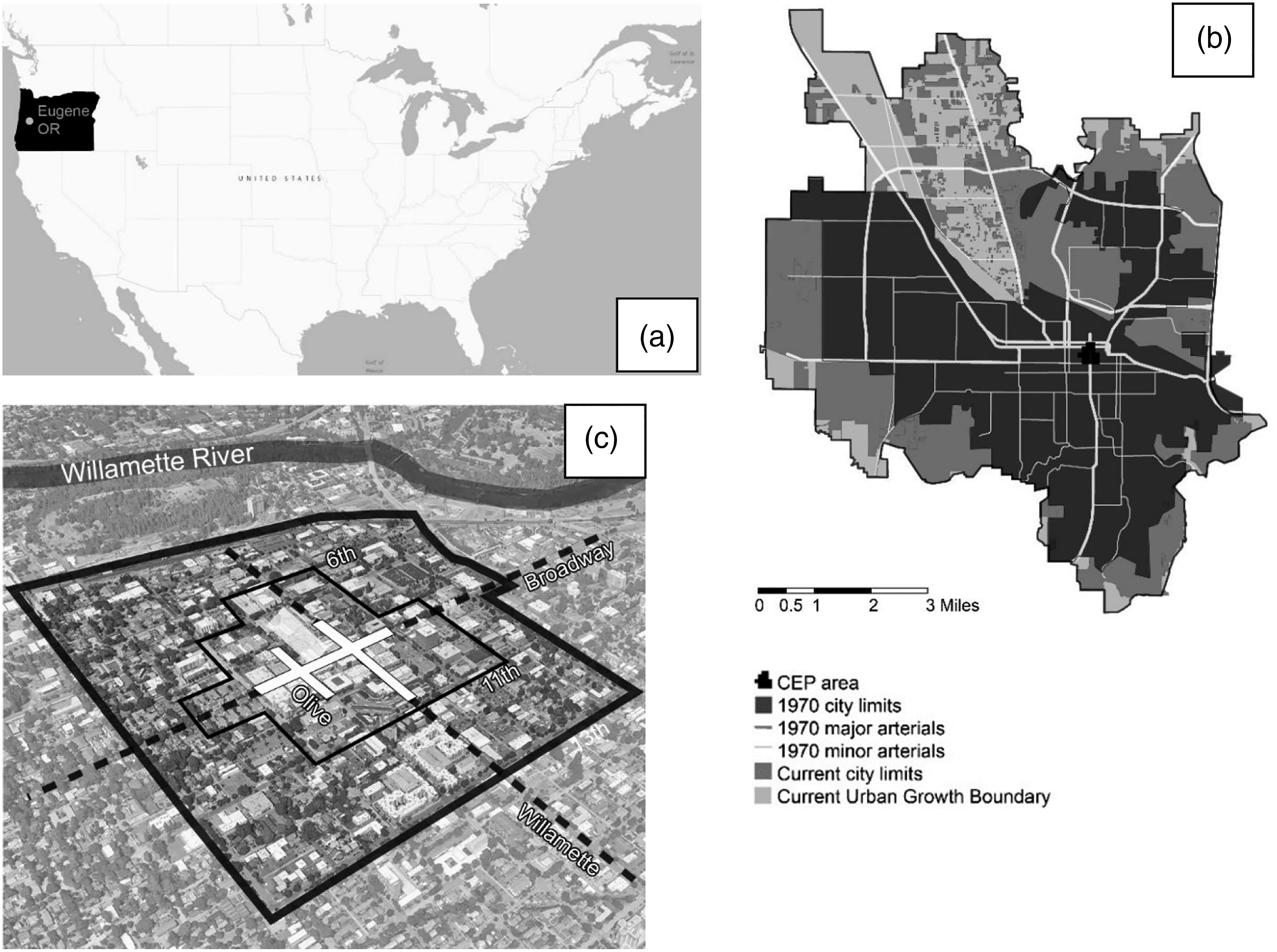
The central problem examined in this paper is the failure of downtown Eugene’s pedestrian mall strategy (the “Eugene Mall”) to facilitate the establishment of a strong retail core and the later resurgence of the downtown core into a mixed-use center. The Eugene Mall, which opened in February 1971, was a part of the city’s federal urban renewal program of the late-1960s. Beginning in late 1985, the Eugene Mall got demolished in four stages, the last of which occurred in 2002.
Downtown Eugene’s retail core transformation between the 1960s and the early 2000s is closely related to several post-war national developments. The federal urban renewal program (1954–1974) and the pedestrian mall strategy (which began in the late-1950s and boomed in the 1960s and the 1970s) aimed to revitalize the central city areas (downtowns) across the country. However, the downtowns of numerous cities across the nation experienced a decline in population 3 and commercial activities 4 during the post-war decades. This trend of decline reached a peak toward the end of the 1970s. As a result, large cities successfully began taking a different approach to economic revitalization in the 1980s, one of which was Public-Private Development. 5 These interventions had a positive impact; for instance, between 1980 and 1984, the thirty largest metropolitan areas experienced the construction of over 500 office buildings. 6 Compared to the dire situation of the late-1970s in terms of population decline, the central regions across most large cities had improved by 2000. 7 This paper explains the manifestation of these phenomena at the local level in downtown Eugene.
This paper consists of two sections presented as five investigations that comprehensively analyze the transformation of Eugene’s downtown core after the urban renewal and pedestrian mall. Eugene Mall’s two phases form the basis for each section. The displacement of retail businesses, a brief rise, and then a fall that led to Eugene Mall’s reopening are the major events that characterized Phase 1 (1970–1985). Although defined by the end of the mall’s existence, the resurgence of the downtown core from a faltering retail center to a mixed-use center characterizes Phase 2 (1986–2002). Of the five investigations, the first centers on understanding the reasons for Eugene Mall’s failure, specifically during the first phase. The second investigation addresses the retail core transformation between the late-1960s and the early 2000s. The two periods represent a point just before the Eugene Mall installation and its complete demolition. The third investigation addresses why the next segment did not reopen until 1992 after the first mall segment had opened in late 1985. Fourth, the focus is on why further reopening eventually occurred. Finally, the fifth investigation will examine how the city successfully steered the direction of its downtown core’s development during the second phase from a retail-centric to a mixed-use approach. These investigations contribute to the knowledge of a less explored topic—the impact of urban renewal and pedestrian malls on a city’s retail structure. Historian Lizabeth Cohen has highlighted this gap in research by arguing that “historians have paid far less attention to the restructuring of American commercial life in the postwar period compared to the transformation of residential experience.” 8
The sources utilized for this research are newspaper articles, the City of Eugene reports, minutes of the renewal agency’s meetings, theses and dissertations related to Eugene, interviews with four people involved in Eugene’s urban renewal, historical maps and images of downtown Eugene, and classified business directories for the Eugene-Springfield Metropolitan Area.
The Envisioning of Eugene’s Urban Renewal and the Pedestrian Mall
“Urban Renewal” in the United States was a federal program instituted formally in 1954 after an amendment to the 1949 Housing Act to introduce provisions for renewing nonresidential areas. 9 As Jon C. Teaford summarizes, “…. the 1954, 1959, and 1961 housing acts permitted an ever-increasing amount of urban renewal money to be spent for commercial projects and facilitated the use of the urban renewal mechanism to expand colleges, universities, and hospitals in the central city.” 10 Eugene’s federal urban renewal program, the “Central Eugene Project,” began in the late-1960s. It was one of over 3284 projects across 1258 communities instituted by the federal government. 11 The ambition of creating the “Eugene Mall”—a pedestrian mall to facilitate the revitalization of the retail core—primarily dictated the urban renewal project. The Eugene Mall, which opened in February 1971, was one of the 200 malls constructed in the United States, mainly in the 1960s and 1970s. 12 Nationally, the journey of downtown pedestrian malls, which began in 1959 in Kalamazoo, Michigan, 13 followed a simple strategy: create an open-air shopping center with enough parking by converting major downtown streets into pedestrianized zones. The pedestrian mall had initially evolved from the unity among downtown merchants to fight the common adversary in the form of the suburban shopping center. 14
According to mall historian Kent Robertson, a pedestrian mall is “a downtown corridor usually a few linear blocks along with the traditional main shopping districts where pedestrian transportation is given the highest priority.” 15 Roberto Brambilla and Gianni Longo contend that the “mall” represents areas where all vehicular traffic has been banned from a central street and are conscious attempts to mimic the popular suburban shopping malls. 16 While adding sociable urban spaces and dramatically improving downtown aesthetics, the pedestrian malls intended to revitalize the adjacent retail core.
The Central Eugene Project, which the City Council approved in 1968 (based on the works of the planning firm of Rogers, Taliaferro, Kostritsky, and Lamb/RTKL), aimed to establish the downtown as the city’s primary economic, social, and cultural center (Figure 2A).
17
Eugene Renewal Agency (ERA), the local agency, monitored the urban renewal program with an estimated budget of $18 million.
18
In addition to a retail center around an H-shaped pedestrian mall (Figure 2B), other components were (1) renewed commercial center (offices and banking institutions); (2) a cultural center (auditorium, convention center, and motor hotel); (3) a civic center; and (4) parking garages. The agency later removed the civic center from the final plan (Figure 3). (A) RTKL’s original CEP plan with land use distribution. Source: RTKL,1968, Phase 4, p. 77. (B) Final design by the team led by Mitchell-McArthur. Source: ERA’s brochure, available at UO Library map collection. RTKL’s 1968 plan for the Central Eugene Project. Source: RTKL’s Phase 4 study, p. 77 (reworked by the author). The major components of the program were (1) parking garages, (2) cultural/entertainment center (consisting of an auditorium, hotel, and convention center), (3) a retail center and pedestrian mall, (4) a new commercial/office center, and (5) a government center (which the ERA later took out). The smaller area shows the intended Retail Core. The pedestrian mall (along Broadway, Olive, and Willamette) is cross-hatched.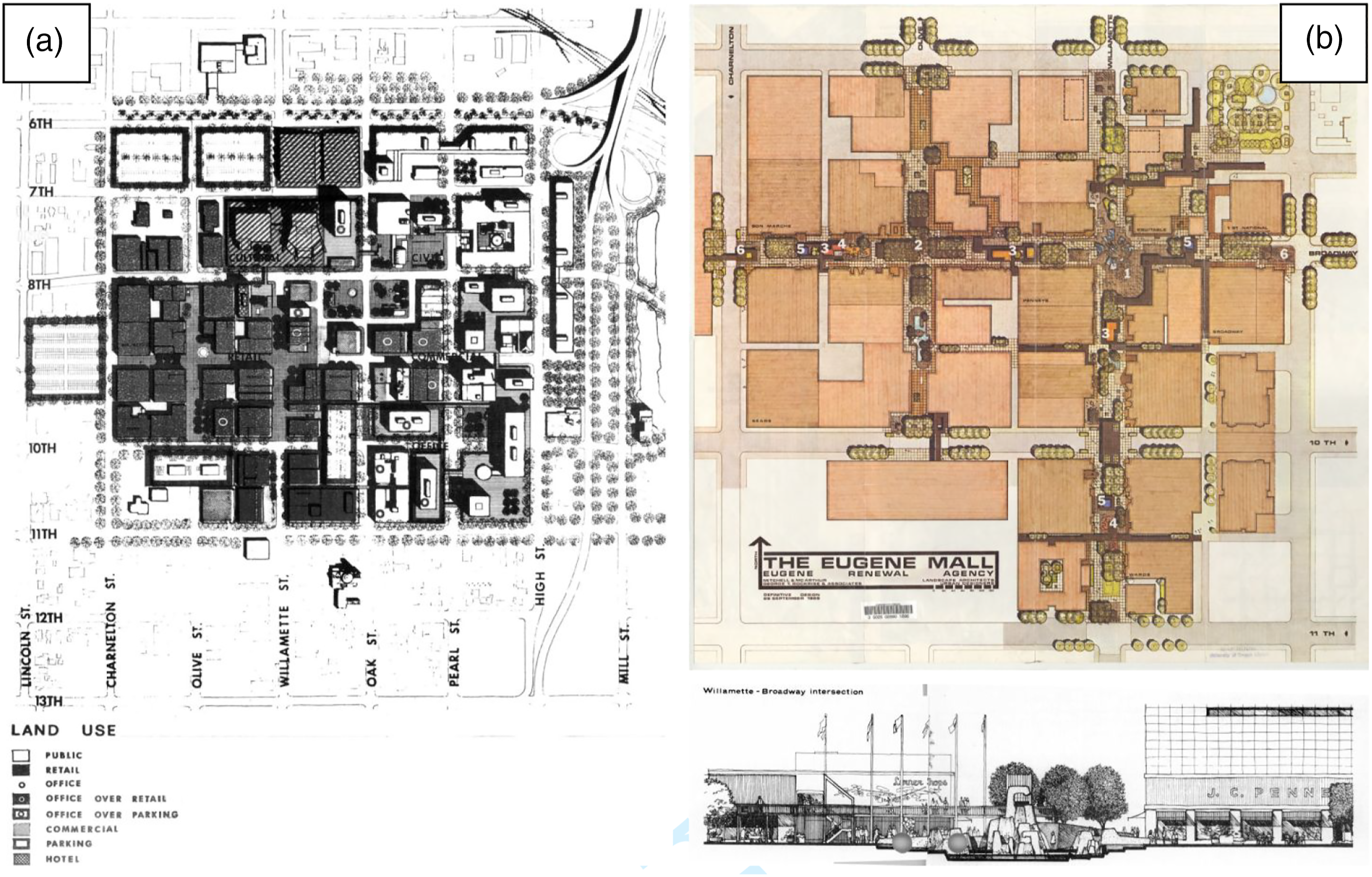
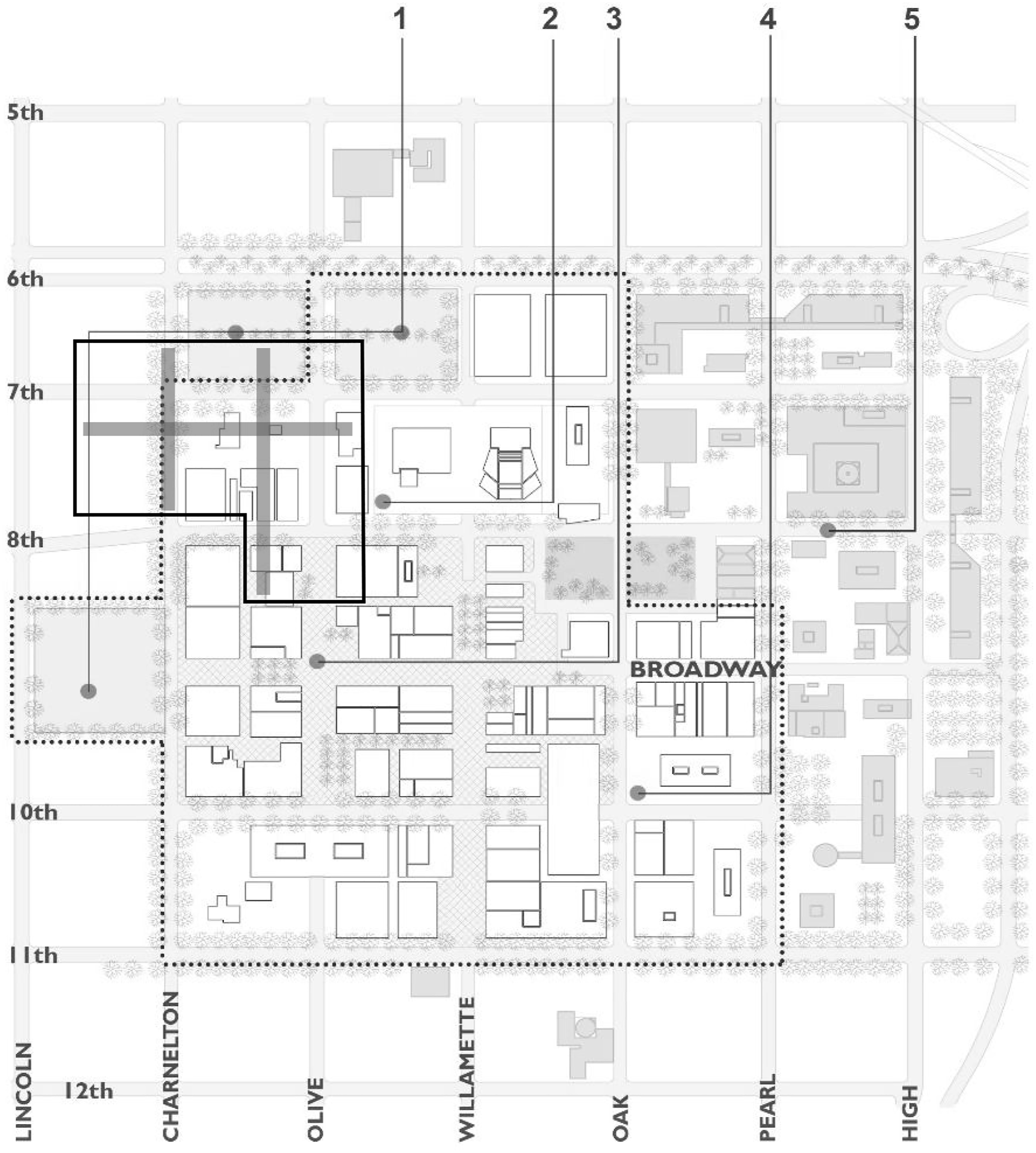
Eight of the seventeen-and-a-half urban renewal blocks adjacent to the Eugene Mall mainly intended to concentrate on retail businesses (Figures 4 and 5). This eight-block area is the main study area of this research and is considered the “retail core.” The Eugene Mall had five components: (1) a central plaza with a water feature and viewing platform, (2) a landscaped shopping plaza, (3) children’s play areas, (4) entrance structures, and (5) public facilities. The pedestrian mall opened formally on February 13, 1971, after the team led by Mitchell-McArthur (Landscape Architects) and George T. Rockrise and Associates (Urban Planners) completed the final design in September 1969.
19
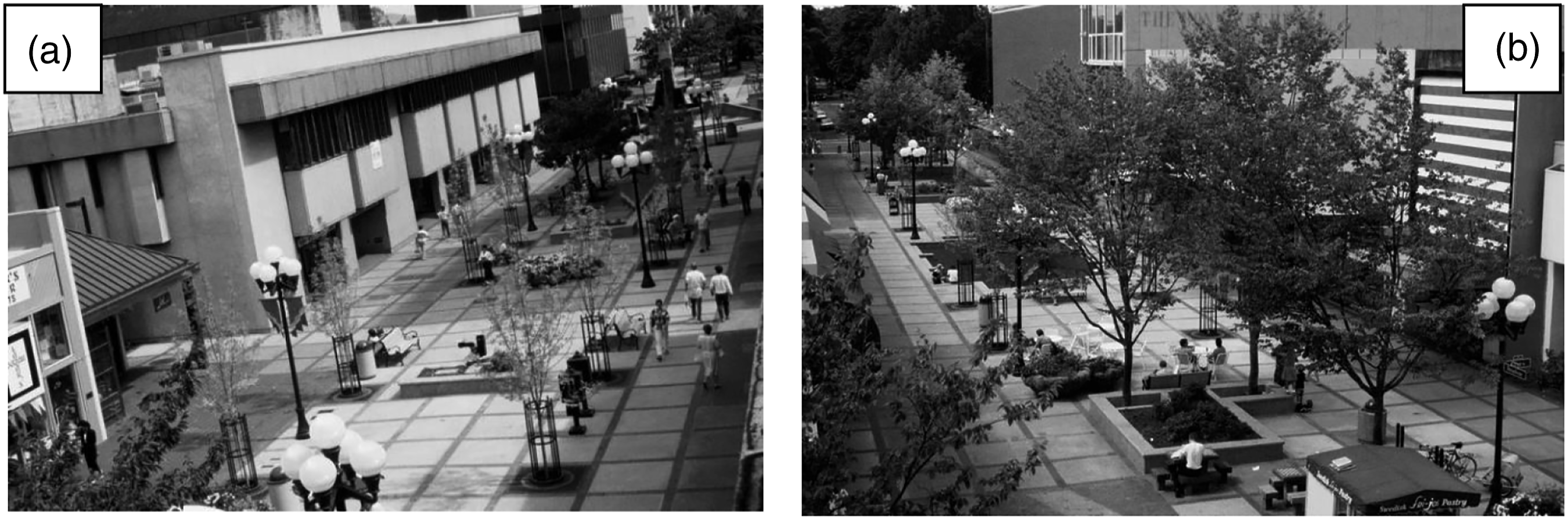
The final “Eugene Mall” design, 1969, by Mitchell-McArthur, Landscape Architects. Source: Mall design brochure released by ERA (reworked by the author). The major components of the mall were 1) a central plaza with a water fountain and viewing platform, (2) a landscaped shopping plaza, (3) a children’s play area, and (4) entrance structures. (A) Views of Eugene Mall: along Broadway, looking toward Charnelton. Source: Oregon Digital, Identifier pna_17620). (B) View looking toward Willamette. Source: Oregon Digital, Identifier pna_17629.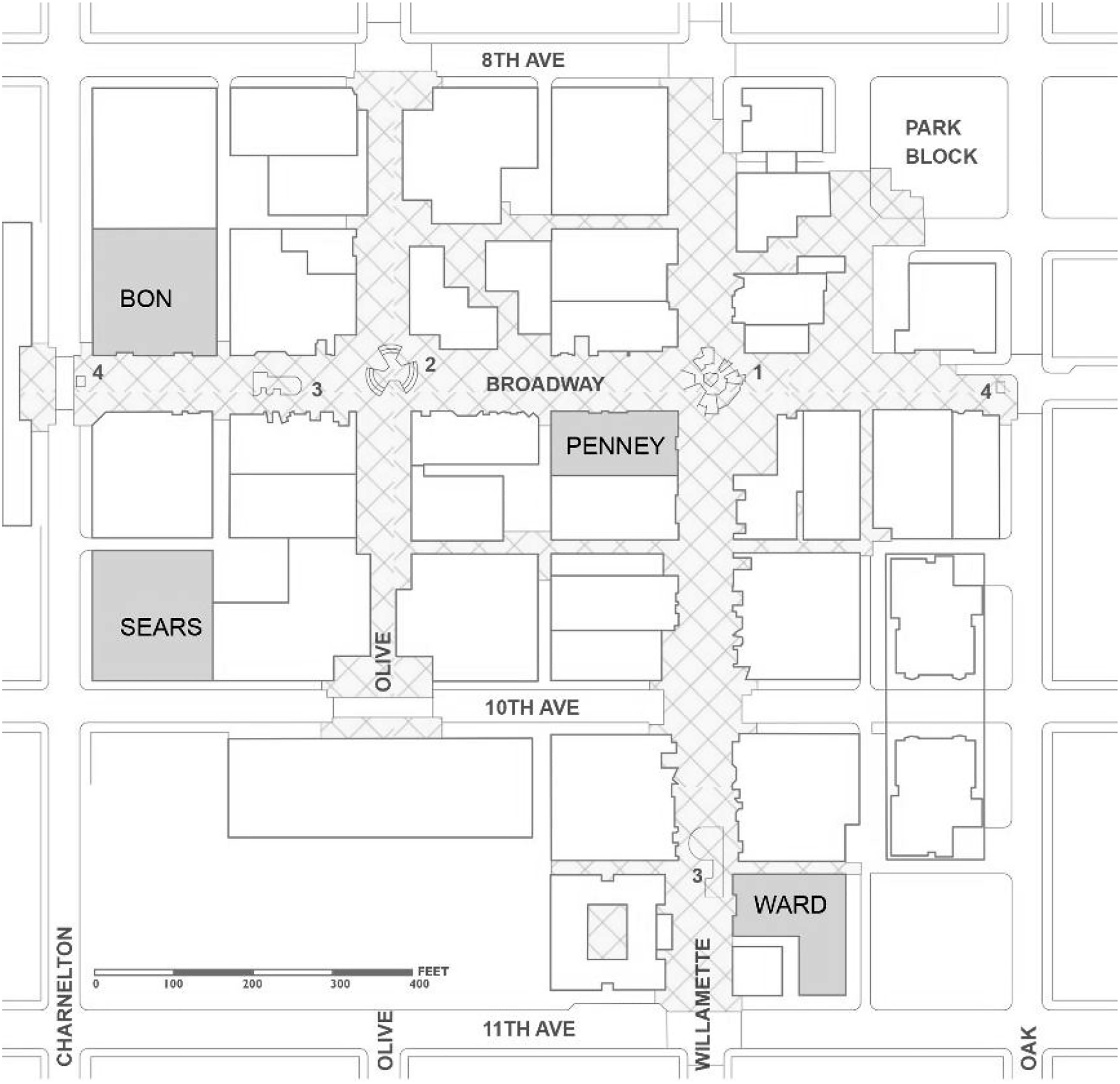
Forces that Pushed Eugene’s Urban Renewal and the Pedestrian Mall
Eugene had started experiencing massive growth beginning in the 1940s, which followed through to the post-war decades. For example, between 1940 and 1960, Eugene’s population grew from nearly 21,000 to 50,000 and reached 80,000 by 1970. A city that had occupied less than five square miles in 1941 had grown to occupy almost 14.6 square miles by 1960. Additionally, several developments in the 1950s and 1960s inspired the city’s decision for urban renewal and pedestrian mall construction. 20
By 1962, on the one hand, Eugene had been experiencing growth, and on the other, downtown problems had started to exacerbate. At least three underlying “internal” issues existed within the rich mixture of buildings and businesses. They were (1) a high proportion of substandard buildings, (2) inadequate parking, and (3) traffic congestion. From an economic standpoint, the downtown core had to be “saved” through revitalization because, among other reasons, it was the city’s primary tax base, which paid 7% of the taxes and occupied only 0.04% of the city’s land. 21
Between 1963 and 1964, city leaders and downtown merchants started to show concern about the downtown’s situation. In one of the early attempts to revitalize the downtown core and make it competitive with the suburban shopping centers (in mid-1964), the Lane County Planning Director had proposed a modified shopping mall for downtown Eugene, combined with an off-street parking program. 22 By 1965, the potential arrival of a large shopping center outside the city (which later opened as the Valley River Center/VRC) had started to worry downtown business owners who were already facing competition from small commercial centers scattered across the city. 23
Critical to the early history of Eugene’s urban renewal and the pedestrian mall is the city leaders’ trip to California in October 1965. The pedestrian malls around that time had successfully improved retail sales across multiple Californian cities. 24 Therefore, twelve city officials and six businesspeople visited pedestrian malls in downtown Fresno and Sacramento to understand the prospect of urban renewal and returned with positive impressions. 25 Shortly after the trip, in December 1965, the Eugene City Council established the Urban Redevelopment Agency, which, in 1967, became the Eugene Renewal Agency (ERA)—a local body of seven citizens that would authorize the city’s urban renewal processes. 26 In March 1966, ERA formally sent its first document to Housing and Urban Development (HUD) as a part of the urban renewal project application. 27 In 1967, ERA hired several firms for urban renewal studies, chief among which was the 1968 study and urban renewal plan by RTKL. 28 After approving the urban renewal application in March 1969, 29 HUD made the first round of grants available through the disbursement of $2.5 million. 30 The pedestrian mall construction began in 1970 and formally opened in early 1971.
Rise and Fall During Phase 1
Across the nation, the period between 1971 and 1976 represented the best years for mall construction when over sixty malls were built. 31 While the 1960s and 1970s marked the era of pedestrian mall successes, by the late-1980s, city leaders and the community no longer viewed them as a viable strategy for downtown revitalization. By 2005, fewer than two dozen downtown pedestrian malls had remained. 32 The first segment of the Eugene Mall got demolished in late 1985, less than fifteen years after its grand opening. Notably, the mall still existed for the next 17 years as the reopening occurred across three stages (1992, 1996, and 2002). During these years, the struggle to keep the mall and the challenge of renewing the downtown core through alternative strategies dominated the events surrounding downtown Eugene.
Previous researchers have linked mall failure to several reasons. According to Kent Robertson, “the malls borrowed only one dimension of the suburban mall formula—the vehicle-free street—and either ignored or failed to replicate the other important design, retail mix, and organizational elements of this model.” 33 Similarly, Linda Baker (2010) argues that the problem with malls was that they were envisioned principally as a structural solution, and little attention was paid to the underlying problem—the lack of a market. 34 The author laments that “malls got the blame for killing downtowns even when they weren’t at fault.” 35 A 2020 work analyzed the national trends (of over 120 pedestrian malls) and found at least seven reasons for mall success and failure. They are (1) population density (higher the better chance of survival), (2) the median age of the residents (as it increases, pedestrian malls are more likely to close), (3) the percent of the population that is white (high percent means less likely to close), (4) proximity to the beach (if present, 77% more likely to survive), (5) whether or not the city is a tourism destination, (6) length of the mall (longer mall tended to close sooner than shorter malls), and (7) the percent of sunny days (higher percentage means more chance of survival). 36 However, most of these assessments on reasons for mall failure entirely disregard the link between national policies and manifestations of those policies at the local level.
The Failure of the Eugene Mall
Several national policies and the local forces that aided the Eugene Mall’s failure took effect during the first phase of its existence (1970 to mid-1980s), which led to the reopening of the first out of eight segments. The findings of this research associate the mall’s failure with at least seven reasons: 1. The radical transformation of the built fabric (buildings and retail businesses) 2. Unforeseeable external causes: changing socioeconomic dynamics and shopping centers 3. Mall’s design qualities 4. Negligence in responding to constructive criticisms 5. A planned project with very little flexibility 6. Disregard for downtown housing 7. The inability of the parking garages to entice the visitors
First, the failure of the Eugene Mall began with the massive intervention of urban renewal-led destruction. Urban Historian Alison Isenberg has commented on the controversial nature of urban renewal policy by arguing that “the downtown investment policy with the most rationalized and repeated supporting arguments…. was also irrational, as embodied in the idea of tearing down Main Streets to save them.” 37 Writing about urban renewal as a practice of Eminent Domain in 1976 (shortly after the end of the federal program), Patricia Munch criticized “the legal right to acquire property by force rather than by voluntary exchange.” 38 In addition to evicting previous owners, many cities got reasons to create attractive shopping environments and parking instead of prioritizing strategies that would support robust retailing activities or make downtowns resilient in the long run. 39 In Eugene’s case, stories like that of the Quackenbush Hardware store, the city’s oldest surviving downtown store that had opened in 1903, exemplify “eminent domain.” 40 Of note is the forceful language used by the renewal agency representatives, like “You’ll have to sign sooner or later, Mrs. Quackenbush. Why not save yourself thousands of wasted dollars and a lot of grief? We’ll win eventually.” 41
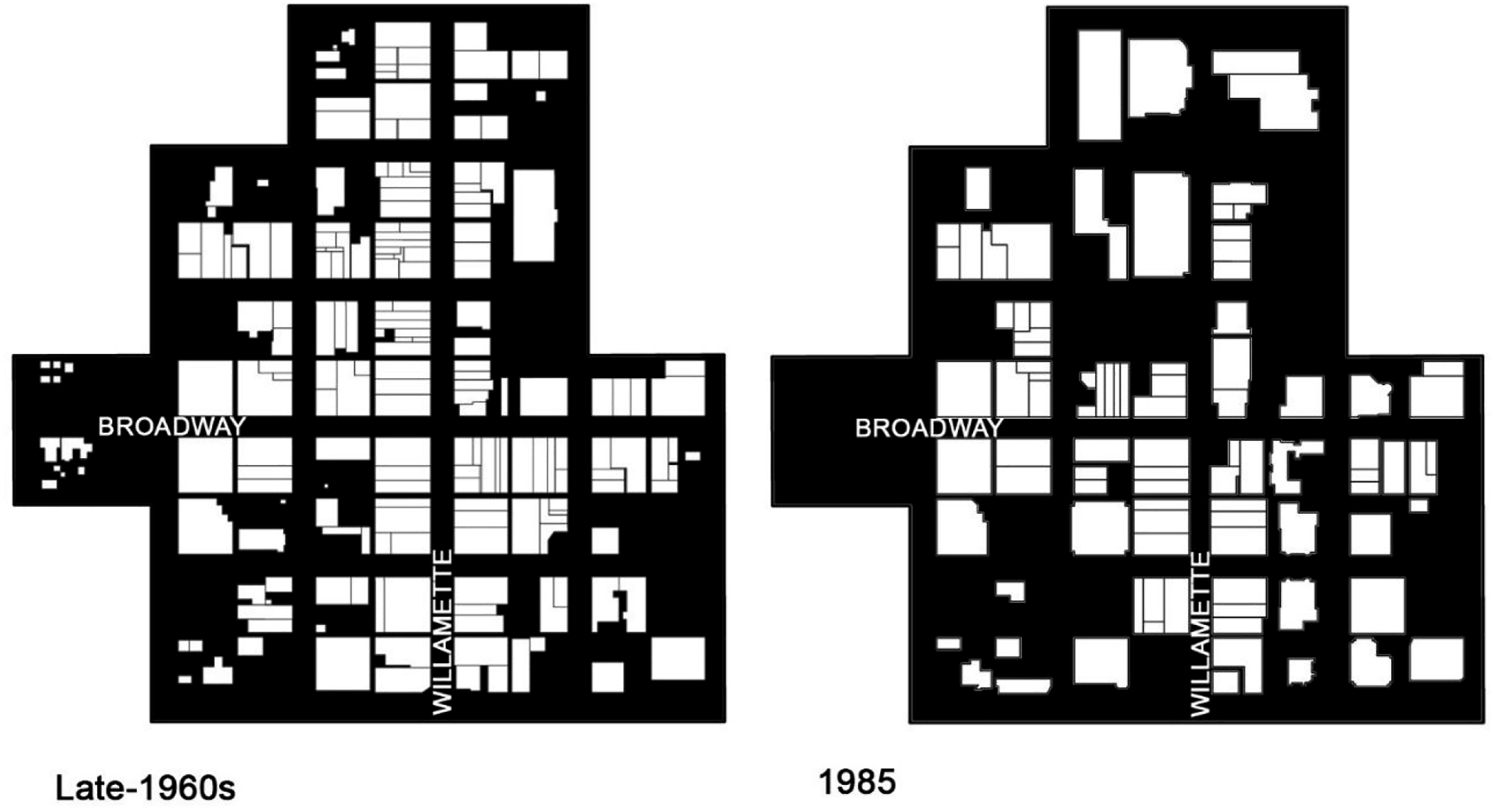
As a part of the urban renewal project, the agency cleared at least 17.5 acres (45%) of the approximately 40.5 acres of developable land. The demolitions cleared significant portions of the original downtown fabric and completely transformed the rich mixture of diverse small stores resulting from over 110 years of growth (Figures 6–9). Although the agency initially hoped to demolish only 77 of the 192 buildings in the urban renewal area (40%),
42
it ended up demolishing at least 117 (60%).
43
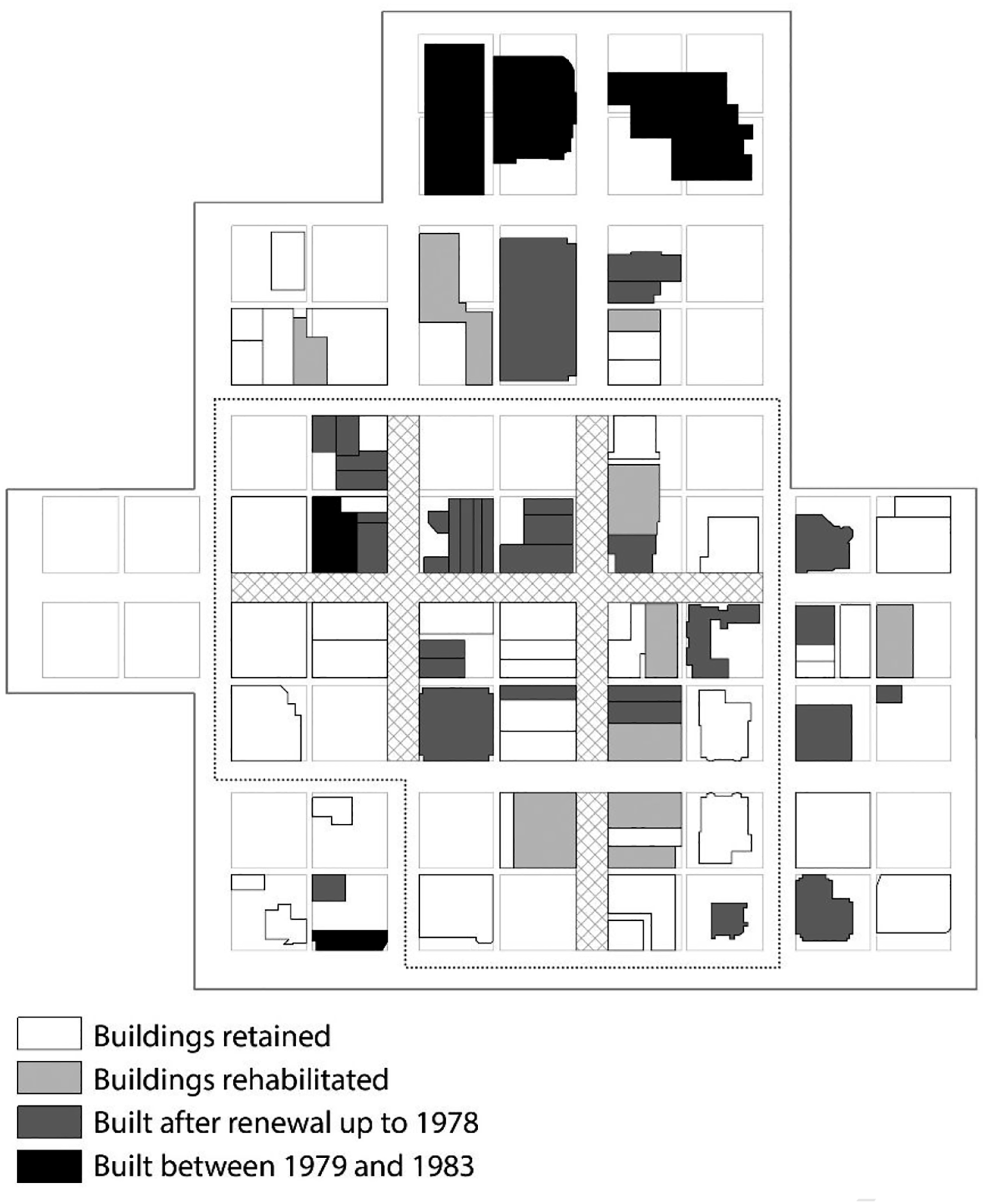
Of the at least 169 retail businesses in the late-1960s before the renewal, only a quarter was still present in 1978 (from the data available). Nearly three-quarters left the project area. At least 133 residents, 334 businesses, and 20 families were also displaced. Compared to the smaller and more diverse retailers before the renewal, larger but fewer and less diverse businesses characterized the post-renewal retail fabric (Figure 10). The analysis reveals that the process of demolition and clearance of the existing fabric may not have been a problem in itself; it was only a step toward revitalization. The actual problem was the demolition scale (proportion of the existing built fabric demolished) and the anticipation to fill the void in a short period. Existing morphology before the renewal (left) and anticipated changes to the renewal area following the urban renewal project (right). Morphology of the renewal area before and after the renewal. Following the demolition of substandard buildings, the renewal area’s inventory declined by over 50%, from 198 in 1968 to 94 in 1985. The numbers declined by almost 40% in the retail core, from ninety-two to fifty-seven. Building morphology of the CEP area showing buildings by year of construction until 1983. The empty areas (white) were still awaiting investments. Views of the pedestrian mall area before and after the renewal and at present: (A) looking southeast from the Broadway-Willamette intersection, (B) looking west from the Olive and Broadway intersection, and (C) looking northeast from the Broadway-Willamette intersection. The three maps of the renewal area’s street segments show the concentration of retail businesses in three different years. The retail business numbers declined in the urban renewal area by almost 50% between 1965 and 1985 and almost 40% in the retail core. This information is critical because improving the numbers or capacity of retail businesses in the retail core was one of Eugene Mall’s primary purposes.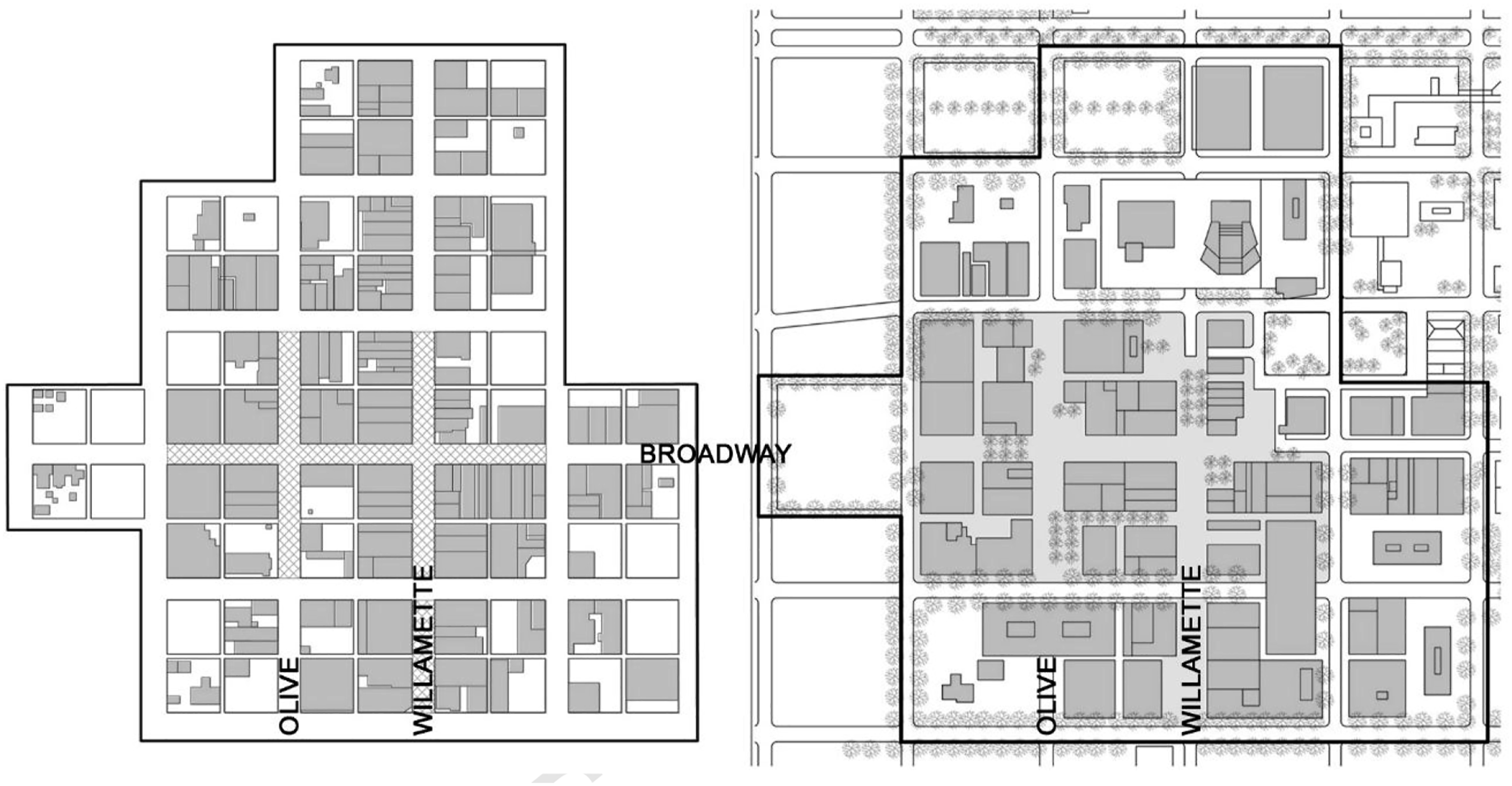
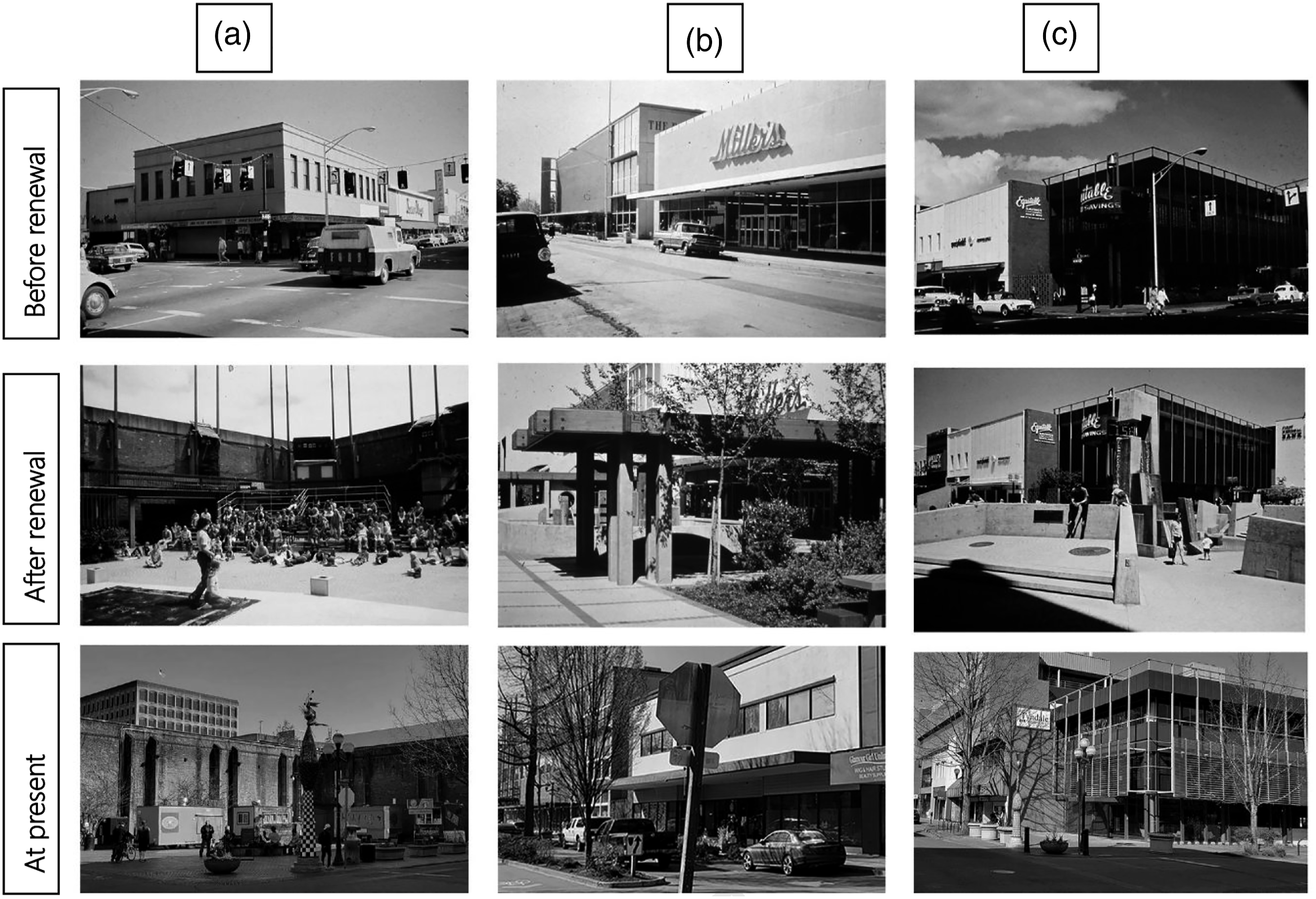
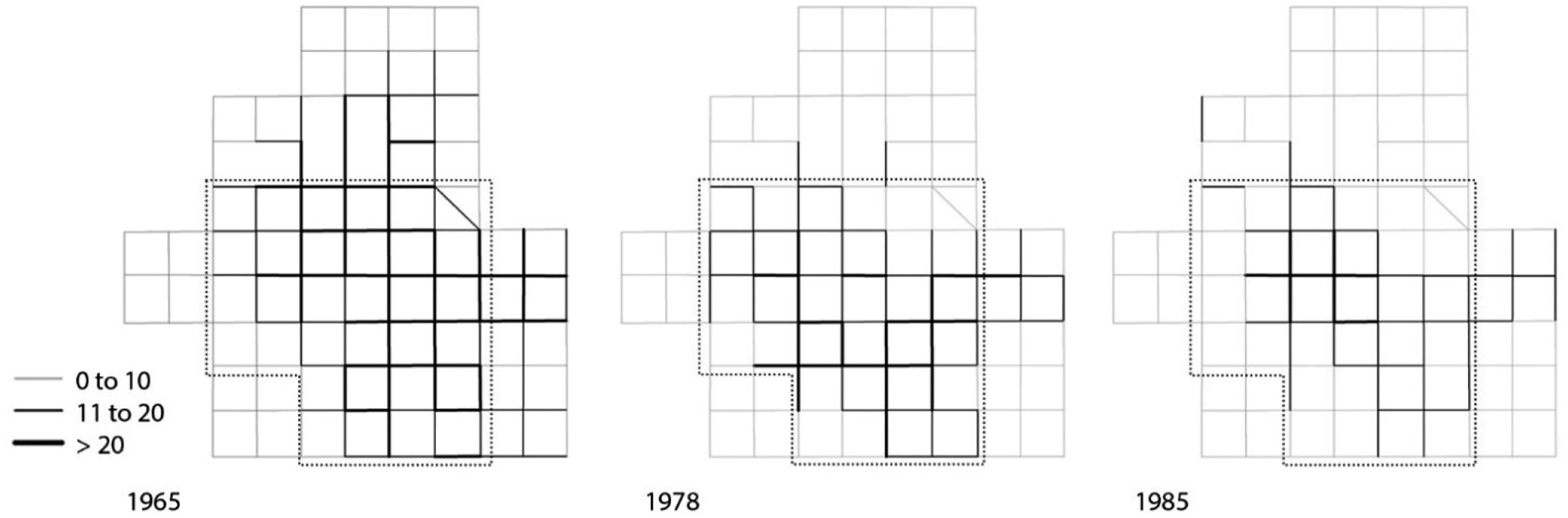
Second, at least two “external causes” influenced the mall’s decline, (1) the changing socioeconomic structure of the Eugene-Springfield Metropolitan Area and (2) the popularity of the peripheral shopping center (Valley River Center). Between 1970 and 1990, the central areas lost population or gained very little, whereas the peripheral areas experienced a substantial increase. Also, the central tracts lost their “income capacity,”
44
whereas peripheral tracts experienced gains (Figure 11). One of the reasons for this outward movement could have been the Valley River Center
45
(VRC; opened in 1969), the Eugene-Springfield region’s first and largest enclosed shopping mall. By the 1980s, the region had not experienced sufficient growth in sales volume following VRC’s opening to justify two large retail centers.
46
Another large shopping center was the Gateway Mall
47
(opened in 1990) just outside Eugene’s eastern boundary. At different points in the mall’s history, these shopping centers took the businesses away from downtown. Maps of the Eugene-Springfield Region’s Census Tracts showing population difference between 1970 and 1990 (top) and Net loss and gain in “income capacity” between 1970 and 1990 in terms of 1990 dollars (bottom). The original data source is Social Explorer (www.socialexplorer.com).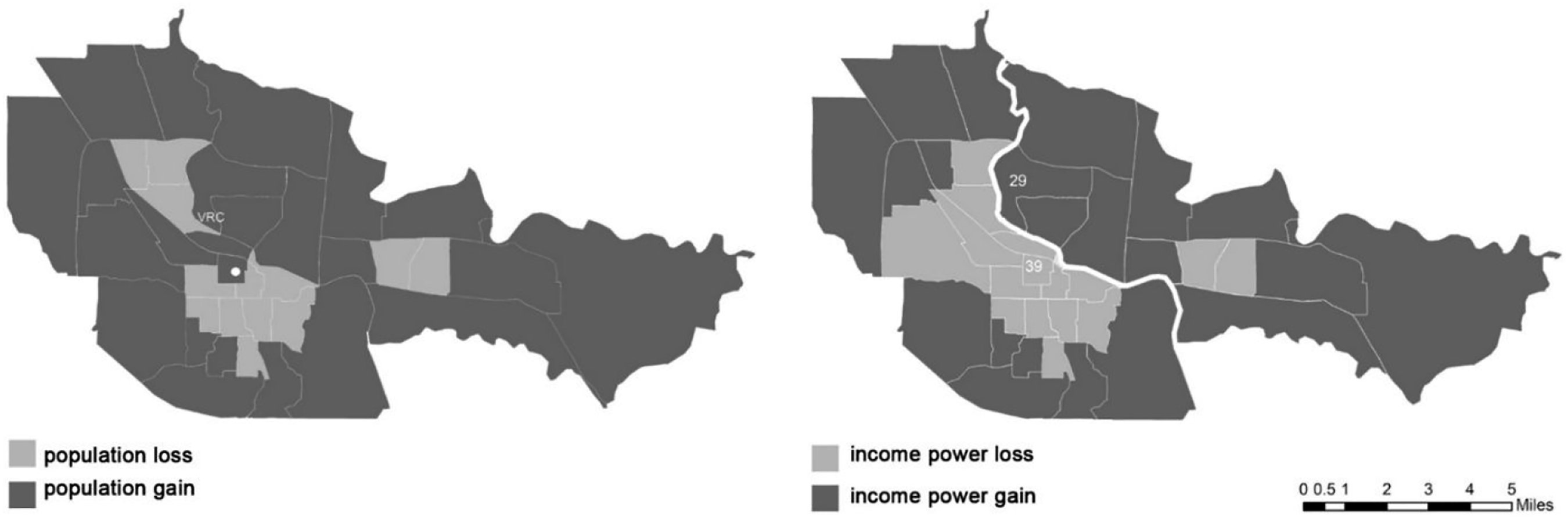
Third, several design qualities caused the mall’s poor functionality and inability to attract and retain visitors. They were (1) the complete closure of eight segments to cars and issues related to vehicular circulation; (2) the mall’s shape and size; and (3) the central plaza fountain and other mall elements. The street closure created a barrier-free pedestrian movement, but it meant that automobile users had to be dropped outside the mall or find parking. All four interview respondents questioned by the author about the fallacy of the pedestrian mall strategy highlighted that the concept of pedestrianization after arriving by car did not work because the patrons did not want to shop unless they could reach close to their destination. Also, the mall had over 3000 feet of street frontage along Broadway, Willamette, and Olive compared to the national average of 1500 feet. 48 In other words, the Eugene Mall was much larger than a typical mall.
An examination and study of the mall’s design demonstrate that several issues limited its ability to function effectively as a public space, provide access and visibility, and support the retail core. Some of them were the fountain in the central plaza (intersection of Broadway and Willamette), playgrounds, and seating in the middle of the mall (Figure 12). The fountain stood twenty-foot tall and occupied 150 feet by 120 feet of space; too large considering its location in a prominent intersection.
49
(A) 1971 view of the Central Plaza fountain. Source: Oregon Digital, Identifier pna_17611. View of the children’s play area along Broadway. Source: Oregon Digital, Identifier pna_17618).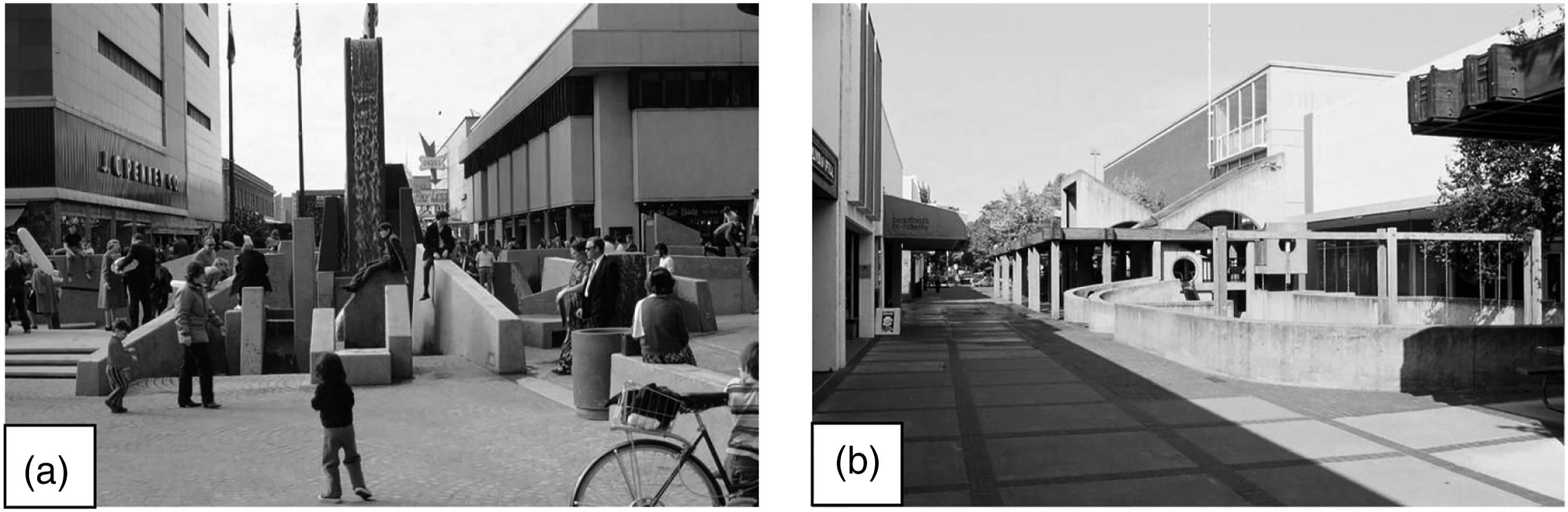
Fourth, the renewal agency paid little attention to criticisms about the potential risks of large-scale destruction. Most criticisms were about the urban renewal project’s top-down approach, lack of sensibilities for the local community and small businesses or property owners, an inclination toward large single-use projects, and complete restriction of vehicles in the mall. For example, a local architect Otto Poticha had argued that the mall was emulating a shopping center and voted instead for a need for a mixture of uses. 50 Another architect, James Longwood, had claimed that the open mall would not be attractive in Oregon’s “miserable wet weather.” In another instance, in 1976, concerns about a proposed retail expansion at the west edge of downtown prompted strong reactions from a newly formed organization called Friends of a Liveable Eugene. 51 The group concentrated its criticism on previous studies which had suggested a large commercial complex in the vacant areas of the mall because they believed housing and other mixed uses would be more beneficial. Instead of focusing on the strengths of smaller businesses or accommodating downtown housing, the renewal agency pursued large retailers and “megaprojects” in the critical years of the late 1970s.
Fifth, the “strict” nature of design and planning-related characteristics defined the inflexibility of the Central Eugene Project. They were (1) reliance on large retailers, (2) land-use segregation and restriction of retail locations, (3) large parcel reservations for pre-established projects, and (4) pursuance of large projects for too long. The Eugene Renewal Agency strongly believed that large retailers were critical to a thriving retail core, while smaller shops were deemed incapable of sustaining a retail core by themselves. Before the renewal, the existing anchor stores primarily determined the future mall segments, such that the anchors defined both the periphery and the center (Figure 13). These anchors would act as magnets by attracting high pedestrian traffic volumes, whereas the buildings between them would contain small businesses. The large retailers present in the mall in the 1970s were Bon Marche (108,000 square feet), Sears (87,000 square feet), JC Penney (56,000 square feet), and Montgomery Ward (43,000 square feet).
52
Locations of large retailers before the renewal (in gray) and the intensity of retail businesses in the core, 1965. The map highlights that the future retail core would be composed of the same streets with maximum retail concentration before the renewal. Each of the eight street segments that would later become the mall constituted high retail business numbers centered at the Broadway and Willamette intersection.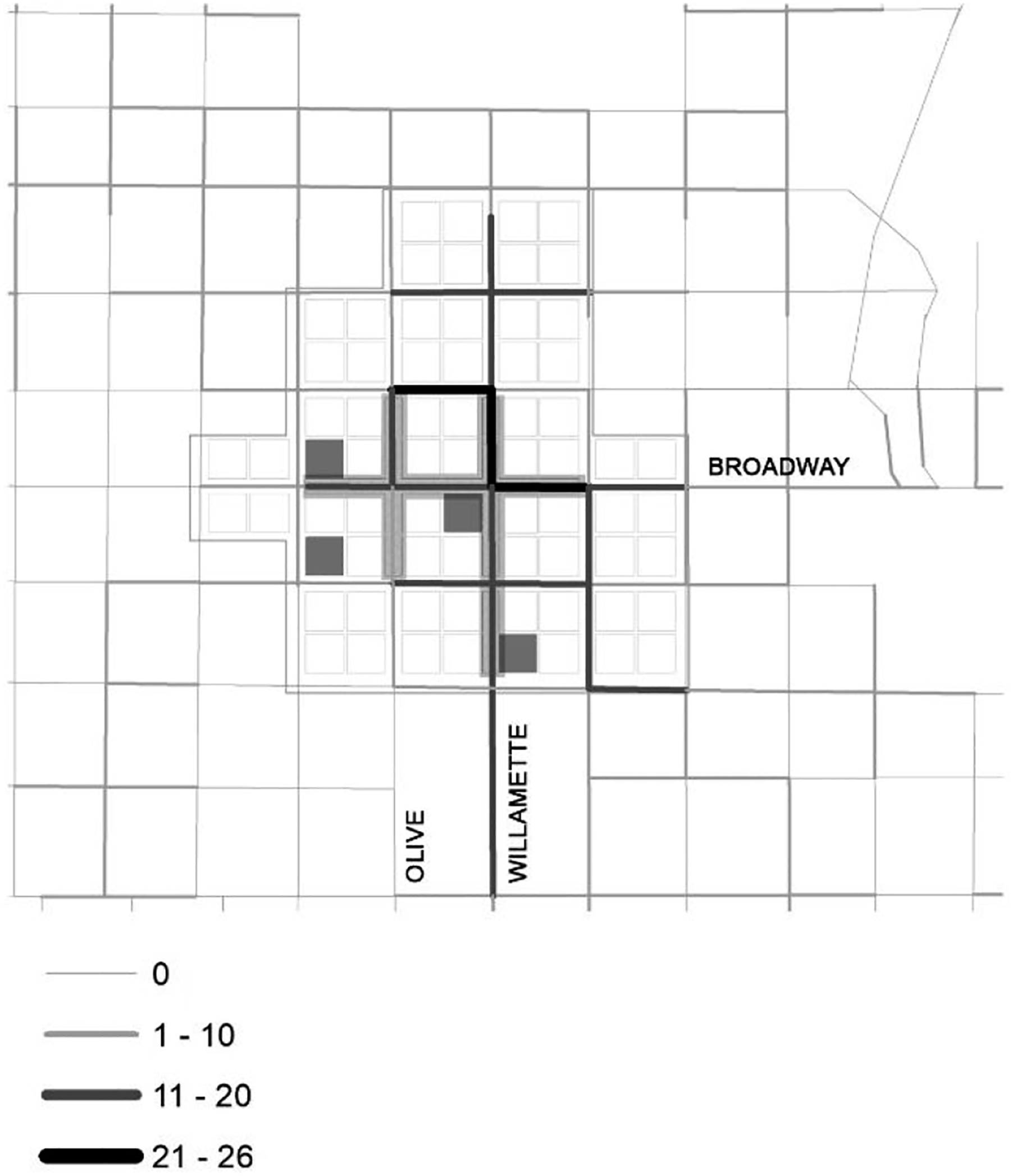
However, the risk was that a huge chunk of retail presence would be gone if they left the area, which is what happened. These large retailers left one by one for VRC and Gateway Mall between 1975 and 1990. 53 It started with Montgomery Ward in March 1975. 54 While JC Penney operated at both locations for 7 years, it eventually left downtown in 1977. 55 In addition to VRC, the downtown started losing businesses to the Gateway Mall around 1990. Sears left for the Gateway Mall in September 1989 56 and Bon Marche in July 1990. 57 The loss of these large retail anchors became an unfillable void as the area could no longer rely solely on the existing small businesses.
In addition to depending on large anchors, segregating and pre-defining the location of different uses was at the core of the urban renewal strategy. In essence, the renewal agency was conscious of not mixing “incompatible uses,” especially among the ones that were retail and non-retail. In hindsight, it has become clear that the anticipation of filling such a large area (800,000 SF) with retail and only a few other compatible business types was not a viable strategy.
Another inflexible component of the urban renewal plan was reserving large parcels for pre-determined projects. The Cultural Center (consisting of an auditorium, a hotel, a conference center, and parking) and a public parking garage (The Parcade) were the most notable.
58
The agency’s rejection of a 1973 proposal by local businessman Archie Weinstein for a mixed-use project on the site reserved for the Cultural Center set an example of its persistence. Instead of Weinstein’s project, the agency chose a hotel project offered by a Portland developer, which later got canceled in 1976. The renewal project had to wait until 1980 (i.e., seven more years) to secure a deal for that site.
59
Weinstein, a displaced tenant, had offered $250,000 to build a 72,500 square feet retail/mixed-use complex on the two-quarter blocks between the sixth and seventh avenues along Willamette Street (Figure 14).
60
However, the renewal agency had planned the site for a motor hotel, and the agency presented several justifications to reject that offer.
61
Archie Weinstein’s proposal for a retail and mixed-use project (instead of a hotel). Source: Register Guard, January 14, 1974. The complex would have included his Surplus Store, a store selling Western merchandise, a restaurant and lounge, a drug store, a beauty supply shop, a sewing center, appliance sales, shoe repair, and a hardware store.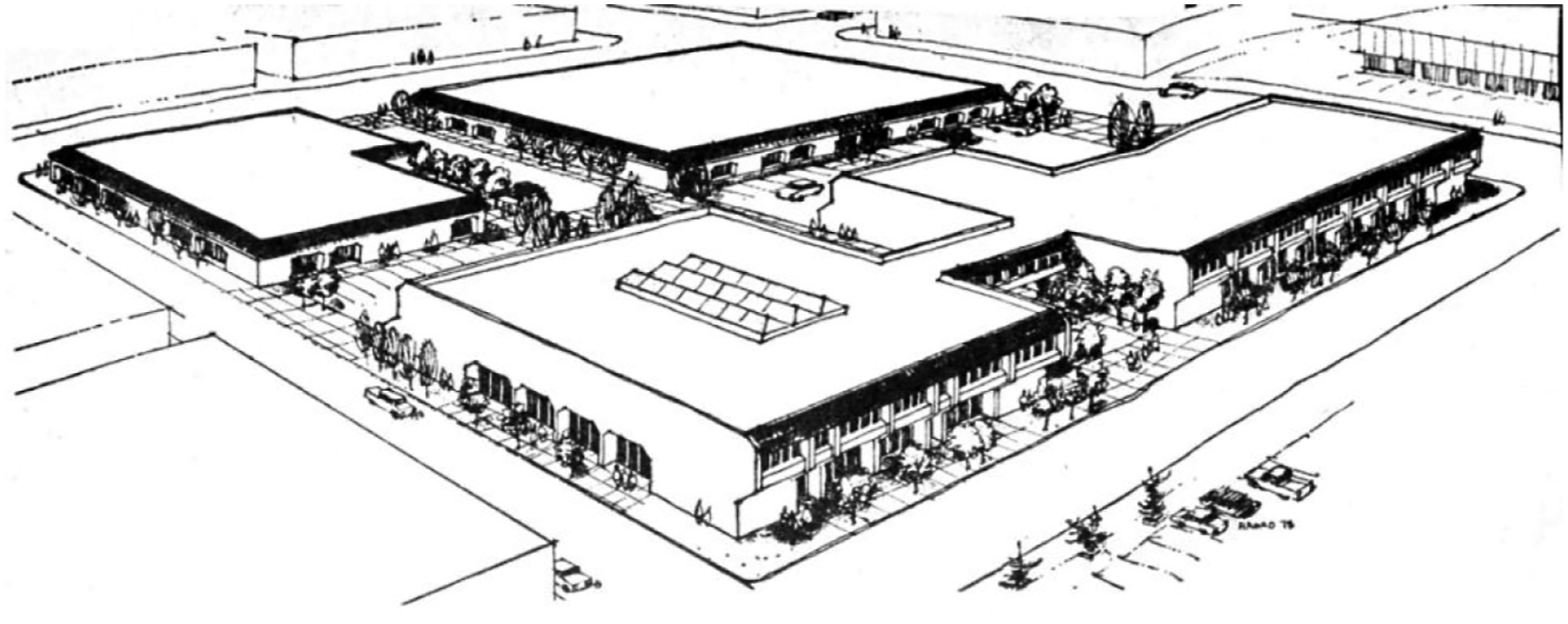
Between 1977 and 1983, the agency and the city spent considerable time, effort, and money for comparatively much lesser gains. They pursued a $50 million mixed-use center in 1977 after hiring the Elbasani, Logan, and Severin Design Group (ELS). 62 Although the plan had ample provisions for small stores as part of the Retail/Commercial Center (estimated to cost $20 million), the key focus was to expand the existing anchors and add a third large anchor. The other vital components were multiple parking garages ($16 million) and a Multi-use Hotel/Convention Center ($14 million). 63 Unfortunately, the developers that the agency hired could not attract enough investors. The concerned authorities realized the plan’s failure by 1981, notably after one of the developers’ efforts to persuade the retail giant Nordstrom failed. 64 The city again commissioned another developer for a possible “climate-controlled shopping center” in the same area in 1983, which also failed shortly after since the city had no control over most of the privately held areas proposed for new constructions. 65
The sixth reason for failure was that despite several studies suggesting the need for housing in the downtown core, the urban renewal plan did not include any residential constructions. Notably, the planning firm RTKL had proposed the development of medium (townhouses) and high-density (high-rise) residential use in the downtown core that accommodated various income ranges. 66 However, ERA did not incorporate those suggestions in the final plan. Several other studies have also suggested the potential of downtown housing in the 1970s. For example, a 1974 report mentioned the need for “two to three-level garden apartments at forty dwelling units per acre with parking under the buildings” for the downtown. 67 Another study predicted that in the mid-1970s, 1000 or more additional housing units would support an estimated 100,000 square feet of retail and services. 68 Furthermore, one 1980 report rated the downtown core and adjacent neighborhoods “higher” for the conversion of existing properties into residential units and “lower” for the ability to attract new construction. 69 However, the renewal agency was reluctant to consider residences as a part of the solution, and it was not until the late-1990s that city leaders considered bringing a housing project to the downtown core.
Finally, the seventh factor associated with Eugene Mall’s failure was the parking garages’ inability to entice visitors as anticipated. Managing vehicular circulation and deciding the parking garage locations around the mall was challenging, considering that automobiles were not allowed in the area. At the least, the urban renewal project successfully delivered free downtown parking and constructed multiple parking garages in the 1970s. 70 Even with ample parking opportunities, the downtown community, including employees, merchants, authorities, and most importantly, the mall patrons, found parking issues problematic. For instance, according to a 1990 survey, 80% of the patrons parked in surface lots, and less than 5% parked in parking structures in 1986. 71 Most people did not want to park in multi-level parking structures, especially during rainy months, and mall patrons perceived parking as unsafe and time-consuming. A May 1990 survey on mall patrons’ preference found that among the popular reasons for not coming to the mall was “inadequate parking or parking that was too distant from the shopper’s destination and imperfect traffic patterns.” 72
Boom and Decline During Phase 1
Although the City Council decided to take out the first segment of the Eugene Mall in late 1985, it had shown signs of a booming retail core between the mid to late 1970s. Naturally, it took a few years after the mall’s opening in 1971 for the new retail core to start taking shape. By 1974, it had received several substantial investments to convince many that the pedestrian mall was a good idea. Even the mall manager echoed the spirit, claiming that the Eugene Mall at the time could be a prototype for cities that wanted to upgrade their core areas. 73
In this regard, the important question is, what aided Eugene Mall’s boom years during the 1970s? During the mall’s most prosperous era in the late-1970s (represented in this research by the year 1978), the retail core boasted about 100 retail businesses, which was only 20% less compared to 1965. According to one of the interview respondents, downtown merchants and property owners remained to protect their investments, 74 and for others, tax increment dollars were available for improvements and new investments. Two interview respondents recall that many merchants who stayed for a while remained either in buildings that the retailers owned themselves or they were able to renegotiate much lower rents than they had been paying.
After a brief period of success, the Eugene Mall’s demise began in the early-1980s with the inability to retain existing businesses and attract new ones. One interview respondent shares the experience in the following ways: “in the hard economic times of 1980-82, I had an office upstairs on the northeast corner of Broadway & Willamette. It looked out over the vast wasteland, including the defunct fountain…. At one time, there were many little coffee shops, breakfast places, sandwich places, and these all gradually disappeared in the eighties and nineties.” According to another interview respondent, “the recession of the 1980s, which involved the collapse of the lumber industry, was (a) huge blow…. Also, since the city did not own most of the property, it was (and is) privately owned by many owners…. it was never easy to have a broad strategy that everyone supported and had the money to invest in.” Therefore, from one viewpoint, the failure was brought upon by the inability to retain the businesses during the “hard times” of the early eighties.
With the scenario changing at the start of the new decade, the downtown merchants started to push for reopening the mall by mid-1983. 75 A high vacancy rate reflected the pedestrian mall’s dire situation around this time. For example, in mid-1984, on one block face alone (the south side of Broadway between Olive and Charnelton streets), four of eleven storefronts were vacant, while those outside the retail core were not suffering as much. 76 Consequently, by July 1984, the City decided to tear a part of the mall segment along Willamette between the 10th and 11th avenues. 77 The reopening occurred on November 1985 at the expense of $200,000. 78 The adopted design included “a two-way street with a raised median island, parallel parking, and sidewalk bulges on both the east and west corners of Willamette at 10th.” 79 The demise of the Eugene Mall had begun, although its final piece would survive for another 17 years.
The Resurgence of the Street During Phase 2
The changes between the early to mid-1980s prompted Eugene’s city leaders to reimagine the way future development would proceed during the second phase (1986–2002). Although this “new direction” eventually included the decision to take out the pedestrian mall in three stages, ERA and the City Council set other progressive priorities to revive the downtown core. Specifically, the narrative on revitalizing the downtown core shifted from a retail-centric approach to incorporating community participation, preserving the existing businesses, and inviting diversity in future projects.
Few scholarly works present urban renewal as a “productive” endeavor compared to the portrayal of destruction and injustice. The works of at least two authors lie in this category—Lizabeth Cohen and Alison Isenberg. Historian Lizabeth Cohen (2019), in “Saving America’s Cities: Ed Logue and the Struggle to Renew Urban America in the Suburban Age,” narrates the work of the prominent urban renewal figure in three American cities (New Haven, Boston, and New York). 80 One aspect that Cohen highlights is the positive impact of citizen participation in urban renewal projects. As Cohen contends regarding Boston’s urban renewal experience, “One of the most important legacies…. was the spur it gave to community organizing, which flourished thereafter in many realms of American society.” 81 Similarly, in “Designing San Francisco: Art, Land, and Urban Renewal in the city by the Bay,” Alison Isenberg (2017) presents urbanist Grady Clay as a unique visionary for the time, who criticized the impact of “top-down, clearance-based, monolithic, automobile-centered downtown redevelopment.” 82 Clay believed that urban renewal should give citizens more say over the urban form so that real people, rather than invisible “machinations,” could set more of the redevelopment agenda.
The events described in the examples above manifested in Eugene Mall’s second phase in at least one crucial way. The city leaders, investors, downtown merchants, and the larger community realized they had to amend their priorities for downtown development instead of being constrained to the original urban renewal plan. Beginning in early 1986, the City Council and renewal agency began working on amendments to the original Central Eugene Project. Through several iterations, the final December 1989 proposal set new priorities like encouraging downtown housing, developing vacant private and public lands, investing in non-retail uses like a downtown public library and a transit hub, building more parking garages, and encouraging rehabilitation of existing structures. 83
Decline and Boom During Phase 2
Nationally, the latter half of the 1980s marked the beginning of a period of decline for pedestrian malls. Between 1985 and 1994, cities across the country removed over thirty pedestrian malls while only constructing one.
84
While there were a few signs of recovery between the mid to late-1980s,
85
Eugene’s retail core experienced a major setback starting in 1990 with the loss of two anchor retailers, Bon Marche and Sears. The retail core would change dramatically in its aftermath. According to a Duncan and Brown study, the downtown retail space vacancy rate jumped to over 29% in 1992 compared to 9% in 1990.
86
Between 1985 and 2000, the retail business numbers inside downtown Eugene’s retail core reduced by almost 20%. Figure 15 shows that the entirety of the central and western retail core lost businesses. Map showing the change in retail business numbers between 1985 and 2000. The impact of the major retail anchors, Bon Marche (BM) and Sears (S) leaving the mall in 1989/90 is visible in the western and central Broadway and Olive stretch.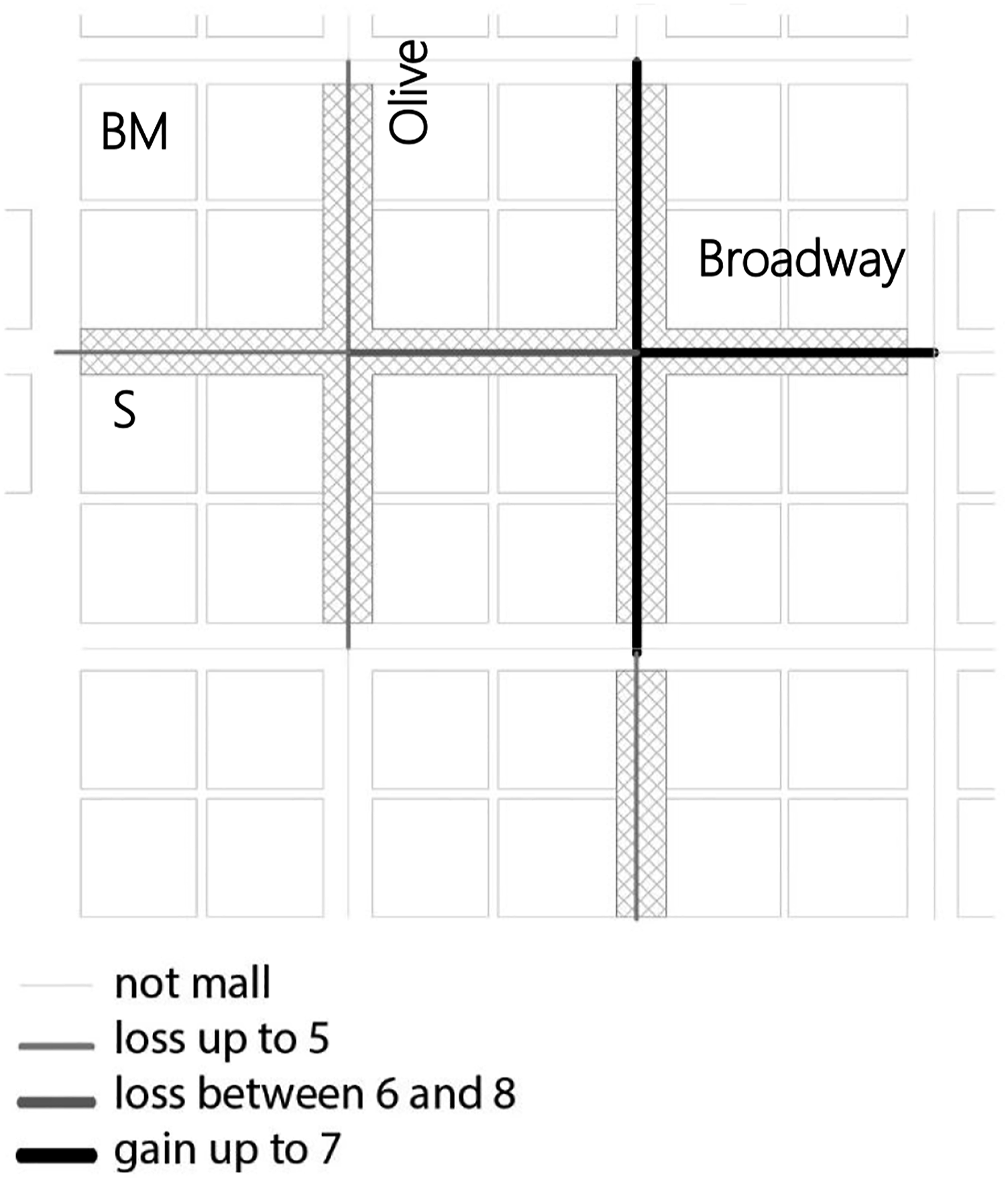
On the contrary, office spaces experienced a positive transformation, which recovered from over 20% vacancy in March 1986 to about 5% by March 1992. The loss of rental space’s appeal along the mall reflects the retail business decline in the early-1990s. According to one interview respondent, properties that had once rented for over a dollar per square foot were asking as little as twenty-five cents per square foot. The situation was so dire that, in June 1993, the west end along Broadway between Olive and Charnelton was 75% vacant. Nine of sixteen storefronts, including the 92,000-square-foot Bon Marche building, stood empty along this stretch. 87
Although the scenario of retail businesses is of central concern to the Eugene Mall story, during the late-1980s and early-1990s, two developments were also critical. The first was whether to protect the remaining mall segments or proceed with further deconstruction. The second was a shifting ground in which non-retail businesses (both local and non-local) were becoming successful in occupying the former “retail only” core.
The Mall Reopening Debate
After the first segment reopened in late 1985, further mall reopening occurred in three stages: the Olive segment in September 1992,
88
the Willamette segment between 8th and 10th streets in November 1996,
89
and the Broadway segment in September 2002, marking the end of the Eugene Mall (Figure 16).
90
In this regard, two questions become important. First, why did it take almost 7 years for the next mall segment to reopen? Second, why did the further reopening eventually take place? Map showing the timeline for mall reopening across four stages from 1985 to 2002. (A) Southern Willamette leg opened in late 1985, (B) Olive opened in 1992, (C) Remaining Willamette portion opened in 1996, and (D) Broadway opened in 2002.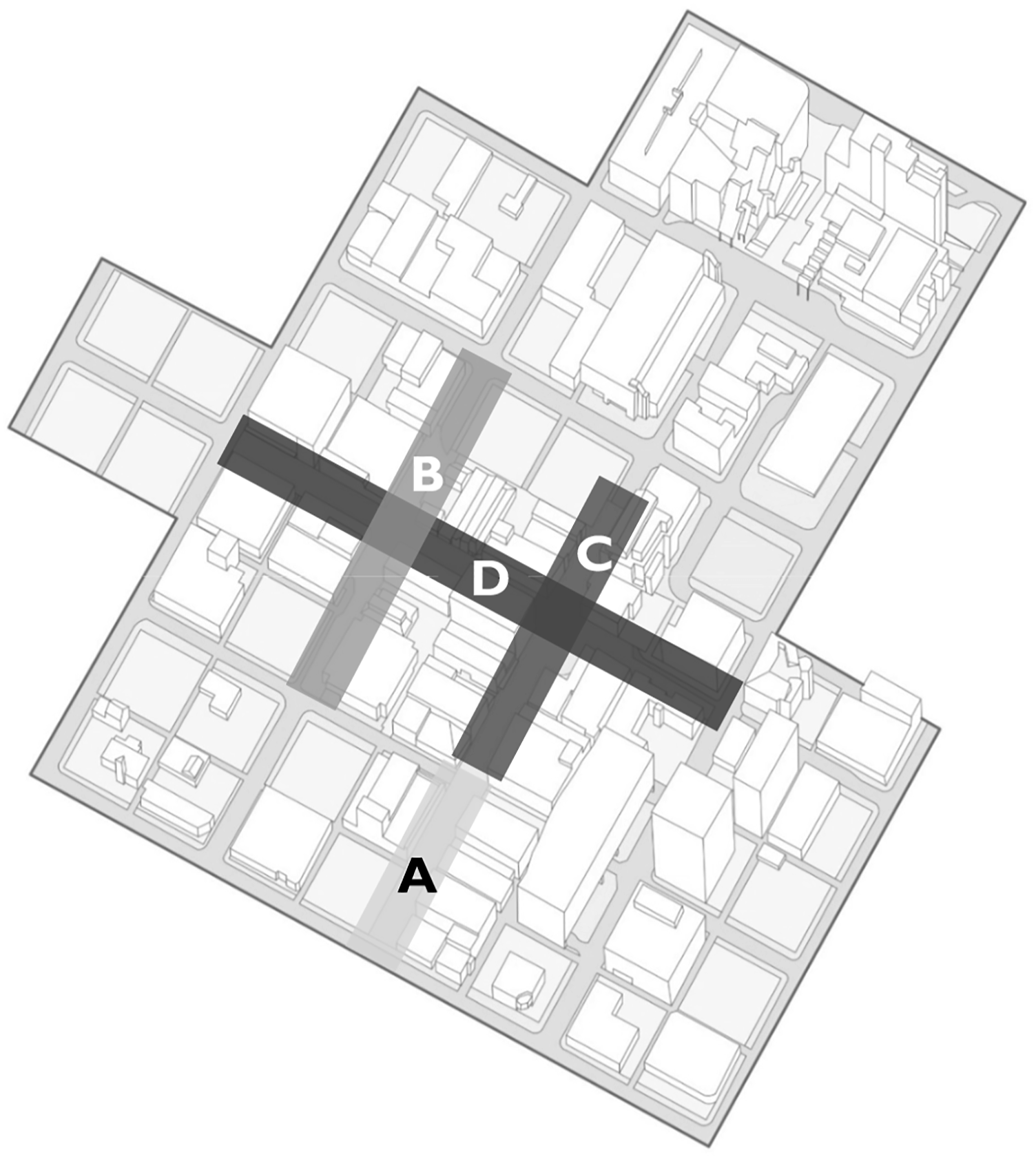
The efforts of “pro-mall” groups postponed further destruction of the mall.
91
Advocacy groups like the Friends of Downtown Eugene demanded evidence to support the fact that bringing cars back to downtown Willamette Street would improve the retail business scene (Figure 17). They argued that the vitality of the downtown retail business depended more upon the individual merchants than upon the rearrangement of store locations. Critics of mall reopening also argued that only good marketing techniques bring customers, like well-designed window displays.
92
Supporters also added that only opening the mall did not guarantee success, and a comprehensive plan for the downtown and mass public transit options was required.
93
Some mall supporters presented an optimistic view of change—while acknowledging the loss of retail stores, they also pointed toward the achievements of the overall urban renewal program.
94
A group of protesters opposed reopening Willamette. Source: Register Guard July 14, 1987.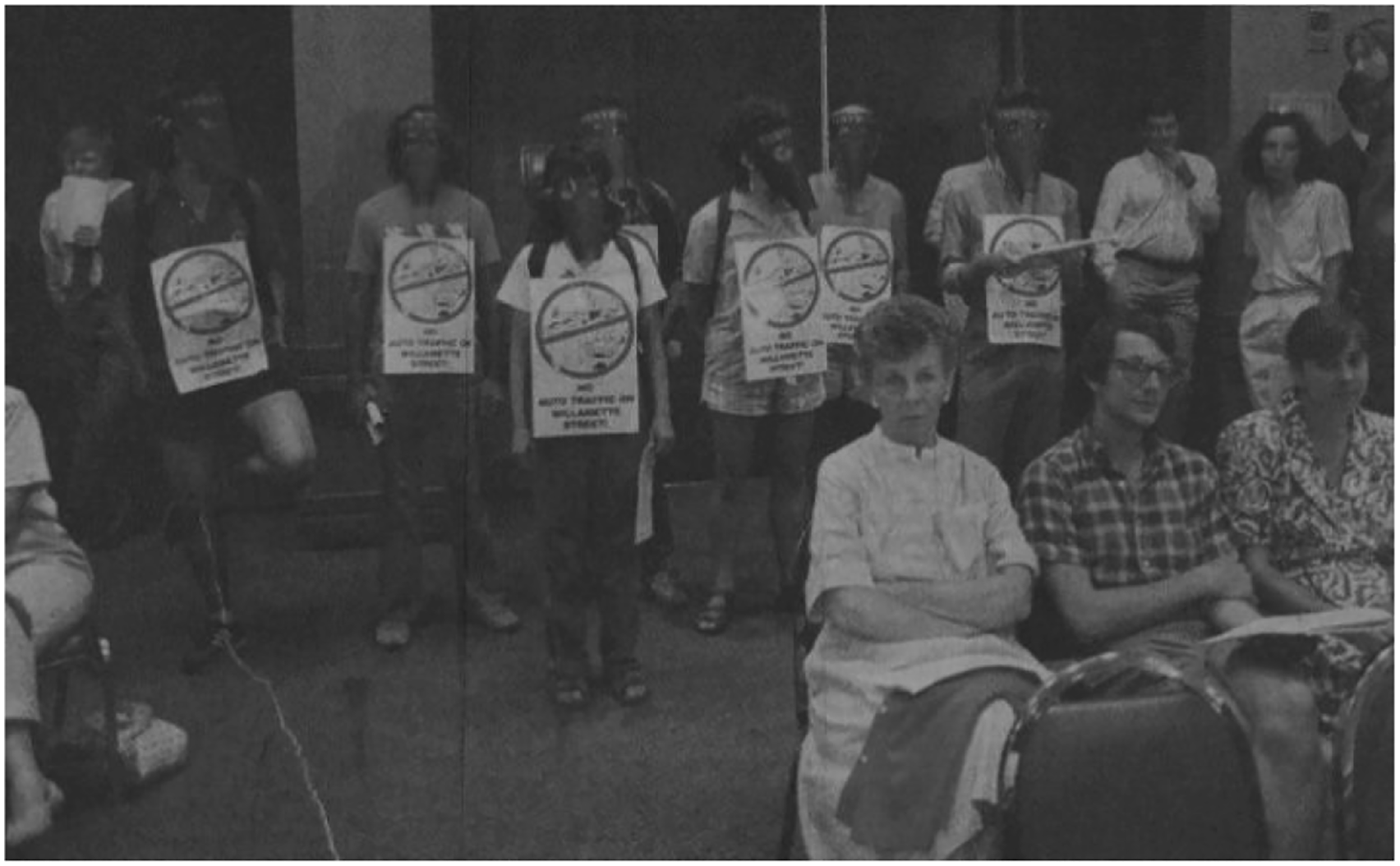
While mall supporters were raising their voices to prevent further “surgery,” several city leaders and downtown merchants began complaining that urban renewal had come at the cost of regular city services like schools, police, and fire protection. 95 The justification was that a tiny downtown area was receiving a disproportionate amount of tax benefits, and in the 22 years between 1968 and 1990, the City Council had spent over $52 million within the urban renewal boundary. The “perceived” prosperity of the first mall reopening in late 1985 (i.e., the Willamette segment between 8th and 10th avenues) also influenced the decision for further mall reopening. Soon after reopening to automobiles, the stretch had received over $1 million in private investments, especially for converting the Ardel building into the Downtown Athletic Club and renovating the McDonald and the Schaefers buildings. 96 Consequently, the downtown business community started believing that other downtown core segments could also benefit from reopening the streets to automobiles.
Ambitions of the Local Community and the Resurgence of the Street (c. 1986 onwards)
In accepting the city’s new direction for downtown, a member of the Eugene Development Department noted in September 1986 that “the public benefit of having a strong downtown…. is…. protecting the investment that the city already has….” 97 In reality, achieving a renewed center—a mixed-use downtown core—required opening the mall to vehicles because, unlike a retail center, the multitude of non-retail activities would not be possible if the buildings were only accessible on foot.
After the destructive experience of the renewal’s first 15 years, local investors, residents, businesspeople, and city leaders contributed to the resurgence of the city’s retail core. Although several sites had to lie vacant until the end of the century, some of them started receiving significant projects by the late-1980s. In this regard, an important question is: how was the city able to steer the direction of its downtown core’s development successfully, and what did the former “retail-only” core look like around the time of the last mall segment’s reopening in 2002?
One of the principal reasons these developments were possible in downtown Eugene was due to a novel approach that was gaining national popularity beginning in the 1980s—the Public-Private Development. According to Lynne B. Sagalyn, starting in the 1980s, US cities captured “public benefits from private developers under several bargaining frameworks,” one of which was the Public-Private Development. 98 Sagalyn asserts that the method was simple—the government would give development opportunities to the private parties in exchange for revenues and public benefits. Specifically, in Eugene’s case, the investments were made possible through Tax-Increment Financing (TIF). According to Callies and Gowder, TIF is “a method of financing the redevelopment of underperforming property by isolating the value added to the property from a proposed redevelopment (the increment) and taxing that increment only to pay for the redevelopment project.” 99 This method is commonly applied to a redevelopment district and is used to raise money from the incremental tax to pay bonds for the renewal/redevelopment project.
Details of projects in the second phase (see Figures 18 and 19).
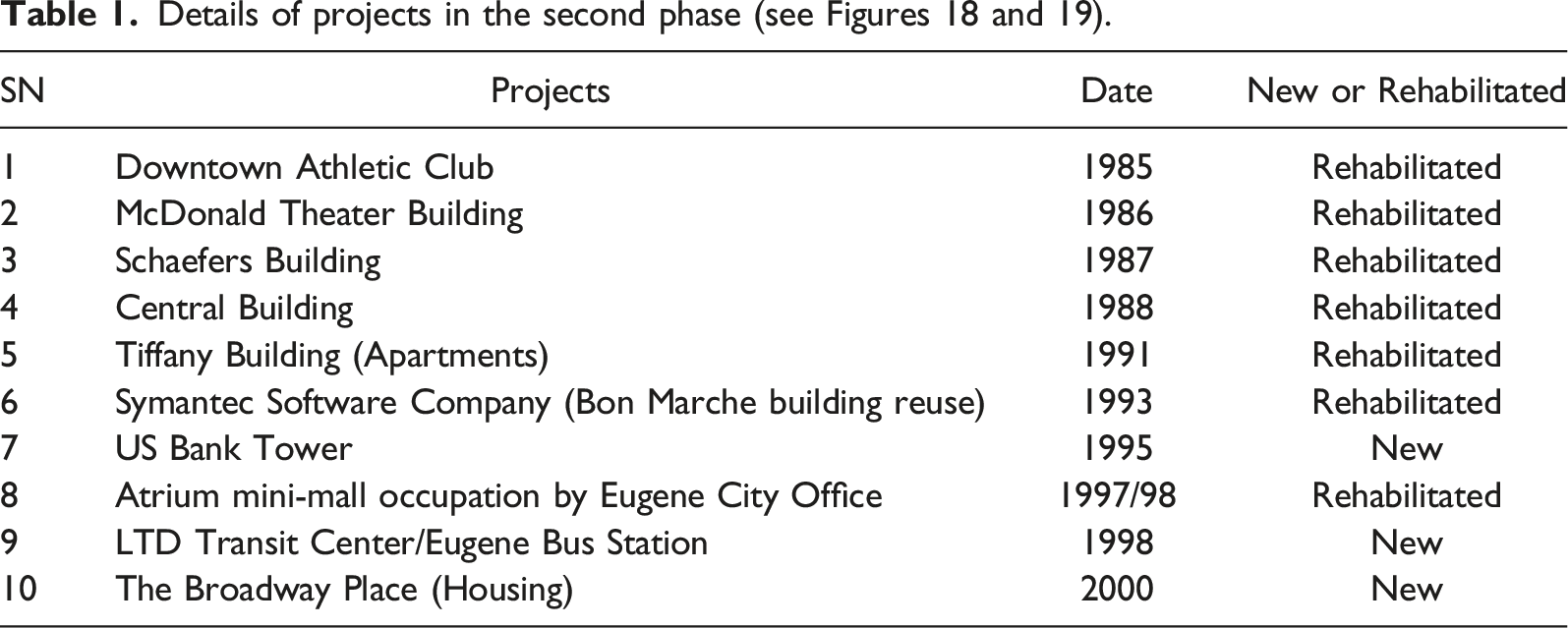
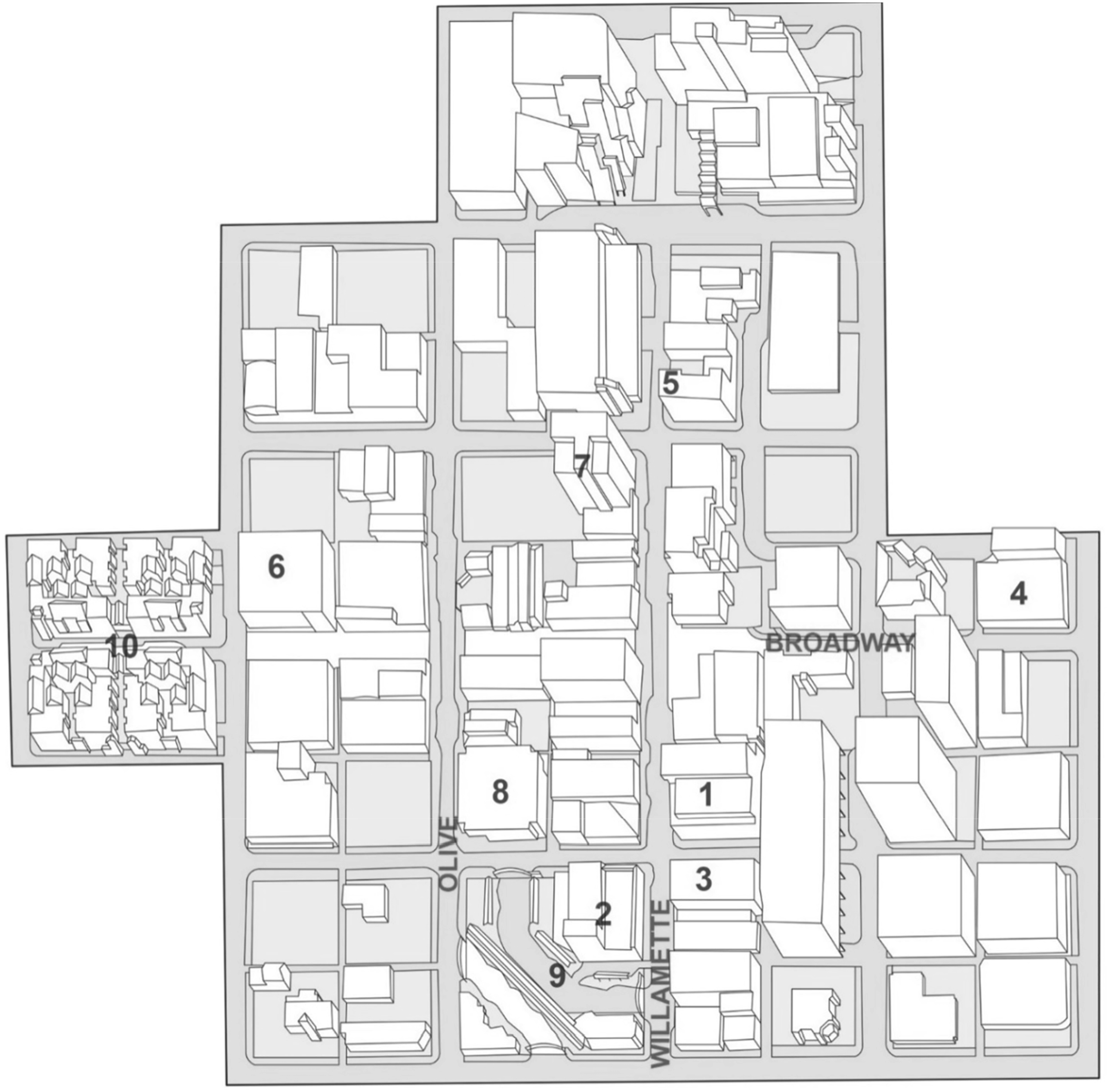
Central Eugene Project area developments (1985–2002) based on an August 1998 map prepared by the City of Eugene (obtained through the UO Library). The important projects of this period were (1) Downtown Athletic Club rehabilitation (1985), (2) McDonald Theater rehabilitation (1985), (3) Schaefers Building rehabilitation (1987), (4) Central Building (1988), (5) Tiffany building restoration into apartments (1991), (6) occupation of Bon Marche by Symantec Software company (1993), (7) US Bank Tower (1995), (8) occupation of Atrium mini-mall by the City of Eugene (1997–98), and (9) LTD Transit Center/Eugene Bus Station (1998), and Broadway Place Apartments (2000).
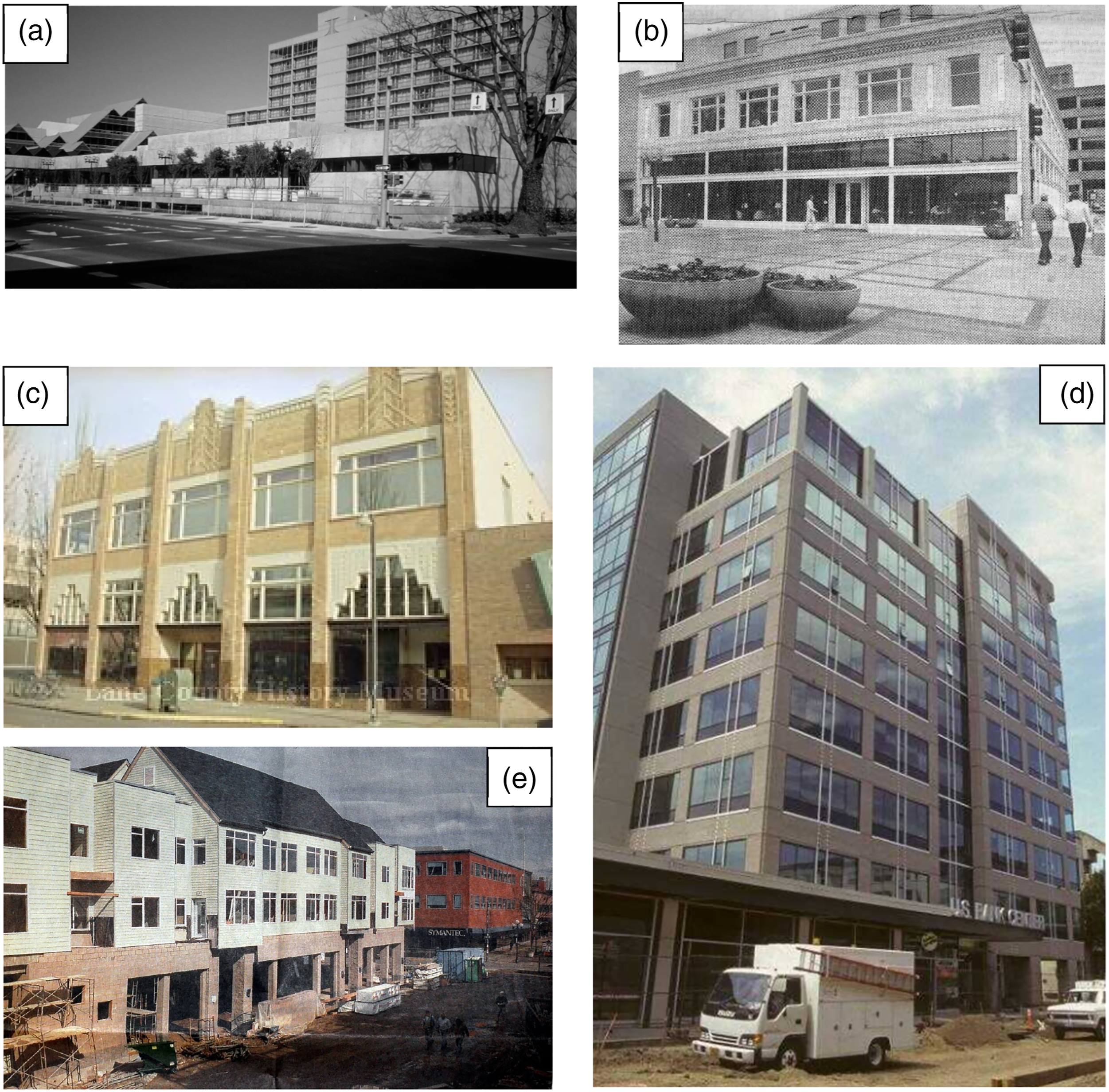
The Hilton Hotel, Conference Center, and Hult Center in the Background, c. 1982. Source: Oregon Digital, Identifier pna_07616. (B) Downtown Athletic Club building after the renovation of the older Ardel’s. Source: Peggy Shekell as published in The Oregonian May 24, 1986. (C) Schaefers Building in 2002. Source: LCHM catalog #GN 10111. (D) US Bank building in 1995. Source: Oregon Digital, Identifier pna_12383). (E) Broadway Place Apartments under construction. Source: Register Guard March 21, 1999.
The Beneficiaries of Urban Renewal Generated Tax Income Between 1985 and 1994.
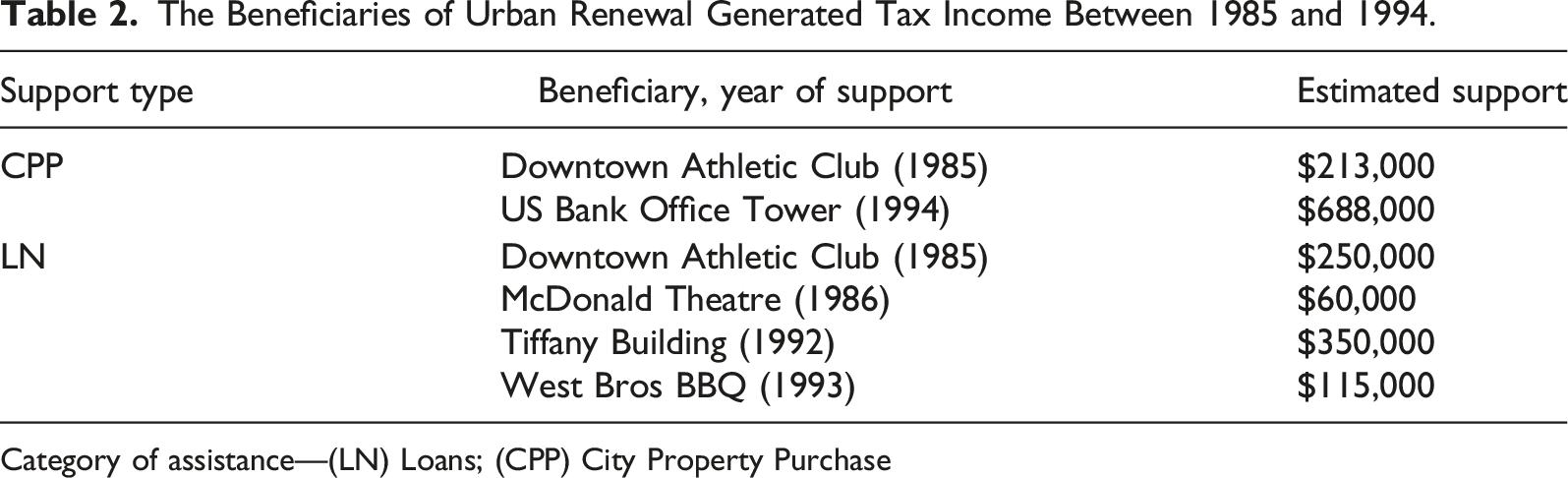
Category of assistance—(LN) Loans; (CPP) City Property Purchase
Regarding the new projects in the 1990s, one interview respondent recalls that the process included selling key city-owned sites for mixed-use projects. The important ones were the site for the US Bank building with ground-floor retail and Broadway Place—the first apartment building in the core area in over 20 years. In another instance, the city partnered with the private sector to rehabilitate the vacated Bon Marche building to make space for the Symantec Software Company’s office in 1993.
Besides the commercial projects, the 1990s was a “renaissance” in urban housing. As one interview respondent recalls, “there were also partnerships with the private and non-profit sectors to add more housing with active (retail) ground floors (e.g., the Tiffany building) and bring in quality affordable units.” Taking out the mall streets influenced downtown Eugene’s transition to a mixed-use area because it made residential developments possible with the occupants having access to the street. The major residential projects in the downtown area included Tiffany Building rehabilitation (1991) 100 , High Street Terrace (1997), Broadway Place (2000), and Aurora Complex (2004). The most significant of these residential developments was Broadway Place, completed in 2000. It was a part of a mixed-use complex occupying 13,500 SF of a vacant site next to the Eugene Mall, which provided 170 apartments, ground-floor retail and office spaces, and two parking garages totaling 736 spaces. 101 In late January 2002, the city even offered new tax breaks to help create new housing downtown (primarily for the low-income population). One criterion was exemption from property taxes to the developers for 10 years. 102 These provisions were influential in bringing a few other downtown housing projects like the 2004 Aurora building (located outside the renewal area)—a fifty-four-unit, five-story structure for low-income renters that offered a one-and two-bedroom apartment and included two retail spaces on the ground floor. 103
Conclusion
Eugene’s city leaders in the 1960s and the 1970s formed an inflexible strategy to revitalize the downtown core centered on “eliminating” the existing urban fabric in hopes of rapid rebuilding. They envisioned an urban fabric of buildings, small and large retail businesses, and other complimentary commercial activities, in addition to a bustling pedestrian mall fully occupying the retail core. However, several national and local factors impacted the way actual development proceeded compared to the anticipated plans. Between the late-1960s to the early 2000s, Eugene’s downtown core transformed from an urban renewal-led “wasteland” to a partially thriving retail center to a struggling center to a somewhat revitalized mixed-use core. At the center of this transformation was the Eugene Mall, whose story, as examined in this paper, is of the utmost significance to the city’s post-war urban history.
While these national factors, like the urban renewal and pedestrian mall, dictated the larger frameworks for revitalization, local bodies like the renewal agency and City Council, along with the downtown merchants, local investors, and the larger community, had considerable roles to play in shaping downtown Eugene. The historical analyses of downtown Eugene in the 1980s and the 1990s showed that to the city leaders, the mall had to reopen because it would not be compatible with the “new direction,” in which uses like apartments and banks would become an essential component of the anticipated retail-only core. While unsuccessful in preventing the mall from being completely deconstructed, the community groups left behind a legacy through a story of a struggle to keep what they believed was a community asset.
Eugene’s case shows that the failure of downtown revitalization strategies, like the pedestrian mall, cannot be judged solely from the perspectives of quantitative losses and gains. On paper, the failure is evident (since the mall no longer exists), and the renewal agency’s strategies were primarily responsible for destroying the existing retail structure. However, hidden from this perspective is the story about the city’s ambitions for a better downtown which resulted in a comparatively “diverse” downtown core of the present (consisting of apartments, banks, institutional buildings, entertainment venues, and services, in addition to retail). The story presented in this paper shows that the experience of Eugene Mall’s rise and fall could be a motivating story for cities across the nation to move forward into the 2020s and beyond.
Footnotes
Declaration of Conflicting Interests
The author(s) declared no potential conflicts of interest with respect to the research, authorship, and/or publication of this article.
Funding
The author(s) received no financial support for the research, authorship, and/or publication of this article.
