Over its nearly quarter-century existence, Contexts has relied on the contributions of dozens and dozens of talented, insightful, brilliant, dedicated, and hilarious graduate students, many of whom have gone on to become thought leaders within and beyond the discipline of sociology. In this training ground, they learn about the inner workings of an academic journal and a public-facing magazine—as well as the synergies and tensions that arise when collaborating with a team of editors to craft a publication meant to be both. Graduate editors’ roles involve tasks as disparate as searching for just the right images to help bring an article to life, conducting and producing video interviews with feature article authors, curating our dynamic blog, and selecting, pitching, writing, and editing research briefs that help us all appreciate the vast array of exciting new work published across a range of journals. In this conversation, faculty co-editors, Amin Ghaziani and Seth Abrutyn, and long-time managing editor Letta Page sit down with University of British Columbia sociology graduate students Sophie X. Liu, Parker Muzzerall, Colter J. Uscola, and Rose Xueqing Zhang, as well as Elena G. Van Stee at the University of Pennsylvania, to talk about their experiences at the magazine and their vision for it going forward.
how has working on the editorial team for Contexts influenced your thinking about publicly engaged sociology?
PARKER MUZZERALL (PM): Working on Contexts has shown me firsthand the impact of public sociology.
SETH ABRUTYN (SA): How so?
PM: Our articles resonate with people—researchers, students, community members—in a way that traditional scholarly articles simply do not. Seeing this impact, I now strive to mobilize all of my research in a publicly accessible way so that the audience of my work becomes not just sub-field specialists but policymakers and people contending with the lived experience of what I study.
LETTA PAGE (LP): I love hearing that working on the editorial side of the magazine has influenced how you write!
ROSE ZHANG (RZ): For me, working with Contexts has also reignited a commitment to making sociological research accessible and relevant beyond aca-demia. In a way, it has brought me back to my initial goal in studying sociology: to address social problems and provide benefits to the public. It’s been a powerful experience to refocus on research that resonates with people’s lives, rather than getting lost in the insularity that can sometimes come with academic pursuits.
AMIN GHAZIANI (AG): The sentiments that you all are sharing are wonderful. They remind me of my interview with Nick Kristof and his call in The New York Times: "Professors, We Need You!" The point of the piece was to motivate researchers to write in ways that can influence some of the greatest social issues and policy debates of our time.
ELENA VAN STEE (EVS): Echoing some of the others’ sentiments, including Kristof’s, I can say that working with Contexts has really driven home the value of clear, concise, and, most importantly, jargon-free writing. Not only does using jargon make our ideas unintelligible to non-specialists, it often indicates fuzzy thinking rather than sophistication or precision. My experience on the editorial team has strengthened my commitment to articulating complex ideas in plain language—not just in my public writing, but when I’m speaking to academic audiences as well.
COLTER USCOLA (CU): As Parker, Rose, and Elena have all said, public sociology is about communicating and clarifying research for the general population. We all hope to produce jargon-free writing both within and beyond academia and to by-pass the waiting line for timely research and policy efforts. Checking out Amin’s interview with Richard Florida in the Summer ’24 Issue only solidifies this belief! Working with Contexts also allowed me to see mentoring of public sociologists from an alternative lens. As I worked for this team and held interviews with authors, it became clear that these individuals truly care about the people they work with and for. They embody positive change and give me something to aim for as I progress along the road to academia. In short, they shifted my view from my research to research for others.
SOPHIE LIU (SL): I agree with Colter. Working on Contexts’ editorial team has emphasized the significance of clarity in communication. I now understand that effective writing is not merely about conveying complex ideas, but about doing so in a way that is understandable and engaging for non-specialists. This commitment to clear communication extends beyond my public-facing work; it informs how I approach discussions with my academic peers. I’m aiming for transparency and accessibility in all my interactions.
tell us about the process of creating the In Brief section of Contexts. What’s been your experience of pitching ideas, drafting briefs, and editing collaboratively in order to give readers a broad look at what’s happening in sociology today?
PM: My favorite thing about working on the In Brief section is that it has offered me the opportunity to read broadly across the discipline. It’s easy in our day-to-day careers to read narrowly within our sub-fields and areas of expertise, but by endeavoring to capture breadth, the In Brief section has introduced me to cutting insights and ideas from all corners of the sociological compass. It’s also been a great exercise in synthesizing academic research into communicable ideas and working collaboratively to produce the best product possible.
AG: Can you walk us through some of the process?
RZ: Like Parker said, the first step is to read broadly, to find out what the top journals are publishing on. After selecting the articles that pique my interest, I then get to create pitches to persuade the rest of the team to feel that same interest. This is the most difficult part for me, because it is similar to product marketing. I need to detangle the academic jargon and pick out the main points of this paper, find out what it means for a general audience.
LP: The pitch meetings are such a good example of Contexts’ collaborative approach.
EVS: The process reminds me of high school debate, but with a much friendlier audience—thank goodness! And drafting In Briefs has been a fantastic intellectual workout.
RZ: YES! Once the pitch is green-lighted, the actual writing is enjoyable since it allows me to briefly escape dull academic writing.
EVS: Distilling dense journal articles into 300-word summaries for non-experts has really sharpened my analytic and writing skills by challenging me to ask, "What’s the story here?" and "Why should people care?" Some authors make this task easy, though. Sam Friedman and colleagues’ recent article on understandings of merit, which I wrote up for the Summer ’24 issue, is a great example. The argument is simple—and thus compelling and memorable—but not at all simplistic.
PM: I love that distinction! What about you, Colter?
CU: While I’ve had the opportunity to summarize articles or books, pitching a minute-long summary took things to a whole new level. In many ways, I’m echoing Elena by saying the pitch process forced me to home in on the key ingredients of what makes each article exceptional—to articulate these essential components for the team and let them know why the research matters. For someone who has spent most of my time thinking and reading, talking about research flipped the script on my development as a scholar.
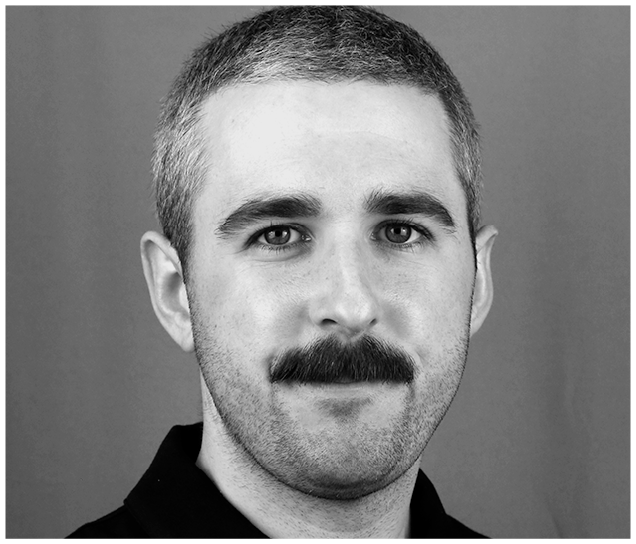
Parker Muzzerall |

Elena G. Van Stee |

Rose Xueqing Zhang |
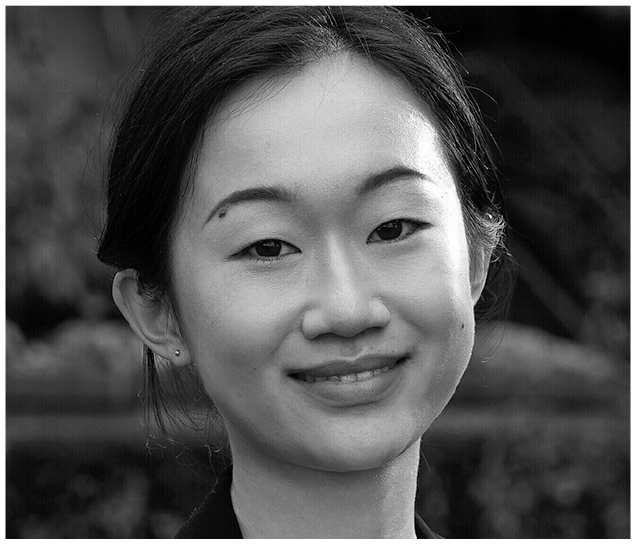
Sophie X. Liu |

Colter J. Uscola |
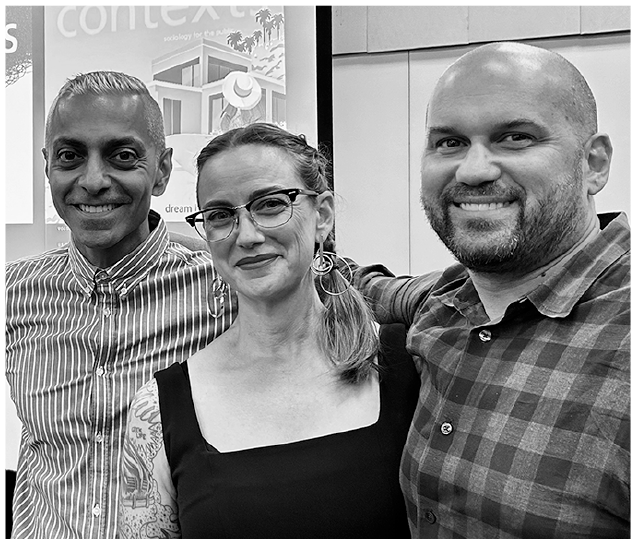
Amin Ghaziani, Letta Page, and Seth Abrutyn |
I have also enjoyed reviewing others’ work. Learning to suggest revisions is an essential part of becoming writers— though this took me a bit to learn, since I tended to believe others’ writings were sacred. Smashing this belief, however, allowed me to contribute to some truly phenomenal public work while tuning up my own writing. As the old idiom goes, it turns out that two heads are better than one when producing clear and concise public-facing sociology.
SA: It sounds like doing these In Briefs has been as beneficial to you as to our audience.
SL: More than that, creating the In Brief section has been transformative. It’s broadened my understanding of the sociological landscape. One of the most enriching aspects has been the opportunity to engage with a wide array of topics beyond my immediate sub-field. Sociology article to read as an undergrad can be intimidating. Contexts articles do an incredible job of distilling big, empirically rich ideas down into accessible concepts. For undergrads, who don’t always need to know the inner workings of a multivariate regression model to understand a basic social relationship, our articles offer an engaging and thoughtful, narrative-rich account of sociological research.
EVS: Parker said it well. I love assigning Contexts articles to students because they communicate complex ideas without getting stuck in details that, let’s be honest, students won’t remember in five minutes, let alone after the course ends. If we want to teach students to think like sociologists, Contexts articles are perfect. They’re also a great way to teach writing, which is a benefit in a wide range of careers beyond social science research.
AG: Over the years, I’ve found that students engage enthusiastically, and quite meaningfully, with pieces published in Contexts. By comparison, articles in traditional or flagship journals can sometimes scholarly generations.
"Contexts serves as a vital bridge, demystifying the field and cultivating an appreciation for sociological research." -Sophie X. Liu
This exposure has deepened my appreciation for the discipline, while the pitching process encourages critical thinking and clarity, prompting me to boil down complex research into concise narratives that capture the broader implications for society. Collaborating with a talented team has added another layer of depth.
when we think about Contexts as "sociology for the public," we’re really talking about a plurality of publics. What does it mean for all of us to think about students, both undergraduate and graduate, as a key "public" audience?
PM: Getting assigned an Annual Sociological Review or American Journal of demotivate and leave some students disillusioned. That certainly doesn’t help them to think like sociologists! This is one of the many reasons why I love Contexts: It provides an accessible platform for teaching and learning, empowering students to see themselves as an important public for sociological research.
RZ: I totally agree. When I recall my time as an undergrad and an earlier-year graduate student, understanding ASR and AJS articles was one of my greatest obstacles, especially since English is my second language. Meanwhile, innovative ideas and fresh perspectives from younger scholars can prompt re-evaluation of established theories and practices, leading to enriching dialogues across
SA: That makes sense—as a theory professor, it’s sometimes hard to get students to engage with dense, abstract papers. Are there other ways Contexts appeals to students as a public?
CU: Contexts is one of those miraculous journals that expands across the breadth of the university precisely because of the de-jargoning and clarification work that it does in its pages. Our amazing team has always been striving for new and innovative ways to reach wider audiences. If students are one of those target audiences, figuring out what they are into now and how we can get into those conversations seems like an important path. If a few brilliant undergrads find their way to sociology, just like many of our feature authors did, I’d call that a win.
SL: I want to pick up on what Rose said, which is that this is especially important for non-native English speakers, who may find traditional academic writing particularly challenging. For many students, the complexity of traditional academic articles can be daunting, especially when they are just beginning to engage with sociological concepts. Contexts serves as a vital bridge, demystifying the field and cultivating an appreciation for sociological research among students who might otherwise feel alienated by dense jargon.
SA: That feels really important, Sophie. Sociology is the science of societies; it needs to be international in its lens and reach. This certainly was part of the mission Amin and I envisioned when we proposed our editorial vision to ASA. Anything else, Sophie?
SL: Well, to me, thinking of students as a key audience for Contexts is essential for fostering a new generation of sociologists. Moreover, incorporating Contexts articles into the curriculum enhances critical thinking and writing skills in a way that is directly applicable to a variety of careers. By presenting complex ideas in a clear and engaging manner, these articles encourage students to think like sociologists, equipping them with the analytical tools needed to understand and address social issues effectively.
LP: Well, that’s just music to my ears!
grad students have been innovators all along with Contexts, and this team has really amplified our reach with video interviews and a revived blog. What other directions could you see us taking to broaden the reach and influence of the magazine?
EVS: Finding a new social media home like the old #academictwitter would be great, but that’s not really in our hands. I’d love to see more author Q&A videos— they’ve been a great way to introduce new books to a wide audience and chat about public engagement with authors. But doing all this well takes time and money. I hope ASA sees how valuable this work is and provides Contexts with the resources to grow and thrive.
PM: And given that students are a key audience, I think greater integration with and development of teachable material would be a great step.
AG: Agreed—but how do we do this?
PM: We already have the Contexts Reader, but more concrete efforts to center students—maybe even a student section—could be a great way to get Contexts into the hands of people just getting interested in sociology. Other media formats could be interesting as well, from audio to more video. As attention spans wane, we might need sociology in 10-second segments.
RZ: Another direction could be to launch a podcast series that complements the magazine’s content. We could feature in-depth discussions with our contributors and include interviews with grad students on their research journeys, fostering a sense of community and highlighting diverse voices.
CU: I love these ideas, team! I was thinking that our In Briefs could be reengineered into Instagram posts— something like, first image, journal and author. Then the second image is the hook, the third the research question, the fourth the methods and findings, and the fifth the take-home point or why we should care. Essentially, I want to think of more ways to get key findings out there while recycling the effort the grad team already puts into summarizing scholarly works. Another possibility could involve recycling clips from our past video interviews to create themed videos.
AG: Listen up, ASA, these are some great ideas!
what advice would you offer the next editorial team?
PM: Read broadly, take some risks, and prioritize the audience.
AG: What kinds of risks do you have in mind?
PM: Trying new article formats or magazine sections, bringing in more non-sociologists, like you have done with journalists, Amin, or even trying to get sociology into other spaces where people are engaged in social issues—could there be a moderated Contexts Discord channel or sub-reddit? The nature of media is ever evolving and we need to be innovative in how we reach new, younger, more online audiences.
EVS: I want to echo Parker’s comment about taking risks. I’ve seen this team thrive under editorial leadership—the dynamic duo of Seth and Amin—that gives section editors like myself both strong support and real autonomy. My advice: trust your team and give them room to experiment.
AG: That’s so kind of you to say, thank you Elena. You’ve been an incredible asset to our team. You’re also our only off-site member! What advice would you give to future teams that wish to collaborate across different universities?
EVS: I think the "team" part of "editorial team" is key. Multi-site collaboration can open the door to siloed work that only comes together in the final product. That model can certainly be efficient, but for me, being included in team meetings (albeit as a face on a laptop propped up on a chair) and collaborating on writing with the rest of the grad team staff is what made this experience so rewarding. Rose, got any other advice for the next editorial team?
RZ: Be creative, never hesitate to express your "rad" ideas!
AG: Hear, hear! Rigorous, Relevant, Readable, and Rad—our signature 4 Rs!
CU: I’ll add that you should collaborate often, recycle the content that you can, and enjoy the ride.
EVS: Amen!
SA: And how exactly does that "recycling" work?
EVS: Every academic article or book publication presents an opportunity for a public-facing complement, such as a blog post or (more ambitiously) a Contexts feature essay. I find that prospective authors are often hesitant to recycle their work in this way because they’re concerned about self-plagiarism. But we’re talking about re-presenting your own work for new audiences. Recycling is totally allowed—even encouraged—at Contexts!
CU: Exactly, Elena! It really comes down to letting minds and talents meet to craft accessible content for the public. Sophie—what’s your advice for the incoming editorial team?
SL: Focus on distilling complex sociological concepts into clear, engaging narratives that resonate with a diverse audience, especially students.
AG: Narratives, yes! Why do stories matter?
SL: Presenting research and ideas through narratives can illustrate real-life implications and experiences, fostering a deeper understanding of social issues. Stories help to bridge the gap between academic discourse and public engagement, allowing readers to connect intellectually and emotionally with sociological research.
LP: I love that. I like to say that sociology is, at its heart, stories about people. Lead with story, and readers can’t help but be interested.




