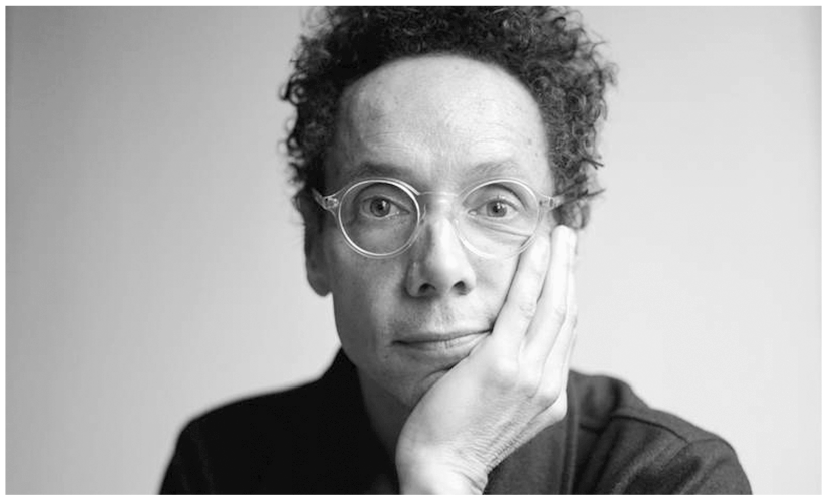
Malcolm Gladwell is a staff writer for the New Yorker and the best-selling author of books including The Tipping Point, Outliers, and, most recently, The Bomber Mafia. He is also the creator and host of the podcasts Revisionist History and Broken Record (with Rick Rubin and Bruce Headlam). Gladwell’s work tends to highlight surprising, sometimes paradoxical, findings from the social sciences and is notable for its ability to translate complex ideas into jargon-free, easily accessible stories.
Malcolm Gladwell
Courtesy Celeste Sloman
SA: So, you travel in the world of very big ideas. We’re curious about how these ideas come to be. What inspires the idea to become the thesis of the project?
MG: Well, you’re an interesting case study. We met because I called you up, because I read a paper that you had written with a colleague [coauthor Anna Mueller], and I thought it was really interesting. And how did I get to that paper? I can’t remember. I was generally interested in this subject of contagion and had sort of known a little bit about suicide contagion. So, I just started to read around and look for… ways of talking about an issue like that, that would be approachable to a non-specialist. And in your work, you’re describing this town, Poplar Grove, and instantly I realized, “Oh, that’s the way! If I want to talk about this really complicated, heartbreaking topic, I need it to be grounded in a place that can be described.” I don’t need to know the exact name of the place, but I need a story… and you guys had provided the story. …A lot of times, what I’m looking for is either work that I can attach a story to, or, in the case of your work, it was work where there’s a story embedded in the results, in the argument. And so instantly I knew I had to talk to you and Anna, right?
SA: And then you start searching for those stories that you’re talking about? Or is it just like you kind of have a lightning strike, and you’re like, “Okay, now how do I flesh this out with research or angles that I’d like to take?”
MG: Well, there’s rarely a lightning strike. It’s that there’s specific things. I mean, I have kind of themes I return to again and again, but there’s also ideas that I’m writing a—I’ve been writing for a couple of years now—there’s a much bigger book that started out because I was really interested in, I’ve always been interested in policing. And so, I started out writing, thought I would write a book about the LAPD, which is this really interesting department because for a while they were the embodiment of all that was thought to be good about policing. And then Rodney King happened, and we realized, oh, they weren’t. And then I thought, “Oh, there’s some really interesting characters involved with the LAPD,” like Darryl Gates, the famous police chief, and another police chief before who was equally famous. And so then I thought, “Oh, okay, I got my characters.” Then I got into it, and I realized there’s actually a different story I wanted to tell, which was maybe tell the story from the perspective of the community the LAPD was oppressing, the African-American community in Los Angeles.
So, you know, another six months passed.
And then I realized, “Oh, actually, there’s an amazing story from that perspective.” And that’s the story of Tom Bradley, the first Black mayor of Los Angeles, who was the great antagonist of the LAPD, and was himself a former LAPD officer—one of the first Black officers on the force. So, what I just described to you is two years of not constant work, but two years of reporting and writing and thinking about this. And I started with one topic, and I ended up with a related topic, but I’d think, “Oh!” And then I wasn’t done. Then, I realized, am I interested in Tom Bradley the person? Or I’m interested in the particular problem that he represents, which is the problem of if you are angry at the world around you in a system, what do you do? And then I realized, “Ah, that’s what I want to write about.” Because in reading him, in reading people about him, I realized he was someone who had a very deliberate and conscious strategy for dealing with his anger. And of all the questions I’d asked myself on that long journey, that was the most interesting.
SA: So, as you know, Contexts is a sociology magazine. How do you think about social science’s role in your work?
MG: Oh, it’s huge. It’s the source of so many of the things I think about. I mean, now I’ve expanded, and I read outside of social science. But, you know, I think of the world of academia as this kind of goldmine of amazing ideas that people have thought about in a sophisticated way. And it’s the raw material for almost everything I do. Now, I draw from other— my job is to draw from other fields and tell stories around those findings. But I couldn’t—my career would not be possible in the absence of the social science community.
SA: When you get this sort of diverse array of reading—a fairly substantive body of literature—how do you synthesize this mass? …How do you take it, translate it, and put it into bite-sized bits?
MG: Well, you have to sort of pick your lane. To use the example of the story that I spoke to you about: I haven’t written it yet, but the thing in all the conversations I had with you and Anna, the thing that struck me as being the most emotionally meaningful about what you were doing was this terrible dilemma that the parents of Poplar Grove have, which is the very thing that they love about this school is probably the thing that is strongly contributing to the [community’s youth] suicide cluster, right? So, that dilemma, that’s an extraordinarily both fascinating and heartbreaking dilemma that is relatable to every, every parent, right? You described that to any parent in that particular way, the way that, I think it was you who was phrasing it to me. And as you were saying it, I was like, “Oh, this is it, this is the core here.” Now, you might not—that’s not the core of your work. That’s an incidental observation that you made as a thoughtful observer of the situation. But for my story, it is the core, because it’s the way I can get people into what you’re doing.
SA: A lot of our readers are qualitative researchers who, like myself, do ethnographic interviews. And, you know, the, the goals of our interviews are probably a bit different than the goals of yours. I’d like to hear a little bit about what, when you sit down and think about talking, what are you thinking about? Like, how do you plan that out?
MG: Well, I’ve been doing journalistic interviews for 40, almost 40 years. I would say that I only got, the first time I would give a grade to myself of better than B+ would have been 5 or 10 years ago! I think it’s taken a long time for me to—I was a very, very poor interviewer in the beginning. And a lot of it is, in the beginning, I think I over-scripted them. I think the most important thing is to leave yourself open to serendipity in an interview. You don’t know what you don’t know. And you don’t know what the person you’re interviewing knows. So, the mistake you make is you, you impose too much of a structure on the conversation. It’s a conversation. It’s a one-sided conversation, but it’s a conversation.
“I think the most important thing is to leave yourself open to serendipity in an interview. You don’t know what you don’t know.”
And I think you just have to be comfortable with ambiguity going in. …I think it’s a real danger in over-preparing sometimes, because you don’t, you want to know enough to ask smart questions, but you don’t want to convince yourself that you know the answer to something, so you don’t ask the question. That’s the biggest mistake of all, because—not the biggest mistake, one of the mistakes— because there’s always, you know, … when you’re reading social science, what you’re reading in a paper is an extremely abbreviated version of what is going on inside …the scientist’s head. So, you can’t read their abbreviated version and think you know it. You have to let them give you context.
And you can’t—the thing that is almost never answered in academic work is why the person was interested in answering, asking the question. Which I think, I sort of wish that was a standard thing, that there was always a kind of mandatory three paragraphs at the start, where you tell us why. Why are you doing this? If it’s idiosyncratic and personal, so much the better! I would love to know that, but that’s the kind of thing that it didn’t occur to me before to ask. Now I’m always sort of curious about how people—and not because I’m judging them on the basis of that, it’s just, it’s just interesting, like, it kind of flavors the way you consider what you’re being told.
SA: What kind of advice would you give somebody who wanted to write like Malcolm Gladwell? To be able to mobilize scientific knowledge in accessible ways? You know, some of our readers do want to be more public-oriented, and not in the policy sense, but to be more communicative in their monographs in a way that …draws in greater numbers of readers.
MG: Well, some of what I’ve talked about, this idea of sharing motivation is really interesting. You know, the, if you go back, you know this better than me, but if you go back and you read like Robert Merton or Erving Goffman, what’s fascinating is how well they write and how simply and clearly they write. Merton is, he’s basically jargon-free. He just, he could be having a conversation with you at a party. And I think that’s the first step, is just understanding that reliance on jargon is a way of keeping people out. I realize it raises, it may raise your standing with your own community, but it limits, dramatically limits your ability to appeal to others.
“…I have very consciously over the years tried to mimize the difference between my conversational voice and my writing voice. It should sound like you’re talking to me.”
The other thing is, I think, resist the urge to be inclusive of, you don’t have to answer every question. I know, for the purposes of rigorous academic research, you are obliged to do that. But when you’re reaching the general public, you’re not. You need to take the risk of leaving stuff out and decide, “What is it I’m trying to communicate here?” You know, pick something, and say, “If they’re going to get one thing out of this, what is it I want that one thing to be?” You’re not going to be able to communicate five points. You know, that’s a big shift for people who have been trained to be as thorough and comprehensive as possible, to instead be focused on one or two very, very key ideas.
Those would be in the biggest, I suppose. And the other thing is, wherever possible, you know, there’s a big distinction between anecdotes and stories. Anecdotes are small examples that illustrate a thesis, and a story is a narrative that frames an idea. And I think there’s— when academics try to write popularly, they adopt lots of anecdotes, but very, very few stories. And I think they need to think more in terms of stories. Give me a single narrative that can occupy me while I ponder whatever idea it is that you’re trying to impress upon me. It’s much easier for the reader, I think, if they can get invested in a story.
SA: One more question. This is from our managing editor: You write with a very distinctive wit. Can you tell me a little bit about how one could develop their voice as a writer to have that sort of wit or whatever it is that is inside of them that they’re struggling to sort of pull out?
MG: Yeah. Well, that’s very nice. A very sweet statement. Thank you. I think it’s just because I have very consciously over the years tried to minimize the difference between my conversational voice and my writing voice. It should sound like you’re talking to me. And, you know, most of us, in our conversational voice, almost all of us are funny in one time or another. But we remove those bits when we’re writing.
I always tell people who are struggling with writing: Don’t write. Just get a tape recorder and speak into it. Speak into your phone and then transcribe it, and then that’s your first draft. … So, I tried very, very hard [to develop my voice as an author]. I think that’s just… I’ve lost the, I think it’s a kind of fear that comes over us where we’re afraid to have that casual part of ourselves in our writing. And I don’t have that fear. I’m very comfortable with it. I think it’s fine. And doing the podcast has helped, because podcasts are supposed to be in your conversational voice. So, that’s made it even easier for me to kind of capture that.
SA: Okay, great. Any last thoughts or things you’d like our readers to know?
MG: No, just what I’ve, like I said before, I owe my entire career to the academic community. So, I used to always describe myself as the, you know, those little birds that would sit on the back of the elephant and take all the bugs off its back. I’m either the bug or the bird—and you guys are the elephant!
Footnotes
Seth Abrutyn is in the Department of Sociology at the University of British Columbia. He is the co-editor of Contexts and the co-author, with Anna S. Mueller, of Life Under Pressure: The Social Roots of Youth Suicide and What to Do about Them.