



Abstract
Allison J. Pugh on Life Under Pressure and Nice Is Not Enough.
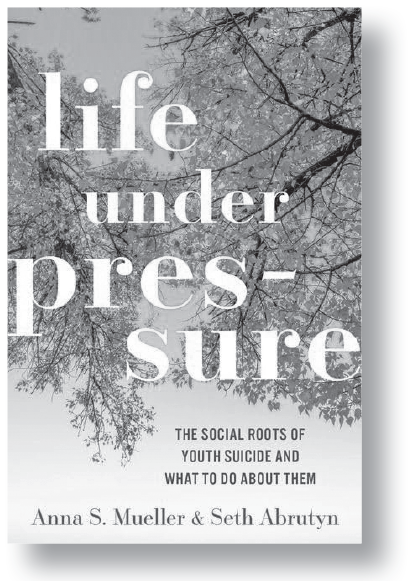
Life Under Pressure: The Social Roots of Youth Suicide and What To Do About Them
by Anna S. Mueller and Seth Abrutyn
Oxford University Press, 2024.
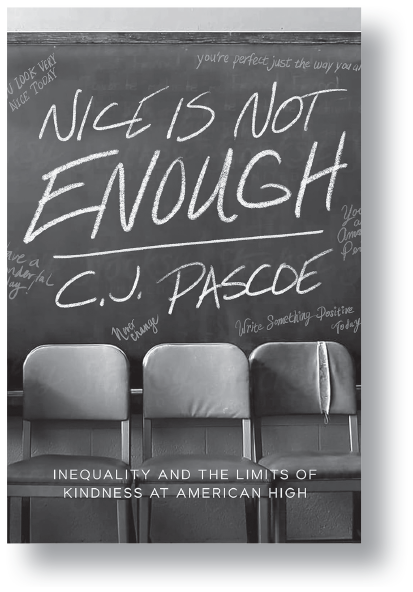
Nice Is Not Enough: Inequality and the Limits of Kindness at American High
by C.J. Pascoe
University of California Press, 2023.
Two recent books on contemporary adolescence start with the same paradox: even when their environments are warm and welcoming, American teens are stumbling over some inordinate challenges. And while the books’ explanations diverge, their underlying stories share marked similarities: adults are, in part, to blame for generating the social environments that youth must navigate, and yet they often try to silence teens, who must be able to name the problems they face on their way to trying to change them.
In C.J. Pascoe’s Nice is Not Enough, adults have tried to solve bullying and anomie by imposing an explicit culture of kindness, but the teens nonetheless face racism and sexism growing in every corner like virulent mushrooms. In Anna S. Mueller and Seth Abrutyn’s Life Under Pressure, parents have built a veritable sociological utopia of social capital and tight-knit connectedness that nonetheless endures a recurring wave of youth suicides.
Pascoe is a noted ethnographer whose influential 2007 book Dude You’re a Fag teased apart the gendered meanings of pervasive sexual mockery. As in that now-classic work, Nice is Not Enough features scenes that so perfectly capture the argument that we can sense Pascoe’s deep immersion—it’s often just when you think an ethnographer is lucky that you realize the time they put in to have such scenes on hand to sample. A drag show put on by queer students, a planned march against gun violence, faculty kneeling at a Senior Assembly, a "powder-puff game"—renamed "power tough" but still featuring a heavy-handed farce of girls playing boys’ games under boys’ tutelage—Pascoe deploys meaning-laden moments to deftly chronicle the politics of power and inequality underlying how the school decides which moments count as political and which do not.
As Pascoe notes, the school invokes kindness to counter bullying, but the code ends up silencing the conversation around the racial and sexual inequalities that the teens both endure and propagate. Kids are told they will be marked unexcused if they participate in a gun control march, because "politics in the school house is not okay." But as Carson, a White senior, notes, "There’s a Young Republican club! That’s actually about politics." While the early chapters about climate and other activists getting shut down at school can seem a bit pious, Nice is Not Enough is particularly compelling when Pascoe documents the steady drumbeat of disparaging comments or leering texts the students struggle to get past—"I never want to be a bully," a girl demurs while trying to set a boundary against a harasser. Despite the ethos of kindness, then, racialized micro-aggressions and sexual harassment proliferate, flourishing in an environment in which the very analyses that might defang them are instead suppressed. For Nice is Not Enough, adults have set up a system in which they refuse kids the tools to change.
Adults do the same in Life Under Pressure. This book is not only beautifully written, it also does an exceptional job at setting up the initial problem— why is youth suicide so common in this warm, friendly, tight-knit community? Why are the teens lost to suicide so often seeming paragons of achievement and popularity? These are not suicides of anomie or alienation, of not belonging or not caring to belong, but of something else. Mueller and Abru-tyn conducted extensive interviews and focus groups in the community they call Poplar Grove with about 80 parents and youth, as well as mental health practitioners and a comparison group of people from other locales who were also touched by suicide. Readers who have followed Mueller and Abrutyn’s prolific academic work know they powerfully extend sociological understandings of suicide; Life Under Pressure is their exploration of the matter for a wider public. Their quick answer is that kids in this elite affluent town face inordinate pressure to perform, and that the close-knit environment of this idyllic community generates not just casseroles, carpools, and social support, but also the gossip and shame that quell all-important help-seeking when teens face psychological pain.
Anyone who has raised or watched a teen in an intense college prep environment recognizes this one-two punch. High school in the United States is an assembly line of high-stakes must-dos performed in front of a critical audience. When the rat race became so oppressive it threatened my own daughter’s zest, for example, we eventually borrowed from Marie Kondo to invent "the joy metric" to help her decide which activities or classes to pursue or drop. At the time, it felt like a lifeline, and she still turns to it as a young adult. That experience meant I felt a deep recognition of the truths that Life Under Pressure reveals about high school, but it also made me want Mueller and Abrutyn to go further: if pressure and gossip are universals among many college-bound elites, why does that combination produce cluster suicides in some places and not others?
Ultimately, Mueller and Abrutyn do address that question, but theirs is not a simple answer: the paradox lies in the very homogeneity of Poplar Grove, with its 90% White non-Hispanic population and its sub-5% poverty rate. When a community celebrates only one path as laudable, only one way of achieving, then teens who find themselves faltering see only total failure ahead. The authors note the knife edge of conformity and recommend that the community celebrate diverse metrics of success, "like the kindest student." But without an actual diversity of paths, produced by an actual diversity of people, a homogeneous community celebrating kindness signals a hypocrisy that teens will see right through. The solution, then, is for these White affluent parents to figure out that choosing to wall themselves off in close-knit communities of achievement is actually risking their children’s mental health, not to mention their very lives.
Both books are potent illustrations of the limits of social capital, good intentions, and adult control.
With the two books side by side, we can see what each offers the other. In Nice is Not Enough, teens are active social agents, both harassed and harasser, navigating their way through an unequal world via charged emotional moments in which we can watch them define themselves and others, with the help and hindrance of adults at school. In Life Under Pressure, the camera pulls back to show us the broader community, where we hear from the parents who both construct and critique a culture of high-stakes performance. Undergraduate students—and the rest of us—will benefit from both books as potent illustrations of the limits of social capital, good intentions, and adult control.