



Abstract
Catherine J. Taylor on life under restrictive abortion laws.
In summer 2022, at a routine prenatal appointment, Kimberly found out that her pregnancy was not viable. Kimberly, a 37-year-old mother of three was “devastated.” Recent legislation, making abortion illegal in Idaho, where Kimberly lived, amplified her suffering. “[B]ecause there was still technically a heartbeat,” she told me, “I had to remain pregnant… I had to keep going to the hospital and have my blood tested… I had to… prove that this fetus was dying, essentially… And that was… taking forever… the hospital staff… didn’t know…what was going on… every time, they’d be like, ‘Oh, you’re pregnant.’ And I was like, ‘Well, I’m actually losing the baby.’ And that…sucked to have to go over again… it was… torturous.” She was also “terrified” because she wondered “what’s going to happen” if her own health were in danger because of the pregnancy. “[N]obody will help me because I can’t get an abortion.”
Many states, including Idaho, made abortion illegal that summer, because the United States Supreme Court had just overturned the constitutional right to abortion. In 2023 I conducted Zoom interviews with twenty-two women, and one gender non-binary, transmasculine person, living in Idaho, for a research project about family planning (names and some identifying details have been changed for privacy). During these conversations, Kimberly told me her story. In the end, she was forced to carry a non-viable fetus for an emotionally difficult two weeks because of Idaho’s abortion law.
Kimberly’s story highlights an often-overlooked fact about abortion bans: the medical procedures for ending a wanted pregnancy due to medical complications and the medical procedures for ending an unwanted pregnancy—for any reason—are the same medical procedures. Laws cannot prohibit use of abortion to end unwanted pregnancies without also making it impossible, or very difficult, for pregnant people to access it to address serious medical complications during wanted pregnancies. My interviews provide evidence of some of the emotional and physical consequences of the extremely restrictive abortion laws in Idaho.
The medical procedures for ending a wanted pregnancy and the medical procedures for ending an unwanted pregnancy are the same medical procedures.
Awful as it is, Kimberly’s experience is not as terrible as other consequences of new abortion laws. For example, since the summer of 2022, journalists, court cases, and health care providers have told stories of people with wanted pregnancies being forced to leave their state for medical care or suffering negative health outcomes, including death, from not having access to medical care (or getting poor medical care) in their own state. Here, I tell less dramatic, but often overlooked, stories of people living with fear and anxiety caused by their vulnerability under state laws restricting their access to full medical care during pregnancy. I give more details of Kimberly’s story for the purpose of detailing some often overlooked consequences of anti-abortion laws. I also share accounts from seven others, who told me how Idaho’s abortion laws affected them.
Kimberly described her wait as “terrible” and “demeaning.” She said, “It was awful. It was totally awful… it was like being in hell. It was also really, really hot here. And I was like, ‘I feel like I’m literally in hell.’…It was definitely really hard to… stay pregnant when I knew that it wasn’t going to happen… being confronted with that 24-hours a day, every day for so many weeks was extremely hard…. I wanted to just not be pregnant and grieve and move on… before when you were crying at the drop of a hat or getting emotional or having a craving, it was, a little beautiful thing, a part of the journey… after this happened, it was… a cruel reminder….”
For those with wanted pregnancies, Kimberly’s story evidences another overlooked consequence of abortion bans. She felt that the law created distance between her and her “baby” and made her feel “second-class to the pregnancy”:
“…Here I am, telling you how bad this is and that I do not want to just be walking around with my unviable pregnancy, and… it doesn’t matter to anyone… it made me feel like whatever happened with this pregnancy, it wouldn’t really matter what I said, what I felt, or what I was going through… of course, I want the health of my baby to be first and foremost. But… it made me feel… second-class to the pregnancy… It’s not like I didn’t want them to care about my baby. I cared about my baby too, but… it wasn’t… a holistic caring of me and the baby…. It’s just colder…. I felt like… we were like, pitted against each other… I was forced… into this weird, ‘…I don’t want you in me anymore’ sort of thing, which is not what you want to ever feel, you know? And it’s not like I consciously… made a decision to feel that way about it, but I just did….It… gave me a weird bitterness and anger about the whole situation…. I should have just been able to feel grief and… feel my loss and mourn….”
Fears from Previous Pregnancy Complications
2023 Interviews from Idaho. Source figure by Aoife Hernon.
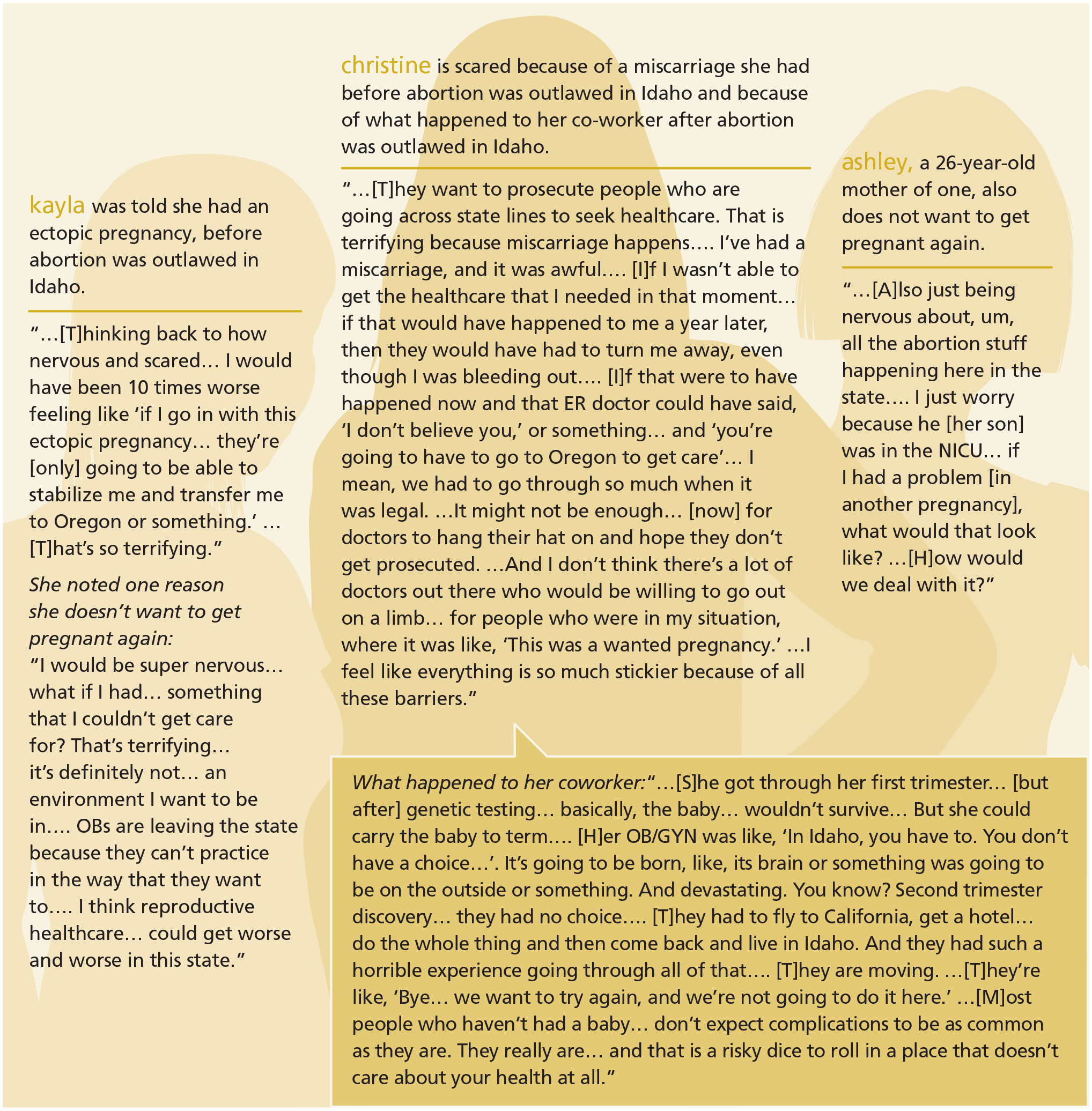
Later, Kimberly was “terrified” when she got pregnant again. She very much wanted another child, but she related, “…I was just waiting for the next terrible thing to happen, and I… had so much anxiety… that… I would miscarry later in the pregnancy and stuff.” That pregnancy gave her a healthy baby, but she is grateful she does not want another child, because “it was terrifying to be pregnant in this climate.” Kimberly explains “it’s just a terrible feeling to feel like you’re not going to be able to get… all the options for care… I’m actively trying to get pregnant and then… knowing that… if something doesn’t go perfectly, I might have to leave the state, you know?”
In the end, Kimberly was able to get the care she needed for her non-viable pregnancy, in Idaho, and went on to complete another healthy pregnancy. Even so, her story conveys the “torture” of being forced, by abortion law, to continue a nonviable pregnancy.
Christine, a 31-year-old, mother of two told me a similar story. In a routine ultrasound, in 2021, she was told there was no heartbeat. Christine related that, although abortion was technically legal at the time, her understanding was that, “in Idaho, you have to show proof that the baby is dead” in order for the doctors to prescribe abortion medication. This involved multiple, medically unnecessary blood tests over several days and a five-day wait for the medication. She remembered, “[W]e were pretty devastated… [and] I felt like a human casket.” Finally, the medication expelled the fetus at home, which was sad and medically difficult. Because of extremely heavy bleeding, Christine eventually went to the hospital. There, a new doctor insisted she again demonstrate she was not pregnant. She was required to undergo a medically unnecessary, 45-minute, and very painful transvaginal ultrasound, more blood tests, and endure a hostile, physically rough doctor. She was “really sad and hurt really, really bad.” She was bleeding heavily “and there’s so many clots. She [the ultrasound tech] can’t see anything… she’s really poking around, like really trying to get the best images she can to prove that… there’s no baby in there anymore….. “ When she got off of the ultrasound table, she recalled vividly, it “looked like I’d been murdered… there was blood everywhere.” Christine’s is another story of a woman forced to undergo multiple, medically unnecessary procedures to get an abortion for a wanted pregnancy that was no longer viable.
These stories are gruesome and difficult. However, the details are important to share because they illuminate the often-overlooked consequences of abortion restrictions. Doctors cannot be expected to risk prison time to save pregnant people the kind of “torture” experienced by women like Kimberly and Christine. Most people—even some of the Idaho legislators who passed the law that affected Kimberly—do not understand that in states where abortion is illegal, or highly regulated, such consequences are inevitable for some people with not-viable, wanted pregnancies.
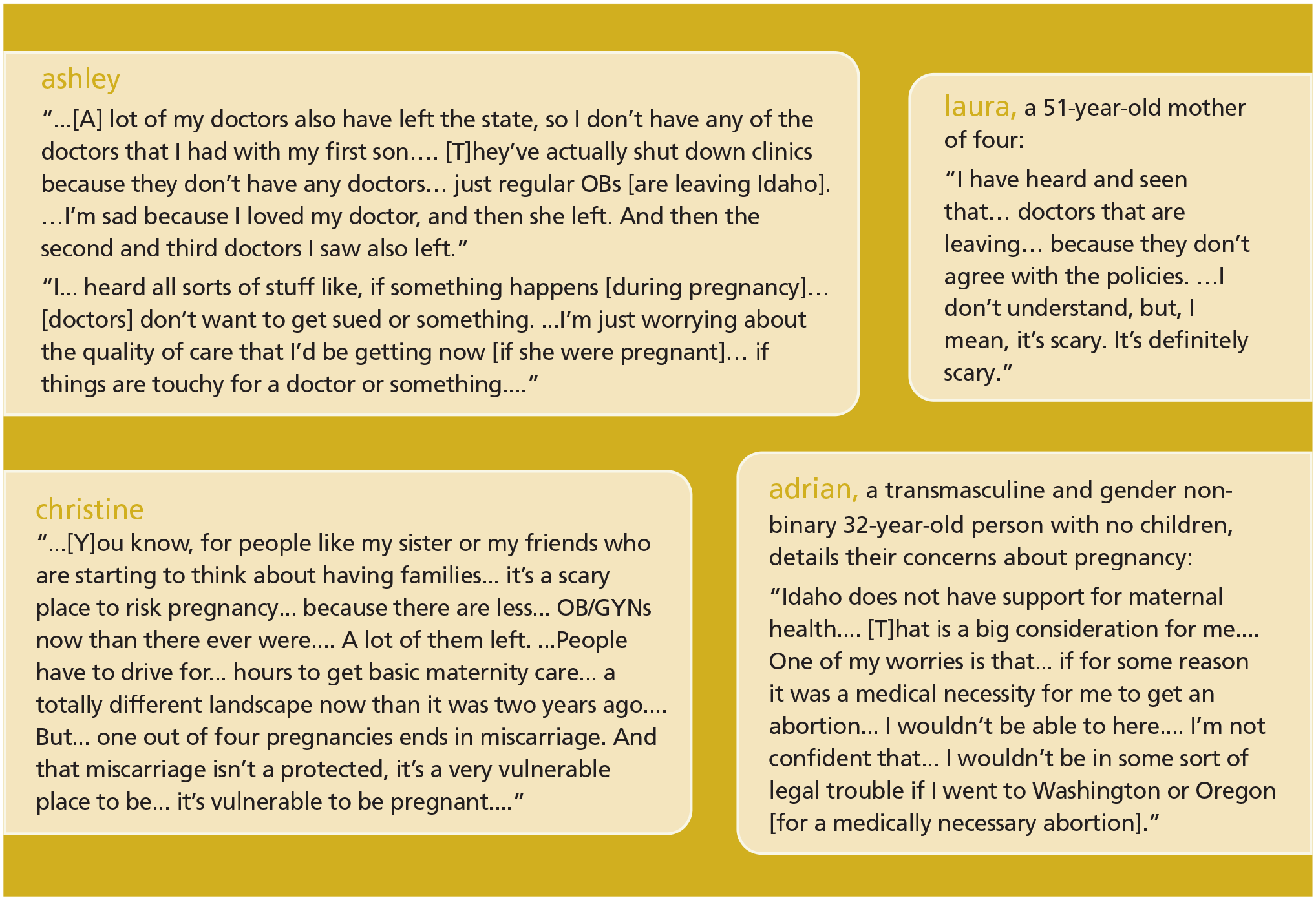
Anxiety and Uncertainty from Idaho’s Current Abortion Law
2023 Interviews from Idaho. Source figure by Aoife Hernon.
Concerns for the Future
2023 Interviews from Idaho. Source figure by Aoife Hernon.
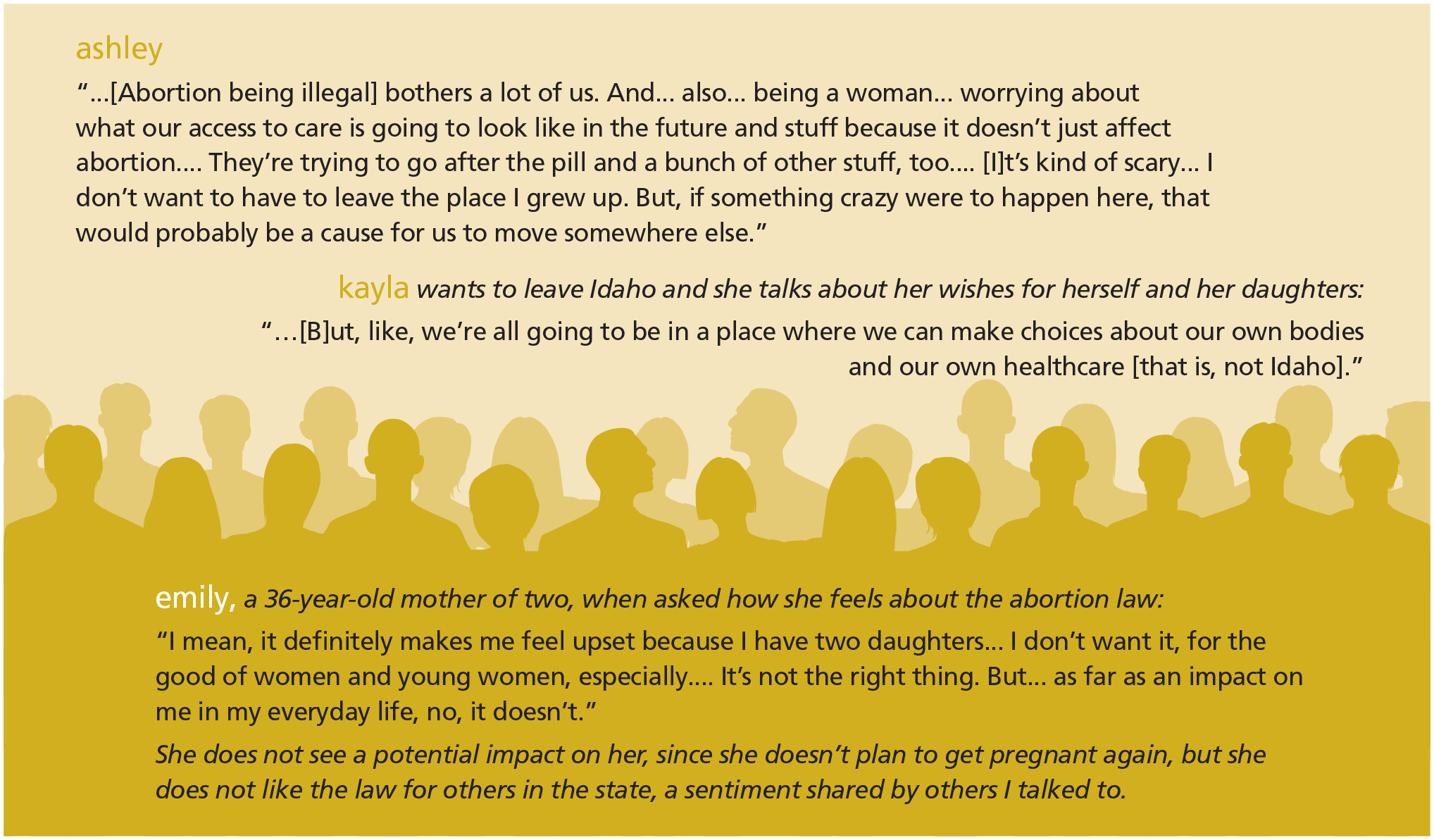
Experiences like Kimberly’s and Christine’s have a ripple effect. Stories like theirs make other people apprehensive about pregnancy and confused about what is legal. Like others I talked to who were exposed to this ripple effect, Kayla, a 34-year-old mother of two, felt “fear” and “uncertainty.” Women who had previous pregnancy complications feared such complications would be disastrous under current law and because maternal-fetal specialists are fleeing Idaho in response to such laws. Women I talked to were also concerned as to how laws might affect them and their daughters in the future.
Here, I told the emerging stories of people in Idaho, who face some of the most severe abortion restrictions in the United States, because such consequences are usually overlooked and poorly understood by legislators, judges, and voters. Some I talked to felt ignored and forgotten—another reason to tell their stories. Christine said, “we don’t get a chance in Idaho to talk about our experiences… I don’t think that real women who are living in Idaho’s stories are… represented a lot of places.” Likewise, Laura wanted a light shone on her experience: “I think that people in other states really need to realize what’s going on, because I don’t think they do….” They saw their stories as urgent enough to share with a stranger over Zoom, almost 1,000 miles away—they wanted to be heard.