



Abstract
Reginald A. Byron on patterns and policy preferences.
The first two years of the 2020s were a troubling time in America. Amidst the COVID-19 pandemic, the country saw a soaring 30% increase in the national murder rate in 2020 followed by an additional 4% increase in 2021, according to the Federal Bureau of Investigation. Similarly, the Centers for Disease Control and Prevention reported a 30% surge in drug overdose deaths in 2020 followed by an additional 15% rise in 2021. National and local news media frequently ran stories on these issues, so it is not surprising that Gallup and Pew polls show that Americans believe that crime and drug addiction are worse than they’ve been in decades. However, because public opinion polls rarely use multivariate analyses, there are still gaps in our understanding of the factors that predict national crime and drug abuse perceptions. A multivariate analysis can control for confounding variables and pinpoint which groups perceive crime and drug abuse as urgent national concerns. Further, studying waves of survey data can determine whether there has been a change in these factors over time.
There are still gaps in our understanding of the factors that predict national crime and drug abuse perceptions.
I use four waves of the General Social Survey (GSS) to do just that. The GSS is an invaluable nationally representative cross-sectional assessment of a variety of American attitudes and behaviors. For this analysis, I pool the GSS years 2016 and 2018 and compare them to the pooled years of 2021 and 2022. Notably, due to the COVID-19 pandemic there was a methodological change from the typical in-person GSS data collection to push-to-web methodology in 2021. These unavoidable data collection modifications influenced my decision to pool the data from 2021 and 2022, the latter of which were designed to be comparable to 2018 GSS data, in the hopes of partially mitigating possibly anomalous effects. The questions that serve as my dependent variables, or outcomes of interest, are represented by the GSS variables natcrime and natdrug and begin, “We are faced with many problems in this country, none of which can be solved easily or inexpensively. I’m going to name some of these problems, and for each one I’d like you to tell me whether you think we’re spending too much money on it, too little money, or about the right amount.” The question then lists specific problems like “Halting the rising crime rate” (i.e., natcrime) and “Dealing with drug addiction” (i.e., natdrug). I use a variable named racecen1 to capture racial/ethnic status because, as my primary independent or predictor variable, it allows me to separate racial minorities into distinct groups, and it is available across all time periods. Racecen1 has 16 racial/ethnic categories which I merged into six groups (Asian American, Black or African American, Hispanic/ Latinx American, Native American, Other Racial Minorities, and White/European American).
Rising concerns about crime and drug abuse can presage preferences for “tough on crime” politics.
iStockPhoto.com // MonthiraYodtiwong

The following figures show how different racial minority groups view America’s spending on halting crime and dealing with drug addiction after accounting for potential confounding variables like a person’s sex, marital status, number of children, employment status, income, age, education, immigrant status, religious service attendance, political views, and geographic region of residence in the United States. In supplementary analyses, I also accounted for whether respondents were afraid to walk alone in their neighborhood at night. This theoretically interesting variable was not significant and yet reduced the final sample size between 17% and 34% because it was not asked of every respondent, so it is omitted from these analyses. Before creating the figures on pages 54 and 55, I recoded the dependent variable and some of the independent variables for ease of statistical and visual interpretation. I also added relevant post-stratification weighting, a statistical technique used to help the sample more accurately represent the general American population, while running these ordinal logistic regression models and adjusted for the geographic clustering of GSS respondents using other commands in the statistical software Stata. Variables that were not significant in any of the four regression models (e.g., number of children, employment status, marital status, and religious service attendance) were left out of the visual presentation, but they are still included in these models.
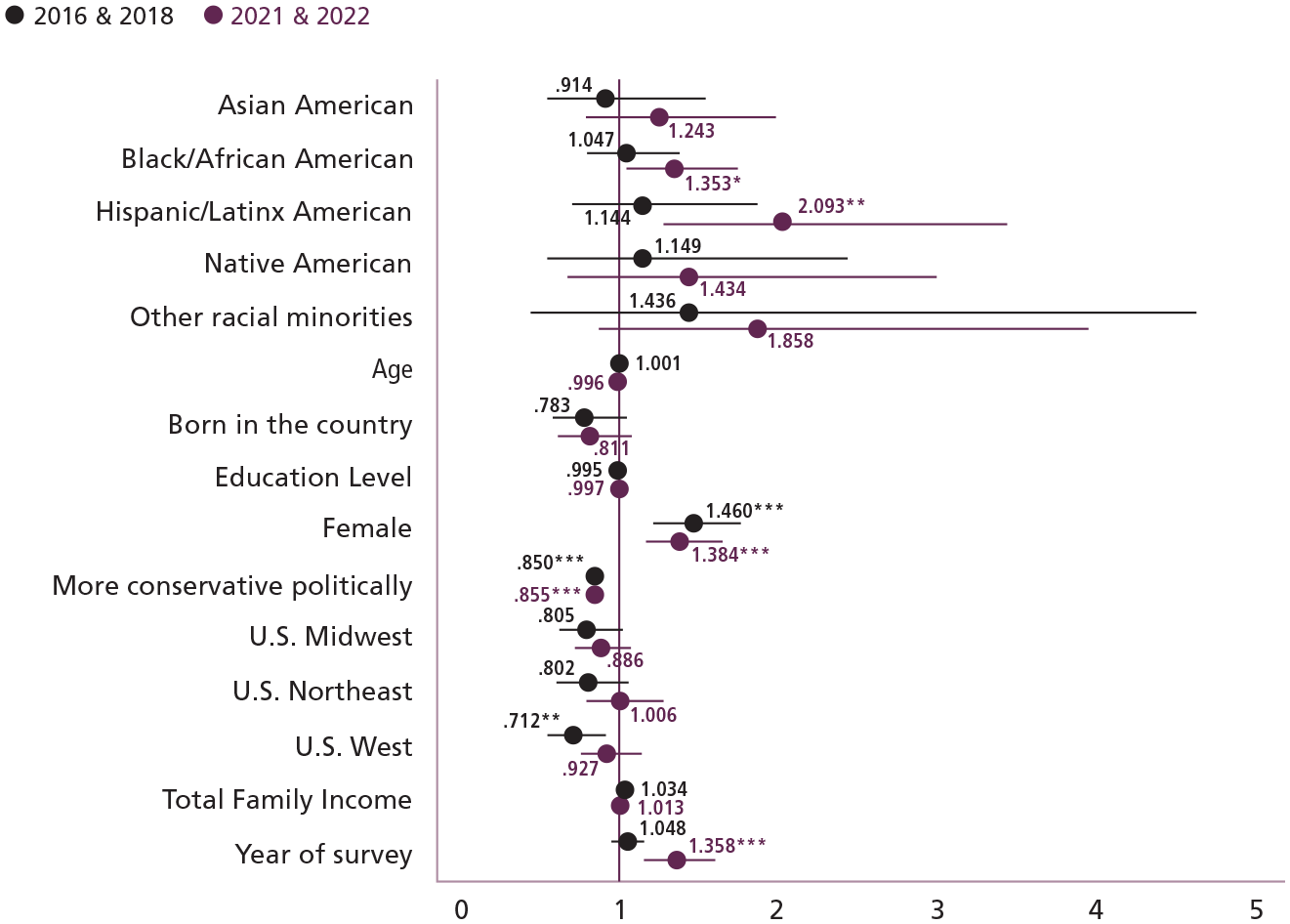
A simple way to interpret these figures is to look for two things. First, if the circle data point and line (-•-) for any given variable does not cross the vertical line drawn from the x-axis value of 1, we know that the variable is a statistically significant predictor of perceptions of how much the United States spends to curb crime and drug addiction. Second, these statistically significant values will also have stars next to them, denoting the probability that the relationship between the variable in question and the dependent variables (natcrime and natdrug) are due to chance (*=p<.05; **=p<.01, and ***=p<.001). The more stars there are, the less likely the relationship between the variables is due simply to chance. Note how some significant variables may appear to cross the vertical line drawn from the x-axis value of 1 (e.g., age in the figure above), but, in truth, they are simply extremely close to it (e.g., 1.008).
What can we learn from these figures? After accounting for possibly confounding variables, Black/African Americans and Asian Americans had significantly different perceptions of the country’s spending on halting the rising crime rate than White/European Americans during both time periods. However, other racial minorities have only recently expressed significantly different perceptions than White/European Americans on this issue. Respectively, as of 2021 and 2022, Black/African Americans, Asian Americans, and other racial minorities had 63% higher odds, over two times the odds (2.197), and almost three times the odds (2.911) of reporting that the country/spends too little to halt the rising crime rate when compared to White Americans. Each of these statistical differences also became more robust since 2016 and 2018. This pattern seems to reflect more widespread racial minority concern about the recent uptick in crime in the United States—a concern that may correspond with the pandemic-related rise in gun violence in many urban communities, anti-Asian hate crimes across the country, as well as several high profile racially motivated mass shootings.
It is also the case that those who completed the GSS survey in 2022 had 51.8% higher odds of reporting that the country spends too little to halt the rising crime rate than those who completed the GSS survey in 2021. Furthermore, by 2021 and 2022, there were no significant regional differences on this question (whereas in 2016 and 2018, those who lived in the Northeastern U.S. expressed that the country spent too much on halting the rising crime rate compared to those in the South). Taken together, national crime rates appear to be increasingly weighing on the conscience of growing segments of the American populace who want the country to spend more to stop it.
Ordinal logistic regression predicting perceptions of the country’s spending on halting the rising crime rate
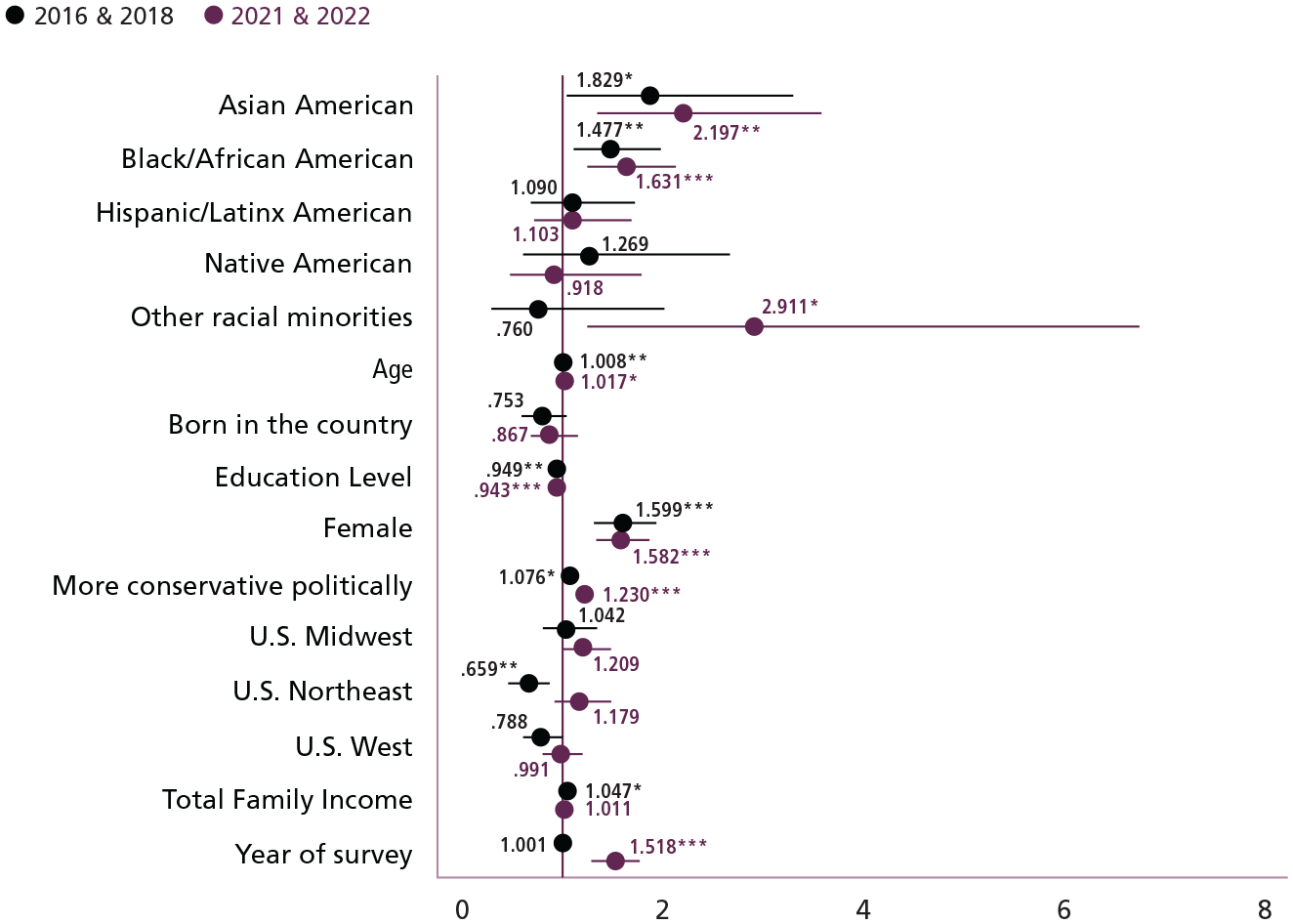
National crime rates appear to be increasingly weighing on the conscience of growing segments of the American pop°lace.
Ordinal logistic regression predicting perceptions of the country’s spending on dealing with drug addiction
Other variables are also significant predictors of Americans’ perceptions of spending on halting the rising crime rate. Across both time periods, women, older respondents, and those who are more politically conservative, on average, suggest that the country is spending too little to halt the rising crime rate when compared to men, younger people, and more liberal respondents. On the other hand, those who are more educated perceive, on average, that the country spends too much in this vein. Lastly, in 2016 and 2018, wealthier Americans perceived that the country was spending too little to curb crime, but this economic difference was not present in the most recent waves of data.
Regarding American perceptions of spending to curb drug addiction, the story is a bit different but has a similar trajectory. In 2016 and 2018, there were no significant racialized differences on the question of how much the United States spends to deal with drug addiction. By 2021 and 2022, though, Black/African Americans and Hispanic/Latinx Americans both had statistically different perceptions than White/European Americans and, on average, expressed that the country was spending too little to deal with drug addiction. Specifically, in the pooled sample of the most recent GSS waves, compared to White Americans, Black/African Americans and Hispanic/Latinx Americans had 35.3% higher odds and slightly over two times the odds (2.093), respectively, of reporting that the country spends too little to deal with drug addiction. This emerging concern may be linked to recent research finding that, while much of the previous literature has linked opioid overdose deaths to White and rural populations, in some states with significant racial minority populations, minorities actually had disproportionate drug abuse deaths when compared to White Americans in the same regions (here, a 2022 article by Majorie C. Gondre-Lewis and colleagues titled “The Opioid Epidemic: A Crisis Disproportionately Impacting Black Americans and Urban Communities” is instructive).
In line with these general trends, those who completed the GSS survey in 2022 had 35.8% higher odds of reporting that the country spends too little to curb addiction than did those who completed the GSS survey in 2021. Likewise, my analyses reveal that although in 2016 and 2018 those who lived in the Western United States expressed that the country spent too much on dealing with drug addiction, by 2021 and 2022 these regional differences had disappeared. Collectively, these statistics all indicate a broadening of concern about this problem across populations, over time, and across places.
Among the other significant variables in these models, on average across both time periods, women reported that the country is spending too little to attend to drug addiction compared to men, and more politically conservative respondents felt that the country is spending too much on this problem compared to more liberal respondents.
The current visualizations offer systematic evidence that, compared to 2016 and 2018, in 2021 and 2022 more diverse swaths of the American public suggested that the country was not spending enough to curb crime and drug addiction. Such trends are meaningful because these perceptions have historically prompted various national developments including increased citizen demand for more police, a growth of defensive gun ownership (see David Yemane’s article Gun Culture 2.0), politically expedient “tough on crime” “solutions” from politicians (see Udi Ofer’s 2022 Time magazine essay on “Politicians’ Tough-On-Crime Messaging”), and an expansion of punitive criminal justice policies (see James Forman’s book Locking Up Our Own). Given some positive reversals in national crime trends, such as declining murder rates in 2023, only time will tell whether American perceptions will follow suit, or if the perceptions outlined here will linger long enough to influence 2024’s Presidential election.