



Abstract
Lawrence M. Eppard, Troy Nazarenus, Lucas Everidge, and Debbie Matesun on racist ideas about welfare recipients.
Americans have historically been “skeptically altruistic” when it comes to government assistance to the poor. While generally sympathetic to the plight of impoverished fellow citizens and supportive of government’s role in assisting them, U.S. citizens are often suspicious of whether recipients of assistance are truly “deserving” of taxpayer-supported aid. Americans want government resources reserved for those who “play by the rules” of hard work, smart choices, traditional morality, and so on. As long as the poor behave in this supposedly virtuous manner, many Americans agree that they are deserving of aid. But support for assistance falls considerably when these rules are thought to be violated.
It has long been known that racial attitudes play an influential role in these subjective calculations of deservingness. Many Americans associate poverty and certain anti-poverty programs with African Americans, and they make racist assumptions that Black Americans are less likely, when compared with Whites, to be committed to hard work, smart choices, and traditional morality. In other words, support for some government programs suffers because many Americans associate them with an “undeserving” racial group.
Some of the most well-known research findings on this phenomenon have come from Martin Gilens, including his seminal 1999 book on the subject, Why Americans Hate Welfare.
As Gilens explained in the following excerpt, his research showed that the American public’s thinking about poverty and welfare were dominated by images of African Americans and beliefs about their work ethic and morality:
First, the American public thinks that most people who receive welfare are black, and second, the public thinks that blacks are less committed to the work ethic than are other Americans… white Americans’ attitudes toward welfare can only be understood in connection with their beliefs about blacks—especially their judgements about the causes of racial inequality and the extent to which blacks’ problems stem from their own lack of effort.
In more recent research (2017), Jazmin Brown-Iannuzzi and her colleagues created a base image that was a morph of images of an African American man, an African American woman, a White man, and a White woman. They then added random visual noise to the base image to create 800 variants. They had research participants look at hundreds of pairs of faces and select the one in each pair that they believed looked more like a welfare recipient.
The researchers then superimposed all of the selected photos onto each other to create one photo of the typical mental image of a welfare recipient. They did the same thing for all the unselected photos to create the typical mental image of a non-recipient. Participants rated the average welfare recipient face as more African American and less White, lazier, more incompetent, more hostile, less human, less responsible, less likeable, less attractive, less happy, and less agentic than the aggregate non-recipient face. Participants were also less supportive of giving food stamps and cash assistance to the recipient image than to the non-recipient one.
In summary, the researchers argued that when Americans think about welfare, they “spontaneously” picture African Americans—and because of negative stereotypes they hold about Black Americans, this mental image of the typical recipient negatively influences their judgments about who deserves assistance and who does not:
We show that when Americans think about recipients of government benefits, they overwhelmingly imagine a Black person—although, in reality, beneficiaries include White, Black, and Hispanic people in roughly equal proportions. Moreover, when people consider granting or withholding benefits to the imagined recipients, they are less willing to grant benefits when the imagined person fits racial stereotypes about Black recipients.
Early 2020 was a time of increasing attention to racial inequality in the United States. It led our research team to wonder if the association between racial attitudes and support for government assistance was still as pronounced.
To explore this question, we distributed online Qualtrics surveys to undergraduate students in multiple introductory sociology courses across three university campuses in Pennsylvania, Virginia, and West Virginia. We received a total of 353 completed Qualtrics surveys.
Our survey questions examined respondents’ views on a range of topics, including perceived causes of racial inequality and degree of support for a variety of government programs. Examples of our racial inequality questions included whether participants believed African Americans had access to equal educational and employment opportunities compared with Whites, whether Black Americans were treated equally by the criminal justice system, and whether racial inequality was more the fault of African Americans or forces beyond their control.
Association between racial prejudice and government support
Note: All group differences reported here are statistically significant below .05.
Source: Lawrence M. Eppard, Troy Nazarenus, Lucas Everidge, and Debbie Matesun. 2020. “Effects of Anti-Black Prejudice and Individualism on Government Support among U.S. College Students,” The New York Sociologist 8: 1-41.
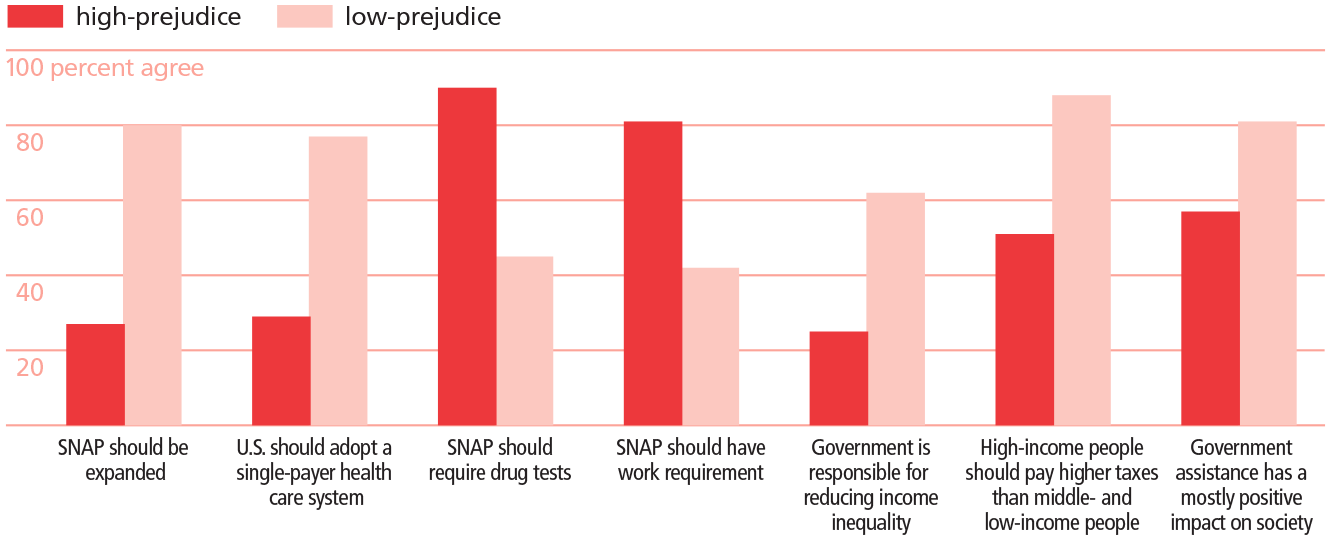
Examples of questions about government programs included whether SNAP (Supplemental Nutrition Assistance Program) should be expanded, whether SNAP recipients should be required to work and pass drug tests, whether the government should reduce income inequality, and whether respondents favored a government-run, single-payer health care system.
We analyzed our data using a variety of index variables, including one based upon responses to the slate of racial inequality questions and one based on responses to questions about government support.
If you are unfamiliar with index variables, imagine for a moment that you wanted to use a survey to assess people’s knowledge of something. For the purposes of this fictional example, let’s say we are examining people’s math knowledge. Asking just one question might not give you the most accurate picture of who knows a lot about math and who knows the least. So you decide to create an index that adds up respondents’ scores across several math questions, giving you a much more comprehensive and accurate view of their math abilities. Our index variables followed this logic—we essentially added up respondents’ scores across a variety of related questions.
We could have asked a single question, such as whether Black and White Americans, on average, attend the same quality schools. Would somebody be considered racially prejudiced just because they believed in the equality of American schools? Not necessarily. Denying the impact of meso- and macro-level forces on racial inequality in one domain might not mean that somebody is racially prejudiced—but denying their importance in every domain and thus dismissing their influence altogether? We assert that this does in fact suggest a higher degree of racial prejudice when compared with those who acknowledge the influence of these forces across multiple domains.
So, what did we find when we constructed these index variables and evaluated their associations? Like previous studies, our findings suggest that racial prejudice is strongly associated with support for a variety of government programs (see figure above).
There were substantial and statistically significant gaps between high- and low-prejudice individuals in SNAP expansion support (53 percentage point gap), support for single-payer health care (48 points), support for SNAP drug tests (45 points) and work requirements (39 points), belief about the government’s role in reducing income inequality (37 points), support for progressive taxation (37 points), and general feelings toward government assistance (24 points).
Racial prejudice was strongly correlated with government support (r = -0.55, p <.001). Individualism (r = -0.60, p <.001) and political orientation (r = -0.59, p <.001) were also strongly correlated with government support. And in a regression model, racial prejudice, individualism, and political orientation continued to associate with government support even when we controlled for things like the race, gender, social class, and religiosity of respondents.
We believe the weight of the evidence suggests that beliefs about racial inequality in the United States continue to operate as what social theorist Pierre Bourdieu called symbolic violence. That is, Americans learn incomplete explanations for racial inequalities—explanations which downplay, ignore, and/or misrepresent crucial meso- and macro-level mechanisms—which helps to perpetuate racial disparities by undermining support for social policy responses. As sociologist Dan Schubert explains: “[W]e all live in symbolic systems that, in the process of classifying and categorizing, impose hierarchies and ways of being and knowing the world that unevenly distribute suffering, and limit even the ways in which we can imagine the possibility of an alternative world.”
Our findings suggest that U.S. racial prejudice, when activated by political and/ or public discourse, can undermine support for a variety of social policies and government functions and thus help to perpetuate racial inequality.