




Abstract
This article explores how notions of citizenship are negotiated in encounters between parents and youth care professionals in Amsterdam in the context of heated debates over citizenship and belonging. We draw on ethnographic research on Egyptian migrant parents’ interactions with the welfare state, and on the work of youth care professionals. We found that both parents and professionals were invested in universal forms of citizenship. Parents wanted to be treated like their fellow citizens regardless of their background, while professionals wanted to care for all children. While parents feared and suspected that their children were subject to unfair treatment, professional practices left little space for disagreement or a consideration of racialized aspects of their encounters with clients. We conclude that notions of equal citizenship provide a primary, but uncertain ground for the elaboration of citizenship and belonging in parenting encounters, which is haunted by the spectre of difference and inequality.
Keywords
Introduction
One day in June 2017, Ibrahim’s eight-year-old son Karim came home saying his teacher, Ms Jacky, had called him stupid. Ibrahim, an Egyptian migrant father in Amsterdam, had long suspected his son’s teachers were treating him unfairly, and the latest incident reinforced his suspicions. The parent–teacher meeting, scheduled a few days later, provided a good opportunity to show Karim’s teachers that they could not get away with racism (unsureyya), Ibrahim said adamantly, almost shouting through the phone to Wiebe Ruijtenberg. Until then, Ibrahim would keep Karim at home, he said, for he first wanted to make sure his son was in good hands.
A few days later, Ibrahim had dressed up, wearing a suit with a tie and heavy perfume. He brought Ruijtenberg and Hager, his eighteen-year-old daughter, along. Hager was ready too: ‘I know these people, they are all racists,’ she said, in Dutch. Inside, Ms Jacky and her colleague Ms Suzanne were already sitting behind their desk. Ms Suzanne welcomed Ibrahim, telling him that they had missed Karim and hoped that he would return soon. Without wasting much time, Ms Suzanne moved on to discuss Karim’s latest results, represented in clear-cut, colourful graphs. Karim had improved a little, but not enough to catch up. This was especially disappointing because they had gone out of their way to help Karim, Ms Suzanne asserted. ‘We are running out of options here,’ she said ‘so we really hope you will reconsider those tests we talked about before. We believe that this is what is best for Karim. If we run some tests, we know how to help him.’
‘Taany’ (again), Ibrahim sighed in Arabic. So far, he and his wife had refused to give their consent because they suspected that this test would be instrumental in transferring Karim to special education, which they felt amounted to being relegated to the drain of the educational system. This would seriously impede Karim’s chances on success in life. Nevertheless, Ibrahim promised to give it another thought, as he had promised several times before.
Next, the school’s care-coordinator entered the classroom. Ibrahim had asked her to join in, to lend the meeting some extra weight. ‘So, what did you want to discuss, Sir?’ she asked as she sat down. Ibrahim looked at his daughter, who nodded reassuringly. Ibrahim sounded nervous as he started to speak, looking down when he professed that his son had complained about Ms Jacky. When he was done, everyone looked at each other, until the care-coordinator broke the silence to tell Ibrahim that this was really a matter between parents and teachers.
As the care-coordinator left the room, Ms Jacky started her defence: ‘I really do not know where this is coming from. Sometimes I am strict with him, but he needs that.’ Hager, Karim’s sister, nodded, commenting that Karim indeed was difficult (lastig). Ibrahim, however, would not let it go: ‘Okay, but why did you tell him he is stupid and has to re-sit the year,’ he countered. Ms Jacky seemed taken aback, but her colleague, Ms Suzanne immediately backed her up, arguing that Ms Jacky was an excellent teacher and she could not imagine her saying something like that to a student. Quickly moving on, Ms Suzanne repeated that they had done everything within their capacity to help Karim, taking the opportunity to mention running a test again. ‘I understand it is scary, but it is really in his best interest,’ she assured Ibrahim. Ibrahim again promised to consider it, and, in an apparent attempt to demonstrate his good intentions, asked if there was anything else he or his wife could do, to which Ms Suzanne replied that Karim would really benefit from reading on a daily basis. Visibly relieved, Ibrahim promised that he would personally make sure that Hager would read with her brother, before getting up to shake hands and leave.
In this paper, we zoom in on parenting encounters like the one described above to explore the enactment and negotiation of citizenship and belonging in the Netherlands. We argue that the welfare state is a central domain and interlocutor for the negotiation of citizenship, belonging, and difference. We draw on Wiebe Ruijtenberg’s ethnography of Egyptian parents’ interactions in Amsterdam’s dense welfare landscape and Anouk de Koning’s ethnography of Parent and Child Teams in Amsterdam North. Both projects were part of the Reproducing Europe project, led by Anouk de Koning, which studied encounters between (Egyptian) migrant parents and welfare professionals in Amsterdam, Milan, and Paris. The Egyptian parents with whom Ruijtenberg worked articulated their sense of citizenship as the right to be treated like their fellow citizens, but feared that they and their children were discriminated against. In turn, the youth care and parenting support professionals with whom de Koning worked sought to reach all children and provide individually tailored care to all, leading them to background sociocultural differences and to ignore structural racism.
Taken together, our findings allow us to complement academic studies that have scrutinized public debates and integration policies to document the racialization (Lentin and Titley, 2011), moralization (Schinkel and Van Houdt, 2010), and culturalization (Duyvendak et al., 2016) of citizenship and belonging in the Netherlands and Europe. Rather than the insistent othering that these authors observed, the migrant parents and welfare professionals we worked with adhered to a more universalist framework for citizenship. This universalism was, however, haunted by difference and inequality. As Iris Marion Young (1989) has incisively argued, universalist conceptions of citizenship perpetrate inequities by not addressing the fact that only some people can take up the position of the neutral, universal citizen, thus maintaining the privilege of these groups, and marginalize and silence others. In the same line, a generic approach may actually reproduce existing inequalities. As a result, universal citizenship becomes a promise that always remains unfulfilled, a horizon that can never be reached (cf. Hansen, 2015).
Contested citizenship
Public debates and politics in the Netherlands, and large parts of Europe, have been dominated by anxious political discourses (De Koning and Modest, 2017) which revolve around the precarious future of the increasingly diverse nation due to the presence and continued arrival of people who are racialized as Other (Lentin and Titley, 2011). In many European countries, questions about national belonging and the rights associated with such national belonging articulate with fiscal crises and a restructuring of the welfare state. These sets of changes, and the questions and anxieties they evoke, intersect in discussions of citizenship: who can belong to the political community, and what rights can they claim?
Various authors have argued that, in this context, citizenship is moralized (Van Houdt et al., 2011) and culturalized (Duyvendak et al., 2016), i.e. that cultural and moral dimensions of citizenship are foregrounded over formal ones, like legal nationality. Culturalized and moralized citizenship agendas (De Koning et al., 2015) are squarely directed at those considered not (quite) Dutch, urging them to adapt to what are portrayed as Dutch cultural values and society. They affect a racialization of Dutchness, which is articulated in contrast to a host of non-white migrant Others. As Lentin and Titley (2011) argue, such cultural concerns serve as a proxy for race thinking in an allegedly post-race era. In reaction to, and working against such tendencies, Black activists have spearheaded debates about race and racism in the Netherlands, putting questions of racial inequality on the agenda. Their efforts have been bolstered by research that evidences wide-spread discrimination in the fields of education (Gemeente Amsterdam, 2007), the labour market (Andriessen et al., 2012; Van der Berg et al., 2017) and policing (Çankaya, 2012).
We consistently use the terms ‘white Dutch’ and ‘non-white Dutch’ to stress the combination of phenotype and origin in determining categories of identification and belonging, and acknowledge the racialization of Dutchness. Since it constitutes an unspoken norm, ‘white Dutch’ is not commonly used in everyday life. In everyday conversations and public debates, ‘others’ are readily named in ethnic terms, for instance as ‘Moroccans’ or ‘Surinamese’, while the white Dutch subject functions as a silent, implicit norm, which may become explicit in references to ‘ordinary Dutch’, for example in populist invocations of ‘ordinary Dutch’ who suffer from the trouble caused by ‘Moroccans’ (De Koning and Vollebergh, 2019).
We did not encounter these same forms of moralization or culturalization in parenting encounters. Publicly dominant discourses are refracted through the institutional logics, ethics, protocols, habits, and everyday sociabilities that mark life in particular settings. In earlier works, De Koning explored how public debates landed in an iconic notorious Amsterdam neighbourhood, among other things in urban policy (De Koning 2015) and youth-and-security policies (De Koning, 2017), and how it came to inform identifications of self and other (De Koning and Vollebergh, 2019).
In this paper, we extend these insights by focusing on citizenship as enacted and negotiated within the welfare state. More specifically, we focus on parenting, a domain in which both parents and professionals are deeply invested. Welfare policies, including youth care and parenting support services, are largely guided by a universalist logic, at least on paper. In the 2000s, policies for people with migrant backgrounds were increasingly viewed as remnants of a much-maligned multicultural past and were defunded (Van Breugel and Scholten, 2017; Van der Haar, 2007). In 2011, the Dutch government officially did away with ‘targeted’ policies meant for specific ‘minority’ or ‘ethnic’ groups in favour of a generiek, i.e. generic or universalist approach that would apply to all irrespective of ethnic background (Dagevos et al., 2013), meaning that all publicly funded institutions and initiatives would have to be universal. Our focus on the welfare state and the domain of parenting brings us back to a more classical understanding of citizenship in a Marshallian sense, revolving around rights and duties and the responsibilities of the state towards its citizens (Turner, 2009).
Fieldwork with migrant parents and professionals
During a year of fieldwork, in which Wiebe Ruijtenberg accompanied numerous parents to their meetings with welfare professionals and other state agents, he grew intimately familiar with Amsterdam’s dense welfare landscape. Several Egyptian associations in Amsterdam, catering to different religious, political, and class factions, presented a fertile entry into the field. These associations hosted weekly meetings and occasionally organized events and workshops, often in collaboration with the municipality or municipally funded organizations. In addition, they served as a platform for moral, financial, and practical support. Ruijtenberg frequented the weekly meetings of three associations, quickly becoming an active member of their support networks by offering to stand by parents before, during, and after their meetings with welfare professionals.
Many Egyptian parents were happy to accept Ruijtenberg’s offer, asking him to help prepare for and join their meetings, to translate between Arabic and Dutch and to simply be present, as many felt that his presence as a young, educated white Dutch man would change the dynamic of the meeting in their favour. Usually, professionals were also happy to have him, saying that it smoothened communication.
Throughout 2017, Ruijtenberg accompanied dozens of parents to myriad welfare organizations. In some cases, this remained limited to a few meetings, while in other cases, he joined several meetings a week for months on end. Such meetings were often rushed, leaving parents little time to share their views and concerns. Professionals mostly updated parents on their child’s situation and proposed next steps. In Ruijtenberg’s experience, such meetings were never used to convey culturalized citizenship agendas. During meetings, parents often appeared understanding and agreeable. However, during more private conversations and the weekly meetings at the associations, parents readily expressed hopes and fears for their children’s future.
Many parents accessed welfare and encountered welfare actors, including the Parent and Child Team professionals with whom Anouk de Koning worked, through schools. Founded in 2015, when youth care was devolved from the national level to that of municipalities, Parent and Child Teams (Ouder- en Kindteams, often referred to with the acronym OKT, here: PCT) have taken up a central position as providers of accessible, simple youth care and parenting support, as monitors of the health and well-being of all Amsterdam children, and as the institution mandated to refer families to more specialized services. Schools are instrumental in this respect: all Amsterdam schools have their own Parent and Child Advisor, who is supposed to work closely with existing school care structures to help children and families who seek their assistance, and to monitor child well-being.
De Koning conducted ethnographic research in two Parent and Child Teams in Amsterdam-North on a part-time basis in 2017 and 2018, examining how PCT professionals conceptualized and went about their work with parents and children, many with working-class and non-white Dutch backgrounds. While her fieldwork also included observations of professional–client interactions, the many collegial and team meetings and the numerous training sessions that are a crucial part of work in PCT teams made up the bulk of her ethnographic data. Our present argument also draws on four focus groups that De Koning organized at the end of her fieldwork.
Below, we first turn to professionals’ professional ethics and practices within an environment organized around generic policies and universalist logics, before we return to Egyptian parents’ fears and suspicions of unfair treatment.
Working with a diverse client population
On Thursday afternoons, Parent and Child Team members would gather in groups of five or six people for their biweekly case discussion sessions. Anouk de Koning often joined these sessions, which provided a crucial space for exchange in an organization that stressed professional expertise and autonomy. When dealing with complex, difficult, and often emotionally charged cases, PCT members could seek advice from colleagues with the range of professional backgrounds present in each of the teams: Parent and Child Advisors, mostly with parenting support and youth care backgrounds, child psychologists, youth health nurses, and paediatricians.
Marco, a white Dutch Parent and Child Advisor in his thirties, had a particularly strong commitment to helping those in need, and, during case discussion sessions, regularly brought up intricate cases that raised complex questions regarding the limits of professional engagement and responsibility. One Thursday, Marco presented a case that concerned a single mother with two children. He had worked with one of the kids, who attended a school under his charge. The boys were often left with their grandparents, who lived nearby, which, Marco said, left them confused and anxious about where they would spend the night. After meeting with the boy a few times, Marco had suggested that the mother would make a schedule a week ahead, indicating when the boys would sleep where.
Recently, things had taken a turn for the worse. ‘Mother’, the abstracted way in which professionals refer to their clients, had met a new man with two girls of his own, who had moved in with her. The boys now seemed to live permanently at their grandparents. ‘And I do not have one, but ten of such cases,’ Marco said. ‘What do we, as Parent and Child Team, think of this?’ ‘Are they Surinamese?’ a colleague asked. ‘No, with one exception they are kaaskoppen,’ Marco said, using an informal, vernacular term for white Dutch, ‘cheese heads’.
Rather than support, Marco was met with mild critique and pushback. ‘Why is this a problem? And for whom? For you?’, the child psychologist asked. Marco said that team leader Hedwig had similarly said that this was not about his norms and values. A consensus formed that he should focus on how the boy is doing: Is he all right with the situation? Does he feel abandoned?
This case discussion introduces us to the complex reality of a universalist approach implemented by a largely middle-class white professional body working with a differentiated client population. During case discussion sessions, cases were discussed anonymously, in a remarkably universalising manner. Professionals invariably introduced their cases by referring to generic family systems featuring ‘mother’, ‘father’, and children, ‘boy age 5’, ‘girl of 9’. Professional protocol and language worked to strip parents of ethnoracial, class, and other markers. Instead, the family system – descriptions of who was involved in meaningful ways with the child in question, and their mutual relations – was central to how professionals presented their difficult cases to each other, mostly verbally, sometimes aided by drawing a kinship diagram. The family system was considered the most important context through which to understand the problem at hand, and propose solutions. Depending on the specific case, professionals would also pay attention to the general situation of the household in terms of finances, parenting capabilities, housing, and residential status. ‘Culture’ or culturally distinct modes of parenting were rarely mentioned.
In light of the prominence of ‘culture’ and ‘ethnicity’ in public debates in the Netherlands, it is striking that ethnic background was rarely foregrounded. In only 12 out of 50 new cases, ethnic background was mentioned in the introduction. In an additional 11, it was briefly mentioned in response to questions. More importantly, such mentions were almost always just that, a mere mention, without a real follow-up or a framing of cases in culturalized terms. Only 4 out of these 50 cases included explicit discussions of cultural differences or ‘other’ parenting practices. These discussions tended to be vague and undecided. Nobody really knew, and rarely did anyone want to assume too much or generalize. This was not for lack of attention to culturally specific forms of parenting in the Netherlands (see Pels, 2000).
Most PCT professionals seemed hesitant to voice culturalized assumptions about this or that parenting culture or family system, and avoided taking an explicit culturally normative stance. During a focus group with four white Dutch Parent and Child Advisors in November 2018, De Koning asked why ethnic background was given such sparse attention. Several professionals doubted that identifying a particular cultural pattern would really change their understanding of that case. Some indeed articulated this as a conscious politics. Marjan, a seasoned white Dutch Parent and Child Advisor, said, ‘You know, when I close my eyes, and just listen to people, everyone looks exactly the same to me. What really matters is their socio-economic level.’
The ethnic backgrounds and potential ‘cultural difference’ of PCT clients were simultaneously absent and present, in understated and uneven ways. In Marco’s case discussion, a colleague brought up ethnic background (Are they Surinamese?). Marco responded by saying that this concerned ‘kaaskoppen’. While discussing ethnic background was not common in these Parent and Child Teams, it was even more unusual to name white Dutch ethnicity this explicitly. Amsterdam North’s white working-class population, with long histories of family problems and involvement of youth protection services, was usually referred to as ‘real’ or ‘old Northerners’, or by mentioning particular neighbourhoods. Marco’s intervention also stood out in highlighting a cultural pattern he saw as problematic. This may have only been possible because it concerned white Dutch families, who, while subject to stigmatization and problematization, were not targeted in public discourses in the same way as parents with migrant backgrounds. And even here, Marco was the odd one out, as his colleagues’ pushback against his moralizing questioning indicates.
A duo interview with Margot, a senior white Dutch paediatrician with a long history in public health, and Lilian, a new, more junior non-white professional, further illustrates the doubt and hesitation in dealing with what in the Parent and Child teams, and in organizational contexts more generally, was often glossed as ‘diversity’ (rather than, for instance, ‘difference’ or (racialized forms of) ‘inequality’) (Vertovec, 2012). Margot: As helping professional, you support the [family] system, and you take a secondary role. And I think we all do not want to discriminate, we don’t want to get near prejudices. [PCT professionals] are all very social types. You won’t find people in the PVV [Wilders’ anti-immigrant Freedom Party] corner here. But perhaps we do overdo it a bit, in the sense that you don’t allow for it [ethnic background] at all. It might be a good idea to put this topic on the agenda for a theme meeting: How do we deal with this? Do you always register the other’s different ethnic background, and what does that do to you? I keep having difficulties with this. I support what you say… but it has two sides. Because what would scare me, if I come to an institution for help, say I am at the general practitioner, or the psychologist, what is the first thing that person sees? Does that person see my culture? Does that person label me, hey, that one is Surinamese, which in any case brings prejudices. Or does that person see me as a woman, as a human being? … When I am on the other side, I try not to do that, because I want to see the person for what they are.
Many professionals indicated that working with a diverse, working-class client population was a positive, attractive aspect of working in Amsterdam-North, in contrast to, for instance, Amsterdam-South, the richest city district, with a wealthy, highly educated white population that was thought to be demanding and unappreciative of professionals’ work and expertise. During a discussion of diversity which De Koning had helped organize as part of a team day, Marjan said: ‘I consider it enriching. Contacts with other cultures, beautiful norms and values.’ She claimed she had no difficulty working with a diverse client population. ‘I have no tricks, but I do have 35 years of experience.’ A colleague added: ‘Sincere interest: “How do things work in your family?”’
Despite this appreciation of diversity, there was hardly any formal or extended discussion of what such diversity meant for the work of youth care professionals. The general sense seemed to be that as a helping professional, one should be able to deal with all types of parents. This reflects the ‘generic’ orientation of an ‘integral approach’ to social work adopted since the early 2000s (Van der Haar, 2006: 100), which … implies that all clients are approached in a similar manner and that professional categorical treatment was no longer permitted; every single professional is expected to be able to help every single client according to his or her individual needs.
How exactly professionals coded, translated, and negotiated complex realities that included intersectional differences in class, gender, race, ethnic background, migration experience, legal status, and religious denomination remained unclear (but see Veltkamp and Brown, 2017). Colour-blind discourses may well draw on deeply racialized stereotypes of good and bad parents, functional and dysfunctional families (Lee, 2016), and thereby create and reproduce racialized social hierarchies and forms of exclusion (Abu El-Haj et al., 2017).
Generic policies
As part of major welfare state restructuring, Parent and Child Teams were deliberately designed to create specific state–citizen relationalities. Elaborate policy principles were translated in myriad protocols, which were conveyed to PCT professionals in regular training sessions. It is therefore very telling that, the PCT mission statement, its protocols, guidelines, and training sessions did not feature discussions of ‘diversity’. Even if the diversity of backgrounds of the client population was a topic that resonated with many professionals, the organization’s top priority was developing and tweaking its general approach in what was meant to be a bottom-up practice, and diversity was only slowly making its way to the top of the PCT priority list. The elaborate PCT website (www.oktamsterdam.nl) did not contain a single mention of ‘diversity’ or ‘culture’, except for an information sheet about cultural customs. Yet, in striking contrast, visual diversity was key to the self-representation of the Parent and Child Teams: all PCT representations featured a phenotypically and sartorially diverse range of children (see Figure 1). The Parent and Child Teams were clearly designed as a generic service, emphatically for all Amsterdam families. This universalist ambition apparently left little space for explicit discussions of the diversity of the client population and the consequences this might have for the work of the Parent and Child Team.
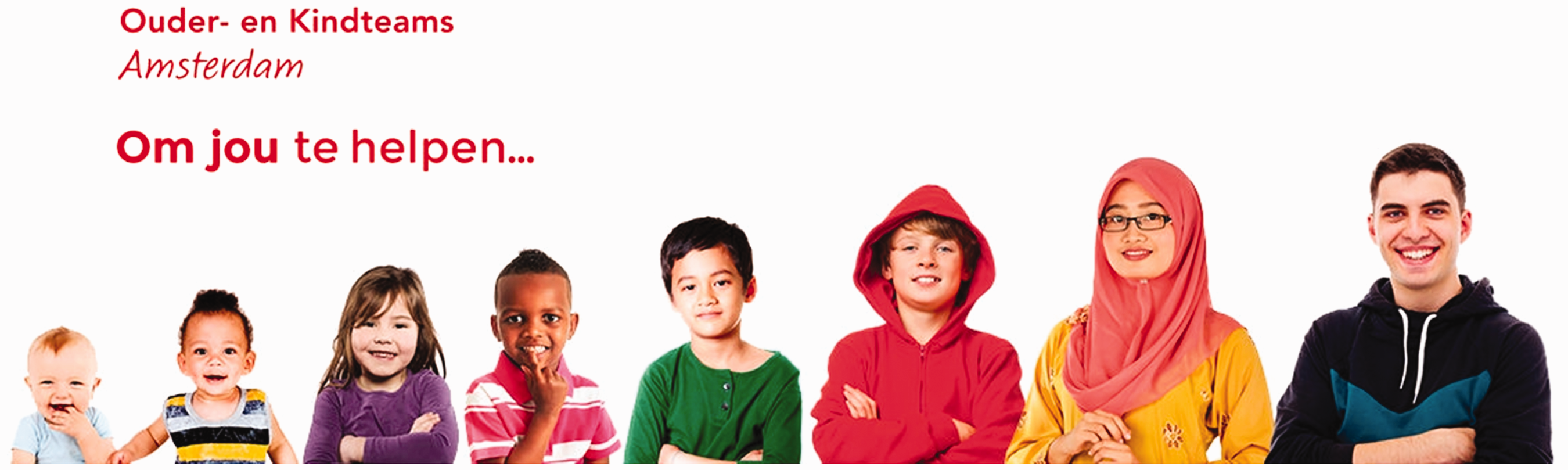
Parent and Child Team promotional material. ‘Parent and Child Teams Amsterdam. To help you…’.
Parent and Child Team protocol set out a model of interaction and course of action that started with a family’s own hulpvraag, their self-formulated request for assistance, and then proceeded to solicit parents’ diagnosis of the situation. In line with eigen kracht, strengths-based, principles, parents were then asked to come up with solutions that would outline their own role and resources. This client-centred perspective was thought to allow for tailor-made professional practices suitable to a diverse client population. However, the idea of a horizontal, cooperative relation between professionals and parents leaves little space for the existence of unbridgeable differences in opinion or conflicts between parents and professionals. When De Koning asked about such conflicts, some professionals argued that they worked in the interest of the child, which was assumed to be also the interest of parents, thereby ruling out the possibility of conflicting visions or professional error. This professional approach was also reflected in stock phrases that were part of professional jargon. De Koning frequently heard several professionals ask ‘why parents had not arrived at [a certain meeting or service]’, a phrase that effectively forestalled the possibility of disagreement or parents’ conscious choice not to attend.
The relatively homogeneous composition of the teams – largely white Dutch and female – was regularly brought up as a disadvantage, and working towards a more diverse team, including having more men on the team, was considered desirable by professionals and management alike. While working with families with ‘different’ backgrounds, professionals could call on colleagues with, for instance, Turkish, Moroccan backgrounds and language skills to translate, literally and, more implicitly, also culturally. These arrangements were largely informal, and while the added value of the presence of non-white Dutch professionals was acknowledged, the additional burden of the ‘diversity work’ that they bore, was not.
Where this formally universal approach seemed to meet its limits, PCT professionals could outsource the intervention or treatment to diversity experts in ‘intercultural’ or ‘culturally sensitive care’ employed by organizations such as Trias Pedagogica or I-Psy (cf. Van Dijk, 2013). However, even such referrals were often explained on practical grounds – someone who speaks the parents’ language – and rarely because of a lack of cultural knowledge and expertise, let alone on account of sociocultural distance or a lack of trust between white professionals and non-white parents.
Professional norms, white institution
The Parent and Child Teams is a largely white state institution that works with a client population made up in large part by parents who were not white Dutch. PCT professionals had to negotiate that potentially tense situation on a routine basis in their daily work. The pushback to Marco’s moral questioning illustrates professionals’ hesitation to impose norms, let alone explicitly Dutch norms, in stark contrast to the culturalization and moralization of citizenship that dominates public debates. This resistance to a normative approach did not preclude adherence to specific norms regarding healthy child development. The following exchange between three experienced, mild-mannered colleagues, brings out disagreements over diversity and what norms to apply. At one point, Kamran, a Parent and Child Team Advisor, said that, perhaps because he himself is non-white Dutch, he does not see what difference a family’s nationality would make. When Ada, his white Dutch colleague, interjected that knowing a parent’s cultural norms and expectations would make a difference with respect to the parenting advice she could give, the usually quiet Kamran remained adamant: ‘So what if you know you are dealing with family from Morocco or Turkey or from whatever country, you cannot change the situation anyway, so what is the added value?’ Brigitte, another white Dutch colleague, offered the example of an acquaintance from Latin America who, when she fell ill, had her daughter take on considerable caring duties. ‘But she was really still a very young girl,’ she said, finding normative ground in normalized visions of child development. The generally laid-back Kamran grew visibly agitated. ‘But those are their norms, their values, that is their culture!’ ‘That is true,’ Brigitte conceded. Kamran: ‘We [professionals] worry about this, but maybe there is nothing to worry about! They have been doing this for generations.’ ‘Do they have to meet our norms and values?’ Kamran asked rhetorically, questioning the tacit grounding of PCT work in Dutch middle-class norms.
While in general eschewing the propagation of ‘Dutch norms’, and working with a broad conception of acceptable parenting, professionals did rely on a by-and-large shared set of norms revolving around the well-being of the child. This was most clearly articulated in discussions of slaan, smacking, which functioned as an iconic case in a profession that struggled to combine normative approaches with a collaborative process, and normative standards with ‘other’ parenting styles. These discussions of smacking illustrate that the universal or generic norms that are part of a colour-blind approach could indeed function to construe self and other, and create hierarchies of value and belonging among clients (Abu El-Haj et al., 2017). They evoked a backward or deviant otherness, in conflict with liberal European understandings of parenting.
During the discussion of diversity on the team day, referred to earlier, Tine, an experienced white Dutch Parent and Child Advisor, offered: I work with an Egyptian mother who thinks smacking is acceptable. She says, I’ve grown up with it and it hasn’t done me any harm. I have a home visit coming up and I want to start a conversation about this. But I did tell her straightaway, this is something that is not up for discussion: in the Netherlands, smacking is not allowed. She didn’t like me saying that, but I do have to be clear on this point.
Professionals reported using various arguments in this respect, which they could combine as they saw fit. One was the legal argument: hitting a child is not allowed here in the Netherlands. This indicates that this conversation was mostly held with non-white Dutch parents, and was framed as part of ‘other’ cultural practices, despite the fact that white Dutch parents may also resort to smacking as a parenting practice. Perhaps, only parents who were not fully aware of the taboo on smacking claimed it as part of their child rearing tradition. None of the parents with whom Ruijtenberg worked would do so in front of professionals, since this was bound to lead to questions and monitoring, and if no progress was made to end such practices, professionals would be obliged to report the family.
However, a recourse to the law did not fit well with the collaborative and empathetic approach that most professionals shared, and, like Marjan suggested, many professionals seemed to prefer psychoeducation, directing parents to focus on how they and their children experienced such forms of disciplining. They could combine this line of argument with recourse to a professional, scientifically validated body of knowledge on child development to sketch out the harm that could come from such practices.
The position of the empathic professional working from an objective knowledge base was most easily occupied by white middle-class professionals, which reflects a default, unspoken definition of professionalism as middle-class whiteness (Ahmed, 2007; Lewis, 2004). Parent and Child Advisors with other backgrounds were positioned differently in such interactions, mediating between their ‘other’ experiences and the ‘neutral’ body of professional knowledge and experience.
This dynamic is well illustrated by the following exchange between Lilian and Margot. Margot asked Lilian whether she ever found it hard to maintain professional distance with parents with similar backgrounds, who might solicit her as one of their own, for instance when having to report child abuse. Lilian: When you … have a strategy to deal with it, it doesn’t present a problem. … While growing up, [smacking] did happen occasionally in my family. In principle, it did not do any damage. But when I discuss smacking with people from the Surinamese community, for instance, people often say, but you’ve faired really well, haven’t you? … So now I simply indicate that it is not allowed. Period. … I tell them, besides you not wanting your child to be afraid of you, and become damaged, what you really want as a parent is for your child to learn not to do something because it’s dangerous and not just because mom and dad have forbidden it. … So yes, they do resort to saying, you’re one of ours, you have been through it too, but my position is different now, it has changed.
In sum, Parent and Child Team professionals elaborated a generic approach to their work with a diverse client population. In the context of deeply racialized public debates, they adhered to an approach that was pointedly colour-blind. Difference punctured these generic models and universal approach in uneven, irregular ways. It most explicitly manifested itself as culturalized difference or even excess that PCT professional could not deal with or accept. While we have shown moments when ‘difference’ also worked to question universalist claims and bring into relief the otherwise tacit whiteness of the institution, and the forms of racialized othering they enabled, such moments were sparse. The limited reflection on the classed and racialized nature of professional–client relations made it hard to counteract what Ruijtenberg found were often strained and unequal encounters between migrant parents and overwhelmingly white Dutch, middle-class professionals. And while democratic professional–client relations could, in principle, make room for a diversity of views regarding parenting, they also helped paper over power differentials in that relation and eliminated conflict and resistance by design. As we will see in the next section, such professional politics, outlook, and protocol left parents little room to discuss their fears of discrimination.
Uncertain citizenship
On a Wednesday morning in March 2017, a group of seven Egyptian mothers sat at a table in a community centre in Amsterdam, drinking tea and coffee and eating cookies. They had been discussing the Dutch healthcare system for some time as Soraya, an outspoken mother of four in her late forties shifted the conversation to her eighteen-year-old son, Mohamed. Mohamed was applying for internships, but was repeatedly rejected while his classmates had long succeeded in securing theirs. ‘This is a clear case of racism,’ his mother asserted. Her friend, sitting next to her, vehemently disagreed. ‘Mohamed is just lazy,’ she exclaimed. ‘You don’t even know if he really applied,’ she said, setting off a heated debate. ‘Everyone knows they won’t take a “Mohamed”,’ one woman argued, supporting Soraya. ‘It took my son a year to find an internship,’ another added. Other mothers were skeptical. ‘Only God knows what our children are up to,’ someone contemplated, while another mother shared the story of her neighbour’s son. The boy claimed he could not get an internship, but it turned out that he had actually received an offer, which he declined because he did not like it. ‘Can you imagine!?’ she sighed, shaking her head. Other mothers were more pragmatic. ‘Maybe he should look for Muslim businesses,’ one suggested. ‘Or just change the name on his CV,’ another added. ‘No, no, no,’ protested one mother, ‘Our children were born here. This is their country. Mohamed should be hired as himself, not as “Jan” or “Kees”.’ The women laughed. ‘So what am I supposed to do?’ Soraya asked. No one seemed to know, and the conversation drifted onto other topics.
Many years after leaving Egypt in search of a better future, the Egyptian parents in Amsterdam with whom Ruijtenberg worked narrated their migration trajectories as a ‘sacrifice’ for their children (cf. Abrego, 2014), thus linking their own sense of success as a migrant to their children’s achievements within the education system and, later on, the labour market (Pettit and Ruijtenberg, 2019). Through this narrative of sacrifice, parents reproduced the notion that their children were better off growing up in the Netherlands, an idea that itself rested on the idea that Dutch state institutions – and in particular the Dutch education system – had more to offer than the Egyptian ones. At the same time, many parents were aware that children like theirs were not benefitting from the Dutch education system like their white Dutch peers were, and often suspected that their own children were also subject to unfair treatment and racism. These fears and suspicions particularly surfaced when their children were struggling in school and only intensified when their children’s teachers and related welfare professionals proposed to run a test or to send a child to special education, as was the case with Ibrahim’s son Karim in the opening vignette. Parents anticipated that these measures would not serve their children’s best interest, as professionals contended, but would, instead, marginalize their children. In the face of these suspicions, parents were left to doubt the calibre of their social citizenship in the Netherlands, wondering whether they were treated like their fellow citizens. These doubts can be understood as emerging in reaction to experiences of a ‘raceless racism’ (Goldberg, 2006: 359).
Raceless racism and doubt
As David Theo Goldberg (2006) has argued, in the wake of the Second World War and the unfathomable horrors of the Holocaust, race and race-thinking were never to have a place in Europe again. However, as race-thinking was declared to be something of the past, enduring racial inequalities were denied as racial problems, as manifestations of racism, and instead understood as class, cultural, religious or immigrant problems (Goldberg, 2006: 356). This shift towards European ‘raceless racisms’ also led to a tendency to personalize and individualize racism, to reduce racist violence to a few rotten folks, to restrict apartness especially in residential, educational, and employment arrangements and access to untouchable segregating schemas of personal preference and the lure of the familial and familiar. (Goldberg, 2006: 359)
However, in recent years, race and racism have become the topic of intense public debate, most ferociously so in the context of debates about the racist figure of Black Pete (Hilhorst and Hermes, 2016) and much more timidly in response to studies showcasing structural racism in the education system (e.g. Gemeente Amsterdam, 2007), the labour market (Andriessen et al., 2012), and the police force (Amnesty International, 2013; Çankaya, 2012). While the parents Ruijtenberg worked with rarely engaged in conversations about Black Pete, they did share and discuss reports on structural racism and discrimination in the Netherlands during their weekly meetings at the different associations and through Facebook and Whatsapp. Several parents shared reports that indicated that children of migrant parents received a significantly lower high-school advice after primary school than their white Dutch peers, as well as reports showing that applicants with ‘foreign-sounding’ names were even less likely to be invited for an interview than applicants with a ‘Dutch’ sounding name with a criminal record (van den Berg et al., 2017). Yet, while parents knew about and discussed structural racism, they were unsure about the effect of racism and discrimination on their actual children’s lives. If parents like Soraya and Ibrahim expressed themselves in no uncertain terms, this reflects their frustration and sense of urgency rather than a certainty about racism.
This sense of urgency mingled with uncertainty is reminiscent of the permanent uncertainty and distrust felt by African Americans in the context of ‘racism-without-racists’ (Bonilla-Silva, 2003), described by John Jackson (2008) as ‘racial paranoia’. As Jackson (2008: 9) notes: when racism was explicit, obvious and legal, there was little need to be paranoid about it. For the most part, what blacks saw is what they got. However, after the social changes of the 1960s, African Americans have become more secure in their legal citizenship but concomitantly less sure about other things, such as when they’re being victimized by silent and undeclared racisms. This uncertainty can make people all the more paranoid about the smallest slights, the subtlest glance, the tiniest inconveniences.
In pursuit of equal treatment
As legal citizens or residents of the Netherlands, Ruijtenberg’s interlocutors felt entitled to equal treatment, but, since they were unsure that they were indeed treated like their fellow citizens, they felt they had to ‘take their rights’, as many phrased it. When Soraya shared her concerns about her son, she received several suggestions as to how her son could take his rights, such as changing his name on his CV to a ‘Dutch’ name or applying to Muslim businesses only.
These, and similar strategies, were commonly adopted by the parents with whom Ruijtenberg worked. For example, Bassant, a mother of two named her sons Ryan and Adam – which are both Dutch and Egyptian names – and intentionally adopted the Dutch way of writing these names so that they could pass as Dutch, at least on paper. Similarly, an Egyptian father of three changed his own name and surname so that he and his children would not be recognized as non-Dutch. Another father, Mohamed, sent his two sons to a (publicly funded) Islamic primary school, not necessarily because he wanted his children to receive an Islamic education, but rather because he felt the school would take him more seriously, while Heba sent her daughter and son to a private school for the same reason. Similarly, when Mervat’s son was struggling in primary school and seemed headed to vocational training, she instead sent him to a private international school in Cairo in an attempt to make him eligible for Dutch and other European universities, illustrating that some parents come to believe that their children are actually better off growing up in Egypt. In sharp contrast, other parents categorically refused to adopt any of these strategies, arguing that changing names or schools was akin to accepting a status as second-rate citizen.
Parents also actively managed their relations with the various professionals involved in their children’s lives in an attempt to motivate them to treat their children fairly, or at least better. For example, some parents tried to speak to their children’s teacher at least once a day to show the teacher that they could not get around them. In practice, this strategy often backfired, as it seemed to annoy teachers. De Koning witnessed a Parent and Child Advisor and a care-coordinator discuss the insistent meddling and overly high ambitions of several migrant parents. Rather than understanding such ‘hovering’ as a strategy of involved, anxious parents who feared discrimination, this behaviour was interpreted as overbearing concern, which risked inducing failure anxiety on the part of children.
For mothers, managing relations often included developing close ties with professionals while also maintaining a strategic distance. That is, mothers wanted to cultivate a certain sense of intimacy with professionals in order to gain their empathy which, they hoped, would benefit their children, while also concealing aspects of their private lives that made them susceptible to more forceful interventions in their family life. Mothers (and fathers) were particularly keen to conceal signs of domestic violence, which, as virtually all parents knew, could trigger the involvement of child protection services and could ultimately lead to a child being placed in a foster home. Mothers and fathers also kept professionals at bay to quietly delay or postpone measures that they opposed.
For fathers, developing friendly ties was less easy, in part because they were less involved in everyday parenting and in part because they felt more distance to professionals, who were predominantly white middle-class women. Instead, fathers stepped in when they or their wives felt that they had to take a more forceful stance vis-à-vis professionals. This was also the case with Ibrahim, who was sent by his wife to show Karim’s teachers that they could not get away with racism. As described in the opening vignette, Ibrahim significantly toned down his rhetoric during the meeting, avoided using words like racism and discrimination and instead merely mentioned that his son had ‘complaints’ about his teacher. Many parents similarly approached their meetings with teachers and related professionals as an opportunity to ‘take their rights’, but they also did not explicitly mention racism or discrimination during their meetings, at least not during the hundred or so meetings that Ruijtenberg witnessed. One mother explicitly instructed Ruijtenberg not to mention racism or discrimination while explaining his research to her son’s teacher, saying that she was afraid that her son’s teachers would hold it against her, which, could hurt her son’s relation to his teacher. Instead, parents mentioned that they worried about their child, or in rare cases, that they had complaints, as Ibrahim had done. Clearly, parents felt that race-talk in front of professionals was still taboo.
Out of the parents with whom Ruijtenberg worked, Ibrahim took the most antagonistic approach, signified in particular by his effort to add pressure to the teachers by involving the school’s care-coordinator. Ibrahim’s unusual approach indeed seemed to take his son’s teachers by surprise – as indicated by the uncomfortable silence after Ibrahim mentioned Karim’s complaints – and might have even upset them. After the meeting, Ibrahim’s daughter, Hager, insisted that he had been too rude and accused him of ruining things for Karim. Ibrahim was unimpressed. His daughter just felt she knew better because she was born in the Netherlands, he told Ruijtenberg after Hager took off, but she should not forget that he had over twenty years of experience with the Dutch ways and knew exactly what he was doing. To Ibrahim, the teachers’ silence had been a sign that he had succeeded in taking a stance. He seemed to have warmed up a little to his son’s teachers as well. He too recognized that Karim was ‘active’ (actief) and ‘not-easy’ (niet makkelijk) as he put it in Dutch. Karim’s teachers certainly did not have an easy job, he now acknowledged. And Ms Jacky calling Karim stupid was certainly wrong, but such things can happen, he said, suddenly casting doubt on the events that had gotten him so riled up in the first place. Either way, Karim’s teachers would now think twice before calling Karim stupid again, Ibrahim said hopefully. That said, although he no longer called them racists for it, he still felt that Karim’s teachers were pushing him towards the margins of the education system, and he feared that he would have no choice but to consent to the test.
In pursuit of their rights, parents did not express their fears and suspicions of unfair treatment directly. Instead, they sought to prevent, circumvent or combat racism in roundabout ways. This was an intricate balancing act. If parents changed their behaviour too much, they ran the risk giving up on essential rights, paradoxically jeopardizing full social citizenship. If they engaged professionals too much or in the wrong way, they ran the risk of annoying them, yet if they engaged too little, they ran the risk of appearing uninterested or even neglectful. Through such strategies, parents sought to ensure equal treatment, and, in a way, contribute to a Dutch state that would actually be raceless and fair. Parents held on to the promise of full social citizenship conceptualized as equal and fair treatment by the state. Yet, as their strategies appeared to yield mixed results at best, parents could only temporarily shake off the spectre of unfair treatment and racism.
Concluding: Universal aspirations, haunting difference
In this paper, we argued that welfare encounters are crucial sites in which the diverse society that is the subject of heated public debates is shaped. We have explored how Egyptian migrant parents and youth care professionals fashioned notions of social citizenship in the context of changing models of welfare and racially inflected public debates about belonging and citizenship. For migrant parents who figured centrally in anxious debates about the nation, the welfare state functioned as a central reference point, interlocutor, and terrain for their citizenship. Amsterdam youth care professionals who worked with such parents were committed to providing good care to their diverse client population. They did so, not through culturalized frames, but rather in broad universalist terms.
Welfare encounters present us with a different citizenship dynamic than the palpable othering operative in culturalizing and moralizing citizenship discourses. Rather than the construction of the nation through the constant invocation of its others, we see the elaboration of a universalist project that foregrounds an ethics and performance of equality. Professionals’ universalist, generic approach or professed colour-blind treatment was, however, punctuated by incidents, evaluations, and doubts through which difference and inequality resurfaced. This happened in inconsistent and often elusive ways, with ethnic background/race being simultaneously present and absent in professional discussions of client families, or in professional resistance to imposing norms alongside the persistent, yet unacknowledged white Dutch gist of the universal approach they propagated, and the more general middle-class whiteness of the institution. Professionals were even less likely to discuss how their practices might contribute to the reproduction of racialized inequalities.
While this absent presence of ‘difference’ (M’charek et al., 2014) and the racialized dynamics of encounters went largely unacknowledged by professionals, it was key to the way parents understood welfare encounters. Much in line with Young’s (1989) argument, parents sensed that the supposedly universal and equal treatment they received actually produced inequality and discrimination. Parents worried deeply about possible unequal treatment and racist evaluations and practices, and discussed such possibilities at length with other parents. They, however, avoided addressing their fears of discrimination directly with welfare agents, afraid that that would only make matters worse.
In welfare encounters, acrimonious public debates about Dutch society and its others were thus refracted through a universalist frame espoused by parents and professionals alike. They informed Egyptian parents’ anxious wondering about the value of their social citizenship, as well as a professional politics that welcomed diversity, refused culturalization, but tended to reproduce a middle-class white professionalism as an unstated, normative foundation. Universalist welfare encounters were thus haunted by the spectre of difference and inequality in persistent, yet elusive, and, for parents, deeply troubling ways.
Footnotes
Acknowledgements
We are deeply grateful to the parents and professionals who welcomed us into their (working) lives, and shared their experiences and views of the welfare landscape with us. Earlier versions of this article were presented at the EASA Biannual Conference in Stockholm, at the University of Amsterdam, and the IUAES 2019 Inter-Congress in Poznan. We thank the audiences for their astute questions. The incisive comments of two anonymous reviewers provided a vital impetus to further develop our argument. Special thanks are due to the Reproducing Europe team – Milena Marchesi, Anick Vollebergh, Lucrezia Botton, and Soukaina Chakkour – as well as to Jasmijn Rana, Markus Balkenhol, Mette-Louise Johansen, Wayne Modest, Iris Sportel, and Raquel Arias for their helpful comments on previous versions.
Declaration of Conflicting Interests
The author(s) declared no potential conflicts of interest with respect to the research, authorship, and/or publication of this article.
Funding
The author(s) disclosed receipt of the following financial support for the research, authorship, and/or publication of this article: This project has received funding from the European Research Council (ERC) under the European Union’s Horizon 2020 research and innovation programme (grant agreement no 640074: ERC Starting Grant for ‘Reproducing Europe: Migrant Parenting and Contested Citizenship’).
