



Abstract
How class blindness undermines collective solutions to collective problems–and creates a situation that just plain stinks.
In March 2021, Jessica Grose, parenting columnist for The New York Times, wrote about a Latina mother of four named Maria who told one of us (Randles), “Diapers is the number one concern for me right now because I don’t want to struggle more, so I have to think about this stuff in this way, and I can’t go over my daily limit. It’s hard living paycheck to paycheck, living diaper to diaper.”
Maria was one of 70 mothers, most women of color, interviewed for a sociological study about what parents do when they cannot afford enough diapers. They’re a basic need for every baby, but safety net programs deem diapers a “discretionary” expense. This problem, called diaper need, is experienced by one in three mothers in the United States. The mothers in the study spoke about keeping strict diaper budgets, going without their own food, and selling their blood plasma to afford diapers.
How did New York Times readers respond to Maria’s diaper dilemma? “Diaper services are still available.” “Oh, come on. In the 1950s, all our mothers used cloth diapers and laundered them, some with machines, some with scrub boards and wash tubs.” “You could just use cloth or old fabric.” “Let’s educate them in family planning and home economics so they can learn to plan ahead and manage their family’s needs.” “Back in the day, there were these pieces of cloth called ‘diapers.’ The neat thing about these things was that a baby would soil one, it was removed, washed, and could be put on again.” “If you can’t afford diapers, why on earth would you have 4 or 5 kids?” “Cloth diapering is cheaper, plain and simple, as is breastfeeding. Sacrifices need to be made in life.”
A smattering of comments on Jessica Grose’s New York Times piece, “’Living Paycheck to Paycheck, Living Diaper to Diaper.’ Diaper need causes more anxiety than food or housing insecurity for some mothers.”
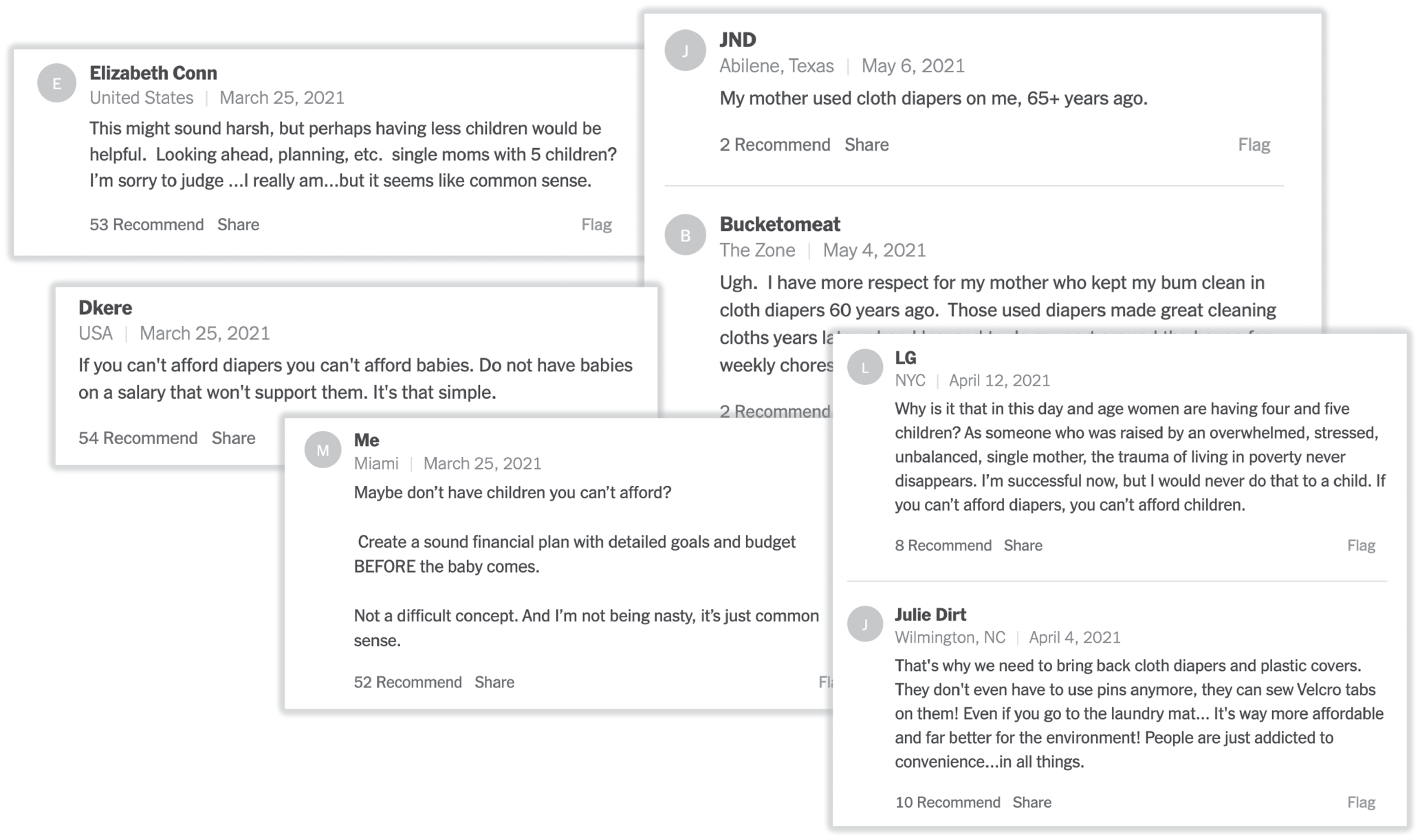
Recalling their own mothers’ experiences decades ago in a culture and economy that no longer exist, readers admonished these moms, some so poor they lived without food or housing, to use cloth diapers, hire diaper services, and learn about home economics. Times commenters condescendingly condemned the childbearing choices and financial acumen of mothers who were, in fact, managing to raise children on incomes of less than $10,000 a year. To women who were ignoring their own growling stomachs and foregoing much-needed medications, they pronounced that “sacrifices need to be made.”
Certainly, some readers called out the “just use cloth” commenters. “The problem is not people having children they can’t afford, but a society where children are not affordable,” rebutted one, while another employed an apt turn of phrase: “The privilege leaking from many of the comments here is disgusting.” Capturing the tension in the comments, one pointed out that the fact that “use cloth diapers” was the most recommended comment on the article “speaks volumes about class issues in this country.” Reminiscent of “welfare queen” controlling images described by sociologist Patricia Hill Collins, these responses pointed to classist and racist assumptions about who is and isn’t “deserving” of motherhood and childbearing.
“Just use cloth” is not just dismissive of mothers’ diaper despair; it signals a profound “class blindness.”
Ultimately, the derisive condescension in the Times comments points to what one of us (Sherman) has termed “class blindness:” biases related to unacknowledged class privilege that undermine efforts to recognize, understand, and effectively address social problems born of combinations of class, race, and gender inequities. In other words, the economically privileged tend to be unaware of their own class advantages, to rationalize their social positions, and to deflect responsibility for inequality and public issues like diaper need that, contrary to popular opinion, don’t have easy solutions. “You can just use cloth” is not just dismissive of mothers’ diaper despair; it signals a profound lack of understanding about the structural conditions that create diaper need and the class-based constraints that stratify access to diapering options.
Why they can’t just use cloth
To be clear, many of the mothers Randles interviewed did use cloth. At least they tried. They did cloth diapering for a while, only to discover that it is often more expensive than disposables by the time you add up initial costs, bus fare or gas money to get to the laundromat, and the $5 or more it typically costs to wash and dry a full load when you can’t afford an in-home washer and dryer (or for that matter, if you can’t afford housing). Leslie, a Black mother of one, figured, “That’s probably why programs don’t cover diapers, because they think cloth are free. But then you have to spend on washing, detergent, water, electricity, and all the work and worry. You still have to pay for it in some way.” Disposable diapering is not always a matter of convenience; it can be a calculated and rational choice.
Cloth diapering, a purportedly cheaper alternative to disposables, assumes and requires multiple forms of social class privilege. Expensive start-up prices for the diapers, money for cleaning equipment, greater housing costs for units that come with washer and dryer hook-ups, higher water and electricity bills, and physical space needed to store, wash, and ventilate cloth diapers require economic resources that poor parents simply don’t have. Beyond this, the class privileges of diapering take the shape of social, cultural, and moral capital. Using cloth diapers requires social support—both knowing how to do it efficiently and having social networks willing and available to help in the effort. It can also be a barrier to childcare, as nearly all daycares in the United States require the use of disposables before children can enroll and get dropped off each day. Only about 5% of U.S. parents now use cloth as their primary diapering method; the practice fell out of favor during the past half century as most mothers of very young children entered the paid labor force, family supportive workplace policies failed to keep pace, and disposable diapers became a way to manage the messier aspects of the second shift and low-paid childcare. Audra, a White mother of five, described using cloth diapers as a “a disaster, not easy, especially when you’re working, worried about how you’re going to get the next meal for your kids, put gas in the car, get to work, get the kids to school…. No, I’ll continue with the usual ones.”
Diapering norms have also changed significantly because of marketing; major diaper companies have positioned disposables as the cleaner and more comfortable choice that better parents make. Mothers in poverty, especially mothers of color, are understandably reluctant to use a type of diaper that might be perceived as inferior or otherwise deviating from current diapering norms. Like Audra, many mothers used the language of usual, normal, regular, and real to describe disposable diapers. Natalie, a multiracial mother of three, said of why she avoided cloth, “When we’re in public and he goes number two, I get so worried that other people think my son doesn’t have a real diaper on. They’d likely say, ‘That lady didn’t put a diaper on her kid. What’s wrong with her?’”
One mother said, “They used to say it takes a village to raise a child. Now that means it takes a village to fund a child, like paying for diapers. I work, go to school. …Even when parents have jobs, on minimum wage, you work hard, and with taxes you still don’t make enough for diapers.”
Courtesy Letta Page
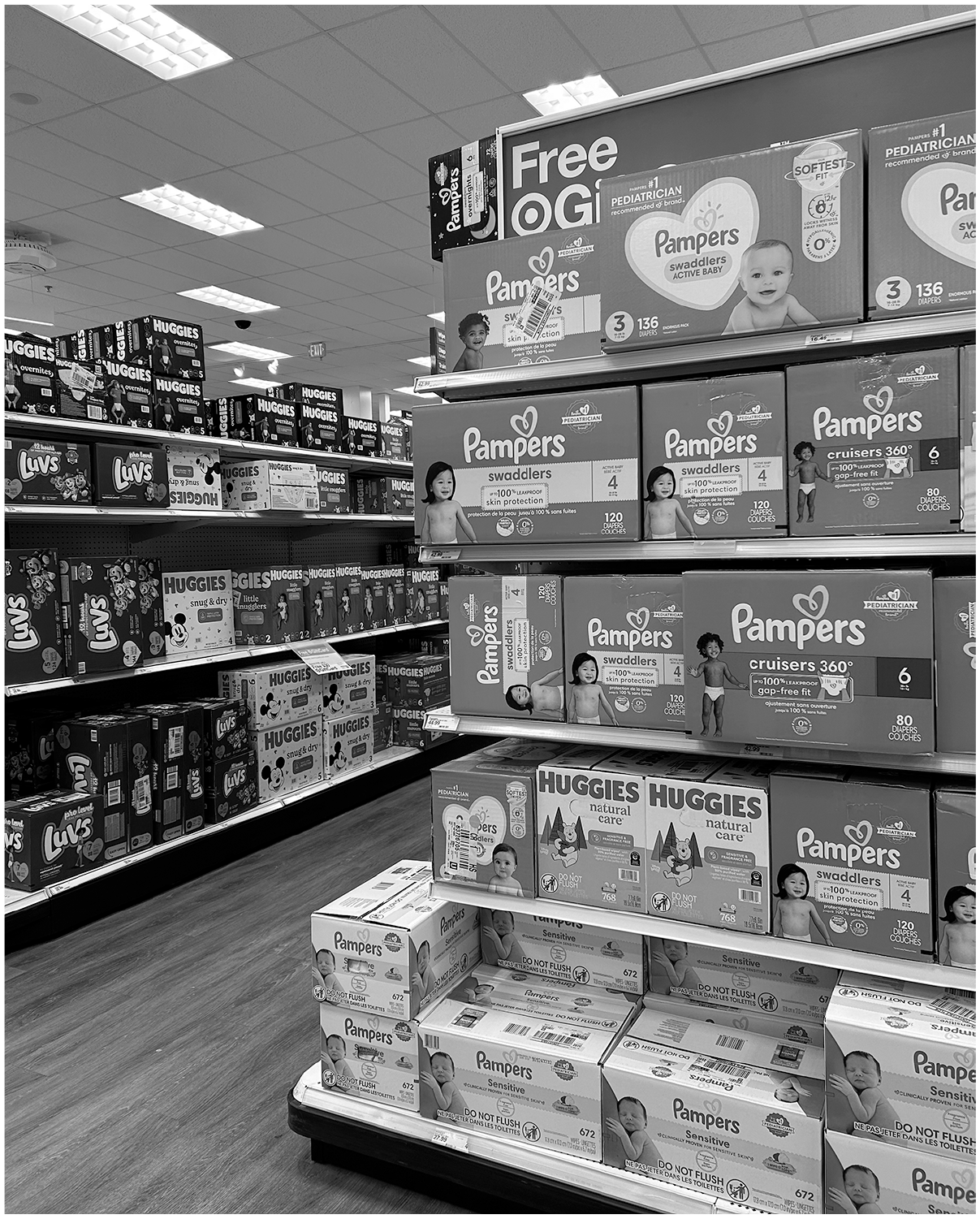
Commenters on The New York Times article are unlikely to have lived with this daily fear of being judged an unfit mother because they don’t use the “right” kind of diaper, the kind that nearly every other parent in the United States now uses. Class blindness obscures how racial and economic privileges enable different diapering choices, especially if one is White, middle-class, and more likely to be given the benefit of the doubt about a cloth diaper potentially perceived as too full, leaky, stained, or smelly. Not all mothers are afforded that same privilege.
Disposable diapers have become ubiquitous and normative in our society. So too are the heavy surveillance and punitive policing of the parenting choices of poor mothers of color. Is it any wonder then that parents like Aisha, a Black mother of one, feared using cloth diapers perceived “as rags” could cause others to question her parental fitness and put her at risk for losing her daughter to the child welfare system? Cloth diapers are neither a cheaper nor safer alternative to disposables in an ostensibly “color-blind” society where the conditions of racialized poverty are often defined as “neglect.” Moms struggling with diaper need already know how to create make-shift diapers out of almost any household paper or cloth item imaginable—toilet paper, pillowcases, dish rags, t-shirts, paper towels, menstrual pads. The public just doesn’t see it. These mothers save their disposables for childcare and public outings when they know that their parenting choices will be on display and open to scrutiny.
Unspoken gender norms also infuse comments about cloth diapers, given the additional childcare and household labor that still falls mostly on the shoulders of mothers. Put differently, the suggestion that cloth diapering is somehow free or cheaper only makes sense if one assumes that women’s time and work have no value. According to a survey by Change-diapers.org, those most likely to use cloth diapers are married, middle-class, home-owning families that include a full-time, stay-at-home parent. Growing inequality, wages that have not kept pace with inflation, and rising costs of living have made it nearly impossible now for most parents, including mothers of very young children, to stay at home full-time. Because family policies in the United States fail to offer universal paid leave to care for new children and do not mandate that employers offer family supportive accommodations, many mothers are back to work mere weeks after giving birth, while others cannot afford to work due to the prohibitively high cost of childcare. Some also receive welfare cash aid that barely covers the cost of other basic needs, much less diapers. Mothers compelled to work for pay when their children are very young are more likely to rely on childcare facilities and social networks of care that prefer or require disposables. These conditions force mothers into a perpetual bind when it comes to work, welfare, and diapers.
Alexis, an Asian mother of two, noted, “They used to say it takes a village to raise a child. Now that means it takes a village to fund a child, like paying for diapers. I work, go to school. [My husband] works…. Even when parents have jobs, on minimum wage, you work hard, and with taxes you still you don’t make enough for diapers.” Times commenters asked why mothers had kids they could not afford. Mothers like Alexis struggling with diaper need asked why we have created a society in which raising kids is unaffordable.
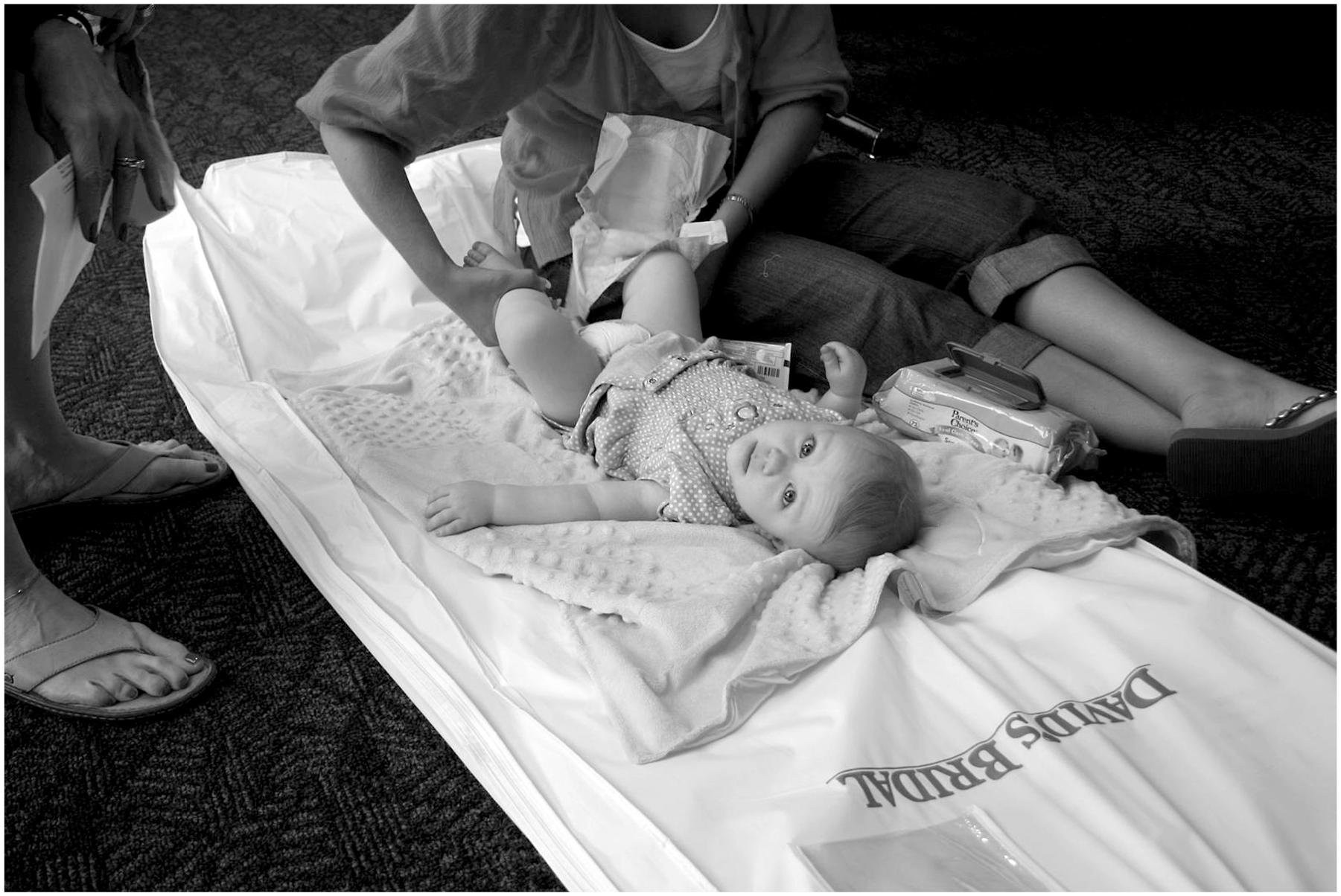
Parents understand the scrutiny that comes with public diaper changes, like this airport clean-up.
Shane Adams, Flickr CC
Failure to recognize class, race, and gender privileges embedded in “choices” to use cloth diapers has severe consequences. It allows diaper need to be dismissed as a personal problem caused by the individual decisions, ignorance, and laziness of those experiencing it, rather than the economic exploitation, racism, and patriarchy that create it. When simple individual choices seem like easy solutions to large-scale structural problems, there is no sense that problems like diaper need are actual needs that deserve policy redress through social solutions that increase diaper affordability and accessibility.
When class blindness obscures the potential for collective action, we are left with a public health crisis with no public policy solution.
What class blindness overlooks and obscures
Sherman’s recent ethnographic work on a community with deep social-class and urban-rural divisions uncovered the phenomenon of class blindness, which captures how privileged individuals often fail to grasp their own advantages and impacts on those with less and refuse to take responsibility for the resultant social inequality. Sherman further uncovered how class blindness often operates in subtle, insidious ways; professed concern for social problems like poverty and inequality exists alongside scorn, judgment, and blame for individuals who actually experience those problems.
As reflected in comments on The New York Times article, class blindness also manifests as apparent alarm about social problems like diaper need that stigmatize and criticize impacted individuals. Asking “Why don’t they just use cloth?” dismisses diaper need as the result of individual failures—having too many kids, being ignorant when it comes to family planning, or being too lazy to do the work of cleaning re-useable diapers—thereby rationalizing social failures to devise systemic solutions and policy interventions. Although they profit from a social system that inequitably distributes resources for the benefit of some and the disadvantage of others, those with class, race, and gender privileges frequently grapple with poverty only as an abstract concept rather than a lived and embodied experience.
Policy impacts of poverty in the abstract
Understanding class blindness helps to elucidate the common tendency to dismiss diaper need as an individual failure of promiscuous and profligate parenting. Even among the readership of The New York Times, which is, on the whole, highly educated and skews politically liberal, failure to recognize the varied material and symbolic resources that enable the “choice” for cloth diapers—time, housing, cultural acceptance, storage/disposal, knowledge, white privilege, and income/wealth—renders diaper need an individual dilemma.
Diaper need accompanies and exacerbates other forms of material deprivation, including food insecurity and housing instability, and puts mothers at greater risk for depression and anxiety. Children whose diapers are changed infrequently are more likely to suffer from numerous pediatric dermatological and urinary problems, including diaper dermatitis (“diaper rash”) and urinary tract and yeast infections. When class blindness obscures the potential for collective action, we are left with a public health crisis without a public policy solution.
As one of us (Randles) discussed in Contexts back in 2017, we have seen this play out in the policy inertia surrounding diapers. Diapers are not systematically covered by existing social safety net programs, including WIC, the Supplemental Nutrition Assistance Program for Women, Infants, and Children. Welfare cash aid (TANF) can be used to pay for diapers, but benefit levels are now so low that, in most states, the average monthly diaper bill of $75 would use up 8-40% of the average monthly cash aid benefit for a family of three. Federal bills proposing public diaper assistance have struggled to garner sufficient support in Congress. In fact, there is a growing political tendency to deflect public responsibility for providing basic needs like diapers, which are still taxed in most states as a discretionary paper product. When class blindness obscures the privileges embedded in the decision to choose cloth as one among many available diaper options, disposables do indeed seem optional. This is the same logic that has ideologically justified many disastrous policy changes in recent decades that have directly contributed to higher rates of deep poverty, especially for young children of color, including shrinking cash aid benefit levels and time limits and work requirements for multiple forms of aid.
Class blindness also influences who gets elected, the priorities of the constituents they represent, and the policies that directly create or ameliorate inequality. The voter who asks “Why don’t they just use cloth?” and believes that poor women are simply too lazy to do the work of cloth diapering will tend to vote for those candidates who see no need to pass diaper assistance policies because they, too, are ignorant of the real needs going unmet. The voter who recognizes structural inequalities is more likely to support politicians who propose realistic and pragmatic solutions to this and similar social problems.
Broadening political conceptions of need and safety nets to account for diapers and similar items necessary for health, bodily care, and dignity, such as menstrual supplies and toilet paper, demand that we understand experiences that lie beyond our own limited perspectives and particular social positions. This requires the ability to perceive how class, race, and gender inequities shape choices that people are able to make—and to grasp that they will be judged, even punished, for those choices.
There are many social issues that fall into this gap. The privileged tend to offer seemingly simple solutions for large-scale problems that fall far short of giving vulnerable families unrestricted money to buy basics based on their own assessments of their children’s needs. But different personal behaviors and choices don’t erase fundamental disparities rooted in discriminatory and deficient social systems and longstanding structural inequalities. Fixing the underlying structures of a society is a large task that can start small, including with recognizing how and why a piece of cloth won’t fix poor mothers’ diaper dilemmas.