



Abstract
jennifer randles on diaper need, a truly shitty situation.
Just before he left office, Barack Obama proposed a $10 million federal initiative to test potential projects aimed at increasing low-income families’ access to diapers. The funding was never administered. States have tried, too: in September 2016, by a vote of 54-12, the California Assembly passed the first state-level diaper assistance bill. It would have provided $50 monthly diaper vouchers to cover the 120,000 children receiving state welfare aid, but the governor, Jerry Brown, vetoed it, citing the bill’s $120 million price tag. He subsequently vetoed another bill, one that would have eliminated state sales taxes on diapers, which the California Assembly had deemed “medically necessary” and therefore qualified for a tax exemption.
One in three U.S. mothers experiences diaper need, which, for kids, can lead to infections, rashes, irritability, and trouble securing childcare. For parents, it creates stress, guilt, anxiety, and problems at work.
The problem these bills aimed to remedy, diaper need, is a common and often hidden consequence of American poverty. One in three mothers in the U.S. experience diaper need—the lack of sufficient diapers to keep an infant dry, comfortable, and healthy—and 45% of infants and toddlers under the age of three live in low-income families whose budgets are impossibly tight. All together, diaper need affects over five million U.S. children, and disproportionately those who are Black and Latinx, those from immigrant families, and those whose parents lack a high school diploma or experience unemployment.
Diaper need can lead to several problems for children, including infections and rashes, irritability, and trouble securing childcare. Severe cases of diaper dermatitis (“diaper rash”) can require emergency room visits and hospitalization. For parents, diaper need creates stress, guilt, and anxiety. Diaper need can also interfere with children’s educational opportunities and parents’ abilities to work, as most childcare centers require parents to bring at least a week’s worth of diapers at a time. If they cannot fully provide diapers, alongside other needs including milk and medicine, parents are left feeling inadequate. As one mother studied by psychologist C. Cybele Raver and colleagues explained, “It’s the same thing as not being able to put food in their mouth. It’s more of a need than a want.” Yet diapers are still not conceptualized as a need in U.S. social policy.
Diaper Gaps
The average cost of disposable diapers is $18 a week or $936 annually per child. This is over 6% of a year-round, full-time federal minimum wage salary ($15,080). Though existing federal and state policies do not cover all eligible families, there are currently public programs to address every other essential need young children have, including food, housing, healthcare, and education. But diapers are not an “allowable expense” for Women, Infant, Children (WIC) or the Supplemental Nutrition Assistance Program (SNAP). California’s food stamp program categorizes diapers as “invalid purchases” alongside cigarettes and alcohol. Parents can use Temporary Assistance for Needy Families (TANF) or welfare cash aid for this expense, but if they do, the benefits do not usually stretch enough to cover other basic needs. In 2016, the average monthly TANF benefit for a single-parent family of three ranged from $170 in Mississippi to $923 in Alaska. The average monthly diaper bill would use up between 8 and over 40% percent of a family’s cash aid check—and only one in four U.S. families in poverty receives any TANF benefits at all. Early Head Start programs provide diapers and formula, but here, too, only a fraction of low-income children are enrolled, and the program does not offer diapers for evenings and weekends.
Cloth diapers are not a viable alternative for most low-income families because they cannot afford in-home washers and dryers (assuming they have homes), it is illegal to wash reusable diapers in most public laundry facilities, and daycare centers require disposables. This leaves many parents struggling to devise “diaper stretching” strategies, including: borrowing from friends and family, creating makeshift diapers from plastic bags and paper towels, reusing diapers by hanging wet ones to dry or scraping feces from dirty diapers, or toilet training children much earlier than recommended. Poor parents also lack access to diaper cost-cutting strategies that more affluent parents take for granted, such as subscription services and bulk purchasing. Diapers can cost up to twice as much at the local markets and drug stores that are closer to where low-income parents live, and parents in poverty rarely have access to transportation to get to big box stores or the space needed to store diapers even if they could purchase in bulk. All this means that poor parents often end up spending more on diapers than higher-income families.
Manufacturer Huggies has teamed up with the NDBN for the “No Child Unhugged” information campaign on diaper need.
Huggies International and the National Diaper Bank Network
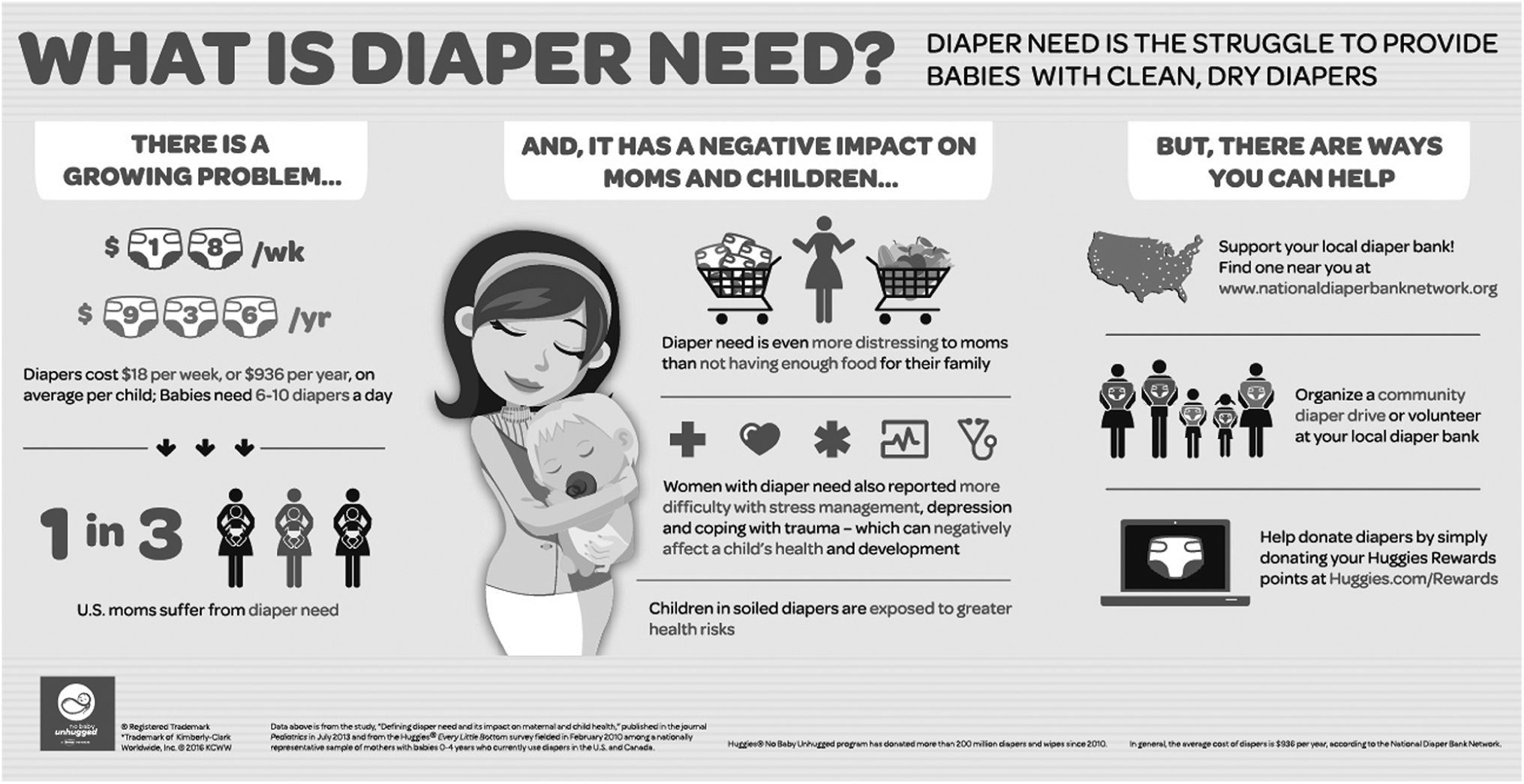
Diaper need is a huge need, and it has negative health, social, and economic consequences for low-income families. So why are policymakers willing to ignore this issue? They seem willing to assume that, contrary to readily available data, all parents can make childbearing and diapering choices unconstrained by economic need.
Needs, Wants, and Public Policy
In addition to the efforts noted earlier, in November 2015, federal lawmakers introduced the “Hygiene Assistance for Families of Infants and Toddlers Act.” If passed, the law would have funded state-based pilot programs to test innovative approaches to providing diapers or diaper vouchers, such as integrating diaper distribution programs with other need-based government services. The bill would have amended the federal Social Security Act to recognize that “Access to a reliable supply of clean diapers is a medical necessity for the health and welfare of infants and toddlers, their families, and child care and health care providers.” The bill explicitly acknowledged that diapers are necessary for children’s access to safe, quality childcare and parents’ abilities to work and fully care for their children. It further recognized that parents need diapers in order to comply with the requirements of other means-tested programs. For example, parents need to supply diapers to childcare providers so that they can work in order to meet the requirements of receiving TANF cash aid. The Hygiene Act bill never got past the Subcommittee on Human Resources.
Some services and resources get framed as “needs” while others are conceptualized as “wants,” unworthy of a policy remedy.
What about the California diaper bill that Governor Brown vetoed last year? California Assemblyperson Lorena Gonzalez Fletcher’s persistence paid off. She reintroduced a revised bill that passed both the State Assembly and Senate by a wide margin in October 2017. Brown immediately signed the bill, AB480: Diaper Assistance for CalWORKS Families, which will provide a $30 monthly diaper voucher for the state’s welfare-to-work program participants. As the country’s first state-wide public diaper program, it will go into effect April 2018 and perhaps be a model for other states considering diaper legislation. Not all families who experience diaper need will be eligible for the vouchers, nor will it cover eligible families’ full needs, but it is a start.
Families across the country are also able to reach out for help from non-profit diaper banks, which work much like food banks and often partner with family agencies. Founded in 2011, the National Diaper Bank Network (NDBN) consists of over 300 diaper banks and is the largest national organization advocating on behalf of policy solutions for diaper need. The NDBN has contracted with national diaper manufacturers to allow community organizations to purchase their products for distribution at a substantial discount. Though non-profit and market-based solutions—such as founding diaper banks and creating more efficient packaging and diapers without licensed cartoons that drive up production expenses—have significantly reduced the costs of diapers, community organizations still struggle to meet families’ full needs.
Together, diaper need and the policy vacuum surrounding it represent a distinct cultural and economic problem. It is also an important case in how some services and resources get framed as “needs” while others are conceptualized as “wants,” unworthy of a policy remedy. The notion that diaper need is not worthy of political intervention rests on the assumptions that disposable diapers are a luxury and that poor parents can simply choose reusable options that presumably cost less, last longer, and have a smaller environmental impact. Many policymakers have ignored this issue because they erroneously assume that disadvantaged parents make choices about diapering within middle-class circumstances—or that they should have never chosen to have children at all. Some lawmakers object to diaper legislation because they believe it supports low-income parents’ choices to have children they cannot afford. This critique echoes racist and classist “welfare queen” stereotypes and exhortations that people in poverty should simply choose not to have babies. This misguided political culture of choice harms poor families by discounting how access to an array of diapering options is a form of privilege and how access to any diapers at all is, in fact, a crucial family need.