



Abstract
This article traces the “shadow geographies” of the 1980s gay bar scene in Ohio’s capital, Columbus, and contrasts it with the emergence of LGBTQ movements in Midwestern small towns. Urban gay bar scenes have declined since at least 2009, and the COVID-19 pandemic has only hastened their demise. At the same time, pride events have emerged in the communities like Parkersburg, West Virginia; Washington, Pennsylvania; Marysville, Ohio, and; and many other cities and towns with populations under 50,000 people. The decline of urban gay bars does not mean the demise of LGBTQ activism; it just means that we should look for activism outside of urban centers.
Across the Midwest and South, sociologists are part of an effort to document the queer histories of their regions. As part of my current research project, “Small Town Pride,” I am interviewing advocates for LGBTQ rights in small, midwestern towns. These small-town residents organize pride festivals, advise high school Gay-Straight Alliances, start support groups for transgender youth and families, welcome LGBTQ parishioners in churches, and pass local non-discrimination ordinances. Their work is transforming the everyday practices of institutions that anchor their communities, including families, churches, schools, and city hall.
LGBTQ people have always lived in small towns and rural communities, but with increasing social acceptance and legal rights comes increasingly visible public action. Diversification of gender identities and sexual orientations combined with increasing social acceptance and legal rights is mirrored in spatial diversification. These social changes are part of what makes research on small-town LGBTQ organizing possible. In the past few years, pride events have emerged in Parkersburg, West Virginia; Washington, Pennsylvania; Marysville, Ohio; and many other small cities and towns with populations under 50,000 people.
One day as I sifted through the digital archives of the Gay Ohio History Initiative (GOHI) to find out when the first pride parade happened in Ohio, I came across a program from the 2nd annual “Gay Parade” in 1983. Inside the program cover is an advertisement for a bar called The Garage that reads, “After the gayparade…continue the celebration of gay pride with us—we’ll refresh you with some eats and your favorite legal beverages. We’ll be going full tilt with hot music & cold beer & a great time for everyone !!!!” On the next page, organizers ask parade-goers to “please patronize our gay supportive bars and restaurants” (including The Garage). As I read the names and locations of these bars, I wondered how long they survived. It only took a beat for me to wonder how many people who attended the 1983 Gay Parade also survived, a thought marked by both the passage of time and the early years of the AIDS epidemic.
Armed with a 38-year-old “map,” I headed to downtown Columbus, Ohio, to discover what became of these “gay supportive” places. Not being very familiar with this downtown section, I was surprised at how densely clustered the bars were. It only took approximately 30 minutes to walk between most of the places on the list—almost all of which were blank facades. It was what I imagined an archaeological find must be like: discovering a whole gay scene hidden under layers of time. These sites share a visible absence that bears silent witness to the past; these are the shadow geographies of gay history. I was struck at just how blank and anonymous these former haunts remain, like the fading “ghost signs” one sees on the sides of old buildings. On the surface, this represents an erasure of the past. But the anonymity, blank facades, and block glass windows are also monuments to the early 1980s when gay bars were places of refuge hidden in plain sight; their survival required invisibility.
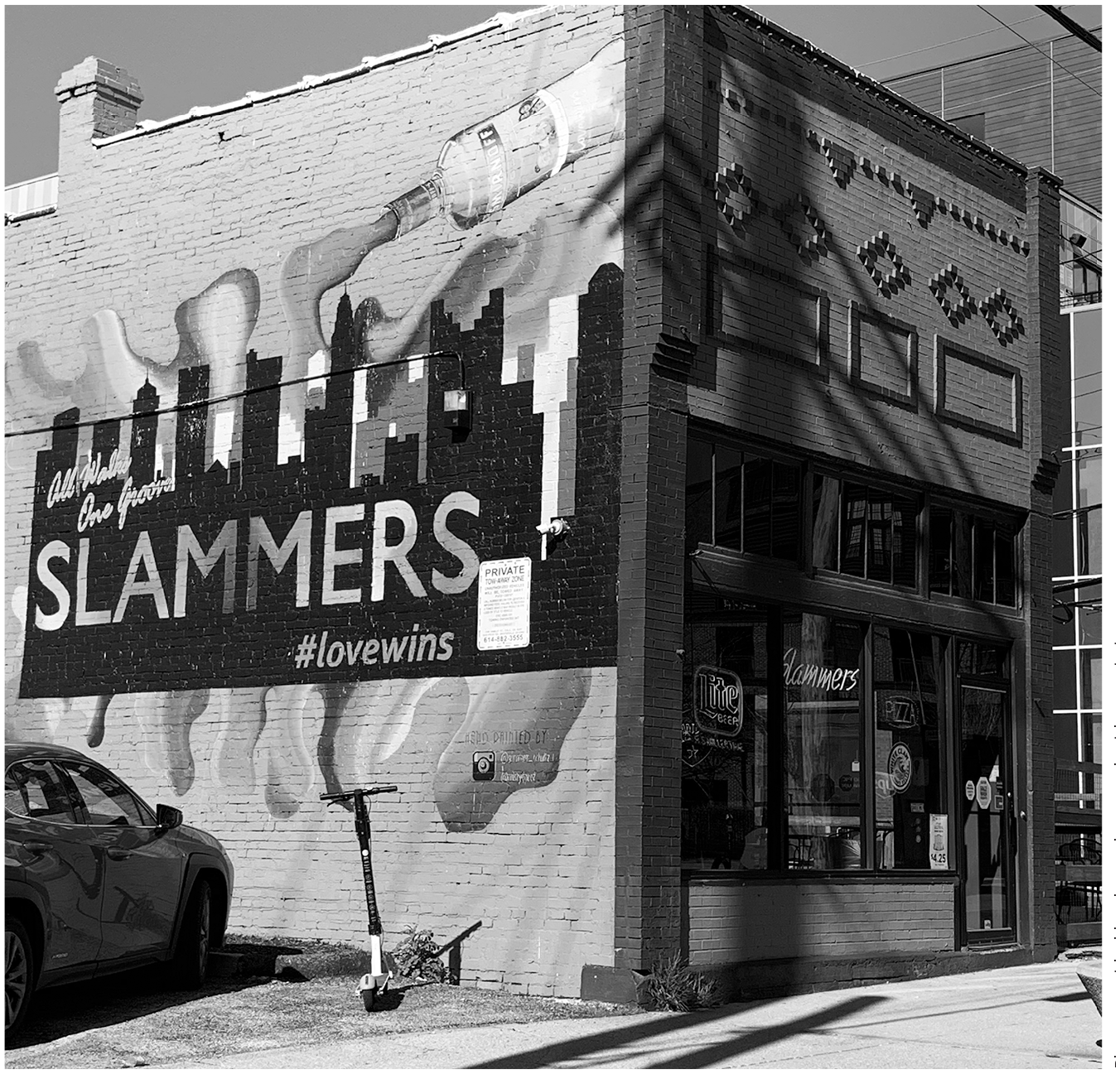
Gay bar scenes have declined since 2009, and the COVID-19 pandemic has only hastened their demise. The Lesbian Bar Project counts only 21 lesbian bars left in the United States and launched a fundraising campaign last year to help mitigate the financial effects of the COVID-19 pandemic. The Columbus Iesbian bar Slammers, dubbed “the last lesbian bar standing” by the local press, was the last stop of my brief tour and the only bar left in the 1980s downtown zone (Figure 1). It was a fitting place to reflect on what I had just observed. From where I sat with my notebook, I overheard wide-ranging conversations about everything from the status of a new same-gender relationship to the introduction of anti-transgender bills that had been recently introduced in the Ohio House of Representatives. This brief observation perfectly encapsulates how gay and lesbian bars still serve not only as social spaces but also networked political spaces—what I have conceptualized elsewhere as “social movement scenes.”
Increasingly, LGBTQ people in small communities can find queer supportive spaces right in their own backyards, even if those spaces are not strictly gay bars.
Slammers bar in downtown Columbus, Ohio is one of the last places in what used to be a thriving downtown gay bar scene. Dubbed “the last lesbian bar standing” by the local press, Slammers is one of only 15 lesbian bars in the United States, according to The Lesbian Bar Project.
Photo provided by the author, used with permission
According to a 2021 report by The WIlliams Institute, Columbus, Ohio ranks 25th in a list of American metro areas with the highest LGBTQ population by percentage (4.4%). Though the downtown bar scene is now a ghost town, LGBTQ life is visible in pockets to the north and south of downtown Columbus. The Short North arts district is where rainbow flags decorate local businesses, and drag queen Nina West boasts a street named in her honor. The Short North is synonymous with “gayborhood” in Columbus, but my initial interviews indicate that some young LGBTQ couples perceive the Short North as only for the affluent; they perceive social class differences as more salient than shared sexual orientation.
Increasingly, though, LGBTQ people in small communities can find queer supportive spaces right in their own backyards, even if those spaces are not strictly gay bars. Standing outside 232 N. Third Street in downtown Columbus, I remembered a night in the late 1990s when it was a gay bar called The Eagle. I was in my early 20s and lived in a small town an hour away; in my hometown, being gay, lesbian, or bisexual—I had never met a trans-gender person at that point—was either totally secret or an open secret, known but never acknowledged. A night out in “the big city” was Big Fun, an opportunity to openly acknowledge one’s queerness.
My own experience presents a contrast with those of the people I have interviewed for my project “Small Town Pride.” For example, I interviewed a 46-year-old gay man I will call “Billy” who lives in Portsmouth, Ohio, right at the state’s southern tip. Billy describes a local bar and restaurant: “they fly a rainbow flag and trans flag in their windows, and they have been willing to host drag shows. They have been right there for us consistently.” Billy’s comment that the bar owners have been “right there for us” indicates just how much their support means to him and other members of his group. Dana, a 41-year-old queer-identified woman, made similar comments about local businesses in her town. She says, “I really think that businesses who support us take a big risk to hang [rainbow] flags and put their name on the back of our pride t-shirts. […] It was very brave of them to do that because of just how conservative it is in our town.” Dana highlights that supporting LGBTQ people in small, conservative communities is socially and financially risky. This creates a sense of loyalty among patrons, making my project’s small-town residents more likely to support local businesses rather than travel to gay bars in urban centers.
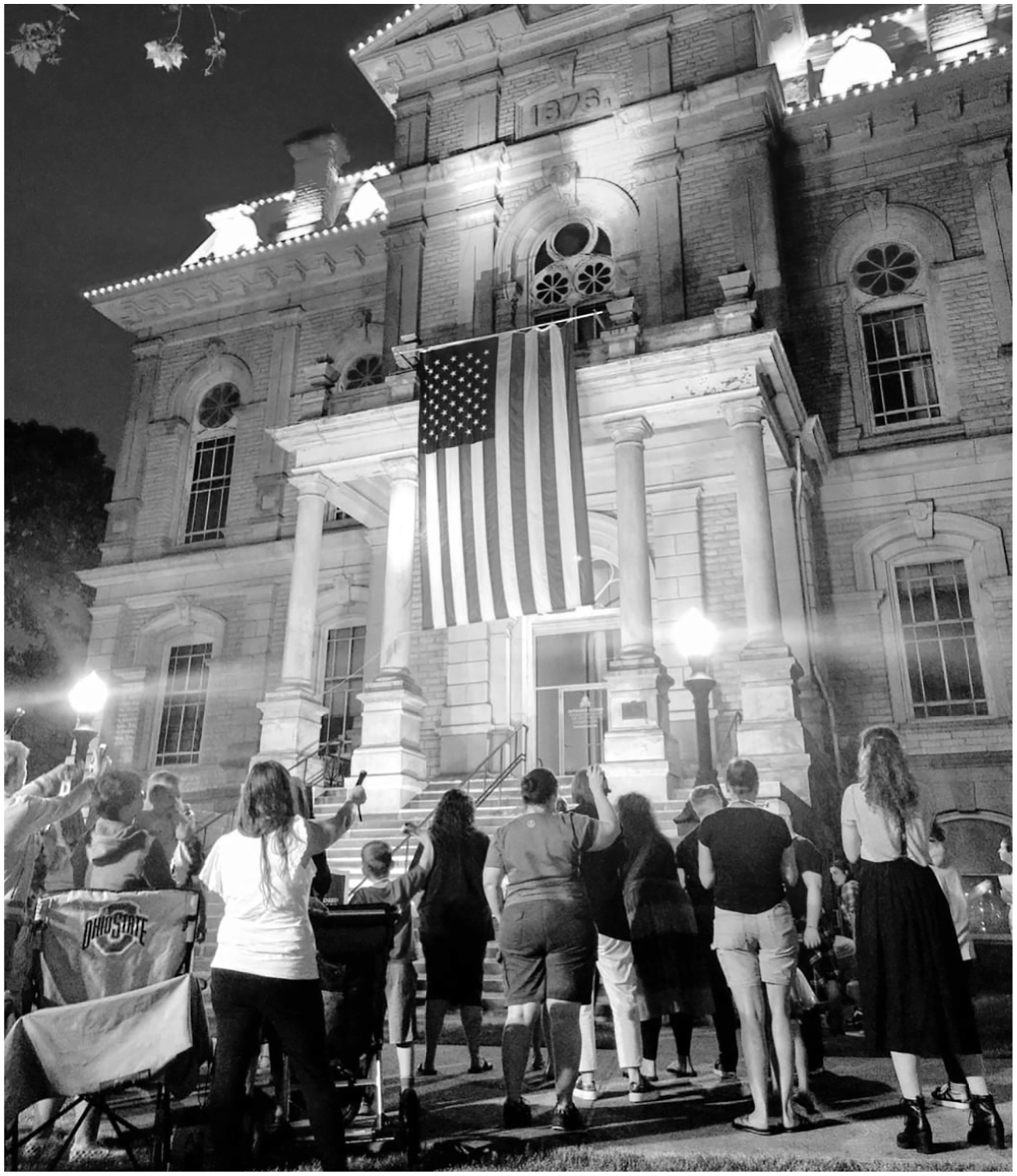
The shadow geography of 1980s gay bars in downtown Columbus made me reflect on how visible LGBTQ pride celebrations have become in small Ohio towns. So far, my interviews and observations are that a handful (or fewer) of protesters show up, but the joyous spirit of pride events diminishes their presence. Dylan, a young bisexual man who organized a pride parade in his town of 1800 people, says, “My friend said ‘why a parade? Can’t we do a picnic or something? [This town] isn’t ready for a parade.’ But I wanted to break the ice, not chip away at it. […] There were only two protesters, and their signs looked like they made them last minute.” In Findlay, Ohio, people painted murals in three locations to celebrate pride, including a large rainbow-colored map of the state painted on a major intersection—which was later vandalized but did not deter the group. In 2018, Newark, Ohio, made headlines when county commissioners denied a Newark Ohio Pride Coalition (NOPC) request to light the courthouse in rainbow colors during the group’s first pride event. The commissioners decided that lighting the courthouse in rainbow colors would signal support for a political cause and denied the request. In response, local residents held a rally at the courthouse in a spirit of both defiance and celebration (Figure 2). A local art professor passed out gel coverings that transformed handheld flashlight beams into a kaleidoscope of color, giving rise to cheers as people lit the courthouse in rainbow colors themselves. Could the Gay Parade marchers in 1983 have ever imagined such a sight?
Residents of Newark, Ohio light the courthouse with rainbow colored flashlights in 2019 in the spirit of celebration and resistance. City council decided that lighting the courthouse in rainbow colors would signal support for a political cause and denied organizers’ requests.
Photo by Dorian Rhea Debussy, used with permission
The ghosts of the Gay Parade remain hidden in plain sight, only visible to those who know they are there. But there is also hope brewing in the small cities and towns of the heartland. Organizers and advocates in small, conservative communities take social, financial, and personal risks to fight for equality in their families, churches, schools, and city governments. This means that LGBTQ people in small communities increasingly find support in their backyards without traveling to urban centers. The decline of urban gay bars, hastened by the onset of the COVID-19 pandemic, is indeed something to mourn. Yet we should not perceive this as an indicator that queer activism is dead, only that we should look for it in less obvious places.