




Abstract
Widespread alarm over gay bar closures in the United States has occurred in a vacuum of data. This visualization depicts changes in gay bar listings from the only national guidebook of LGBT places, published annually between 1964 and 2017 and again (and finally) in 2019. Trends in gay bar listings support perceptions of recent gay bar decline. They showed their largest five-year decline between 2012 and 2017, losing 18.6 percent. An additional 14.4 percent of bar listings disappeared in from 2017 to 2019. The listings at greatest risk receive little attention: Between 2007 and 2019, when all bar listings declined by 36.6 percent, lesbian bar listings shed 51.6 percent, cruisy men’s bar listings declined by 59.3 percent, and listings for bars serving people of color declined by 59.3 percent. The largest change in bar types, those serving gay men and women together, became the largest single category between 1997 and 2017. Caution must be exercised, however, in inferring rates of bar closure from bar listings.
These data are from an original database (N = 13,963) of gay bar listings created from the Damron Guide (see the appendix). This is the only national travel guidebook of LGBT places, which was published annually between 1964 and 2017 and again in 2019, making it an unparalleled and formidable national record of LGBT placemaking in the United States.
Trends in gay bar listings support recent popular perceptions of gay bar decline (e.g., Thomas 2011):
The table displays data at five-year intervals for the period from 1977 to 2017 and includes listings from the most recent, and perhaps final, 2019 guidebook. Change in total listings is disaggregated by bar patronage: cruisy/leather bars serving men involved in BDSM, sex work, or sex on the premises; lesbian bars; bars serving primarily people of color; bars with mixed-gender socializing; and gay bars for mostly or only men. Consistent with popular perceptions, gay bar listings show their largest five-year percentage decline in the period from 2012 to 2017, losing 18.6 percent. This trend appears to have accelerated between 2017 and 2019, when the guide shed fully 14.4 percent of listings in a two-year period.
There were always far fewer lesbian bars (e.g., Wolfe 1992), consistent with longtime differences between gay male and lesbian placemaking (e.g., Brown-Saracino 2018). Listings show substantial recent decline, albeit from much smaller numbers. Between 2007 and 2019, lesbian bar listings shed 51.6 percent. Losing even one lesbian bar when the 2019 listings suggest only 15 in the entire country represents substantial loss, particularly if it is the only one serving a large region. Caution must be exercised in interpreting the number of lesbian bars before 1990, however, before which the company was run by and for men.
The time period from 1987 to 1992 marked a dramatic increase in the number of listings that indicated women and gay men were socializing together (the codes do not specify whether the women were lesbians), indicated in Figure 1 as “Mixed M/F.” These listings more than doubled between 1987 and 1992; from 1997 onward, they were the most common type of gay bar. The rise of gay bar listings describing bars patronized by both men and women represents the largest change in market mix among gay bar types during any time period observed, is a trend that has attracted little attention, and coincided with the largest decline of lesbian bar listings, from 1987 to 1992.
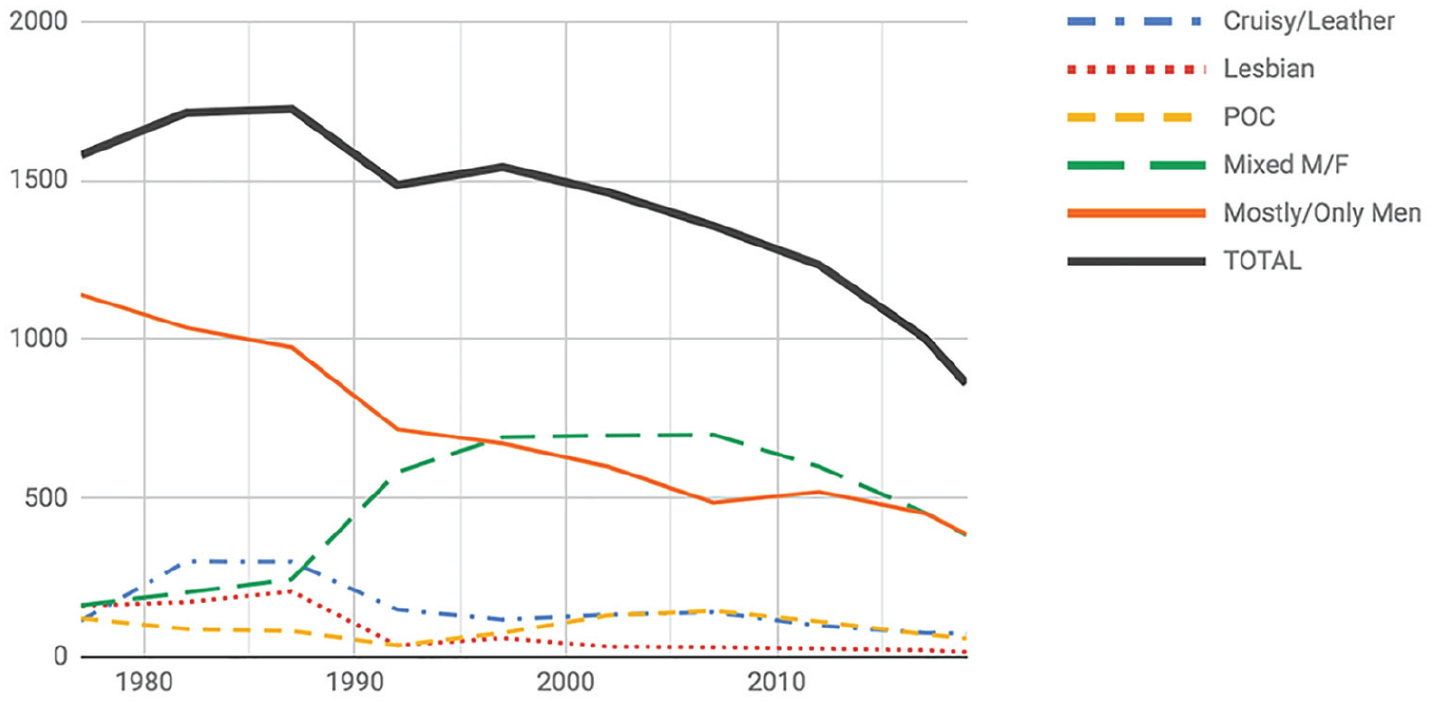
Gay bar listings in Damron guides at five-year intervals, 1977–2017 and 2019.
There has been little public discussion about the gay bars most at risk of closure: those serving women, those serving people of color, and cruisy men’s bars. While all gay bar listings declined by 36.6 percent between 2007 and 2019, the number of listings for bars serving people of color declined by 59.3 percent, cruisy men’s bar listings declined by 47.5 percent, and bars for women declined by 51.6 percent. Discussions of gay bar closures should pay attention to those LGBT communities at greatest risk of losing their places.
Caution must be exercised when inferring change in gay bars and lesbian bars from business listings. The quality and quantity of the guidebooks’ informants may have peaked with the popularity of physical guidebooks and declined with the recent rise of online sources. Guidebook codes changed over time and thus may not describe the same phenomena, nor is it clear whether informants and readers interpreted the codes in the same way. Further research is necessary to assess the degree to which changes in gay bar listings reflect change in the number of physical gay bars, such as through longitudinal case studies of individual cities. If we infer a relationship between listings and establishments, however, these data suggest that there have been recent and dramatic changes in the number and types of gay bars, consistent with recent changes in gay neighborhoods (Ghaziani 2014; Mattson 2015).
Supplemental Material
Visualizing_appendix – Supplemental material for Are Gay Bars Closing? Using Business Listings to Infer Rates of Gay Bar Closure in the United States, 1977–2019
Supplemental material, Visualizing_appendix for Are Gay Bars Closing? Using Business Listings to Infer Rates of Gay Bar Closure in the United States, 1977–2019 by Greggor Mattson in Socius
Supplemental Material
Visualizing_table_for_appendix_1 – Supplemental material for Are Gay Bars Closing? Using Business Listings to Infer Rates of Gay Bar Closure in the United States, 1977–2019
Supplemental material, Visualizing_table_for_appendix_1 for Are Gay Bars Closing? Using Business Listings to Infer Rates of Gay Bar Closure in the United States, 1977–2019 by Greggor Mattson in Socius
Footnotes
Acknowledgements
The author thanks eagle-eyed research assistants Jack Spector-Bishop, Wren Fiocco, Will Jacobsen, Charlie Sherman, and Tory Sparks and is grateful for research funds from Oberlin College.

Supplemental Material
Supplemental material for this article is available online.
Author Biography
References
Supplementary Material
Please find the following supplemental material available below.
For Open Access articles published under a Creative Commons License, all supplemental material carries the same license as the article it is associated with.
For non-Open Access articles published, all supplemental material carries a non-exclusive license, and permission requests for re-use of supplemental material or any part of supplemental material shall be sent directly to the copyright owner as specified in the copyright notice associated with the article.
