




Abstract
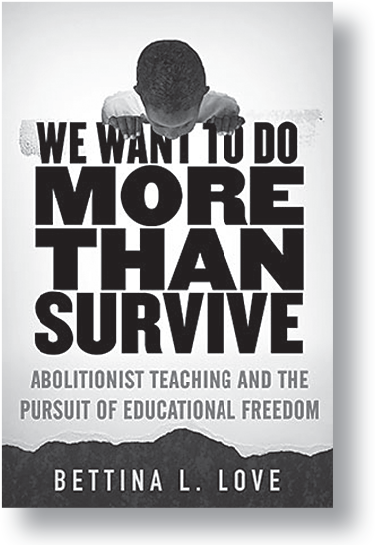
This book review explores We Want to Do More than Survive: Abolitionist Teaching and the Pursuit of Educational Freedom by Bettina L. Love, and highlights how withholding Black history forces students of color to merely aim for survival in a white-dominated education system.
Keywords
Growing up, I was an avid Kanye West fan—especially his Graduation album. In “Good Morning,” West raps “I’m like the fly Malcolm X, by any means necessary.” I remember hearing this line and having no idea who Malcolm X was, so I Googled him. A lot of information appeared on my screen about a Civil Rights Activist that I had never heard of prior to listening to this song. While Kanye has arguably devolved into a figure that is probably a less than ideal person to learn Black History from, he was my first introduction to the radical Black activist, Malcolm X.
The withholding of information forces students of color to merely aim for survival in the White-dominated education system—instead of what White kids are offered: to thrive.
My school history courses skimmed over the Civil War because my teacher felt it was a “boring, unimportant war.” As a result, I only learned about Black leaders who were assimilationist or whose narratives were watered down to the point that they were deemed acceptable by the White people in charge. Now, as a social scientist, I realize how detrimental the lack of Black history in my primary education was for me as a White person. However, the erasure of figures who were unapologetically Black is even more detrimental to Black students and other students of color, who do not get to learn about powerful figures that look like them. The withholding of information forces students of color to merely aim for survival in the White-dominated education system—instead of what White kids are offered: to thrive.
In We Want to Do More than Survive: Abolitionist Teaching and the Pursuit of Educational Freedom, Bettina L. Love critiques the current American public educational system. By arguing that the system employs racist and classist techniques to ensure the continued success of white upper-class students, she points out that this ultimately leaves low socioeconomic students of color striving for mere survival. Using her own life experiences as a youth of color growing up in a low socioeconomic status community, Love’s own teaching experiences, as well as her own research conducted in urban schools over the course of her academic career serve as the foundation for this discussion. Writing for educators and educational activists, Love expresses the need for schools to reassess what and who is most important. If it truly is the student, then the current system needs to be dismantled, and educators need to center the importance on “mental, physical, and spiritual health,” more than any test score, Love argues.
At the heart of We Want to Do More Than Survive is abolitionist teaching. Love defines abolitionist teaching as “the practice of working in solidarity with communities of color while drawing on the imagination, creativity, refusal, (re) membering, visionary thinking, healing, rebellious spirit, boldness, determination, and subversiveness of abolitionists to eradicate injustice in and outside of schools” (p. 2). These practices challenge the American precedent that “dark people” do not matter in society generally, and education particularly. Currently, Love sees how the educational system furthers a pernicious deficit narrative that Black and Brown bodies need saving from themselves, similar to the criminal justice system.
In order to combat this overarching narrative, Love emphasizes the importance of creating a community that is “deeply invested in racial uplift” to fostering a new education system (pp. 11 and 67). Based on Angela Davis’s perspective that “freedom is a constant struggle,” Love challenges educators and the surrounding community to “reimagine schools… based on intersectional justice, anti-racism, love, healing, and joy,” which represent true educational freedom (p. 11). Examples of this include teachers working with community groups to “address issues impacting their students and their students’ communities,” and “rewriting the curriculums with local and national activists to provide students with not only examples of resistance but also strategies of resistance” (p. 11). Instead of the current educational system where the government, with a predominantly white voice, tells the teachers what to teach, the community would shape the curriculum and decide what is important for its children to learn. This approach promotes communal “self-determination” and allows students to find relevance in curriculum, as well as define Blackness and Black history for themselves.
Love makes a strong connection between de facto segregation and educational isolation. As the United States steered further from explicit de jure segregation (1880s to 1964), de facto segregation practices were used to ensure that schools remained segregated, and therefore, isolating Black and Brown bodies. Essentially, Love argues education is one of the major tools used to protect White supremacy because the current education system was never supposed to work for students of color; it wasn’t built for them. Love deems this process the “educational survival complex,” meaning the educational system has become a place where kids of color’s main goal is just to survive, mimicking the world they are living in (p. 27). Today, educational management organizations (EMOs) try to provide an answer to racial educational disparities with charter schools, but in reality, these schools just “further perpetuate inequalities, pulling high-achieving students from traditional public schools,” instead of addressing the failures of the public schools (p. 30). Love further argues that this system profitizes education, again at the expense of “dark bodies.” “Schools are mirrors of our society,” and if our schools are racist and murdering the spirits of students of color, teaching them merely to survive, what are we then teaching the students about the real world (p. 40)?
Love introduces the idea of the “teacher education gap,” which suggests teachers do not know the students they are teaching. Yes, teachers know who their students are, but how well do they really know their students? Do they know what individual daily challenges they face? How do they have to navigate oppressive systems in grade school? Love explains how teachers are taught stereotypes and not the reality of students and their schools. Some of this teacher education gap is linked to the lack of Black educators. White teachers comprise “more than 80 percent of the teaching force,” while teachers of color make up less than 20 percent of all teachers, and Black men make up “less than 2 percent of teachers” (p. 29). The teacher education gap inevitably and negatively affects the education of students of color. For example, Love notes how many teachers, White teachers specifically, never learn about the culture of the students they are teaching. This reality prevents them from including culturally relevant examples in curriculum, therefore, hindering some students’ ability to connect to the curriculum.
As White educators and activists learn how to be co-conspirators—continuing to invest in the education of communities of color—a new educational system will replace the old, where all students thrive instead of merely survive.
One set of strategies Love explores are those for cultivating relationships with White educators. Love rejects the idea of allyship because she sees this approach as “working toward something that is mutually beneficial and supportive to all parties involved” that allows allies to merely “show up and mark the box present… [demonstrating that] allyship is performative [and] self-glorifying” (p. 117). Instead, Love calls for co-conspirators in education. That is, the American educational system needs people who understand their positioning of privilege and their willingness to use that privilege, while simultaneously not putting themselves in the center of the movement. White educators and activists must learn how to use privilege in order to advocate with communities of color, not for them.
The current education system is dominated by narratives that “other” students of color, pushing their history and experiences to the side, similar, and arguably more maliciously compared to my lack of exposure to Malcolm X and other social justice leaders during my primary education. Love calls for a centering of the narratives and experiences of students of color through curriculum and communal support. The education system needs to be examined, but more importantly, the structural oppression built into the system meant to uphold White supremacy needs to be eliminated.
Finally, Love argues that part of eliminating structural oppression is to address the teacher education gap given its immense negative impacts on students of color. As White educators and activists learn how to be co-conspirators—continuing to invest in the education of communities of color—a new educational system will replace the old, where all students thrive instead of merely survive.