




Abstract
In this article, the authors present findings from a community action research partnership to investigate what obtaining a driver’s license would mean to undocumented immigrants in Central New Jersey.

For Rafaela, a 35-year-old Guatemalan immigrant and single mother living in Trenton, New Jersey, getting to and from work is a daily struggle. After dropping her toddler off with the babysitter, Rafaela depends on rides from friends and coworkers to get to the consignment store where she works as a merchandise stocker. However, it is not unusual for her transportation arrangements to fall through at the last minute, leaving her scrambling to clock in on time for her 7:00 am shift or to be reunited with her child at the end of the day.
On a cold November evening in the offices of the Latin American Legal Defense and Education Fund (LALDEF), a Trenton-based nonprofit organization serving low-income immigrants, Rafaela confides in a client advocate about the constant uncertainty and disruption caused by her transportation limitations: “I feel that I enjoy almost nothing about living in Trenton. I work a lot. The only thing I have is my son and the hours I spend with him… but I do not have the time.”
Like an estimated 466,000 other undocumented immigrants of driving age in New Jersey—a figure produced in 2018 by the New Jersey Policy Perspective thinktank—Rafaela had not been eligible to obtain a driver’s license. Until mid-2021, non-citizens were required to provide proof of authorized presence in the country and meet stringent documentary requirements to apply for a driver’s license—documents that Rafaela could not possibly provide due to her immigration status.
In late 2019, however, fortunes changed for the better for New Jersey’s undocumented community. After years of lobbying by immigration activists including LALDEF, the state assembly and senate passed a bill on December 16 to expand access to driver’s licenses to people who cannot provide proof of lawful residence in the country. Three days later, Democratic Governor Phil Murphy signed the bill into law, making New Jersey the fifteenth state, along with the District of Columbia and Puerto Rico, to give undocumented immigrants the right to drive. Similar legislative battles are still ongoing in other states around the country.
State-level debates in the post 9/11 era over whether undocumented immigrants should get the green light to drive have reframed immigration as a national security concern. In this context, driver’s licenses and other identification documents have become subject to increased securitization and surveillance at the federal level. In 2005, Congress passed the REAL ID Act, which set minimum security standards for a state-issued driver’s license and other forms of identification, including the requirement for applicants to provide proof of citizenship or lawful presence in the U.S. Even while the deadline for the federal enforcement of the Act has been extended multiple times due to logistical dificulties and political opposition (and was most recently pushed to 2023 due to the COVID-19 pandemic), undocumented immigrants continue to face multiple vulnerabilities and exclusions in the U.S. In the aftermath of former President Trump’s efforts to further dismantle the legal safeguards afforded to undocumented immigrants, the new Biden administration now faces a difficult legislative battle ahead with regards to passing its proposed immigration reforms.
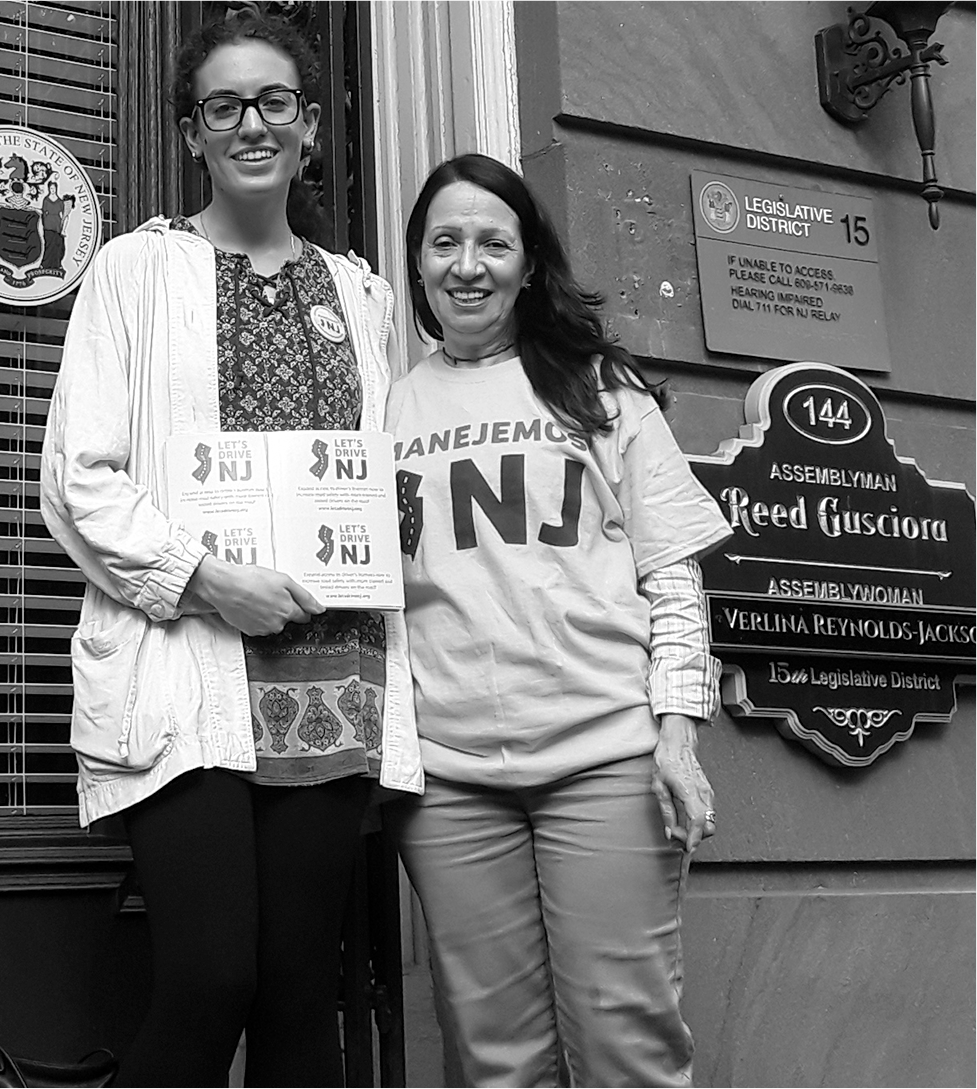
LALDEF legal services coordinator Edianys Lima (left) and community organizer Laura Mora (right) deliver 600 signed petitions to the 15th legislative district office.
Edianys Lima, Laldef worker
In counteraction to these developments, subnational legislative victories such as the one achieved in New Jersey affirm the following: (1) that, despite efforts by the federal government to exclude or even deport them, undocumented immigrants in the U.S. are integral contributors to the social and economic life of the communities in which they live; and (2) that even— or especially—when comprehensive immigration reform has stalled at the highest levels of government, actions taken at the local and state levels can make a meaningful difference to the integration prospects of undocumented immigrants. These subfederal actions have ranged widely from being more restrictive (such as the implementation of sanctions for employers who hire unauthorized immigrants), to more inclusionary (such as the declaration of municipal jurisdictions as “sanctuary” cities), with states having gone in divergent ways on the matter of driver’s licenses.
…the denial of drivers’ licenses effectively deprives respondents of their recognition as autonomous individuals, and consequently constrains their ability to integrate—and therefore contribute—on economic, social, and civic levels.
Policy debates surrounding whether undocumented immigrants should have the right to obtain a driver’s license center narrowly around this decision’s macro-economic and public safety implications. For example, research conducted by the National Immigration Law Center and other organizations suggests that allowing undocumented immigrants to drive would increase states’ licensing and auto insurance revenues. Political scientists Hans Lueders, Jens Hainmueller, and Duncan Lawrence found a correlation between access expansion and a decline in California’s number of hit and runs. Missing from the conversation, however, is a focus on the impacts of access to a driver’s license for the everyday lives and well-being of undocumented immigrants themselves and the communities they are embedded in. Paying attention to these impacts is also crucial from a policy perspective, given their far-reaching consequences on the economic, political, and social integration of undocumented immigrants and their children—a growing number of whom are U.S.-born citizens.
In this article, we present findings from a community action research partnership to investigate what a driver’s license would mean for undocumented immigrants in Central New Jersey. Community action research involves close collaboration between academics and local stakeholders applying social science frameworks and methodologies to community-identified problems. LALDEF, a community-based, grassroots nonprofit organization, has served low-income immigrants in Mercer County since 2004. LALDEF’s years of engagement on the ground and as part of the Let’s Drive NJ advocacy coalition provide us with unique insight into how policy changes surrounding access to a driver’s license might impact immigrants themselves.
More than a metaphor for unauthorized status, we argue for a need to expand our understanding of being “undocumented” to also refer to the literal deprivation of official documents at local and state levels, given its multiple negative impacts on the lived experiences of immigrants in the U.S.
In late 2018, we drew from LALDEF’s community networks to interview 21 immigrants about their experiences and challenges living in New Jersey, focusing on the role that (the lack of) documentation plays in their daily lives. Respondents originated from Guatemala, Mexico, Costa Rica, Brazil, the Dominican Republic, and Honduras. Given that interviews were conducted before bill A4743/S3229 passed in New Jersey, all respondents at the time were not eligible to obtain a driver’s license. The findings, therefore, are intended to inform the ongoing decision-making processes in states considering similar legislative changes.
We found that a driver’s license provides more than just the legal permission to operate a motor vehicle. Learning to drive an automobile is a major rite of passage for young Americans, symbolizing the transition into adulthood and attaining freedom, autonomy, and potential for mobility. In addition to the risks and challenges of living without authorized status, the denial of drivers’ licenses effectively deprives respondents of their recog- nition as autonomous individuals, and consequently constrains their ability to integrate—and therefore contribute—on economic, social, and civic levels. As we show, living without a “license to integrate” brings a range of disadvantages to undocumented immigrants and their families (including U.S.-born children), workplaces, and local communities. More than a metaphor for unauthorized status, we argue for a need to expand our understanding of being “undocumented” to also refer to the literal deprivation of official documents at local and state levels, given its multiple negative impacts on the lived experiences of immigrants in the U.S. We detail these impacts below and conclude with policy recommendations stemming from this research.
“There is No Other Way to Move”: Constraints on Economic Opportunity
Without a driver’s license, interview participants conveyed a sense of feeling stuck—both in terms of their ability to get from one place to another within the heavily suburban state of New Jersey and the limited range of employment options available to them. Many pulled long shifts starting early in the morning or ending late at night in the sectors of service, retail, and construction, often in locations that were hard to reach via public transportation. Alternatives to driving—such as hitching rides from friends and coworkers, paying for transportation provided by bosses, or (when in a pinch) hailing taxis or ride-sharing services—were described as time-consuming, costly, and unreliable. Beatriz, a 31-year-old woman from Brazil who had previously been undocumented, recounts, “Before, when I did not have a license, I lost hours or even days of work. When the girl who gave me transport got sick, I would be left without a ride and wouldn’t know how to get to work. That’s happened to me many times.”
For 48-year-old Claudia, her transition to the U.S. from Costa Rica involved both the gaining and losing of freedom: “My experience living in Trenton has been beautiful. I come from the countryside, which was very different. Here, I feel comfortable. I can earn a little more here, and help my family—especially my son, to provide him the chance to study, and my parents, who are older.” Claudia’s increased economic security, however, has been offset by restrictions in her day-to-day mobility: “I know how to drive, but I don’t do it here [in the U.S.] because I do not have a license due to my legal status. This has had a great impact on my life because in my country, I always had a car. In fact, I was licensed as a truck driver, and did that for many years. I always had a way to get around, because I had my own car. But here, even the buses aren’t like back in my country, where you can go anywhere. Paying a taxi will cost you your whole salary. So now I’ve come to the U.S. to depend on others even to do laundry, to go shopping…for everything.” The loss of her ability to drive entailed not just a reallocation of her time, but also the degradation of her self-identity as an autonomous individual.
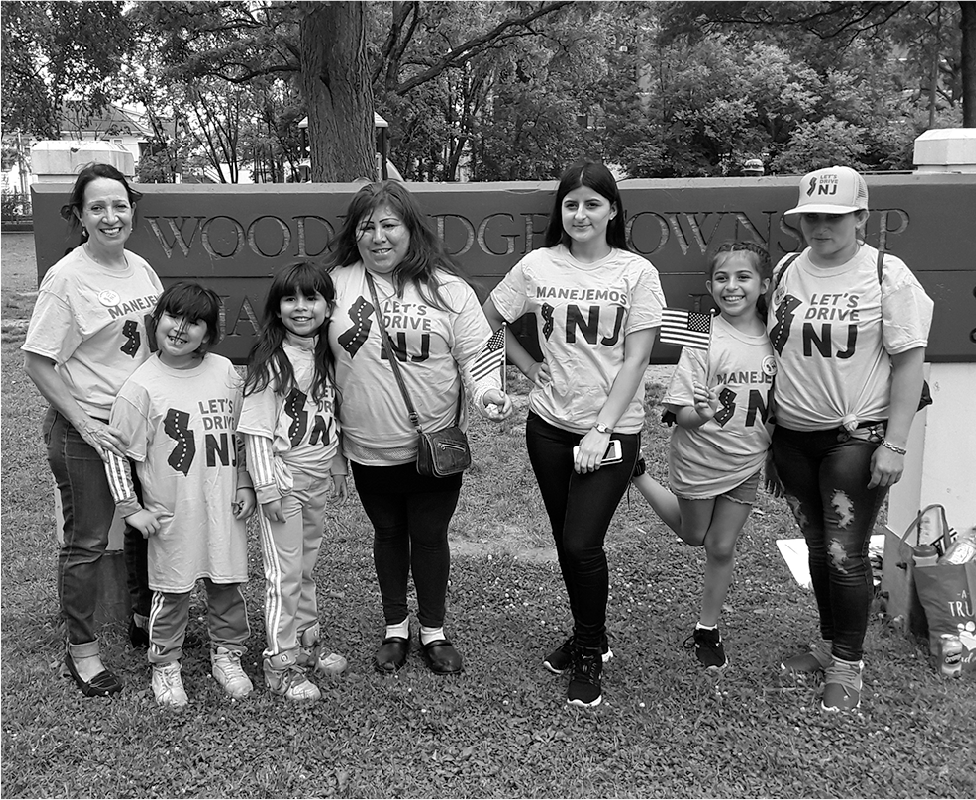
Let’s Drive NJ holds a rally on Father’s Day in Woodbridge Township, New Jersey.
Graciela Trigueros
Being unable to legally drive also constrains immigrants’ choices in the kinds of jobs they take. Many respondents spoke about foregoing better employment opportunities solely on the basis of transportation considerations. For example, Hector, a 41-year-old father of two who recently arrived from Costa Rica, feels tied down to his current job as a waiter in a restaurant in Trenton. A percentage of his daily earnings gets deducted in order to pay for a van provided by his boss that shuttles him and his coworkers to and from work. Though Hector is dissatisfied with his earnings, he has remained because his ride to and from work is guaranteed. “If I had a driver’s license,” says Hector, “the first thing I would do is find a better job. You lose out when you don’t have a license. You completely rule out the idea of other opportunities, since you can’t drive legally.” Geographic and economic immobility affects not only individual immigrants but also their families.
“My Biggest Challenge is Taking My Family Forward”: Impacts on Children and Households
The inability to drive also hampers respondents’ desires to be present and available caregivers in the home outside of working hours. The burdens of balancing obligations from both work and home disproportionately fall upon the shoulders of women. For example, Rosa, a 39-year-old single mother from Mexico, has struggled to balance her dual roles as sole breadwinner and caregiver without a car. Her long shifts as a supermarket cashier are compounded by the two and a half additional hours spent taking multiple buses to and from work each day. With her current schedule, she has no choice but to leave her children to fend for themselves after school hours while they wait for their mother to come home. “If I had the opportunity to speak with the government on behalf of our immigrant people, I would tell them that we are here, that we need to work to survive, and that we need a driver’s license that would make life easier for us to get home early enough to see our children.”
Mariana, a 40-year-old mother of one from Guatemala, shared a similar sense of remorse at her inability to be more available to her school-aged son: “It would make a big difference in my life if I had an ID like a driver’s license. I would save so much time and money, and I would not experience so many hardships with transportation. I could even participate in my child’s activities at school. I could take him to soccer school, to the park, to the mall. I wouldn’t have to run around so much to get to work and back home to help my son with his homework.”
In summary, having a driver’s license “greatly facilitates the well-being of the family,” as Raul, a 48-year-old father from Mexico, put it. Respondents expressed a need to drive not just to get to work, but also to transport their children to school, bring them to extracurricular activities, and to meet essential needs of the household. Furthermore, time expended in transit often equaled precious hours that otherwise would have been invested in the home. Children of undocumented immigrants lose out on crucial developmental time spent with their parents, as well as the chance to be involved in social life outside of school and the home. Given that a growing number of these children were born in the U.S., the denial of access to a driver’s license negatively impacts the growth and well-being of U.S. citizens, and consequently their ability to contribute to the nation to their full potential.
“To Walk Free Without Fear”: Participation in Public Life
For the average American, showing proof of identification is a commonplace and normalized practice. Whether an individual is boarding a plane, speaking to a bank teller, or picking up a package at a post office, she must be ready to produce some form of official ID to conduct these or any number of other routine transactions. In the U.S., where there is no national-level identity card program, a state-issued driver’s license has become a de facto form of primary ID, handy not only for driving but also for interacting with a range of public and private institutions.
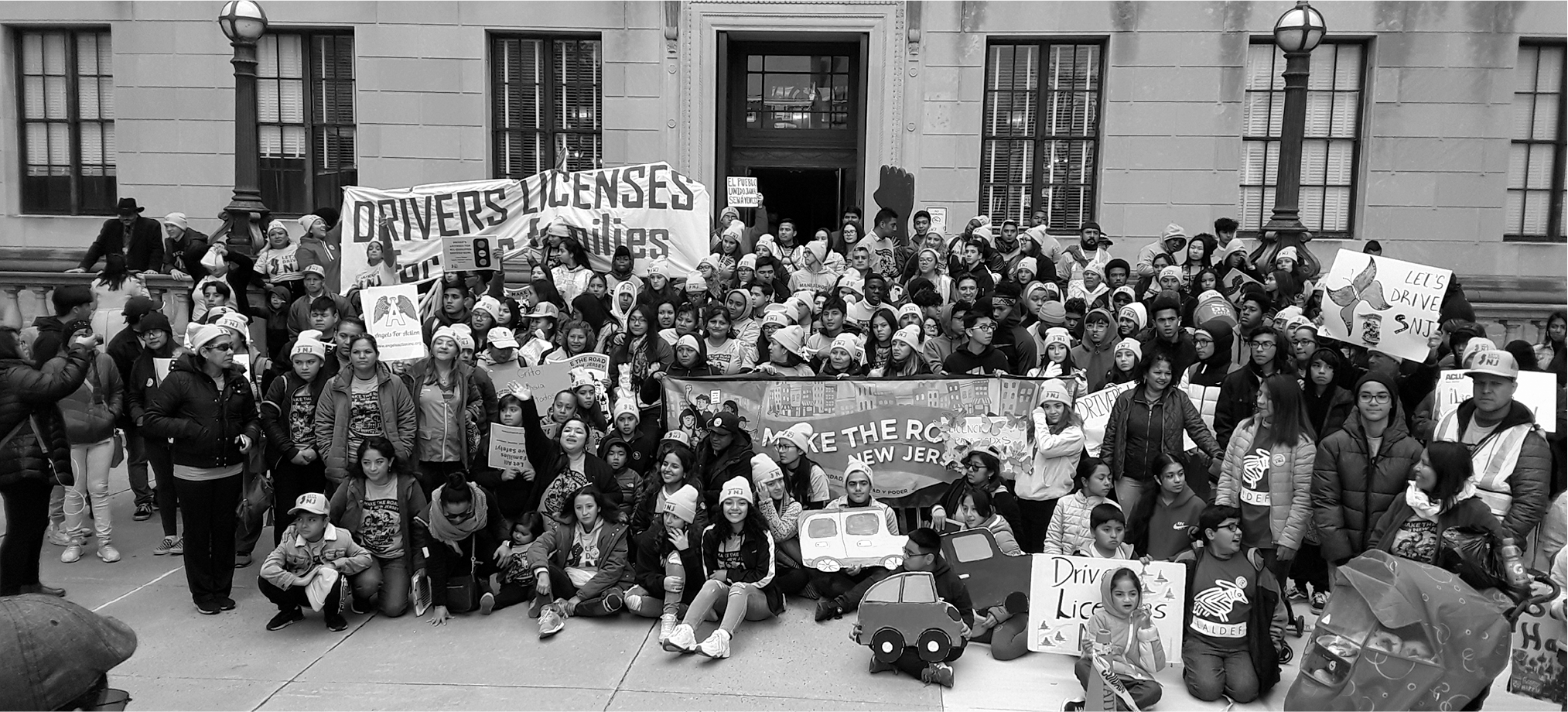
Let’s Drive NJ holds a rally at the State House Annex in Trenton, New Jersey.
Graciela Trigueros
For undocumented immigrants, the lack of a recognized form of ID closes off much of public life. Jimmy, a formerly undocumented Guatemalan immigrant, reflects on the time before he became legalized: “Before, when I did not have legal documents, it was a problem because I did not have an identity. Once, I went to a bank to open an account, but I couldn’t because I didn’t have an ID—just my [Guatamalan] passport, which wasn’t enough.” Many respondents reported similar problems opening a bank account or depositing checks, making it difficult for them to keep their cash safe and manage their savings for the long-term. Other institutions, such as hospitals and libraries, also routinely demand proof of identification. “Everywhere when they ask for an ID, the question is: Do you have a license?” says Beatriz, recounting the time she was denied for a credit card at Walmart because her Brazilian passport did not qualify as sufficient documentation.
If I had the opportunity to speak with the government on behalf of our immigrant people, I would tell them that we are here, that we need to work to survive, and that we need a driver’s license that would make life easier for us to get home early enough to see our children.
Getting around without a car also poses other risks and dangers, causing immigrants to experience habitual fear and marginalization. Raul expressed feeling unsafe while walking on the streets, having known members of his community who were victims of assault. Such concerns are backed up by sociologists Raymond Barranco and Edward Shihadeh, whose research suggests that Latinos are disproportionately targeted for robbery (the “walking ATM phenomenon”) due to assumptions that they are more likely to rely on a cash-based economy and less likely to report their victimization to authorities.
Despite having spent years living in New Jersey, some respondents had no means of proving their residency in the state.
Driver’s licenses not only provide government-approved recognition of one’s identity but also symbolize one’s membership to a state by virtue of their physical residence. Mariana, for example, ran into trouble with the administration at her child’s school because she could not produce official proof of her residence in the district. Feeling a loss of confidence, Mariana confided, “The need to provide proof at school, at the hospital, at the bank, is overwhelming. You can’t even buy things without identification. Having an ID would be one less barrier—especially at my son’s school, which is very strict in regards to proof of address.” Without official documentation to assert her status as a Mercer County local, Mariana likened her situation to being surrounded by “closed doors.”
“With an ID You Can Do Many Things”: Conclusion
While much is known about the negative impacts of unauthorized status, we draw attention to an understudied “paper” barrier to integration: state-level policies that restrict undocumented immigrants from obtaining driver’s licenses. Denying access to a driver’s license constitutes yet another means by which immigrants can be made “undocumented” in the U.S., imbuing the term with a different kind of significance from its conventional usage as a metaphor for illegality. This is because driver’s licenses provide more than just the legal ability to operate a motor vehicle. Moreover, they enable their holders to become autonomous individuals by enhancing their geographic mobility, expanding their range of economic opportunities, and deepening their engagement in their communities’ social and institutional life.
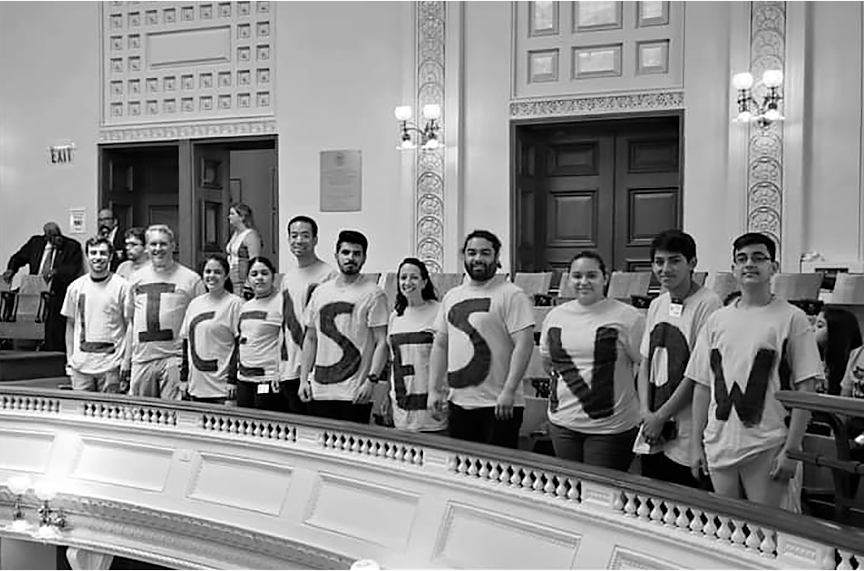
Let’s Drive NJ holds a rally at the State House in Trenton, New Jersey.
LALDEF
Our qualitative findings suggest that expanding access to obtaining a driver’s license is beneficial for the well-being of both immigrants as well as the communities they live in and contribute to. While state and local governments alone are unable to enact comprehensive immigration reform to improve the lives and capacities of their undocumented residents, they still have a number of legislative and policy capabilities at hand. We therefore recommend:
That states cease requiring residents to provide evidence of lawful status when applying for driver’s licenses;
That states accept a wider range of documentary evidence of identity and state residency for driver’s license applications, such as consular ID cards, county or municipal ID cards, or letters of proof of receipt of social services, and so on;
That local jurisdictions consider institutionalizing local forms of identiication such as municipal ID cards (issued already in cities such as New Haven, San Francisco, and New York), or endorsing and/or expanding the recognition of community-based ID programs (such as LALDEF’s own Mercer County Area Community ID Card), in order to facilitate the integration of, and extend symbolic and actionable membership to, undocumented migrants and other marginalized populations within their communities.
To underscore these recommendations, we close with the words of Manuel, a gardener from Mexico who has lived in the U.S. for 15 years. Manuel implores the U.S. government to consider the potential for a driver’s license to empower undocumented immigrants like himself: “If I may have the opportunity to speak with the Governor or another authority with respect to licenses for undocumented immigrants, I would say that we are all equal—that there is no difference between one or another.
Those that were born in the United States have a possibility of having a license, and that is a great and beautiful thing. If you could put yourself in our situation and see how we fight, you would realize that if we could have the chance to have licenses too, we can accomplish wonders.”
Data Accessibility
For this study, we draw on original qualitative interviews conducted with undocumented immigrants in central New Jersey. To protect our respondents, many of whom are unauthorized and therefore vulnerable, the full interview transcripts are not available for public access.